JOURNAL OF FOREST SCIENCE, 62, 2016 (8): 345–356 doi: 10.17221/50/2016-JFS
Quantification of the utility value of the recreational
function of forests from the aspect of valuation practice
P. Hlaváčková, D. Šafařík
Department of Forest and Wood Products Economics and Policy, Faculty of Forestry and Wood Technology, Mendel University in Brno, Brno, Czech Republic
ABSTRACT: The article is focused on quantification of the utility value of the recreational function of forests from the aspect of valuation practice. The aim of the article is a description of a methodical procedure which would enable to determine the market value of the recreational function of forests in the case of creation of real market demand. The methodical approach was verified on a case study in the chosen area. Results imply that determination of the market price of the recreational function in the case of creation of real market demand is possible and the formulated hypothesis is not rejected. The final rental value in the closed time period from the price determined for forest lands by application of the nominal interest rate 4.75% is 0.169 CZK·m–2. The procedure can be understood as a
theoreti-cal and methoditheoreti-cal tool usable in the valuation practice, but especially as a polititheoreti-cal tool in the creation of legislative regulations in the area of valuation of ecosystem forest functions and services at the national and international level.
Keywords: economics; forestry; valuation method; economic value; recreation; servitude
According to Haines-Young and Potschin (2010) ecosystem functions are defined as the ca-pacity of the potential to deliver ecosystem ser-vices. Forest ecosystems provide numerous goods and services to human societies (e.g. Daily 1997; de Groot et al. 2002; Haines-Young, Potschin 2010, 2013; Bateman et al. 2011; Ninan, Inoue 2013; Nunes et al. 2014). Identification of goods and services provided by ecosystems, determina-tion of their value and measuring the valuadetermina-tion of these values are not always a straightforward pro-cess. Benefits of forest ecosystems are called by the cited authors as ecosystem services, thus benefits to people gained from ecosystems (Millennium Ecosystem Assessment 2005), and the creation of this approach is dated to the 80s of the 20th century (Kindler 2016). In the forest sector of central Eu-rope, benefits offered by forests are known under the German term Waldfunktionen – forest tions (e.g. Bürger-Arndt 2013). The term
func-tion of forests was formulated by the German for-est researcher Viktor Dieterich (Dieterich 1953), however, the conceptual idea can already be found in the 19th century (Bader, Riegert 2011). In the Czech Republic, Vladimír Krečmer was one of the founders of the theory of forest functions. He dis-tinguishes forest services as spontaneous forest benefits or goods and services of forest manage-ment (e.g. Krečmer et al. 2006). The comparison of approaches, ecosystem services and the function of forests can be found in the study of Kindler (2016). Conclusions of the study showed that al-though these approaches have different origin in the area of application, the conceptual idea is simi-lar. In the Czech Republic, the term forest is defined by Forest Act No. 289/1995 Coll. in §2 in the fol-lowing way: the forest means vegetation and lands with their environment and land intended for the fulfilment of forest functions. With respect to this law and valuation practice the term forest function
or forest ecosystem function will be further used in relation to benefits resulting from the forest.
As stated by Matějíček (2003), forestry currently acquires a more intensive form, there are still more contradictions between the orientation of wood production and application of so-called all-useful forest functions. These functions are discussed in various works and they are understood according to their contents, form and structure. For example according to Dieterich (1953) the forest function is a social demand posed on forest like wind pro-tection or water retention. For the purposes of the targeted development of the issue of forest func-tions the unification of terms is necessary. The val-uation is in accordance with the Resolution V2 of the 4th Ministerial Conference on the Protection of Forests in Europe, Vienna 2003 (Anonymous 2003).
The term valuation can generally be defined as searching for a price of the value for products and services. Explanation of the value or price of prod-ucts and services in the economic theory is dealt by the theory of value. Development of these theo-ries was described for example by King, McLure (2014). The price is set in the market and it is a re-sult of meeting the supply and demand. Thus prod-ucts and services which are realized in the market can be evaluated by a price. Since forest functions are not in a majority of the cases realized in the market, it is suitable to use the term value which represents a certain assumption, expression or esti-mation of a possible price. Economists use the term “utility” or “utility value” to explain the degree of satisfaction of human needs (e.g. Friedman 1990; Peemöller 2001).
Current science has a whole set of explicit and implicit methods by which it is possible to express the value of forest functions by money (e.g. Bate-man et al. 2011; Bergen et al. 2013; Ninan, In-oue 2013). These methods for the determination of a usual price are mostly useless in the valuation practice. An overall value in the multifunctional conception should be the sum of all relevant for-est function values – use and non-use (e.g. Free-man 1993; Pearce 1993; Pearce, Warford 1993; Matějíček 2003; Hanley et al. 2006). These valu-ation methods that we have known so far are able to evaluate forest functions, however, each of them provides different results (e.g. Shvidenko et al. 2005; Ninan, Inoue 2013; Kupec 2014; Kindler 2016). The authors agree that to find out the value of a forest ecosystem function a context as well as a local value should be taken into consideration. Therefore the article is focused on the valuation practice in the Czech Republic. The practical
valua-tion of property and services in the Czech Republic is governed by Act No. 151/1997 Coll. on Property Valuation of and by amendments of certain Acts and its implementing regulations. In this Act it is laid down that it is necessary to primarily evalu-ate property and services by so-called usual price, which is based on a comparison of the evaluated property or services with similar property or ser-vice already realized in the market. However, this price cannot be used for forest functions, since there is not a sufficient database of comparable ob-jects available. Therefore it is necessary to search for different ways of valuation.
For the purposes of valuation the recreational function was chosen, for which there is actually an increasing potential of market realization.
As reported by Rolfe and Windle (2015), rec-reation benefits constitute a substantial part of the total economic value of forest in modern societies, and are an increasingly important determinant in multifunctional forest management. The recre-ational function was included among forest func-tions by Hasel (1971). Especially urban and subur-ban forests are used for the recreational purposes, which offer important ecosystem services includ-ing the recreational function for residents and non-residents (Bolund, Hunhammar 1999).
The recreational uses of forests which are in-cluded in the category of commercial forests are limiting the forest owner by decreasing the benefits from the production function. With development of various types of sporting spots and pathways on lands intended for the fulfilment of forest func-tion there is arising a quesfunc-tion how it is possible to determine the value of the recreational function of forests and to offer a possibility of the owner’s compensation for the limitation of the production function of forests.
Results are useful for the valuation practice itself for example with regard to determination of the rental value of forest lands especially because of their use for recreational purposes. They can also be taken into account in the definition of legisla-tive regulations and policies in the forestry at the national as well as international level.
MATERIAL AND METHODS
The research question was asked as a basis of sci-entific research which identifies the main problem of the current valuation practice: How much to claim for realization of the utility value – forest function? Based on this research question the research hy-pothesis was formulated which should fulfil the set objective: The recreational function of forest can be considered as a benefit which can be realized in the market, thus a service with non-zero tariff.
The research was divided into two parts – theo-retical and practical. The first part of results of this research brings the theoretical and methodological basis which can be used for further research and for realization of the practical part. Results of the theoretical and practical part should lead to rejec-tion or non-rejecrejec-tion of the formulated hypothesis. Among the most commonly used approaches to monetary valuation of environmental products and services at present methods relevant to the solved issue will be chosen, especially those used in the Czech Republic because of consideration of locali-sation of forest properties and local value as it is
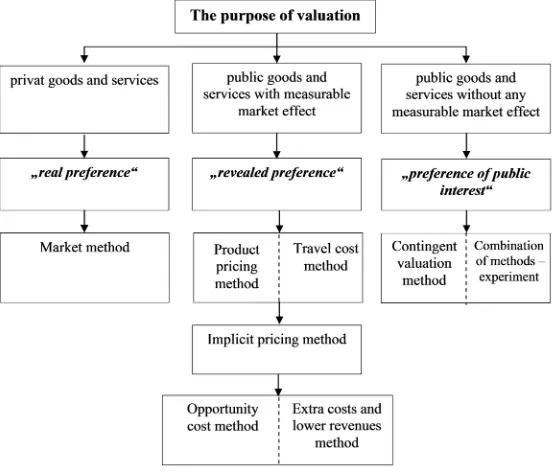
re-ported in publications of Shvidenko et al. (2005), Ninan and Inoue (2013), and Kindler (2016). The most frequently used approaches to monetary valuation of environmental properties and services are documented in Fig. 1.
From the perspective of the Czech Republic only two methods of valuation of the recreational func-tion were taken into account for research purposes – The Method of Quantification and Evaluation of Forest Functions (Vyskot et al. 2003) and The Method of Socio-economic Importance of Basic Non-wood Production Forests Functions Appris-ing (Šišák et al. 2002; Šišák, Pulkrab 2008). The application of these methods in the valuation prac-tice was evaluated.
The result of the first part is especially the devel-opment of a methodical procedure for market valu-ation of the recrevalu-ational function of forest ecosys-tems. In this part especially secondary data from publications of domestic and foreign authors were used. Another source was the Czech legislation and the international valuation standard, namely: (i) Forest Act No. 289/1995 Coll. with its latest
amendments;
(ii) Act No. 151/1997 Coll. on the Valuation of Property with its latest amendments;
(iii) Decree No. 441/2013 Coll. on the implementati-on of Act No. 151/1997 Coll. (Valuatiimplementati-on Decree) with its latest amendments;
(iv) Act No. 89/2012 Coll., Civil Code with its latest amendments;
[image:3.595.158.437.499.735.2](v) International Valuation Standard 1: London 2005, and/or 2008, 2013.
The used methods included analysis, synthesis, comparison and deduction.
In the second part of research a case study was conducted in order to verify methodical proce-dures in practice. For the purposes of the case study the area of 137.91 ha was chosen. Totally it includes 4 divisions which are subjected to the in-tention to build a network of single tracks with the primary target group of inhabitants of the town of Brno and neighbouring districts Brno-venkov, Vyškov, Prostějov, secondarily all active enthusiasts of terrain cycling. The area is owned by the Czech Republic with the right to be managed by the state enterprise Forests of the Czech Republic, Bučovice forest service. The area of interest is attractive from recreational aspects, it neighbours with the Protected Landscape Area Moravian Karst in the northwest, and with the recreationally used Marian Valley in the south. Single track paths will be built and operated by a private company on a commer-cial basis. The developed methodical procedure was applied in the chosen area, which should de-termine the rental value for a private operator.
RESULTS
Theoretical basis of the valuation of recreational forest functions
Firstly, it is necessary to define the term forest function. Currently, there exist two conceptions of this term as it is documented inTable 1.
With regard to legislation and valuation prac-tice the term explains non-production functions of forests. The definition is based on Forest Act No. 289/1995 Coll. with its latest amendments (forest law), which divides forest functions (benefits) into productive and non-productive ones. As it was stated by Matějíček (2003), the attribute non-productive implies that the characteristics of the output of the given function are non-material com-ponents. This conception was criticized by Šišák et al. (2002) and Vyskot et al. (2003). Social forest functions – life-giving (life restorative, healthy) for-est functions cover needs of the human population, which are the synergic realization of all ecosystems – natural effects of forests and their effect is insep-arable. At the same time, the social (group) place
or time delimited interest cannot be confused with the social necessity (balance of carbon, oxygen, water, climate, biodiversity, etc.). Nationwide func-tions of forests exist also outside the framework of forestry (Vyskot et al. 2003).
In other words, there currently exist two views on understanding the term forest function. The first view is so-called natural – causal, where forest fea-tures are searched. From the economic and social aspects not all these features are actively required and searched by the population and therefore it is not necessary to look for their value. On the other hand, by the teleological approach forests offer util-ity values, so-called functions, which are created by the activity of humans who search for them. These functions should be evaluated for the market real-ization. Division of properties and forest functions is based on the works of Papánek (1971), Polák (1975), and Matějíček (2003).
In order to meet the requirement for monetary expression of forest utility it is necessary to leave the natural viewpoint and to work with the termi-nology of social sciences, otherwise it is not pos-sible to conclude any financial expression. Utility benefits of forest are classified by some authors as environmental functions (Papánek 1978; Pearce 1993; Tutka et al. 2003).
In the next part it is necessary to look for pos-sibilities of finding a value for these environmen-tal functions. Especially Pearce (1993) dealt with searching for a value of environmental assets.
According to Pearce (1993) economic valuation is a two-part process in which it is necessary: (i) to demonstrate and measure the economic value
of environmental assets – what we will call the demonstration process;
(ii) to find ways to capture the value – the appro-priation process.
The economic value of the environmental assets was defined by Pearce (1993), when he measured conservation benefits by the total economic value on an example of tropical forests. This value can be broken down into a set of component parts. Total economic value (TEV) comprises use and non-use values and can be expressed as Eq. 1:
TEV = direct use value + indirect use value +
+ option value + existence value (1)
[image:4.595.63.292.724.757.2]The recreational forest function represents a di-rect utility value, which is derived from its didi-rect use. These activities may be commercial and their value is directly derived from a market value, alter-natively it is possible to use an administrative price
Table 1. Different definitions of the term forest function
(Pearce 1993). An administrative (official, found) price is a price set according to price regulations.
Valuation of property, property rights in general and especially of forest properties in the Czech Republic is currently carried out according to Act No. 151/1997 Coll. on Property Valuation and amendments to some laws. According to this Act, forest property is evalu-ated by so-called usual price. This price is primarily based on a comparison of evaluated property or ser-vice with the price of similar properties or serser-vices established by domestic business relations to the day of evaluation (thus the price arising in the market), exceptionally with justification of the expected capi-talized yield of property. In the evaluation of ecosys-tem services it is not possible to use the comparative method in practice because there do not exist any market equivalents and price-setting characteristics which would enable the comparison defined by law. In this case it is possible to use so-called found prices. According to §2 of Act No. 151/1997 Coll., there exist several ways how to find out this price. It is neces-sary to realize that although this possibility is not laid down by law; the basis is still a comparison which is also required by Act No. 89/2012 Coll., Civil Code.
According to §2, item 5 of Act No. 151/1997 Coll., by different valuation laid down by this Act or by its basis according to letter b, the yield method can be based on two different yields. The first one is the yield of the object of valuation really achieved. The second one is the yield which can be obtained from object of valuation at given conditions and of capi-talization of this yield (interest rate).
The use of the yield method is also supported by the option to look at the recreational function of forests as so-called servitude. Servitude is defined in the Czech Republic by Act No. 89/2012 Coll., Civil Code. Servitude means that the owner of property is obliged to suffer something in benefit of an au-thorised person (e.g. allows another person to cross their land) or to refrain from acting which they could realize as an owner (e.g. economic activity on lands intended for fulfilling forest functions). It is one form of easements. In foreign literature we mostly meet with this term in connection with the restriction of rights in terms of nature protection, for example in Rissman et al. (2006) or Farmer et al. (2015). Ac-cording to §16 of Act No. 151/1997 Coll., servitude is also evaluated by the yield method based on the annual benefit with consideration of the rate of ser-vitude restriction in the amount of usual price.
Except for an administrative price, the authors Šišák et al. (2002), Vyskot et al. (2003), and Šišák and Pulkrab (2008) dealt with searching for an economic value for forest functions in the Czech
Republic. After the review of both methods from the aspect of utility in the evaluation practice, the following facts have been discovered.
The ecosystem method of quantification and evaluation of forest functions by Vyskot et al. (2003) is based on quantification and evaluation of elements and parameters of forest ecosystems, de-termining their functional benefits. The key prob-lem is the way of forest function quantification. A quantitative value of the bio-production of ecosys-tems is directly measurable. The quantity of other functions is difficult to measure in this way. The process of parametric intervention is usable. Eco-system quantification means that valuation is not influenced or burdened by social limits.
The system of the valuation of social economic im-portance of forest functions including criteria and indicators of multifunctional forest management (Šišák et al. 2002; Šišák, Pulkrab 2008) is the con-cept of the valuation of forest functions according to their different socio-economic contents differen-tiated into a market, intervention-market and non-market value. Expressing the importance of social forest functions with the emphasis on recreational and culture-educational functions in money is fo-cused on the use of the theory of marginal benefit and consumer surplus – willingness to pay.
The literature research implies that the yield method appears to be the most suitable way for the recreational function of forest ecosystem in the case of real demand and market realization, which evaluates the function of forests according to the utility effects which are offered by forest.
Methodological approach to determining the market value of recreational functions
Thus, how to determine the usual (market) value of recreational function in the case of creation of real market demand and offering (ceding) it to another person in case that there is no object of comparison?
Here the following process can be suggested: (i) to find out the price of forest property either
according to the Valuation Decree or by com-parison;
(ii) to estimate an expected yield, thus a direct value in monetary expression by the application of an appropriately chosen nominal interest rate; (iii) to identify and if necessary to
eliminate/highli-ght social limits;
In order to find out the price of forest property in the Czech Republic we will use the valid legis-lation: namely Act No. 151/1997 Coll. and valid implementing regulations especially by Decree No. 441/2013 Coll. to the implementation of Act No. 151/1997 Coll. (Valuation Decree). In the theoreti-cal part of results it was found that it is not pos-sible to use a usual price. According to the valua-tion practice it seems to be appropriate to evaluate by the yield method, which is based on a deduc-tion of the value of forest land and expected yield. The yield method calculates future yields expressed in an actual value. Expression in an actual value is carried out by discounting or capitalization. In our case capitalization is appropriate.
According to §7 of Decree No. 441/2013 Coll., the price of forest land and non-forest land with vegetation (hereinafter “forest land”) is determined as the product of its acreage and basic adjusted price in CZK·m–2. The basic price of forest land is determined according to the price of prevailing for-est site complex (FSC) in the space group. Prices in CZK·m–2 for individual FSC are listed in Appen-dix 6 of Decree No. 441/2013 Coll. The basic price can additionally be adjusted by surcharges accord-ing to Appendix 7 of Decree No. 441/2013 Coll.
For capitalization it is the most important to de-termine an interest rate. An interest rate according to the Swiss valuation guideline was used in the cal-culation. The Swiss valuation guideline (Sagl 1995) defined interest rates in the range of 1.5–5.5% for calculations based on effective costs and yields for capitalization of servitude.
Social limits which should be identified and in case of need eliminated or highlighted include the forest categorization, ownership relations or forest infrastructure.
A case study
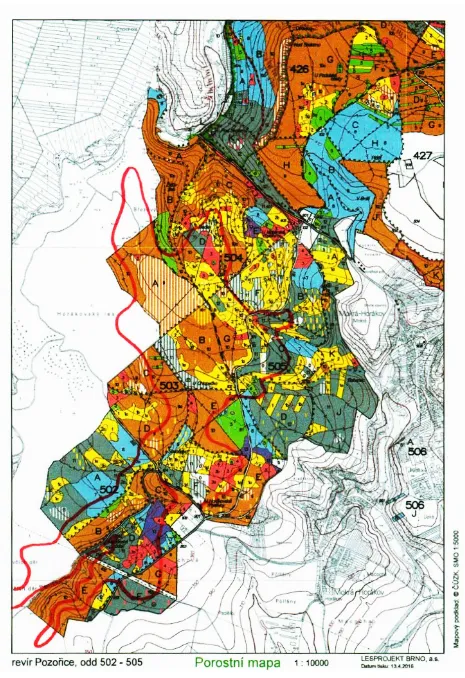
The case study was carried out in the Pozořice area of interest. This area is managed by state en-terprise Forests of the Czech Republic. It included totally 27 vegetation groups in 4 divisions with the area of 137.91 ha. The vegetation map with the marked area of interest is illustrated in Fig. 2.
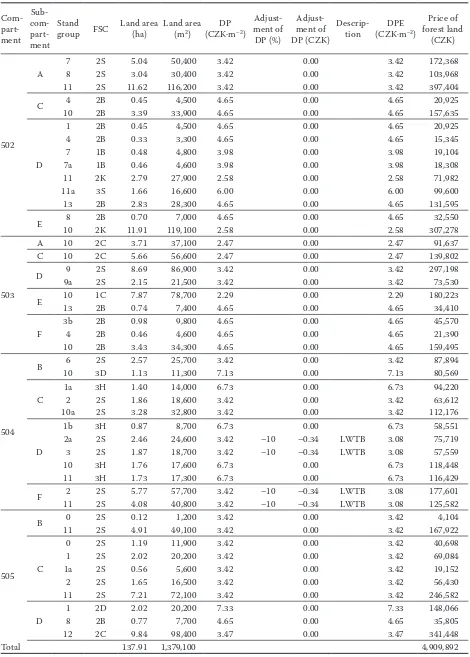
Firstly, the total price of the forest land was calcu-lated in CZK as determined according to the Valu-ation Decree, i.e. according to types of FSC and acreage, this price was further adjusted by poten-tial surcharges. In the area of interest it was pos-sible to apply surcharges in lands where the terrain adjustments are located. The determined price was
afterwards rounded to dimes according to §50 of Decree No. 441/2013 Coll. The calculation of the total price of forest land per individual divisions is shown in Table 2.
For the total area of forest land equalling 137.91 ha the total price of 4,909,892 CZK rounded to 4,909,890 CZK was determined according to §50 of Decree No. 441/2013 Coll.
Furthermore, it is necessary to calculate the rent-al vrent-alue resulting from an increase in the yield from the production function, since forests in this area will fulfil predominantly the recreational function and they are not included in the category of specif-ic purpose forests with the supported recreational function. In other words, fulfilment of the recre-ational function of forest ecosystems will be further considered as so-called servitude. The reason is the future development of single track paths which will be provided by a private company on lands of the owner intended for fulfilment of forest function (LOIFFF). The given situation will be solved in leg-islative terms by a land lease agreement according to Act No. 89/2012 Coll.
For the calculation based on effective yields cre-ated during a delimited period of time, which is also capitalization, the application of an interest rate in the range of 4.0–5.5% is recommended ac-cording to Sagl (1995) and Matějíček (2013). These calculations are often the valuation of ser-vitude by calculating the yield value. A justifiable surcharge derived from a capitalization interest rate is the factor of low mobility of capital in the case of LOIFFF. Therefore such an interest rate was chosen that is an average value of the rec-ommended range in the time delimited period of 10 years, thus 4.75%.
The final annual calculated rent from the deter-mined price of forest land with the application of nominal interest rate 4.75% makes 233,220 CZK. In the application of a nominal interest rate in CZK·m–2 this value is 0.169 CZK·m–2. It implies that realization of the utility forest function in the area of interest can be considered as leasing or rent in the form of lost yield on the production func-tion. This price should be subsequently tested by the market and its acceptance found. In the case of positive results, equilibrium has been found which represents the satisfaction of supply and demand and realized real market valuation.
Table 2. Calculation of the total determined price of forest land (Item No. 7 of Appendix 7 of Decree No. 441/2013 Coll., forest lands with terrain barriers in the edaphic categories B, K, M, S, W)
Com- part-ment
Sub- com- part-ment
Stand
group FSC Land area (ha) Land area (m2) (CZK·mDP –2)
Adjust-ment of
DP (%)
Adjust-ment of DP (CZK)
Descrip-tion (CZK·mDPE –2)
Price of forest land
(CZK)
502 A
7 2S 5.04 50,400 3.42 0.00 3.42 172,368
8 2S 3.04 30,400 3.42 0.00 3.42 103,968
11 2S 11.62 116,200 3.42 0.00 3.42 397,404
C 4 2B 0.45 4,500 4.65 0.00 4.65 20,925
10 2B 3.39 33,900 4.65 0.00 4.65 157,635
D
1 2B 0.45 4,500 4.65 0.00 4.65 20,925
4 2B 0.33 3,300 4.65 0.00 4.65 15,345
7 1B 0.48 4,800 3.98 0.00 3.98 19,104
7a 1B 0.46 4,600 3.98 0.00 3.98 18,308
11 2K 2.79 27,900 2.58 0.00 2.58 71,982
11a 3S 1.66 16,600 6.00 0.00 6.00 99,600
13 2B 2.83 28,300 4.65 0.00 4.65 131,595
E 8 2B 0.70 7,000 4.65 0.00 4.65 32,550
10 2K 11.91 119,100 2.58 0.00 2.58 307,278
503
A 10 2C 3.71 37,100 2.47 0.00 2.47 91,637
C 10 2C 5.66 56,600 2.47 0.00 2.47 139,802
D 9 2S 8.69 86,900 3.42 0.00 3.42 297,198
9a 2S 2.15 21,500 3.42 0.00 3.42 73,530
E 1013 1C2B 7.870.74 78,7007,400 2.294.65 0.000.00 4.652.29 180,22334,410
F
3b 2B 0.98 9,800 4.65 0.00 4.65 45,570
4 2B 0.46 4,600 4.65 0.00 4.65 21,390
10 2B 3.43 34,300 4.65 0.00 4.65 159,495
504
B 6 2S 2.57 25,700 3.42 0.00 3.42 87,894
10 3D 1.13 11,300 7.13 0.00 7.13 80,569
C
1a 3H 1.40 14,000 6.73 0.00 6.73 94,220
2 2S 1.86 18,600 3.42 0.00 3.42 63,612
10a 2S 3.28 32,800 3.42 0.00 3.42 112,176
D
1b 3H 0.87 8,700 6.73 0.00 6.73 58,551
2a 2S 2.46 24,600 3.42 –10 –0.34 LWTB 3.08 75,719
3 2S 1.87 18,700 3.42 –10 –0.34 LWTB 3.08 57,559
10 3H 1.76 17,600 6.73 0.00 6.73 118,448
11 3H 1.73 17,300 6.73 0.00 6.73 116,429
F 2 2S 5.77 57,700 3.42 –10 –0.34 LWTB 3.08 177,601
11 2S 4.08 40,800 3.42 –10 –0.34 LWTB 3.08 125,582
505
B 0 2S 0.12 1,200 3.42 0.00 3.42 4,104
11 2S 4.91 49,100 3.42 0.00 3.42 167,922
C
0 2S 1.19 11,900 3.42 0.00 3.42 40,698
1 2S 2.02 20,200 3.42 0.00 3.42 69,084
1a 2S 0.56 5,600 3.42 0.00 3.42 19,152
2 2S 1.65 16,500 3.42 0.00 3.42 56,430
11 2S 7.21 72,100 3.42 0.00 3.42 246,582
D
1 2D 2.02 20,200 7.33 0.00 7.33 148,066
8 2B 0.77 7,700 4.65 0.00 4.65 35,805
12 2C 9.84 98,400 3.47 0.00 3.47 341,448
Total 137.91 1,379,100 4,909,892
of utility value – the forest function? At the same time, the hypothesis formulated at the beginning of research was not rejected.
DISCUSSION
The article offers a different view on the issue of forest function valuation. The accomplished lit-erature research discovered the actual state of the given issue. Here it is necessary to point out the is-sue of a differentiated approach to terminology in the area of forest functions and ecosystem services (e.g. Dieterich 1953; Matějíček 2003; Bader, Riegert 2011; Bateman et al. 2011; Bürger-Arndt 2013; Ninan, Inoue 2013; Kindler 2016). These authors agree that forest ecosystems provide several intangible benefits that are either ignored or not captured by conventional markets (Ninan, Inoue 2013).
Another problem in the area of forest functions is determination of their values, i.e. evaluation of the value of forest ecosystem functions. There ex-ist many different approaches to evaluation or valuation.
In the valuation practice we often meet with the requirement to determine the “objective” val-ue of a specific asset or service. It is necessary to emphasize that something like an objective value does not exist. Every asset or service has a set of objective properties; however, the value does not belong among them. Surely, there exist properties for acquiring of which it was necessary to spend certain costs, costs that were necessary to be spent on the provision of a service. These costs can be determined, they can also be estimated, however, the problem is that neither costs nor past yields are determinant for an objective value.
However, what is a value in the economic sense and how to understand it? An economic value is understood as a relationship between a certain sub-ject and obsub-ject assuming rational behaviour (e.g. Friedman 1990; Peemöller 2001). An economic value results from two basic facts of the economic life:
(i) Human needs have no boundaries;
(ii) Resources for satisfaction of human needs are limited.
The ability of an asset to satisfy human needs makes its utility value. A utility value depends on possibilities of usage, preferences and intentions of a specific owner of a given property. For various owners there exists a different utility value. If an asset or service has a utility value and at the same
time it is available in a limited quantity or availabil-ity, it can be an object of exchange and realisation in the market. Thus, it has an exchange value. An exchange value expressed in money leads to a mar-ket price (Peemöller 2001).
According to a definition of the International Valuation Standards Council (IVSC 2013), Market Value is the estimated amount for which a property should exchange on the date of valuation between a willing buyer and a willing seller in an arm’s-length transaction after proper marketing wherein the parties had each acted knowledgeably, prudently and without compulsion.
Economic and political relationships between forests and humans are determined by the business framework of the market and the society and not by the fact if a forester works or not (Matějíček 2003). However, currently there do not exist any relevant markets where it would be possible to trade non-wood forest functions, although demand for these functions surely exists. Therefore it is nec-essary to search for different solutions how to de-termine the market price of forests. There are many reasons for determination of their economic value. According to de Groot et al. (2012), valuations also help to understand users’ preferences and rela-tive values placed on ecosystem services. However, the authors of the article see the main reason in a possibility to calculate the market value of a given function in the creation of real demand.
with amendment of certain laws. According to this Act, forest property is evaluated by so-called usual price. This price is based on a comparison of the valuation of property or service and the price of similar properties or services emerging from do-mestic business relationships to the date of valu-ation. It is already clear from this definition that this method is not applicable to the valuation of the utility value of recreational function because there does not exist a database of prices of similar services. Therefore valuation by the yield method is suggested in the article, which is based on the philosophy of a net yield from forest.
In order to determine the net yield of forest, thus for determination of the utility value it is important to correctly define an interest rate. Determination of an interest rate in the valuation of forest is not an easy task, especially because its value is determined not only by yields and market forces, but also by the factors applied which are specific of this type of property (Matějíček et al. 2013). There exist several opinions about determination of a correct value of interest rate. In various publications this value is in the range of 0–8%, which is a wide range from the perspective of valuation, and it also de-pends on the purpose of valuation. For example, for a long time representatives of the theory of the net yield of land have tried to enforce the interest rate of 3% for forestry as the generally valid calculation interest rate (Endres 1923). In the Czech Repub-lic the calculation interest rate of 2% is used for all groups of wood according to Decree No. 441/2013 Coll. Other interest rates were used for example by Mantel (1968), Oesten (1991), Tutka et al. (2003), and Moog and Bösch (2013).
Particular importance of using the appropriate in-terest rate for example during the valuation of forest and servitude on forest land can be supported by the requirements for valuation experts in Austria. There is an individual point obligatory in the structure of expert assessments requiring an expert reason for the used interest rate in valuation calculations (Sagl 1988). In the valuation regulation (Sagl 1995) the range of interest rates 1.5–5.5% was defined graded according to calculation types. This range was ac-cepted by Matějíček et al. (2013), who adjusted the rules for the grading of the interest rate. According to this publication, the most appropriate interest rate for capitalization is in the interval 4.0–5.5%. For the purposes of valuation performed in the article an average value of the recommended range – 4.75% was chosen. The calculated annual final rent from the price of forest land with the application of the nominal interest rate 4.75% is 233,220 CZK.
CONCLUSIONS
The forest function forms the social, i.e. socio-eco-nomic, system reflecting the synergic nature of for-est object. If there is no market for these assets, they are non-commercial and their valuation is more complex and includes a whole set of techniques.
The contribution is focused on a description of possible valuation methods of forest ecosystem functions and their limits for use in practice. The effort was to find a theoretical and methodical so-lution for the most demanded ecosystem function – the recreational function. It was found by the lit-erature research that there exist many approaches to the evaluation of forest functions, however, none of them has an application character.
Based on the literature research and experience from the valuation practice a methodical proce-dure for determination of the market value of the recreational function was developed, which was eventually applied and verified in the area of inter-est. The objective of the article was to answer the question if it is possible to set the market price of the recreational value in case that there is market demand and in case that it is not possible to use the comparative methods usually applied in the valua-tion practice, since there does not exist an object of comparison. The result is the non-rejection of the hypothesis that the recreational function of forest can be considered as a benefit realized in the mar-ket, thus a service with non-zero tariff.
The developed theoretical and methodical tool can be used in the valuation practice for evaluation of forest ecosystem functions of and further in the definition of methodologies and policies in the area of forestry at the national and international level.
References
Anonymous (2003): Vienna Resolution 2: Enhancing eco-nomic viability of sustainable forest management in Eu-rope. Available at http://www.foresteuEu-rope.org/docs/MC/ MC_vienna_resolution_v2.pdf
Bader A., Riegert C. (2011): Interdisciplinarity in 19th and
early 20th century: Reflections on ecosystem services of
forest. Rupkatha Journal on Interdisciplinary Studies in Humanities, 3: 87–98.
Bateman I.J., Mace G.M., Fezzi C., Atkinson G., Turner K. (2011): Economic analysis for ecosystem services as-sessment. Environmental and Resource Economics, 48: 177–218.
Bolund P., Hunhammar S. (1999): Ecosystem services in urban areas. Ecological Economics, 29: 293–301.
Bürger-Arndt R. (2013): Waldfunktionen und Ökosystem-leistungen im wissenschaftlichen Diskurs. In: Ring I. (ed.): Der Nutzen von Ökonomie und Ökosystemleistungen für die Naturschutzpraxis. Workshop III: Wälder. Bonn, Bundesamt für Naturschutz: 24–30.
Daily G.C. (1997): Introduction: What are ecosystem ser-vices? In: Daily G.C. (ed.): Nature’s Services: Societal Dependence on Natural Ecosystems. Washington D.C., Island Press: 1–10.
de Groot R.S., Wilson M.A., Boumans R.M.J. (2002): A typology for the classification, description and valuation of ecosystem functions, goods and services. Ecological Economics, 41: 393–408.
de Groot R.S., Brander L., van der Ploeg S., Costanza R., Ber-nard F., Braat L., Christie M., Crossman N., Ghermandi A., Hein L., Hussain S., Kumar P., McVittie A., Portela R., Rod-riguez L.C., ten Brink P., van Beukering P. (2012): Global estimates of the value of ecosystems and their services in monetary units. Ecosystem Services, 1: 50–61.
Dieterich V. (1953): Forstwirtschaftspolitik. Eine Einführung. Hamburg, Berlin, Paul Parey Zeitschriftenverlag: 398. Endres M. (1923): Lehrbuch der Waldbewertrechnung und
Forststatik. 4th Ed. Berlin, Springer-Verlag: 330.
Farmer J.R., Meretsky V., Knapp D., Chancellor C., Fisher B.C. (2015): Why agree to a conservation easement? Under-standing the decision of conservation easement granting. Landscape and Urban Planning, 138: 11–19.
Freeman A.M. (1993): The Measurement of Environmental and Resource Values: Theory and Methods. Washington D.C., Resources for the Future Press: 538.
Friedman D.D. (1990): Price theory: An intermediate text. Available at http://www.daviddfriedman.com/Academic/ Price_Theory/Price%20Theory-%20D.%20Friedman.pdf (accessed Apr 12, 2016).
Haines-Young R.H., Potschin M.P. (2010): The links between biodiversity, ecosystem services and human well-being. In: Raffaelli D., Frid C. (eds): Ecosystem Ecology: A New Syn-thesis. Cambridge, Cambridge University Press: 111–139. Haines-Young R.H., Potschin M.P. (2013): CICES. Report to
the European Environment Agency. Available at http:// test.matth.eu/content/uploads/sites/8/2012/07/CICES-V43_Revised-Final_Report_29012013.pdf (accessed Apr 6, 2016).
Hanley N., Wright R.E., Alvarez-Farizo B. (2006): Estimat-ing the economic value of improvements in river ecology using choice experiments: An application to the water framework directive. Journal of Environmental Manage-ment, 78: 183–193.
Hasel K. (1971): Waldwirtschaft und Umwelt. Eine Ein-führung in die Forstwirtschafts politischen Probleme der Industriegesellschaft. Hamburg, Berlin, Paul Parey Zeitschriftenverlag: 322.
IVSC (2013): International Valuation Standards 2013. Framework and requirements. Available at http://www. valuersinstitute.com.au/docs/professional_practice/Inter-national%20Valuation%20Standards%202013.pdf (accessed Apr 1, 2016).
Kindler E. (2016): A comparison of the concepts: Ecosystem services and forest functions to improve interdisciplinary exchange. Forest Policy and Economics, 67: 52–59. King J.E., McLure M. (2014): History of the Concept of Value.
Discussion Paper No. 14.06. Crawley, University of Western Australia: 18.
Krečmer V., Šišák L., Šach F., Švihla V., Flora M. (2006): K eko-nomickému hodnocení mimotržních funkcí lesa z hledisek lesopolitických. Zprávy lesnického výzkumu, 51: 195–215. Kupec P. (2014): Possibilities of the recreational function of
forests assessment with using of the complex methods of forest function evaluation. In: Fialová J., Pernicová D. (eds): Public Recreation and Landscape Protection – with Man Hand in Hand?, Brno, May 5–6, 2014: 194–197.
Lesprojekt (2016): The stand map 1: 10 000. Lesprojekt Brno, a.s.
Mantel W. (1968): Waldbewertung, Einführung und Anlei-tung. 5th Ed. München, Basel, Wien, Bayerischer
Land-wirtshaftsverlag: 308.
Matějíček J. (2003): Vymezení základních pojmů a vztahů z oblasti mimoprodukčních funkcí lesa. Strnady, VÚLHM: 54.
Matějíček J., Šafařík D., Vala V., Sebera J., Lenoch J. (2013): Úroková míra v lesnictví. Kostelec nad Černými lesy, Le-snická práce, s.r.o.: 160.
Millennium Ecosystem Assessment (2005): Ecosystems and Humal Well-being: Synthesis. Washington, D.C., Island Press: 137.
Moog M., Bösch M. (2013): Interest rates in the German forest valuation literature of the early nineteenth century. Forest Policy and Economics, 30: 1–5.
Ninan K.N., Inoue M. (2013): Valuing forest ecosystem services: What we know and what we don’t. Ecological Economics, 93: 137–149.
Nunes P.A.L.D., Kumar P., Dedeurwaerdere T. (eds) (2014): Handbook on the Economics of Ecosystem Services and Biodiversity. Cheltenham, Edward Elgar Publishing, Ltd.: 608.
Oesten G. (1991): Gedanken zur Wahl der Zinsrate in der Waldbewertung. Forst und Holz, 46: 536–538.
Papánek F. (1971): Nový prístup k hospodárskému určeniu lesov – FILH. Strnady, VÚLHM: 130.
Papánek F. (1978): Teória a prax funkčne integrovaného lesného hospodárstva. Bratislava, Príroda: 218.
Pearce D. (1993): Economic Values and the Natural World. London, Earthscan Publications, Ltd.: 131.
Peemöller V.H. (2001): Praxishandbuch der Unternehmens-bewertung. Berlin, NWB Verlag: 728.
Polák O. (1975): Hodnocení ostatních užitečných funkcí lesů v lesním hospodářství. Závěrečná zpráva úkolu P-16-331-053-6/1. Brno, VŠZ: 42.
Rissman A.R., Lozier L., Comendant R., Kareiva P., Kiesecker J.M., Shaw M.R., Merenlender A.M. (2006): Conservation easements: Biodiversity protection and private use. Con-servation Biology, 21: 709–718.
Rolfe J., Windle J. (2015): Multifunctional recreation and nouveau heritage values in plantation forests. Journal of Forest Economics, 21: 131–151.
Sagl W. (1988): Waldbewertung, eine Einführung für den Stu-diengebrauch Studienrichtung Forst- und Holzwirtschaft. Wien, Universität für Bodenkultur: 145.
Sagl W. (1995): Bewertung in Forstbetrieben. Berlin, Wien, Blackwell Wissenschafts-Verlag: 306.
Shvidenko A., Barber C.V., Persson R., Gonzalez P., Hassan R., Lakyda P., McCallum I., Nilsson S., Pulhin J., van Rosenburg
B., Scholes B.R., Scholes N.A. (2005): Forest and woodland systems. In: Hassan R. (ed.): Ecosystems and Human Well-being: Current State and Trends. Washington D.C., Covelo, London, Island Press: 595–621.
Šišák L., Pulkrab K. (2008): Hodnocení společenské sociál-ně-ekonomické významnosti funkcí lesa. Prague, Czech University of Life Sciences Prague: 133.
Šišák L., Švihla V., Šach F. (2002): Oceňování společenské sociálně-ekonomické významnosti základních mimopro-dukčních funkcí lesa. Prague, Ministry of Agriculture of the Czech Republic: 71.
Tutka J. et al. (2003): Oceňovanie lesa. Zvolen, Insitute for Education and Training for Staffs of the Forest and Water Management: 254.
Vyskot I., Kapounek L., Krešl J., Kupec P., Macků J., Rožnovský J., Schneider J., Smítka D., Špaček F., Volný S. (2003): Kvan-tifikace a hodnocení funkcí lesů České republiky. Prague, Ministry of the Environment of the Czech Republic: 218.
Received for publication April 30, 2016 Accepted after corrections July 12, 2016
Corresponding author: