Many soils in developing and industrialized countries are affected by acid deposition, mine waste disposal, utilization of organic refuses such as sewage sludge, industrialization and urbanization that could be inputs of pollutants and especially heavy metals to the soil. The heavy metals may be retained by soil components, may exchange or precipitate or coprecipitate as sulfides, carbonate and/or Fe or Mn oxides or hydroxides. In arid zone soils, the presence of carbonate minerals ef-fectively immobilizes heavy metals by providing an absorbing surface and by buffering pH at high values where precipitation takes place.
The chemical forms of heavy metals in the solid phase can strongly influence their behavior, such as their mobility, toxicity, bioavailability and chemical interactions, since metal speciation has determinis-tic control over physical, chemical, and biological processes that lead to transport and transformation of heavy metals among environmental compart-ments (air, water, biota, soil/sediment) in complex ecosystems (Allen et al. 1995).
Mobility of heavy metals relates to their capacity to pass from one soil compartment to another where the elements is bound more or less energetically, the ultimate mobile compartment being the soil solution which determines the bioavailability of heavy met-als. Extraction of heavy metals by unbuffered salt solutions (CaCl2, NH4Cl, etc.) is a rapid and simple way to evaluate their phytoavailability (Beckett 1989). However, in some cases, salt solutions do not reflect the plant available metals (Gupta and Atten 1993), so that must be used other extractants based on DTPA or hydroxylamine that are more predictive of phytoavailability. This research was
designated to determine the extractability of some heavy metals in polluted soils.
MATERIAL AND METHODS
In this research, eight surface soils (0–25 cm) were selected on the basis of the diversity of pol-lution sources (industrial and agricultural activi-ties). The soils were classified as non-calcareous (soils 1 to 3) and calcareous (soils 4 to 8). The soil samples were taken from the Bursa plain, Turkey. Soil 1 was polluted by acidic industrial wastewater. Soils 2 and 3 are typical sewage sludge amended soil. Soils 4 to 6 are sewage sludge amended calcar-eous soils irrigated by water with increasing level of Cd contamination (25, 85 and 210 mg/l). Soils 7 and 8 represented typical calcareous agricultural soils without anthropogenic pollution.
The following soil characteristics were evalu-ated: Particle size distribution determined by the hydrometer method (Gee and Bauder 1982), pH in a 1:2 soil:water ratio (McLean 1982), organic carbon (Nelson and Sommers 1982), calcium carbonate (Nelson 1982), electrical conductivity (SCS 1972) and CEC (Rhoades 1982). Pseudototal contents of metals were determined following microwave digestion using concentrated HNO3 and analysed by ICP-MS (Krishnamurti et al. 1994).
Four different extraction methods were used to establish the extractability and predict the phytoa-vailability of heavy metals for these soils (Table 1). Each extraction method was performed in duplicate in 50 ml polycarbonate centrifuge tubes. All the extracts were centrifuged for 10 min at 3000 rpm,
T
he comparison of extraction methods for evaluating
some heavy metals in polluted soils
C. Aydinalp, A.V. Katkat
Faculty of Agriculture, Uludag University, Bursa, Turkey
ABSTRACT
The extractability of Cd, Co, Cr, Ni and Pb was evaluated using ammonium chloride, calcium chloride, strontium chloride and DTPA extractants in this research. The eight surface soils were used to assess plant available metals with different extraction methods. The amounts of metal extracted were related to pseudototal contents, determined a�er microwave digestion using HNO3. Quantification of dissolved metals was used by ICP-MS matrix-matched stan-dards. The obtained results indicated a high variability of metal extraction depending on extraction procedure, source of pollution, and nature of the soil. The results showed that the extractability for calcareous soils was best determined by DTPA. In comparison of chloride salts, a higher efficiency of extraction with ammonium chloride for these soils was found.
and the supernatant filtered into volumetric flasks containing 10 µg In/Rh/l. All the extracts and stand-ard solution were acidified to 1% HNO3. Inductively coupled plasma mass spectrometry (ICP-MS) of Ultramass 700 Varian Model determinations were obtained with matrix-matched standards.
RESULTS AND DISCUSSION
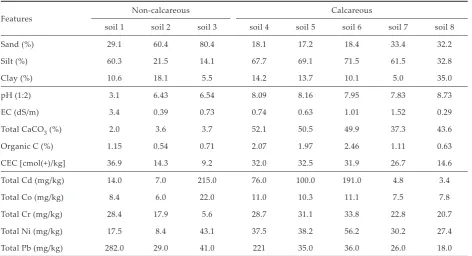
The physical and chemical properties of the stud-ied soils were presented in Table 2. These soils showed a wide range of physical and chemical properties. Clay content of soils ranged from 5.1 to 35.0%. The silt and sand contents varied from 14.1 to 69.1% and from 17.2 to 80.4%, respectively. The pH values of soils ranged from 3.1 to 8.73. The low pH of soil 1 is due to acidic pollution from
industrial wastewater. Electrical conductivity val-ues ranged from 0.29 to 3.40 dS/m. The highest EC value occurred in the soil 1 that was polluted by acidic wastewater. CEC varied from 9.2 to 32.5 cmol(+)/kg. Organic carbon content ranged from 0.54 to 2.46% with the highest level for the sewage sludge amended soils.
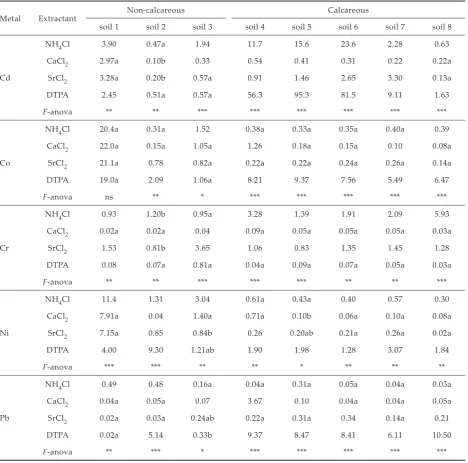
The results of extractable Cd, Co, Cr, Ni and Pb for the different extractants are presented in Table 3. The values are expressed as percentages of the pseudototal content in these soils.
Cadmium
[image:2.595.64.529.84.227.2]Nakhone and Young (1993) stated that the lability of Cd ranged from 3 to 102% of total Cd (HNO3 extractable digest). Cd was the most extractable
Table 1. Summary of the extraction methods used for soils
Extractant (w/v)Ratio Time(h) Temperature(°C) Pool Reference
1M NH4Cl 1:6 16 20 soluble/exchangeneutral salt, Krishnamurti et al. (1995)
0.01M CaCl2 1:5 16 20 soluble/exchangeneutral salt, Whitten and Ritchie (1991)
0.01M SrCl2 1:7 2 20 soluble/exchangeneutral salt, Ahnstrom and Parker (1999)
[image:2.595.63.536.507.763.2]0.005M DTPA 1:2 2 20 chelating extraavailable pool Lindsay and Norvell (1978)
Table 2. The chemical and physical properties of the experimental soils
Features Non-calcareous Calcareous
soil 1 soil 2 soil 3 soil 4 soil 5 soil 6 soil 7 soil 8
Sand (%) 29.1 60.4 80.4 18.1 17.2 18.4 33.4 32.2
Silt (%) 60.3 21.5 14.1 67.7 69.1 71.5 61.5 32.8
Clay (%) 10.6 18.1 5.5 14.2 13.7 10.1 5.0 35.0
pH (1:2) 3.1 6.43 6.54 8.09 8.16 7.95 7.83 8.73
EC (dS/m) 3.4 0.39 0.73 0.74 0.63 1.01 1.52 0.29
Total CaCO3 (%) 2.0 3.6 3.7 52.1 50.5 49.9 37.3 43.6
Organic C (%) 1.15 0.54 0.71 2.07 1.97 2.46 1.11 0.63
CEC [cmol(+)/kg] 36.9 14.3 9.2 32.0 32.5 31.9 26.7 14.6
Total Cd (mg/kg) 14.0 7.0 215.0 76.0 100.0 191.0 4.8 3.4
Total Co (mg/kg) 8.4 6.0 22.0 11.0 10.3 11.1 7.5 7.8
Total Cr (mg/kg) 28.4 17.9 5.6 28.7 31.1 33.8 22.8 20.7
Total Ni (mg/kg) 17.5 8.4 43.1 37.5 38.2 56.2 30.2 27.4
element with DTPA from the contaminated calcar-eous soils, which corresponds to the findings of Lindsay and Norvell (1978). Young et al. (2000) in comparison of labile Cd with Cd dissolved in four extractants showed that weak extractants like CaCl2 and KNO3 consistently underestimated labile Cd. In this research, very high recovery of total Cd (57 to 96%) was determined with DTPA for calcareous soils, especially for soils 4 to 6, where Cd pollu-tion was due to irrigapollu-tion with polluted water and organic amendments. Mahler (1988) stated that both native and sludge-derived Cd was mainly in the carbonate fraction in calcareous soils. It
ap-pears that high extraction percentages of Cd with DTPA are closely related to the chelating capacity of the Lindsay-Norvell solution while maintaining the soil pH at alkaline values to optimize cation extraction. It was observed that an increase of the exchangeable Cd fraction with increasing organic matter in the soil (from soil 4 to 6), which is a con-sistent result with He and Singh (1993).
The ammonium was the most efficient chloride salt for extracting Cd for the non-calcareous soils. This could be due to pH of the soil-NH4Cl sus-pension being similar to soil pH, and also to the similar order of magnitude of the stability
con-Table 3. Percentage of total metal content released by each extraction procedure
Metal Extractant Non-calcareous Calcareous
soil 1 soil 2 soil 3 soil 4 soil 5 soil 6 soil 7 soil 8
Cd
NH4Cl 3.90 0.47a 1.94 11.7 15.6 23.6 2.28 0.63
CaCl2 2.97a 0.10b 0.33 0.54 0.41 0.31 0.22 0.22a
SrCl2 3.28a 0.20b 0.57a 0.91 1.46 2.65 3.30 0.13a
DTPA 2.45 0.51a 0.57a 56.3 95.3 81.5 9.11 1.63
F-anova ** ** *** *** *** *** *** ***
Co
NH4Cl 20.4a 0.31a 1.52 0.38a 0.33a 0.35a 0.40a 0.39
CaCl2 22.0a 0.15a 1.05a 1.26 0.18a 0.15a 0.10 0.08a
SrCl2 21.1a 0.78 0.82a 0.22a 0.22a 0.24a 0.26a 0.14a
DTPA 19.0a 2.09 1.06a 8.21 9.37 7.56 5.49 6.47
F-anova ns ** * *** *** *** *** ***
Cr
NH4Cl 0.93 1.20b 0.95a 3.28 1.39 1.91 2.09 5.93
CaCl2 0.02a 0.02a 0.04 0.09a 0.05a 0.05a 0.05a 0.03a
SrCl2 1.53 0.81b 3.65 1.06 0.83 1.35 1.45 1.28
DTPA 0.08 0.07a 0.81a 0.04a 0.09a 0.07a 0.05a 0.03a
F-anova ** ** *** *** *** ** ** ***
Ni
NH4Cl 11.4 1.31 3.04 0.61a 0.43a 0.40 0.57 0.30
CaCl2 7.91a 0.04 1.40a 0.71a 0.10b 0.06a 0.10a 0.08a
SrCl2 7.15a 0.85 0.84b 0.26 0.20ab 0.21a 0.26a 0.02a
DTPA 4.00 9.30 1.21ab 1.90 1.98 1.28 3.07 1.84
F-anova *** *** ** ** * ** ** **
Pb
NH4Cl 0.49 0.48 0.16a 0.04a 0.31a 0.05a 0.04a 0.03a
CaCl2 0.04a 0.05a 0.07 3.67 0.10 0.04a 0.04a 0.05a
SrCl2 0.02a 0.03a 0.24ab 0.22a 0.31a 0.34 0.14a 0.21
DTPA 0.02a 5.14 0.33b 9.37 8.47 8.41 6.11 10.50
F-anova ** *** * *** *** *** *** ***
*, **, *** indicate significant differences at p = 0.05, 0.01, 0.001, respectively
[image:3.595.64.533.83.546.2]stant of Cd-chloride complex and Cd-organic acid complex for many of the low molecular-weight organic acids that exist in the rhizosphere (Smith and Martell 1977). The influence of the cation in the chloride salts was minimal in the very acidic conditions (soil 1).
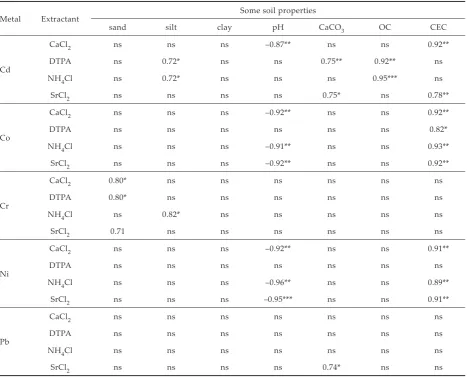
Simple linear correlation analysis shows a highly significant relationship for Cd-NH4Cl and Cd-DTPA extracts with soil organic carbon content between Cd in the different extracts and selected soil properties (Table 4). The obtained results indicated that cadmi-um was the most easily extractable metal studied.
Chromium
The most stable form in soil is Cr3+ and at slightly
acidic to alkaline pH values, ionic Cr3+ species
precipitate with precipitation being favoured by the presence of Fe (Cifuentes et al. 1996). This low solubility is consistent with the very low amounts (from 0.04 to 5.95% compared to total content in
soils) of Cr in the soluble-exchangeable pool. DTPA extracted less Cr than the chloride salts. Comparing these salts, we can observe that ammonium chlo-ride and in lesser extent strontium chlochlo-ride were more efficient extracting agent for Cr than calcium chloride. The ammonium chloride seems to be the best extractant for evaluating the extractability of Cr for calcareous soils.
Cobalt
[image:4.595.64.532.369.746.2]The different behaviors were observed for Co extraction depending on soil properties for the non-calcareous soils. The soil 1 induced a very high level of soluble Co compared with soil 3 with its near neutral pH. The influence of soil pH on soluble-exchangeable Co was very high for almost all the extractants and especially for the neutral chloride salts. The extractable Co pool was closely related to the electrical conductivity (i.e. salinity) of the soil. Extractability of Co was very low, except
Table 4. Pearson correlation coefficients between selected soil properties and different extracting methods
Metal Extractant Some soil properties
sand silt clay pH CaCO3 OC CEC
Cd
CaCl2 ns ns ns –0.87** ns ns 0.92**
DTPA ns 0.72* ns ns 0.75** 0.92** ns
NH4Cl ns 0.72* ns ns ns 0.95*** ns
SrCl2 ns ns ns ns 0.75* ns 0.78**
Co
CaCl2 ns ns ns –0.92** ns ns 0.92**
DTPA ns ns ns ns ns ns 0.82*
NH4Cl ns ns ns –0.91** ns ns 0.93**
SrCl2 ns ns ns –0.92** ns ns 0.92**
Cr
CaCl2 0.80* ns ns ns ns ns ns
DTPA 0.80* ns ns ns ns ns ns
NH4Cl ns 0.82* ns ns ns ns ns
SrCl2 0.71 ns ns ns ns ns ns
Ni
CaCl2 ns ns ns –0.92** ns ns 0.91**
DTPA ns ns ns ns ns ns ns
NH4Cl ns ns ns –0.96** ns ns 0.89**
SrCl2 ns ns ns –0.95*** ns ns 0.91**
Pb
CaCl2 ns ns ns ns ns ns ns
DTPA ns ns ns ns ns ns ns
NH4Cl ns ns ns ns ns ns ns
SrCl2 ns ns ns ns 0.74* ns ns
for the DTPA extraction from calcareous soils. This result could mainly reflect the low levels of pollu-tion by this metal and also the high proporpollu-tion of soil Co present in non-available pools compared with Co pseudo total concentration in soils.
Lead
The soluble-exchangeable pool of lead was gen-erally low due to the high percentage of insoluble forms in the soils. DTPA seems to be a better extract-ant for the majority of the soils, probably due to its capacity to dissolve Pb precipitates (Schalscha et al. 1980). Shuman (1988) stated that addition of organic matter to soil could decrease Pb lability probably by increasing CEC. Addition of soluble ligands in organic matter could decrease adsorp-tion and increase leaching. Only for soil 1, which is very acidic, ammonium chloride was more effi-cient than DTPA. These results are consistent with the findings of Shuman (1988) who reported on increased mobilization of Pb in soil columns with hydrochloric acid but not with sulfuric acid. The correlation of soil properties with Pb extractabil-ity was also low, which is consistent with the low mobility of this metal. Willams et al. (1987) found that Pb availability to Swiss chard was unaffected by soil pH. Lead extractable by SrCl2 was slightly correlated with total and active calcium carbonate in the soils. Cabral and Lefebvre (1988) found that soils contaminated with Pb showed an accumula-tion of Pb in the sorbed/carbonate phase.
Nickel
DTPA extracted more Ni than the chloride salts in calcareous soils. However, for non-calcareous soils, ammonium chloride extracted more Ni from soils 1 and 3. Li and Shuman (1996) reported that neutral salts such as Mg(NO3)2 were equivalent to DTPA in estimating the extractability of Ni from polluted soils. A strong dependence of the amount of Ni extracted by chloride salts on the pH and salinity of soils (Table 4) was observed. Thus, with decreasing soil pH and increasing salinity, higher metal extraction percentages were obtained with these salts. There were significant differences between calcium and strontium chloride in the amount of Ni extracted, probably due to ionic radii. The efficiency of DTPA in extracting Ni was not affected by any soil property. A high percentage of extractable Ni occurred in soil 1. This soil had been polluted with sulfidic sediments deposited by wastewater flood with a high impact of soil acidity on nickel availability according with the findings of Adamo et al. (1996).
CONCLUSION
Generally, the extractability of heavy metals is best determined with DTPA for calcareous soils. This may reflect the chelating capacity of the Lindsay-Norvell solution while maintaining soil pH at alkaline values to optimize cation extraction. For the non-calcareous soils, smaller differences were observed between extractants although ammonium chloride was the most effective extractant under acid conditions for heavy metals. The influence of soil pH and electrical conductivity on soluble-exchangeable heavy metals was noticeable for Cd, Co and Ni for all the extractants and especially for chloride salts.
REFERENCES
Adamo P.S., Dudka S., Wilson M.J., McHardy W.J. (1996): Chemical and mineralogical forms of Cu and Ni in contaminated soils from the Sudbury mining and smelting region. Can. Environ. Pollut., 161: 226–232. Ahnstrom Z.S., Parker D.R. (1999): Development and
assessment of a sequential extraction procedure for the fractionation of soil cadmium. Soil Sci. Soc. Am. J., 63: 1650–1658.
Allen H.E., Huang C.P., Bailey G.W., Bowers A.R. (1995): Metal speciation and contamination of soil. Lewis Publ., Ann Arbor.
Beckett P.H.T. (1989): The use of extractants in studies on trace metals in soils, sewage sludges and sludge-treated soils. Adv. Soil Sci., 9: 143–176.
Cabral A.R., Lefebvre G. (1988): Use of sequential ex-traction in the study of heavy metal retention by silty soils. Water Air Soil Pollut., 102: 329–344.
Cifuentes F.R., Lindemann W.C., Barton L.L. (1996): Chromium sorption and reduction in soil with im-plications to bioremediation. Soil Sci., 161: 233–239. Gee G.W., Bauder J.W. (1982): Particle-size analysis.. In:
Klute A. (ed.): Methods of soil analysis. Part I: Physical and mineralogical methods. 2nd ed. Am. Soc. Agron.,
Madison, WI: 383–412.
Gupta S.K., Aten C. (1993): Comparison and evaluation of extraction media and their suitability in a simple model to predict the biological relevance of heavy metal concentrations in contaminated soils. Int. J. Environ. Anal. Chem., 51: 25–46.
He Q.B., Singh B.R. (1993): Effect of organic matter on the distribution, extractability and uptake of cadmium in soils. J. Soil Sci., 44: 641–650.
Krishnamurti G.S.R., Huang P.M., Van Rees K.C.L., Korak L.M., Rostead H.P.W. (1994): Microwave diges-tion technique for the determinadiges-tion of total cadmium in soils. Commun. Soil Sci. Plant Anal., 25: 615–625. Krishnamurti G.S.R., Huang P.M., Van Rees K.C.L.,
cadmium in soils. Commun. Soil Sci. Plant Anal., 26: 2857–2867.
Li Z., Shuman L.M. (1996): Extractability of zinc, cad-mium, and nickel in soils amended with EDTA. Soil Sci., 161: 226–232.
Lindsay W.L., Norvell W.A. (1978): Development of a DTPA soil test for zinc, iron, manganese and cop-per. Soil Sci. Soc. Am. J., 42: 421–428.
Mahler R.J. (1988): Cadmium sulphate application to sludge-amended soils: II. Extraction of Cd, Zn and Mn from solid phases. Commun. Soil Sci. Plant Anal., 56: 1747–1770.
McLean E.O. (1982): Soil pH and lime requirement. In: Page A.L., Miller R.H., Keeney D.R. (eds.): Methods of soil analysis. Part 2: Chemical and microbiologi-cal properties. 2nd ed. Am. Soc. Agron., Madison, WI:
199–224.
Nakhone L.N., Young S.D. (1993): The significance of radio-labile cadmium pools in soils. Environ. Pollut., 56: 1747–1770.
Nelson D.W., Sommers L.E. (1982): Total carbon, organic carbon, and organic matter. In: Page A.L., Miller R.H., Keeney D.R. (eds.): Methods of soil analysis. Part 2: Chemical and microbiological properties. 2nd ed. Am.
Soc. Agron., Madison, WI: 538–580.
Nelson R.E. (1982): Carbonate and gypsum. In: Page A.L., Miller R.H., Keeney D.R. (eds.): Methods of soil analysis. Part 2: Chemical and microbiological proper-ties. 2nd ed. Am. Soc. Agron., Madison, WI: 181–198.
Rhoades J.D. (1982): Cation exchange capacity. In: Page A.L., Miller R.H., Keeney D.R. (eds.): Methods of soil analysis. Part 2: Chemical and microbiological proper-ties. 2nd ed. Am. Soc. Agron., Madison, WI: 149–158.
Schalscha E.G., Morales M., Ahumada Y., Schirado T., Pratt P.F. (1980): Fractionation of Zn, Cu, Cr and Ni in wastewater solids and in soil. Agrochimie, 24: 361–368.
SCS (1972): Soil Conservation Service. Soil survey laboratory methods and procedures for collecting and analysing soil samples. Soil Survey Invest. Rep. 1. USDA, Washington D.C., USA.
Shuman L.M. (1988): Effect of organic waste amendments on cadmium and lead fractions of two soils. Commun. Soil Sci. Plant Anal., 29: 2939–2952.
Smith R.M., Martell A.E. (1977): Critical stability con-stants; other organic ligands. Plenum Press: New York, Vol. 3.
Whitten M.G., Ritchie S.G.P. (1991): Calcium chloride extractable cadmium as an estimate of cadmium uptake by subterranean clover. Aust. J. Soil Res., 29: 215–221.
Williams D.E., Vlamis J., Putkite A.H., Corey J.E. (1987): Metal movement in sludge-amended soils: A nine-year study. Soil Sci., 143: 124–131.
Young S.D., Tye A., Carstensen A., Resende L., Crout N. (2000): Methods for determining labile cadmium and zinc in soil. Eur. J. Soil Sci., 51: 129–136.
Received on June 16, 2003
ABSTRAKT
Porovnání extrakčních metod pro hodnocení vybraných těžkých kovů ve znečištěných půdách
Byla hodnocena extrahovatelnost Cd, Co, Cr, Ni a Pb z půd roztokem chloridu amonného, chloridu vápenatého, chloridu strontnatého a DTPA. Pro hodnocení rostlinou přijatelného podílu kovů v půdách jednotlivými extraktanty bylo vybráno osm vzorků kontaminovaných půd. Extrahovatelné obsahy prvků byly vztaženy k pseudototálnímu obsahu prvků stanovenému po mikrovlnné digesci vzorků v HNO3. Pro kvantifikaci jednotlivých prvků v roztocích bylo použito metody ICP-MS s kalibrací pomocí standardů s modifikovanou matricí vzorku. Výsledky naznačily významnou variabilitu extrahovatelnosti prvků v závislosti na metodě extrakce, zdroji kontaminace a původu ana-lyzované půdy a ukázaly nejlepší extrahovatelnost půd s vysokým obsahem vápníku pomocí roztoku DTPA. Při porovnání chloridových solí byla u těchto půd zaznamenána nejvyšší účinnost extrakce v případě roztoku chloridu amonného.
Klíčová slova: ICP-MS; těžké kovy; znečištěné půdy; kontaminace; extrakční metody; mobilita
Corresponding author:
Dr. Cumhur Aydinalp, Uludag University, Faculty of Agriculture, Department of Soil Science, 16059 Görükle-Bursa, Turkey