Many synthetic additives have been used over the years to enhance the quality of minced meat and to ex-tend the period of refrigerated storage. But synthetic additives have been accused of some carcinogenic and toxic properties. This increased the consumer concerns in healthier and higher quality meat prod-ucts and the demand for natural food additives over the years, which led researchers to examine natural alternatives to synthetic food additives (Mariutti et al. 2011; Dinesh 2013).
The combined use of bioflavonoids as natural an-tioxidants with lactic acid and linalool for treatment of modified atmosphere packaged fresh meat has not been discussed in the available literature. Dihydro-quercetin (known also as taxifolin) is a member of the group of flavonons (Vladimirov et al. 2009). Satis-factorily pure taxifolin may be extracted from Siberian larch (Larix sibirica Ledeb). Taxifolin has a positive
effect on human health, as it prevents accumulation of free radicals (Teselkin et al. 2000;Trouillas et al. 2004), influences the physical properties of lipids in biological membranes (Theriault et al. 2000), ameliorates the cerebral ischemia-reperfusion injury (Wang et al. 2006) and activates the formation of collagen fibres (Tarahovsky et al. 2007). Applica-tion of taxifolin is quite widely distributed in the production of different categories of products. In general, taxifolin can be used as a natural antioxidant and additive with antimicrobial activities in the food industry (Wang et al. 2011).
Weak organic acids are among several primary agents used to control microorganisms in both fer-mented and non-ferfer-mented foods (Buchanan et al. 2002). For example, lactic acid, citric acid and acetic acid are either naturally produced or added to food or marinades to achieve food safety and meet
Combined Effect of Lactic Acid, Bioactive Components and
Modified Atmosphere Packaging on the Quality of Minced Meat
Anita RokAityte 1, Gintare ZAboRskiene 1,2, irena MAcioniene 2, irmantas RokAitis 3 and Dalia sekMokiene 1
1Department of Food safety and Quality,Lithuanian University of Health sciences, Lithuani
Veterinary Academy, kaunas, Lithuania;2Food institute,kaunas University of technology, taikos kaunas, Lithuania;3Faculty of chemistry, Vilnius University, Vilnius, Lithuania
Abstract
Rokaityte A., Zaborskiene G., Macioniene I., Rokaitis I., Sekmokiene D. (2016): Combined effect of lactic acid, bioactive components and modified atmosphere packaging on the quality of minced meat. Czech J. Food Sci., 34: 52–60.
The quality of minced beef was improved. Combinations of modified atmosphere packaging (MAP) and vacuum pack-aging (VP) with lactic acid (LA), dihydroquercetin (DHQ) and linalool (LIN) mixes were used on fresh minced beef. In the course of the study the total aerobic bacterial, escherichia coli, yeast and mouldcounts and formation of biogenic amines during 9 days of storage at +4°C temperature were investigated. Mixtures of DHQ+LA+LIN and DHQ+LA solutions statistically significantly reduced the total aerobic bacterial and e. coli count and meat pH (P ≤ 0.05) in com-parison with control samples. We have identified a strong positive correlation between pH and total aerobic bacterial (R = 0.736, P < 0.01) and e. coli count (R = 0.818, P < 0.01). Significant differences in the total biogenic amine content were determined between DHQ+LA+LIN and DHQ+LA treated samples in air packaging (AP) (P ≤ 0.05). However, there were no significant differences (P > 0.05) in the total aerobic bacterial and e. coli count between the different packaging techniques, but VP effectively inhibited yeasts and moulds in minced beef (P ≤ 0.05).
quality requirements (Lambert & Stratford 1999; Mani-Lόpez et al. 2012). Lactic acid has shown antimicrobial activities against many pathogenic organisms because of its abilities to reduce the pH level, exert feedback inhibition and interfere with proton transfer across cell membranes (Davidson et al. 2005).
One of the traditional ways of controlling microbial growth in these products, thus improving safety and delaying spoilage, is the application of essential oils (EOs) (Dinesh 2013). Antimicrobial activity of lin-alool has been reported to possess both fungistatic and antibacterial properties against a wide spectrum of microorganisms such as staphylococcus aureus, Listeria innocua, and escherichiacoli (Suppakul et al. 2003). EOs may be applied as part of a hurdle system to achieve preservative action (Mastromat-teo et al. 2009). A series of preservative hurdles is established by combined processes (Zhou et al. 2010), which in turn improves the microbial stability and the sensory quality of meat and meat products. But the use of EOs as preservatives in food has been limited as they are required in high concentrations in order to achieve the sufficient antimicrobial ac-tivity (Celikel & Kavas 2008; Hyldgaard et al. 2012). Lower concentrations of EOs can be combined with other antimicrobial compounds and/or other preservative technologies to obtain a synergistic ef-fect without compromising antimicrobial activities (Nguefack et al. 2012).
The objective of the study was to enhance the shelf-life of beef using a combination of MAP and vacuum packaging with lactic acid, dihydroquerce-tin and linalool mixes on microorganisms found in fresh minced beef with regard to acceptability and formation of biogenic amines.
MATERIAL AND METHODS
Meat samples. Meat was purchased from a
lo-cal establishment in Kedainiai, Lithuania. Samples used for analysis were taken from pectoralis major and minor muscles of beef carcasses from older than 2-year cattle 48 h after the slaughter and they exceeded the requirements of Commission Regula-tion (EC) No 1441/2007 for e. coli (500 CFU/g) and aerobic colony count (5 × 10⁶ CFU/g). The meat was
trimmed of all exterior fat and connective tissue. The samples were transported to a laboratory at 4°C and minced with a sterilized meat mincer in 3 mm size.
Minced meat samples were divided into 9 groups (9 × 0.5 kg) considering different treatments with lactic acid and bioactive substances. The samples were named as follows: (i) DHQ+LA+LN, (ii) DHQ+LA, (iii) untreated control group.
Preparation of bioactive component solutions
for analyses of antibacterial properties. Powder
concentrate of dihydroquercetin (99.4%), extracted from Siberian larch (Larix sibirica Ledeb) and pro-duced by the company Flavit Ltd. (Pushtino, Russia), was used. Dihydroquercetin was diluted into 35°C distilled water to make 10 ml of 0.024% (w/v) dihy-droquercetin aqueous solution.
Linalool (97.0% – LN) and lactic acid (50.0% – LA) were purchased from Sigma-Aldrich Chemie GmbH (Steinheim, Germany) and kept at 4°C. All of the solutions (10 ml of each of them) were made on the day of research: 0.003% (w/v) linalool aqueous solution and 0.5% (w/v) lactic acid aqueous solution.
Packaging parameters. The minced meat
sam-ples were weighed and packed using three different packaging methods: VP, MAP, and AP. VP and MAP were performed using a Multivac R230 model 542 packaging machine (Multivac, Wolfertschwenden, Germany). The vacuum bag (Clingvac 90; Cure-vac AB, Göteborg, Sweden) was 90 μm thick with transmission rates (cm3/m2, 24 h, 23°C): O
2 40, CO2
150. In MAP the gas composition 80% O2 and 20% CO2 was used. Control samples (AP) were packaged under atmospheric air without giving any gas com-position. The samples were stored in the dark under refrigeration conditions +4°C) for 9 days. Analyses of microorganisms and pH were carried out on the 1st, 3rd, 5th, 7th, and 9th day of storage. Samples for
compositional analysis (protein, moisture, fat, and collagen) were obtained after 24 h after the treat-ment. Detection of biogenic amines was carried out on the 1st, 3rd, 5th, and 7th day of storage. The whole
experiment was replicated three times.
Microbiological analysis. Samples of 10 g were
(Ref. 4021562; Biolife, Milano, Italy) at 37°C for 24 h;yeast and mouldwere enumerated by plating on Sabouraud CAF Agar (Ref. 610203, Liofilchem) at 30°C for 48 hours.
Microbiological data were transformed into logarithms of the number of colony forming units (CFU/g).
Compositional analysis. The analysis was
con-ducted using an AOAC-approved (Official Method 2007.04) near-infrared spectrophotometer (FOSS Food ScanTM 78800; Dedicated Analytical
Solu-tions, Hillerod, Denmark). Compositional values are reported on a percent basis.
Detection of biogenic amines. A reversed-phase
high-performance liquid chromatography (RP-HPLC) method was used for the quantitative analysis of the biogenic amines – tryptamine, phenylethyl-amine, putrescine, cadaverine, histphenylethyl-amine, tyrphenylethyl-amine, spermidine, and spermine. Biogenic amines were extracted from a homogenised sample with 0.4 mol/l perchloric acid. The derivatisation of samples was carried out using the modified methodology of Ben-Gigirey et al. (2000). The extract was derivatised for 45 min by dansyl chloride (5-dimethylamino- naphthalene-1-sulfonylchloride) solution in acetone at 40°C. The samples were filtered through 0.45 μm membrane filter (Millipore Co., Bedford, USA), 10 μl was injected into a chromatographic system (Aligent 1200 Series, Waldbronn, Germany). The analysis was performed using LiChro column CART® 95 125-4.
Carrier phase – eluents: B – acetonitrile, A – am-monium acetate 0.1 mol/l. The analysis lasted 28 min changing the content of eluents during the first 19 min from 50% of B to 90% of B (from 50% of A to 10% of A, respectively), then leaving the content constant for 1 min – 90% of B. Later, to ensure the isolation of materials for another analysis, an eluent with the composition of 50% of B and 50% of A was added to the chamber for 8 minutes. The flow rate of 0.9 ml/min did not change during the analysis, column temperature 40°C. UV detection was observed at 254 nm. Biogenic amines were identified by comparing the retention time of each amine in the chamber with the retention time of the respective reference material. An internal standard method of calculating the peak area for the defined amount of reference material was used to perform the quantitative analysis. The limit of detection is between 0.02 and 0.1 μg/ml for different biogenic amines.
pH measurement. pH was measured on the surface
of all samples according to the standard method for determination of meat pH (LST ISO 2917:2002). The average pH of the sample was determined. pH measurements were carried out using Professional pH Meter PP-15 (Sartorius GmbH, Göttingen, Germany).
Acceptability evaluation. A four-member trained
[image:3.595.66.532.531.730.2]panel was used to evaluate the acceptability of all samples. Before evaluation, samples were wrapped in aluminium foil individually and cooked in a steam
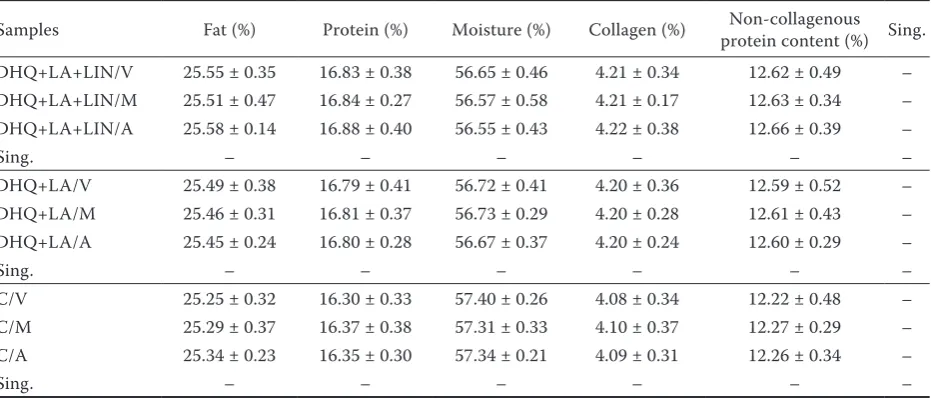
Table 1. Chemical composition of minced beef after 24 h of storage at +4°C
Samples Fat (%) Protein (%) Moisture (%) Collagen (%) protein content (%) Sing.Non-collagenous
DHQ+LA+LIN/V 25.55 ± 0.35 16.83 ± 0.38 56.65 ± 0.46 4.21 ± 0.34 12.62 ± 0.49 – DHQ+LA+LIN/M 25.51 ± 0.47 16.84 ± 0.27 56.57 ± 0.58 4.21 ± 0.17 12.63 ± 0.34 – DHQ+LA+LIN/A 25.58 ± 0.14 16.88 ± 0.40 56.55 ± 0.43 4.22 ± 0.38 12.66 ± 0.39 –
Sing. – – – – – –
DHQ+LA/V 25.49 ± 0.38 16.79 ± 0.41 56.72 ± 0.41 4.20 ± 0.36 12.59 ± 0.52 – DHQ+LA/M 25.46 ± 0.31 16.81 ± 0.37 56.73 ± 0.29 4.20 ± 0.28 12.61 ± 0.43 – DHQ+LA/A 25.45 ± 0.24 16.80 ± 0.28 56.67 ± 0.37 4.20 ± 0.24 12.60 ± 0.29 –
Sing. – – – – – –
C/V 25.25 ± 0.32 16.30 ± 0.33 57.40 ± 0.26 4.08 ± 0.34 12.22 ± 0.48 – C/M 25.29 ± 0.37 16.37 ± 0.38 57.31 ± 0.33 4.10 ± 0.37 12.27 ± 0.29 – C/A 25.34 ± 0.23 16.35 ± 0.30 57.34 ± 0.21 4.09 ± 0.31 12.26 ± 0.34 –
Sing. – – – – – –
cooker (MultiGourmet FS20; Braun, Kronberg, Ger-many) for 30 minutes. Each sample was served warm in dishes coded with 3-digit random numbers and presented in individual booths to each panellist for evaluation. Panellists were asked to evaluate flavour, texture, odour, and overall acceptability based on a standard 9-point hedonic scale, where 9 = like extremely and 1 = dislike extremely. Acceptability evaluation was accomplished on the 1st, 3rd, and
5th day of storage at +4°C.
Statistical analysis. Data were statistically ana-lysed using the SPSS 20.0 software (SPSS Inc., Chi-cago, USA). Differences between dates were evaluated by the analysis of variance method (one-way ANOVA) with a significance level of P ≤ 0.05 (Draper & Smith 1998). Multiple comparisons were estimated by Fisher’s Least Significant Difference method and Dunnett’s test was applied when the control group was present. Student’s t-test was used to determine average values of indicators, standard deviations (SD) and linear correlations. The correlation was considered reliable when P < 0.05.
RESULTS AND DISCUSSION
The results obtained showed that the combination of packaging and lactic acid, dihydroquercetin and linalool mixes used on beef did not significantly modify the proximate composition of beef (Table 1).
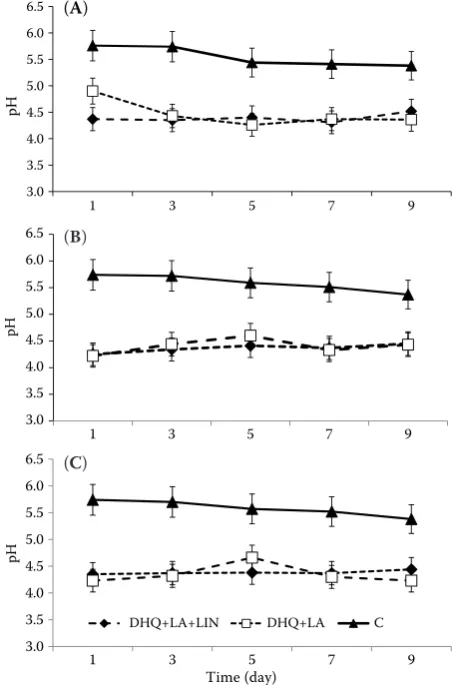
Significant differences were observed between the pH values of control and treated samples throughout storage. However, there were no significant differences (P > 0.05) in pH between the different treatments and packaging (Figure 1).
Gutierrez et al. (2009) found that the antimicro-bial activity of EOs against foodborne pathogens and spoilage bacteria was increased at acidic pH condi-tions (pH = 5). Previously, it was also observed that the inhibitory effect of plant extracts was greater at acidic pH values.
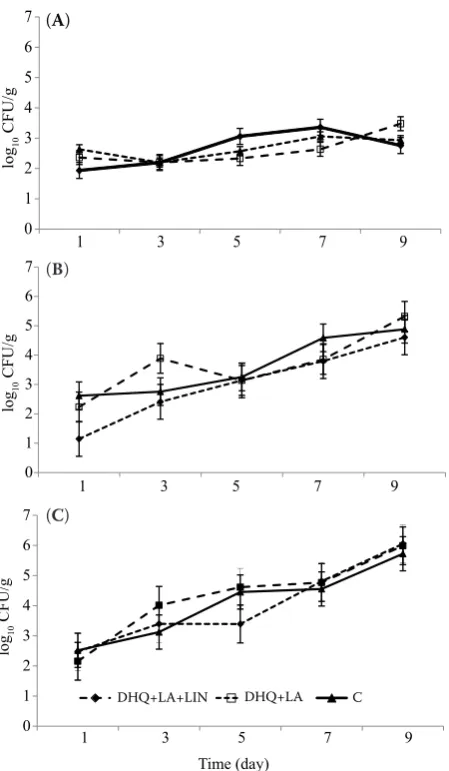
Results demonstrated that DHQ+LA+LIN and DHQ+LA effectively inhibited bacterial growth or reduced numbers of viable bacteria (P ≤ 0.05). The numbers of total aerobic bacteria in control sam-ples reached after 1 week of storage 7.23, 7.71, and 7.86 log10 CFU/gfor VP, MAP, and AP packaging, respectively. DHQ+LA+LIN and DHQ+LA had a moderately inhibitory effect against these micro-organisms. Regarding the total aerobic bacterial count (Figure 2), both DHQ+LA+LIN and DHQ+LA
3.0 3.5 4.0 4.5 5.0 5.5 6.0 6.5
1 3 5 7 9
pH
Time (day)
3.0 3.5 4.0 4.5 5.0 5.5 6.0 6.5
1 3 5 7 9
pH
Time (day)
3.0 3.5 4.0 4.5 5.0 5.5 6.0 6.5
1 3 5 7 9
pH
Time (day)
[image:4.595.305.533.342.685.2]DHQ+LA+LIN DHQ+LA C
Figure 1.Variation of the pH mean values of minced beef during 9 days of storage at +4°C: (A) vacuum packaging (VP), (B) modified atmosphere packaging (MAP), and (C) vacuum packaging with lactic acid (LA)
DHQ – dihydroquercetin; LIN – linalool; V – vacuum packag-ing; C – untreated control group
evidently caused a highly significant decrease of mi-crobial counts. However, there were no significant differences (P > 0.05) in the total aerobic bacterial count between the different packaging techniques.
In general, the antimicrobial activity of mixtures of lactic acid and bioactive components increased when the pH decreased. Previously, it was also ob-served that the inhibitory effect of plant extracts was greater at acidic pH values (Del Campo et al. 2000; Hsieh et al. 2001).
Results demonstrated that VP effectively inhibited yeasts and moulds in minced beef during 9 days of storage (P ≤ 0.05). However, there were no significant differences (P > 0.05) in the total yeast and mould count between the different treatments. These results do not agree with Rubio et al. (2007), who found a progressive decrease in mould and yeast counts
(A)
(B)
during storage in salchichón packaged under MAP. Furthermore, the conditions within the package were not sufficient to slow down their growth.
Lactic acid, used in a mixture with LN and DHQ, was distinguished by a strong synergistic effect and statistically significantly reduced the e. coli count. In addition, the mixture of DHQ and LA was distin-guished by a strong bactericidal activity against e. coli. Indeed, a reduction of 4.22 and 4.14 log10 CFU/gwas recorded after 3 days compared with the control of storage in VP and MAP, respectively.However, the effect of DHQ+LA+LIN was much lower compared with that of DHQ+LA in VP. Regarding the e. coli
(Figure 4), both DHQ+LA+LIN and DHQ+LA caused a highly significant decrease of microbial counts most evidently. Nevertheless, there were no significant differences (P > 0.05) in the e. coli count between the different packaging techniques.
Dimitriević et al. (2007) noted that the antilis-terial effect of essential oils (thymus vulgaris and Rosmarinus officinalis) was noticeably increased using it with lactic acid. The same synergistic effect was reported by Naveena et al. (2006), who found that the combination of syzygium aromaticum es-sential oil and lactic acid provided a decrease of psychrotrophic and coliform counts in buffalo meat.
0 1 2 3 4 5 6 7 8 9
lo
g10
C
FU/g
Time (day)
DHQ+LA+LIN DHQ+LA C
1 3 5 7 9
0 1 2 3 4 5 6 7 8 9
log10
CFU/g
Time (d)
1 3 5 7 9 0
1 2 3 4 5 6 7 8 9
1 3 5 7 9
log
10
CFU/g
0 1 2 3 4 5 6 7
log
10
C
FU/g
1 3 5 7 9
0 1 2 3 4 5 6 7
1 3 5 7 9 log10
C
FU/g
0 1 2 3 4 5 6 7
log
10
C
FU/g
Time (day)
DHQ+LA+LIN DHQ+LA C
1 3 5 7 9 (A)
(B)
[image:5.595.66.307.97.491.2](C)
Figure 3. Variation of the total yeast and mould count in minced beef during 9 days of storage at +4°C: (A) vacuum packaging (VP), (B) modified atmosphere packaging (MAP), and (C) atmosphere packaging (AP)
[image:5.595.308.533.104.490.2]DHQ – dihydroquercetin; LIN – linalool; V – vacuum packag-ing; C – untreated control group
Figure 2. Variation of the total aerobic bacterial count in minced beef during 9 days of storage at +4°C: (A) vacuum packaging (VP), (B) modified atmosphere packaging (MAP), and (C) atmosphere packaging (AP)
DHQ – dihydroquercetin; LIN – linalool; V – vacuum packag-ing; C – untreated control group
(A)
(B)
According to Dimitriević et al. (2007) it is dif-ficult to understand the mechanism of the enhancing antimicrobial effect from the combined application of essential oils and organic acids. Studies on the antibacterial mechanism of phenolic compounds found in essential oils focused on their effects on the cell membrane, changing its structure and perme-ability. Lin et al. (2004) stated that damage to the cell membrane might explain the observed effects, since phenolics could cause a sublethal injury to cell membranes, causing disruption of the proton motive force due to a loss of H+-ATPase. This could make
bacteria more susceptible to an acidic environment.
Moreover, at low pH the hydrophobicity of an essen-tial oil increases, enabling it to more easily dissolve in the lipids of the cell membrane of target bacteria.
The strong positive correlation between pH and total aerobic bacterial count (R = 0.736, P < 0.01) and e. coli count (R = 0.818, P < 0.01) was observed during a 9-day period. We find a weak positive cor-relation between biogenic amine contents and total yeast and mould count (R = 0.389, P < 0.01). However, correlations between biogenic amine contents and total aerobic bacterial and e. coli counts were not observed. The capability to form biogenic amines is generally considered a strain specific characteristic 0
1 2 3 4 5
1 3 5 7 9
lo
g10
CF
U/
g
0 1 2 3 4 5
1 3 5 7 9
log10
CFU/g
0 1 2 3 4 5
1 3 5 7 9
lo
g10
C
FU/g
Time (day)
[image:6.595.303.527.100.501.2]DHQ+LA+LIN DHQ+LA C
Figure 4.Variation of the e. coli count in minced beef during 9 days of storage at +4°C:(A) vacuum packaging (VP), (B) modified atmosphere packaging (MAP), and (C) atmosphere packaging (AP)
DHQ – dihydroquercetin; LIN – linalool; V – vacuum packag-ing; C – untreated control group
0 20 40 60 80 100 120 140
1 3 5 7
mg/kg
0 20 40 60 80 100 120 140
1 3 5 7
mg
/kg
0 50 100 150 200
1 3 5 7
m
g/
kg
Time (day) DHQ+LA+LIN DHQ+LA C
(A)
(B)
(C)
(A)
(B)
(C)
0 50 100 150 200
1 3 5 7
m
g/
kg
Time (day)
DHQ+LA+LIN DHQ+LA C
[image:6.595.68.297.103.497.2]rather than a species property. It is thus difficult to find precise correlations between biogenic amine contents and total bacterial count (Halász et al. 1994; Suzzi & Gardini 2003; Standarová et al. 2008). Amine production has been recognised as a defence mechanism of microorganisms against an acidic environment (Suzzi & Gardini 2003; Karovičová & Kohajdová 2005). Tkachenko et al. (2001) suggested an interesting hypothesis on the physiological role of biogenic amines in microorgan-isms. Some strains, with amino acid decarboxylase activity, could overcome or reduce the effects of temperature, NaCl, and other biological and chemico-physical factors that induce stress responses in the cells, with the production of some biogenic amines (Karovičová & Kohajdová 2005; Galgano et al. 2009). We find a weak positive correlation between biogenic amine contents and pH (R = 0.276, P < 0.01). Hu et al. (2007) and Mah and Hwang (2009) suggested that lactic acid has a positive effect on reducing biogenic amines in meat products.
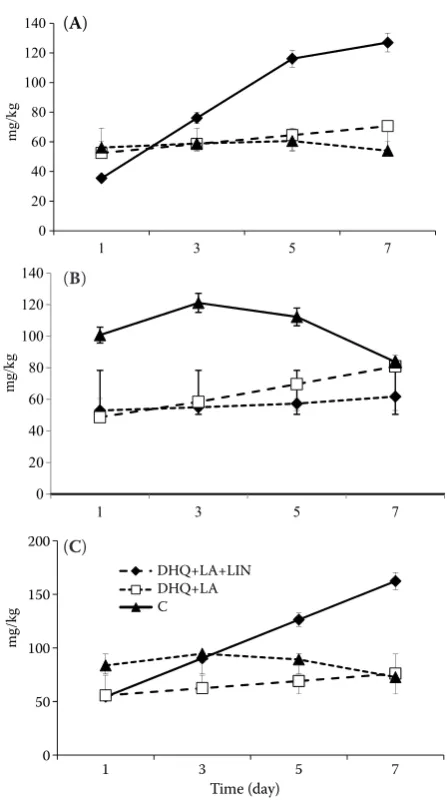
A significant difference (P ≤ 0.05) was detected in the total amine content between the treated sam-ples DHQ+LA+LIN and DHQ+LA in AP, while no differences were observed between the different packaging techniques (Figure 5). After 7 days of storage DHQ+LA solutions suppressed the forma-tion of biogenic amines: putrescine (25.67 ± 1.37 to 15.98 ± 0.61 mg/kg) and histamine (32.96 ± 0.81 to 21.47 ± 0.54 mg/kg) in AP (P ≤ 0.05). During the analysis tyramine, spermidine, and spermine were detected only in the control sample. Small quanti-ties of tryptamine, phenylethylamine, putrescine, cadaverine, histamine were formed in all cases.
After the analysis of boiled samples a significant difference (P ≤ 0.05) in flavour and overall accept-ability was detected between the control and treat-ed samples, while no significant differences were detected between the different treatments. After one day of storage samples treated with DHQ+LA showed the highest score of flavour (6.28 ± 0.17) and overall acceptability (6.08 ± 0.25), followed by DHQ+LA+LN treated samples (5.94 ± 0.11 and 5.87 ± 0.20, respectively), while control samples exhibited the least acceptable scores (4.42 ± 0.31 and 4.37 ± 0.24, respectively). Furthermore, after one day of storage the odour of samples treated with DHQ+LA+LN (5.86 ± 0.14) was significantly higher (P ≤ 0.05) compared with the control (4.33 ± 0.33). The increased storage time decreased the sensory scores of flavour, texture, odour, and overall
accept-ability in all samples and after 5 days of storage the samples were unacceptable to use.
CONCLUSION
Both mixtures of DHQ+LA+LIN and DHQ+LA solutions showed a synergistic antibacterial effect in minced beef and showed the highest score of flavour and overall acceptability. But samples treated with DHQ+LA solutions showed the strongest synergistic antibacterial effect on e. coli count (in all different packaging techniques) and suppressed the formation of biogenic amines like putrescine and tyramine after 7 days of storage (AP) (P ≤ 0.05). We identified the strong positive correlation between pH and total aerobic bacterial (R = 0.736, P < 0.01) and e. coli count (R = 0.818, P < 0.01).
These mixtures could be used in the food industry as a natural barrier to control the growth of patho-gens and natural spoilage microflora in combination with VP. VP effectively inhibited the yeast and mould count in minced beef (P ≤ 0.05).
Our results encourage further researches, focus-ing on the application of mixtures of lactic acid and bioactive components in low doses to control the growth of microorganisms mostly found in selected foods, particularly meat products.
References
Ben-Gigirey B., Vieites Baptista de Sousa J., Villa T., Barros-Velázquez J. (2000): Characterization of biogenic amine-producing stenotrophomonas maltophilia strains isolated from white muscle of fresh and frozen albacore tuna. International Journal of Food Microbiology, 57: 19–31. Buchanan R.L., Whiting R.C., Golden M.H. (2002): Mod-elling acid inactivation of foodborne microorganisms. In: Juneja V.K., Sofos J.N. (eds): Control of Foodborne Microorganisms. New York, Marcel Dekker: 461–478. Celikei N., Kavas G. (2008): Antimicrobial properties of
some essential oils against some pathogenic microor-ganisms. Czech Journal of Food Sciences, 26: 174–181. Davidson P.M., Sofos J.N., Branen A.L. (2005):
Antimicro-bials in Food. 3rd Ed. Boca Raton, CRC Press: 460–469. Del Campo J., Amiot M.J., Nguyen-The C. (2000): Antimi-crobial effect of rosemary extracts. Journal Food Protec-tion, 63: 1359–1368.
lactic-acid and essential oils from thymus vulgaris L.,
Rosmarinus officinalis L. and origanum vulgare L. Food Chemistry, 74: 774–782.
Dinesh D., Jayasena A. (2013): Essential oils as potential an-timicrobial agents in meats and meat products: a review. Food Science & Technology, 34: 96–108.
Draper N., Smith H. (1998): Applied Regression Analysis 3rd Ed. New York, Wiley.
Galgano F., Favati F., Bonadio M., Lorusso V., Romano P. (2009): Role of biogenic amines as index of freshness in beef meat packed with different biopolymeric materials. Food Research International, 42: 1147–1152.
Gutierrez J., Barry-Ryan C., Bourke P. (2009): Antimicrobial activity of plant essential oils using food model media, efficacy, synergistic potential and interactions with food components. Food Microbiology, 26: 142–150.
Halász A., Barath A., Simon-Sarkadi L., Holzapfel W. (1994): Biogenic amines and their production by micro-organisms in food. Trends in Food Science & Technology, 5: 42–49. Hsieh P.C., Mau J.L., Huang S.H. (2001): Antimicrobial
effect of various combinations of plant extracts. Food Microbiology, 18: 35–43.
Hu Y., Xia W., Liu X. (2007): Changes in biogenic amines in fermented silver carp sausages inoculated with mixed starter cultures. Food Chemistry, 4: 188–195.
Hyldgaard M., Mygind T., Meyer R.L. (2012): Essential oils in food preservation: mode of action, synergies, and interactions with food matrix components. Frontiers in Microbiology, 3: 1–24.
Karovičová J., Kohajdová Z. (2005): Biogenic amines in food. Chemistry Paper, 59: 70–79.
Lambert R.J., Stratford M. (1999): Weak-acid preservatives: modelling microbial inhibition and response. Journal of Applied Microbiology, 86: 157–164.
Lin Y.T., Labbe R.G., Shetty K. (2004): Inhibition of Listeria monocytogenes in fish and meat system by use of oregano and cranberry phytochemical synergies. Applied and Environmental Microbiology, 70: 5672–5678.
Mah J.H., Hwang H.J. (2009): Effects of food additives on biogenic amine formation in Myeolchi-jeot, a salted and fermented anchovy (engraulis japonicus). Food Chem-istry, 114: 168–173.
Mani-Lόpez E., García H.S., Lόpez-Malo A. (2012): Organic acids as antimicrobials to control salmonella in meat and poultry products. Food Research International, 45: 713–721. Mariutti L.R.B., Nogueira G.C., Bragagnolo N. (2011): Lipid
and cholesterol oxidation in chicken meat are inhibited by sage but not by garlic. Journal of Food Science, 76: 909–915.
Mastromatteo M., Lucera A., Sinigaglia M., Corbo M.R. (2009): Combined effects of thymol, carvacrol and
tem-perature on the quality of non conventional poultry pat-ties. Meat Science, 83: 246–254.
Naveena B.M., Muthukumar M., Sen A.R., Babji Y., Murthy T.R.K. (2006): Improvement of shelf-life of buffalo meat using lactic acid, cove oil and vitamin C during retail display. Meat Science, 74: 409–415.
Nguefack J., Tamgue O., Dongmo J.B.L., Dakole C.D., Leth V., Vismer H.F., Zollo P.H.A., Nkengfack A.E. (2012): Synergis-tic action between fractions of essential oils from cymbopo-gon citratus, ocimum gratissimum and Thymus vulgaris
against Penicillium expansum. Food Control, 23: 377–383. Rubio B., Martínez B., Sánchez M.J., García-Cachán M.D., Rovira J., Jaime I. (2007): Study of the shelf life of a dry fermented sausage salchichón made from raw material enriched in monounsatured and polyunsatured fatty acids and stored under modified atmospheres. Meat Science, 76: 128–137.
Standarová E., Bořkovcová I., Vorlová L. (2008): The oc-currence of biogenic amines in dairy products on the Czech market. Acta Scientiarum Polonorum – Medicina Veterinaria, 7: 35–42.
Suppakul P., Miltz J., Sonneveld K., Bigger S. (2003): Anti-microbial properties of basil and its possible application in food packaging. Journal of Agricultural and Food Che-mistry, 11: 3197–3207.
Suzzi G., Gardini F. (2003): Biogenic amines in dry fer-mented sausages: a review. International Journal of Food Microbiology, 88: 41–54.
Tarahovsky Y.S., Selezneva I.I., Vasilieva N.A., Egorochkin M.A., Kim Y.A. (2007): Acceleration of fibril formation and thermal stabilization of collagen fibrils in the pres-ence of taxifolin (dihydroquercetin). Bulletin of Experi-mental Biology and Medicine, 144: 791–794.
Teselkin Y.O., Babenkova I.V., Kolhir V.K., Baginskaya A.I., Tjukavkina N.A., Kolesnik Y.A., Selivanova I.A., Eichholz A.A. (2000): Dihydroquercetin as a means of antioxida-tive defence in rats with tetrachloromethane hepatitis. Phytotherapy Research, 14: 160–162.
Theriault A., Wang Q., Iderstine S.C.V., Chen B., Franke A.A., Adeli K. (2000): Modulation of hepatic lipoprotein synthesis and secretion by taxifolin, a plant flavonoid. Journal of Lipid Research, 41: 1969–1979.
Tkachenko A.G., Nesterova L.Y., Pshenichnov K. (2001): Role of putrescine in the regulation of the expression of the oxidative stress defence genes of escherichia coli. Microbiology, 70: 133–137.
corresponding author:
Dr Anita Rokaityte, Lithuanian University of Health Sciences, Luthuanian Veterinary Academy,
Department of Food Safety and Quality, Tilžés st. 18, Kaunas 47181, Lithuania; E-mail: [email protected] Vladimirov Y.A., Proskurnina E.V., Demin E.M., Matveeva
N.S., Lubitskiy O.B., Novikov A.A., Izmailov D.Y., Osipov A.N., Tikhonov V.P., Kagan V.E. (2009): Dihydroquercetin (taxifolin) and other flavonoids as inhibitors of free radi-cal formation at key stages of apoptosis. Biochemistry (Moscow), 74: 301–307.
Wang Y., Wang W., Chang C., Liou K., Sung Y., Liao J., Chen C., Chang S., Hou Y., Chou Y., Shen Y. (2006): Taxifolin amelio-rates cerebral ischemia-reperfusion injury in rats through its anti-oxidative effect and modulation of NF-kappa B activa-tion. Journal of Biomedical Science, 13: 127–141.
Wang Y., Zu Y., Long J., Fu Y., Li S., Zhang D., Li J., Wink M., Efferth T. (2011): Enzymatic water extraction of taxifolin from wood sawdust of Larix gmelini (Rupr.) Rupr. and evaluation of its antioxidant activity. Food Chemistry, 126: 1178–1185.
Zhou G.H., Xu X.L., Liu Y. (2010): Preservation technolo-gies for fresh meat – a review. Meat Science, 86: 119–128.