1582
https://doi.org/10.1107/S2056989019013148 Acta Cryst.(2019). E75, 1582–1585research communications
Received 9 September 2019 Accepted 23 September 2019
Edited by A. J. Lough, University of Toronto, Canada
Keywords:crystal structure; xanthate; zinc (II); DFT; molecular electrostatic potential.
CCDC reference:1420207
Supporting information:this article has supporting information at journals.iucr.org/e
Crystal structure and DFT study of a zinc xanthate
complex
Adnan M. Qadir,aSevgi Kansiz,b* Necmi Dege,bGeorgina M. Rosaircand Igor O. Fritskyd*
aDepartment of Chemistry, College of Science, Salahaddin University, Erbil, Iraq,bDepartment of Physics, Faculty of Arts and Sciences, Ondokuz Mayıs University, 55139, Kurupelit, Samsun, Turkey,cInstitute of Chemical Sciences, School of Engineering & Physical Sciences, Heriot-Watt University, Edinburgh, EH14 4AS, UK, anddTaras Shevchenko National University of Kyiv, Department of Chemistry, 64, Vladimirska Str., Kiev 01601, Ukraine. *Correspondence e-mail: [email protected], [email protected]
In the title compound, bis(2-methoxyethyl xanthato-S)(N,N,N0,N0
-tetramethyl-ethylenediamine-2N,N0)zinc(II) acetone hemisolvate, [Zn(C
4H7O2S2)2 -(C6H16N2)]0.5C3H6O, the Zn
II
ion is coordinated by two N atoms of the N,N,N0,N0-tetramethylethylenediamine ligand and two S atoms from two
2-methoxyethyl xanthate ligands. The amine ligand is disordered over two orientations and was modelled with refined occupancies of 0.538 (6) and
0.462 (6). The molecular structure features two C—H O and two C—H S
intramolecular interactions. In the crystal, molecules are linked by weak C—
H O and C—H S hydrogen bonds, forming a three-dimensional
supra-molecular architecture. The supra-molecular structure was optimized using density functional theory (DFT) at the B3LYP/6–311 G(d,p) level. The smallest HOMO–LUMO energy gap (3.19 eV) indicates the suitability of this crystal for optoelectronic applications. The molecular electrostatic potential (MEP) further identifies the positive, negative and neutral electrostatic potential regions of the molecules. Half a molecule of disordered acetone was removed with the solvent-mask procedure inOLEX2[Dolomanovet al.(2009).J. Appl. Cryst.42, 339–341] and this contribition is included in the formula.
1. Chemical context
Xanthates (dithiocarbonates) are related to the dithiolate family. Xanthate is a bidentate monoanionic sulfur–sulfur donor ligand. It stabilizes complexes of most of the transition elements and can bind metal centers in monodentate, isobi-denate, anisobidenate or ionic modes. Xanthates have the ability to inhibit the replication of both RNA and DNA viruses in vitro (Friebolin et al., 2005). They have been used as accelerators in the vulcanization of rubber (Guptaet al., 2012), in cellulose synthesis (Tiravanti et al., 1998), as collectors in the froth flotation of metal sulfide ores (Leeet al., 2009) and as reagents for heavy-metal sedimentation in waste-water treat-ment (Chakraborty et al., 2006). In our previous work, we prepared and structurally characterized nickel(II) and zinc(II) n-propylxanthate complexes containing N,N,N0,N0
-tetra-methylethylenediamine as a neutral ligand. Both complexes showed a distorted octahedral environment around the metal center (Qadir & Dege, 2019). In this paper, we report the synthesis and crystal structure of a zinc(II) 2-methoxy-ethylxanthate complex containing N,N,N0,N0 -tetramethyl-ethylenediamine, [Zn(S2COC2H4OCH3)2(tmeda)], which was investigated by a DFT study.
2. Structural commentary
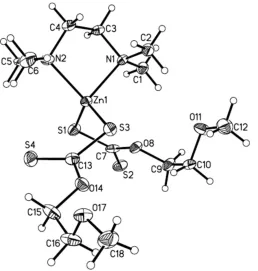
The molecular structure of the title compound is illustrated in Fig. 1. The ZnII ion is coordinated by two N atoms of the N,N,N0,N0-tetramethylethylenediamine molecule and two S
atoms from two 2-methoxyethylxanthate molecules. The Zn1—N1, Zn1—N2, Zn1—S1 and Zn1—S3 bond lengths are 2.141 (5), 2.123 (5), 2.3107 (9) and 2.3050 (9) A˚ , respectively (Table 1). These bond distances are similar to those reported
in the work of Cusacket al.(2004). The C7—O8 and C13—
O14 bond lengths are similar [1.344 (3) and 1.346 (3) A˚ , respectively], while the C9—O8 and C15—O14 bonds are also not significantly different [1.454 (3) and 1.459 (3) A˚ , respec-tively]. In the same way, the C10—O11 [1.417 (3)] and C16— O17 [1.418 (4)] bond lengths are similar to each other. All of
the C—O bonds show single-bond character. In the {S2C}
section of the xanthate ligands, the carbon-to-sulfur S1 distance is 1.731 (3) A˚ , which is typical of a single bond whereas the carbon-to-sulfur S2 distance of 1.647 (3) A˚ is typical of a carbon-to-sulfur double bond. In the molecule,
weak C1—H1C O8, C2A—H2AB O11, C5A—
H5AA S1 and C6—H6C S4 intramolecular interactions
are observed (Table 2).
research communications
Acta Cryst.(2019). E75, 1582–1585 Qadiret al. [Zn(C
[image:2.610.44.295.78.223.2]4H7O2S2)2(C6H16N2)]0.5C3H6O
1583
Table 1
Selected geometric parameters (A˚ ,).
Zn1—S1 2.3107 (9) S1—C7 1.731 (3)
Zn1—S3 2.3050 (9) S2—C7 1.647 (3)
Zn1—N1 2.141 (5) S3—C13 1.723 (3)
Zn1—N2 2.123 (5) S4—C13 1.657 (3)
S3—Zn1—S1 125.54 (3) N1—Zn1—S3 106.5 (2)
[image:2.610.46.304.437.708.2]N1—Zn1—S1 105.2 (2) N2—Zn1—N1 86.9 (2)
Figure 1
The molecular structure of the title complex, with the atom labelling. Only the major component of the disordered amine ligand is shown. Displacement ellipsoids are drawn at the 50% probability level.
Table 2
Hydrogen-bond geometry (A˚ ,).
D—H A D—H H A D A D—H A
C1—H1C O8 0.98 2.48 3.103 (7) 121
C2A—H2AB O11 0.98 2.24 3.207 (13) 168
C5A—H5AA S1 0.98 2.92 3.454 (16) 115
C6—H6C S4 0.98 2.74 3.512 (13) 136
C6—H6B O11i 0.98 2.54 3.321 (13) 136
C3A—H3AB S2ii 0.99 2.81 3.483 (7) 125
C6A—H6AA S1ii 0.98 2.84 3.764 (16) 158
C4A—H4AA O17iii 0.99 2.44 3.380 (6) 159 C4A—H4AB S3iii 0.99 2.81 3.774 (8) 164
C9—H9A O17iv 0.99 2.61 3.415 (4) 138
C9—H9B S2v 0.99 2.94 3.708 (3) 135
C18—H18B S2vi 0.98 3.02 3.998 (3) 176
Symmetry codes: (i)x1 2;yþ
1 2;zþ
1 2; (ii)xþ
1 2;yþ
1 2;zþ
1 2; (iii)x
1 2;yþ
1 2;z
1 2;
[image:2.610.319.563.488.710.2](iv)x;y;z1; (v)xþ2;y;z; (vi)xþ2;y;zþ1.
Figure 2
A view of the crystal packing of the title complex. Dashed lines denote the intermolecular hydrogen bonds (Table 2). Symmetry codes: (i)x1
2,
y+1
2,z
1 2; (ii)x+
1 2,y+
1 2,z+
3. Supramolecular features
The crystal packing of the title compound (Fig. 2) features
intermolecular hydrogen bonds (C6—H6B O11i, C3A—
H3AB S2ii, C6A—H6AA S1ii, C4A—H4AA O17iii, C4A—H4AB S3iii, C9—H9A O17iv, C9—H9B S2v and
C18—H18B S2vi; symmetry codes as in Table 2), which
connect the molecules into a three-dimensional supra-molecular architecture.
4. Database survey
Previously reported complexes related to the title complex are [Cd(S2COCH2CH2OMe)2(bipy)] [CSD (Groom et al., 2016) refcode BENDII; Chen et al., 2002], [Ni(C4H7O2S2)2 -(C6H16N2)] (NADTAQ; Qadir, 2016), [Ni(moexa)2phen] (unsolvated form) and [Ni(moexa)2phen] (benzene solvate),
moexa = O-methoxyethylxanthato-S,S0 (with refcodes
SICTUT and SICVAB, respectively; Edwards et al., 1990a), [Ni(moexa)2bpy]; forms I and II (with refcodes VETVIZ and
VETVIZ01, respectively; Edwards et al., 1990b) and
[Cd(S2COCH2CH2OCH3)2(4,7-Me2phen)] (WACPOG; Chen et al., 2003). The Cd—S and Cd—N bond lengths range from 2.489 to 2.796 A˚ and 2.334 to 2.406 A˚, respectively. Similarly, the Ni—S and Ni—N bond lengths range from 2.432 to 2.458 A˚ and 2.070 to 2.172 A˚, respectively. In these complexes, compared with the ZnIIcomplex, the metal-to-ligand distances withM—S/N bond lengths follow the order ZnII< NiII< CdII in the corresponding complexes.
5. Frontier molecular orbital analysis
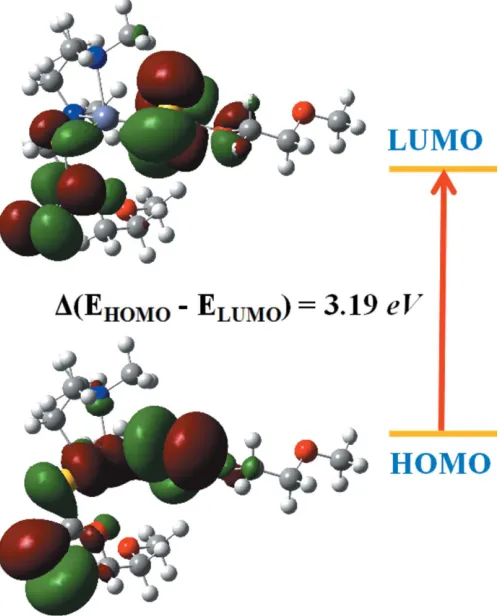
The highest occupied molecular orbitals (HOMOs) and the lowest unoccupied molecular orbitals (LUMOs) are named as frontier molecular orbitals (FMOs). The FMOs play an important role in the optical and electric properties. The frontier orbital gap characterizes the chemical reactivity and the kinetic stability of the molecule. A molecule with a small frontier orbital gap is generally associated with a high chemical reactivity, low kinetic stability and is also termed a soft molecule. The density functional theory (DFT) quantum-chemical calculations for the title compound were performed at the B3LYP/6–311 G(d,p) level (Becke, 1993) as imple-mented inGAUSSIAN09(Frischet al., 2009). Fig. 3 illustrates the HOMO and LUMO energy levels of the title compound. The small HOMO–LUMO energy gap (3.19 eV) in this compound indicates the chemical reactivity is strong and the kinetic stability is weak, which in turn increases the non-linear optical activity. As a result, with the small HOMO–LUMO energy gap, this compound could potentially be used in optoelectronic applications.
6. Molecular electrostatic potential (MEP)
The MEP map of the title molecule was calculated theoretically at the B3LYP/6-311G(d,p) level of theory and is illustrated in Fig. 4. The blue-coloured region is electrophilic
and electron poor, whereas the red colour indicates the nucleophilic region with rich electrons in the environment and provide information about interactions that can occur between molecules (Tankov & Yankova, 2019). In the title compound, the reactive sites are localized near the C—O group: this is the region having the most negative potential spots (red colour), all over the oxygen atom because of the
1584
Qadiret al. [Zn(C4H7O2S2)2(C6H16N2)]0.5C3H6O Acta Cryst.(2019). E75, 1582–1585
[image:3.610.316.565.73.381.2]research communications
Figure 3
[image:3.610.317.565.542.705.2]The electron distribution of the HOMO and LUMO energy levels of the title compound.
Figure 4
C—H O interactions in the crystal structure. The negative potential value of0.092 a.u. indicates the region that shows the strongest repulsion (electrophilic attack). In addition, the most positive region is located at the hydrogen atoms and shows the strongest attraction (nucleophilic attack) sites, which involve the N,N,N0,N0-tetramethylethylenediamine
moiety.
7. Synthesis and crystallization
Tetramethylethylenediamine (10 mmol, 1.16 g) was added to a hot solution of Zn(CH3CO2)2H2O (10 mmol, 2.20 g) in 2-methoxyethanol. A hot solution of potassium 2-methoxy-ethylxanthate (20 mmol, 3.81 g) in 2-methoxyethanol was added and the mixture was stirred for 30 min. Water was added to the mixture and a white precipitate was formed. The product was recrystallized from acetone.
8. Refinement
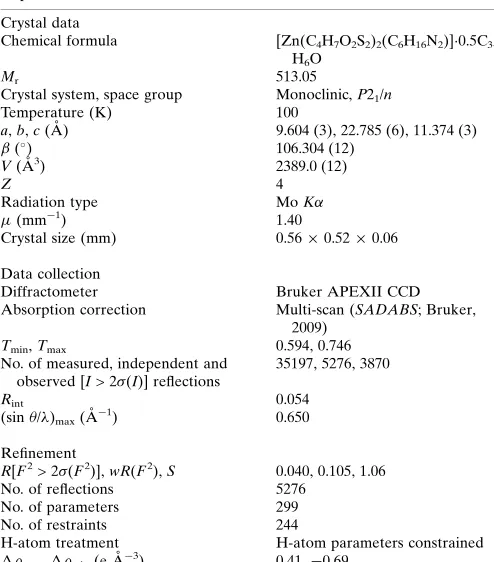
Crystal data, data collection and structure refinement details are summarized in Table 3. The C-bound H atoms were positioned geometrically and refined using a riding model, with C—H = 0.98 and 0.99 A˚ and withUiso(H) = 1.5Ueq(C) for methyl H atoms and 1.2Ueq(C) otherwise. All atoms of the amine ligand are disordered and were modelled as two orientations with relative occupancies of 0.538 (6) and 0.462 (6). The diffuse electron density of half an acetone solvent molecule was removed with the solvent-mask proce-dure implemented inOLEX2(Dolomanovet al., 2009). There are two voids of 122.4 A˚3 in the unit cell and the electron count was 18.2 per void.
Funding information
We would like to thank the EPSRC for an equipment grant, which funded the diffractometer at Heriot-Watt University.
References
Becke, A. D. (1993).J. Chem. Phys.98, 5648–5652.
Bruker (2009). APEX2, SADABS and SAINT. Bruker AXS Inc., Madison, Wisconsin, USA.
Chakraborty, S. & Tare, V. (2006).Bioresour. Technol.97, 2407–2413. Chen, D., Lai, C. S. & Tiekink, E. R. T. (2002).Z. Kristallogr.217,
747–752.
Chen, D., Lai, C. S. & Tiekink, E. R. T. (2003). Appl. Organomet. Chem.17, 247–248.
Cusack, J., Drew, M. G. B. & Spalding, T. R. (2004).Polyhedron,23, 2315–2321.
Dolomanov, O. V., Bourhis, L. J., Gildea, R. J., Howard, J. A. K. & Puschmann, H. (2009).J. Appl. Cryst.42, 339–341.
Edwards, A. J., Hoskins, B. F. & Winter, G. (1990a).Acta Cryst.C46, 1789–1792.
Edwards, A. J., Hoskins, B. F. & Winter, G. (1990b).Acta Cryst.C46, 1786–1789.
Friebolin, W., Schilling, G., Zo¨ller, M. & Amtmann, E. (2005).J. Med. Chem.48, 7925–7931.
Frisch, M. J., Trucks, G. W., Schlegel, H. B., Scuseria, G. E., Robb, M. A., Cheeseman, J. R.,et al. (2009).GAUSSIAN09. Gaussian Inc., Wallingford, CT, USA.
Groom, C. R., Bruno, I. J., Lightfoot, M. P. & Ward, S. C. (2016).Acta Cryst.B72, 171–179.
Gupta, B., Kalgotra, N., Andotra, S. & Pandey, S. K. (2012).Monatsh. Chem.143, 1087–1095.
Lee, K., Archibald, D., McLean, J. & Reuter, M. A. (2009).Miner.
Eng.22, 395–401.
Qadir, A. M. (2016).Asian J. Chem.28, 1169–1170.
Qadir, A. M. & Dege, N. (2019).J. Struct. Chem.60, 844–848. Sheldrick, G. M. (2015a).Acta Cryst.A71, 3–8.
Sheldrick, G. M. (2015b).Acta Cryst.C71, 3–8.
Tankov, I. & Yankova, R. (2019).J. Mol. Liq.278, 183–194. Tiravanti, G., Marani, D., Passino, R. & Santori, M. (1998). Stud.
Environ. Sci.34, 109–118.
research communications
Acta Cryst.(2019). E75, 1582–1585 Qadiret al. [Zn(C
[image:4.610.314.561.89.370.2]4H7O2S2)2(C6H16N2)]0.5C3H6O
1585
Table 3
Experimental details.
Crystal data
Chemical formula [Zn(C4H7O2S2)2(C6H16N2)]0.5C
3-H6O
Mr 513.05
Crystal system, space group Monoclinic,P21/n
Temperature (K) 100
a,b,c(A˚ ) 9.604 (3), 22.785 (6), 11.374 (3) (
) 106.304 (12)
V(A˚3) 2389.0 (12)
Z 4
Radiation type MoK
(mm1) 1.40
Crystal size (mm) 0.560.520.06
Data collection
Diffractometer Bruker APEXII CCD
Absorption correction Multi-scan (SADABS; Bruker, 2009)
Tmin,Tmax 0.594, 0.746
No. of measured, independent and observed [I> 2(I)] reflections
35197, 5276, 3870
Rint 0.054
(sin/)max(A˚ 1
) 0.650
Refinement
R[F2> 2(F2)],wR(F2),S 0.040, 0.105, 1.06
No. of reflections 5276
No. of parameters 299
No. of restraints 244
H-atom treatment H-atom parameters constrained max, min(e A˚
3) 0.41,0.69
Computer programs:APEX2andSAINT(Bruker, 2009),SHELXT(Sheldrick, 2015a),
supporting information
sup-1
Acta Cryst. (2019). E75, 1582-1585
supporting information
Acta Cryst. (2019). E75, 1582-1585 [https://doi.org/10.1107/S2056989019013148]
Crystal structure and DFT study of a zinc xanthate complex
Adnan M. Qadir, Sevgi Kansiz, Necmi Dege, Georgina M. Rosair and Igor O. Fritsky
Computing details
Data collection: APEX2 (Bruker, 2009); cell refinement: SAINT (Bruker, 2009); data reduction: SAINT (Bruker, 2009);
program(s) used to solve structure: SHELXT (Sheldrick, 2015a); program(s) used to refine structure: SHELXL
(Sheldrick, 2015b); molecular graphics: OLEX2 (Dolomanov et al., 2009); software used to prepare material for
publication: OLEX2 (Dolomanov et al., 2009).
Bis(2-methoxyethyl xanthato-κS)(N,N,N′,N′-\ tetramethylethylenediamine-κ2N,N′)zinc(II) acetone hemisolvate
Crystal data
[Zn(C4H7O2S2)2(C6H16N2)]·0.5C3H6O
Mr = 513.05
Monoclinic, P21/n
a = 9.604 (3) Å
b = 22.785 (6) Å
c = 11.374 (3) Å
β = 106.304 (12)°
V = 2389.0 (12) Å3
Z = 4
F(000) = 1016
Dx = 1.346 Mg m−3
Mo Kα radiation, λ = 0.71073 Å
Cell parameters from 8223 reflections
θ = 2.4–27.2°
µ = 1.40 mm−1
T = 100 K
Plate, colourless 0.56 × 0.52 × 0.06 mm
Data collection
Bruker APEXII CCD diffractometer
φ and ω scans
Absorption correction: multi-scan (SADABS; Bruker, 2009)
Tmin = 0.594, Tmax = 0.746
35197 measured reflections
5276 independent reflections 3870 reflections with I > 2σ(I)
Rint = 0.054
θmax = 27.5°, θmin = 2.6°
h = −12→12
k = −29→29
l = −13→14
Refinement
Refinement on F2
Least-squares matrix: full
R[F2 > 2σ(F2)] = 0.040
wR(F2) = 0.105
S = 1.06
5276 reflections 299 parameters 244 restraints
Hydrogen site location: inferred from neighbouring sites
H-atom parameters constrained
w = 1/[σ2(F
o2) + (0.057P)2] where P = (Fo2 + 2Fc2)/3
(Δ/σ)max = 0.001
Δρmax = 0.41 e Å−3
supporting information
sup-2
Acta Cryst. (2019). E75, 1582-1585
Special details
Geometry. All esds (except the esd in the dihedral angle between two l.s. planes) are estimated using the full covariance matrix. The cell esds are taken into account individually in the estimation of esds in distances, angles and torsion angles; correlations between esds in cell parameters are only used when they are defined by crystal symmetry. An approximate (isotropic) treatment of cell esds is used for estimating esds involving l.s. planes.
Fractional atomic coordinates and isotropic or equivalent isotropic displacement parameters (Å2)
x y z Uiso*/Ueq Occ. (<1)
Zn1 0.94679 (3) 0.20615 (2) 0.25390 (3) 0.01743 (10)
S1 0.77332 (8) 0.16292 (3) 0.09443 (7) 0.02362 (17)
S2 0.81448 (9) 0.08333 (3) −0.10110 (7) 0.02709 (19)
S3 1.11500 (8) 0.15676 (3) 0.40643 (6) 0.02205 (17)
S4 0.82433 (9) 0.13279 (3) 0.44905 (8) 0.0312 (2)
N1 1.0669 (9) 0.2630 (3) 0.1684 (7) 0.0187 (17) 0.538 (6)
N2 0.8649 (9) 0.2832 (2) 0.3157 (8) 0.0199 (19) 0.538 (6)
C1 1.0675 (9) 0.2455 (3) 0.0430 (7) 0.0234 (15) 0.538 (6)
H1A 0.9674 0.2412 −0.0084 0.035* 0.538 (6)
H1B 1.1167 0.2757 0.0081 0.035* 0.538 (6)
H1C 1.1187 0.2081 0.0465 0.035* 0.538 (6)
C2 1.2174 (11) 0.2697 (6) 0.2467 (12) 0.022 (2) 0.538 (6)
H2A 1.2162 0.2813 0.3294 0.034* 0.538 (6)
H2B 1.2689 0.2323 0.2505 0.034* 0.538 (6)
H2C 1.2669 0.3000 0.2121 0.034* 0.538 (6)
C3 0.9856 (7) 0.3192 (2) 0.1604 (6) 0.0229 (13) 0.538 (6)
H3A 0.8955 0.3170 0.0919 0.027* 0.538 (6)
H3B 1.0453 0.3517 0.1431 0.027* 0.538 (6)
C4 0.9477 (7) 0.3317 (2) 0.2780 (5) 0.0245 (13) 0.538 (6)
H4A 1.0384 0.3385 0.3442 0.029* 0.538 (6)
H4B 0.8894 0.3681 0.2679 0.029* 0.538 (6)
C5 0.7089 (10) 0.2896 (4) 0.2515 (12) 0.022 (2) 0.538 (6)
H5A 0.6950 0.2885 0.1628 0.033* 0.538 (6)
H5B 0.6548 0.2573 0.2750 0.033* 0.538 (6)
H5C 0.6736 0.3271 0.2740 0.033* 0.538 (6)
C6 0.883 (2) 0.2849 (6) 0.4502 (9) 0.029 (3) 0.538 (6)
H6A 0.9861 0.2808 0.4943 0.044* 0.538 (6)
H6B 0.8470 0.3225 0.4719 0.044* 0.538 (6)
H6C 0.8282 0.2527 0.4729 0.044* 0.538 (6)
N1A 1.0736 (10) 0.2669 (3) 0.1831 (8) 0.019 (2) 0.462 (6)
N2A 0.8391 (10) 0.2822 (3) 0.2930 (9) 0.020 (2) 0.462 (6)
C1A 1.0349 (10) 0.2672 (4) 0.0475 (7) 0.0209 (17) 0.462 (6)
H1AA 0.9303 0.2736 0.0142 0.031* 0.462 (6)
H1AB 1.0877 0.2988 0.0201 0.031* 0.462 (6)
H1AC 1.0611 0.2294 0.0184 0.031* 0.462 (6)
C2A 1.2323 (12) 0.2571 (7) 0.2278 (15) 0.026 (3) 0.462 (6)
H2AA 1.2624 0.2566 0.3175 0.039* 0.462 (6)
H2AB 1.2564 0.2194 0.1968 0.039* 0.462 (6)
supporting information
sup-3
Acta Cryst. (2019). E75, 1582-1585
C3A 1.0409 (7) 0.3254 (3) 0.2283 (8) 0.0261 (15) 0.462 (6)
H3AA 1.0678 0.3568 0.1787 0.031* 0.462 (6)
H3AB 1.0991 0.3307 0.3145 0.031* 0.462 (6)
C4A 0.8818 (7) 0.3300 (3) 0.2199 (7) 0.0258 (15) 0.462 (6)
H4AA 0.8618 0.3687 0.2514 0.031* 0.462 (6)
H4AB 0.8237 0.3269 0.1332 0.031* 0.462 (6)
C5A 0.6793 (11) 0.2766 (5) 0.2581 (15) 0.022 (2) 0.462 (6)
H5AA 0.6435 0.2671 0.1708 0.033* 0.462 (6)
H5AB 0.6520 0.2452 0.3063 0.033* 0.462 (6)
H5AC 0.6365 0.3137 0.2741 0.033* 0.462 (6)
C6A 0.889 (2) 0.2966 (7) 0.4260 (10) 0.023 (3) 0.462 (6)
H6AA 0.9949 0.3006 0.4516 0.035* 0.462 (6)
H6AB 0.8448 0.3336 0.4409 0.035* 0.462 (6)
H6AC 0.8603 0.2651 0.4731 0.035* 0.462 (6)
C7 0.8778 (3) 0.11821 (10) 0.0299 (3) 0.0221 (6)
O8 1.0160 (2) 0.11540 (7) 0.09989 (17) 0.0220 (4)
C9 1.1153 (3) 0.07649 (11) 0.0618 (3) 0.0262 (7)
H9A 1.1345 0.0914 −0.0139 0.031*
H9B 1.0731 0.0367 0.0454 0.031*
C10 1.2527 (3) 0.07470 (11) 0.1641 (3) 0.0246 (6)
H10A 1.2301 0.0685 0.2429 0.030*
H10B 1.3139 0.0417 0.1514 0.030*
O11 1.3286 (2) 0.12830 (8) 0.1677 (2) 0.0318 (5)
C12 1.4621 (3) 0.12837 (14) 0.2611 (3) 0.0380 (8)
H12A 1.5113 0.1660 0.2607 0.057*
H12B 1.4437 0.1226 0.3408 0.057*
H12C 1.5237 0.0965 0.2463 0.057*
C13 1.0016 (3) 0.12252 (11) 0.4785 (3) 0.0208 (6)
O14 1.0774 (2) 0.08476 (8) 0.56361 (18) 0.0248 (4)
C15 1.0045 (4) 0.05469 (13) 0.6430 (3) 0.0303 (7)
H15A 0.9223 0.0311 0.5933 0.036*
H15B 0.9664 0.0836 0.6911 0.036*
C16 1.1136 (4) 0.01571 (12) 0.7265 (3) 0.0330 (8)
H16A 1.0658 −0.0086 0.7762 0.040*
H16B 1.1574 −0.0109 0.6779 0.040*
O17 1.2226 (2) 0.05108 (8) 0.80437 (19) 0.0278 (5)
C18 1.3393 (4) 0.01777 (13) 0.8787 (3) 0.0378 (8)
H18A 1.4112 0.0443 0.9305 0.057*
H18B 1.3026 −0.0089 0.9307 0.057*
H18C 1.3847 −0.0050 0.8264 0.057*
Atomic displacement parameters (Å2)
U11 U22 U33 U12 U13 U23
Zn1 0.01874 (19) 0.01410 (15) 0.01842 (19) 0.00001 (12) 0.00353 (13) −0.00176 (11)
S1 0.0204 (4) 0.0212 (3) 0.0258 (4) 0.0008 (3) 0.0008 (3) −0.0072 (3)
S2 0.0331 (5) 0.0199 (3) 0.0239 (4) −0.0004 (3) 0.0008 (3) −0.0061 (3)
supporting information
sup-4
Acta Cryst. (2019). E75, 1582-1585
S4 0.0221 (4) 0.0326 (4) 0.0391 (5) −0.0011 (3) 0.0089 (4) −0.0034 (3)
N1 0.019 (3) 0.014 (3) 0.024 (3) 0.004 (2) 0.006 (3) 0.002 (2)
N2 0.023 (3) 0.016 (2) 0.018 (4) −0.002 (2) 0.002 (3) −0.003 (2)
C1 0.029 (4) 0.022 (4) 0.023 (3) 0.001 (3) 0.012 (3) −0.003 (3)
C2 0.023 (4) 0.022 (5) 0.024 (5) 0.001 (3) 0.009 (3) 0.001 (3)
C3 0.027 (3) 0.013 (2) 0.029 (3) 0.003 (2) 0.009 (2) 0.003 (2)
C4 0.028 (3) 0.016 (2) 0.030 (3) −0.002 (2) 0.009 (3) −0.005 (2)
C5 0.019 (4) 0.011 (4) 0.034 (4) −0.006 (3) 0.006 (3) −0.003 (3)
C6 0.045 (5) 0.028 (5) 0.014 (4) 0.002 (4) 0.008 (4) −0.008 (4)
N1A 0.022 (3) 0.016 (3) 0.020 (3) −0.001 (3) 0.004 (3) −0.001 (3)
N2A 0.025 (4) 0.016 (3) 0.016 (4) −0.002 (2) 0.002 (3) −0.009 (2)
C1A 0.024 (4) 0.024 (4) 0.016 (3) −0.001 (3) 0.008 (3) −0.005 (3)
C2A 0.013 (4) 0.033 (7) 0.030 (6) −0.004 (4) 0.001 (4) 0.002 (4)
C3A 0.034 (3) 0.015 (2) 0.031 (3) −0.002 (2) 0.010 (3) −0.005 (2)
C4A 0.033 (3) 0.017 (2) 0.025 (3) 0.005 (3) 0.004 (3) −0.002 (2)
C5A 0.016 (5) 0.013 (5) 0.033 (5) −0.004 (3) 0.000 (4) −0.006 (3)
C6A 0.023 (4) 0.033 (6) 0.014 (5) −0.001 (4) 0.003 (4) −0.005 (4)
C7 0.0281 (17) 0.0105 (11) 0.0239 (16) −0.0027 (11) 0.0008 (13) 0.0009 (10)
O8 0.0218 (11) 0.0173 (9) 0.0240 (11) 0.0031 (7) 0.0019 (9) −0.0058 (7)
C9 0.0274 (17) 0.0213 (13) 0.0292 (17) 0.0043 (12) 0.0070 (13) −0.0070 (11)
C10 0.0270 (17) 0.0133 (12) 0.0343 (18) 0.0000 (11) 0.0097 (13) −0.0023 (11)
O11 0.0291 (13) 0.0238 (10) 0.0375 (13) −0.0099 (9) 0.0012 (10) 0.0063 (9)
C12 0.0253 (19) 0.0333 (17) 0.049 (2) −0.0047 (13) −0.0001 (16) −0.0026 (14)
C13 0.0247 (16) 0.0187 (12) 0.0174 (15) −0.0010 (11) 0.0033 (12) −0.0016 (10)
O14 0.0255 (12) 0.0254 (10) 0.0253 (12) −0.0016 (8) 0.0100 (9) 0.0046 (8)
C15 0.037 (2) 0.0319 (15) 0.0236 (18) −0.0143 (13) 0.0105 (14) 0.0024 (12)
C16 0.052 (2) 0.0203 (14) 0.0284 (18) −0.0091 (14) 0.0133 (15) 0.0034 (12)
O17 0.0337 (13) 0.0198 (9) 0.0277 (12) 0.0002 (8) 0.0051 (10) 0.0041 (8)
C18 0.044 (2) 0.0318 (16) 0.037 (2) 0.0101 (14) 0.0098 (16) 0.0124 (14)
Geometric parameters (Å, º)
Zn1—S1 2.3107 (9) C1A—H1AB 0.9800
Zn1—S3 2.3050 (9) C1A—H1AC 0.9800
Zn1—N1 2.141 (5) C2A—H2AA 0.9800
Zn1—N2 2.123 (5) C2A—H2AB 0.9800
Zn1—N1A 2.144 (6) C2A—H2AC 0.9800
Zn1—N2A 2.128 (6) C3A—H3AA 0.9900
S1—C7 1.731 (3) C3A—H3AB 0.9900
S2—C7 1.647 (3) C3A—C4A 1.508 (7)
S3—C13 1.723 (3) C4A—H4AA 0.9900
S4—C13 1.657 (3) C4A—H4AB 0.9900
N1—C1 1.482 (6) C5A—H5AA 0.9800
N1—C2 1.477 (7) C5A—H5AB 0.9800
N1—C3 1.489 (6) C5A—H5AC 0.9800
N2—C4 1.492 (6) C6A—H6AA 0.9800
N2—C5 1.478 (7) C6A—H6AB 0.9800
supporting information
sup-5
Acta Cryst. (2019). E75, 1582-1585
C1—H1A 0.9800 C7—O8 1.344 (3)
C1—H1B 0.9800 O8—C9 1.454 (3)
C1—H1C 0.9800 C9—H9A 0.9900
C2—H2A 0.9800 C9—H9B 0.9900
C2—H2B 0.9800 C9—C10 1.495 (4)
C2—H2C 0.9800 C10—H10A 0.9900
C3—H3A 0.9900 C10—H10B 0.9900
C3—H3B 0.9900 C10—O11 1.417 (3)
C3—C4 1.509 (6) O11—C12 1.417 (4)
C4—H4A 0.9900 C12—H12A 0.9800
C4—H4B 0.9900 C12—H12B 0.9800
C5—H5A 0.9800 C12—H12C 0.9800
C5—H5B 0.9800 C13—O14 1.346 (3)
C5—H5C 0.9800 O14—C15 1.459 (3)
C6—H6A 0.9800 C15—H15A 0.9900
C6—H6B 0.9800 C15—H15B 0.9900
C6—H6C 0.9800 C15—C16 1.494 (4)
N1A—C1A 1.482 (7) C16—H16A 0.9900
N1A—C2A 1.482 (7) C16—H16B 0.9900
N1A—C3A 1.494 (7) C16—O17 1.418 (4)
N2A—C4A 1.496 (7) O17—C18 1.420 (4)
N2A—C5A 1.479 (7) C18—H18A 0.9800
N2A—C6A 1.490 (7) C18—H18B 0.9800
C1A—H1AA 0.9800 C18—H18C 0.9800
S3—Zn1—S1 125.54 (3) H1AB—C1A—H1AC 109.5
N1—Zn1—S1 105.2 (2) N1A—C2A—H2AA 109.5
N1—Zn1—S3 106.5 (2) N1A—C2A—H2AB 109.5
N2—Zn1—S1 111.1 (2) N1A—C2A—H2AC 109.5
N2—Zn1—S3 113.7 (2) H2AA—C2A—H2AB 109.5
N2—Zn1—N1 86.9 (2) H2AA—C2A—H2AC 109.5
N1A—Zn1—S1 109.9 (3) H2AB—C2A—H2AC 109.5
N1A—Zn1—S3 104.2 (3) N1A—C3A—H3AA 109.6
N2A—Zn1—S1 103.0 (3) N1A—C3A—H3AB 109.6
N2A—Zn1—S3 121.3 (3) N1A—C3A—C4A 110.4 (6)
N2A—Zn1—N1A 85.1 (3) H3AA—C3A—H3AB 108.1
C7—S1—Zn1 101.98 (10) C4A—C3A—H3AA 109.6
C13—S3—Zn1 100.13 (10) C4A—C3A—H3AB 109.6
C1—N1—Zn1 115.0 (5) N2A—C4A—C3A 110.2 (6)
C1—N1—C3 108.4 (5) N2A—C4A—H4AA 109.6
C2—N1—Zn1 110.4 (8) N2A—C4A—H4AB 109.6
C2—N1—C1 109.9 (7) C3A—C4A—H4AA 109.6
C2—N1—C3 110.8 (7) C3A—C4A—H4AB 109.6
C3—N1—Zn1 102.0 (4) H4AA—C4A—H4AB 108.1
C4—N2—Zn1 103.9 (4) N2A—C5A—H5AA 109.5
C5—N2—Zn1 109.6 (7) N2A—C5A—H5AB 109.5
C5—N2—C4 109.5 (6) N2A—C5A—H5AC 109.5
supporting information
sup-6
Acta Cryst. (2019). E75, 1582-1585
C6—N2—Zn1 114.5 (7) H5AA—C5A—H5AC 109.5
C6—N2—C4 110.9 (7) H5AB—C5A—H5AC 109.5
N1—C1—H1A 109.5 N2A—C6A—H6AA 109.5
N1—C1—H1B 109.5 N2A—C6A—H6AB 109.5
N1—C1—H1C 109.5 N2A—C6A—H6AC 109.5
H1A—C1—H1B 109.5 H6AA—C6A—H6AB 109.5
H1A—C1—H1C 109.5 H6AA—C6A—H6AC 109.5
H1B—C1—H1C 109.5 H6AB—C6A—H6AC 109.5
N1—C2—H2A 109.5 S2—C7—S1 123.82 (18)
N1—C2—H2B 109.5 O8—C7—S1 111.76 (19)
N1—C2—H2C 109.5 O8—C7—S2 124.4 (2)
H2A—C2—H2B 109.5 C7—O8—C9 118.3 (2)
H2A—C2—H2C 109.5 O8—C9—H9A 110.3
H2B—C2—H2C 109.5 O8—C9—H9B 110.3
N1—C3—H3A 109.4 O8—C9—C10 107.1 (2)
N1—C3—H3B 109.4 H9A—C9—H9B 108.5
N1—C3—C4 111.1 (5) C10—C9—H9A 110.3
H3A—C3—H3B 108.0 C10—C9—H9B 110.3
C4—C3—H3A 109.4 C9—C10—H10A 109.8
C4—C3—H3B 109.4 C9—C10—H10B 109.8
N2—C4—C3 113.3 (5) H10A—C10—H10B 108.2
N2—C4—H4A 108.9 O11—C10—C9 109.5 (2)
N2—C4—H4B 108.9 O11—C10—H10A 109.8
C3—C4—H4A 108.9 O11—C10—H10B 109.8
C3—C4—H4B 108.9 C12—O11—C10 111.9 (2)
H4A—C4—H4B 107.7 O11—C12—H12A 109.5
N2—C5—H5A 109.5 O11—C12—H12B 109.5
N2—C5—H5B 109.5 O11—C12—H12C 109.5
N2—C5—H5C 109.5 H12A—C12—H12B 109.5
H5A—C5—H5B 109.5 H12A—C12—H12C 109.5
H5A—C5—H5C 109.5 H12B—C12—H12C 109.5
H5B—C5—H5C 109.5 S4—C13—S3 126.24 (16)
N2—C6—H6A 109.5 O14—C13—S3 110.2 (2)
N2—C6—H6B 109.5 O14—C13—S4 123.6 (2)
N2—C6—H6C 109.5 C13—O14—C15 119.2 (2)
H6A—C6—H6B 109.5 O14—C15—H15A 110.2
H6A—C6—H6C 109.5 O14—C15—H15B 110.2
H6B—C6—H6C 109.5 O14—C15—C16 107.5 (3)
C1A—N1A—Zn1 113.0 (6) H15A—C15—H15B 108.5
C1A—N1A—C3A 109.8 (6) C16—C15—H15A 110.2
C2A—N1A—Zn1 114.3 (9) C16—C15—H15B 110.2
C2A—N1A—C1A 106.9 (8) C15—C16—H16A 109.9
C2A—N1A—C3A 108.2 (7) C15—C16—H16B 109.9
C3A—N1A—Zn1 104.5 (4) H16A—C16—H16B 108.3
C4A—N2A—Zn1 104.6 (4) O17—C16—C15 108.8 (2)
C5A—N2A—Zn1 113.7 (7) O17—C16—H16A 109.9
C5A—N2A—C4A 109.8 (7) O17—C16—H16B 109.9
supporting information
sup-7
Acta Cryst. (2019). E75, 1582-1585
C6A—N2A—Zn1 110.8 (9) O17—C18—H18A 109.5
C6A—N2A—C4A 110.1 (8) O17—C18—H18B 109.5
N1A—C1A—H1AA 109.5 O17—C18—H18C 109.5
N1A—C1A—H1AB 109.5 H18A—C18—H18B 109.5
N1A—C1A—H1AC 109.5 H18A—C18—H18C 109.5
H1AA—C1A—H1AB 109.5 H18B—C18—H18C 109.5
H1AA—C1A—H1AC 109.5
Zn1—S1—C7—S2 −170.71 (15) C2—N1—C3—C4 −73.8 (9)
Zn1—S1—C7—O8 9.49 (19) C5—N2—C4—C3 −84.1 (8)
Zn1—S3—C13—S4 −6.90 (19) C6—N2—C4—C3 156.4 (9)
Zn1—S3—C13—O14 172.51 (16) N1A—C3A—C4A—N2A 58.4 (9)
Zn1—N1—C3—C4 43.8 (6) C1A—N1A—C3A—C4A 81.0 (8)
Zn1—N2—C4—C3 32.9 (7) C2A—N1A—C3A—C4A −162.6 (10)
Zn1—N1A—C3A—C4A −40.5 (8) C5A—N2A—C4A—C3A −164.5 (9)
Zn1—N2A—C4A—C3A −42.1 (8) C6A—N2A—C4A—C3A 77.0 (10)
S1—C7—O8—C9 176.11 (18) C7—O8—C9—C10 −171.4 (2)
S2—C7—O8—C9 −3.7 (3) O8—C9—C10—O11 −73.4 (3)
S3—C13—O14—C15 174.79 (18) C9—C10—O11—C12 −178.4 (2)
S4—C13—O14—C15 −5.8 (3) C13—O14—C15—C16 179.5 (2)
N1—C3—C4—N2 −55.6 (8) O14—C15—C16—O17 65.4 (3)
C1—N1—C3—C4 165.5 (6) C15—C16—O17—C18 −173.9 (3)
Hydrogen-bond geometry (Å, º)
D—H···A D—H H···A D···A D—H···A
C1—H1C···O8 0.98 2.48 3.103 (7) 121
C2A—H2AB···O11 0.98 2.24 3.207 (13) 168
C5A—H5AA···S1 0.98 2.92 3.454 (16) 115
C6—H6C···S4 0.98 2.74 3.512 (13) 136
C6—H6B···O11i 0.98 2.54 3.321 (13) 136
C3A—H3AB···S2ii 0.99 2.81 3.483 (7) 125
C6A—H6AA···S1ii 0.98 2.84 3.764 (16) 158
C4A—H4AA···O17iii 0.99 2.44 3.380 (6) 159
C4A—H4AB···S3iii 0.99 2.81 3.774 (8) 164
C9—H9A···O17iv 0.99 2.61 3.415 (4) 138
C9—H9B···S2v 0.99 2.94 3.708 (3) 135
C18—H18B···S2vi 0.98 3.02 3.998 (3) 176