5,5
000-Dichloro-2,2
000-dimethoxybiphenyl
Hans-Joachim Lehmler,a* Huimin Wuaand Sean Parkinb
aThe University of Iowa, Department of Occupational and Environmental Health, Iowa City, IA 52242-5000, USA, andbUniversity of Kentucky, Department of Chemistry, Lexington, KY 40506-0055, USA
Correspondence e-mail: [email protected]
Received 18 March 2013; accepted 25 March 2013
Key indicators: single-crystal X-ray study;T= 90 K; mean(C–C) = 0.003 A˚;Rfactor = 0.042;wRfactor = 0.111; data-to-parameter ratio = 17.9.
In the title molecule, C14H12Cl2O2, the dihedral angle between
the least-square planes of the benzene rings is 62.17 (6). Both
methoxy groups are slightly out of the plane of the benzene rings to which they are attached, making dihedral angles of 4.22 (18) and 18.82 (16).
Related literature
For background to polychlorinated biphenyls, see: Basuet al.
(2009); Huet al.(2008); Kaminskyet al.(1981); Kennedyet al.
(1981); McLean et al. (1996); Rodenburg et al. (2010). For related structures, see: Chattopadhyayet al.(1987); Nakaema
et al. (2008); Sun et al. (2001). For the synthesis of the title compound, see: Joshiet al.(2011).
Experimental
Crystal data
C14H12Cl2O2 Mr= 283.14
Monoclinic,P21=n a= 10.9629 (2) A˚
b= 7.2177 (1) A˚
c= 16.7812 (3) A˚ = 104.7108 (7)
V= 1284.32 (4) A˚3
Z= 4
MoKradiation = 0.50 mm1 T= 90 K
0.220.200.18 mm
Data collection
Nonius KappaCCD diffractometer Absorption correction: multi-scan
(SCALEPACK; Otwinowski & Minor, 1997)
Tmin= 0.899,Tmax= 0.916
21357 measured reflections 2948 independent reflections 2347 reflections withI> 2(I)
Rint= 0.047
Refinement
R[F2> 2(F2)] = 0.042 wR(F2) = 0.111
S= 1.11 2948 reflections
165 parameters
H-atom parameters constrained
max= 0.43 e A˚
3
min=0.41 e A˚
3
Data collection: COLLECT (Nonius, 1998); cell refinement:
SCALEPACK (Otwinowski & Minor, 1997); data reduction:
DENZO-SMN (Otwinowski & Minor, 1997); program(s) used to solve structure: SHELXS97(Sheldrick, 2008); program(s) used to refine structure:SHELXL97(Sheldrick, 2008); molecular graphics:
XP in SHELXTL (Sheldrick, 2008); software used to prepare material for publication:SHELXL97and local procedures.
This research was supported by grant Nos. ES05605, ES013661 and ES017425 from the National Institute of Environmental Health Sciences, National Institutes of Health.
Supplementary data and figures for this paper are available from the IUCr electronic archives (Reference: LH5598).
References
Basu, I., Arnold, K. A., Venier, M. & Hites, R. A. (2009).Environ. Sci. Technol.43, 6488–6492.
Chattopadhyay, D., Banerjee, T., Majumdar, S. K., Podder, G., Kashino, S. & Haisa, M. (1987).Acta Cryst.C43, 482–484.
Hu, D., Martinez, A. & Hornbuckle, K. C. (2008).Environ. Sci. Technol.42, 7873–7877.
Joshi, S. N., Vyas, S. M., Duffel, M. W., Parkin, S. & Lehmler, H. J. (2011).
Synthesis, pp. 1045–1054.
Kaminsky, L. S., Kennedy, M. W., Adams, S. M. & Guengerich, F. P. (1981).
Biochemistry,20, 7379–7384.
Kennedy, M. W., Carpentier, N. K., Dymerski, P. P. & Kaminsky, L. S. (1981).
Biochem. Pharmacol.30, 577–588.
McLean, M. R., Bauer, U., Amaro, A. R. & Robertson, L. W. (1996).Chem. Res. Toxicol.9, 158–164.
Nakaema, K., Okamoto, A., Maruyama, S., Noguchi, K. & Yonezawa, N. (2008).Acta Cryst.E64, o1731.
Nonius (1998).COLLECT. Nonius BV, Delft, The Netherlands.
Otwinowski, Z. & Minor, W. (1997). Methods in Enzymology, Vol. 276,
Macromolecular Crystallography, Part A, edited by C. W. Carter Jr & R. M. Sweet, pp. 307–326. New York: Academic Press.
Rodenburg, L. A., Guo, J., Du, S. & Cavallo, G. J. (2010).Environ. Sci. Technol.44, 2816–2821.
Sheldrick, G. M. (2008).Acta Cryst.A64, 112–122.
Sun, D. L., Lindeman, S. V., Rathore, R. & Kochi, J. K. (2001).J. Chem. Soc. Perkin Trans. 2, pp. 1585–1594.
Acta Crystallographica Section E Structure Reports
Online
supporting information
Acta Cryst. (2013). E69, o650 [https://doi.org/10.1107/S160053681300826X]
5,5
′
-Dichloro-2,2
′
-dimethoxybiphenyl
Hans-Joachim Lehmler, Huimin Wu and Sean Parkin
S1. Comment
3,3′-Dichlorobiphenyl (CB11) is a polychlorinated biphenyl (PCB) congener found at comparatively high concentrations
in water and air (Basu et al., 2009; Hu et al., 2008; Rodenburg et al., 2010). It is probably produced during the
manufacturing of paint pigments and/or the degradation of higher chlorinated PCBs (Basu et al., 2009). Early metabolism
studies with CB11 demonstrate its oxidation to mono-hydroxylated metabolites by hepatic cytochrome P450 enzymes
(Kaminsky et al., 1981; Kennedy et al., 1981). Similar to other lower chlorinated PCB congeners (McLean et al., 1996),
it is likely that these mono-hydroxylated metabolites are further oxidized to dihydroxylated metabolites, such as
2,2′-di-hydroxy PCB 11. Here we report the crystal structure of the title compound, a dimethylated derivative of 2,2′-di2,2′-di-hydroxy
PCB 11.
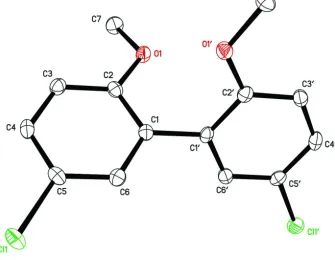
There is one molecule of the title compound in the asymmetric unit (Fig. 1). The dihedral angle between the least-square
planes of the two aromatic rings is 62.17 (6)°. The corresponding dihedral angles of structurally related biphenyls,
2,2′-dimethoxybiphenyls, 4,4′-dimethyl-2,2′,5,5′-dimethoxybiphenyl and 2,2′,4,4′,5,5′-hexamethoxybiphenyl, are comparable
with 66.94 (7)°, 69.1° (no s.u. available) and 81.1 (1)°, respectively (Nakaema et al., 2008; Sun et al., 2001;
Chattopadhyay et al., 1987). In the title compound, the methoxy group at C7′ has an almost coplanar arrangement with
aromatic ring system, with a dihedral angle of 4.22 (18)°. In contrast, the methoxy group at C7, with a dihedral angle of
18.82 (16)°, is slightly out of the plane of the aromatic ring system. The twist of this methoxy group out of the plane of
the aromatic ring system is relatively large compared to related crystal structures, which display dihedral angles ranging
from 1.0° to 12.2° (Nakaema et al., 2008; Sun et al., 2001; Chattopadhyay et al., 1987).
S2. Experimental
The title compound was prepared by the Suzuki coupling of 2-iodo-4-chloroanisole and
2-methoxy-5-chlorobenzene-boronic acid as described previously (Joshi et al., 2011). Crystals suitable for crystal structure analysis were obtained by
slow evaporation of a methanolic solution.
S3. Refinement
H atoms were found in difference Fourier maps and subsequently placed in idealized positions with constrained distances
Figure 1
View of the title compound showing displacement ellipsoids drawn at the 50% probability level.
5,5′-Dichloro-2,2′-dimethoxybiphenyl
Crystal data
C14H12Cl2O2
Mr = 283.14
Monoclinic, P21/n
Hall symbol: -P 2yn
a = 10.9629 (2) Å
b = 7.2177 (1) Å
c = 16.7812 (3) Å
β = 104.7108 (7)°
V = 1284.32 (4) Å3
Z = 4
F(000) = 584
Dx = 1.464 Mg m−3
Mo Kα radiation, λ = 0.71073 Å Cell parameters from 3160 reflections
θ = 1.0–27.5°
µ = 0.50 mm−1
T = 90 K Block, colourless 0.22 × 0.20 × 0.18 mm
Data collection
Nonius KappaCCD diffractometer
Radiation source: fine-focus sealed tube Graphite monochromator
Detector resolution: 9.1 pixels mm-1
ω scans at fixed χ = 55°
Absorption correction: multi-scan
(SCALEPACK; Otwinowski & Minor, 1997)
Tmin = 0.899, Tmax = 0.916
21357 measured reflections 2948 independent reflections 2347 reflections with I > 2σ(I)
Rint = 0.047
θmax = 27.5°, θmin = 2.0°
h = −14→14
k = −9→9
Refinement
Refinement on F2
Least-squares matrix: full
R[F2 > 2σ(F2)] = 0.042
wR(F2) = 0.111
S = 1.11 2948 reflections 165 parameters 0 restraints
Primary atom site location: structure-invariant direct methods
Secondary atom site location: difference Fourier map
Hydrogen site location: inferred from neighbouring sites
H-atom parameters constrained
w = 1/[σ2(F
o2) + (0.0529P)2 + 0.9091P]
where P = (Fo2 + 2Fc2)/3
(Δ/σ)max < 0.001
Δρmax = 0.43 e Å−3
Δρmin = −0.41 e Å−3
Special details
Geometry. All e.s.d.'s (except the e.s.d. in the dihedral angle between two l.s. planes) are estimated using the full
covariance matrix. The cell e.s.d.'s are taken into account individually in the estimation of e.s.d.'s in distances, angles and torsion angles; correlations between e.s.d.'s in cell parameters are only used when they are defined by crystal symmetry. An approximate (isotropic) treatment of cell e.s.d.'s is used for estimating e.s.d.'s involving l.s. planes.
Refinement. Refinement of F2 against all reflections. The weighted R-value wR and goodness of fit S are based on F2.
Conventional R-values R are based on F, with F set to zero for negative F2. The threshold expression of F2 > 2σ(F2) is
used only for calculating R-factors(gt) etc. and is not relevant to the choice of reflections for refinement. R-values based on F2 are statistically about twice as large as those based on F, and R-values based on ALL data will be even larger.
Fractional atomic coordinates and isotropic or equivalent isotropic displacement parameters (Å2)
x y z Uiso*/Ueq
Cl1 0.07535 (4) 0.15602 (7) 0.32405 (3) 0.02285 (15)
O1 0.56298 (12) 0.53852 (19) 0.38856 (9) 0.0168 (3)
C1 0.43664 (17) 0.2807 (3) 0.33719 (12) 0.0137 (4)
C2 0.45037 (18) 0.4500 (3) 0.37970 (12) 0.0149 (4)
C3 0.35230 (18) 0.5203 (3) 0.40971 (12) 0.0170 (4)
H3 0.3636 0.6321 0.4406 0.020*
C4 0.23774 (18) 0.4264 (3) 0.39443 (12) 0.0171 (4)
H4 0.1709 0.4726 0.4154 0.020*
C5 0.22250 (18) 0.2655 (3) 0.34850 (12) 0.0170 (4)
C6 0.32045 (18) 0.1903 (3) 0.32061 (12) 0.0163 (4)
H6 0.3085 0.0776 0.2903 0.020*
C7 0.56729 (19) 0.7317 (3) 0.40866 (14) 0.0211 (4)
H7A 0.4958 0.7952 0.3718 0.032*
H7B 0.6463 0.7851 0.4020 0.032*
H7C 0.5628 0.7470 0.4659 0.032*
Cl1′ 0.59609 (5) 0.10229 (8) 0.08207 (3) 0.02197 (15)
O1′ 0.66596 (13) 0.1598 (2) 0.44014 (8) 0.0174 (3)
C1′ 0.54159 (18) 0.2061 (3) 0.30496 (12) 0.0137 (4)
C2′ 0.65747 (18) 0.1509 (3) 0.35747 (12) 0.0147 (4)
C3′ 0.75356 (18) 0.0855 (3) 0.32448 (12) 0.0163 (4)
H3′ 0.8319 0.0501 0.3603 0.020*
C4′ 0.73626 (19) 0.0711 (3) 0.23964 (13) 0.0175 (4)
H4′ 0.8024 0.0277 0.2173 0.021*
C5′ 0.62136 (18) 0.1210 (3) 0.18870 (12) 0.0157 (4)
H6′ 0.4465 0.2235 0.1839 0.019*
C7′ 0.78413 (19) 0.1104 (3) 0.49485 (13) 0.0212 (5)
H7′1 0.8051 −0.0177 0.4841 0.032*
H7′2 0.7782 0.1214 0.5520 0.032*
H7′3 0.8501 0.1935 0.4860 0.032*
Atomic displacement parameters (Å2)
U11 U22 U33 U12 U13 U23
Cl1 0.0134 (2) 0.0267 (3) 0.0286 (3) −0.00368 (19) 0.0056 (2) 0.0006 (2)
O1 0.0159 (7) 0.0120 (7) 0.0239 (8) −0.0027 (5) 0.0075 (6) −0.0041 (6)
C1 0.0140 (9) 0.0144 (9) 0.0130 (9) 0.0016 (7) 0.0040 (7) 0.0015 (8)
C2 0.0135 (9) 0.0158 (10) 0.0151 (9) 0.0010 (8) 0.0032 (7) 0.0029 (8)
C3 0.0188 (10) 0.0146 (10) 0.0178 (10) 0.0016 (8) 0.0048 (8) −0.0016 (8)
C4 0.0146 (9) 0.0195 (10) 0.0186 (10) 0.0038 (8) 0.0070 (8) 0.0012 (8)
C5 0.0127 (9) 0.0195 (10) 0.0184 (10) −0.0010 (8) 0.0031 (7) 0.0035 (8)
C6 0.0172 (10) 0.0152 (10) 0.0167 (10) 0.0009 (8) 0.0048 (8) −0.0001 (8)
C7 0.0218 (10) 0.0122 (10) 0.0293 (12) −0.0031 (8) 0.0065 (9) −0.0035 (9)
Cl1′ 0.0204 (3) 0.0295 (3) 0.0170 (3) −0.0005 (2) 0.00670 (19) −0.0048 (2)
O1′ 0.0169 (7) 0.0198 (7) 0.0153 (7) 0.0038 (6) 0.0036 (5) 0.0010 (6)
C1′ 0.0153 (9) 0.0084 (9) 0.0189 (10) −0.0007 (7) 0.0069 (7) −0.0015 (8)
C2′ 0.0165 (9) 0.0113 (9) 0.0172 (10) −0.0017 (7) 0.0058 (8) −0.0009 (8)
C3′ 0.0135 (9) 0.0140 (9) 0.0215 (10) 0.0008 (8) 0.0046 (8) −0.0002 (8)
C4′ 0.0169 (9) 0.0135 (10) 0.0250 (11) 0.0007 (8) 0.0109 (8) −0.0015 (8)
C5′ 0.0197 (10) 0.0146 (10) 0.0142 (9) −0.0031 (8) 0.0069 (8) −0.0020 (8)
C6′ 0.0142 (9) 0.0127 (9) 0.0201 (10) −0.0004 (7) 0.0047 (8) 0.0000 (8)
C7′ 0.0202 (10) 0.0224 (11) 0.0177 (10) 0.0052 (9) −0.0016 (8) 0.0004 (9)
Geometric parameters (Å, º)
Cl1—C5 1.749 (2) Cl1′—C5′ 1.745 (2)
O1—C2 1.364 (2) O1′—C2′ 1.368 (2)
O1—C7 1.432 (2) O1′—C7′ 1.430 (2)
C1—C6 1.395 (3) C1′—C6′ 1.391 (3)
C1—C2 1.404 (3) C1′—C2′ 1.407 (3)
C1—C1′ 1.491 (2) C2′—C3′ 1.391 (3)
C2—C3 1.393 (3) C3′—C4′ 1.392 (3)
C3—C4 1.392 (3) C3′—H3′ 0.9500
C3—H3 0.9500 C4′—C5′ 1.379 (3)
C4—C5 1.381 (3) C4′—H4′ 0.9500
C4—H4 0.9500 C5′—C6′ 1.390 (3)
C5—C6 1.386 (3) C6′—H6′ 0.9500
C6—H6 0.9500 C7′—H7′1 0.9800
C7—H7A 0.9800 C7′—H7′2 0.9800
C7—H7B 0.9800 C7′—H7′3 0.9800
C7—H7C 0.9800
C6—C1—C2 118.90 (17) C6′—C1′—C2′ 118.68 (17)
C6—C1—C1′ 120.57 (17) C6′—C1′—C1 119.16 (17)
C2—C1—C1′ 120.38 (16) C2′—C1′—C1 122.16 (17)
O1—C2—C3 123.39 (18) O1′—C2′—C3′ 123.77 (18)
O1—C2—C1 116.12 (16) O1′—C2′—C1′ 116.10 (16)
C3—C2—C1 120.48 (17) C3′—C2′—C1′ 120.09 (18)
C4—C3—C2 119.96 (19) C2′—C3′—C4′ 120.81 (18)
C4—C3—H3 120.0 C2′—C3′—H3′ 119.6
C2—C3—H3 120.0 C4′—C3′—H3′ 119.6
C5—C4—C3 119.19 (18) C5′—C4′—C3′ 118.72 (18)
C5—C4—H4 120.4 C5′—C4′—H4′ 120.6
C3—C4—H4 120.4 C3′—C4′—H4′ 120.6
C4—C5—C6 121.58 (18) C4′—C5′—C6′ 121.41 (18)
C4—C5—Cl1 119.00 (15) C4′—C5′—Cl1′ 119.85 (15)
C6—C5—Cl1 119.41 (16) C6′—C5′—Cl1′ 118.74 (15)
C5—C6—C1 119.72 (18) C5′—C6′—C1′ 120.26 (18)
C5—C6—H6 120.1 C5′—C6′—H6′ 119.9
C1—C6—H6 120.1 C1′—C6′—H6′ 119.9
O1—C7—H7A 109.5 O1′—C7′—H7′1 109.5
O1—C7—H7B 109.5 O1′—C7′—H7′2 109.5
H7A—C7—H7B 109.5 H7′1—C7′—H7′2 109.5
O1—C7—H7C 109.5 O1′—C7′—H7′3 109.5
H7A—C7—H7C 109.5 H7′1—C7′—H7′3 109.5
H7B—C7—H7C 109.5 H7′2—C7′—H7′3 109.5
C7—O1—C2—C3 −17.7 (3) C6—C1—C1′—C2′ −119.2 (2)
C7—O1—C2—C1 161.82 (17) C2—C1—C1′—C2′ 65.4 (3)
C6—C1—C2—O1 −175.20 (17) C7′—O1′—C2′—C3′ 4.5 (3)
C1′—C1—C2—O1 0.3 (3) C7′—O1′—C2′—C1′ −177.96 (17)
C6—C1—C2—C3 4.3 (3) C6′—C1′—C2′—O1′ −175.93 (17)
C1′—C1—C2—C3 179.85 (18) C1—C1′—C2′—O1′ 3.6 (3)
O1—C2—C3—C4 176.63 (18) C6′—C1′—C2′—C3′ 1.7 (3)
C1—C2—C3—C4 −2.9 (3) C1—C1′—C2′—C3′ −178.75 (18)
C2—C3—C4—C5 −0.9 (3) O1′—C2′—C3′—C4′ 176.60 (18)
C3—C4—C5—C6 3.2 (3) C1′—C2′—C3′—C4′ −0.9 (3)
C3—C4—C5—Cl1 −176.05 (15) C2′—C3′—C4′—C5′ −0.7 (3)
C4—C5—C6—C1 −1.7 (3) C3′—C4′—C5′—C6′ 1.5 (3)
Cl1—C5—C6—C1 177.55 (15) C3′—C4′—C5′—Cl1′ −179.32 (15)
C2—C1—C6—C5 −2.1 (3) C4′—C5′—C6′—C1′ −0.6 (3)
C1′—C1—C6—C5 −177.59 (18) Cl1′—C5′—C6′—C1′ −179.82 (15)
C6—C1—C1′—C6′ 60.3 (3) C2′—C1′—C6′—C5′ −1.0 (3)