Perturbed-Angular-Correlation Studies
on
111Cd and
117In in Pyrochlore Cd
2Nb
2O
7Yoshitaka Ohkubo
1, Yukihiro Murakami
2;*, Tadashi Saito
3,
Akihiko Yokoyama
4and Yoichi Kawase
11Research Reactor Institute, Kyoto University, Kumatori 590-0494, Japan 2Graduate School of Science, Kyoto University, Kyoto 606-8502, Japan 3Radioisotope Research Center, Osaka University, Toyonaka 560-0043, Japan
4Department of Chemistry, Faculty of Science, Kanazawa University, Kanazawa 920-1192, Japan
The nuclear-electric-quadrupole interactions at111Cd and117In nuclei arising from111mCd and117Cd, respectively, chemically introduced in pyrochlore ferroelectric Cd2Nb2O7(TC¼196K) were studied using the perturbed-angular-correlation technique. At temperatures aboveTC,
there is one type of Cd sites. However, at liquid nitrogen temperature, belowTC, there are two types of Cd sites. The ratio of the electric
quadrupole frequency of117In to that of111Cd is anomalously deviated from a value expected from the purely ionic In and Cd ions in the same lattice environment.
(Received January 14, 2004; Accepted March 4, 2004)
Keywords: cadmium pyrochlore oxides, structural phase transition, cadmium, indium, perturbed-angular-correlation technique
1. Introduction
Cadmium pyrochlore oxides with the formula Cd2M2O7
show a variety of physical properties, depending on M. Several of them undergo a structural phase transition at
200K, which seems to be related to their interesting physical properties emerging. Cd2Re2O7 may be such an
example. Although this oxide exhibits superconductivity at as low as12K, a structural phase transition at200K is considered to change the electronic state of its high temper-ature phase, leading eventually to the appearance of the superconductivity.1) For the Re sites, nuclear magnetic
resonance (NMR) and quadrupole resonance (NQR) are excellent microscopic probes for the structure and electronic states. On the other hand, in the case of the Cd sites, NQR technique is not applicable to the nuclear ground states of the stable Cd isotopes, because those spin (I) values are either 0 or 1/2. However, another nuclear technique called perturbed angular correlation (PAC) could be effective because this technique can be used for radioactive111Cd (245-keV level) withI¼5=2.
In the present study, in order to examine the applicability of PAC technique to the structural study on cadmium pyrochlore oxides, we performed PAC measurements at 77, 290, and 1073 K on111Cd arising from111mCd incorporated
in polycrystalline Cd2Nb2O7. This pyrochlore oxide is a
ferroelectric withTC¼196K and is subject to a structural
phase transition at the same temperature.2) We also
per-formed PAC measurements at 77 and 299 K on 111Cd in
polycrystalline Cd2Ta2O7. Although this pyrochlore oxide is
subject to a phase transition near 200 K, it does not exhibit ferroelectricity below the transition temperature.2)Moreover,
we carried out PAC measurements on117In (660-keV level) with I¼3=2 arising from 117Cd in these oxides. It is expected that a structural relaxation may take place when
117Cd changes to117In, because the ionic radius of In3þ ion
(92 pm)3) is smaller than that of Cd2þ (110 pm),3) the
Coulomb interaction between In and O ions is stronger than that between Cd and O ions, and the oxygen array is not close-packed. Two assumptions that Cd and In are in the same lattice environment and that those ions are in the purely ionic states lead to the ratio of the electric quadrupole frequency !Q of 117In3þ to that of 111Cd2þ being 2.3. A deviation of the measured ratio from 2.3 may indicate a structural relaxation or a participation of the 5s and 5p
electrons in the bonding in addition to the purely ionic bonding.
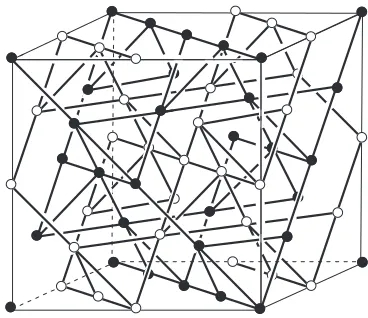
The room-temperature Cd2Nb2O7structure belongs to the Fd33mspace group, as general high-temperature-phase pyro-chlores do. The Cd and Nb ions form identical pyrochlore lattices (networks of corner-sharing tetrahedra, see Fig. 1). However, there are two non-equivalent oxygen sites, and the Nb ions are located within oxygen octahedra, whereas the Cd ions within scalenohedra (distorted cubes).
Fig. 1 Unit cell displaying only cation arrays in the room-temperature pyrochlore Cd2Nb2O7 structure (closed circles: Cd; open circles: Nb). These two types of cations are not in the equivalent lattice positions. Nb ions are located within oxygen octahedra, whereas the Cd ions within scalenohedra (distorted cubes).
*Graduate Student, Kyoto University
Special Issue on Grain Boundaries, Interfaces, Defects and Localized Quantum Structures in Ceramics
[image:1.595.333.517.570.729.2]2. Experimental Procedures
2.1 Sample preparation
Cd2Nb2O7(Cd2Ta2O7) polycrystalline samples containing 111mCd and those containing 117Cd were prepared with an
identical method,4,5) for LiNbO
3 and LiTaO3 containing
those Cd isotopes. The parent nuclei111mCd and117Cd were
separately produced by irradiating enriched 110CdO and 116CdO, respectively, with thermal neutrons at the research
reactor of Kyoto University. The irradiated oxides, mixed with high-purity powders of CdO and Nb2O5 (Ta2O5), and
then pressed into pellets, were sintered in air at 1100C for
about 1 h, and thereby obtained were samples containing
111mCd and those containing117Cd. Owing to the short
half-lives of 111mCd (49 min) and 117Cd (2.5 h), samples were prepared for each PAC-measurement temperature. The room-temperature x-ray-diffraction pattern of a sample after a PAC measurement showed a singe phase of it. The concentration of impurities117In and117Sn, which are the decay products of 117Cd, in Cd
2Nb2O7 and Cd2Ta2O7 is estimated to be the
order of one part per trillion.
2.2 PAC measurements
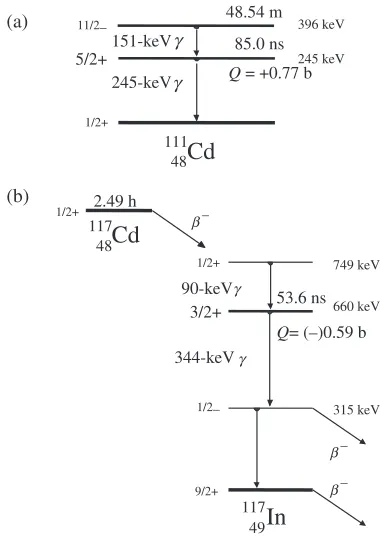
The PAC method is mostly applied to an ensemble of nuclei emitting two consecutive rays. Figure 2 shows relevant parts of the decay schemes of (a)111mCd!111Cd and (b) 117Cd!117In. The 396-keV excited level of 111Cd, i.e.,
111mCd with a half-lifet
1=2 ¼48:54min, decays to the ground
level through the 245-keV intermediate level having a spin
I¼5=2,t1=2¼85:0ns, and an electric quadrupole moment Q¼ þ0:77ð12Þ b.6) The 749-keV excited level of 117In is
populated by the decay of the parent 117Cd with t1=2¼2:49h, which decays to the 315-keV excited level
through the 660-keV intermediate level having I¼3=2,
t1=2¼53:6ns, and Q¼ ðÞ0:59ð1Þ b.6) The intermediate
level is split by the interaction of the electric quadrupole moment of the nuclei with an extranuclear electric field gradient (EFG). Detection of the 151-keV (90-keV) rays with a detector sorts out a set of 111Cd (117In) nuclei in
intermediate states with spin alignments against the direction of the detector from the source. Time-differential measure-ments of the 245-keV (344-keV)rays from the same nuclei with another detector permits a determination of the spin precession frequency of111Cd (117In) nuclei in intermediate states, and then a determination of the magnitude of the splitting of the level. Thus the PAC of the 151- and 245-keV (90- and 344-keV)rays emitted in successivetransitions reveals an electric quadrupole interaction during the stay of
111Cd (117In) nuclei in intermediate states.
The time dependence of the coincidence countsNð;tÞof the 151–245-keV cascade rays for samples containing
111mCd, and that of the 90–344-keV rays for samples
containing117Cd, were taken at 77, 290, and 1073 K using a
measurement system consisting of four BaF2 scintillation
detectors and standard fast-slow electronic modules. Here
and t denote the angle and time interval, respectively, between the cascade rays. The directional anisotropy
A22G22ðtÞwas obtained according to eq. (1):
A22G22ðtÞ ¼2½Nð;tÞ Nð=2;tÞ
=½Nð;tÞ þ2Nð=2;tÞ: ð1Þ
The coefficientA22 depends only on the nuclear properties,
and the values for 111Cd( 111mCd) and 117In( 117Cd) are þ0:18and0:36, respectively.7)
We give the relevant expressions of G22ðtÞ for a unique
static quadrupole interaction. The perturbation factorG22ðtÞ
for an ensemble of randomly oriented microcrystals is a function of the electric quadrupole frequency !Q and the
asymmetry parameter of EFG through the interaction Hamiltonian. The quantities!Qandare defined as follows:
h!Q¼ eQVzz=½4Ið2I1Þ and ¼ ðVxxVyyÞ=Vzz. The
three components of EFG in the principal-axis system are chosen such thatjVxxj jVyyj jVzzj, and thus the
asymme-try parameter takes a value between 0 and 1. In case of
111Cd (I¼5=2),G
22ðtÞhas the form
G22ðtÞ ¼S0þS1cosð6!QC1tÞ
þS2cosð6!QC2tÞ þS3cosð6!QC3tÞ: ð2Þ
The Sn and Cn in eq. (2) are numerically calculated for a
given value of. For an axially symmetric case of¼0,Sn
and Cn can be calculated analytically: G22ðtÞ ¼ ½7þ 13 cosð6!QtÞ þ10 cosð12!QtÞ þ5 cosð18!QtÞ=35. In case
of117In (I¼3=2),
G22ðtÞ ¼ ½1þ4 cosf6!Qð1þ2=3Þ1=2tg=5: ð3Þ
It should be noted that in case of111Cd, the values of!
Qand
can be determined because Sn andCn in eq. (2) are each
modified in a characteristic way as a function of, whereas in case of117In,G22ðtÞcontains only one frequency component
and they cannot be determined independently from the spectrum.
(b) (a)
Cd
111 48
1/2+ 11/2–
5/2+
Q = +0.77 b 48.54 m
85.0 ns 151-keV
245-keV
396 keV
245 keV
1/2+
In
117 49
Q= (–)0.59 b 3/2+ 53.6 ns
1/2–
9/2+
Cd
117 48 2.49 h
1/2+
344-keV 90-keV
749 keV
660 keV
315 keV γ
γ
β–
γ
γ
β–
β–
Fig. 2 Partial decay schemes of (a)111mCd!111Cd and (b)117Cd!117In.
[image:2.595.72.263.499.767.2]3. Results and Discussion
The PAC spectra measured at 77, 290, and 1073 K of111Cd
in Cd2Nb2O7 and those of 117In are shown, respectively, in
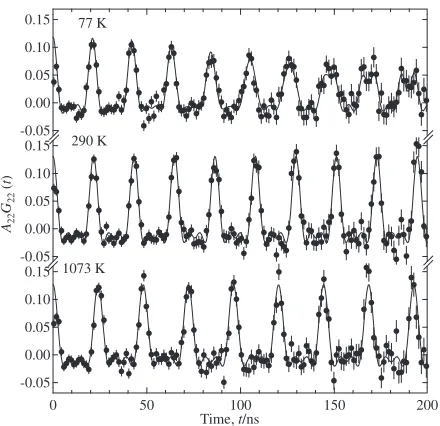
Figs. 3 and 4. At 290 and 1073 K each spectrum is modulated in a manner characteristic of a single quadrupole interaction in polycrystalline samples depending on the spin value of the nuclear level. However, in the 111Cd spectrum at 77 K the oscillation appears to become damped as the time passes. With a careful look at the spectrum beyondt140ns we can see that there are two quadrupole components with the !Q
values close to each other and roughly equal amplitudes. In the case of the117In spectrum at 77 K, it is easy to recognize
the beat, which is also due to two close quadrupole frequencies in the spectrum. We analyzed the PAC spectra at 290 and 1073 K with a single quadrupole frequency, and those at 77 K with two quadrupole frequencies, using eqs. (2) and (3) with¼0. The least-squares fits were satisfactorily executed. The solid curves in Figs. 3 and 4 are the results of the fits. The derived absolute values of the quadrupole frequencies are summarized in Table 1. Note that site 1, for example, of111Cd does not necessarily correspond to site 1 of
117In.
The analysis of the 111Cd spectra shows that at
temper-atures above 290 K (perhaps aboveTC), there is one type of
Cd sites, as evident from the high-temperature pyrochlore structure. However, at 77 K,i.e.belowTC, there are two types
of Cd sites. Since the amplitudes corresponding to the two quadrupole frequencies are equal, it seems plausible that the two types of the Cd sites appear alternatively along a Cd-Cd chain. It is natural to consider that the change of the number of Cd types relates to the structural transition at 196 K. Since the fits was successfully carried out with¼0, we consider that the coordination around Cd remains axially symmetric belowTC. We are thus confident that PAC is effective for the
structural studies of cadmium pyrochlores.
As shown in Figs. 5 and 6, the PAC spectra measured at 77 and 299 K of111Cd and117In in Cd
2Ta2O7consist of a single
quadrupole component below and above the transition temperature. This means that the transition is not accom-panied by a structural change around the probe nuclei, which in turn relates to the fact that Cd2Ta2O7 is not ferroelectric
below the transition temperature. The values of the quadru-pole frequencies derived from the least-squares fits with¼ 0are listed in Table 2.
0.15
0.10
0.05
0.00
-0.05
A22 G22
(
t
)
200 150
100 50
0
Time, t/ns
0.15
0.10
0.05
0.00
-0.05 0.15
0.10
0.05
0.00
-0.05 77 K
290 K
1073 K
Fig. 3 PAC spectraA22G22ðtÞof111Cd( 111mCd) in Cd2Nb2O7at 77, 290, and 1073 K with the solid curves representing the least-squares fits of eq. (2) in the text.
-0.4
-0.2
0.0
0.2
A22 G22
(
t
)
150 100
50 0
Time, t/ns
-0.4
-0.2
0.0
0.2
-0.4
-0.2
0.0
0.2 77 K
290 K
1073 K
[image:3.595.60.280.69.282.2]Fig. 4 PAC spectraA22G22ðtÞof117In( 117Cd) in Cd2Nb2O7at 77, 290, and 1073 K with the solid curves representing the least-squares fits of eq. (3) in the text.
Table 1 Absolute values of the quadrupole frequencies of111Cd and117In in Cd2Nb2O7, as derived from least-squares fits to the PAC spectra.
T/K j!Qj/Mrads
1
111Cd( 111mCd) 117In( 117Cd) 77 Site 1(50%) 50.6(1) Site 1(57%) 188(1)
Site 2(50%) 49.0(1) Site 2(43%) 177(1)
290 48.5(1) 188(1)
1073 43.5(1) 183(1)
0.1
0.0
A22 G22
(
t
)
200 150
100 50
0
Time, t/ns
0.1
0.0 77 K
299 K
Fig. 5 PAC spectraA22G22ðtÞof111Cd( 111mCd) in Cd2Ta2O7at 77 and
[image:3.595.305.549.94.172.2] [image:3.595.61.280.352.565.2] [image:3.595.317.537.594.748.2]Although In seems to behave like Cd in the two oxides, the ratioj!Qð117InÞ=!Qð111CdÞjis much larger than a value of
2.3 expected from the purely ionic In and Cd ions in the same lattice environment (in case of Cd2Nb2O7 at room
temperature, for example, the ratio is 3.88(1)). Before considering this anomalous value of the ratio, we first derive the value 2.3.
According to a phenomenological model of Sternheimer,8)
the largest electric field gradient componentVzzis expressed
as Vzz¼ ð1RÞVzz(valence) + (11ÞVzz(lattice), where
Vzz(valence) is due to the non-cubic electron distribution in
partially filled valence orbitals of the probe ion and
Vzz(lattice) to the charges on the lattice ions surrounding
the probe ion non-cubic symmetrically.Rand1are called
the Sternheimer shielding and antishielding factors, respec-tively, both representing the effect of the distortion of the closed-shell electron distributions in the probe ion. In case of the purely ionic In and Cd ions, i.e., In3þ and Cd2þ, both having the (same) closed-shell electron configuration,
Vzz(valence) may be neglected, and thus Vzz(lattice) =
Vzz=ð11Þ. Furthermore, when In and Cd are in the same
lattice environment, i.e., the same Vzz(lattice), the ratio
!Q(117In)/!Q(111Cd) is expressed simply as
!Qð117InÞ=!Qð111CdÞ
¼ ð10=3Þ ½Qð117InÞ=Qð111CdÞ
f½11ð117InÞ=½11ð111Cd)g;
ð4Þ
according to the definition of!Qgiven above eq. (2). Using
the calculated values of1ðIn3þÞ ¼ 25:8and1ðCd2þÞ ¼
29:3, the absolute value of the ratio is evaluated to be 2.3. This value is actually realized, for example, for117In and
111Cd substituted at the Li sites of LiNbO
3 and LiTaO3 at
4.2 K; i.e., 2.26(1) and 2.30(2), respectively.4) Since Li in these oxides is considered to be essentially pure-ionic, as indicated by a first-principles calculation on LiNbO3,9)it is
expected that non-transition elements In and Cd at the Li positions are also highly ionic. These oxides take an ilmenite-related structure and the metal ions are located at interstitial positions in a hexagonal close-pack array of oxygen ions. When117Cd decays to117In, a structural relaxation seems to
be prohibited. Consequently, the two assumptions leading to the value of 2.3 is considered to hold well in LiNbO3 and
LiTaO3.
The anomalous values of the quadrupole frequency ratio for Cd2Nb2O7 and also Cd2Ta2O7 (e.g., 4.120(5) at 299 K)
are due to either of the two assumptions being inappropriate. Since the oxygen array of the pyrochlore oxides is not close-packed, a structural relaxation may take place when 117Cd decays to 117In. This relaxation would be such that the
distances between an indium ion and some of the surrounding eight oxygen ions become shorter, because of the higher positive charge on In and its smaller ionic size, giving a larger
Vzzthan that expected from a situation where there would be
no structural relaxation.
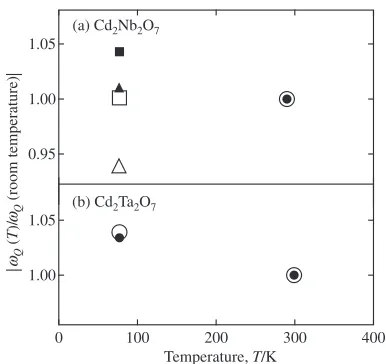
In Fig. 7(a) are plotted the absolute values of !QðTÞ=
!Q(room temperature) vs temperature T of 111Cd (closed
square and closed triangle: 77 K; closed circle: 290 K) and of
117In (open square and open triangle: 77 K; open circle:
290 K)) in Cd2Nb2O7. Those for Cd2Ta2O7are given in Fig.
7(b). In case of Cd2Ta2O7where there is no structural change
around the probe nuclei below and above about 200 K, the!Q
of 111Cd and that of 117In both decrease with increasing temperature. However, in Cd2Nb2O7 where there is a
structural phase transition, the !Q of 117In rather increases
with temperature on the average in contrast to the !Q of
111Cd. This difference might be due to a participation of the
5s and 5p electrons in the bonding between In and O in Cd2Nb2O7 at 77 K. If this is so, we can speculate that the
change of the In-O bonding nature is brought by the structural change.
-0.3
-0.2
-0.1
0.0
0.1
A22 G22
(
t
)
150 100
50 0
Time, t/ns
-0.3
-0.2
-0.1
0.0
0.1 77 K
299 K
[image:4.595.62.280.72.222.2]Fig. 6 PAC spectraA22G22ðtÞof117In( 117Cd) in Cd2Ta2O7 at 77 and 299 K with the solid curves representing the least-squares fits of eq. (3) in the text.
Table 2 Absolute values of the quadrupole frequencies of111Cd and117In in Cd2Ta2O7, as derived from least-squares fits to the PAC spectra.
T/K j!Qj/Mrads
1
111Cd( 111mCd) 117In( 117Cd)
77 51.0(1) 211(1)
299 49.3(1) 203(1)
1.05
1.00
0.95
|Q
(
T
)/
Q
(
room temperature)
|
400 300
200 100
0
Temperature, T/K
1.05
1.00
(a) Cd2Nb2O7
(b) Cd2Ta2O7
ω
ω
Fig. 7 Temperature dependences of j!QðTÞ=!Q(room temperature)j of
111Cd (closed figures) and117In (open figures) in (a) Cd2Nb2O7and (b) Cd2Ta2O7.
[image:4.595.45.291.313.366.2] [image:4.595.330.523.564.746.2]4. Conclusions
In order to examine the applicability of PAC technique to the structural study on cadmium pyrochlore oxides, PAC measurements were performed at 77, 290, and 1073 K on
111Cd arising from 111mCd in polycrystalline Cd
2Nb2O7,
which is a ferroelectric withTC¼196K and is subject to a
structural phase transition at the same temperature. At temperatures above TC, there is one type of Cd sites.
However, at liquid nitrogen temperature, belowTC, there are
two types of Cd sites. It is considered that this change reflects the structural phase transition and thus that PAC is effective for the structural studies of cadmium pyrochlores. PAC measurements were also performed at 77 and 299 K on111Cd in polycrystalline Cd2Ta2O7, which is subject to a phase
transition near 200 K, but not ferroelectric below the transition temperature. Different from the case of Cd2Nb2O7,
there is one type of Cd sites above and below the transition temperature, meaning that the transition in Cd2Ta2O7is with
no structural change around the probe nuclei. Furthermore, PAC measurements were carried out on 117In arising from 117Cd in the two oxides. The ratio of the electric quadrupole
frequency of117In to that of111Cd is anomalously deviated
from a value expected from the purely ionic In and Cd ions in the same lattice environment. It is considered that a structural relaxation takes place when117Cd changes to117In, because the ionic radius of In3þ ion is smaller than that of Cd2þ, the
Coulomb interaction between In and O ions is stronger than that between Cd and O ions, and the oxygen array is not
close-packed. Although on the whole In behaves like Cd, the temperature dependence of!Qof117In in Cd2Nb2O7is rather
opposite to the others. This might be due to a participation of the5sand5pelectrons in the bonding in addition to the ionic bonding.
Acknowledgements
This work was supported by the Ministry of Education, Culture, Sports, Science, and Technology of Japan [Grant-in-Aid for Scientific Research on Priority Areas (B) No. 751].
REFERENCES
1) H. Sakai, H. Kato, S. Kambe, R. E. Walstedt, H. Ohno, M. Kato, K. Yoshimura and H. Matsuhata: Phys. Rev. B66(2002) 100509(R). 2) A. W. Sleight and J. D. Bierlein: Solid State Commun.18(1976) 163–
166.
3) R. D. Shannon: Acta Crystallogr., Sec. A: Cryst. Phys., Diffr., Theor. Gen. Crystallogr.32(1976) 751–767.
4) Y. Ohkubo, Y. Murakami, T. Saito, A. Yokoyama, S. Uehara, S. Shibata and Y. Kawase: Phys. Rev. B60(1999) 11963–11970.
5) Y. Ohkubo, T. Saito, Y. Murakami, A. Yokoyama and Y. Kawase: Mater. Trans.43(2002) 1469–1474.
6) R. B. Firestone:Table of Isotopes, 8th ed., edited by V. S. Shirley (Wiley, New York, 1996), Vol. I.
7) H. H. Rinneberg: At. Energy Rev.17(1979) 477–595. 8) R. M. Sternheimer: Phys. Rev.130(1963) 1423–1425.