Recently, the issues related to knowledge manage-ment have started receiving a continuously increasing level of attention. Professional literature introduces an entire range of synonyms, such as “knowledge admi-nistration”, “cognitive management”, and “information management”. The problems related to this issue did not originate by change and they inherently reflect the changes that are taking place within the immedi-ate surroundings of every individual, company, and even within entire societies. In relation to this fact, some professionals have formulated a prediction that, in the near future, the value of land and capital will be superseded by the value of knowledge, which will thus become the wealth of the respective owner. Managers of leading companies are therefore start-ing to fully appreciate the value of knowledge and skills of transferring this knowledge further. The knowledge in this context can be interpreted as the full utilization of information and data, coupled with the potential of people’s skills, competencies, ideas, intuitions, commitments and motivations.
It will be similar under the conditions of Czech ag-riculture. There is a range of troubleshooting domains
which require saving the knowledge and eventually, if need be, expert consultation or resolution.
MATERIAL AND METHODS
For the management knowledge, they are employed the assorted technologies, most often:
– intranet – data warehouse – data mining – expert systems and – eLearning.
In this connection, the idea to functionally inter-connect both products in one total with the pur-pose to preserve advantages of the both applications and minimize their disadvantages may be useful. The proposition of the efficient knowledge transfer (forwarding) in the scope of the given companies or institutions independent on the human subject can be a suitable way of the multimedia teaching applications. This solution then makes it possible
Expert systems utilization in knowledge management
Využití expertních systémů v znalostním managementu
V. VOSTROVSKÝ
Czech University of Agriculture, Prague, Czech Republic
Abstract: Knowledge and information are the key to successful pursuit of business activity. For the management knowledge, there can be employed among others the expert systems and eLearning. The article provides the expert systems utilization in knowledge management as the expert eLearning component. This solution then makes it possible to preserve the appropriate set of knowledge for a given business activity in knowledge bases and to pass this knowledge in the moment of need in the form of multimedia teaching applications to the appropriate employees.
Key words: knowledge, knowledge management, expert system, eLearning, expert eLearning
Abstrakt: Znalosti a informace hrají klíčovou roli v úspěšném provozování podnikatelských aktivit.Pro řízení znalostí je možno mimo jiné použít expertní systémy a eLearning. Článek je zaměřen na problematiku uplatnění expertních systémů v znalostním managementu jako součásti tzv. expertního eLearningu. Takovéto řešení umožňuje uchovávání důležitých znalostí v bázi znalostí a jejich efektivní předávání v momentě potřeby příslušným pracovníkům ve formě multimediální výukové aplikace.
Klíčová slova: znalost, znalostní řízení, expertní system, eLearning, expertní eLearning
to preserve appropriate set of knowledge to a given business activity in knowledge bases and to pass this knowledge in the moment of need to the appropriate employees in the form of multimedia teaching ap-plications including problem solving by the means of the expert consultation with the included expert system. Such solutions can be qualified as the expert eLearning. The expert eLearning then represents the functional link of two components: expert system and eLearning in one integral.
eLearning
eLearning represents an effective and efficient system of self-paced personal training, available over the Internet, intranets, extranets and CD-ROM. It presents the whole category of technology-based learning and covers a wide set of applications and processes, including computer-based learning.
Expert systems
Expert systems are part of the general category of computer applications known as artificial intel-ligence. One of the possible definitions of the expert system can be the following: An expert system is a class of computer programs developed by researcher in artificial intelligence during the 1970s and applied commercially throughout the 1980s. In essence, they are programs made up of a set of rules that analyze in-formation (usually supplied by the user of the system) about a specific class of problems, as well as provide analysis of the problem(s), and, depending upon their design, recommend a course of user action in order to implement corrections (Wikipedia 2006). A related term is wizard (software). Like an expert system, a wizard is also an interactive computer program that helps a user to solve a problem. Usually, the term wizard is used for programs that search a database for the criteria entered by the user. Unfortunately, the distinction between these two definitions is not universal, and some rule-based programs are called wizards (http:/en.wikipedia).
The expert systems have enhanced productivity in business, ecology, medical diagnosis, social sphere and the military.These systems also may be applied
in our agriculture.This concerns mainly the problems of the diseases and pests of agricultural animals and crops, designing optimum cultivating methods, and the causes of poor productivity in conducting the relevant agricultural enterprise activities.
The expert systems are usually designed to have the following general characteristics:
– High performance. The system must by capable of responding at a level of competency equal to or better than that of an expert in the field.
– Adequate response time. The system must also perform in a reasonable amount of time, comparable to or better than the time required by an expert to reach a decision.
– Good reliability. The expert system must be reliable and not prone to crashes or it will not be used. – Understandable. The system should be able to explain
the steps of its reasoning while executing so that it is understandable (Giarratano, Riley 1998).
As Figure 1 shows, the typical expert system con-sists of
– knowledge base, – inference engine, – user interface and – explanation facilities.
The knowledge base is the most important part of the expert system, which implicates its total quality. This base contains the knowledge from which the infer-ence engine draws conclusions. The expert knowledge will typically be in the form a set of IF-THEN rules (Popper, Kelemen 1989). A rule is composed of an if
portion and a then portion. The if portion of a rule is a series of patterns which specify the facts which cause the rule to be applicable. The expert system tool provides a mechanism, called the inference engine, which automatically matches facts with patterns and determines which rules are applicable. The then por-tion of a rule is the set of acpor-tions to be executed when the rule is applicable. The actions of applicable rules are executed when the inference engine is instructed to begin execution (Giarratano, Riley 1998).
The function of the user interface is to present ques-tions to the user and supply the user’s responses to the inference engine. The inference engine selects a
[image:2.595.70.533.683.766.2]Knowledge base Inference engine Facts Expertis Database (facts) Explanation facilities User interface USER
rule from the knowledge base and then the actions of the selected rule are executed. The inference engine then selects another rule and executes its actions. This process continues until the final solution (required diagnosis) finding (Holsapple, Whiston 1996).
Some expert systems contain explanation facili-ties that allow the user to ask why it asked certain question.
From the point of view of the expert systems exploi-tation, we distinguish the following categories: – planning expert systems,
– diagnostic expert systems, – control expert systems.
In connection with the above-mentioned proposed solution, there above all come into force the diagnostic expert systems.
RESULTS AND DISCUSSION
At this point, it has to be emphasized that an over-whelming majority of the existing expert systems
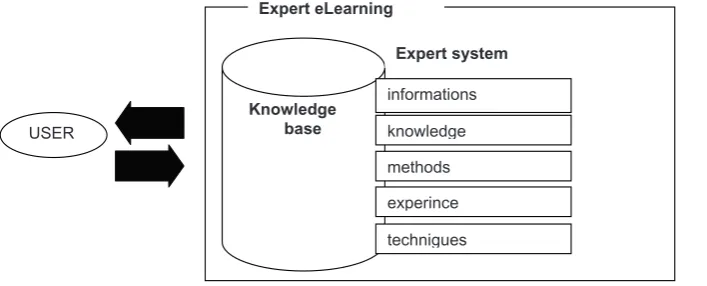
have an unsuitable user interface. This shortcoming can be corrected by the means of eLearning, mainly by its multimedia options. Such graphical interfaces then can supply information in any number of forms: simple text in windows, pop-up menus or various graphical objects. The basic scheme of a proposed solution is shown in Figure 2.
To illustrate such expert consultation in the pro-posed solution, we suppose the simple following knowledge:
If the murmur is heard during the winter-inspection and the humidity and mildew are smelled from the beehive, then the colony of bees is too week, unable to live the winter over.
The following rule will correspond with the men-tioned knowledge:
IF murmur_during_ the_ winter-inspection AND humidity_ and_mildew from_ beehive
THEN colony_of_bees_too_week_unable_winter_over.
In the proposed solution, there will be the expert consultation in the following form:
Knowledge
base knowledge methods experince technigues informations
Expert system
USER
[image:3.595.66.420.69.212.2]Expert eLearning
Figure 2. Basic scheme of a proposed solution
System:Is heard the murmur during the winter-inspection?
User:
System:Is it true, that the humidity and mildew are smelt from beehive?
User:
System: The murmur can be the symptom of the top weak colony of bees?
Is it true that the humidity and mildew are smelt from beehive? User:
System: I conclude, that the colony of bees is too weak, unable to live the winter over.
User:
Next to the problem source identification by the expert system, there will be the user relocation to theoretical part of the eLearning application with a more detailed information to the found solu-tion.
The proposed concept has the following advantages (Figure 4):
– the lucidity of the knowledge saving, – the availability of the knowledge saving,
– the efficient forwarding of the knowledge independ-ent on the human subject,
– more visual presentation of the saving knowledge by means of the multimedia components,
– more efficient ways of the knowledge forwarding independent of the space, time and subject. This proposed solution can be used in the follow-ing areas:
[image:4.595.68.411.80.310.2]– plant production – animal production – operations management – business administration.
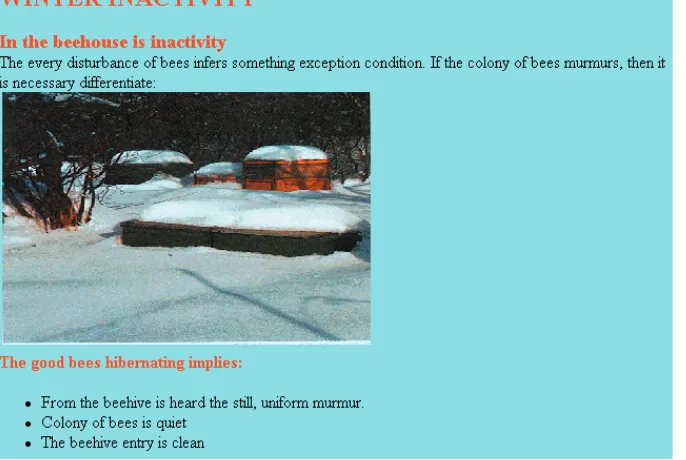
Figure 3. Example of the ex-pert consultation enabling the subsequent detailed informa-tion about identified through eLearning application
Expert eLearning
[image:4.595.68.286.446.523.2]knowledge holding knowledge forwarding expert support of problem solving
[image:4.595.64.416.584.767.2]Figure 4. Convergence of three important principles to create the expert eLearning
Like any other applications, expert eLearning have of course some bottlenecks:
– time and financial severity of the such solution further increases,
– to find the willing experts for the cooperation in knowledge base filling,
– mistake-free function of the expert system (right-ness and integrity of the knowledge base).
CONCLUSION
In closing, a certain justification for the proposed resolution as faced with the goals of the knowledge management should be mentioned. The dynamics of technical development strongly influence the de-velopment of society, whereby in order for a busi-ness entity to survive, it must evaluate a situation quickly, to activate resources rapidly, to communi-cate speedily, and to cooperate at a higher level of quality. The successful development of a company requires the mobilization of the existing knowledge and skills and, on the basis thereof, the performance of a quick, high-quality action. This task would not be the responsibility of only the human element. The concurrent search for a solution by using expert
com-ponents would contribute to the overall objectivity of the proposed solutions. Evaluations of successful companies have confirmed that the application of these integrated system approaches to knowledge represents a decisive factor in the managerial ef-ficiency of the company in question.
In today’s market environment, the only reliable resource for ensuring the competitiveness of a busi-ness entity is knowledge. Analyses performed of the failures of some companies during recent years provide an additional evidence of this fact. These failures correspond to an insufficient value being placed on knowledge on the part of these business entities.
REFERENCES
Giarratano J., Riley G. (1998): Expert systems – prin-ciples and programming. PWS Publishing Com-pany, Boston.
Holsapple C.W, Whinston A.B. (1996): Decision Sup-port Systems: A Knowledge-based Approach. West Publishing Co., Minneapolis,.
Popper M., Kelemen J. (1989): Expertné systémy. Alfa, Bratislava.
http:/en.wikipedia.org/wiki/expert_system
Arrived on 20th December 2005
Contact address:
Václav Vostrovský, Czech University of Agriculture in Prague, Kamýcká 129, 165 21 Prague 6-Suchdol, Czech Republic