2013. Vol.4, No.3A, 335-339
Published Online March 2013 in SciRes (http://www.scirp.org/journal/psych) http://dx.doi.org/10.4236/psych.2013.43A048
Anything but Race: Avoiding Racial Discourse to
Avoid Hurting You or Me
Phillip Atiba Goff
1, Matthew Christian Jackson
1, Andrew H. Nichols
2,
Brooke Allison Lewis Di Leone
31The University of California, Los Angeles, USA 2National Center for Post-Traumatic Stress Disorder, Boston, USA
3Maryland Higher Education Commission, Baltimore, USA Email: [email protected]
Received December 21st, 2012; revised January 23rd, 2013; accepted February 24th, 2013
The present research examines how Whites employ strategic colorblindness—the strategic assertion that race should not and/or does not matter—in interracial interactions, and how stereotype threat and concern about non-Whites influence the use of this conversational technique. Because colorblindness can be egalitarian or anti-egalitarian (Knowles, Lowery, Hogan, & Chow, 2009), one must define colorblindness in order to understand how it is employed. Two studies provide evidence that both concerns that racial categorization harms non-Whites and concerns with appearing racist affects the use of strategic color- blindness. Study 1 uses field observations to explore the content of spontaneous colorblind statements and their relationship to stereotype threat. Study 2 manipulates stereotype threat and concerns for non-Whites, revealing that each independently increases Whites’ endorsement of strategic colorblindness relative to control conditions. This research highlights the importance of both studying interracial interactions in field settings and considering how definitions of diversity shape intergroup contexts.
Keywords: Stereotype Threat; Interracial Interactions; Intergroup Processes
Introduction
“You know, like King said: color shouldn’t matter so don’t, like, pay any attention to it.”—Study 1, Participant 73
It is often good advice to avoid talking about controversial topics. We are admonished to avoiding talking about politics or religion over casual dinners, and to eschew painful family sto- ries during the holidays. It should not be surprising, then, that the controversial topic of race causes many to feel anxious (Richeson & Shelton, 2007, Vorauer, Main, & O’Connell, 1998; Vorauer, Hunter, Main, & Roy, 2000) and subsequently, to avoid the topic all together (Apfelbaum, Norton, & Sommers, 2008; Goff, Steele, & Davies, 2008). An emerging consensus in research on interracial interactions reveals that this response is particularly true for dominant group members, usually Whites. Unfortunately, this literature also finds that avoiding the topic and the attendant anxiety around it can be counterproductive, creating inefficient interactions at best (Apfelbaum et al., 2008) and even the ironic suspicion among non-Whites that avoidant Whites are racist (Apfelbaum et al., 2008; Richeson & Shelton, 2007; Dovidio, Kawakami, & Gaertner, 2002).
Apfelbaum and colleagues refer to avoiding the topic of race as “strategic colorblindness,” and suggest that it stems from Whites’ concern with appearing prejudiced (Apfelbaum et al., 2008). Apfelbaum and colleagues argue that, by avoiding the topic of race, Whites may believe that they need not fear accu- sations of racism. But given that colorblindness is often per- ceived as a hierarchy-enhancing ideology, one designed to for- bid the consideration of race for the purposes of creating inter- group equality (Knowles et al., 2009), why would individuals believe employing colorblindness would protect them from ac-
cusations of racism?
Perhaps the answer depends on how Whites believe color-blindness affects non-Whites? Research by Knowles and col-leagues suggests that, while some perceive colorblindness as a procedural ideology, designed to enhance hierarchies, some see it as a distributive ideology, designed to protect non-Whites from the negative consequences of discrimination. This distribu-tive colorblindness, historians argue, is consistent with Martin Luther King, Jr.’s “colorblindness” and seen as an egalitarian principle (Carson, 1987). The possibility that strategic color- blindness could be a response to egalitarian impulses is not ex- plored in previous research on strategic colorblindness and leaves us with the outstanding question: does strategic colorblindness stem from concerns about the self, concerns about others, or both? The present research is designed to answer this question.
We expect that both concerns with appearing prejudiced and concerns with how categorization affects non-Whites will in-fluence the use of strategic colorblindness. Specifically, the presence of either concern may be sufficient to produce either spontaneous colorblind utterances or endorsement of strategic colorblindness. If confirmed, this would suggest that, much like other uncomfortable topics, regardless of whether one’s con- cerns center around one’s self or someone else, the most obvi- ous way to avoid injury is to avoid the topic. However, it would also suggest that, unlike previous research, understanding the motivation of an individual that employs strategic colorblind-ness may be crucial for modifying the behavior.
spon-taneous strategic colorblindness in naturalistic conversations about race. With regard to the first, the literature on strategic colorblindness is couched in terms of concerns with appearing prejudiced, this concerns has not been framed in terms of ste- reotype threat—the concern with conforming to or being evalu- ated in terms of a negative stereotype about ones group (Goff, Steele, & Davies, 2008; Steele, 1997). Stereotype threat often leads to performance decrements either through cognitive load (Schmader & Johns, 2003) or simply anxiety (Goff et al., 2008). However, scholars traditionally use stereotype threat to frame educational outcomes, and tend to focus on stigmatized group members. A growing literature establishes that Whites can and do experience stereotype threat around appearing prejudiced, and can even access that experience consciously (Frantz, Cuddy, Burnett, Ray, & Hart, 2004; Goff et al., 2008). Consequently, the present research measures and manipulates stereotype threat for Whites with the aim of expanding the traditional conceptu- alization—and application—of the theory.
With regards to the second, we use actual group conversa-tions about race to examine the prevalence of comments that communicate colorblindness, providing applied evidence for the previously laboratory phenomena. Taken together, the present research provides an important translation of strategic colorblind- ness to actual conversations and clarifies the motivations of do- minant group members as they engage in intergroup interactions.
Overview of Research
Our efforts to expand and apply the literature on strategic colorblindness took the form of two studies. Study 1 examined real world conversations about race to determine whether or not individuals spontaneously engaged in strategic colorblindness in mixed-race context more often than in same-race contexts. Previous research suggests that the mere presence of outgroup members is enough to provoke stereotype threat (Inzlicht & Ben-Zeev, 2000). Consequently, because we expected that ste- reotype threat would produce spontaneous strategically color- blind comments, we expected more of these utterances in mixed- race contexts than same-race ones. Evidence that stereotype threat produces strategic colorblindness would then allow us to test potentially competing hypotheses: that either stereotype threat or concerns for outgroup members prompt Whites to endorse strategic colorblindness.
To test these potential motivations, Study 2 manipulates ste- reotype threat and information about the harms that categoriz- ing non-Whites in terms of race produce. Again, we expected that, either when Whites were concerned with appearing preju-diced or when they were concerned that race-consciousness would harm non-Whites, they would be more likely to endorse strategic colorblindness.
Study 1
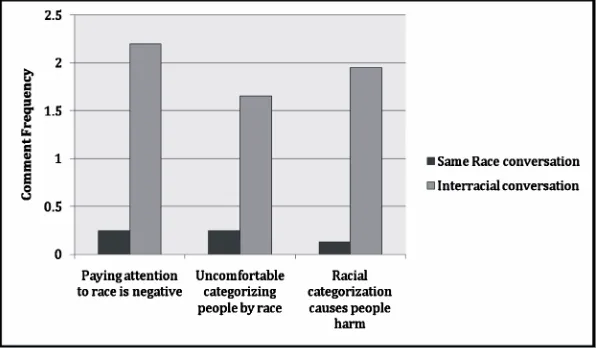
Study 1 was designed to identify the language Whites use when discussing race in interracial and same-race groups and to assess whether or not this language maps on to the concept of “strategic colorblindness.” During group conversations, we counted the number of comments made about race in the fol-lowing three ways: paying attention to race is negative, catego- rizing people by race is uncomfortable, and categorizing people by race hurts those who are categorized—each an explicit ar-ticulation of strategic colorblindness. Study 1 tests whether
Whites will employ explicit colorblind strategies in interracial interactions, devaluing race-consciousness to the extent that non-Whites are present.
Method
Participants and Design
A total of 214 American undergraduate participants (116 women & 98 men; 182 White & 32 Black) at a large public university in the US participated in 28 conversation groups ranging in size from of 5 to11 people. Groups contained either White participants only (8 groups) or White and non-White participants (20 groups) creating our two-cell design. Partici-pants came to the laboratory in order to participate in a student run roundtable discussion called the Race Relations Project (RRP). Participants were part of an optional summer prepara- tory program for incoming students and were randomly as- signed to discussion groups by the project coordinators. Stu-dents were offered extra credit in their summer classes as com-pensation for participation. The stated purpose of the 90-minute conversations was to provide an open forum for university stu-dents to discuss racial issues. Student facilitators led discus-sions, and were trained to have minimal involvement in the conversations. All conversations were videotaped. Four inde-pendent raters coded the videos of the 28 conversations for comments about race.
Video coders were instructed to count all comments that mentioned race in three ways. First, they were to count all comments that said that paying attention to race was negative. Comments included:
“Really, why does it even matter? We shouldn’t even care whether someone is Black or White or Pink or Purple or what-ever. Paying attention to it makes it worse.”
and
“I don’t think people really even notice anymore, which is a good thing. Like, who wants to be ‘White,’ or whatever? I’m a person. You’re a person. Just, you know, treat people like they’re people; like human beings.”
Second, coders were asked to count the number of comments that explicitly mentioned that categorizing individuals by race was uncomfortable, an explicit indication of stereotype threat. Comments included:
“Like, which one is it? Black or African American or what? It seems like it’s just easier not to do the label thing at all, right?”
and
“I don’t like labeling people by their race.”
Finally, coders were asked to count the number of comments that explicitly stated that categorizing individuals by race hurt those who were categorized, an explicit articulation of our competing hypothesis. Comments included:
“If you care that much about their race, you don’t see them as a person.”
and
“Looking at their race demeans them.”
Inter-rater reliability was 86% with conflicts resolved through conversation. We hypothesized that White participants would make more strategically colorblind comments (meaning all three category codes) in the presence of non-Whites.
Results
race and same-race groups (see Figure 1), such that Whites
were more likely to indicate that paying attention to race was negative during mixed-race interactions than in all-White in-teractions, t(26) = 2.11, p < .05. Similarly, Whites were more likely to state that they were uncomfortable categorizing people by race during mixed-race interactions than in all-White inter-actions, t(26) = 2.41, p < .05. Finally, Whites were more likely
to state that racial categorization causes people harm during mixed-race interactions than in all-White interactions, t(26) =
2.12, p < .05. Of note, no Black participants made such
com-ments, meaning that only White participants did (in both the mixed-race and same-race groups).
Discussion
As predicted, Whites employed more strategic colorblindness in the presence of non-Whites than they did in all-White groups. Importantly to our hypotheses, they also indicated both more stereotype threat and more concern for the outcomes of non- Whites in the presence of non-Whites. This suggests that both concerns for the self and for others prompt the use of strategic colorblindness. To test these competing hypotheses directly, Study 2 manipulated stereotype threat and concerns with hurt- ing non-Whites. Again, we expected that both the presence of stereotype threat and the likelihood that non-Whites would suf- fer from racial categorization would prompt increased reliance on strategic colorblindness.
Study 2
Method
Participants and Design
Participants were 91 White American undergraduates who were enrolled in introductory psychology courses at a large public university in the United States. They were randomly assigned to a 2 (Experience of stereotype threat: Present v. Absent) × 3(Harms of Racial Categorization: High v. Low v. Control) between subjects factorial design.
Materials
Stereotype Threat Scale. Participants filled out an explicit
stereotype threat scale (STS; adapted from Goff et al., 2008) to
measure the anxiety about being perceived as racist. The scale (α = .80) included 5 questions such as: “During this conversa-tion, I worried that something I said might have been misinter-preted as prejudiced.”
Strategic Colorblindness Scale. The authors developed the
Strategic Colorblindness Scale (SCS, = .91) to measure par- ticipants’ beliefs about the value of enacting colorblindness. Examples include: “Seeing people in terms of race is a signifi-cant hindrance to racial harmony”, and “Ending racial catego- rization would create a more just society”. The measure con- tains 11 items that participants respond to on a 7-point Likert scale (See appendix for full set of items). Higher scores on this measure indicate that one strongly believes that racial categori-zation has negative consequences.
Procedure
Participants arrived individually and were greeted by a White experimenter. After consenting to participate, participants were told that the purpose of the study was to examine interracial interactions. The experimenter then informed participants that they would engage a Black student from the university in a conversation about race and race relations. Participants were told that before having the interaction, the experimenters wanted to evaluate baseline racial attitudes. Participants were then given the Attitudes Towards Blacks scale (ATB; Brigham, 1993), a measure of explicit anti-Black prejudice. Participants were then given false feedback, such that half of the partici-pants were told that they held low amounts of prejudice for this college and the other half told that they had high levels of prejudice for the college. Participants were then told that they had one more preliminary packet to fill out, during which they were given the second manipulation.
One third of participants were told that “people regularly categorize others based on their racial/ethnic affiliations. This racial categorization often contributes to various detrimental effects such as depression, lowered self-esteem, academic un-derachievement, and, in extreme cases, suicide.” This was in-tended to persuade participants that racial categorization came with high costs—particularly for non-Whites. One third of par-ticipants were told that “people regularly categorize others based on their racial/ethnic affiliations. Very few serious detri- mental effects have been found to be associated with this type
Figure 1.
[image:3.595.149.448.539.713.2]of racial categorization.” This was intended to persuade par-ticipants that racial categorization came with low costs. Finally, in the control condition, participants were simply told that “people in certain environments tend to have similar political perspectives.” Participants then completed our measures of stereotype threat and the devaluation of racial categorization. Participants were then told that the conversation would not actually occur and were fully debriefed.
Consistent with the comments observed in Study 1 indicating egalitarian motivations, we predicted that, absent the anxiety of appearing prejudiced, participants would employ strategic co- lorblindness, but only when informed that there were high costs to non-Whites as a result. However, we predicted that those who were concerned about appearing prejudiced would employ strategic colorblindness uniformly. That is, participants would employ strategic colorblindness even when given information that racial-awareness comes at no costs to non-Whites.
Results
Stereotype Threat Scale. Participants experienced more an-
xiety about appearing prejudiced after receiving feedback indi- cating high racial bias, relative to those told they held low racial bias, F(1, 85) = 15.63, p < .001. No other main effects or inter-actions were observed.
Strategic Colorblindness Scale. Analyses revealed a main
effect of stereotype threat,such that participants under threat employed strategic colorblindness more than those that were not under threat, F(1, 85) = 6.51, p = .01. Analyses also
re-vealed a main effect of harms due to racial categorization such that participants devalued racial categorization more when they were told it harmed others, F(2, 85) = 3.07, p = .05. These ef-fects were qualified by the predicted two-way interaction: F(2,
85) = 4.22, p < .05 (see Figure 2).
Simple effects tests revealed that, absent stereotype threat, strategic colorblindness was employed more when participants believed race-consciousness harmed non-Whites than in each other condition, F’s(1, 85) = 10.50, p’s < .005. Simple effects
tests also revealed that, for participants who received no in-for-mation about racial harms, strategic colorblindness was en dorsedmore under threat than in the absence of threat, F(1, 85)
= 7.21, p < .01. The same pattern holds for participants who
were told that racial categorization was not harmful, F(1, 85) = 6.77, p = .01.
Mediational Analyses
We conducted mediational analyses to test whether the rela- tionship between the feedback on the test of prejudice and stra-tegic colorblindness was mediated by stereotype threat. We fol- lowed the mediation procedure outlined by Baron and Kenny (1986). The independent variable (feedback on test of prejudice type) significantly predicted the dependent variable (strategic colorblindness), B = .26, t = 2.50, p = .01. The independent
variable predicted the mediator variable (stereotype threat score), B = .39, t = 4.00, p < .001. The mediator predicted the
dependent variable when controlling for comment type, B =
−.53, t = 5.42, p < .001. And lastly, controlling for the
stereo-type threat score, the independent variable no longer predicted the dependent variable, B = .05, n.s. (Sobel, Z = 3.2, p = .001).
Discussion
The observed pattern of data reveals a clear relationship be-tween the anxiety with being seen as prejudiced and strategic colorblindness. Specifically, the results suggest that when Whi- tes experience stereotype threat, they employ strategic color- blindness even when being told that racial categorization has no impact on non-Whites. Study 2 also provides evidence that White’s use of strategic colorblindness is closely related to their concerns about non-Whites. This provides the first direct test of the hypothesis that both egalitarian and self-protective motives influence Whites’ responses to intergroup threat.
General Discussion
[image:4.595.145.454.522.706.2]Across two studies, the present research finds consistent evi-dence that Whites’ use of strategic colorblindness is motivated by both self-protective and egalitarian concerns—in both labo-ratory and field settings. Further, we have demonstrated that the use of colorblindness as a discourse strategy is not simply a function of demand characteristic in lab settings, but also oc- curs spontaneously in everyday conversation about race. This
Figure 2.
research differs from previous work that focused on self-pro- tective motivations without directly testing the possibility for genuine egalitarian motives. The application of research on strategic colorblindness to actual interactions has the benefit of providing the literature with the ability to generalize beyond the lab and, simultaneously, to advance our theoretical understand-ing of Whites’ motives for endorsunderstand-ing colorblindness, itself an important predictor of intergroup outcomes (Gutiérrez & Un- zueta, 2010).
Previous research has also demonstrated that adopting a co-lorblind ideology can lead to elevated racial prejudice among Whites’ (Richeson & Nussbaum, 2004; Morrison, Plaut, & Ybarra, 2010). Future research, however, should examine whe- ther this is the case regardless of the meaning of colorblindness. That is, it may be the case that egalitarian and hierarchy-en- hancing interpretations of colorblindness lead to different inter-group outcomes, one increasing prejudice and interinter-group ten-sions, the other decreasing them.
Regardless, the present research highlights the importance of translating research on intergroup relations to the worlds in which groups actual interact—and suggests that this can be done successfully. Doing so not only expands the boundary conditions for theories of intergroup interactions, but, in the case of the present research, provides information about the mechanisms that underlie those theories. In the specific exam- ple of strategic colorblindness, the present research suggests not only that the phenomena occurs naturally in the world, but that it can be motivated by nobler intentions than previously be-lieved—a good thing for the future of intergroup interactions in the real world and the laboratory.
REFERENCES
Apfelbaum, E. P., Sommers, S. R., & Norton, M. I. (2008). Seeing race and seeming racist? Evaluating strategic colorblindness in social in- teraction. Journal of Personality and Social Psychology, 95, 918-932. doi:10.1037/a0011990
Baron, R. M., & Kenny, D. A. (1986). The moderator-mediator variable distinction in social psychological research: Conceptual, strategic, and statistical considerations. Journal of Personality and Social Psy- chology, 51, 1173-1182. doi:10.1037/0022-3514.51.6.1173
Brigham, J. C. (1993). College students’ racial attitudes. Journal of Applied Social Psychology, 23, 1933-1967.
doi:10.1111/j.1559-1816.1993.tb01074.x
Carson, C. (1987). Eyes on the prize: America’s civil rights years: A reader and guide. New York: Penguin Books.
Dovidio, J. F., Kawakami, K., & Gaertner, S. L. (2002). Implicit and
explicit prejudice and interracial interaction. Journal of Personality and Social Psychology, 82, 62-68. doi:10.1037/0022-3514.82.1.62 Frantz, C. M., Cuddy, A. J. C., Burnett, M., Ray, H., & Hart, A. (2004).
A threat in the computer: The race Implicit Association Test as a stereotype threat experience. Personality and Social Psychology Bul- letin, 30, 1611-1624. doi:10.1177/0146167204266650
Goff, P. A., Steele, C. M., & Davies, P. G. (2008). The space between us: Stereotype threat and distance in interracial contexts. Journal of Personality and Social Psychology, 94, 91-107.
doi:10.1037/0022-3514.94.1.91
Gutiérrez, A. S., & Unzueta, M. M. (2010). The effect of interethnic ideologies on the perceptions of stereotypic vs. counter stereotypic minority targets. Journal of Experimental Social Psychology, 46, 743- 752. doi:10.1016/j.jesp.2010.03.010
Inzlicht, M., & Ben-Zeev, T. (2000). A threatening intellectual envi- ronment: Why females are susceptible to experiencing problem- solving deficits in the presence of males. Psychological Science, 11, 365-371. doi:10.1111/1467-9280.00272
Knowles, E. D., Lowery, B. S., Chow, R. M., & Hogan, C. M. (2009). On the malleability of ideology: Motivated construals of color-blind- ness. Journal of Personality and Social Psychology, 96, 857-869. doi:10.1037/a0013595
Morrison, K. R., Plaut, V. C., & Ybarra, O. (2010). Predicting whether multiculturalism positively or negatively influences White Ameri- cans’ intergroup attitudes: The role of ethnic identification. Person- ality and Social Psychology Bulletin, 36, 1648-1661.
doi:10.1177/0146167210386118
Richeson, J. A., Baird, A. A., Gordon, H. L., Heatherton, T. F., Wyland, C. L., Trawalter, S., & Shelton, J. N. (2003). An fMRI investigation of the impact of interracial contact on executive function. Nature Neuroscience, 6, 1323-1328. doi:10.1038/nn1156
Richeson, J. A., & Nussbaum, R. J. (2004). The impact of multicultur-alism versus color-blindness on racial bias.Journal of Experimental Social Psychology, 40, 417-423. doi:10.1016/j.jesp.2003.09.002 Richeson, J. A., & Shelton, J. N. (2007). Negotiating interracial
interac-tions: Costs, consequences, and possibilities. Current Directions in Psychological Science, 16, 316-320.
doi:10.1111/j.1467-8721.2007.00528.x
Schmader T. & Johns M. (2003). Converging evidence that stereotype threat reduces working memory capacity. Journal of Personality and Social Psychology, 85, 440-452. doi:10.1037/0022-3514.85.3.440 Vorauer, J. D., Hunter, A. J., Main, K. J., & Roy, S. A. (2000).
Me-tastereotype activation: Evidence from indirect measures for specific evaluative concerns experienced by members of dominant groups in inter-group interactions. Journal of Personality and Social Psychol- ogy, 78, 690-707. doi:10.1037/0022-3514.78.4.690
Vorauer, J. D., Main, K. G., & O’Connell, G. B. (1998). How do indi- viduals expect to be viewed by members of lower status groups: Content and implications of meta-stereotypes. Journal of Personality and Social Psychology, 75, 917-937.
doi:10.1037/0022-3514.75.4.917
Appendix: Study 2. Strategic
Colorblindness Scale
1. Seeing people in terms of race contributes to racial tension for everyone.
2. Seeing people in terms of race breeds interracial mistrust and prejudice.
3. Seeing people in terms of race creates inequality among racial groups.
4. Categorizing people by race is in and of itself racist. 5. Seeing people in terms of race strips one of their
individu-ality.
6. Seeing people in terms of race is an injustice.
7. Ending racial categorization would create a more just so-ciety.
8. Seeing people in terms of race leads to stereotyping. 9. Racism and prejudice are products of racial categorization. 10. Recognizing racial affiliations prevents the United States from moving towards a more socially just society.