Munich Personal RePEc Archive
Cheating in the workplace: An
experimental study of the impact of
bonuses and productivity
Gill, David and Prowse, Victoria and Vlassopoulos, Michael
University of Oxford, Cornell University , University of Southampton
4 July 2013
Cheating in the workplace: An experimental study of
the impact of bonuses and productivity
∗
David Gill†
Oxford University - Department of Economics
Victoria Prowse ‡
Cornell University - Department of Economics
Michael Vlassopoulos §
University of Southampton - Division of Economics
This version: July 4th, 2013 First Version: June 28th, 2012
Abstract
We use an online real-effort experiment to investigate how bonus-based pay and worker pro-ductivity interact with workplace cheating. Firms often use bonus-based compensation plans, such as group bonuses and firm-wide profit sharing, that induce considerable uncertainty in how much workers are paid. Exposing workers to a compensation scheme based on random bonuses makes them cheat more but has no effect on their productivity. We also find that more productive workers behave more dishonestly. These results are consistent with work-ers’ cheating behavior responding to the perceived fairness of their employer’s compensation scheme.
Keywords: Bonus, compensation, cheating, dishonesty, lying, employee crime, productivity, slider task, real effort, experiment.
JEL Classification: C91, J33.
∗We thank Leigh Wedenoja and Jiadi Yao for excellent research assistance. Funding for this project was provided by the Economic and Social Research Council and a Zvi Meitar/Vice-Chancellor Oxford University Social Sciences Research Grant.
1
Introduction
A vast body of evidence shows that cheating, fraud and crime are pervasive in the workplace.1
In this paper, we investigate how pay structures and worker productivity interact with workplace cheating. We focus on two specific questions. First, how does the uncertainty inherent in bonus-based compensation schemes influence the amount of employee dishonesty? Second, is there a link between workers’ productivity and how much they cheat?
1.1 Summary of experimental design and findings
To study these questions, we conducted an online experiment using the computerized real-effort ‘slider task’ (Gill and Prowse, 2012) that involves moving sliders across a screen. To start with, subjects were paid to complete a certain amount of the task. In the control, the subjects were paid a fixed amount, either£2 or £8, for completing the work. In the bonus treatment, subjects
were paid£2 for sure for completing the work, but with 50% probability were also paid a bonus
of an additional £6. Notice that the two-point distribution of remuneration was therefore held
constant across the control and the bonus treatment. In a subsequent stage, all subjects worked under a common piece rate, and simultaneously were given an opportunity to cheat: we asked the subjects to report the last digit of their best friend’s phone number and paid them an amount in pounds equal to the number that they reported. The design allows us to identify the causal effect of the random component of bonuses on later cheating and productivity, and also to determine whether there is a relationship between working harder and cheating more. The experimental nature of our design gives us the control necessary to identify cleanly causal effects and to measure accurately changes in productivity and cheating.
We find three main results. First, the use of random bonuses increases cheating but has no effect on productivity. Subjects who have been exposed to the bonus-based compensation scheme are more likely to behave dishonestly by inflating the number that they report: using random bonuses increases the average report by 5% and increases the proportion of subjects reporting a 7 or higher by 9%. This result suggests that the uncertainty inherent in bonus-based compensation may have important unintended side effects that firms ought to take into account when designing their human resource policies. Second, receiving a random bonus has no effect on cheating or productivity: within the subjects exposed to bonus-based system, those who received the bonus cheat to the same extent and work as hard as those subjects who did not receive the bonus. Third, across our whole sample more productive subjects also cheat more: our regression results indicate that the hardest-working subjects report a number 22% higher than that reported by the least hard-working, while the most productive are 43% more likely to report a 7 or higher. Although not the main focus of our paper, we also find that males cheat more: on average males report a number 7% higher than that reported by females.2
1
We survey some of the evidence in Section 1.2.
2
1.2 Relevance of our set-up to labor markets
Our set-up is relevant to labor markets for three main reasons: first, workers have many oppor-tunities to cheat their employers; second, our methodology for measuring cheating allows what we call ‘soft’ as well as ‘hard’ cheating, both of which are important in labor markets; and third, firms commonly use bonus-based compensation that involves an important random component.
First, employee cheating and crime is an enormous and pervasive problem for firms and the economy. The Association of Certified Examiners estimates that the typical firm loses about 5% of revenues to occupational fraud, which translates into a loss of $3.5 trillion at the global level (ACFE, 2012). Dickens et al. (1989) survey the evidence, reporting that 5% to 30% of business failures in the US result from the cost of employee theft, while finding “overwhelming empirical evidence that firms expend considerable resources trying to detect employee malfeasance.” Jacob and Levitt (2003) find evidence of teachers cheating on standardized test scores in about 5% of classrooms annually. Employees can cheat their employers in a wide variety of ways. Grover (1993) summarizes many of the ways in which employees can lie in their reports (self-reporting of hours worked, for instance, is common in professional services such as auditing, consultancy and the law).3
Other forms of cheating include: payroll fraud; falsifying revenue figures; false or inflated invoicing; false expense claims; cash skimming; check tampering; theft of inventory or telephone services; customer identity theft; and theft of intellectual property.
Second, our methodology for measuring cheating provides an opportunity for what we call ‘soft’ and ‘hard’ cheating. By hard cheating we mean a subject who cheats knowingly, that is a subject who either (i) knows the last digit of her best friend’s phone number but reports something higher or (ii) does not know the last digit but reports a number instead of selecting “don’t know”.4
By soft cheating we mean a subject who subconsciously deceives herself in a favorable way about either (i) the identity of her best friend or (ii) the last digit of her best friend’s phone number.5
The scope for soft cheating introduced by our novel design mimics the many opportunities for soft cheating and self-deception in the workplace that might impact the employer. Workers can deceive
3
“People have ample opportunity to either lie or tell the truth in the course of their work. Workers continually report their behavior and give information to peers, superordinates, and others, in written form, orally, and nonverbally. The truck driver records the number of hours on the road, the nurse charts vital signs, the certified public accountant states what has been audited, and the forester reports a tree census. Organizations generally rely on these reports to be honest. However, each of these individuals may have reasons to lie. The truck driver returns home sooner if he says he drove the speed limit when in fact he exceeded it; the nurse may not have time to actually observe vital signs that must be recorded; CPA’s may gain partner status by exaggerating their work quantity; and the forester may misreport the tree census to prevent deforestation.” (Grover, 1993, p. 478)
4
Our methodology for measuring cheating is related to a recent wave of experimental studies that use a report of a privately-known outcome as an indicator of cheating or dishonesty. These papers use a ‘hard’ form of cheating or deception, where subjects report the outcome of a coin flip (Bucciol and Piovesan, 2011; Houser et al., 2012; Abeler et al., 2012), a die roll (Fischbacher and Heusi, 2008; Lammers et al., 2010; Conrads et al., 2013; Fischbacher and Utikal, 2011; Hao and Houser, 2011; Shalvi et al., 2011; Suri et al., 2011; Cojoc and Stoian, 2012; Lewis et al., 2012; Shalvi et al., forthcoming) or some other random variable (Coricelli et al., 2010; Eisenkopf et al., 2011). Some studies ask subjects to report their score on a task (e.g., Mazar et al., 2008; Cadsby et al., 2010; Schwieren and Weichselbaumer, 2010). There is also a literature on strategic sender-receiver games in which a sender can report the outcome of a random variable truthfully or lie (e.g., Charness and Garoupa, 2000; Lundquist et al., 2009; Wang et al., 2010), and on lying in games more generally (e.g., Croson et al., 2003; Gneezy, 2005; Charness and Dufwenberg, 2006).
5
themselves on a number of dimensions, including for example: their personal contribution to team success (especially if they are a team leader deciding on individual bonuses); their perception of the quality of junior colleagues (who might not be promoted) or job candidates who might become future competitors (who might not be hired); the extent to which double-billing of time can be justified in professions where clients are billed for self-reported and unverifiable hours; whether they are ill enough to justify taking a paid sick day; and whether it is justified to take office equipment for personal use and make personal phone calls at work.6
Third, firms often use bonus-based compensation plans that, from the perspective of the worker, contain a component that is unrelated to individual performance, but instead depends on factors that are beyond the worker’s control. Compensation based on the performance of the entire firm or a subgroup of employees is one source of such uncertainty. Examples include discretionary group bonuses, stock options and firm-wide profit-sharing plans. The use of stock option plans for non-executive employees is widespread and growing (Core and Guay, 2001), and non-executives receive over 60% of stock options granted by value (Oyer and Schaefer, 2005). For executives, too, stock options are becoming a more important part of total pay (Hall and Liebman, 1998), and even though CEOs impact firm performance directly, luck also plays an important role in how they are paid.7
Group bonuses, where individuals share a bonus based on their group’s performance, are also common, especially in financial services (see Hansen, 1997, for a case study), and some successful firms make extensive use of profit-sharing.8
Even when bonuses are based on individual performance, randomness can play an important role due to measurement error when evaluating output, especially when evaluations are subjective, and because the underlying process that translates worker input into measurable output is stochastic.9
Winning a tournament is essentially equivalent to being paid a bonus, and a large literature looks at the design of optimal tournaments in the presence of such noise (e.g., Lazear and Rosen, 1981).
Of course, we cannot be certain about the extent to which the response to the random bonuses that we find in our experimental setting would translate into real-world settings in which bonuses depend on both individual performance and uncertainty. The advantage of focusing attention only on the uncertain aspect is that we can identify cleanly the effect of the uncertainty holding remuneration constant across the control and the random bonus treatment. Future work could study profitably how the performance-based element interacts with the uncertainty in determining
6
These opportunities for soft cheating may be greater for workers with more responsibility and discretion. On average more able workers will tend to hold such positions. In our experiment, it is conceivable that more productive workers have more friends and thus have greater scope for soft cheating.
7
Bertrand and Mullainathan (2001) find that CEO pay responds as much to luck, defined as observable shocks to performance beyond the firm’s control, as it does to performance that is under the firm’s control, and that luck affects salaries and bonuses as well as grants of stock options. One justification is that firms might want to link CEO compensation to the value of outside opportunities (Oyer, 2004).
8
Knez and Simester (2001) provide a brief survey and a case study of a Continental Airlines bonus scheme for its 35,000 employees based on a firm-wide performance target; see also Bhattacherjee (2005) for a case study of a bonus scheme based on a firm-wide productivity target for the 15,000 employees of the Indian firm ITC Limited that makes up about 6% of pay on average.
9
behavior.
1.3 Novelty and interpretation of our results
Despite their importance, employee cheating and crime have not received much attention by economists, and their determinants are not well understood. Our paper contributes to a small yet growing literature that examines the interaction between various compensation schemes and cheating in the workplace. Burns and Kedia (2006) and Efendi et al. (2007) find a positive rela-tionship between CEO compensation based on stock options and financial misreporting. Curry and Mongrain (2009) and Gilpatric (2011) study theoretically the incentives to cheat in a rank-order tournament, where cheating increases both output and the probability of failing an audit. Experimental subjects have been found to cheat more when competing (Schwieren and Weichsel-baumer, 2010, compared to when they are paid piece-rate) or when paid for reaching a goal or target (Schweitzer et al., 2004; Cadsby et al., 2010),10
and subjects report higher die rolls when paid in teams of two and share the proceeds (Conrads et al., 2013). Finally, Waller and Bishop (1990) and Chow et al. (1994) consider experimentally how different pay schemes affect subordi-nate managers’ communication of private information. However, none of these papers examines the influence of bonuses on subsequent productivity and cheating behavior. Furthermore, to the best of our knowledge we are the first to analyze whether a link exists between productivity in a work task and cheating behavior.11
A plausible interpretation of our finding that the level of cheating depends on whether subjects were exposed to the bonus treatment, but not on whether they actually received the bonus, is that subjects perceive exposure to the random bonus as unfair, but are not influenced by outcomes per se in their perceptions of fairness. Being subject to an unfair payment mechanism provides a moral justification for negative reciprocity in the form of more dishonesty. This interpretation is broadly consistent with existing notions of procedural fairness and with a compelling body of evidence, from both laboratory experiments and field data, that workers respond negatively to unfair treatment and bad intentions. Under Trautmann (2009)’s concept of process fairness, the outcome generating process rather than the actual outcomes influences fairness perceptions, while Konow (2003, p. 1230)’s survey notes that “some argue that procedural justice is valued for itself, independent of outcomes.” Charness and Levine (2007) find experimentally that worker punishment of an employer is much more sensitive to the component of wages that is under their employer’s control than it is to the component due to luck, concluding that intentions matter
10
In Schweitzer et al. (2004) and Cadsby et al. (2010), the opportunity to cheat occurs during the task for which the bonus is paid and consists in exaggerating one’s performance. The emphasis is on whether the nature of a performance-based bonus scheme induces cheating by providing an opportunity for a small lie about one’s performance to result in a large increase in one’s earnings. Instead, we present the same opportunity to cheat in both the random bonus treatment and the control condition, and the cheating opportunity occurs subsequently. Thus, perceptions of fairness operate independently of any incentive to hit a target.
11
much more than outcomes, while Houser et al. (2012) find that cheating following a dictator game is higher when recipients report that they have been treated unfairly, but fail to uncover any link between income and cheating at a later stage. Evidence from the field also backs up the idea that fairness perceptions influence employee cheating: Greenberg (1990) finds that employee theft increases when a pay cut in manufacturing plants is perceived as unfair; Nagin et al. (2002) find that call center workers who feel well treated cheat their employer less; while Chen and Sandino (forthcoming) find that employee theft decreases when wages rise relative to other comparable retail stores.12
Although we believe that a plausible interpretation of our results relies on the perceived fairness of the payment scheme, we should make clear that we have no direct evidence that the subjects perceived exposure to the bonus-based compensation as unfair. Future work could ask subjects directly at the end of the experiment about their perceptions of the fairness of the payment scheme. It is also possible that fairness perceptions depend on how closely pay relates to performance. A consequence would be that firms should aim to reduce the uncertainty in their payment mechanisms and attempt to justify any uncertainty that remains.
Our result that more productive workers also cheat more might be viewed as surprising: one might expect harder workers to be more honest as well. Indeed, Eisenberger and Shank (1985) find that subjects with a strong survey-measured work ethic resisted for longer before taking an opportunity to cheat.13
On the other hand, people who are more strongly motivated by money might work harder in order to earn more and be more inclined to take advantage of opportunities to cheat for personal gain. Working hard on the real-effort task might also deplete subjects’ ability to withstand the temptation to cheat: Mead et al. (2009) and Gino et al. (2011) find that subjects whose self-control was depleted by being forced to undertake an onerous task cheated more than subjects made to undertake a less onerous task. Another possibility is that the subjects who worked harder felt that they deserved more for their labor. If the piece-rate wage was felt to be insufficient or unfairly low, this could have led to the more productive subjects convincing themselves that more cheating was justified. Such perceptions of unfairness would imply that low-wage or exploitative firms should be particulary wary of fraudulent behavior from their higher-productivity workers.
1.4 Plan of the paper
Section 2 describes the experimental design. Section 3 presents the empirical analysis and the results. Section 4 concludes. Appendix A provides the experimental instructions. Appendix B provides robustness checks. Appendix C provides some further statistics that are not in the main text.
12
See also Evans III et al. (2001), Zhang (2008) and Matuszewski (2010) for a link between fairness and honesty in managerial reporting.
13
2
Experimental design
We ran an online experiment during a two-week period in May 2011. To recruit subjects we sent email announcements to students at the University of Southampton. During the two-week period, 641 subjects completed the experiment at a time and location of their choosing.14
The experiment lasted 20 to 25 minutes and had to be completed in one go. The subjects were informed that they would be paid£3 for completing the experiment, on top of any money that they earned during the
experiment (all payments were in pounds Sterling). The average total payment to the subjects who completed the experiment was£19.32. At the end of the experiment, we asked the subjects
to report their gender. We paid the subjects privately in cash on two pre-advertised dates. The experiment was implemented using the Django open-source web application framework, which is written in Python. Appendix A provides the experimental instructions.
2.1 The slider task
We used the computerized real-effort ‘slider task’, which was first developed by Gill and Prowse (2012).15
The slider task consists of a screen displaying a large number of sliders (as described below, the number of sliders and the time allotted to the task varied across the stages of the experiment). Figure 1 shows a schematic representation of a single slider. Each slider is initially positioned at 0, as shown in Figure 1(a). By using her mouse or touchpad, the subject can position each slider at any integer location between 0 and 100 inclusive.16
Each slider can be readjusted an unlimited number of times during the time allotted to the task, and the current position of each slider is displayed to the right of the slider. In this experiment, subjects received 2 points for each slider positioned at exactly 50 and 1 point for each slider positioned at exactly 49 or 51. Figure 1(b) shows a slider positioned at exactly 50, worth 2 points.
(a) Initial position. (b) Positioned at 50.
Figure 1: Schematic representation of a slider.
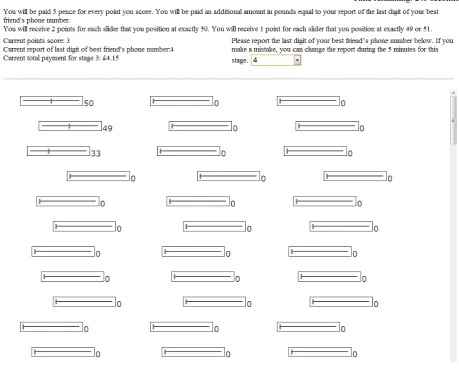
Figure 2 shows a screen of sliders as seen by the subjects. In this example, the subject has positioned one slider at 50 and one at 49, giving a points score of 3. As the task proceeds, the screen displays the subject’s current points score and the amount of time remaining. The slider task involves little randomness and the subject’s points score gives a finely gradated measure of performance or work output, which we term ‘productivity’.
14
All those who expressed an interest were given log in details and were able to participate. 683 subjects logged in, of which 42 failed to complete the experiment. Footnote 17 provides evidence that attrition was not related to the allocation to the different experimental conditions.
15
Gill and Prowse (2011b) provide details of how to implement the task, which has been used by Hetzel (2010), Bonein and Denant-Boemont (2011), Cettolin and Riedl (2011), Eacret et al. (2011), Gill and Prowse (2011a), Hammermann et al. (2011), Riener and Wiederhold (2011), Djawadi and Fahr (2012) and Monahan (2012).
16
Figure 2: Screenshot of Stage 3.
Note: Not all the sliders are displayed: the subject can scroll down to see more sliders.
2.2 Stage 1: Practice
In the first of the three stages, subjects were given two minutes to practice the slider task (with 102 sliders) and become familiar with it. This stage was not compensated.
2.3 Stage 2: Control and bonus treatment
In the second stage, subjects were given ten minutes to achieve a points score of 40 in the slider task (again with 102 sliders). We chose a long time limit to give the subjects more than ample time to achieve the required score, but subjects were aware that as soon as they reached a points score of 40 they would move on to the third and final stage and that if they did not achieve the score they would exit the experiment. Our experimental conditions varied how the subjects were compensated for completing the stage.
completing the stage. In the ‘Treatment’ condition (T), subjects were told that they would be paid £2 for completing the stage, and that there was a 50% chance they would earn a bonus
of an additional £6 for completing stage 2, in which case they would be paid a total of £8 for
completing the stage. The treated subjects were informed that a random number generator would decide randomly whether or not they had earned the bonus, and that they would find out the outcome after completing the stage. ‘Treatment 1’ (T1) refers to the subgroup of treated subjects who did not receive the bonus, and who were thus paid£2 for completing the stage. ‘Treatment
2’ (T2) refers to the subgroup of treated subjects who did receive the bonus, and who were thus paid a total of £8 for completing the stage. Subjects were randomly allocated to C1, C2, T1 or
T2 with equal probability.17
To summarize, we have a 2 (£2 or£8)×2 (fixed payment or bonus) between-subjects design.
In C1 the subjects earned £2 for sure. In C2 they earned £8 for sure. In T1 they earned £2,
but failed to receive a random bonus of£6. In T2 they earned£8, including a random bonus of £6. The design allows us to identify the causal effects of the random bonus: in Section 3.1 we
look at the causal effect of the bonus treatment on later cheating and productivity in stage 3, holding remuneration constant; in Section 3.2 we look at the causal effect of receiving the bonus on cheating and productivity.
2.4 Stage 3: Cheating and productivity
The third stage is designed to measure cheating and productivity. Subjects were given five minutes to work on the slider task (now with 201 sliders), and were paid£0.05 for every point they scored.
In addition, we asked the subjects to report the last digit of their best friend’s phone number and told them that they would be paid an amount in pounds equal to the number that they reported (we also gave them the option of reporting “don’t know”, which paid nothing). The subjects were informed that they could report the number at any time during the five minutes, that they could change their report if they made a mistake, and that the report at the end of the five minutes would determine payoffs.18
Figure 2 provides a screenshot of this stage.
Asking the subjects to report the last digit of their best friend’s number introduces an oppor-tunity for the subjects to cheat. By reporting a value higher than the true one, the subjects could raise their payoff without any possibility of detection. As discussed in Section 1.2, this aspect of the experimental design provides opportunities for both ‘soft’ and ‘hard’ cheating, and in so doing mimics the nature of many real-world cheating opportunities. Although we do not know
17
When subjects logged in to start the experiment, they were randomly allocated to C1, C2 or T, with 25% probability, 25% probability and 50% probability respectively. After completing stage 2, the subjects in T were randomly allocated to T1 or T2 with equal probability. Of the 641 subjects who completed the experiment, 152 were in C1, 183 in C2, 164 in T1 and 142 in T2. Of the 42 subjects who logged in but failed to complete the experiment, 11 dropped out during the practice stage before they were given any information about their payment scheme. Of the 31 who dropped out after the practice stage, 7 were in C1, 6 in C2 and 18 in T (16 of the 18 dropped out before discovering whether they had earned the bonus or not). The attrition rate in T was not significantly different to that in C (a t-test gives a 2-sidedp= 0.265 for the null that the attrition rates were the same), and within C the attrition rate in C1 was not significantly different to that in C2 (2-sidedp= 0.554).
18
the exact distribution of the last digit of people’s phone numbers, we can compare the average number reported by subjects who were in different control and treatment conditions in stage 2 to detect differences in cheating. Given the subjects have no compelling incentive to underreport, any increase in the average report can reasonably be interpreted as an increase in cheating.19
3
Results
We split our analysis into three parts. First, we look at the causal effect of the bonus treatment on later cheating and productivity. Second, we consider the causal effect of being paid a random bonus on cheating and productivity. Finally, we see whether there is a relationship between cheating and productivity in stage 3.
3.1 Effect of bonus treatment on cheating and productivity
In this section, we want to discover whether subjects exposed to the random bonus treatment T change their behavior, compared to subjects in the control C. Recall that the comparison holds remuneration constant, as subjects in C1 are paid the same as in T1 (£2) while those in C2 are
paid the same as in T2 (£8). To identify the causal effect of using random bonuses in stage 2
on cheating and productivity in stage 3, we regress three outcomes of interest on a dummy for the bonus treatment, namely: (i) the report of the last digit of each subject’s best friend’s phone number; (ii) an indicator of the report being greater than or equal to 7; and (iii) each subject’s points score in the slider task. In each case, we run the regression with and without a male control.
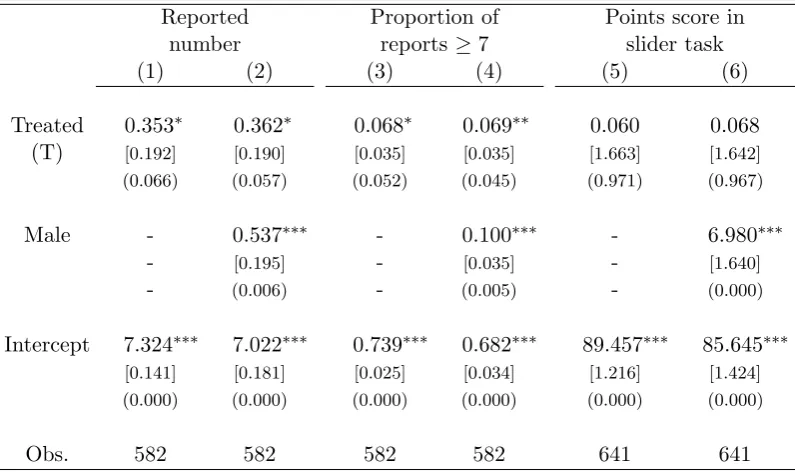
Table 1 shows that the bonus treatment induces more cheating but has no effect on pro-ductivity: subjects who have been exposed to the bonus treatment report significantly higher numbers on average (columns 1-2; 2-sided p = 0.057 with a male control) and are significantly
more likely to report a number greater than or equal to 7 (columns 3-4; 2-sidedp= 0.045 with a
male control), but do not work significantly harder (columns 5-6; 2-sided p= 0.967 with a male
control). Using random bonuses increases the average report by 5% and increases the proportion of subjects reporting a 7 or higher by 9%, but the increase in the average points score is less than 0.1% and not significant.20
,21 Given the large estimated magnitude of cheating in the workplace
and its implications for businesses (See Section 1.2), the increase in cheating that we find from
19
It is possible that some subjects underreported high numbers in order to avoid any suspicion of cheating. In common with experiments which identify cheating using reports of random outcomes such as coin flips or die rolls where the underlying distribution is known, we cannot identify such behavior, but we find it unlikely that it played an important role in our experiment.
20
Other papers have found that productivity in the slider task can be influenced by a variety of factors, including the size of the incentives and the productivity of the first-mover in a sequential tournament (Gill and Prowse, 2012), and by whether a subject won or lost in a previous round with repeated competition (Gill and Prowse, 2011a).
21
using random bonuses, if translated to real-world settings, is economically significant.22
In the light of evidence that firms often use bonus-based compensation that includes an important ran-dom component (see Section 1.2), this suggests that firms ought to take into account possible unintended consequences for worker honesty when designing bonus-based pay structures.
Reported Proportion of Points score in number reports≥7 slider task (1) (2) (3) (4) (5) (6) Treated 0.353∗ 0.362∗ 0.068∗ 0.069∗∗ 0.060 0.068
(T) [0.192] [0.190] [0.035] [0.035] [1.663] [1.642] (0.066) (0.057) (0.052) (0.045) (0.971) (0.967)
Male - 0.537∗∗∗ - 0.100∗∗∗ - 6.980∗∗∗
- [0.195] - [0.035] - [1.640]
- (0.006) - (0.005) - (0.000)
[image:12.595.99.497.152.388.2]Intercept 7.324∗∗∗ 7.022∗∗∗ 0.739∗∗∗ 0.682∗∗∗ 89.457∗∗∗ 85.645∗∗∗
[0.141] [0.181] [0.025] [0.034] [1.216] [1.424] (0.000) (0.000) (0.000) (0.000) (0.000) (0.000)
Obs. 582 582 582 582 641 641
Notes: (i)∗,∗∗and∗∗∗denote, respectively, significance at the 10%, 5% and 1% levels.
Heteroskedasticity-robust standard errors are in brackets. 2-sidedp-values are in parentheses. (ii) We weight the data to allow
for the fact that the ratio of subjects in C1 to C2 is not exactly the same as the ratio of subjects in T1 to T2 (see footnote 17). Table 4 in Appendix B shows that our results are robust to using the unweighted data. (iii) The first four columns include only the 582 subjects who reported a number. Table 5 in Appendix B shows that our results are robust to including all 641 subjects who completed the experiment, and so using money earned from the report as the dependent variable rather than the report itself. The effects are slightly larger in magnitude, but not quite as precisely estimated. (iv) The results in columns (3) and (4) are robust to running Probit or Logit regressions. (v) When we add a male-treatment interaction term to the specification in column 2, the coefficient on this additional term is not significantly different from zero. (vi) A Mann-Whitney test indicates that the distribution of the reported number for the control C is statistically different from that for the random bonus treatment T (2-sidedp= 0.086).
Table 1: Effect of bonus treatment: OLS regressions.
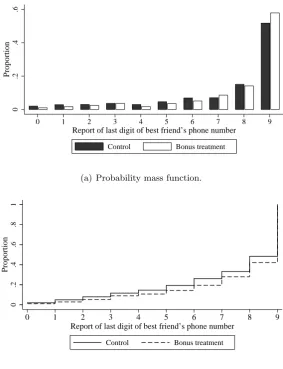
We can see visually the impact of the bonus treatment on cheating by inspecting the probabil-ity and cumulative distributions of the reported number in Figure 3. Figure 3(b) illustrates that the cumulative distribution of the reported number for subjects who have been exposed to the bonus treatment first-order stochastically dominates that for subjects exposed to the control. In Figure 3(a) we can see that about 55% of the subjects report 9, the number that maximizes earn-ings: a high but incomplete rate of cheating is consistent with the existing evidence on cheating more broadly (e.g., Fischbacher and Heusi, 2008). Our finding that males cheat more (positive
22
coefficients on the male dummy in columns 2 and 4 of Table 1, significant at the 1% level) also matches previous findings (Dreber and Johannesson, 2008; Conrads et al., 2013; Houser et al., 2012).
0
.2
.4
.6
Proportion
0 1 2 3 4 5 6 7 8 9
Report of last digit of best friend’s phone number
Control Bonus treatment
(a) Probability mass function.
0
.2
.4
.6
.8
1
Proportion
0 1 2 3 4 5 6 7 8 9
Report of last digit of best friend’s phone number
Control Bonus treatment
(b) Cumulative distribution function.
Figure 3: Effect of bonus treatment on distribution of reported number.
Notes: The distributions are for the 582 subjects who reported a number. The data are weighted as explained in the notes to Table 1.
3.2 Effect of receiving bonus on cheating and productivity
Next, we focus on the causal effect of receiving the random bonus on cheating and productivity. In Section 3.1, we looked at whether subjects exposed to the bonus treatment change their behavior, compared to the control subjects. Here we want to discover, within the subjects exposed to the bonus treatment in stage 2, whether those who received the random bonus (T2) change their behavior in stage 3 compared to those who did not receive the bonus (T1).
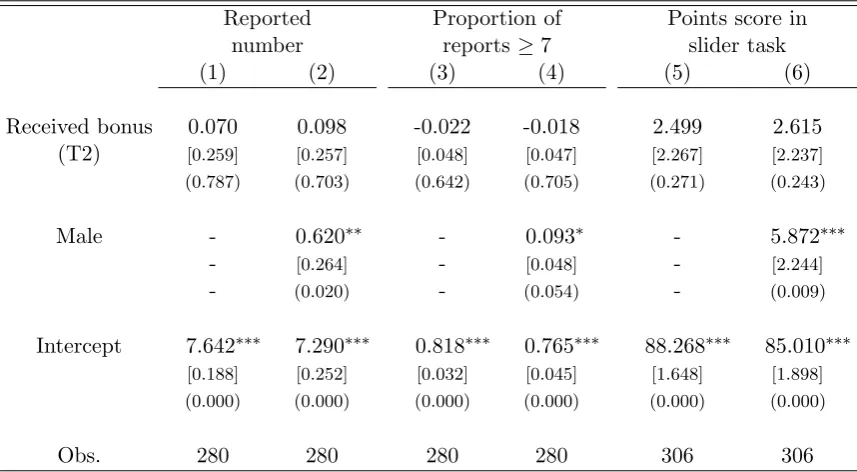
[image:13.595.156.440.134.504.2]produc-tivity. Receiving the bonus has a small positive effect on the average number reported, a small negative effect on the proportion of subjects reporting a 7 or higher, and a small positive effect on the average points score in the slider task, but none of the effects are close to being significant.23
The probability and cumulative distributions of the reported number in Figure 4 confirm visually the absence of any effect of receiving the bonus on cheating.
Reported Proportion of Points score in number reports≥7 slider task (1) (2) (3) (4) (5) (6) Received bonus 0.070 0.098 -0.022 -0.018 2.499 2.615
(T2) [0.259] [0.257] [0.048] [0.047] [2.267] [2.237] (0.787) (0.703) (0.642) (0.705) (0.271) (0.243)
Male - 0.620∗∗ - 0.093∗ - 5.872∗∗∗
- [0.264] - [0.048] - [2.244]
- (0.020) - (0.054) - (0.009)
[image:14.595.83.512.169.405.2]Intercept 7.642∗∗∗ 7.290∗∗∗ 0.818∗∗∗ 0.765∗∗∗ 88.268∗∗∗ 85.010∗∗∗
[0.188] [0.252] [0.032] [0.045] [1.648] [1.898] (0.000) (0.000) (0.000) (0.000) (0.000) (0.000)
Obs. 280 280 280 280 306 306
Notes: (i)∗,∗∗and∗∗∗denote, respectively, significance at the 10%, 5% and 1% levels.
Heteroskedasticity-robust standard errors are in brackets. 2-sided p-values are in parentheses. (ii) The first four columns
include only the 280 subjects exposed to the bonus treatment T who reported a number, while the final two include all 306 subjects exposed to T. (iii) The results in columns (3) and (4) are robust to running Probit or Logit regressions.
Table 2: Effect of receiving bonus: OLS regressions.
23
We also find that income does not affect cheating when we compare the behavior of all the subjects who earned
£2 (C1 and T1) to those who earned £8 (C2 and T2) and when comparing those who earned £2 in the Control
0
.2
.4
.6
Proportion
0 1 2 3 4 5 6 7 8 9
Report of last digit of best friend’s phone number
Did not receive bonus (T1) Received bonus (T2)
(a) Probability mass function.
0
.2
.4
.6
.8
1
Proportion
0 1 2 3 4 5 6 7 8 9
Report of last digit of best friend’s phone number
Did not receive bonus (T1) Received bonus (T2)
(b) Cumulative distribution function.
Figure 4: Effect of receiving bonus on distribution of reported number.
Note: The distributions are for the 280 subjects exposed to the bonus treatment T who reported a number.
In summary, the results presented above in Sections 3.1 and 3.2 reveal that the level of cheating depends on whether subjects were exposed to the bonus treatment, but not on whether they actually received the bonus. As discussed in Section 1.3, drawing on notions of procedural fairness and existing empirical evidence, a plausible interpretation is that subjects judge the random aspect of the bonus in the Treatment to be unjust, and reciprocate negatively in the form of more dishonesty.
3.3 Relationship between cheating and productivity
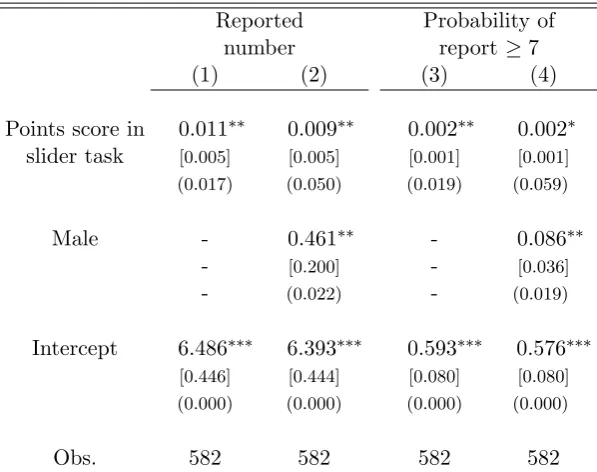
[image:15.595.157.442.74.440.2]of the report being greater than or equal to 7 on each subject’s points score in the slider task. Once again, we run the regressions with and without a male control. Table 3 shows that the more productive subjects also cheat more: a higher points score is positively associated with the reported number (columns 1-2; 2-sidedp= 0.050 with a male control) and the probability that a
subject reports a number greater than or equal to 7 (columns 3-4; 2-sidedp= 0.059 with a male
control). The regression coefficients imply that, on average, moving from the lowest points score of 32 to the highest points score of 159 is associated with an increase in the report of 22% and an increase in the probability of a subject reporting a 7 or higher of 43%.24
Reported Probability of number report ≥7 (1) (2) (3) (4) Points score in 0.011∗∗ 0.009∗∗ 0.002∗∗ 0.002∗
slider task [0.005] [0.005] [0.001] [0.001] (0.017) (0.050) (0.019) (0.059)
Male - 0.461∗∗ - 0.086∗∗
- [0.200] - [0.036]
- (0.022) - (0.019)
[image:16.595.148.447.215.451.2]Intercept 6.486∗∗∗ 6.393∗∗∗ 0.593∗∗∗ 0.576∗∗∗
[0.446] [0.444] [0.080] [0.080] (0.000) (0.000) (0.000) (0.000)
Obs. 582 582 582 582
Notes: (i)∗,∗∗and∗∗∗denote, respectively, significance at the 10%, 5% and 1% levels.
Heteroskedasticity-robust standard errors are in brackets. 2-sidedp-values are in parentheses. (ii) We include only the 582
subjects who reported a number. Table 6 in Appendix B shows that our results are robust to including all 641 subjects who completed the experiment, and so using money earned from the report as the dependent variable rather than the report itself. The effects are slightly larger in magnitude, but not quite as precisely estimated. (iii) The results in columns (3) and (4) are robust to running Probit or Logit regressions.
Table 3: Relationship between cheating and productivity: OLS regressions.
Our result that more productive workers cheat more is consistent with people who are more strongly motivated by money working harder in order to earn more and also being more tempted to cheat for personal gain. The result may also reflect that subjects’ self-control is eroded by working on the real-effort task. Alternatively, hard-working subjects may have felt that they deserved more for their labor. Further discussion of these mechanisms can be found in Section 1.3.
24
The relationship between cheating and productivity does not depend on whether subjects were exposed to the bonus treatment (T) or the control (C), and nor does the relationship depend on whether subjects were paid £2 (C1 and T1) or£8 (C2 and T2). When we run the regressions in Table 3 for subjects in C only or for subjects in
4
Conclusion
Despite their importance, employee cheating and crime have received insufficient attention by economists. Our analysis contributes to a burgeoning literature that examines the interaction between compensation schemes and cheating in the workplace, and we are the first to investigate a link between productivity and dishonesty. Our findings are consistent with workers perceiving exposure to random bonuses as unfair, providing a justification for negative reciprocity in the form of increased cheating. Thus, bonus-based compensation may have important unintended side-effects that have not been highlighted sufficiently in the existing literature, which has instead focused mainly on the incentive effects of bonuses.25
Complementary field evidence and replication of our novel experimental findings in laboratory studies would be of particular value to determine the degree to which our results extend to different work tasks and to bonus schemes used in practice.
25
Appendix
A
Experimental instructionsLog In
You are being asked to take part in an experiment on economic decision-making. The experiment will last about 20 to 25 minutes. We are very grateful for your participation. You will be paid a participation fee of £3 for completing the experiment. You will also have the opportunity to
earn additional money. Your earnings today will depend on your own actions and some element of chance. Further details will be provided during the experiment. You will be able to come to Room 3115 in Building 58 (Murray Building - Highfield Campus) between 9am and 6pm on Thursday 26 May or Wednesday 1 June to collect your payment for the experiment. You will be paid in cash. If you cannot come on one of these days, please do not participate. Please complete the experiment on a desktop or laptop computer. Tablet computers, iPads, iPhones etc. will not work properly. You must not press any of your browser buttons (e.g., stop, refresh, reload, back, forward) at any time. If you do so, you will exit the experiment and you will not be paid anything. Please do not use your keyboard: use only your mouse or touchpad. Once you log in to start the experiment, you must complete it in one go. If you leave the experiment, you cannot return and you will not be paid anything. You have the right to withdraw from the experiment at any time. If you withdraw from the experiment, you will not be paid anything. If you have a technical problem during the experiment please contact: [email protected]. If you have forgotten your password, or for any other query, please contact: [email protected]. If you wish to participate now, please enter your username and password below. [Box to enter previously provided username and password] Note, if you have trouble logging in using Firefox, please follow the troubleshoot [Web link]. Alternatively, you can use the Google Chrome browser or use a computer in the computing room at the Hartley Library.
Instructions - General Overview
You must not press any of your browser buttons (e.g., stop, refresh, reload, back, forward) at any time. If you do so, you will exit the experiment and you will not be paid anything. Please do not use your keyboard: use only your mouse or touchpad. The experiment will consist of 3 stages. At the start of each stage, you will receive instructions about that stage. What you do in stage 1 will not affect what happens in stages 2 and 3, and what you do in stage 2 will not affect what happens in stage 3. As is the case in all economics experiments, we will not deceive you in any way during the experiment. In particular, this means that we will not give you any false information at any time during the experiment. [“Proceed” button] Button will enable in 50 seconds. Once the button is enabled, please press it to proceed when you are ready.
Instructions - The Task
as far as 100. Each slider has a number to its right showing its current position. You can use your mouse or touchpad in any way you like to move each slider. You can readjust the position of each slider as many times as you wish. All the sliders will be on one page, but you may need to scroll down the page to see them all. You will receive 2 points for each slider that you position at exactly 50. You will receive 1 point for each slider that you position at exactly 49 or 51. Your “points score” in the task will be your total number of points. During the task, a number of pieces of information will appear at the top of your screen, including the time remaining and your points score in the task so far. [“Proceed” button] Button will enable in 90 seconds
Stage 1 out of 3: Instructions
In stage 1 you will have 2 minutes to practice the task. The purpose of this stage is purely to allow you to practice the task. Therefore, you will not be paid for this stage. [“Start Practice” button] Button will enable in 20 seconds
Stage 2 out of 3: Instructions
To complete stage 2 you must reach a points score of 40 in the task within 10 minutes. As soon as you reach a points score of 40 you will proceed immediately to the next screen. {C1: You will be paid£2 for completing stage 2.} {C2: You will be paid £8 for completing stage 2.} {T1
and T2: You will be paid £2 for completing stage 2. There is also a 50% chance that you will
earn a bonus of an additional £6 for completing stage 2. If you earn the bonus, you will thus be
paid a total of £8 = £2 + £6 for completing the stage. A computer will use a random number
generator to decide randomly whether or not you have earned the bonus for completing stage 2. You will find out whether you have earned the bonus only after completing the stage.}If you fail to complete stage 2 within 10 minutes you will leave the experiment automatically and you will not be paid anything. [“Start Stage 2” button] Button will enable in 90 seconds
Stage 2 out of 3: Summary of payment
{C1: Your payment for completing stage 2 is £2.} {C2: Your payment for completing stage
2 is £8.} {T1: Remember that there was a 50% chance that you would earn a bonus of £6 for
completing stage 2. You did not earn the bonus. Your payment for completing stage 2 is£2.}{T2:
Remember that there was a 50% chance that you would earn a bonus of £6 for completing stage
2. You did earn the bonus. Your payment for completing stage 2 is £8.} [“Proceed” button]
Button will enable in 45 seconds Stage 3 out of 3: Instructions
during the 5 minutes for this stage. If you make a mistake, you can change your report during the 5 minutes. At the end of the 5 minutes your report will be final. If you do not know or cannot find your best friend’s phone number, please select the “don’t know” option. Your payment for stage 3 will then depend only on your points score in the task. [“Start Stage 3” button] Button will enable in 90 seconds
B
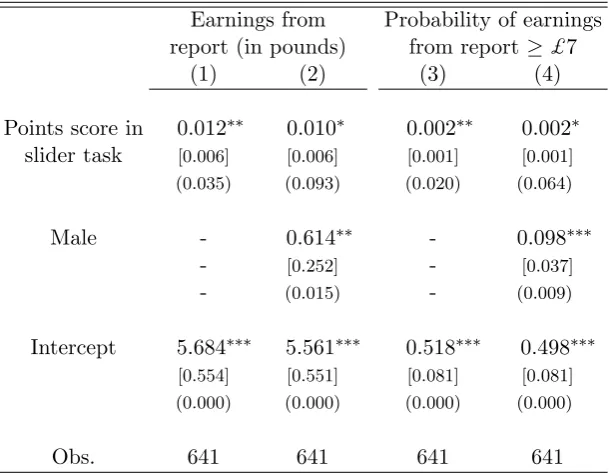
RobustnessWe collect here three tables that are referred to in the notes to Tables 1 and 3 as providing robustness checks.
Reported Proportion of Points score in number reports≥7 slider task (1) (2) (3) (4) (5) (6) Treated 0.354∗ 0.364∗ 0.069∗∗ 0.071∗∗ -0.160 -0.114
(T) [0.192] [0.191] [0.035] [0.034] [1.667] [1.645] (0.066) (0.057) (0.048) (0.041) (0.924) (0.945)
Male - 0.535∗∗∗ - 0.099∗∗∗ - 7.031∗∗∗
- [0.195] - [0.035] - [1.638]
- (0.006) - (0.005) - (0.000)
[image:20.595.98.496.254.490.2]Intercept 7.321∗∗∗ 7.018∗∗∗ 0.738∗∗∗ 0.682∗∗∗ 89.588∗∗∗ 85.706∗∗∗
[0.141] [0.180] [0.025] [0.034] [1.214] [1.418] (0.000) (0.000) (0.000) (0.000) (0.000) (0.000)
Obs. 582 582 582 582 641 641
Notes: All results are from OLS regressions. ∗,∗∗ and ∗∗∗ denote, respectively, significance at the 10%,
5% and 1% levels. Heteroskedasticity-robust standard errors are in brackets. 2-sided p-values are in
parentheses.
Earnings from Proportion of earnings report (in pounds) from report≥£7
(1) (2) (3) (4) Treated 0.413∗ 0.414∗ 0.071∗∗ 0.071∗∗
(T) [0.243] [0.242] [0.036] [0.036] (0.089) (0.087) (0.050) (0.049)
Male - 0.682∗∗∗ - 0.111∗∗∗
- [0.245] - [0.036]
- (0.006) - (0.003)
[image:21.595.162.435.70.304.2] [image:21.595.146.452.408.645.2]Intercept 6.619∗∗∗ 6.247∗∗∗ 0.668∗∗∗ 0.607∗∗∗
[0.174] [0.226] [0.026] [0.034] (0.000) (0.000) (0.000) (0.000)
Obs. 641 641 641 641
Notes: (i) All results are from OLS regressions. ∗,∗∗ and ∗∗∗ denote, respectively, significance at the
10%, 5% and 1% levels. Heteroskedasticity-robust standard errors are in brackets. 2-sidedp-values are in
parentheses. (ii) Since we include the subjects who did not report a number, the dependent variable is money earned from the report rather than the report itself.
Table 5: Robustness (columns 1-4 of Table 1): all 641 subjects. Earnings from Probability of earnings report (in pounds) from report ≥£7
(1) (2) (3) (4) Points score in 0.012∗∗ 0.010∗ 0.002∗∗ 0.002∗
slider task [0.006] [0.006] [0.001] [0.001] (0.035) (0.093) (0.020) (0.064)
Male - 0.614∗∗ - 0.098∗∗∗
- [0.252] - [0.037]
- (0.015) - (0.009)
Intercept 5.684∗∗∗ 5.561∗∗∗ 0.518∗∗∗ 0.498∗∗∗
[0.554] [0.551] [0.081] [0.081] (0.000) (0.000) (0.000) (0.000)
Obs. 641 641 641 641
Notes: (i) All results are from OLS regressions. ∗,∗∗ and ∗∗∗ denote, respectively, significance at the
10%, 5% and 1% levels. Heteroskedasticity-robust standard errors are in brackets. 2-sidedp-values are in
parentheses. (ii) Since we include the subjects who did not report a number, the dependent variable is money earned from the report rather than the report itself.
C
Further statisticsThis Appendix contains additional summary statistics as well as the cumulative distributions of the reported number for C1 and C2 not provided in the main text.
Treatment Number of Points score Reported Proportion of subjects in slider task number reports≥7
Mean (SD) Mean (SD)
Control 1 (C1) 141 88.1 (21.6) 7.36 (2.4) 0.74 Control 2 (C2) 161 91.1 (22.1) 7.29 (2.5) 0.73 Treatment 1 (T1) 148 88.2 (21.3) 7.64 (2.3) 0.82 Treatment 2 (T2) 132 91.2 (18.9) 7.71 (2.1) 0.80
[image:22.595.128.470.153.254.2]Notes: The data are for the 582 subjects who reported a number. Standard deviations (SD) are in parentheses.
Table 7: Additional summary statistics.
0
.2
.4
.6
.8
1
Proportion
0 1 2 3 4 5 6 7 8 9
Report of last digit of best friend’s phone number
C1 C2
[image:22.595.157.441.360.524.2]References
Abdolmohammadi, M.J.andBaker, C.R.(2007). The relationship between moral reasoning and plagiarism in accounting courses: A replication study. Issues in Accounting Education, 22(1): 45–55
Abeler, J., Becker, A., and Falk, A. (2012). Truth-telling – A representative assessment.
Mimeo, University of Oxford
ACFE (2012). Report to the Nations on Occupational Fraud and Abuse: 2012 Global Fraud
Study. Association of Certified Fraud Examiners, TX: Austin
Bertrand, M. andMullainathan, S. (2001). Are CEOs rewarded for luck? The ones without principals are. Quarterly Journal of Economics, 116(3): 901–932
Bhattacherjee, D. (2005). The effects of group incentives in an Indian firm: Evidence from payroll data. Labour, 19(1): 147–173
Bonein, A.andDenant-Boemont, L.(2011). Temptation, commitment and peer pressure: A laboratory experiment. Mimeo, University of Rennes
Bucciol, A.and Piovesan, M. (2011). Luck or cheating? A field experiment on honesty with children. Journal of Economic Psychology, 32(1): 73–78
Burns, N. and Kedia, S. (2006). The impact of performance-based compensation on misre-porting. Journal of Financial Economics, 79(1): 35–67
Cadsby, C.B.,Song, F., andTapon, F.(2010). Are you paying your employees to cheat? An experimental investigation. B.E. Journal of Economic Analysis & Policy, 10(1): Article 35
Cettolin, E. and Riedl, A.(2011). Fairness and uncertainty. Mimeo, Maastricht University
Charness, G. and Dufwenberg, M. (2006). Promises and partnership. Econometrica, 74(6): 1579–1601
Charness, G.and Garoupa, N.(2000). Reputation, honesty, and efficiency with insider infor-mation: An experiment. Journal of Economics & Management Strategy, 9(3): 425–451
Charness, G. and Levine, D.I. (2007). Intention and stochastic outcomes: An experimental study. Economic Journal, 117(522): 1051–1072
Chen, C.X.andSandino, T.(forthcoming). Can wages buy honesty? The relationship between relative wages and employee theft. Journal of Accounting Research
Chow, C.W.,Hirst, M.K., and Shields, M.D. (1994). Motivating truthful subordinate re-porting: An experimental investigation in a two-subordinate context.Contemporary Accounting
Research, 10(2): 699–720
Cojoc, D. and Stoian, A. (2012). Dishonesty and charitable behavior. Mimeo, University of Iowa
Conrads, J., Irlenbusch, B., Rilke, R.M., and Walkowitz, G. (2013). Lying and team incentives. Journal of Economic Psychology, 34: 1–7
Core, J.E.and Guay, W.R. (2001). Stock option plans for non-executive employees. Journal
of Financial Economics, 61(2): 253–287
Coricelli, G., Joffily, M., Montmarquette, C., and Villeval, M.C. (2010). Cheating, emotions, and rationality: An experiment on tax evasion. Experimental Economics, 13(2): 226–247
Croson, R., Boles, T., and Murnighan, J. (2003). Cheap talk in bargaining experiments: lying and threats in ultimatum games. Journal of Economic Behavior & Organization, 51(2): 143–159
Curry, P.A. and Mongrain, S.(2009). Deterrence in rank-order tournaments. Review of Law
& Economics, 5(1): 723–740
Dickens, W.T.,Katz, L.F.,Lang, K., andSummers, L.H.(1989). Employee crime and the monitoring puzzle. Journal of Labor Economics, 7(3): 331–347
Djawadi, B.M. and Fahr, R. (2012). The impact of tax knowledge and budget spending influence on tax compliance. Mimeo, University of Paderborn
99(1): 197–199
Eacret, N.D.,Lafferty, N.C., andJhunjhunwala, T.(2011). When is inequality fair? Mimeo, University of Texas at Dallas
Efendi, J., Srivastava, A., and Swanson, E. (2007). Why do corporate managers misstate financial statements? The role of option compensation and other factors. Journal of Financial
Economics, 85(3): 667–708
Eisenberger, R. and Shank, D.M. (1985). Personal work ethic and effort training affect cheating. Journal of Personality and Social Psychology, 49(2): 520–528
Eisenkopf, G., Gurtoviy, R., and Utikal, V. (2011). Size matters - when it comes to lies.
IAAEG Discussion Paper 02/2011
Erat, S.and Gneezy, U. (2012). White lies. Management Science, 58(4): 723–733
Evans III, J.H., Hannan, R.L., Krishnan, R., and Moser, D.V. (2001). Honesty in managerial reporting. Accounting Review, 76(4): 537–559
Fischbacher, U. and Heusi, F. (2008). Lies in disguise: An experimental study on cheating.
TWI Research Paper 40
Fischbacher, U.and Utikal, V. (2011). Disadvantageous lies. TWI Research Paper 71
Gill, D.and Prowse, V.(2011a). Gender differences and dynamics in competition: The role of luck. Department of Economics Discussion Paper 564, University of Oxford
Gill, D. and Prowse, V. (2011b). A novel computerized real effort task based on sliders. IZA Discussion Paper 5801
Gill, D. and Prowse, V. (2012). A structural analysis of disappointment aversion in a real effort competition. American Economic Review, 102(1): 469–503
Gilpatric, S.M.(2011). Cheating in contests. Economic Inquiry, 49(4): 1042–1053
Gino, F.,Schweitzer, M.E.,Mead, N.L., andAriely, D.(2011). Unable to resist temptation: How self-control depletion promotes unethical behavior. Organizational Behavior and Human
Decision Processes, 115(2): 191–203
Gneezy, U. (2005). Deception: The role of consequences. American Economic Review, 95(1): 384–394
Greenberg, J.(1990). Employee theft as a reaction to underpayment inequity: The hidden cost of pay cuts. Journal of Applied Psychology, 75(5): 561–568
Grover, S.L. (1993). Lying, deceit, and subterfuge: A model of dishonesty in the workplace.
Organization Science, 478–495
Gubler, T.,Larkin, I.I., andPierce, L.(2013). The dirty laundry of employee award programs: Evidence from the field. Harvard Business School Working Paper No. 13–069
Hall, B.J. and Liebman, J.B. (1998). Are CEOs really paid like bureaucrats? Quarterly
Journal of Economics, 113(3): 653–691
Hammermann, A.,Mohnen, A., andNieken, P. (2011). Whom to choose as a team mate? A lab experiment about in-group favouritism. IZA Discussion Paper 6286
Hansen, D. (1997). Worker performance and group incentives: A case study. Industrial and
Labor Relations Review, 51(1): 37–49
Hao, L. and Houser, D. (2011). Honest lies. ICES Discussion Paper 2011-03, George Mason University
Hetzel, S.(2010). The impact of financial incentives on individual performance: An experimental approach. Diplomarbeit, University of Mannheim
Houser, D., Vetter, S., and Winter, J. (2012). Fairness and cheating. European Economic
Review, 56(8): 1645–1655
Jacob, B.A. and Levitt, S.D. (2003). Rotten apples: An investigation of the prevalence and predictors of teacher cheating. Quarterly Journal of Economics, 118(3): 843–877
Jensen, M.C. (2001). Corporate budgeting is broken - let’s fix it. Harvard Business Review, 79(10): 94–101
Jensen, M.C. (2003). Paying people to lie: The truth about the budgeting process. European
Kaur, S.,Kremer, M., and Mullainathan, S. (2011). Self-control at work. Mimeo, Harvard University
Knez, M.andSimester, D.(2001). Firm-wide incentives and mutual monitoring at Continental Airlines. Journal of Labor Economics, 19(4): 743–772
Konow, J.(2003). Which is the fairest one of all? A positive analysis of justice theories.Journal
of economic literature, 41(4): 1188–1239
Lammers, J.,Stapel, D., andGalinsky, A. (2010). Power increases hypocrisy. Psychological
Science, 21(5): 737–744
Larkin, I.I.(forthcoming). The cost of high-powered incentives: Employee gaming in enterprise software sales. Journal of Labor Economics
Lazear, E.P. and Rosen, S. (1981). Rank-order tournaments as optimum labor contracts.
Journal of Political Economy, 89(5): 841–864
Lewis, A., Bardis, A., Flint, C., Mason, C., Smith, N., Tickle, C., and Zinser, J.
(2012). Drawing the line somewhere: An experimental study of moral compromise. Journal of
Economic Psychology, 33(4): 718–725
Lundquist, T., Ellingsen, T., Gribbe, E., and Johannesson, M. (2009). The aversion to lying. Journal of Economic Behavior & Organization, 70(1-2): 81–92
Matuszewski, L.J. (2010). Honesty in managerial reporting: Is it affected by perceptions of horizontal equity? Journal of Management Accounting Research, 22(1): 233–250
Mazar, N.,Amir, O., and Ariely, D. (2008). The dishonesty of honest people: A theory of self-concept maintenance. Journal of Marketing Research, 45(6): 633–644
Mead, N.L., Baumeister, R.F., Gino, F., Schweitzer, M.E., andAriely, D. (2009). Too tired to tell the truth: Self-control resource depletion and dishonesty. Journal of Experimental
Social Psychology, 45(3): 594–597
Moers, F. (2005). Discretion and bias in performance evaluation: the impact of diversity and subjectivity. Accounting, Organizations and Society, 30(1): 67–80
Monahan, J.(2012). We’re all Lockeans now: A test of the prevalence of just-desert consider-ations in a dictator game experiment. M.Phil. Thesis, University of Oxford
Nagin, D.S.,Rebitzer, J.B.,Sanders, S., andTaylor, L.J.(2002). Monitoring, motivation, and management: The determinants of opportunistic behavior in a field experiment. American
Economic Review, 92(4): 850–873
Ordonez, L.D.,Schweitzer, M.E.,Galinsky, A.D., and Bazerman, M.H. (2009a). Goals gone wild: The systematic side effects of overprescribing goal setting. Academy of Management
Perspectives, 23(1): 6–16
Ordonez, L.D., Schweitzer, M.E., Galinsky, A.D., and Bazerman, M.H. (2009b). On good scholarship, goal setting, and scholars gone wild. Academy of Management Perspectives, 23(3): 82–87
Oyer, P.(2004). Why do firms use incentives that have no incentive effects? Journal of Finance, 59(4): 1619–1650
Oyer, P. andSchaefer, S.(2005). Why do some firms give stock options to all employees?: An empirical examination of alternative theories. Journal of financial Economics, 76(1): 99–133
Riener, G. and Wiederhold, S. (2011). On social identity, subjective expectations, and the costs of control. Jena Economic Research Paper 2011–035
Schweitzer, M.E., Ordonez, L., and Douma, B. (2004). Goal setting as a motivator of unethical behavior. Academy of Management Journal, 47(3): 422–432
Schwieren, C. and Weichselbaumer, D. (2010). Does competition enhance performance or cheating? A laboratory experiment. Journal of Economic Psychology, 31(3): 241–253
Shalvi, S.,Dana, J.,Handgraaf, M.J.J., andDe Dreu, C.K.W.(2011). Justified ethicality: Observing desired counterfactuals modifies ethical perceptions and behavior. Organizational
Behavior and Human Decision Processes, 115(2): 181–190
Suri, S., Goldstein, D.G., and Mason, W.A. (2011). Honesty in an online labor market.
Human Computation: Papers from the 2011 AAAI Workshop (WS-11-11)
Trautmann, S.T.(2009). A tractable model of process fairness under risk. Journal of Economic
Psychology, 30(5): 803–813
Waller, W.S. and Bishop, R.A. (1990). An experimental study of incentive pay schemes, communication, and intrafirm resource allocation. Accounting Review, 65(4): 812–836
Wang, J.T.,Spezio, M., andCamerer, C.F.(2010). Pinocchio’s pupil: Using eyetracking and pupil dilation to understand truth telling and deception in sender-receiver games. American
Economic Review, 100(3): 984–1007