Labour-use Eciency in the Italian
Machinery Industry: a Non-parametric
Stochastic Frontier Perspective
Ferrara, Giancarlo and Vidoli, Francesco and Canello,
Jacopo and Campagna, Arianna
SOSE - Soluzioni per il sistema economico SpA
2013
A non-parametric stochastic frontier for the
analysis of labour-use efficiency in the Italian
machinery industry
Giancarlo Ferrara
Francesco Vidoli
Arianna Campagna
Jacopo Canello
SOSE - Soluzioni per il Sistema Economico S.p.A.
E-mail: [email protected], [email protected], [email protected] [email protected]
Summary: Firms’ efficiency is a mainstream in the study of economic growth. Within this broad research area, the present work, conducted as part of the research activities of SOSE S.p.A., analyses the labour-use efficiency in the Italian machinery industry through the application of a non-parametric stochastic frontier model with the aim of suggesting new insights to better understand the recent dynamics of the Italian manufac-turing system. An extended panel data of manufacmanufac-turing Small and Medium Enterprises (SMEs) operating in the mechanical industry for the period2002-2012has been ex-tracted (in anonymous form) from the Italian Ministry of Economy and Finance annual survey and used for the implementation of the proposed method. Results show the pres-ence of a persistent level of labour-use inefficiency in the sample used for the analysis: this issue is particularly evident for the subset of firms using non standard jobs, while firms entitled to access to wage redundancy fund appear to have achieved higher levels of efficiency in labour input use on average. The analysis also shows that the inefficiency gap between the two subsets of firms tends to reduce in absolute terms over time.
Keywords:Labour-use efficiency; Stochastic frontier; SMEs; GAM; Splines.
1. Introduction
The measurement of productive efficiency and productivity growth has received in-creasing attention in the econometrics literature with particular emphasis on model esti-mation. Following this recent trend, the present research1aims at evaluating the different
1
labour-use efficiency for a given set of Italian manufacturing firms through a stochastic frontier approach (Kumbhakar and Hjalmarsson, 1995).
Parametric stochastic frontier models introduced by Aigneret al.(1977) and Meeusen and van den Broeck (1977) specify output in terms of a response function and a com-posite error term. The comcom-posite error term consists of a two-sided error representing random effects and a one-sided term capturing technical inefficiency. Since the introduc-tion of this model, several attempts to improve the structure of the original specificaintroduc-tion have appeared in the literature (for extensive reviews of this topic, see: Kumbhakar and Lovell, 2000; Greene, 2008).
Despite its limited computational complexity, the stochastic frontier approach has an im-portant drawback: the lack of flexibility. Indeed, the assumptions about the functional form of the frontier are often too restrictive and not always appropriated: this issue can introduce substantial bias and might lead to misleading conclusions about the actual re-lationship between inputs and output. To overcome this problem, we adopt in this paper a flexible estimation of the frontier modelled by a Generalized Additive Model (GAM), relaxing the linear assumption about the link between fitted values and the linear predic-tor (Vidoli and Ferrara, 2014).
The paper is structured as follows: in section2, efficiency methods are discussed and the GAM stochastic frontier specification is introduced; in section3, the results of the em-pirical application are presented; in section4, the main conclusions from the study are drawn and the potential implications of the empirical findings and directions for future research in this area are provided.
2. The GAM Stochastic Frontier Specification
The determination of technical efficiency is based on the prior knowledge of the so-called “production function”; this preliminary information allows one to associate the production process of individual units to theoptimallevel of output. The measure of the distance of each unit from the frontier is the most immediate way to assess its efficiency (Farrell, 1957).
However, both the production function and the efficient frontier are generally unknown, while a limited set of information is available for each production unit. It is therefore essential to develop techniques to estimate the production frontier.
In literature, the specification and the estimation of production frontier functions are usually carried out through the two following approaches:
• Stochastic Frontier Analysis (SFA)(Aigneret al., 1977; Meeusen and van den Broeck, 1977) - Deterministic Frontier Analysis (DFA) (Aigner and Chu, 1968);
• Data Envelopment Analysis (DEA) (Farrell, 1957; Charneset al., 1978) - Free Disposal Hull (FDH) (Deprinset al., 1984; Grosskopf, 1996).
non-parametric (DEA, FDH) methods, respectively. In the first case thea priorispecification of an explicit functional form for the boundary of the production set is required; on the other hand, the nonparametric analysis is characterized by the possibility to determine the relative efficiency of such units through linear programming, without specifying the functional form for the production function. In other words, unlike parametric tech-niques, the DEA-FDH approach allows the determination of the relative efficiency of each decision-making unit when relevant information on the production process is not available; however, when the marginal substitution rate between inputs is known,value judgementscan be added into the optimization problem; in this context, F¨areet al.(1989) have proposed a modification of the DEA model for estimating capacity utilization as-suming constrained use of variable inputs.
Despite the benefits in terms of flexibility and generalization, the main drawback of DEA (or FDH) is its deterministic nature. Indeed, this methodology does not allow one to assess whether efficiency gaps, namely the distance between observed and maximum possible output, are due to technical inefficiency or rather to disturbance effects of an accidental type (Greene, 2008). Therefore, it is not possible to determine whether in-efficiency is due to factors that are independent of the entrepreneur actions(e.g. a dry season that has negative consequences on the performance of the farmers) or is rather explained by other reasons such as the lack of management skills.
The parametric model with stochastic production frontier (SFA) allows one to over-come some of the main drawbacks of the classical DFA by discriminating between the efficiency term and an error term which includes sources of inefficiency that are not di-rectly attributable to the production function or disturbances of an accidental type; over against, the most important drawback associated with the SFA approach is the lack of flexibility associated with the specification of the production function.
In this paper, the above mentioned issues associated with parametric and nonparametric approaches are addressed by introducing a novel semiparametric specification based on a Generalize Additive Model (GAM) framework; the main benefit of this methodology is the possibility to avoid the choice of a particular specification of the production function. IndicatingLas the employment level (number of employees),Y as the production output (turnover),T as the trend variable (year) andK as the capital stock, the labour requirement function introduced by Kumbhakar and Zhang (2013) can be written as:
L=h(Y, K, T). (1) The relevant stochastic frontier model with panel data becomes, in general terms, as:
ln(Lit) =h(ln(Kit),ln(Yit), T;β) +vit+uit, (2)
noise anduit ≥ 0 is a one-sided error term reflecting technical inefficiency. In
ap-plications, the two-sided error term is generally assumed to be normally distributed
vit ∼ N(0, σ2v), while several assumptions have been made for the one-sided
compo-nent (e.g. half-normal, truncated (other than at zero) normal, gamma and exponential). Following common practice, we assume that: (i)uis distributed as an half-normal on the non-negative part of the real number line (uit ∼ |N(0, σ2u)|) and (ii)v anduare
identically and independently distributed (iid).
Regarding the production function, the most commonly used specifications in em-pirical studies are the Cobb-Douglas and the translog forms. These functions are widely diffused in economic theory and their properties lead to direct interpretability of the esti-mation results. However, their use can often generate overparameterized model specifi-cations: in many cases, the specifications used are at best just convenient approximations of the unknown frontier function, and their adoption may lead to incorrect interpretations of the efficiency patterns.
The specification proposed in this paper considers a more flexible estimate of the fron-tier (2) by considering the relevant conditional expectation ofh(·), namelyhm(·), as a
Generalized Additive Model. In general terms a GAM specification forhm(·), given a
set ofpcovariatesX1, X2, . . . , Xp, may be written as:
hm(X1, X2, . . . , Xp) =α+ X
j
fj(Xj), (3)
where thefjs are allowed to be arbitrary nonlinear functions of the set of covariates
(Hastie and Tibshirani, 1990). Additive models retain most of the desirable properties of linear models, while increasing computational flexibility. One of the main benefits of linear models is that they are fairly straightforward to interpret: in order to know how the prediction changes in response toXj, one only needs to knowβj while the partial
response functionfjplays the same role in an additive model.
For the estimation of the stochastic frontier model (2) we consider the following two-step procedure as proposed by Olsonet al.(1980):
1. estimation of the conditional expectationhm = E(L|Y, K, T)(i.e. the “mean”
frontier) of the model (2) by means of GAMs (3);
2. estimation of the error term parameters (σv, σu) using the method of moments
approach.
More specifically, thefjs smooth functions are represented using thin plate
regres-sion splines with smoothing parameters selected by the Generalized Cross Validation (GCV) criterion:n∗D/(n−DoF)2, whereDis the deviance,nis the number of data
andDoF are the effective degrees of freedom of the model. Following this approach, the knot placement issue of conventional regression spline modelling is specifically ad-dressed (see Wood, 2006, for further details).
After obtaining the “mean” frontierE(Y|dX=x), the estimated production func-tionh(·)is obtained by shifting downwards the estimation of the conditional expectation by an amount equal to the average estimate of the expected value of the inefficiency term (Kumbhakar and Lovell, 2000).
Having obtained the pseudo maximum-likelihood estimates of the parameter σv and
σu, the next step is to estimate the technical efficiency of each unit. In this context,
Jondrowet al.(1982) propose to derive the conditional distribution of the componentu
with respect to the compound errorε=v−uas follows:
fu|ε(u|ε) =
1
√
2πσ∗ ·
expn−(u−2σµ∗∗)2
o
1−Φ −µ∗
σ∗
,
whereµ∗=−σ2uε/σ2eσ∗2=σu2σv2/σ2; consequently, a point estimator ofuiis:
E(u|ε) = σλ 1 +λ2
φ(z)
1−Φ(z)−z
, z= ελ
σ, (4)
whereλ=σu/σvandσ = p
σ2
u+σ2v; as usual in frontier models, if the response is
measured in logs, the relative estimates of technical efficiency for each unit are obtained by:
T Ei= exp{−uˆi}. (5)
Frontier models have a number of consistency properties: the most relevant assump-tions about the underlying production function are monotonicity and concavity. In gen-eral, a multi factors - multi products production technology can be formulated with respect to the set of production possibilities, defined as the technically feasible combi-nation set (Ψ) of(x, y). The most common assumptions onΨare:
1. Weak essentiality. This hypothesis requires positive amounts of input to be used in order to produce a positive amount of output. In other words, this hypothesis ensures that any non-negative level of input can produce at least a zero level of output and the production of positive output is impossible without at least one input(x,0M) ∈ Ψ, but ify ≥ 0 ⇒ (0K, y) 6∈ Ψ. This assumption is usually
replaced by a stronger assumption in a situations where every input is essentially for production;
3. Ψis a non-empty set;
4. Scarcity. This ensures that a finite amount of input does not produce infinite quan-tities of output, formally implying that for eachx,Ψis upper bounded.
5. Input free disposal. This implies that it is possible to eliminate inputs without cost; formally if(x1, y)∈Ψandx2≥x1⇒(x2, y)∈Ψ;
6. Output free disposal. It guarantees the possibility of an output reduction; formally if(x, y1)∈Ψandy2≤y1⇒(x, y2)∈Ψ;
7. Ψis a convex set.
[image:7.595.164.359.381.494.2]Regarding monotonicity, properties (5) and (6) imply the existence of inefficient combinations of input and output. This assumption, in other terms, implies that if a productive unit is capable to transform a given amount of input into a given level of output, a greater amount of input will always lead to at least the same amount of output. Moreover, the monotonicity assumption implies that the optimal combination between inputs and between outputs can be achieved without cost: for this reason this hypothesis is usually also calledfree disposal(see Figure 1).
Figure 1. Free disposal hull
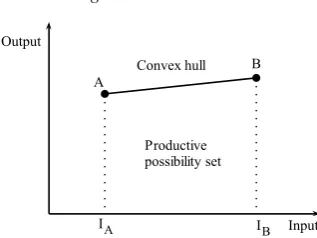
The convex assumption (7), instead, arises from the following question: given two differentDMU, what can you say about the feasibility of the input-output combinations that lie between these two observations? In classical models this issue is addressed by assuming that the production possibility set is convex, implying that the convex hull of the two units lies in the set of production possibilities (see Figure 2).
Figure 2. Convex hull
The convexity assumption (7) is a consequence of decreasing marginal returns to scale in the theory of production and ensures that, in the whole production set, two or more input-output linear combinations are always possible.
As outlined by previous contributions proposed in literature about the two step pro-cedures (Olsonet al., 1980; Fan et al., 1996), the method here considered does not impose any constraints on the fitted frontier; this approach is consistent with the recent work of Kumbhakaret al.(2007) who proposed a nonparametric stochastic frontiers by a local maximum likelihood approach that does not assume monotonicity and concavity. Since monotonicity and concavity restrictions are not here closely considered, given that we have preferred to enhance a greater flexibility on the whole frontier, future research will possibly consider the estimation of GAM by backfitting algorithm; the basic idea behind backfitting is to estimate each smooth component of an additive model by iter-atively smoothing partial residuals, thus imposinga prioriconstraints on the estimated frontier functions.
3. Analysing the recent trends of labour use efficiency in Italian SMEs: an application to the machinery industry
The model proposed in this paper has been applied to a balanced sample of5821
value (Federmeccanica, 2006). The study of labour use efficiency appears to be particu-larly relevant in Italy, where, despite the efforts made by the national governments in the recent past, a number of legislative and institutional constraints still affect the efficient use of labour in several industries (for an extensive review of the topic, see Schindler, 2009): these weaknesses contribute to explain the structural gap in labour productivity existing between Italy and other advanced countries (Bassaniniet al., 2009). Despite the rigidities of the Italian labour market, the level of employment protection varies con-siderably across employee groups: in this context, a key role is played by the Wage Guarantee Fund (Cassa Integrazione Guadagni), a temporary lay-off scheme available to particular groups of firms that is used to counterbalance labour market rigidity and allocate the optimal level of labour after economic shocks. Aside from influencing the unemployment risk of permanent employees, this asymmetry across employment pro-tection regulations has a potential positive impact on labour-use efficiency of the eligible firms. In this context, the study of employment use dynamics is particularly relevant to evaluate the speed of adjustment in the labour input use after the recent economic cri-sis and to assess the degree to which labour-use efficiency has varied among different groups of firms where employment protection was different. These issues have been addressed by evaluating the labour efficiency dynamics over time and relative to the use of Wage Guarantee Fund and relative to firms employing non standard workers.
Taking into account equation (1), the production output (Y) is measured in terms of turnover, labour (L) as the number of employees and capital stock (K) is proxied by the value of machinery and equipment. The financial variables included in the specification have been deflated using production price indices extracted from the Italian Bureau of Statistics (ISTAT) database.
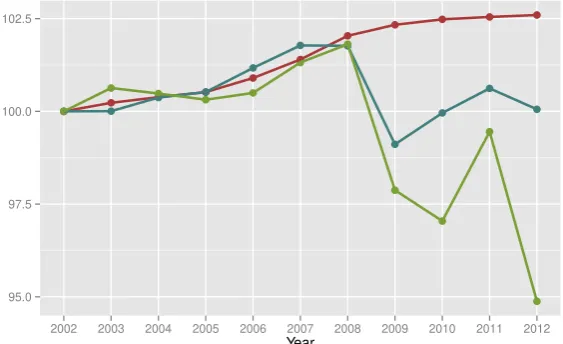
Figure 3 shows the trend for the aggregate levels of capitalK, labour factor L and production outputY of the sample. During the period considered in the analysis, the dynamics of factorKclearly appears to be anelastic with respect to the economic cycle, thus justifying the choice to treat this input asquasi-fixed in the subsequent part of analysis. Conversely, the significant decrease ofY during the double dip (2008-2010
and from2012) appears to affect the dynamics of the labour factor only.
After estimating the model with GAM, the focus of the analysis is moved to the individual components contributions. The model has been estimated by using the R Environment (R Core Team, 2013) exploiting thesemsfapackage (Ferrara and Vidoli, 2015) which draws on themgcvpackage (Wood, 2004).
Figure 4 shows contributions of the model terms to labour, that is the smooth terms associated to time, output and capital.
Figure 3. Aggregate levels of Labour, Capital and Output per year (base = 2002)
● ●
● ●
● ●
● ●
● ● ●
● ●
● ●
●
● ●
● ●
●
● ●
● ●
● ●
● ●
●
● ●
●
95.0 97.5 100.0 102.5
2002 2003 2004 2005 2006 2007 2008 2009 2010 2011 2012 Year
● Labour ● Output ● Capital
The median estimated values of labour-use efficiency obtained through the proposed procedure are reported in Table 1 (Total): during the time span considered, individ-ual labour-use efficiency ranged from24.2%to97.3%with the mean value of82.6%; therefore, on average, labour is overused by17.4%. Overall, the inefficiency levels in the sample appear to be fairly stable over time.
Considering the estimates of labour-use efficiency are firm and time specific, the results can be examined in further detail by focusing on those firms that have used Wage Guar-antee Fund during the time span considered. The results of the estimates (Table 1 and Figure 5) show that this subset of firms have achieved a higher level of labour-use ef-ficiency during the2005-2012period2: therefore, the empirical evidence suggests that this policy measure has been effective in mitigating the negative effects associated with the demand shocks experienced during the recent economic crisis, limiting the rigidities of the Italian labour market.
Finally, the focus of the investigation on labour-use efficiency is moved to the subset of firms that have not used standard forms of employment such as part-time, casual, fixed-term, temporary agency workers namely “No Employees”: this analysis is partic-ularly relevant as it provides empirical evidence to inform the ongoing debate about the medium and long run effects of the labour market reforms introduced in Italy between
2
Figure 4. Contributions of the model terms to labour L with respect to capital K (a), time T (b) and output Y (c).
11 12 13 14 15
−0.5
0.0
0.5
K
s(K,8.89)
a
11 12 13 14
−0.5
0.0
0.5
Y
s(Y
,7.53)
c
2002 2004 2006 2008 2010 2012
−0.5
0.0
0.5
T
s(T
,8.89)
b
the end of the 1990s and the beginning of the 2000s.
The implementation of this set of reforms has resulted in a significant decrease in the strictness of regulation, increasing the share of non standard typologies of contracts and stimulating job creation within the Italian economic system (De Stefanis and Fonseca, 2007). However, a number of works have raised concerns over the potential side effects generated by the reforms in terms of stagnating labour productivity (Boeri and Garibaldi, 2007; Lucidi and Kleinknecht, 2010): according to these contributions, the slowdown in productivity experienced by the Italian economic system during the last two decades could be partly explained by the increased presence of less productive workers who are often employed with non standard contracts. Indeed, the wage gap existing between these type of workers and regular employees (Picchio, 2006) reduces the incentive for firms to invest in both labour-saving innovative activities and limits the motivation of employees to accumulate human capital and increase their skills, hampering the chances of cooperative relationships between management and employees and resulting in lower productivity levels among workers employed with non standard contracts.
Table 1. Median labour-use efficiency in the Italian machinery industry, time span2002
-2012.
efficiency by year efficiency by year, index values (base year = 2007)
Firms using Firms using Firms using Firms using
Year Total Wages Guarantee Non standard jobs Wages Guarantee Non standard jobs
Fund Fund
2002 0,849 . 0,779 0,984
2003 0,851 . 0,780 0,985
2004 0,848 . 0,783 0,989
2005 0,853 0,880 0,789 0,975 0,996
2006 0,848 0,890 0,782 0,986 0,987
2007 0,854 0,903 0,792 1,000 1,000
2008 0,845 0,885 0,783 0,980 0,989
2009 0,854 0,884 0,793 0,979 1,001
2010 0,849 0,874 0,803 0,968 1,014
2011 0,851 0,882 0,811 0,977 1,024
2012 0,848 0,883 0,804 0,978 1,015
The efficiency estimate for firms using non standard jobs in year2006is affected by a methodological change in the fiscal system; therefore this data it’s not reported in Figure 5.
Figure 5. Median labour-use efficiency by type of firm and production output (base =
2007) ● ● ● ● ● ● ● ● ● ● ● 0.8 0.9 1.0
2002 2003 2004 2005 2006 2007 2008 2009 2010 2011 2012
Year Y ● ● ● ● ● ● ● ● ● ● ● ● ● ● ● ● ● ● 0.98 1.00 1.02
2002 2003 2004 2005 2006 2007 2008 2009 2010 2011 2012
Year
Median efficiencies
[image:12.595.94.432.369.571.2]flexible workers and those relying solely on standard forms of employment is expected to provide new insights to enhance a more comprehensive evaluation of the effects of the labour market reforms briefly discussed above. The results of the estimates show that labour input use, holding capital and output constant, is lower than average among the subset of firms using non standard forms of employment. although the gap tends to decrease over time.
As far as the dynamics of the aforementioned gap is concerned, Figure 5 shows that the reaction to the sharp decrease in production experienced by the sector since2009has been substantially different among the two subsets of firms analyzed in this paper. The downturn was preceded by a period of moderate growth (2002-2007) characterized by a generalized increase in labour-use efficiency. In2008, all firms experienced a significant contraction of labour-use efficiency, motivated by the difficulty to quickly readjust the labour input to the demand shock in the short term. However, during the following years firms using non standard jobs were capable to react to the crisis by increasing their labour use efficiency; on the other hand, the ability of other firms to readjust their use of the labour input appears to have been limited during the crisis.
According to these results, the diffusion of non standard jobs following the introduc-tion of the labour market reforms in Italy between the end of the1990s and the beginning of the2000s, appears to have supported the entrepreneurs in the optimal allocation of the labour input, thus generating benefits in terms of labour use efficiency in addition to those associated with employment growth. However, a potential trade-off may exist between these desirable effects and the lower productivity of this type of employees, as the recent literature has highlighted. This considered, further research to address this potential issue is certainly needed.
4. Conclusions
This work provides a novel framework to evaluate labour-use efficiency of Italian manufacturing firms, in an attempt to partially fill the existing gap in the relevant litera-ture due essentially to the lack of firm level data.
The model proposed in this paper aims overcome the main drawbacks associated with the preliminary specification of a particular form for the production function: the higher degree of flexibility in the new approach is the consequence of the limited set of assumptions specified for the model. Nevertheless, these simplifications do not affect the additivity and separability assumptions, as well as the hypothesis regarding the indepen-dence between noise and efficiency. However, monotonicity and concavity restrictions have been ruled out of the model: therefore, future research will consider the estimation of GAM by backfitting algorithm. The basic idea behind backfitting is to estimate each smooth component of an additive model by iteratively smoothing partial residuals: by this way one can impose some constraints on the estimated smooth functions.
labour-use efficiency dynamics of Italian manufacturing firms in the recent past. Results show the presence of a persistent level of labour-use inefficiency in the sample used for the analysis: this issue is particularly evident for the subset of firms using non standard jobs, while firms entitled to access to wage redundancy fund appear to have achieved higher levels of efficiency in labour input use on average. Therefore, the study shows that this policy measure was effective in mitigating the negative effects associated with the de-mand shocks experienced during the recent economic crisis, limiting the rigidities of the Italian labour market.
The analysis also shows that the inefficiency gap between the two subsets of firms tends to reduce in absolute terms over time: this trend appears to be the result of the in-creased efficiency in firms using non standard jobs, possibly associated with the higher possibility to rapidly readjust the labour input during the negative phase of the eco-nomic cycle. According to these results, the diffusion of non standard jobs following the introduction of the labour market reforms introduced in Italy between the end of the
1990s and the beginning of the 2000s appears to have supported the entrepreneurs in the optimal allocation of the labour input, thus generating benefits in terms of labour use efficiency in addition to those associated with employment growth. However, a po-tential trade-off may exist between these desirable effects and the lower productivity of this type of employees, as the recent literature has highlighted. This considered, further research to address this potential issue is certainly needed.
Other possible directions for future research include the implementation of alterna-tive specifications of the inefficiency componentuit, integrating internal and external
factors associated with tangible and intangible factors such as R&D, human capital, public infrastructure and degree of internalisation. Furthermore, the analysis could be moved forward by estimating the employment elasticity with respect to the covariates with particular regard to time: according to Kumbhakar and Zhang (2013) this compo-nent can be interpreted as technical change.
References
Aigner D.J., Chu S.F. (1968), On estimating the industry production function.American Economic Review,58, 826–839
Aigner D., Lovell C.A.K., Schmidt P. (1977), Formulation and estimation of stochastic frontier production function models,Journal of Econometrics,6, 21–37.
Bassanini A., Nunziata L., Venn D. (2009), Job protection legislation and productivity growth inOECD Countries. Econ. Policy,24, 349–402.
Boeri T., Garibaldi P. (2007), Two tier reforms of employment protection: a honeymoon ends?,Economic Journal,117, 357–385.
Congia M.C., Pacini S. (2012), La stima da fonti amministrative di indicatori retributivi congiunturali al netto della cassa integrazione guadagni,Rivista di Statistica Ufficiale,
14, 19–40.
Cooper W., Seiford L., Zhu J. (2000), A unified additive model approach for evaluating inefficiency and congestion with associated measures in dea.Socio-economic planning science,34, 1–25.
Deprins D., Simar L., Tulkens H. (1984), Measuring labor inefficiency in post offices, In: Marchand, M., Pestieau, P., Tulkens, H. (eds.)The Performance of Public Enterprises: Concepts and Measurements, North-Holland, Amsterdam.
De Steis S., Fonseca R. (2007), Matching efficiency and labour market reform in Italy: a macroeconomic assessment,Labour,21(1).
Fan Y., Li Q., Weersink A. (1996), Semiparametric estimation of stochastic production frontier models.Journal of Business & Economic Statistics,14, 460–468.
F¨are R., Grosskopf S., Kokkelenberg E.C. (1989), Measuring plant capacity, utiliza-tion and technical change: A nonparametric approach.International Economic Review,
30(3), 655–666.
Farrell M.J. (1957), The Measurement of Productive Efficiency. Journal of the Royal Statistic Society,120, 253–281
Federmeccanica (2006),Indagine congiunturale.
Ferrara G., Vidoli F. (2015), semsfa: semiparametric estimation of stochastic frontier models. R package version 1.0
Greene W. (2008), The econometric approach to efficiency analysis. In: Fried, O., Lovell, C.A.K., Schmidt, S.S. (eds.)The measurement of productive efficiency and pro-ductivity change, Oxford University Press, New York.
Grosskopf S. (1996), Statistical inference and nonparametric efficiency: a selective sur-vey.Journal of Productivity Analysis,7, 161–176
Hastie T., Tibshirani R. (1990),Generalized additive models, Chapman & Hall/CRC. Jondrow J., Lovell C.A.K., Materov I.S., Schmidt P. (1982), On the estimation of techni-cal inefficiency in the stochastic frontier production function models,Journal of Econo-metrics,119, 233–238.
Kumbhakar S.C., Park B., Simar L., Tsionas E. (2007), Nonparametric Stochastic Fron-tiers: A Local Maximum Likelihood Approach,Journal of Econometrics,137, 1–27 Kumbhakar S.C., Hjalmarsson L. (1995), Labour-use efficiency in Swedish social insur-ance offices,Journal of Applied Econometrics,10, 33–47.
Kumbhakar S.C., Lovell C.A.K. (2000),Stochastic Frontier Analysis, Cambridge Uni-versity Press, Cambridge.
Olson J.A., Schmidt P., Waldman D. M. (1980), A monte carlo study of estimators of stochastic frontier production functions,Journal of Econometrics,13, 67–82.
Picchio M. (2006), Wage differentials between temporary and permanent workers in Italy,Quaderni del dipartimento di Economia dell’Universita’ Politecnica delle Marche,
257.
R Core Team (2013), R: A language and environment for statistical computing,R Foun-dation for Statistical Computing, Vienna, Austria.
Schindler M. (2009), The Italian labour market: recent trends, institutions and reform options,IMF Working Papern.47.
Tone K., Sahoo B. K. (2004), Degree of scale economies and congestion: A unified DEA approach,European journal of operational research,158(3), 755–772.
Vidoli F., Ferrara G. (2014), Analyzing Italian citrus sector by semi-nonparametric fron-tier efficiency models, Empirical Economics. http://dx.doi.org/10.1007/s00181-014-0879-6
Wood S.N. (2003), Thin plate regression splines,Journal of the Royal Statistical Society series B,65, 95–114.
Wood S.N. (2004), Stable and efficient multiple smoothing parameter estimation for generalized additive models,Journal of the American Statistical Association,99, 673– 686.