Software Quality
Engineering
Testing, Quality Assurance, and
Quantifiable Improvement
Jeff Tian
Department of Computer Science and Engineering Southern Methodist University
Dallas, 7X
INTERSCI ENCE
This Page Intentionally Left Blank
This Page Intentionally Left Blank
This Page Intentionally Left Blank
This Page Intentionally Left Blank
This Page Intentionally Left Blank
This Page Intentionally Left Blank
This Page Intentionally Left Blank
This Page Intentionally Left Blank
This Page Intentionally Left Blank
This Page Intentionally Left Blank
This Page Intentionally Left Blank
C O ~ P U T E R
SOCIETY
Press Operating Committee
Chair Editor-in-Chief
Donald F. Shafer
Athens Group, Inc.
Roger U. Fujii
Vice President Chief Technology Officer
Northrup Grumman Mission Systems
Board Members
Mark J. Christensen, Independent Consultant
Richard Thayer, Professor Emeritus, California State University, Sacramento
Ted Lewis, Professor Computer Science, Naval Postgraduate School
Linda Shafer, Professor Emeritus, University of Texas at Austin
James M. Conrad, Associate Professor, UNC-Charloffe
John Horch, Independent Consultant
Deborah Plummer, Manager-Authored books ,
IEEE Computer Society Executive Staff David Hennage, Executive Director
Angela Burgess, Publisher
IEEE Computer Society Publications
The world-renowned IEEE Computer Society publishes, promotes, and distributes a wide variety of authori- tative computer science and engineering texts. These books are available from most retail outlets. Visit the CS Store at http:/komputer.org/cspress for a list of products.
IEEE Computer SocietyMliley Partnership
The IEEE Computer Society and Wiley partnership allows the CS Press authored book program to produce a number of exciting new titles in areas of computer science and engineering with a special focus on software engineering. IEEE Computer Society members continue to receive a 15% discount on these titles purchased through Wiley or at wiley.com/ieeecs.
To submit questions about the program or send proposals please e-mail [email protected] or write to Books, IEEE Computer Society, 100662 Los Vaqueros Circle, Los Alamitos, CA 90720-13 14. Telephone
Additional information regarding the Computer Society authored book program can also be accessed from our web site at http://computer.org.cspress.
Software Quality
Engineering
Testing, Quality Assurance, and
Quantifiable Improvement
Jeff Tian
Department of Computer Science and Engineering Southern Methodist University
Dallas, 7X
INTERSCI ENCE
Copyright 0 2005 by the IEEE Computer Society. All rights reserved.
Published by John Wiley & Sons, Inc., Hoboken, New Jersey. Published simultaneously in Canada.
No part of this publication may be reproduced, stored in a retrieval system or transmitted in any form or by any means, electronic, mechanical, photocopying, recording, scanning or otherwise, except as permitted under Section 107 or 108 of the 1976 United States Copyright Act, without either the prior written permission of the Publisher, or authorization through payment of the appropriate per-copy fee to
the Copyright Clearance Center, Inc., 222 Rosewood Drive, Danvers, MA 01923, (978) 750-8400, fax (978) 646-8600, or on the web at www.copyright.com. Requests to the Publisher for permission should be addressed to the Permissions Department, John Wiley & Sons, Inc., 1 I 1 River Street, Hoboken, NJ 07030, (201) 748-601 I , fax (201) 748-6008.
Limit of Liahility/Disclaimer of Warranty: While the publisher and author have used their best efforts in preparing this book, they make no representation or warranties with respect to the accuracy or
completeness of the contents of this book and specifically disclaim any implied warranties of merchantability or fitness for a particular purpose. No warranty may be created or extended by sales representatives or written sales materials. The advice and strategies contained herein may not be suitable for your situation. You should consult with a professional where appropriate. Neither the publisher nor author shall be liable for any loss of profit or any other commercial damages, including but not limited to special, incidental, consequential, or other damages.
For general information on our other products and services please contact our Customer Care Department within the U.S. at 877-762-2974, outside the U.S. at 317-572-3993 or fax 317-5724002.
Wiley also publishes its books in a variety of electronic formats. Some content that appears in print, however, may not be available in electronic format.
Library of Congress Cataloging-in-Publication Data is available.
ISBN 0-471-71345-7
Printed in the United States of America
This Page Intentionally Left Blank
This Page Intentionally Left Blank
This Page Intentionally Left Blank
This Page Intentionally Left Blank
This Page Intentionally Left Blank
This Page Intentionally Left Blank
This Page Intentionally Left Blank
This Page Intentionally Left Blank
This Page Intentionally Left Blank
This Page Intentionally Left Blank
This Page Intentionally Left Blank
CONTENTS
List of Figures
List of Tables
Preface
PART
I
OVERVIEWAND BASICS
1
Overview
1.1 Meeting People’s Quality Expectations 1.2
1.3 Dependency and Suggested Usage
1.4
Book Organization and Chapter Overview
Reader Preparation and Background Knowledge Problems
2 What Is Software Quality?
2.1 Quality: Perspectives and Expectations 2.2 Quality Frameworks and ISO-9126
2.3 Correctness and Defects: Definitions, Properties, and Measurements 2.4 A Historical Perspective of Quality
2.5 So, What Is Software Quality? Problems
xvii
xxi
xxv
3
3
6 9 11 13
15
15 18 20 24 25 26
viii CONTENTS
3 Quality Assurance
3.1
3.2 Defect Prevention
Classification: QA as Dealing with Defects
3.2.1 Education and training 3.2.2 Formal method
3.2.3 Other defect prevention techniques
3.3.1 3.3.2 3.3.3
3.4.1 Software fault tolerance 3.4.2
Problems 3.3 Defect Reduction
Inspection: Direct fault detection and removal Testing: Failure observation and fault removal Other techniques and risk identification 3.4 Defect Containment
Safety assurance and failure containment 3.5 Concluding Remarks
4 Quality Assurance in Context
4.1 4.2
4.3 Verification and Validation Perspectives 4.4 Reconciling the Two Views
4.5 Concluding Remarks
Handling Discovered Defect During QA Activities QA Activities in Software Processes
Problems
5 Quality Engineering
5.1 5.2
5.3 Quality Assessment and Improvement 5.4
5.5 Concluding Remarks
Quality Engineering: Activities and Process
Quality Planning: Goal Setting and Strategy Formation
Quality Engineering in Software Processes
Problems
PART II SOFTWARETESTING
6 Testing: Concepts, Issues, and Techniques
6.1
6.2 Questions About Testing 6.3
6.4
6.5 Concluding Remarks
Purposes, Activities, Processes, and Context
Functional vs. Structural Testing: What to Test?
Coverage-Based vs. Usage-Based Testing: When to Stop Testing?
CONTENTS
r Test Activities, Management, and Automation
7.1 Test Planning and Preparation
7.1.1 Test planning: Goals, strategies, and techniques 7.1.2 Testing models and test cases
7.1.3 Test suite preparation and management 7.1.4 Preparation of test procedure
Test Execution, Result Checking, and Measurement 7.2
7.3 Analysis and Follow-up
7.4 Activities, People, and Management 7.5 Test Automation
7.6 Concluding Remarks Problems
I Coverage and Usage Testing Based on Checklists and Partitions
8.1 8.2 8.3 8.4 8.5 8.6
Checklist-Based Testing and Its Limitations Testing for Partition Coverage
8.2.1 Some motivational examples 8.2.2 Partition: Concepts and definitions 8.2.3
Usage-Based Statistical Testing with Musa’s Operational Profiles 8.3.1
8.3.2 Musa OP: Basic ideas 8.3.3
Constructing Operational Profiles 8.4.1 Generic methods and participants 8.4.2 OP development procedure: Musa-1 8.4.3 OP development procedure: Musa-2 Case Study: OP for the Cartridge Support Software 8.5.1 Background and participants
8.5.2 OP development in five steps
8.5.3 Metrics collection, result validation, and lessons learned Concluding Remarks
Problems
Testing decisions and predicates for partition coverage
The cases for usage-based statistical testing
Using OPs for statistical testing and other purposes
Input Domain Partitioning and Boundary Testing
9.1
9.2 9.3
Input Domain Partitioning and Testing
9.1.1 Basic concepts, definitions, and terminology
9.1.2 Input domain testing for partition and boundary problems Simple Domain Analysis and the Extreme Point Combination Strategy Testing Strategies Based on Boundary Analysis
X CONTENTS
9.3.2
Other Boundary Test Strategies and Applications 9.4.1 Strong and approximate strategies 9.4.2 Other types of boundaries and extensions 9.4.3 Queuing testing as boundary testing
Weak 1 x 1 strategy 9.4
9.5 Concluding Remarks Problems
10 Coverage and Usage Testing Based on Finite-State Machines and Markov Chains
10.1 Finite-State Machines and Testing
10.1.1 Overcoming limitations of simple processing models 10.1.2 FSMs: Basic concepts and examples
10.1.3 Representations of FSMs
10.2 FSM Testing: State and Transition Coverage
10.2.1 Some typical problems with systems modeled by FSMs 10.2.2 Model construction and validation
10.2.3 Testing for correct states and transitions 10.2.4 Applications and limitations
10.3 Case Study: FSM-Based Testing of Web-Based Applications 10.3.1 Characteristics of web-based applications
10.3.2 What to test: Characteristics of web problems 10.3.3 FSMs for web testing
10.4.1 Markov chains and operational profiles
10.4.2 From individual Markov chains to unified Markov models 10.4.3 UMM construction
10.4 Markov Chains and Unified Markov Models for Testing
10.5 Using UMMs for Usage-Based Statistical Testing 10.5.1 Testing based on usage frequencies in UMMs 10.5.2 Testing based on other criteria and UMM hierarchies 10.5.3 Implementation, application, and other issues 10.6 Case Study Continued: Testing Based on Web Usages
10.6.1 Usage-based web testing: Motivations and basic approach 10.6.2 Constructing UMMs for statistical web testing
10.6.3 Statistical web testing: Details and examples
Problems
10.7 Concluding Remarks
11 Control Flow, Data Dependency, and Interaction Testing
1 1.1 Basic Control Flow Testing 1 1.1.1 General concepts
CONTENTS xi
1 1.1.2 Model construction 11.1.3 Path selection
1 1.1.4 Path sensitization and other activities 11.2 Loop Testing,
CFT
Usage, and Other Issues1 1.2.1 Different types of loops and corresponding CFGs 11.2.2 Loop testing: Difficulties and a heuristic strategy 1 1.2.3 CFT Usage and Other Issues
1 1.3 Data Dependency and Data Flow Testing
11.3.1 Basic concepts: Operations
on
data and data dependencies 11.3.2 Basics of DFT and DDG11.3.3 DDG elements and characteristics
11.3.4 Information sources and generic procedure for DDG construction 11.3.5 Building DDG indirectly
11.3.6 Dealing with loops 1 1.4 DFT Coverage and Applications
1 1.4.1 Achieving slice and other coverage 1 1.4.2 DFT: Applications and other issues 11.4.3 DFT application in synchronization testing
Problems
1 1.5 Concluding Remarks
12
Testing Techniques: Adaptation, Specialization, and Integration12.1 Testing Sub-Phases and Applicable Testing Techniques 12.2 Specialized Test Tasks and Techniqu,es
12.3 Test Integration f
12.4 Case Study: Hierarchical Web Testing 12.5 Concluding Remarks
Problems
PART 111 QUALITY ASSURANCE BEYOND TESTING
13 Defect Prevention and Process lmpirovement
13.1 Basic Concepts and Generic Approaches 13.2 Root Cause Analysis for Defect Prevention 13.3 Education and Training for Defect Prevention 13.4 Other Techniques for Defect Prevention
13.4.1 Analysis and modeling for defect prevention
13.4.2 Technologies, standards, and methodologies for defect prevention 13.4.3 Software tools to block defect injection
13.5.1 Process selection, definition, and conformance 13.5.2 Process maturity
13.5 Focusing on Software Processes
xii CONTENTS
13.5.3 Process and quality improvement
Problems
13.6 Concluding Remarks
14 Software Inspection
14.1 Basic Concepts and Generic Process 14.2 Fagan inspection
14.3 Other Inspections and Related Activities
14.3.1 Inspections of reduced scope or team size 14.3.2 Inspections of enlarged scope or team size 14.3.3 Informal desk checks, reviews, and walkthroughs 14.3.4 Code reading
14.3.5 Other formal reviews and static analyses
14.4 Defect Detection Techniques, TooYProcess Support, and Effectiveness 14.5 Concluding Remarks
Problems
15 Formal Verification
15.1 Basic Concepts: Formal Verification and Formal Specification 15.2 Formal Verification: Axiomatic Approach
15.2. I Formal logic specifications 15.2.2 Axioms
15.2.3 Axiomatic proofs and a comprehensive example
15.3.1 Weakest pre-conditions and backward chaining 15.3.2 Functional approach and symbolic execution
15.3.3 Seeking alternatives: Model checking and other approaches 15.3 Other Approaches
15.4 Applications, Effectiveness, and Integration Issues 15.5 Concluding Remarks
Problems
16 Fault Tolerance and Failure Containment
16.1 Basic Ideas and Concepts
16.2 Fault Tolerance with Recovery Blocks 16.3 Fault Tolerance with N-Version Programming
16.3.1 NVP: Basic technique and implementation 16.3.2 Ensuring version independence
16.3.3 Applying NVP ideas in other QA activities
16.4 Failure Containment: Safety Assurance and Damage Control 16.4.1 Hazard analysis using fault-trees and event-trees 16.4.2 Hazard resolution for accident prevention
CONTENTS xiii
16.4.3 Accident analysis and post-accident damage control
16.5.1 Modeling and analyzing heterogeneous systems 16.5.2 Prescriptive specifications foir safety
Problems
16.5 Application in Heterogeneous Systems
16.6 Concluding Remarks
17 Comparing Quality Assurance Techniques and Activities
17.1 General Questions: Cost, Benefit, and Environment 17.2 Applicability to Different Environments
17.3 Effectiveness Comparison 17.3.1 Defect perspective 17.3.2 Problem types
17.3.3 Defect level and pervasiveness
17.3.4 Result interpretation and constructive information 17.4 Cost Comparison
17.5 Comparison Summary and Recommendations Problems
PART IV QUANTIFIABLE QUALITY IMPROVEMENT
18 Feedback Loop and Activities for Quantifiable Quality Improvement
18.1 QA Monitoring and Measurement
18.1.1 Direct vs. indirect quality measurements
18.1.2 Direct quality measurements Result and defect measurements 18.1.3 Indirect quality measurements: Environmental, product internal,
and activity measurements
18.2 Immediate Follow-up Actions and Feedback 18.3 Analyses and Follow-up Actions
18.3.1 Analyses for product release decisions
18.3.2 Analyses for other project management decisions 18.3.3 Other feedback and follow-up actions
18.4.1 Feedback loop: Implementation and integration 18.4.2 A refined quality engineering, process
18.4.3 Tool support: Strategy, implementation, and integration
Problems
18.4 Implementation, Integration, and Tool Support
18.5 Concluding Remarks
278 279 279 28 1 282 282 285 285 289 29 1 29 1 292 293 294 295 297 298
303
304 304 306 306 308 309 309 311 3 12 313 3 14 3 16 317 320 32019 Quality Models and Measurements
19.1 Models for Quality Assessment
323
xiv CONTENTS
19.2 Generalized Models 19.3 Product-Specific Models
19.4 Model Comparison and Interconnections 19.5 Data Requirements and Measurement 19.6 Selecting Measurements and Models 19.7 Concluding Remarks
Problems
20 Defect Classification and Analysis
20.1 General Types of Defect Analyses 20.1.1 Defect distribution analysis
20.1.2 Defect trend analysis and defect dynamics model 20.1.3 Defect causal analysis
20.2.1 ODC concepts
20.2.2 Defect classification using ODC: A comprehensive example 20.2.3 Adapting ODC to analyze web errors
20.3. I One-way analysis: Analyzing a single defect attribute
20.3.2 Two-way and multi-way analysis: Examining cross-interactions
Problems
20.2 Defect Classification and ODC
20.3 Defect Analysis for Classified Data
20.4 Concluding Remarks
21 Risk Identification for Quantifiable Quality Improvement
21.1 Basic Ideas and Concepts
21.2 Traditional Statistical Analysis Techniques 21.3 New Techniques for Risk Identification
2 1.3.1 Principal component and discriminant analyses 2 1.3.2 Artificial neural networks and learning algorithms 21.3.3 Data partitions and tree-based modeling
21.3.4 Pattern matching and optimal set reduction 2 1.4 Comparisons and Integration
2 1.5 Risk Identification for Classified Defect Data 2 1.6 Concluding Remarks
Problems
22 Software Reliability Engineering
22.1 SRE: Basic Concepts and General Approaches 22.2 Large Software Systems and Reliability Analyses 22.3 Reliability Snapshots Using IDRMs
22.4 Longer-Term Reliability Analyses Using SRGMs
CONTENTS XV
22.5
22.6 22.7
TBRMs for Reliability Analysis and Improvement 22.5.1 Constructing and using TBRMs
22.5.2 TBRM Applications
22.5.3 TBRM’s impacts on reliability improvement Implementation and Software Tool Support
SRE: Summary and Perspectives Problems
Bibliography
Index
380 38 1 382 384 385 386 387
389
LIST OF FIGURES
1.1
1.2
2.1
3.1
4.1
4.2
5.1
5.2
5.3
6.1
7.1
8.1
8.2
9.1
Scope and content hierarchy: Testing, quality assurance (QA), and software quality engineering
Chapter and
PART
dependency diagramDefect related concepts and relations
Generic ways to deal with defects
QA activities in the waterfall process
Verification and validation activities associated with the V-Model
Quality engineering process
Quality engineering in the waterfall process
Quality engineering effort profile: The share of different activities as part of the total effort
Generic testing process
Test coverage analysis with S-TCAT
An operational profile (OP) of requested file types for the SMU/SEAS web site
A tree-structured or graphical operational profile
1-dimensional domain testing with I P C strategy
6
10
21
30
45
49
54
61
63
69
100
113
121
133
xviii 9.2 9.3 9.4 9.5 9.6 9.7 10.1 10.2 10.3 10.4 10.5 10.6 11.1 11.2 11.3 11.4 11.5 11.6 11.7 11.8 11.9
LIST OF FIGURES
2-dimensional domain testing with EPC strategy
l-dimensional domain testing with weak N x 1 strategy
2-dimensional domain testing with weak
N
x 1 strategy for the boundary between CO and C22-dimensional boundary tilt detection by the weak
N
x 1 strategy2-dimensional domain testing with weak 1 x 1 strategy for the boundary between CO and C6
2-dimensional boundary tilt detection by the weak 1 x 1 strategy
An example finite-state machine (FSM) for call processing
Multi-layered web applications
Example Markov chain for call processing FSM in Figure 10.1
Example UMM (unified Markov model): Expanding state E of the top-level UMM in Figure 10.3 into a lower-level UMM
Sample entries in an access log
Top-level UMM for SMU/SEAS
A sample control flow graph (CFG)
A sample program and its control flow graph (CFG)
Control flow graphs (CFGs) for “for” and “while” loops
Data dependency graph (DDG) element: An example of data definition through assignment
DDG element: An example of data selector node
A sample data flow graph (DDG)
Data selectors for multiple variables in branches
Three data slices for the DDG in Figure 1 1.6 and their sensitization
Combination
of
independent data selectors and related slices11.10 Combination of nested data selectors and related slices
12.1 Testing sub-phases associated with the V-Model
12.2 Hierarchical implementation of an integrated web testing strategy
14.1 Generic inspection process
14.2 A program segment (left) and its permutation (right)
15.1 A program segment with its formal specification
16.1 Fault tolerance with recovery blocks
LIST OF FIGURES xix 16.2 16.3 16.4 16.5 16.6 18.1 18.2 18.3 19.1 19.2 19.3 19.4 19.5 20.1 20.2 21.1 21.2 21.3 21.4 21.5 21.6 21.7 21.8 22.1 22.2 22.3 22.4 22.5 22.6
Fault tolerance with NVP 272
Fault-tree analysis (FTA) for an automobile accident 276
Event-tree analysis (ETA) for
an
automobile accident 277Two-frame model for a CCSCS 280
Prescription monitor for safety assurance
Refined quality engineering process: Measurement, analysis, and feedback
for quantifiable quality improvement 304
Further refined quality engineering process with detailed measurement
sources and feedback paths 315
Tools for quality measurement, analysi,s, and feedback 319
28 1
Classification of quality assessment models
Effort or defect profile in the Putnam Model
Relating measurements to quality assessment models
A fitted SRGM for an IBM product
A tree-based reliability model (TBRM) for an IBM product
One-way analysis of defect impact for ian IBM product
Error (type E) and hit profiles for SMU/SEAS
Processing model of a neuron
324 326 332 335 336 349 350 358
Backward propagation algorithm for artificial neural networks 359
360 Algorithm for tree-based model construction
Tree-based defect model for a commercial product
Algorithm for optimal set reduction
361
362
Example hierarchy for optimal set reduction 363
Predictions of defect impact for an IBM product
Defect impact distributions for an IBM product
Measured runs (per day) for products D
Measured transactions (per run) for products
E
SRGMs for test run indexed failures for product D
TBRMl for product D
TBRM2 for product D
Comparing failure arrivals for products A, B, C, and D
LIST OF TABLES
2.1
4.1
7.1
8.1
8.2
8.3
8.4
8.5
8.6
8.7
8.8
10.1
10.2
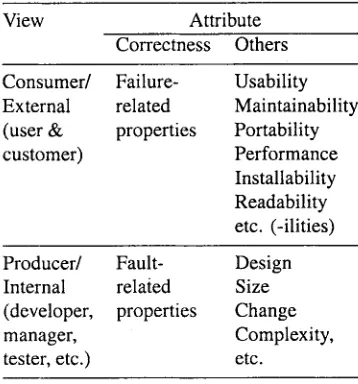
Correctness-centered properties according to quality views and attributes
23
QA activities: Mapping from defect-centered (DC) view to verification and validation (V&V) view
A template for test execution measurements
A high-level functional checklist for some relational database products
A template for a two-dimensional checklist by combining a standards checklist and a component checklist
Sample test cases for the program sallving the equation ax2
+
bx
+
c = 0Usage frequencies (hits) and probabilities (% of total) for different file types for SMU/SEAS
A sample customer profile
A sample user profile
CSS user profile
CSS OP: CSS functions classified according to usage probabilities
An example finite-state machine (FSM) for call processing in tabular representation
Top entry pages to SMU/SEAS
51
93
105
106
108
112
118
119
123
124
152
170
xxii LIST OF TABLES 12.1 13.1 13.2 15.1 17.1 17.2 17.3 17.4 17.5 17.6 17.7 17.8 17.9 19.1 19.2 19.3 19.4 19.5 19.6 20.1 20.2 20.3 20.4 20.5 20.6 20.7 21.1 21.2
Comparison of key characteristics and applicable testing techniques for different testing sub-phases
Distribution of modules of different maturity for an IBM product
Process maturity levels in CMM
Example symbolic execution traces
Objects of QA alternatives
Development activities where different QA alternatives are applicable
Required expertise and background knowledge for people to perform different QA alternatives
Defect observed and dealt with by different QA alternatives
Main problem types dealt with by different QA alternatives
Defect levels where different QA alternatives are suitable
Ease of result interpretation for different QA alternatives and amount of constructive informatiodmeasurements
Cost comparison for different QA alternatives
General comparison for different QA alternatives
A segmented model for reliability level estimation
DRM (defect removal model): defect distribution for previous releases of a product
High-defect modules for two products identified by tree-based modeling
Summary of quality assessment models and their applications
Summary of measurements required by different quality models
Data attributes used in Figure 19.5
Common error types and error distribution for SMU/SEAS
Characterizing web errors by file types
Distribution of DF for a commercial product LS
Distribution of DF for a commercial product NS
A sample defect dynamics model
Some defect attributes and values for an IBM product
Two-way analysis results: Interaction between impact and severity
Principal components for a commercial product
Predicting defects using artificial neural networks
209
227
233
26 1
289 290 29 1 292 292 294 295 297 298 326 327 329 329 33 1 336 34 1 342 342 343 344 347
35 1
357
LIST OF TABLES xxiii
2 1.3 Characterizing high-defect modules for a commercial product 361
2 1.4 Comparison of risk identification techniques
22.1 Estimated reliability
(A)
and failure rate(A)
for successive time segments364
376
22.2 Daily error rate (or failure rate) for SM’U/SEAS 377
PREFACE
With the pervasive use of software systems in modern society and people’s reliance
on
them in daily life, work, and societal functions, we need to make sure that these systems meet people’s expectations for quality and reliability. This is the general subject of Software Quality Engineering, which is organized into three major topics:0 Software testing as a primary means to ensure software quality;
0 Other alternatives for quality assurance (QA), including defect prevention, process
improvement, inspection, formal verification, fault tolerance, safety assurance, and damage control;
0 Measurement and analysis to close the feedback loop for quality assessment and
quantifiable improvement.
These topics and related concepts are introduced in Part I, with detailed coverage for each major topic in Parts 11,111, and IV, respectively.
This book evolved from class notes for the one-semester course “Software Testing and Quality Assurance” that
I
have taught many times at Southern Methodist University since 1995. Most of our students are full-time software professionals enrolled in SMU’s MS program in Software Engineering, with a few other graduate students or undergraduate juniors/seniors in related programs. Although there are many books on software testing and some on specific software QA techniques, they are typically too specialized to be suitable as a main textbook for a course like ours. On the other hand, general books on software engineering or software management cannot and do not cover software quality topics in enough detail or depth. Consequently, a combination of class notes and multiple textbooks was used. Similar situations were also common at other universities for similarxxvi PREFACE
courses, such as “Software Quality Assurance” and “Software Verification and Validation”. With its comprehensive coverage of all the major topics in software quality engineering in an integrated framework, this book is suitable as the main textbook for such a course.
In addition, this book could be used as a technical reference about software testing, QA, and quality engineering by other readers, particularly professionals who perform QA activities as testers, inspectors, analysts, coordinators, and so forth. It should also be useful to people involved in project planning and management, product release, and support. Similarly, this book could help prepare students for their internship assignments or future employment related to testing or QA.
For more information on this book, please visit the following website: www.engr.smu.edu/ tian/SQEbooW
www.
wiley.com/WileyCDA/WileyTitle/productCd-047
17
13457. html Supplementary material for instructors is available at the Wiley.com product page:Acknowledgments
First, I thank all my students in the SMU/CSE 5314/7314 classes since 1995, particularly, Katherine Chen, Tony Cluff, DeLeon English, Janet Farrar, Nishchal Gupta, Gina Habash, Chris Jordan, Zhao Li, Sateesh Rudrangi, Zahra Shahim, and Nathan Vong, for reading the manuscript and offering many invaluable suggestions. I also thank Tim Culver, for sharing his detailed class notes with me, and Li Ma, for checking the exercise questions.
I
thank the co-authors of my technical papers and the sponsors of my research projects for the material included in this book based on related publications. Since all these publications are individually cited in the bibliography, I only single out my project sponsors and industrial collaborators here: National Science Foundation, through awards MRI-97245 17, CCR- 9733588, and CCR-0204345; Texas Higher Education Coordinating Board, through awards 003613-0030-1999 and 003613-0030-2001; IBM, Nortel Networks, and Lockheed-Martin. I am grateful to SMU for granting me a sabbatical leave for the 2003/2004 academic year to work on my research and to write this book. I thank my colleagues at SMU, particularly Prof. Hesham El-Rewini, for their encouragement and help. I also appreciate the opportunity to work for the IBM Software Solutions Toronto Laboratory between 1992 and 1995, whereI
gained invaluable practical experience in software QA and testing.This book would not be possible without the love and support of my wife Sharon and my daughters Christine and Elizabeth. Sharon, a professional tester for many years, also helped me greatly by offering her invaluable technical critique. Utilizing her strength in reading and writing, Christine edited the entire manuscript (and many of my previous papers too).
I also thank my editor Val Moliere, her assistant Emily Simmons, and my production editor Melissa Yanuzzi, for their professional help.
JEFF (JIANHUI) TIAN
PART
I
OVERVIEW AND
BASICS
CHAPTER 1
OVERVIEW
Computers and software systems are becoming ubiquitous in modern society. Worldwide users rely on individual and interconnected computers, as well as the global information infrastructure, such as the Internet and the World Wide Web (WWW), to fulfill their needs for information processing, storage, search, and retrieval. All these needs are met with the support of the underlying software. This reliance requires the software to function correctly over a long time, to be easy to use, and so on. In general, such requirements for high quality need to be satisfied by the people involved in the development and support of these software systems through various quality assurance activities, and the claims for high quality need to be supported by evidence based on concrete measurements and analyses. This chapter introduces various concepts related to quality, quality assurance (QA), and quality engineering, and outlines the contents of this book.
1.1
MEETING PEOPLE’S QUALITY EXPECTATIONS
In general, people’s quality expectations for software systems they use and rely upon are two-fold:
1. The software systems must do what they are supposed to do. In other words, they must do the right things.
2. They must perform these specific tasks correctly or satisfactorily. In other words, they must do the things right.
4 OVERVIEW
The former requires that the software be the “right software”, or perform the right functions. For example, an airline reservation system is supposed to handle reservations, not intended to fly airplanes automatically. The focus of the related activities is to validate
the required software functions under their intended operational environment. The latter requires that the software systems perform their intended functions without problems. In the airline reservation system example, the system should help travel agents or individual travelers make valid reservations within a pre-specified time limit, instead of making invalid ones, taking too long to make a reservation, or refusing to make reservations without proper justification. The focus of the related activities is to verify that the implemented software
functions operate as specified.
Main tasks for software quality engineering
As the main topics of this book, the tasks for software QA and quality engineering are to ensure software quality through the related validation and verification activities. These activities need to be carried out by the people and organizations responsible for develop- ing and supporting these software systems in an overall quality engineering process that inc 1 udes :
0 quality planning;
0 execution of selected QA or software validation and verification activities;
0 measurement and analysis to provide convincing evidence to demonstrate software
quality to all parties involved.
In particular, customers and users need to have the assurance that their quality expectations are satisfied by the delivered software systems. The overall experience and lessons learned in delivering such high-quality software systems can be packaged into the software quality engineering process for quantifiable quality improvement in future development projects or to provide better product support.
When viewed from a different angle, the negative impact of software problems is also increasing, accompanying the pervasive use of and reliance on software systems in modern society. The problems could be associated with performing wrong functions, or performing intended functions incorrectly, thus causing unintended consequences. We would like to see such negative impact be eliminated, if possible. However, due to the increasing demand for automation, additional functionality and convenience by modern society to the computer and software systems, and due to the ubiquitous nature
of
modern computer, software, and information infrastructure, the size and complexity of modern software systems have also increased steadily. This increase in size and complexity also has unintended consequences in terms of causing quality problems.Quality problems in large software systems
MEETING PEOPLE‘S QUALITY EXPECTATIONS 5
software used on Boeing 777, to defense related software systems, such as various com- mandcommunicatiodcontrol (CCC) systems.
Such large and complex systems typically involve hundreds or even thousands of people in their development over months or even years, and the systems are often to be operated under diverse, and sometimes unanticipated, application environments. One may argue that some systems are unnecessarily large and complex. According to (Wirth, 1995), such “fat software” may be caused by indiscriminately adding non-essential features, poor design, improper choices of languages and methodologies, which could be addressed by disci- plined methodologies and return to essentials for “lean software”. Various QA techniques, including many of those covered in this book, can help produce high-quality, lean software. However, there is no “silver bullet”, or an all powerful and effective solution to the size, complexity, quality, and other software engineering problems, due to the fundamental requirements and constraints that a software system must satisfy (Brooks, 1987). Accom- panying the size and complexity problems are the many chances for other problems to be introduced into the software systems. Therefore, dealing with problems that may impact customers and users negatively and trying to manage and improve software quality are a fact of life for people involved in the development, management, marketing, and operational support of most modern software systems.
Testing, quality assurance (QA), and quality engineering
The above factors make it virtually impossible or practically infeasible to achieve the com- plete prevention or elimination of software problems and related negative impact. Con- sequently, various software QA activities are carried out to prevent or eliminate certain classes of problems that lead to such negative impact, or to reduce the likelihood or severity of such negative impact when it is unavoidable. This book systematically describes topics and issues related to these software QA activities, with an emphasis on the technical aspects. Software testing plays a central role among the software QA activities. By running the software system or executing its prescribed functions, testers can determine if the ob- served system behavior conforms to its specifications or requirements. If discrepancies exist between the two, follow-up actions can be carried out to locate and remove the re- lated problems in software code, which may also include modifying the software design. Therefore, the detection and removal of defects through testing help reduce the number of defects in delivered software products, thus helping to achieve the quality goals. Even if no discrepancy is observed, the specific instances can be accumulated as evidence to demon- strate that the software performs as specified. Consequently, testing is the most frequently used means to assure and to demonstrate software quality. A substantial part of this book is devoted to software testing, with an emphasis on commonly used techniques that have proven to be effective in various practical application environments.
Beyond testing, there are many other QA alternatives supported by related techniques and activities, such as inspection, formal verification, defect prevention, and fault tolerance. Inspection is a critical examination of software code or other artifacts by human inspectors to identify and remove problems directly, without resorting to execution. Fault tolerance prevents global system failures even if local problems exist, through various redundancies strategically designed and implemented into the software systems. Other QA techniques employ specific means to assure software quality. This book also provides a comprehensive coverage of these topics.
6 OVERVIEW
Figure 1.1 engineering
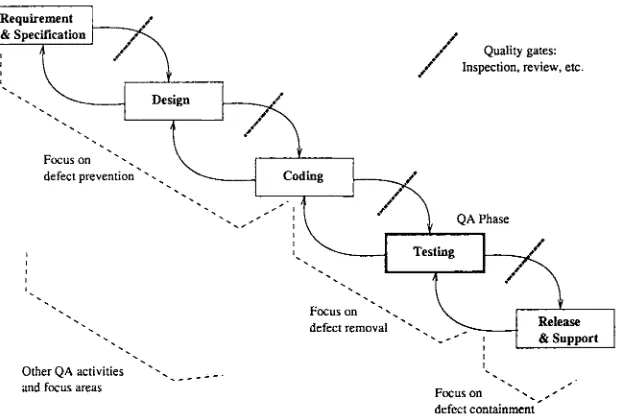
Scope and content hierarchy: Testing, quality assurance (QA), and software quality
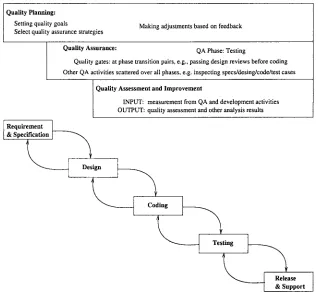
development, and strategies for QA selected, carried out, and monitored to achieve these preset quality goals. As part of this overall process, data collected during the QA activities, as well as from the overall development activities,can be analyzed to provide feedback to the software development process for decision making, project management, and quantifiable quality improvement. This book also provides a comprehensive coverage of these topics.
1.2 BOOK ORGANIZATION AND CHAPTER OVERVIEW
Figure 1.1 illustrates the general scope of the topics introduced above: Testing is an impor- tant subset of QA activities; and QA is an important subset of quality engineering activities. This diagram also explains our book title: “Software Quality Engineering: Testing, Quality Assurance, and Quantifiable Improvement”. This book is organized in four major parts and 22 chapters, with the main topics outlined below.
Part
I:
Overview
andBasics
Part I gives a general introduction and overview of the topics covered in the book, and presents the basic concepts and definitions related to quality, QA, testing, quality engineer- ing, etc. Specific questions answered include:
About this book: What is it? How to use it? How is it organized? In addition, what background knowledge is needed to have a thorough understanding of the technical aspects of this book? These questions are answered in Chapter 1.
What is software quality? In particular, what are the different views of quality? Is quality a single, atomic concept, or does it consist of many different attributes or characteristics? What is the relationship between quality, correctness, and defect? Can we narrow down the definition of quality to better focus our attention
on
various QA activities commonly carried out during software life cycles? These questions are answered in Chapter 2.What is QA? The question is answered from a particular perspective in Chapter 3,
representing a defect-based interpretation of quality and QA.
What are the different QA activities and related techniques? A defect-based classifi- cation is presented, also in Chapter 3, for the major QA alternatives and techniques, such as testing, inspection, formal verification, fault tolerance, and so on.
BOOK ORGANIZATION AND CHAPTER OVERVIEW 7
0 The QA activities are broadened in Chapter
5
into quality engineering that includesquality planning prior to specific QA activities and measurement, analysis, and feed- back activities to close the loop for quality assessment and quantifiable improvement.
Part II: Software Testing
Part I1 deals with all the important topics related to software testing, with an emphasis on commonly used testing techniques that have proven to be effective and efficient in many practical application environments. The chapters in this part are organized into two sub- parts: Descriptions of specific testing techniques (Chapters 8 through 11) are surrounded by chapters on the general issues of testing (Chapters 6,7, and 12). Individual chapters are described below:
0 General questions, issues, terminology about testing, including the generic testing
process and a taxonomy for testing, are discussed in Chapter 6.
0 The major testing activities, people’s roles and responsibilities in these activities, test
management, and test automation issues are covered in Chapter 7.
0 Checklist and partition-based testing: Chapter 8 starts with the simplest testing of
them all, ad hoc testing, then progresses to more organized testing using simple models such as lists and partitions. Specific testing techniques covered in Chapter 8 include:
-
testing with different types of general checklists;-
decision and predicate testing;-
usage-based statistical testing using flat operational profiles.0 Boundary testing: As a special case and extension of partition testing, we cover
boundary testing in Chapter 9. Application of boundary testing ideas in other testing situations is also covered.
0 State-based testing: Both the finite-state machines (FSMs), which serve as the basis
for state-based testing, and the augmented FSMs, which form Markov chains for more in-depth usage-based statistical testing, are covered in Chapter 10.
Interaction testing: Instead of focusing on individual partitions or states, the testing techniques described in Chapter 11 deal with the interactions along a complete ex- ecution path or a dependency slice. Specifically, this chapter covers the following traditional testing techniques:
-
control-flow testing (CFT);-
data-flow testing (DFT).0 Chapter 12 discusses application of specific testing techniques for specific testing
8 OVERVIEW
Part
111:Quality Assurance Beyond Testing
Part I11 covers important QA techniques other than testing, including the ones described below, and a comparison of all the QA alternatives at the end.
0 Various defect prevention techniques are described in Chapter 13.
0 Software inspection, or critical examination of software artifacts by human inspectors,
is described in Chapter 14.
0 Formal verification of program correctness with respect to its formal specifications
is covered in Chapter 15.
0 Fault tolerance techniques that prevent failures through some redundancy or dupli-
cation are discussed in Chapter 16. Related techniques based on similar ideas, such as failure containment to minimize failure impact, are also discussed in Chapter 16.
0 Some program analysis techniques, specifically static analyses, are also covered in
Chapter 14 in connection to inspection. Related topics on dynamic program analyses are briefly covered in Chapter 12 in connection to specialized testing techniques.
0 Comparison of different QA alternatives and techniques, including those covered in
Part I11 as well as testing covered in Part 11, is presented in Chapter 17.
Part
I VQuantifiable Quality Improvement
Part IV covers the important activities carried out in parallel or as follow-up to the main QA activities described in Part I1 and Part 111. The purpose of these activities is to monitor the QA activities to provide quantitative quality assessment and feedback to the quality engineering process. Such assessment and feedback can be used to help with decision making, project management, and various improvement initiatives. The main contents of the specific chapters in this part are described below:
0 First, the parallel and follow-up activities, as well as the collection and usage of the
raw and processed data in related analyses to provide specific feedback for various purposes, are described in Chapter 18.
Chapter 19 describes different models and measurements for quality assessment and improvement, and classifies them according to the information provided and the specific types of data required.
Defect classification and analysis models are described in Chapter 20, as an important sub-class of quality assessment models that focuses on the collection and analysis of detailed defect information.
0 Further analysis of the discovered defects and other measurement data from QA
and overall development activities can be carried out to identify high-risk or high- defect areas for focused remedial actions aimed at effective quality improvement. Various risk identification techniques and related models for doing this are presented in Chapter 2 1.
0 As an alternative to the defect-based view of quality that is closer to the developers’
DEPENDENCY AND SUGGESTED USAGE 9
and more meaningful to target customers. Chapter 22 presents software reliability models and analysis techniques to provide reliability assessments and guidance for reliability improvement.
1.3 DEPENDENCY AND SUGGESTED USAGE
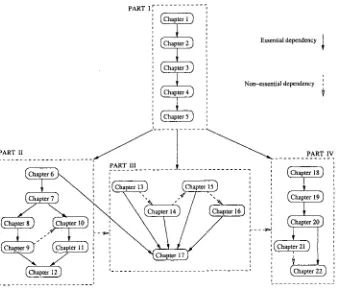
The integration of the interconnected chapters is an important feature of this book. We next examine the topic and chapter dependencies, and discuss different ways that these topics can be combined for different readers with different purposes in mind.
Chapter dependency
Figure 1.2 depicts the dependencies among different chapters, as well as among different parts, with each part grouped by dotted lines. We use solid lines to depict essential depen- dencies and dashed lines to depict dependencies that are desirable but not essential. An example of the latter type of dependencies is the non-essential dependency between quality assessment and analysis in Part IV and QA topics in Parts I1 and 111: The knowledge of the topics presented in Parts I1 and I11 would make most of topics covered in Part IV more meaningful. However, one can have a general understanding of Part IV without a thorough knowledge of Parts I1 and 111. Similarly, although all the chapters in Part I11 except the last one can be treated as parallel ones, Chapters 13 through 16 generally follow the sequence of activities or phases in the development process. Therefore, it would be more logical to follow this sequence. Some specific dependencies are explained below:
0 In addition to Chapter 17’s dependency on previous chapters of Part 111, it should also
be preceded by chapters in Part 11, at least Chapter 6, because the comparison of QA alternatives in Chapter 17 rely on the general knowledge of individual alternatives and techniques.
0 The chapters on testing techniques in Part I1 follow the natural progression from
simple models to complex ones. However, there is no essential dependency between those based on simple partitions (Chapters 8 and 9) and those based on more complex models (Chapters 10 and 11).
0 The last two chapters in Part IV can be treated as parallel chapters except that part of
Chapter 22, the topic on tree-based reliability models (TBRMs), uses the modeling technique called tree-based modeling covered in Chapter 21.
Suggested usage
This book is suitable as the main textbook for a one-semester course in various software engineering programs. Other people who are interested in learning all the major topics in software quality engineering should also read the whole book. However, for people who just want to get a general idea of the topics covered in this book, the following chapters are
appropriate:
0 The minimal set: Chapters 1-6,17, and 18. This minimal set includes all five chapters
10 OVERVIEW
,
!+
Chapter2:
i
Essential dependencyI
Non-essential dependency:
Chapter4:
B
*
t r - -
j
(-1
i i - i
I Chapter 19I
t
I
[image:39.509.81.419.70.360.2]I
(-)
Chapter22 IFigure 1.2 Chapter and PART dependency diagram
Between these two extremes (the minimal set and all chapters), there are also other possible usages of this book. All the followingwould assume the basic coverageof minimal set of chapters above and some other chapters in addition to it. Some suggested usages are given below:
0 Half semester course: Cover all in selective details, with emphasis on either Part 11,
111, or IV.
0 Short course on specialized topics: minimal set above plus one of the part from Parts
11, 111, and IV. Such short courses would be similar in length to about ten hours or
3-4 weeks of class lectures.
0 Other combinations of chapters are also possible, but would require the reader to keep
track of the cross-references in topics and related dependencies using Figure 1.2 as the guide.
READER PREPARATION AND BACKGROUND KNOWLEDGE 11
1.4 READER PREPARATION AND BACKGROUND KNOWLEDGE
To have a good understanding of the technical details, the readers need to have a general knowledge of mathematics, statistics, computer science, and software engineering, equiv- alent to that at the level of college juniors, seniors, or new graduate students in computer science, software engineering, or a related field. The following is intended as a general checklist for the readers: If you find that you lack certain background knowledge listed be- low, you need to study or review them on your own before proceeding to related technical discussions. This checklist will help readers link specific pieces of background knowledge to specific parts of the book.
Mathematical and statistical knowledge
Reviewing standard textbooks on mathematics and statistics covering the following topics would be useful if you are unfamiliar with some of them:
0 Basic concepts of relations, algebra, and set theory: Used throughout the book, and
especially in the following:
-
Sets, subsets, partitions, basic types of relations, and equivalence classes in-
Use of algebraic equations to define boundaries in Chapter 9 for boundary-
Precedence and dependency relations in Chapter 11 for control-flow and data--
Cause-effect relations in Chapter 16 for hazard analysis and safety assurance, Chapter 8 for partition-based testing.testing.
flow testing.
and in Chapter 20 for defect analysis.
0 Logic, particularly Boolean logic, and related formalisms: Used throughout the book,
and especially in the following:
-
Boolean logic for predicate and decision testing in Chapter 8.-
Mathematical logic and formalisms in Chapter 15 for formal verification of program correctness.0 Some basic concepts of graph theory: Used throughout the book, and especially in
the following:
-
Decision trees in Chapter 8 for operational profiles used in statistical testing.-
Graph elements for finite-state machines (FSMs) and related testing in Chap--
Flow-chart like situations for control-flow testing in Chapter 1 1.-
Data dependency graphs (a tree-structured graph) for data-flow testing in Chap--
Trees in fault-tree analysis and event-tree analysis in Chapter 16 for hazard-
Tree-based models for risk identification in Chapter 21 and for reliability anal- ter 10.ter 11.
analysis and safety assurance.
12 OVERVIEW
0 Basic concepts of probability and statistics: Particularly important to the following
topics:
-
Usage-based testing in Chapters 8 and 10.-
Defect classification and distribution analysis in Chapter 20.0 Basic concepts of statistical analysis and modeling: Important to the topics in Part
IV, in particular,
-
General analysis and modeling techniques in Chapter 19.-
Various specific types of analyses for risk identification in Chapter 2 1.-
Stochastic process and analysis for software reliability modeling in Chapter 22.Computer science knowledge
Reviewing standard textbooks on computer science covering the following topics would be useful if you are unfamiliar with some of them:
0 Familiarity with programming and general software development using a high-level
language. However, to make the understanding of basic concepts independent of spe- cific implementation languages, example programs in the book are given in pseudo- code form. Therefore, at a minimum, the readers need to be familiar with pseudo- code commonly used to present basic algorithms in computer science literature and sometimes to illustrate design ideas during software development.
0 Fundamentals of computing, particularly:
-
Finite-state machines (FSMs), which are the basis for state-based testing in Chapter 10.-
Execution flow and data dependencies, which are the basis for control flow and data.flow testing in Chapter 11.-
Some formalisms about computing and programming languages used in Chap- ters 10, 11, and 15.-
Some analysis techniques commonly identified with computer science and ar- tificial intelligence, such as pattern matching, learning algorithms, and neural networks used in Chapter 2 1.0 Design and organization of computer and software systems such as used in parallel
and redundant systems in Chapter 16.
Software engineering knowledge
Reviewing standard textbooks on software engineering covering the following topics would be useful if you are unfamiliar with some of them:
0 General knowledge of software development and maintenance activities, including
requirement analysis, product specification, design, coding, testing, release, support,
PROBLEMS 13
0 General awareness of different software development processes, including water-
fall, spiral, incremental, iterative, extreme programming ( X P ) , etc., and the software process capability maturity model (CMM).
0 General awareness with software management and system engineering issues, in-
cluding economic consequences of project decisions, tradeoffs between different objectives and concerns, feedback and improvement mechanisms, optimization, etc.
0 Familiarity with at least one of the commonly used development methodologies (and
related tools), such as object-oriented development (OOD), structured development (SD), Cleanroom technology, agile methods, formal methods, etc.
0 Practical experience working with some industrial software projects would be ex-
tremely helpful.
Problems
1.1 Consider some of your daily activities and classify them according the role played by computers and underlying software: no role, minor role, major role, and critical role. If “no role” is your answer for all the areadactivities, STOP - this is not a book for you. Otherwise, perform an overall assessment on how important software quality is to your daily activities.
1.2 Use the dependency diagram in Figure 1.2 and related explanations in Section 1.3 to construct your individual study plan to fulfill your personal goals.
CHAPTER 2
WHAT
IS SOFTWARE QUALITY?
The question, “What is software quality?’, is bound to generate many different answers, depending on whom you ask, under what circumstances, for what kind of software systems, and so
on.
An alternative question that is probably easier forus
to get more informative answers is: “What are the characteristics for high-quality software?’In this chapter, we attempt to define software quality by defining the expected character- istics or properties of high-quality software. In doing so, we need to examine the different perspectives and expectations of users as well as other people involved with the develop- ment, management, marketing, and maintenance of the software products. We also need to examine the individual characteristics associated with quality and their inter-relationship, and focus our attention on the critical characteristics of functional correctness. We con- clude the chapter with a comparison of software quality with quality concepts for other (non-software) systems and the evolving place of quality within software engineering.
2.1 QUALITY: PERSPECTIVES AND EXPECTATIONS
We next examine the different views of quality in a systematic manner, based on the dif- ferent roles, responsibilities, and quality expectations of different people, and zoom in on a small set of views and related properties to be consistently followed throughout this book. Five major views according to (Kitchenham and Pfleeger, 1996; Pfleeger et al., 2002) are: transcendental, user, manufacturing, product, and value-based views, as outlined below:
16 WHAT IS SOFTWARE QUALITY?
0 In the transcendental view, quality is hard to define or describe in abstract terms,
but can be recognized if it is present. It is generally associated with some intangible properties that delight users.
0 In the user view, quality is fitness for purpose or meeting user’s needs.
0 In the manufacturing view, quality means conformance to process standards.
0 In the product view, the focus is on inherent characteristics in the product itself in
the hope that controlling these internal quality indicators (or the so-called product- internal metrics described in Chapter 18) will result in improved external product behavior (quality in use).
0 In the value-based view, quality is the customers’ willingness to pay for a software.
People’s roles and responsibilities
When software quality is concerned, different people would have different views and ex- pectations based on their roles and responsibilities. With the quality assurance (QA) and quality engineering focus of this book, we can divide the people into two broad groups:
0 Consumers of software products or services, including customers and users, either
internally or externally. Sometime we also make the distinction between the cus- tomers, who are responsible for the acquisition of software products or services, and the users, who use the software products or services for various purposes, although the dual roles of customers and users are quite common. We can also extend the concept of users to include such non-human or “invisible” users as other software, embedded hardware, and the overall operational environment that the software operates under and interacts with (Whittaker, 2001).
0 Producers of software products, or anyone involved with the development, manage-
ment, maintenance, marketing, and service of software products. We adopt a broad definition of producers, which also include third-party participants who may be in- volved in add-on products and services, software packaging, software certification, fulfilling independent verification and validation (IV&V) responsibilities, and so on.
Subgroups within the above groups may have different concerns, although there are many common concerns within each group. In the subsequent discussions, we use external
view for the first group’s perspective, who are more concerned with the observed or external behavior, rather than the internal details that lead to such behavior. Similarly, we use a generic label internal view for the second group’s perspective, because they are typically familiar with or at least aware of various internal characteristic of the products. In other words, the external view mostly sees a software system as a black box, where one can observe its behavior but not see through inside; while the internal view mostly sees it as a white box, or more appropriately a clear box, where one can see what is inside and how it works.
Quality expectations on the consumer side
QUALITY: PERSPECTIVES AND EXPECTATIONS 17
right functions as specified, which, hopefully fits the user’s needs (fit for use). Second, it performs these specified functions correctly over repeated use or over a long period of time, or performs its functions reliably. These two elements are related to the validation and verification aspects of QA we introduced in the previous chapter, which will be expanded further in Chapter 4. Looking’into the future, we can work towards meeting this basic expectation and beyond to delight customers and users by preventing unforeseen negative impacts and produce unexpected positive effects (Denning, 1992).
For many users of today’s ubiquitous software and systems, ease of use, or usability, may be a more important quality expectation than reliability or other concerns. For example, the adoption of graphical user interfaces (GUI) in personal computers to replace text- based command interpreters often used in mainframes is primarily driven by the usability concerns for their massive user population. Similarly, ease of installation, is another major trend for software intended for the same population, to allow for painless (and nearly effortless) installation and operation, or the so-called “plug-and-play”. However, different users of the same system may have different views and priorities, such as the importance of usability for novice users and the importance of reliability for sophisticated users of the web (Vatanasombut et al., 2004).
When we consider the extended definition of users beyond human users, the primary expectations for quality would be to ensure the smooth operation and interaction between the software and these non-human users in the form of better inter-operability and adaptability, so that the software can work well with others and within its surrounding environment.
The basic quality expectations of a customer are similar to that of a user, with the additional concern for the cost of the software or service. This additional concern can be reflected by the so-called value-based view of quality, that is, whether a customer is willing to pay for it. The competing interests of quality and other software engineering concerns, such as cost, schedule, functionality, and their trade-offs, are examined in Section 2.4.
Quality expectations on the producer side
For software producers, the most fundamental quality question is to fulfill their contractual obligations by producing software products that conform to product specifications or pro- viding services that conform to service agreement. By extension, various product internal characteristics that make it easy to conform to product specifications, such as good de- signs that maintain conceptual integrity of product components and reduce coupling across different components, are also associated with good quality.
For product and service managers, adherence to pre-selected software process and rele- vant standards, proper choice of software methodologies, languages, and tools, as well as other factors, may be closely related to quality. They are also interested in managing and satisfying user’s quality expectations, by translating such quality expectations into realistic quality goals that can be defined and managed internally, selecting appropriate and effective QA strategies, and seeing them through.
18 WHAT IS SOFTWARE QUALITY?
2.2 QUALITY FRAMEWORKS AND ISO-9126
Based on the different quality views and expectations outlined above, quality can be defined accordingly. In fact, we have already mentioned above various so-called “-ilities” connected to the term quality, such as reliability, usability, portability, maintainability, etc. Various models or frameworks have been proposed to accommodate these different quality views and expectations, and to define quality and related attributes, features, characteristics, and measurements. We next briefly describe ISO-9 126 (ISO, 2001), the mostly influential one in the software engineering community today, and discuss various adaptations of such quality frameworks for specific application environments.
ISO-9126
ISO-9 126 (ISO, 2001) provides a hierarchical framework for quality definition, organized into quality characteristics and sub-characteristics. There are six top-level quality charac- teristics, with each associated with its own exclusive (non-overlapping) sub-characteristics, as summarized below:
0 Functionality: A set of attributes that bear on the existence of a set of functions and
their specified properties. The functions are those that satisfy stated or implied needs. The sub-characteristics include:
-
Suitability-
Accuracy-
Interoperability-
Security0 Reliability: A set of attributes that bear on the capability of software to maintain
its level of performance under stated conditions for a stated period of time. The sub-characteristics include:
-
Maturity-
Fault tolerance-
Recoverability0 Usability: A set of attributes that bear on the effort needed for use, and on the
individual assessment of such use, by a stated or implied set of users. The sub- characteristics include:
-
Understandability-
Learnability-
Operability0 Efficiency: A set of attributes that bear on the relationship between the level of per-
formance of the software and the amount of resources used, under stated conditions. The sub-characteristics include:
QUALITY FRAMEWORKS AND 180-9126 19
0 Maintainability: A set of attributes that bear on the effort needed to make specified
modifications. The sub-characteristics include:
-
Analyzability-
Changeability-
Stability-<