QUANTITATIVE DETERMINATION AND VALIDATION OF HEAVY
METALS ARSENIC, LEAD AND CHROMIUM FROM CARDIOL VATI
BY ICP-MS
Raju P. Suryawanshi1* and Sudhir S. Kamat2
1
Dept. of Chemistry, Elphinstone College, Fort, Mumbai-400 032; India. 2
Dept. of Chemistry Shiromani Gurudwara Prabandhak Committee’s Guru Nanak Khalsa
College of Arts, Science and Commerce, Matunga, Mumbai-19; India.
ABSTRACT
Cardiol vati is one of the most popular herbal medicines in Indian
market for Cardiac patients. The rapid development of metropolitan
cities in developing as well as in developed countries it causes adverse
life style effects like unhealthy food, pollutions and a sedentary job,
and transportation mode are likely to be risk factors for cardiac
diseases. Due to the minimum side effects and easily available in
market people are preferred herbal medicines than allopathy
medicines. Herbal medicines required standardization with
implementation and constant review of technical standards of herbal
product and effective quality control methods. Therefore it is thought necessary about the
efficacy and standardization of Cardiol vati. Hence in present study Cardiol vati was scanned
for the analysis of Heavy metals like Arsenic (As), Lead (Pb), Chromium (Cr) etc. These
metals can bind several physiological and health effects. These metals can determine by
quantitatively and validated by using modern technique such as ICP-MS.
KEYWORDS: Cardiol vati, Standardization, Herbal medicine, validation, Icp-ms.
INTRODUCTION
World health organization states that around 85-95% of the world population uses traditional
medicines.[1] Indian traditional herbal medicines is the oldest health practice by ancient Aryans which is based on the oldest scripture of Hindus about 6000 years old. In the
preparation of herbal medicines various parts of the plants are used as a raw material. After
passing through many process they are converted in to finished herbal products. Herbs
Volume 5, Issue 7, 1369-1379. Research Article ISSN 2277– 7105
*Corresponding Author
Raju P. Suryawanshi
Dept. of Chemistry,
Elphinstone College, Fort,
Mumbai-400 032; India. Article Received on 07 May 2016,
Revised on 28 May 2016, Accepted on 19 June 2016
include crude plant materials such as leaves, flowers, fruit, seeds, stems, wood, bark, roots,
rhizomes or other plant parts, which may be whole, fragmented or powdered. Herbal
materials include, in addition to herbs, fresh juices, gums, fixed oils, essential oils, resins and
dry powders of herbs.[2] Arsenic is known to cause arsenicosis. Inorganic arsenic compounds causes cancer, inorganic oxides of arsenic may develop cancer.[3] But patients are not aware about their content, standards and validation. World health Organization gives some
guidelines[4] for the preparation of herbal medicines and listed some methods for the standardization of herbal medicines[5] and also give maximum permissible limit of heavy metal[6] and quality controlled norms. It is important to follows the quality control norms to standardize the herbal medicines. Varies instrumental methods like HPLC -high –
performance chromatographic techniques[7], GC-gas chromatography[8], electrophoresis and TLC -thin layer chromatography.[9] However those methods cater to mostly organic active ingredients. Therefore XRPD-Ray diffraction[10] and ICP methods are developed for the quality control from inorganic prospective such as Arsenic (As), lead (Pb) and Chromium
(Cr) elements. Standardized herbal medicines maintained the quality and containing well
defined constituents are required for reliable, beneficial therapeutic effects without any toxic
effects.
MATERIALS AND METHODS
Chemicals
Yttrium as internal standard, de-ionized water solution of 0.5% nitric acid and 2 ppm gold.
(Thermo – fisher ICP-MS icap model.).
Sampling
In the present study, the marketed herbal tablets Cardiol vati, was selected for the analysis. The brand names of the medicines, license number and the plants used as per company’s
label are included (Table 1).
Table: 1. Tablet name with company name and plants as per label.
Sr. No Brand and Company Name
Medicines
Name Plants as per label *
1 Safe life (Mfg. Lic.No-
NKD/ AYU 82) Cardiol Vati
Suthi, Arjun ghan, Punarnava, Bringrajn, Abhrak bhasma, shuddha shiljit, Amalki ghan, Guduch ghan, Gokshur ghan, Akik pisti,
Experimental design
Methods
Samples: Cardiol vati, taking five tablets code number was given A, B, C, D and E. By
taking the weight of each tablet on digital balance. Tablet of each sample is gently ground to
fine powder using mortar and pestle and packed in butter paper until analysis. Quantitative
multi-elemental analysis by inductively coupled plasma (ICP) Icap-Q spectrometry depends
on a complete digestion of solid samples. However, fast and thorough sample digestion is a
challenging analytical task in modern multi-elemental analysis. To determine each heavy
metal concentration, 0.125 mL internal standard and 4.675 mL of diluent added in to 0.2 mL
sample solution. De-ionzed water solution of 0.5% nitric acid and 2 ppm gold was used as a
diluent.
Instrument configuration
Thermo – fisher ICP-MS icap model was used for all measurements. The instrument was
operated in a single collision cell mode with kinetic energy discrimination (KED), using pure
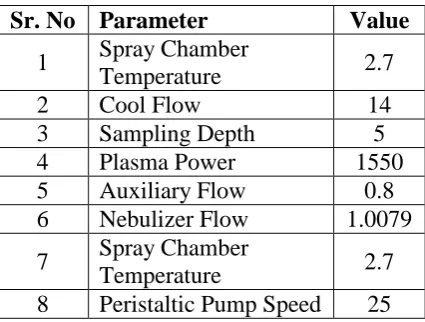
He as collision gas. The general analytical condition set for the ICP-MS are given in table
[image:3.595.192.405.449.610.2]number 2.
Table: 2. General analytical condition.
Sr. No Parameter Value
1 Spray Chamber
Temperature 2.7
2 Cool Flow 14
3 Sampling Depth 5
4 Plasma Power 1550
5 Auxiliary Flow 0.8
6 Nebulizer Flow 1.0079
7 Spray Chamber
Temperature 2.7
8 Peristaltic Pump Speed 25
Table -3. Standard Preparation. Stock Standards Available of 10 ppm Multi Elemental
Standards and Mercury Analysis.
Concentration Yttrium
1 ppm MES
MES + Hg (20 ppb)
Final Volume (mL)
Std .05 ppb 750 µL - 75 µL 30
Std 0.5 ppb 750 µL - 750 µL 30
Std 1.0 ppb 750 µL - 1500 µL 30
Std 2.0 ppb 750 µL - 3000 µL 30
Std 20 ppb 750 µL 600 µL - 30
Std 50 ppb 750 µL 1500 µL - 30
Std 100 ppb 750 µL 3000 µL - 30
Std 200 ppb 750 µL 6000 µL - 30
ARSENIC
1. Elemental arsenic and arsenic compounds are toxic and dangerous for environment and
subsequently for human life.
2. Arsenic is highly toxic in its inorganic form.
3. Arsenic is naturally present at high level in the ground water of a number of countries.
4. Contaminated water used for drinking, food preparation and irrigation of food crops
possess the greatest threat to public health from Arsenic.
5. Long –term exposure to arsenic from drinking water can cause cancer and skin lesion. It
has also been associated with developmental effects, cardiovascular diseases,
neurotoxicity and diabetes.[11]
Lead
Lead is particularly dangerous to children because their growing bodies absorb more lead
than adult and it can effect on their brain and nervous system. Adult may be exposed to lead
by eating and drinking food or water containing lead or from dishes or glasses that contain
lead.[12] Lead can cause several effects like, Rise in BP, Kidney damage.[13]
RESULTS AND DISCUSSION
Dilutedsamples of Cardiol vati were used for the further analysis on ICP-MS Icap Q model.
As a heavy metals Arsenic (As), Lead (Pb) and Chromium (Cr). are great importance for life.
Detected accuracy of Heavy metal concentration in selected samples by ICP-MS are given in
[image:4.595.129.472.74.130.2]Table 4.
Table: 4. Accuracy of elemental concentration per Tablet.
Sr. No Tablet code Concentration of Elements in ppm
1 A 0.00099 0.02749 0.0101311
2 B 0.00121 0.020412 0.0106504
3 C 0.00101 0.02532 0.01042
4 D 0.00132 0.02166 0.01101
Figure-1A. Cardiol vati Sample.
Figure-1B. Cardiol vati.
Cardiol Vati- Application
Heart is the most important organ of the circulatory system which nourishes the whole body
by supplying pure blood .Obviously abnormal heart function lead to serious problems. Heart
is made up of muscle fibers. Any abnormality in the constitution of heart and the other factors
like blood, mind and Oja give rise to diseases related to heart. Cardiol vati helps to reduce
cholesterol and triglyceride level in blood. It also tones the cardiac muscles and improves the
function of heart. (Information collected from the leaflet provided with sample).
Fig: 2. Graphical representation of Elements present in different samples
LD 50 FROM MERCK INDEX - 11TH EDITION AND ACGIH Threshold limit Value
Sr. No Elements Compounds LD50 TLV (Airborne
Threshold Limit Value)
1 As Arsenic acid 06 mg/kg iv in rabbit 0.01mg/m3
2 Pb Lead acetate 200 mg /kg ip ion rat 0.05 mg/m3
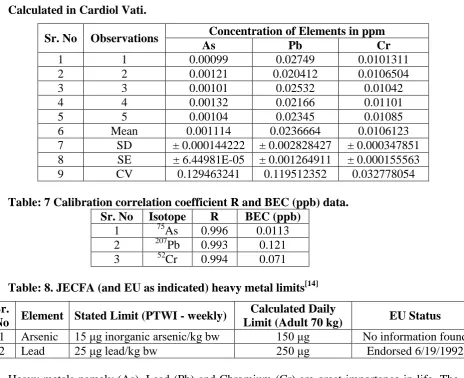
Table: 6. Standard deviation, standard errors and Coefficient variance of Heavy Metals
Calculated in Cardiol Vati.
Sr. No Observations Concentration of Elements in ppm
As Pb Cr
1 1 0.00099 0.02749 0.0101311
2 2 0.00121 0.020412 0.0106504
3 3 0.00101 0.02532 0.01042
4 4 0.00132 0.02166 0.01101
5 5 0.00104 0.02345 0.01085
6 Mean 0.001114 0.0236664 0.0106123
7 SD ± 0.000144222 ± 0.002828427 ± 0.000347851
8 SE ± 6.44981E-05 ± 0.001264911 ± 0.000155563
9 CV 0.129463241 0.119512352 0.032778054
Table: 7 Calibration correlation coefficient R and BEC (ppb) data.
Sr. No Isotope R BEC (ppb)
1 75As 0.996 0.0113
2 207Pb 0.993 0.121
3 52Cr 0.994 0.071
Table: 8. JECFA (and EU as indicated) heavy metal limits[14] Sr.
No Element Stated Limit (PTWI - weekly)
Calculated Daily
Limit (Adult 70 kg) EU Status
1 Arsenic 15 μg inorganic arsenic/kg bw 150 μg No information found
2 Lead 25 μg lead/kg bw 250 μg Endorsed 6/19/1992
Heavy metals namely (As), Lead (Pb) and Chromium (Cr) are great importance in life. The
detected accuracy of heavy metals concentration in selected samples by ICP-MS is given in
Table 4. In Cardiol vati sample A to E, most abundant element was Lead (Pb) whereas
Arsenic (As) was found in lowest concentration. The Standard deviation (SD), standard error
(SE) and coefficient variance (CV) calculated from the different observations of all samples
are given in table number 6 and table number 7 shows that for most of the target elements,
low ppt BEC (background equivalent concentration). Table number 8 shows the heavy metal PTWI-weekly stated limit and calculated daily limit for adult by the Joint Expert Committee
on Food Additives.
The CV for the Arsenic (As) calculated from the different observation was 0.129463241 and
the SE was found ± 6.44981E-05.
The CV for the Lead (Pb) calculated from the different observation was 0.119512352 and the
The CV for the Chromium (Cr) calculated from the different observation was 0.032778054
and the SE was found ± 0.000155563.
From the above observation and calculation of CV and SE for the heavy metals Arsenic (As),
Lead (Pb) and Chromium (Cr) was found in very low concentration and it was found in
[image:7.595.145.454.257.463.2]below toxic limit in all samples.
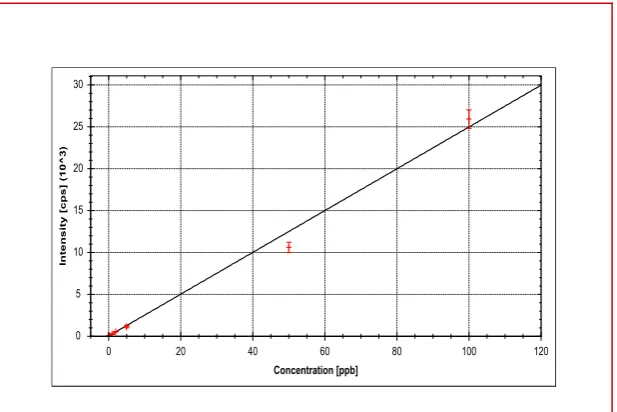
Figure 3, 4 and 5 shows the standard calibration graph for the elements Arsenic (As), Lead
[image:7.595.138.457.266.701.2](Pb) and Chromium (Cr) by ICP-MS.
Fig-3 Calibration graph of Arsenic
Fig: 5. Calibration graph of Chromium
Fig: 6. Percentage of Arsenic per sample
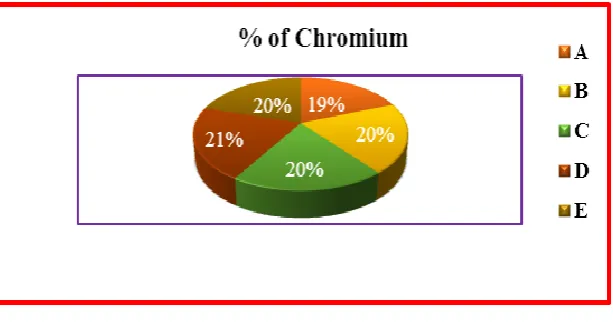
Fig: 8. Percentage of Chromium per sample
The above figure number six indicate that the 18%, 22%, 18%, 24%, and 18% of Arsenic
(As) in A, B, C, D, E and F samples respectively.
Figure number seven indicates that the 23%, 17%, 22%, 18% and 20% of Lead (Pb) in A, B,
C, D, E and F samples respectively.
Figure number eight indicates that the 19%, 20%, 20%, 21% and 20% of Chromium (Cr) in
A, B, C, D, E and F samples respectively.
The above figure number 6 shows that the percentage of Arsenic (As) in all samples, figure
number 7 shows that the percentage of Lead (Pb) in all samples and the figure number 8
shows that the percentage of Chromium (Cr) in all samples. It observed that the difference
between each Heavy metals in all samples was very low concentration.
CONCLUSION
The CV of the samples are less than one are consider as low variance and CV is greater than
one are consider as high variance in all samples very low CV was found. All these values of
heavy metals showed less toxicity in herbal medicines, and are detected below LD50 and
within permissible limit by WHO. A low SD means that the data is very closely related to the
average thus very reliable. The sufficient quality controlled parameters and condition were
followed during the manufacturing process. Results obtained from ICP-MS analysis of tablet
samples detected the accurate values of Heavy metal concentration in ppm. The content of
heavy metals is not indicated on their label. Elemental analysis by ICP-MS is a recent
technique which gives more accurate concentration of heavy metal contain in the samples
which is not previously reported by researchers. Quantitative estimation of metals is done by
concentration of the heavy metal are below the hazardous levels to the patient. The
standardization and validation of herbal tablets should be mandatory for the preparation of
herbal medicines for the more efficiency and accurate results.
ACKNOWLEDGEMENTS
Authors sincerely acknowledge the valuable support provided by the Principal Elphinstone
College, Fort Mumbai-32, Principal G. N. Khalsa, College Matunga, Mumbai and Thyrocare
laboratory Mumbai.
REFERENCES
1. WHO 2007.
2. Krunali Thakkar and et al. Recent advances in Herbal drug standardization –A Review
International Journal of Advances in Pharmaceutical Research /August, 2013; 4(08):
2130–2138.
3. Kumudhaveni Babu and et al. Analysis of heavy metals and inorganic element content in
Stereospermum colais leaves.
4. Dr. .K. Kokade and et al. Pharmacognosy thirty-nineth edition Nirali Prakashan august,
2007; 5: 564.
5. World Health Organization (WHO). WHO guidelines for assessing quality of herbal
medicines with reference to contaminants and residues, WHO publication, Switzerland,
2007; 19-20.
6. World Health Organization (WHO) 2011. Quality control methods for herbal materials.
Updated edition of Quality control methods for medicinal plant materials, 1998.
7. The Merck Index. 1989. Eleventh edition. An Encyclopedia of Chemicals, Drugs and
Biologicals. Merck & co. Inc. Rahway. New Jersy. USA.
8. United states Department of Labor. www.dol.gov
9. Nilesh, S. Studies in standardization of traditional drugs using modern analytical
methods, Ph.D. Thesis, Mumbai University, 2005-06; 67-83.
10.Sunil, S. Application of thermal methods and X-ray powder diffraction methods in
developing fingerprints of some herbal and synthetic drugs, Ph.D. Thesis, Mumbai
University, 2009-10; 169-239.
11.Frank, J. Standard methods of chemical analysis, sixth edition, and volume three part B.
Instrumental methods in clinical medicines published by D. Van Nostrand Company Ltd.
12.WHO Fact sheet No 372, December 2012.
13.www.EPA US Environmental Protection Agency.
14.http://www.lenntech.com.
15.Heavy Metals: Analysis and Limits in Herbal Dietary Supplements, Prepared by the
American Herbal Products Association (JECFA, or the Joint Expert Committee on Food
Additives), December 2009.
16.Amol, V. Application of modern analytical methods in herbal drug analysis, Ph.D. thesis,
Mumbai University, 2005-06; 65-89.
17.Dr. Sudhir S. Kamat Raju Suryawanshi, Metal Determination from medicinal Herbal
product of Sarpagandha by AAS, World Journal of Pharmaceutical Research, 2016; 5(5):