The process of divorce : a study of solicitors and their
clients
WRIGHT, Katherine
Available from Sheffield Hallam University Research Archive (SHURA) at:
http://shura.shu.ac.uk/3190/
This document is the author deposited version. You are advised to consult the publisher's version if you wish to cite from it.
Published version
WRIGHT, Katherine (2004). The process of divorce : a study of solicitors and their clients. Doctoral, Sheffield Hallam University.
Copyright and re-use policy
See http://shura.shu.ac.uk/information.html
ProQuest Number: 10702804
All rights re se rve d IN FO R M A TIO N T O A LL USERS
T h e q u a lity of this re p ro d u c tio n is d e p e n d e n t u p o n the q u a lity of the c o p y s u b m itte d . In the unlikely e v e n t that the a u th o r did not send a c o m p le te m a n u s c rip t
and there are missing p a g e s , these will be n o te d . Also, if m a te ria l had to be re m o v e d , a n o te will in d ic a te the d e le tio n .
uest
P ro Q u e s t 10702804
Published by ProQ uest L L C (2 01 7). C o p y rig h t of the Dissertation is held by the A u th o r. All rights reserved .
This w ork is p ro te c te d a g a in s t u n a u th o riz e d c o p y in g under Title 17, United States C o d e M icro fo rm Edition © ProQ uest LLC.
ProQ uest LLC.
789 East Eisenhow er P arkw ay P.O. Box 1346
The Process of Divorce: A Study of Solicitors and
their Clients
Katherine M Wright
A thesis submitted in partial fulfilment of the requirements of
Sheffield Hallam University
For the degree of Doctor of Philosophy
Acknowledgments
This thesis would never have been completed without the help of many friends, colleagues and acquaintances. The contribution of my supervisor, Professor Joanna Shapland of Sheffield University, has been immense and no words can adequately express the debt of gratitude I owe her. Her level of commitment to this project has been outstanding throughout, and her advice invaluable. This thesis could not have been completed without her help.
I would also like to thank Professor Mary Hayes, Alan Sanders, Jim Hanlon, Mark O’Brien, David Woodhill and colleagues at Sheffield Hallam University who have provided support, encouragement, and help of a more practical nature over the years this thesis took to complete.
A large debt is owed to the solicitors and clients who participated in this study. These brave individuals allowed a novice researcher into their lives for a significant period of time recording some difficult and emotional issues. To these persons, who have to remain nameless, I give my thanks.
The Process of Divorce: A Study of Solicitors and their Clients.
Katherine M Wright
Abstract
The central aim of this thesis is to explore how the service provided by solicitors is currently operating and meeting the needs of clients seeking a divorce. The impetus for this project was the growth and government promotion of family mediation in the 1990s as an alternative/adjunct to the services provided by a solicitor. This change to the divorce process was proposed without an adequate knowledge of the solicitor led service and appeared to be based on assumptions which were not supported by substantial evidence.
An ethnographic study was undertaken involving forty clients and ten solicitors. As divorce is a dynamic process rather than a single event each case was followed as far as possible from the first appointment between the solicitor and client until the conclusion of the case. A combination of observation of the solicitor-client meetings and interviews with both the solicitor and client after each meeting enabled the researcher to obtain a unique perspective on the interaction between solicitors and their clients.
The results from the study include, that the process was largely solicitor led, such that there was a degree of failure on the part of solicitors to listen to their clients with the result that issues such as domestic violence and the possibility of reconciliation were often not adequately explored; that clients had their own ‘boundaries of fairness’ regarding the appropriate resolution of their case, which were quite distinct from the solicitors’ view of the appropriate outcome; that the solicitor-client interaction is often not dyadic, new partners of clients being observed to exert significant influence on the process and outcomes, and that the solicitors in this study appeared to have absorbed some of the ethos and values behind family mediation into their practice, working to goals of neutrality, objectivity and a desire to minimise any rise in spousal conflict. This latter goal sometimes led to the replication of spousal power imbalances, in terms of the final settlement.
Contents
Page
Abstract i
List of Tables vii
Chapter 1 Introduction 1
1.1 The structure of the thesis 6
Chapter 2 Background to the Study 9
2.1 Introduction 9
2.2 Changes to the law: a lesser role for solicitors in
divorce? 10
2.3 The progress of empirical research on dispute
resolution on divorce 24
2.4 Family mediation
2.41 The history of family mediation 41 2.42 Client control within mediation 45
2.43 Reducing conflict 50
2.44 Costs 52
2.45 Effectiveness and durability of settlements 53 2.46 Inadequacies of mediation research 55 2.5 Solicitor negotiation 58
2.51 Client control 58
2.52 Spousal conflict: the effect of lawyer involvement 65 (i) Lawyers’ approach
-adversarial or conciliatory? 67 2.53 The goal of settlement 70 2.54 The shadow of the law 72
2.55 Gender 74
2.56 Inadequacies of research into lawyer’s
negotiations of divorce settlements 76
2.6 Social Class 78
2.7 Conclusion and resulting research focus 80
Chapter 3 Methodology 85
3.1 Introduction 85
3.2 General approach to the study, and ascertainment
of the most appropriate methodology 86
(i) Ethnography 90
(ii) Credibility of ethnographic research 92
3.3 Research design 95
3.31 Case study 96
(i) Justifications for undertaking a longitudinal
case study 97
(ii) The reasons for ensuring that all cases were monitored from the first
(iii) Characteristics of case studies 100 (iv) Credibility of research employing
a case study strategy 102
3.32 Observation 106
(i) The method of undertaking observation
-the degree of participation 111 (ii) The researcher’s role 115 (iii) Recording of the observational data 118
(iv) Note-taking 120
(v) ‘What’ should the observer note? 121 (vi) Note-taking specifically related to the
research questions 123 (vii) When and how note-taking was
accomplished 126
(viii) Transcription of fieldnotes 128 (ix) The combination of observation and
interview 130
3.33 Interviews 132
(i) Advantages and disadvantages of
interviews 134
(ii) The interview process 137 (iii) Style of interviewing 141 (iv) Interview content 144 (v) Solicitors’ preliminary interview 144 (vi) First client interview 146 (vii) Interview with the solicitor following
the client’s initial appointment 149 (viii) Interviews following the clients’ second
and subsequent appointments with the
solicitor 151
(ix) Final client interview 152 (x) Concluding interview with solicitors 153 3.4 Impact of researcher’s presence 155
3.5 Research questions 158
3.6 Access 163
(i) How access was negotiated in this project 167
3.7 The pilot 176
3.8 The sample 181
(i) Legal firms 182
(ii) Solicitors 185
(iii) The clients 187
3.9 Legal and ethical issues 192 (i) Confidentiality 193 (ii) Informed consent-autonomy 197 (iii) Avoidance of detriment -
non-maleficence 201
(iv) Ensuing benefit - beneficence 205
(v) Legal Issues 207
(vi) Personal issues 211
3.11 Number and methods: a brief outline of the research
plan 217
3.12 Brief outline of the reality of the research 217
Chapter 4 The Initial Appointment 221
4.1 Introduction 221
4.2 Why study the initial appointment? 222 4.3 Background contextual information 224
4.31 Temporal aspects 224
4.32 Physical surroundings 227 Research findings
4.4 Expectations of the initial appointment
4.41 The expectations of the solicitors 232 4.42 The expectations of the clients 235 4.43 Comparison of the prior expectations of solicitors
and clients 238
4.5 How the initial appointment progressed
4.51 How clients presented themselves 239 4.52 The clients’ information 244 4.53 The solicitor’s information 252 4.54 Control of the initial appointment 264 4.55 Was there a plan of action in place at the close
of the initial appointment? 271 4.56 The establishing of a working relationship 273 4.6 The views of the solicitors and clients after the initial
appointment
4.61 The views of the clients 274 4.62 The solicitors’ views after the initial appointment 280 4.63 A comparison of the views of the solicitors and clients 287
4.7 Comment 288
Chapter 5 How did the Cases Progress? 293
5.1 Introduction 293
5.2 Forty clients - what happened to them? 293 5.3 The non-returnees or “fizzler” cases 295 5.4 The cases which continued: the subsequent appointments 299 5.5 The financial, property and child issues 304 5.6 The duration of the process 307
5.7 Comment 311
Chapter 6 Control 313
6.1 Introduction 313
6.7 The views of solicitors and their clients on the exercise of
control 330
6.8 Comment 333
Chapter 7 What do solicitors contribute to the
process? 340
7.1 Introduction 340
7.2 The clients’ needs 341
7.3 The imparting of information: do solicitors meet clients’
needs? 348
7.4 Do solicitors provide partisan or other forms of support? 354 7.5 Solicitor’s involvement: the effect on spousal conflict 370 7.6 Emotional factors: how do solicitors deal with guilty spouses? 382 7.7 Resolving disputes: the contributions of the solicitors and the
clients 392
Chapter 8 Discussion 401
8.1 Does the initial appointment between the solicitor and client
set a path towards divorce? 401 8.2 Aspects of control in solicitor-client interaction 412
8.21 The exercise of control in the discussions between
the solicitor and client 412 8.22 The exercise of control over the process 417 8.23 Control over outcomes 419 8.3 The approach of solicitors to resolving the disputes arsing
on divorce 427
8.31 Partisanship 427
8.32 The effect of solicitors’ involvement on spousal conflict 429 8.33 Guilt or innocence: does the client’s perception affect
the outcome? 433
8.34 Solicitors’ reaction to spouses negotiating directly
with each other 436
8.35 Has mediation influenced solicitors’ approach to
resolving the disputes arising on divorce? 437
8.4 The client’s perspective 440
8.41 Characteristics of the clients 440 8.42 Clients’ understanding of the process 444 8.43 The involvement of clients in resolving the disputes 447
8.5 Emerging questions 451
Bibliography
Appendices
Appendix 1. Solicitors’ preliminary interview 1
2. First client interview 2
3. Interview with solicitors after clients initial
appointment 4
4. Second and subsequent client interviews 5
5. Final client interview 6
6. Solicitors’ final interview 7
7. Letter to solicitors seeking access 12
8. Statement of ethical practice - Socio-Legal Studies
Association 14
List of Tables
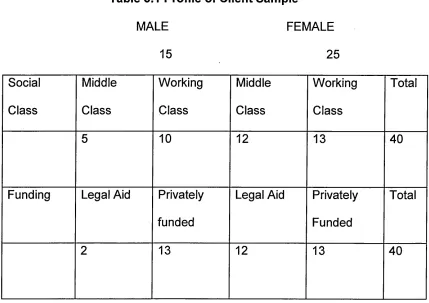
3.1 Profile of client sample 190
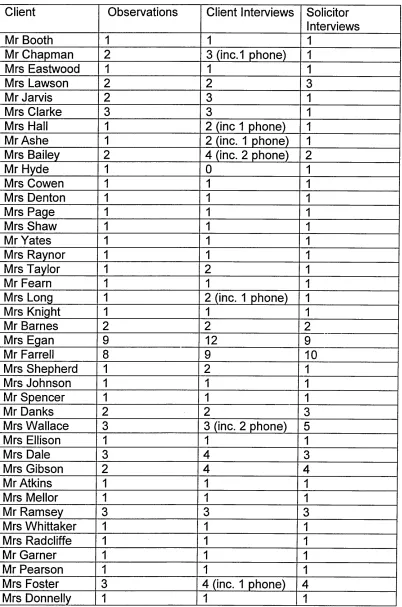
3.2 Number of initial meetings observed 218
3.3 Research profile of clients 219
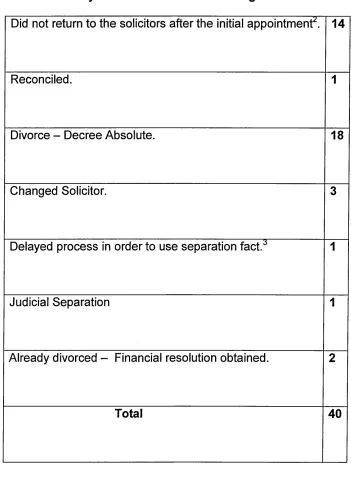
5.1 Forty clients - outcomes relating to divorce 294
5.2 Forty clients - outcomes relating to financial issues 305
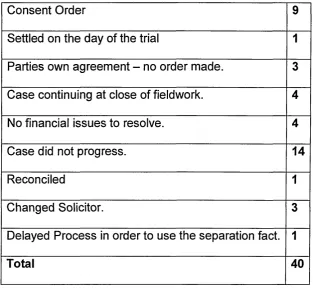
5.3 Case duration 308
7.1 The needs of clients in relation to overall aims 344
Chapter One
Introduction
Divorce is a very traumatic personal event and also a legal event
involving parties who may have had little contact with lawyers previously.
Parties going through divorce are experiencing family upsets. Problems
faced by these men and women, at the time of marital breakdown, can
be wide ranging and may include issues of domestic violence. Providing
people with the best advice, including legal advice, is crucial both for the
families involved and for social policy. This is one of the reasons there
was so much discussion by the government on the divorce process
during the 1990s. Yet, it could be argued that policy decisions at that
time were not taken on sufficient evidence.
This study examines interaction between solicitors and clients during the
process of obtaining a divorce and resolving related financial and
property disputes. At the time of writing the majority of parties seeking a
divorce employ a solicitor (see for example Davis et al 2000 b), who
acting on their behalf, deals with the procedural aspects of obtaining the
divorce and resolves the financial and property disputes, most often by a
process of solicitor negotiation. An alternative, or adjunct, to the solicitor
led service is provided by family mediation. Family mediation grew
Government incorporated provisions, designed to increase the take up of
mediation, into a major legislative reform, The Family Law Act 1996.
The government justified its support of family mediation by claiming that
it would better meet the needs of the divorcing population than the
traditional solicitor led service, in a number of respects1. Potential
advantages cited in support of mediation included that parties had
control over the process and outcome;2 that spousal conflict would be
reduced3 and costs would be lower.4 The traditional system of lawyer
negotiation and adjudication was thought to be defective in these
aspects.
In order to ensure that these potential benefits were more widely
experienced, legislation was proposed in which changes to the divorce
process would be complemented with provisions designed to increase
the take up of mediation. A number of provisions were included in the
legislation (the Family Law Act 1996) which would facilitate wider use of
mediation during the divorce process. Arguably, the most significant of
these were the amendments to the Legal Aid Act 1988, by which those
wishing to claim public funding to assist them in resolving their disputes,
would first be subjected to mandatory mediation assessment. Public
funding for legal representation would not be provided, unless the case
had been deemed to be unsuitable for resolution in mediation. There
1 These were made explicit in the White Paper, “Looking to the future: mediation and the ground for divorce.” Cm 2799.
was, therefore, a potential shift envisaged, as much of the work involved
in the resolution of divorce disputes, particularly in relation to clients who
were legally aided, could have moved from solicitors to family mediators.
As the reader will be aware, the changes to the divorce process were not
in the event implemented. However, the provisions relating to the pubic
funding of mediation, including the requirement for mediation
assessment prior to being awarded legal aid, were put into effect.
Starting this research in 1995, the author was concerned that this
potential transformation of the divorce process, particularly for those
claiming legal aid, was being proposed without an adequate knowledge
of how the current system of solicitor negotiation was meeting the needs
of the divorcing population. The author also questioned whether the
rather negative image of the traditional system, portrayed in policy
documents, was supported by substantial evidence. Without an in-depth
knowledge of the solicitor led service, the author also felt it would be
difficult adequately to assess the benefits or otherwise of the proposed
changes to the dispute resolution service. This proposed change to the
divorce process, which did not appear to the author to be based on clear
evidence, was the original impetus for this project.
The principal aim of the research, therefore, was to carry out a small in-
depth exploratory study of the solicitor led service in order to discover
government’s assumptions regarding the advantages of family mediation
over the solicitor led service, it was thought that knowledge as to how the
service provided by solicitors performed in relation to those aspects, was
of central importance to the debates regarding the most appropriate form
of dispute resolution on divorce. An analytical framework was therefore
devised which included the issues of party control and the effect of
solicitors’ involvement on spousal conflict.
In order to keep the project within manageable limits the focus of the
study is on divorce and the resolution of the financial and property
disputes. Consideration of the disputes regarding children and the
process of judicial separation, as an alternative to divorce, have
therefore not been included.
A review of the literature (see chapter two) revealed that the solicitor led
service had not been subjected to the same degree of academic interest
as had mediation. Moreover, much of the research in both methods of
dispute resolution had been carried out in the US. Whilst this can
provide very valuable insights, legal and cultural differences can limit
applicability to practices in England and Wales. The evidence reviewed,
although not extensive, did not appear to support the government’s
negative view of the solicitor service, although many areas had not been
fully explored. Furthermore, the author felt that the methodology which
had been adopted did not always lead to the insights that were required.
one to question whether the responses could have been influenced by
self presentational issues. In order to surmount this, it was going to be
necessary to undertake direct observation. It was also noted that social
and contextual factors, such as social class and gender, had not been
given sufficient consideration.
In light of the inadequacies identified in the existing research, it was
decided that two elements needed to be included in the research design,
which would go some way to addressing the deficit in knowledge. Firstly,
it was considered crucial to observe the solicitor client appointments, in
order to see what went on rather than rely solely on the accounts of the
participants. Secondly, the researcher, aware that divorce is a dynamic
process, rather than a single event, decided to undertake a longitudinal
study in which clients were followed from their first appointment until the
conclusion of their case, whatever that might be. Though interviews are
inadequate as a sole source of information, they can provide very useful
data on the perceptions and expectations of both solicitors and clients
and so they were also used in this study. Each participant (solicitors and
clients) was interviewed after each solicitor client meeting. Final
interviews were carried out with the clients whose cases completed
during the research, and with solicitors on conclusion of the fieldwork. It
was envisaged that by using a combination of methods and undertaking
a study over a long period of time (during which time a trusting
relationship should be built up between the researcher and the research
experienced by the solicitors and clients involved in this study, might be
obtained.
This thesis, therefore, reports on the experiences of forty clients and their
solicitors as they progressed through the process of divorce, whether the
outcome was divorce or withdrawal from the process. Ten solicitors were
involved in the project from four solicitors’ firms in a northern city. In
order to consider the impact of social class a number of both working
and middle class clients were recruited. An advantage of the location
selected, beyond the pragmatic advantages for the researcher, was that
as a large city it had a number of solicitors’ firms of different sizes
including practices which dealt principally with a legal aid clientele.
1.1 The Structure of the thesis
The background to the study is provided in chapter two. The chapter
begins by outlining the legal and policy context in which the research
was carried out and includes reference to subsequent developments
which are relevant to this topic. Information is then provided on the key
empirical studies which informed this research. The literature on both
family mediation and lawyer negotiation (in relation to divorce) is
reviewed before concluding with the resulting research questions.
The methodology selected to answer the research questions is detailed
in chapter three. A detailed discussion of the ethnographic approach
problems which could be encountered by using this approach and the
strategies adopted to minimise these difficulties. Consideration of the
many legal and ethical issues arising from this study is also reported and
the method of analysis is outlined.
The results of the research are reported in chapters four, five, six and
seven. Chapter four outlines the findings in relation to the initial
appointment between the solicitor and the client. Chapter five informs
the reader how each of the cases in the study progressed, including the
number of cases which did not progress after the first meeting; the
duration of the cases, and the nature of the subsequent solicitor client
meetings.
Chapter six contains the findings in relation to the exercise of control in
solicitor client interaction, and chapter seven considers the results
relating to the solicitors’ contributions to resolving the disputes arising on
divorce. This latter chapter includes the findings in relation to the clients’
perceptions of their needs; the effectiveness of solicitors in imparting
information to the client; the partisanship or other forms of support
provided by the solicitors, the effect of solicitor negotiation on spousal
conflict, the impact of clients’ feelings of guilt or innocence on the
solicitors’ actions and the contributions made by both the clients and the
The conclusion in chapter eight draws together the findings from the
results chapters and discusses their significance in light of the existing
knowledge and recent policy debates. The chapter closes with a number
of questions which have emerged from the study and which could
Chapter Two
Background to the Study
2.1 Introduction
“The main ‘story’ of private family law since 1980s has been the emergence of mediation as an alternative to the traditional (and still dominant) mode of dispute resolution on relationship breakdown, which is that of lawyer negotiation.” (Davis and Bevan 2002 p 175)
When individuals seek a divorce it is, in the main, solicitors to whom they turn.
Mediation has become increasingly prominent firstly as an alternative and later
as an adjunct to the services provided by solicitors. At the time that this present
project was conceived it was envisaged that the law relating to divorce would
change and mediation would be more widely used to resolved the disputes
arising on divorce. In the event the law relating to divorce did not change,
although provisions relating to the public funding of mediation were enacted.
This is a study of the ‘traditional’ mode of dispute resolution on divorce, that is,
solicitor negotiation. The impetus for this study coming from, in part, the rise in
mediation (see above), and this study will, therefore, review both the literatures
relating to family mediation and lawyers, concerning the resolution of the
2.2 Changes to the law: a lesser role for solicitors in divorce?
This project began in 1995, at which time persons wishing to obtain a divorce
and reallocate the various assets and/or debt arising from the marriage followed
the procedures contained within the Matrimonial Causes Act 1973. This Act
requires that in order to obtain a divorce a petitioner will have to satisfy a court
that their marriage has irretrievably broken down and this is evidenced by
proving one or more of the five ‘facts’ set out in S.1(2).1 Part two of the Act
contains the orders and guidelines regarding the redistribution of any marital
property or finances that a court can make on divorce. Most cases however,
are resolved by a process of negotiation undertaken by the parties’ solicitors.
Under the special procedure2 the time taken to obtain a divorce could be as
little as four months,3 although the financial and property disputes could last
much longer. Legal aid was provided to those satisfying the criteria under the
‘green form’ advice and assistance scheme and under a legal aid certificate
were appropriate.4
The process of obtaining a divorce under the provisions contained within the
Matrimonial Causes Act 1973 had been subject to a number of criticisms,
1 The facts are, (a) that the respondent has committed adultery and the petitioner finds it intolerable to live with the respondent;(b) that the respondent has behaved in such a way that the petitioner cannot reasonably be expected to live with the respondent;(c) that the respondent has deserted the petitioner for a continuous period of at least two years immediately preceding the presentation of the petition; (d) that the parties to the marriage have lived apart for a continuous period of at least two years immediately preceding the presentation of the petition and the respondent consents to a decree being granted; (e) that the parties to the marriage have lived apart for a continuous period of at least five year immediately preceding the presentation of the petition.
Introduced in 1973, the special procedure simplified the process, allowing the granting of a divorce after a petition has been scrutinized by a District Judge sitting in chambers, the decree being announced in open court. The majority of divorces now follow this procedure.
3 Fourth Annual Report of the Advisory Board on Family Law 2000-2001 Para 3.4
consideration of which is outside the scope of this thesis.5 For the purposes of
this present work the key areas of censure, acknowledged in the consultation
paper of 1993,6 were that divorce could be obtained too quickly, allowing the
parties little time to consider the consequences of a divorce; that the law did
nothing to save the marriage; and that the process exacerbated bitterness and
hostility/After extensive consultation and consideration of proposals for reform
published by the Law Commission,8 the government published a White Paper in
April 1995.9 The paper emphasised the need to support marriage and promote
reconciliation and, should the marriage be beyond saving, use of family
mediation was to be encouraged as a means of resolving the financial/property
and child disputes. In November 1995 a bill outlining a new process for divorce
was introduced into Parliament. Strong opposition led to the introduction of a
number of amendments. The Family Law Act was finally passed in 1996.
Implementation, however, was to be delayed until two research projects had
been carried out; one examining the most effective way of carrying out the
information meetings10 and other to assess the effectiveness of publicly
mediation.11
In order to obtain a divorce under the Family Law Act 1996,12 parties would
have to go through a process which, briefly, involved attendance at an
5 For a detailed consideration of the evolution of the law relating to divorce and an account of the various criticisms levelled at the divorce process contained within the Matrimonial Causes Act 1973 the reader is directed to Cretney (2003) Family Law in the Twentieth Century: A
History.
6 Looking to the Future. Mediation and the Ground for Divorce (Cm. 2424) 7 Ibid para 5.1-24.
8 The Ground for Divorce, Law Com. No. 192 (1990)
9 Looking to the Future: Mediation and the Ground for Divorce. Cm2799 10 Walker (2001)
11 Davis et al (2000 (b))
information meeting; filing of a statement of marital breakdown; and expiration
of a period of reflection and consideration (originally nine months in length but
extended where there where children under sixteen, or where one party had
applied for an extension) during which time the parties had to both consider if
the marriage could be saved whilst also making arrangements (resolving the
financial/property and child disputes) for their post divorce life. Finally, once
arrangements for the future had been made, an application could be made for
the divorce order. The preferred means by which any financial/property and
child disputes were to be resolved was through mediation.13
In order to facilitate the shift from lawyer negotiation to mediation the Family
Law Act 1996 contained specific measures intended to promote greater use of
this alternative form of dispute resolution. Firstly, the information meeting that a
party (except in prescribed circumstances) initiating the divorce was required to
attend,14 was to include, inter alia, information on the advantages of
mediation.15 Secondly, courts were given the power, once the statement of
marital breakdown had been filed, to direct each party to a meeting for the
purpose, “of enabling an explanation to be given of the facilities available to the
parties for mediation in relation to disputes between them; and of providing an
opportunity for each party to agree to take advantage of those facilities.”16
Further, part 3 of the Family Law Act 1996 amended the Legal Aid Act 1988 to
13 The Family Law Act has been criticised for the apparent tension between autonomy and coercion present. On the one hand the law sought to encourage certain forms of behaviour (that is not to divorce or failing that, to behave in a particular way throughout the divorce process), whilst also allowing a decree of autonomy over the financial and property resolution as lawyers were replaced by mediators. (Dewar 1998)
14 Section 8 part two.
15 In the Lord Chancellors Department explanatory notes, “Marriage and the Family Law Act (1997) it is specifically stated that the information sessions are to include information on “the availability and advantages of mediation” (emphasis added) (p 2).
provide for the public funding of mediation in family matters. Of particular
importance was S. 29 of the Act which provides,
“A person shall not be granted representation for the purposes of proceedings relating to family matters, unless he has attended a meeting with a mediator to determine
-(a) (i) whether mediation appears suitable to the dispute and the parties and all the circumstances, and,
(ii) in particular, whether mediation could take place without either party being influenced by fear of violence or other harm; and
(b) if mediation does appear suitable, to help the person applying for representation to decide whether instead to apply for mediation.17
It could be argued, therefore, that these measures designed to promote greater
use of mediation would have the greatest impact on those parties wishing to
apply for legal aid in order to resolve the financial and property disputes arising
on divorce.
The goals of encouraging reconciliation and promoting a more conciliatory
mode of dispute resolution are reflected in the principles of the Family Law Act
which are contained within part one:
(a) that the institution of marriage is to be supported;
(b) that the parties to a marriage which may have broken down are to be encouraged to take all practicable steps, whether by marriage counselling or otherwise, to save the marriage;
(c) that a marriage which has irretrievably broken down and is being brought to an end should be brought to an
end-(i) with minimum distress to the parties and to the children affected;
(ii) with questions dealt with in a manner designed to promote as good a continuing relationship between the parties and any children affected as is possible in the circumstances; and
(d) that any risk to one of the parties to a marriage, and to any children, of violence from the other party should, so far as reasonably practicable, be removed or diminished.
The procedure introduced by the Family Law Act differed in a number of
respects from the scheme envisaged by the Law Commission.18 For the
purposes of this present work a crucial difference concerned the emphasis on
mediation. The Law Commission, in their report foreshadowing the Act,
although generally positive about mediation, also expressed a cautionary note
warning that there were, “dangers ... in relying too heavily on conciliation or
mediation instead of the more traditional methods of negotiation and
adjudication.”19
The government's support for mediation in divorce can be seen as part of a
wider trend of incorporating private ordering into the substantive law, apparent
in the principles of non-intervention20 and parental responsibility21 in the
Children Act 1989 and in the reforms to civil justice introduced by Lord Woolf.22
Commentators have suggested a number of motives for the growth of private
ordering: cost cutting, welfare paternalism, encouragement of individual
responsibility and self reliant dispute resolution (Eekelaar and Dingwall 1988,
Day-Sclater 1995(b), Roberts 1995 (a)). The last of these objectives links in
with the liberal ideology of individual rights and freedom from interference by
the state (Mnookin 1985), which was so apparent in much of the Conservative
government's (1979 - 1997) rhetoric.
18 The Ground for Divorce, Law Com No. 192 (1990). For a discussion of some of these differences see Hale (2000).
19 Law Commission, The Ground for Divorce, paras 5.34 - 5 20 S .1.(5)
21 S.3
The government justified its support for mediation, as a form of private ordering,
in the White Paper23 by stating that mediation is purported to be: better
equipped to promote reconciliation;24 able to effect a reduction in conflict
between the parties; thus lessening the trauma for children25 and further
allowing couples to reach their own agreements, whilst improving
communication between them.26 Of the existing system, whereby disputes are
resolved by the parties’ solicitors, the White Paper states “Litigation and arms
length negotiation can heighten conflict, reduce communication and exacerbate
the stress and hostility arising from marriage breakdown.”27
Commentators have criticised the government’s espousal of such polarized
views of the two methods of marital dispute resolution (Cretney 1995(a), Day-
Sclater 1995(b), Piper 1996(a), Roberts 1995(a)). As Eekelaar observes,
“Loaded language contrast an image of the legal process as being inherently
hostile with an uncritically laudatory presentation of the non-legal alternative.
No evidence is cited to support this negative image of the legal process.” (1995
p192).
In the event, part two of the Family Law Act, which contains the provisions
relating to divorce, was abandoned. On 17 June 1999 the Lord Chancellor’s
Department announced that implementation was to be delayed. The reasons
for the delay were given in the following press release.
23 Looking to the Future: Mediation and the Ground for Divorce. Cm 2799. 24 Para 5.4
“Reiterating the Government’s commitment to reducing conflict in divorce and supporting families, the Lord Chancellor said that before implementing part II the government must be satisfied that these objectives are fulfilled. However, the interim results of the extensive pilots testing information meetings had been disappointing: only 7% of those attending the pilots, for example, had been diverted into mediation and 39% of those attending had reported they were more likely than before to go to a solicitor.”28
A later announcement on 16 January 2001 confirmed that the new divorce
process would not be implemented and part two of The Family Law Act 1996
would be repealed. The research into the information meetings was once again
cited, as this had shown that the information meetings were not meeting the
government’s objectives of helping people save their marriages. It, has,
however also been suggested that the unwillingness of parties to use mediation
instead of solicitors was influential29
Although it has been decided that part two of the Family Law Act will not be
implemented, there are a number of elements contained within the Act which
remain. Part three of the Act which provides for the public funding of mediation
was implemented. The provisions within s.29 of the Act (see above), which
directs those wishing to claim legal aid to fund legal assistance to first meet with
a mediator, are now contained within the Community Legal Service Funding
Code30 and are a part of the divorce process, although, the operation of the s.
29 provision is now different from that originally envisaged.31
28 Lord Chancellors Department Press Notice 17 June 1999.
29 Fourth Annual Report of the Advisory Board on Family Law 2000-2001 para 3.19. 30 C27-29.
Mediation then remains, although the means to encourage greater take up of
this means of dispute resolution, such as the compulsory information meetings
and the s.13 directions, have been lost.32 As the pilots of the information
meetings revealed that clients were generally very positive about the service,33
it is possible that a very similar provision may be provided. Towards this end
the government is currently piloting an alternative information service, Family
Advice and Information Service (FAInS).34 Finally, the principles contained
within part one of the Act, some of which arguably support the general ethos of
mediation, also remain in force.
At the time the fieldwork for this project began the majority of people wishing to
obtain a divorce would seek the services of a solicitor. This can be verified by
Genn’s (1999) Paths to Justice Study, in which it was reported that divorce or
separation were the “justiciable”35 problems which were most likely to lead
people to seek advice from a solicitor or law centre.36 Solicitors dealing with
divorce would arrange legal aid37 if appropriate, draft the divorce petition and
supporting documentation, communicate with the court, apply for any
32 Davis and Bevan (2002) present an argument for the retention of a measure similar to s 13, whereby a District Judge will operate as a ‘gatekeeper’ directing parties to mediation where appropriate.
3 A summary of the results from the pilots can be found in Annex C of the Fourth Annual Report of the Advisory Board on Family Law, 2001-2002.
34 This initiative, announced by the Lord Chancellor in 2001, aims to provide people facing relationship difficulties with information regarding a range of services to assist in resolving their disputes or help those who are trying to save their relationship (Legal Services Commission). 35 Genn defines the term ‘justiciable’ as a “matter experienced by a respondent which raised legal issues, whether or not it was recognised by the respondent as being ‘legal’ and whether or not any action taken by the respondent to deal with the event involved the use of any part of the civil justice system” (p12).
36 p 89.
emergency orders required (for example an injunction in the case of domestic
violence), and take action towards resolution of the financial and property
disputes (ancillary relief). This latter action was likely to consist of a process of
negotiation by solicitors cumulating in a consent order38 verifiable by a court.
Adjudication by the court was rare. Davis et al (2000(a)) in their study of
ancillary relief applications carried out in four county courts during 1999 found
that only 4.6% of the applications were adjudicated; furthermore 70% of
ancillary relief applications in their sample were consent applications (p50). The
fact that so few cases are adjudicated has attracted some academic comment
and this is considered later in this chapter.39
Solicitors dealing with divorce and conducting the financial and property
negotiations may belong to the Solicitors Family Law Association (SFLA),40 a
professional body for family lawyers, which operates a code of practice
advocating a particular conciliatory approach to family work and negotiations.41
It is also worthy of note that at the time of the research there was a gender and
age bias in family law practice. Maclean et al (1998) examining the family law
workforce, found that female solicitors were more likely than their male peers to
be family law specialists (66 % compared to 12%), and younger solicitors were
more likely to be family law specialists than older solicitors (of solicitors aged
under 35, 43% were family law specialists this dropped to 22% for the age
range 45 -54) (p676).
38 s. 33A Matrimonial Causes Act 1973. 39 See section 2.53.
40 In 1999 the Solicitors Family Law Association claimed to have over 4,000 members (Jackson 1999 p 118). Coincidently this figure of 4,000 is the same figure arrived at by Maclean et al (1998) for the number of family law specialists; that is solicitors who spend more than half their time on family law work.
At the time that the fieldwork began, s.29 of the Family Law Act, which provides
for mandatory mediation assessment, was not in operation. Therefore, there
was no requirement on solicitors to refer clients to mediation, although some
might do so if they felt it to be appropriate.
Since the fieldwork began, there have been a number of changes to the divorce
process. The s.29 mandatory mediation assessment has already been referred
to, as has the piloting of the Family Advice and Information Service (FAInS). In
addition, in 2000, there was the introduction of a new ancillary relief
procedure,42 a protocol relating to the pre-application stage in ancillary relief
cases,43 a best practice protocol published by the Law Society (2002) which
covers all areas of family work, and the introduction of specialist accreditation
schemes administered by both the Law Society and the Solicitors Family Law
Association.
The new ancillary relief procedure and, the pre-application protocol are
designed both to increase the efficiency of solicitors working practices and to
promote settlement (Douglas and Murch 2002 p 58). The aims of the pre -
application protocol are that,
(a) pre- application disclosure and negotiation takes place in appropriate cases;
(b) where there is pre-application disclosure and negotiation, it is dealt with: (i) cost-effectively;
(ii) in line with the overriding objectives of the Family Proceedings (Amendments) Rules 1999;
42 Family Proceedings Rules 1991. S1 1991/1247.
(c) the parties are in a position to settle the case fairly and early without litigation.”44
Under the ancillary relief scheme a timetable is imposed for early exchange of
information. An initial appointment with a district judge will clarify any further
information needed and an appointment will be made for a Financial Dispute
Resolution hearing (FDR). The FDR meeting is settlement seeking and
conciliatory; the judge can make a consent order at this time. These measures
are intended to promote settlement and divert clients from a formal hearing.
Should a hearing be required this will be carried out by a different judge to the
one involved in the FDR.
The Law Society’s protocol is wider in scope, covering all of family law practice.
The aims are,
1. to encourage a constructive and conciliatory approach to the resolution of family disputes;
2. to encourage the narrowing of the issues in dispute and the effective and timely resolution of disputes;
3. to endeavour to minimise any risks to the parties and/or the children and to alert the client to treat safety as a primary concern;
4. to have regard to the interests of the children and long-term family relationships;
5. to endeavour to ensure that costs are not unreasonably incurred (p xii).
Part VII of the Law Society’s protocol is concerned solely with mediation,
including the benefits of mediation, supporting clients in mediation and the role
of solicitors in mediation (p86-87). Solicitors are reminded throughout the
protocol of the existence of mediation as a means to resolve the disputes
arising in family law.
The measures outlined above reflect in many ways the ethos and values behind
the Family Law Act 1996. The aims of the protocols are similar to the principles
incorporated into part one of the Family Law Act. Adjudication of disputes is
discouraged, in line with other areas of civil law; settlement is encouraged; and
the emphasis is on a conciliatory approach. Solicitors are encouraged to
consider mediation as a means of resolving disputes.
In 1999 new family and child law accreditation schemes were introduced by the
Law Society and the Solicitors Family Law Association. The Law Society
justified the introduction of their schemes, in part, by referring to the pace of
change in family law and “...the government’s belief in the use of mediation as
a means of resolving disputes by agreement rather than costly conflict and the
changes envisaged in the Family Law Act 1996”(Stowe 1999 p 38). Although
these schemes have a role as marketing tool, the Solicitors Family Law
Association scheme in particular can be seen to encourage specialisms within
particular areas of family law. A declared aim is, “to identify and encourage
specific areas of specialism within family law itself (Jackson 1999 p 118).
In sum, the reforms contained within the Family Law Act 1996 were intended to
promote much greater use of mediation as a means of resolving the disputes
arising on divorce. Part two of the Family Law Act, which contained the new
divorce process, has been abandoned, but mediation and an emphasis on a
conciliatory approach to resolving disputes remains. When the measures to
encourage greater use of mediation as an alternative to the services provided
would lose their monopoly on divorce (Roberts 1994). This did not happen;
mediation is still a minority pursuit (Davis et al 2000 (b)), although the use of
mediation is still being encouraged, not only in the sphere of divorce but also
within other areas of family law.45
The promotion of mediation, as a preferred means of resolving the disputes
arising on divorce, which has not been a reflection of consumer demand,
suggests that the scheme in place prior to the reforms was perceived to be
defective in some way. It has been argued, however, that the promotion of
mediation was not solely about resolving disputes, but also a way of pressuring
people to behave in a responsible manner (Eekelaar 1999 p 391). The
Supporting Families policy document from the Home Office (1998) contained
very similar references to mediation to those contained in the White Paper,
stating that when marriages do break down, “government should ensure that
the divorce process does not make the situation worse for the family as a
whole... This is why it is important to reduce conflict on divorce and strengthen
mediation as an alternative to ‘arms length’ negotiation through lawyers on
divorce proceedings.”46 The implication is, that lawyers were not providing the
appropriate service in relation to divorce. Lewis (2000) examined the
government’s reform proposals and policy documents and identified the
following assumptions regarding role of lawyers in divorce,
1. Arms length negotiation through lawyers often reduces communication;
2. A translation problem between client and lawyer causes misunderstanding and anger in the other client about what is said, and how it is said;
3. Arms length negotiation through lawyers often increases tension and conflict;
4. Negotiating through lawyers is associated with getting the ‘best deal’ at the other’s expense;
5. Lawyers give only legal advice, that is, an explanation of how the law applies to the facts of a particular case and the recommendation of a course of action;
6. Negotiation is dyadic; only the parties are involved;
7. Lawyers cannot be trained to recognise signs of uncertainty.
(p9-10)
Lewis then reviews the existing research on the role of lawyers in divorce, to
question whether there is any evidence to support these assumptions. Lewis,
although acknowledging that the research is restricted, both because of its age
and its being geographically limited (p10), concludes that the research did
support some of the government’s assumptions, but highlights the point that
marital breakdown itself causes many of the difficulties linked to spousal conflict
and lack of communication. Crucially, the assumptions informing the policy
change ignore the fact that parties to a divorce will often be experiencing such
difficulties. When parties are failing to communicate, Lewis notes parties “need
help in going forward” and “in such cases negotiation through solicitors on
financial matters facilitated, but did not improve communication between the
parties.” Lewis concludes, “ I am left by reading this research with a sense that
its authors see many matrimonial solicitors, perhaps a majority of them, as
having done a good job in difficult circumstances; some, however, could have
been doing appreciably more.” (p16) This current project was carried out prior
to the publication of Lewis’s report; however the assumptions identified by
Lewis are relevant to the findings in this project.
As the above discussion has indicated, this current study was conceived at a
identified with the process had been linked to the service provided by lawyers.
Mediation which, was (and continues to be), viewed very positively by the
government, was proposed as a preferable means of resolving the disputing
arising on divorce. The author of this current work did not believe that the
evidence which existed at the time that the proposals were made did support
the government’s conviction that mediation would be a better way to resolve the
disputes arising on divorce. Moreover, it appeared to the author that there were
a number of shortfalls and inadequacies in the existing research which the
current study aims to resolve. The empirical studies relating to the resolution of
disputes arising on divorce will now be outlined and the findings reviewed.
2.3 The progress of empirical research on dispute resolution on divorce
This section outlines the key empirical studies which have examined the dispute
resolution process on divorce. The section is structured chronologically and will
consider research into both family mediation and solicitor negotiation
concurrently. The detailed findings which have informed the current work are
reported in the sections relating to the specific areas of inquiry which this study
is to follow. So, for example, detailed findings relating to the effect of solicitor
involvement on spousal conflict can be found in section 2.52. This section is
merely intended to provide the reader with a general chronological resume of
An early study which looked at the role of lawyers in negotiating divorce
settlements was that by Griffiths (1986) and was carried out in the Netherlands.
Griffiths’ focus was to discover how lawyers and clients contributed to the
process. The methodology adopted in this exploratory work consisted of
interviews with both parties to a divorce. Each party was interviewed twice,
once at the start of the process, and once about a year later. One hundred and
three couples were included this way; in addition, in a further thirty six cases,
one party to the divorce was interviewed. Griffiths also interviewed nine lawyers
and a number of individuals who dealt with divorce on a professional basis (for
example judges, clergy, school officials, policeman, family doctors). Crucially,
in this study, observations of lawyer-client interaction were also carried out.
This was important, according to Griffiths, as earlier research was over-reliant
on interview data which Griffiths acknowledges contributes information about,
“what lawyers say they do” (p139), but which may differ from the client’s
perception of what the lawyer does. Twelve lawyers were included in the
observational element of the research. The case sample was confined to those
couples with children and the focus was on “those aspects of divorce that bear
on the children, especially custody and visitation” (p 146). Griffiths provides an
interesting account of the interaction between lawyers and their clients, and the
participants’ impressions of such. An important finding was that clients and
lawyers may be working to different agendas in communicating with each other.
As Griffiths states, “lawyers and clients are in effect largely occupied with two
different divorces: lawyers with a legal divorce, clients with a social and
settlement orientated, seeking a ‘reasonable divorce,’ to be achieved if at all
possible without invoking the court.
Two years later in 1988, Davis published his Partisans and Mediators book.
This work combines the results of five separate research projects examining the
resolution of disputes arising on divorce and includes, as the title suggests, an
exploration of the work of lawyers and mediators. Fieldwork was carried out
between 1978-1985. The methods employed in the five projects include,
examination of court records and mediation case files; postal surveys;
interviews with solicitors and observation of mediation sessions. The work,
however, relies most heavily on interviews carried out with 299 divorcing
couples. Davis aimed to “discover the parties’ reaction to every aspect of the
legal process” (p170). But he categorically states that the parties themselves
are not the subject of inquiry. The subject is “the way in which law and legal
procedure both define and respond to family conflict” (p18). Davis found that
people undergoing divorce did exhibit a strong need for partisan support and
this in turn did lead to a loss of control. Davis also notes (as was also found by
Griffiths above) a preoccupation amongst lawyers with avoidance of court trials.
Davis comments, “the accent is not on the service being offered to the parties:
the objective, on the contrary, is to restrict access to a service, the service in
question being that of judicial determination” (p203).
This preference for settlement was not confined to lawyers working in the UK.
In 1987, Erlanger, Chambliss and Melli published a study in the US of lawyers’
and informality apparent in the resolution of these disputes. Erlanger et al
carried out in-depth interviews with parties and lawyers in 25 informally settled
divorce cases, during 1982. In addition, they examined the court records
relating to each of these settlements. All cases involved children. Four family
court judges were also interviewed. Erlanger et al report that although the
majority of cases do settle (as Griffiths and Davis above also found), settlement
does not equal agreement and in only a minority of cases that were settled was
there co-operation between the parties, "... instead of reflecting the parties’
interests, settlements more typically reflect the parties’ relative stamina and
vulnerability to the pressures of a prolonged dispute” (p592). Erlanger et al in
their article question the value of informality. Informality is not only a
characteristic of lawyers’ negotiation of divorce disputes but is a defining feature
of mediation. It is to this we now turn, as during the late eighties and early
nineties there was a proliferation of academic research in this area.
Much work was carried out in the US at this time, for example Kelly and Gigy
(1989) report on the Divorce Mediation project which began in 1983. This study
was designed to assess the effectiveness of comprehensive mediation in
comparison to the traditional attorney/adversarial approach. The sample
consisted of 212 individuals (106 couples) who were undertaking mediation,
and 225 individuals (47 couples) who were following the traditional lawyer route.
Kelly and Gigy, although acknowledging that the mediation sample was
“voluntary, self-selected, predominantly white, middle to upper-middle class,
and well educated,” (p 280) reported that clients undertaking mediation were
proceeded via the lawyer route and also highlighted the complexities of the
various outcomes achieved in mediation.
Other examples of US research from this period are the two longitudinal studies
carried out by Pearson and Thoennes (1988), the Denver Custody Mediation
Project (began in 1979) and the Divorce Mediation Research Project (began in
1981). Methods adopted in these studies included interviews with parents who
were in dispute relating to child issues, reviews of court files, taping of
mediation sessions and interviews with lawyers, judges, and mediators (p 12).
The research questions included who chooses mediation, how effective is the
mediation process and how the users of mediation reacted to the service.
Pearson and Thoennes report a number of findings, including clients who chose
to mediate were more likely to belong to a higher socio-economic class than
those who rejected mediation, that mediation did not reduce animosity between
the parties, and that there was a high level of user satisfaction with child issue
mediation.
The most extensive empirical study in the UK in the late eighties was the
“Report of the Conciliation Project Unit University of Newcastle upon Tyne to
the Lord Chancellor on the Costs and Effectiveness of Conciliation in England
and Wales.” (1989). The questions regarding costs concerned both what
conciliation costs to provide and whether the presence of conciliation reduced
other associated legal costs. Effectiveness was measured by recording the
duration and satisfaction with the agreements reached, reduction in conflict, and
conciliation provider were included in the study: (a) court-based with high
judicial control, (b) court -based with low judicial control, (c) independent with
probation control and (d) independent with no probation control. The research
took three years and included 1,392 families, all in dispute about arrangements
for children. The report concluded that conciliation generated important social
benefits, though as concerns costs the research found no evidence that wider
provision of conciliation would result in significant savings.
Published in the same year as the Conciliation Project Unit research was the
influential work by Greatbatch and Dingwall (1989). This study focussed on one
of the central tenets of mediation, that is the neutrality of the mediator.
Greatbatch and Dingwall questioned whether mediators’ influence was
restricted to facilitating communication between the parties, or whether such
influence was also being used to guide parties towards outcomes favoured by
the mediator. Greatbatch and Dingwall tape recorded 45 mediation sessions in
the UK, which involved three mediators and fifteen cases. Using a method of
conversational analysis Greatbatch and Dingwall examined the communications
between the parties and the mediators. They found that there was evidence of
mediators exerting pressure on the parties towards the mediators’ preferred
outcomes. This was accomplished by the mediator managing communication
between the parties in a way that the authors refer to as “selective facilitation.”
Greatbatch and Dingwall conclude their discussion by recommending the use of
conversational analysis as a methodological tool and suggest that the debate
Ingleby, writing in 1992, did consider issues of practice, although the focus of
Ingleby’s study is on the role of solicitors in resolving the disputes on divorce.
Ingleby, however, acknowledges that his research was carried out at a time
when mediation was becoming increasingly important to policy makers,
academics and practitioners. In particular, Ingleby was interested in the activity
of solicitors in regard to resolving disputes and the strategies employed in the
out of court negotiations. Ingleby continuously monitored 60 cases by
examining the solicitor’s files. The files had been obtained from five solicitors
from various types and size of practice in Britain and were examined at
quarterly intervals. Ingleby found that settlement was preferred by solicitors (a
pervading theme of the literature) and that most solicitor activity took place at
the bottom end of the litigation scale,
The activity of solicitors in relation to negotiating financial settlements on
divorce was further examined in detail in a study by Jackson, Wasoff, Maclean
and Dobash (1993). Jackson et al looked in detail as to how solicitors construct
financial settlements so that they adequately provide for lone parent families.
They aimed to discover how the legislation and underlying principles were
working in practice. The research was carried out in Scotland and England and
involved 68 solicitors. The methodology included use of a ‘simulated client’ (a
researcher), who participated in a typical solicitor client interview. The solicitor
was then asked to assess the eventual outcome of the case. The simulated
client methodology was used in the Scottish sample of 58 cases. In the smaller
English sample, ten solicitors were interviewed. They were presented with two
expect a court might decide (p242). The findings once again showed that
solicitors were reluctant to go to trial, preferring to settle out of court, as an
adjudicated outcome was seen as both uncertain and extensive. The factors
that the solicitors rated as most important to each case were, firstly access to
housing, secondly income and thirdly a clean break if possible. Finally Jackson
et al noted “we found a universal concern for the position of the other side and a
strong desire for compromise” (p 253). and conclude by raising the question of
whether solicitors are “assuming the position of mediators,” (p 253) a question
which they leave unanswered.
The role performed by solicitors in divorce was further explored in the study by
Davis, Cretney and Collins (1994). Davis et al focussed their research on the
parties’ approach to financial disputes; the family law solicitors’ relationship with
their clients going through a divorce, and the solicitors’ case management and
negotiating strategies (p1). Davis et al’s starting point is that most cases are
resolved (as earlier research has indicated) by a process of negotiation by the
parties’ solicitors rather than through adjudication and therefore, they argue, it is
important to study solicitors’ case handling and general strategies of
negotiation, as it is this that largely determines the eventual outcome for the
majority of persons undergoing divorce. The fieldwork consisted of the
continuous monitoring of 80 ancillary relief cases. The majority of cases were
drawn from ancillary relief applications to the court and this may, the authors
acknowledge, have resulted in a sample bias, as cases concluded without any
application to court may have been under-represented. The cases selected