www.wjpr.net Vol 7, Issue 08, 2018. 881
STABILITY INDICATING RP-HPLC METHOD
DEVELOPMENT AND VALIDATION FOR THE
SIMULTANEOUS ESTIMATION OF GEMCITABINE AND
CLARITHROMYCIN IN BULK AND PHARMACEUTICAL
DOSAGE FORM
Y. Anil Kumar*, Y. Sirisha, A. L. Harini and A. Prathyusha
Department of Pharmacology, Hindu College of Pharmacy, Amaravathi road, Department of
Pharmaceutical Analysis, Sims College of Pharmacy, Guntur-522 002, A. P, India.
ABSTRACT
A simple, accurate and precise Stability indicating RP-HPLC method
for the estimation of in pure and pharmaceutical dosage form has been
reported. Quantitative estimation of Gemcitabine and Clarithromycin
was done by using WATERS HPLC 2965 SYSTEM with Auto
Injector and PDA Detector on a Chromosil C18 Column (150mm x
4.6mm) 5µg.). A 10µL syringe was used for injecting the samples.
Data was analyzed by using Empower 2 software. UV-VIS
spectrophotometer shimadzu with special bandwidth of 2mm and
10mm and matched quartz was used for measuring absorbance for
Gemcitabine and Clarithromycin solutions. The mobile phase consists
of a water: phosphate Buffer: Methanol (35:65v/v) And at a flow rate
of 1 milliliter/minute. Gemcitabine and Clarithromycin were eluted at
approximately 7 minutes. The wavelength was found to be 254nm. A
linear response was observed in the concentration ranges of 20-
60μg/ml with a regression coefficient of 0.999. Forced degradation studies were performed
on pure sample of Gemcitabine and Clarithromycin using acid (0.1 Normal (N) hydrochloric
acid), base (0.1 N sodium hydroxide), peroxide (30% H2O2) and thermal (105°C) conditions.
The developed method was validated with respect to specificity, precision (% RSD about
0.4%), linearity (linearity of range about 20-60 μg/mL), robustness, LOD and LOQ values
were found to be 0.001µg/ml, 0.005µg/ml and 0.004µg/ml 0.015µg/ml respectively.
Volume 7, Issue 08, 881-888. Research Article ISSN 2277–7105
Article Received on 21 Feb. 2018,
Revised on 13 March 2018, Accepted on 03 April 2018
DOI: 10.20959/wjpr20188-11858
*Corresponding Author
Y. Anil Kumar
Department of
Pharmacology, Hindu
College of Pharmacy,
Amaravathi road,
Department of
Pharmaceutical Analysis,
Sims College of Pharmacy,
www.wjpr.net Vol 7, Issue 08, 2018. 882
KEYWORDS: High performance liquid chromatography, Gemcitabine and Clarithromycin.
INTRODUCTION
Gemcitabine[1]
Gemcitabine, sold under the brand name Gemzar, among others, is a chemotherapy
medication used to treat a number of types of cancer. These cancers include breast cancer,
ovarian cancer, non-small cell lung cancer, pancreatic cancer, and bladder cancer. It is given
by slow injection into a vein. Common side effects include bone marrow suppression, liver
and kidney problems, nausea, fever, rash, shortness of breath, and hair loss. Use during
pregnancy will likely result in harm to the baby. Gemcitabine is in the nucleoside analog
family of medication. It works by blocking the creation of new DNA, which results in cell
death.
Clarithromycin[2]
Clarithromycin, sold under the brand name Biaxin .among others, is an antibiotic used to
treat various bacterial infections. This includes strep throat, pneumonia, skin infections, H.
pylori infection, and Lyme disease, among others.[1] Clarithromycin can be taken by mouth as
a pill or liquid. .Common side effects include nausea, vomiting, headaches, and diarrhea.
Severe allergic reactions are rare. Liver problems have been reported. It may cause harm if
taken during pregnancy. It is in the macrolide class and works by decreasing protein
production of some bacteria.
www.wjpr.net Vol 7, Issue 08, 2018. 883 MATERIALS AND METHODS
Gemcitabine and Clarithromycin Gemcitabine and Clarithromycin tablets, HPLC grade
water, acetonitrile, phosphate buffer, ammonium acetate buffer, glacial acetic acid, methanol,
potassium dihydrogen phosphate buffer, tetra hydro furan, tri ethyl amine, ortho-phosphoric
acid, 2N Hcl,2N NaoH,20% H2O2 etc.
INSTRUMENTATION[3-6]
Quantitative estimation of was done by using WATERS HPLC 2965 SYSTEM with Auto
Injector and PDA Detector on a BDS C18 column (250 mm x 4.6 mm, 5µ). A 10µL syringe
was used for injecting the samples. Data was analyzed by using Empower 2 software.
UV-VIS spectrophotometer shimadzu with special bandwidth of 2mm and 10mm and matched
quartz was used for measuring absorbance for Gemcitabine and Clarithromycin solutions.
Degassing of the mobile phase was done by using a shimadzu ultrasonic bath sonicator. A
Shimadzu balance was used for weighing the materials.
CHROMATOGRAPHIC CONDITIONS[7]
Chromatographic separation achieved using an analytical column; Chromosil C18 Column
(150mm x 4.6mm) 5µg. Mobile phase was consisted of water: Acetonitrile PH 2.5 (30:70
v/v). The elution was achieved isocratically at a flow rate of 1 mL/min with injection volume
of 10 μL. Column temperature was maintained at 30°C and chromatograph was recorded at
wavelength 254nm.
Preparation of Sample
Standard preparation
Weigh accurately 10mg Gemcitabine Working Reference Standard and 15mg of
Clarithromycin Working Reference Standard is taken in to 100ml volumetric flask and then it
was dissolved and diluted to volume with mobile phase up to the mark. After that 50ml of the
above solution was taken into 100ml standard flask and made up with mobile phase. Further
pipette 0.5ml of the above stock solution in to a 10ml volumetric flask and dilute up to the
mark with diluent.
Sample preparation
Amount of 694.2mg of the tablet powder was taken in to 100ml standard flask. A volume of
70ml of mobile phase was added and sonicate for 30min. Then the solution was cooled and
www.wjpr.net Vol 7, Issue 08, 2018. 884
pipette 0.25ml of Gemcitabine and Clarithromycin of the above stock solution in to a 10ml
volumetric flask and dilute up to the mark with diluent.
RESULTS AND DISCUSSION
Method development and validation
Some important parameters like pH of the mobile phase, concentration of the acid or buffer
solution, etc., were tested for a good chromatographic separation. Trials showed that mobile
phase with reverse phase C18 column gives symmetric and sharp peaks. After the
optimization of chromatographic conditions, estimation is carried out by the developed
RP-HPLC method. Standard solution of drug was injected separately and chromatogram of
Gemcitabine and Clarithromycin recorded in Fig.1 now the sample solution was injected
separately and chromatogram was recorded until the reproducibility of the peak areas were
satisfactory.
Validation[8]
HPLC method was validated according to the International Conference on Harmonization
Guidelines (ICH Q2B, validation of analytical procedures, methodology). The method was
validated for parameters such as system suitability, linearity, precision, accuracy, and
robustness.
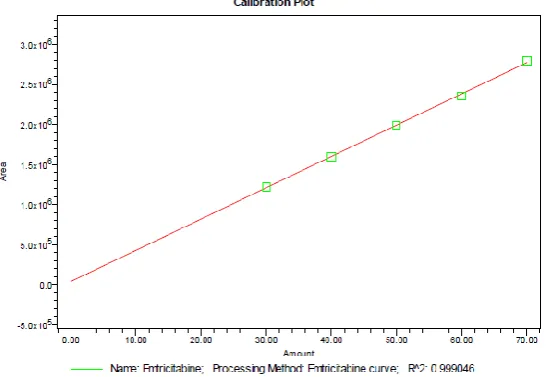
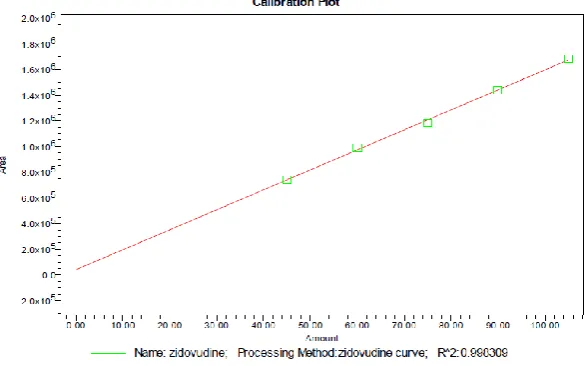
Linearity
Linear range of Gemcitabine and Clarithromycin was found to be 20-60µg/ml. And
[image:4.595.161.435.545.733.2]regression co-efficient was 0.999.
www.wjpr.net Vol 7, Issue 08, 2018. 885 Fig 2: Showing calibration graph for Clarithromycin.
Tab. 1: Linearity of Gemcitabine and Clarithromycin.
Sample ID
Gemcitabine Clarithromycin
Concentration
(mcg/ml) Area
Concentration
(mcg/ml) Area
20% of operating
concentration 20 1224140 10 740046 40% of operating
concentration 30 1595681 15 990204 60% of operating
concentration 40* 1992966 20* 1183023 80% of operating
concentration 50 2356546 25 1439886 100% of operating
concentration 60 2797214 30 1682302 Correlation Coefficient 0.999
Accuracy
The percentage recovery of Gemcitabine was found to be 101.39%, 100.01% and100.39% &
percentage recovery of Clarithromycin was found to be 101.91%, 99. 66% and 102.09% for
accuracy 50%, 100% and 150% samples respectively. The %RSD was found to be less than
www.wjpr.net Vol 7, Issue 08, 2018. 886 Tab 2: Accuracy for Gemcitabine.
Tab 3: Accuracy for Clarithromycin.
Recovery level
Accuracy of Clarithromycin
Average % Recovery Amount taken (mcg/ml) Area Average area Amount recovered (mcg/ml) % Recovery 50% 8.1 646754
648293.3 101.91 101.91
101.22% 8.1 648998
8.1 649128
100%
15 1172743
1174011.1 99.66 99.66 15 1174031
15 1175259
150%
23.3 1866742
1868236.3 102.09 102.09 23.3 1867956
23.3 1870011
Precision
The % Relative standard deviations of Gemcitabine and Clarithromycin were found to be 0.5
and 0.2 respectively. Hence the %RSD values indicate a good degree of precision within the
specified range.
Tab 4: Method precision Gemcitabine,
S.No Injection Peak Name Rt Area Height
1 Injection-1 Gemcitabine 2.586 2010800 346322 2 Injection-2 Gemcitabine 2.588 2002956 340800 3 Injection-3 Gemcitabine 2.590 2012800 346911 4 Injection-4 Gemcitabine 2.590 2005243 344089 5 Injection-5 Gemcitabine 2.591 2011092 345720 Average 2008578.1 Standard Deviation 4237
%RSD 0.2
Recovery level
Accuracy of Gemcitabine
Average % Recovery Amount
taken (mcg/ml)
Area Average
area Amount recovered (mcg/ml) Percentage Recovery 50%
5.05 1011326
1017498.5 101.3927 101.3927
100.599% 5.05 1015029
5.05 1026141
100%
10 1986534
1987384.8 100.0106 100.0106 10 1987425
10 1988195
150%
15 2989367
2992493.4 100.3936 100.3936 15 2991556
www.wjpr.net Vol 7, Issue 08, 2018. 887 Clarithromycin
Tab 5: Method precision Clarithromycin.
S.No Injection Peak Name Rt Area Height
1 Injection-1 Clarithromycin 3.713 1184689 162348 2 Injection-2 Clarithromycin 3.714 1188199 163120 3 Injection-3 Clarithromycin 3.734 1195842 163500 4 Injection-4 Clarithromycin 3.737 1184210 160362 5 Injection-5 Clarithromycin 3.741 1198327 162484 Average 1190253.2 Standard Deviation 6483.1
%RSD 0.5
Limit of Detection
The LOD for this method was found to be 0.001µg/ml for Gemcitabine and 0.005µg/ml for
Clarithromycin.
Limit of Quantification
The LOQ for this method was found to be 0.004µg/ml a Gemcitabine nd 0.015µg/ml for
Clarithromycin.
Robustness: The robustness was tested by changing the, mobile phase composition and PH.
The %RSD Values by changing the above parameters were found to be within the acceptance
criteria i.e. less than 2.
Tab 6: Flow rate results forGemcitabine.
S.No Flow Rate
(ml/min)
System Suitability Results
USP Plate Count USP Tailing
1 0.8 5752 1.4 2 1.0 5026.5 1.3 3 1.2 4476
Tab7: Flow rate results forClarithromycin.
S.No Flow Rate
(ml/min)
System Suitability Results
USP Plate Count USP Tailing
1 0.8 7187 1.2 2 1.0 6381.5 1.2 3 1.2 6471 5.0
Specificity
Specificity is the ability of the analytical method to measure the analyte free from
www.wjpr.net Vol 7, Issue 08, 2018. 888
obtained from analyses of sample solution containing ingredients with that of test results
those obtained from standard drug. Chromatograms for standard & samples were recorded
and they represent no interference.
System Suitability
All the system suitability parameters such as % RSD, Tailing factor, Theoretical plate count
are within the acceptance criteria.
CONCLUSION
The RP-LC method developed for the analysis of Gemcitabine and Clarithromycin in their
pharmaceutical preparations is simple, precise, and accurate. The method is useful for routine
analysis due to short run time.
ACKNOWLEDGEMENT
Authors express their sincere thanks to The Management of Hindu College of Pharmacy &
Sims College of Pharmacy for providing necessary facilities to carry out the research work.
REFERENCES
1. https://en.wikipedia.org/wiki/Clarithromycin.
2. http://www.drugbank.ca/drugs/db00316.
3. Gurudeep Chatwal and Sham Anand, Instrumental methods of chemical analysis.
Himalaya publishers, 7th edition, 1992; 2.624-2.639.
4. Skoog et al., Principles of Instrumental Analysis. Barkhanath publishers, 8th edition,
973-995.
5. Hobart.H. Willard et al., Instrumental methods of analysis, CBS Publications and
Distributors, New Delhi, 1st edition, 1986; 529-563.
6. Sethi P.D., Quantitative analysis of Drugs & Pharmaceuticals. CBS publishers and
distributors, New Delhi, 3rd edition, 2001; 1-120.
7. Lloyd R. Snyder et al., practical HPLC method development. John Wiley & sons
publishers, 2nd edition, 350-400.
8. Interna ICH of technical requirements for the registration of pharmaceuticals for human