www.wjpr.net Vol 4, Issue 06, 2015.
2241 Arti et al. World Journal of Pharmaceutical Research
EXPLORING COMPETENCE OF FLUORESCENT
PSEUDOMONAS
SPP
.
FOR HEAVY METAL TOLERANCE
Ashwini S. Darokar and Arti S. Shanware*
Rajiv Gandhi Biotechnology Centre, Laxminarayan Institute of Technology, Campus, Rashtrasant Tukdoji Maharaj Nagpur University, Amravati Road, Nagpur - 440033,
Maharashtra, India.
ABSTRACT
During the current investigations in the laboratory, some potential strains of fluorescent nature were isolated from the rhizospheric soil of plants viz., Tomato, Brinjal and Sugarcane from different field sites of vidarbha region. These isolates were subsequently identified as
fluorescent Pseudomonas spp. by performing standard microbiological and biochemical tests. The present studies deal with exploration of the heavy metal tolerance capability of these isolates against various concentrations of some selected heavy metals. In preliminary investigations, total 6 heavy metal compounds – Zinc Sulphate (ZnSO4), Potassium dichromate (K2Cr2O7), Copper sulphate (CuSO4), Arsenic chloride (AsCl3), Mercuric chloride (HgCl2), Lead nitrate [Pb(NO3)2] were screened against these isolates to generate a sensitivity profile. Further the growth and fluorescence pattern of the said isolates were verified by incorporating different concentration of heavy metals while performing the standard tests and through
spectrophotometric analysis. The effect of heavy metals on growth and PGPR activity was analyzed in this study. The heavy metal resistant isolates could be interned in solid or liquid bioinoculants and could be effectively used in agricultural soil contaminated with heavy metals.
KEYWORDS: Heavy metal compounds, fluorescent Pseudomonas, contaminants, MIC, PGPR.
Volume 4, Issue 6, 2241-2252. Research Article ISSN 2277– 7105
Article Received on 15 April 2015,
Revised on 08 May 2015, Accepted on 31 May 2015
*Correspondence for
Author
Dr. Arti S. Shanware
Rajiv Gandhi
Biotechnology Centre,
Laxminarayan Institute of
Technology, Campus,
Rashtrasant Tukdoji
Maharaj Nagpur
University, Amravati
Road, Nagpur - 440033,
www.wjpr.net Vol 4, Issue 06, 2015.
2242 1. INTRODUCTION
The sewage sludge, industrial waste and long term use of chemical fertilizer in agriculture contaminated the agricultural soil due to toxicity rendered by the heavy metals such as Cadmium (Cd), Copper (Cu), Zinc (Zn), Nickel (Ni), Cobalt (Co), Mercury (Hg), Chromium (Cr), Lead (Pb) and Arsenic (As).[1,2,3] The soil microorganism suffer from direct or indirect impacts of the heavy metals. However, these heavy metals, in traces, are requisite for soil biota as co-factor for enzymatic reaction.[4] Heavy metal toxicity in soil and water causes dreadful effects on plants, animals and humans.[5] The bioremediation of these heavy metals remains the major problem till today. Bioremediation of heavy metals by using microorganisms has drawn a great attention globally. Some fluorescent Pseudomonas spp. showed key role in degradation of pesticides as well as heavy metals.[6] According to
literature, few microorganisms are capable of surviving in high concentration of heavy metal including Pseudomonas spp. In addition to heavy metal tolerance ability, they also have plant growth promotional and phytopathogenic activity and hence could be effectively used in agricultural practices.
Pseudomonas spp. are the significant bacteria in agriculture soil and the fluorescent
Pseudomonas sp. is one of the most prominent strains of genus Pseudomonas.[7] The traits
that make fluorescent Pseudomonas spp. helpful for use in agriculture include, production of phytoharmones, siderophore, antibiotics, lytic enzymes and hydrogen cyanide (HCN). The competitive root colonization and induction of systemic resistance against plant pathogen are other important properties of these spp. Many workers focus on heavy metal tolerance capacity of these spp. because heavy metals reduce soil fertility and harm soil beneficial microorganisms.[7]
The present study deals with probable isolation and characterization of heavy metal tolerant strains of fluorescent Pseudomonas. Six different heavy metals Zinc sulphate (ZnSO4), Potassium dichromate (K2Cr2O7), Copper sulphate (CuSO4), Arsenic chloride (AsCl3), Mercuric chloride (HgCl2), Lead nitrate [Pb(NO3)2] were used for this study. The plant growth promotional activity of these isolates, like phosphate solubilization, Indol acetic acid production, was analyzed by incorporating different concentration of each heavy metals.
www.wjpr.net Vol 4, Issue 06, 2015.
2243 2. MATERIALS AND METHODS
2.1. Sampling sites and collection
The soil samples were collected from rhizospheric region of Sugercane,Tomato and Brinjal plants from villages Bazargaon, Mohapa, Kalmesher and Kuhi respectively, Dist. Nagpur. The samples were collected in polythene bags for transportation in the laboratory and kept in refrigerator till use.
2.2. Isolation of fluorescent Pseudomonas isolates
A soil suspension was prepared by shaking 1g of soil having 2-3 cm undamaged root pieces with tightly adhered soil in 100 ml of sterile distilled water and kept for 24hrs on a rotary shaker to release the rhizoplane bacteria. The processed samples were serially diluted from 10-1 to 10-6 and 0.1 ml of the suspension was spread on to King’s medium B ( KMB ) agar plate and incubated at 28ºC for 48h. The occurrence of fluorescent Pseudomonas was examined under UV light (356 nm) by using Spectroline Ultravoilet Transilluminator.
2.3. The heavy metals used for study
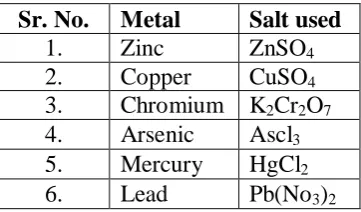
[image:3.595.208.389.443.549.2]The study was carried out by using six heavy metal compounds given in Table 1.
Table 1 - Heavy metals used in the study
Sr. No. Metal Salt used
1. Zinc ZnSO4
2. Copper CuSO4 3. Chromium K2Cr2O7 4. Arsenic Ascl3 5. Mercury HgCl2 6. Lead Pb(No3)2
2.4. Heavy metal sensitivity profile
www.wjpr.net Vol 4, Issue 06, 2015.
2244 2.5. Determination of effect of heavy metal compounds on bacterial growth
The growth curve of isolates were determined by incorporating 50ug/ml, 100ug/ml, 150ug/ml, 200ug/ml, 250ug/ml and 300ug/ml concentration respectively of each heavy metal and measuring the optical density at 600nm by spectrophotometer (Dynamica Halo DB - 20S).
2.6. Determination of MIC
The bacterial cultures were streaked onto the Nutrient Agar (NA) medium, containing different concentration of heavy metal salts and then plates were incubated at 37°C for 24-48 hrs, checking everyday for bacterial growth. The concentration of heavy metals at which no bacterial growth was observed, considered as the MIC of that metal for that strain.
2.7. Visual Quantization of fluorescence
King’s B agar plates were streaked with the King’s B broth containing test organism treated
by different concentration of heavy metal. The streaked plates were kept in incubator for 24-48 hrs and were photographed. The bacterial fluorescence was observed visually under UV- Transilluminator.
2.8. Determination of effect of heavy metal on the activity of isolate Different concentrations of heavy metal were used to perform following tests.
2.8.1. IAA production
Heavy metal of different concentration was added to King’s B broth and transferred into test
tubes. No Heavy metal was added in control tubes. All the tubes were inoculated with test bacterial culture. Determination of indol acetic acid production (IAA) was performed according to method described by Ramyasmruthi S. et al. Briefly, bacterial cultures were grown in metal containing KMB broth and supplemented with Tryptophan (5mg/ml) for 24 hrs at 280 C. Fully grown bacterial cultures were centrifuged for 30 min at 3000 rpm. Later, 2 ml of culture filtrate was mixed with two drops of orthophosphoric acid and 4 ml of the Salkowski reagent (50 ml, 35% of perchloric acid, 1 ml 0.5 M FeCl3 solution).
2.8.2. Phosphate solubilization
www.wjpr.net Vol 4, Issue 06, 2015.
2245 Phosphate solubilization was determined by clear halo zone formation after 3 days of incubation.
3. RESULTS AND DISCUSSION
3.1. Isolation of fluorescent Pseudomonas bacteria
The test organisms used in this study were found to be the fluorescent Pseudomonas sp. These strains were isolated from the rhizosphere region of crop plant Tomato and Sugarcane from different field sites of Vidarbha region while no any strain was found from the rhizosphere region of Brinjal plant. On the basis of standard microbiological and biochemical tests, the test organisms were identified as the Pseudomonas sp. PcFRB039 (FP 3) and Pseudomonas aeruginosa ( FP 4 ) a fluorescent bacterial strains [Fig.1 (A&B)].
Fig.1 (A&B) : Fluorescent Pseudomonas isolates under UV-light
3.2. Preliminary screening of the test organisms against heavy metals
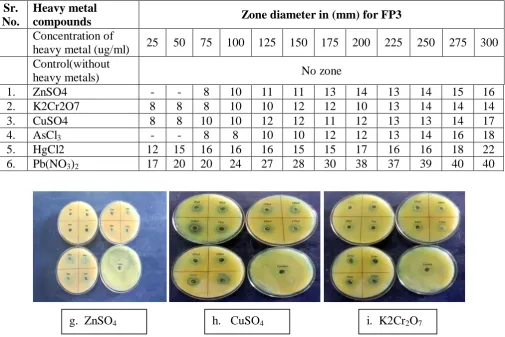
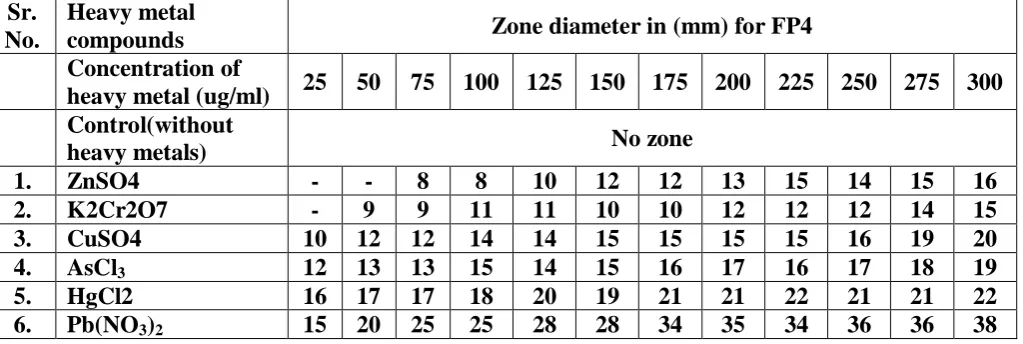
The isolates were tested for their sensitivity towards six different heavy metals by Kirby-Bauer test method. The bacterial isolates were treated with the six heavy metal – ZnSO4, CuSO4, K2Cr2O7, AsCl3, HgCl2, Pb(NO3)2. The growth of bacterial isolates was analyzed on the basis of zone of inhibition against different concentration of heavy metals used. When the isolate FP3 and FP4 were tested against heavy metals- ZnSO4, CuSO4, K2Cr2O7, AsCl3, no zone or slightest zone was found as compared to the control up to the conc. 300 ug/ml,
indicating good growth of isolates even after addition of contaminants. While greater zone of inhibition for heavy metal HgCl2, Pb(NO3)2 indicated sensitivity of the isolates for these heavy metals{ [ fig. 2 ( a-f) & Table 2] and [Fig. 3 (g - l) & Table 3]}.
www.wjpr.net Vol 4, Issue 06, 2015.
2246 Fig. 2 (a - f): Zone of inhibition shown by isolate FP3 against different heavy metals
Table 2 - Interpretation of zone given by isolate FP3 against different conc. of heavy metals
Sr. No.
Heavy metal
compounds Zone diameter in (mm) for FP3
Concentration of
heavy metal (ug/ml) 25 50 75 100 125 150 175 200 225 250 275 300 Control(without
heavy metals) No zone
1. ZnSO4 - - 8 10 11 11 13 14 13 14 15 16
2. K2Cr2O7 8 8 8 10 10 12 12 10 13 14 14 14
3. CuSO4 8 8 10 10 12 12 11 12 13 13 14 17
4. AsCl3 - - 8 8 10 10 12 12 13 14 16 18
5. HgCl2 12 15 16 16 16 15 15 17 16 16 18 22
6. Pb(NO3)2 17 20 20 24 27 28 30 38 37 39 40 40 a. ZnSO
4 ZnSO 4
c. K2Cr2O7 b. CuSO4
d. AsCl3 e. HgCl2 f. Pb(NO3)2
[image:6.595.73.506.67.311.2] [image:6.595.48.554.398.735.2]www.wjpr.net Vol 4, Issue 06, 2015.
2247 Fig. 3 (g - l) : Zone of inhibition shown by isolate FP4 against different heavy metals
Table 3 - Interpretation of zone given by isolate FP4 against different conc. of heavy metals
3.4. Spectrophotometric analysis
The effect of heavy metal compounds on cell density of P. fluorecens strains FP3 and FP4 was analysed by spectrophotometer. Heavy metal compounds ZnSO4, K2Cr2O7, CuSO4 and
AsCl3 had little or no effect, while HgCl2 and Pb(NO3)2 had adverse effect on the cell density, after 24 hrs to 48 hrs of incubation with heavy metal compounds. These results
showed that the bacterial candidates under study was found to be resistant to heavy metals ZnSO4, K2Cr2O7, CuSO4 and AsCl3 while sensitive to HgCl2 and Pb(NO3)2 ( Figs. 4 & 5 ). Sr.
No.
Heavy metal
compounds Zone diameter in (mm) for FP4
Concentration of
heavy metal (ug/ml) 25 50 75 100 125 150 175 200 225 250 275 300 Control(without
heavy metals) No zone
1. ZnSO4 - - 8 8 10 12 12 13 15 14 15 16
2. K2Cr2O7 - 9 9 11 11 10 10 12 12 12 14 15
3. CuSO4 10 12 12 14 14 15 15 15 15 16 19 20
4. AsCl3 12 13 13 15 14 15 16 17 16 17 18 19
5. HgCl2 16 17 17 18 20 19 21 21 22 21 21 22
6. Pb(NO3)2 15 20 25 25 28 28 34 35 34 36 36 38
[image:7.595.86.512.67.210.2] [image:7.595.46.558.289.461.2]www.wjpr.net Vol 4, Issue 06, 2015.
[image:8.595.144.454.68.241.2]2248 Fig. 4 : Effect of different concentration of heavy metal on cell density of Pseudomonas sp.
Fig. 5: Effect of different concentration of heavy metal on cell density of Pseudomonas aeruginosa PcFRB039
3.5. Determination of MIC
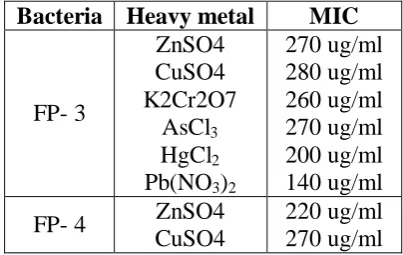
The minimal inhibitory concentration of heavy metal compounds were evaluated against selected heavy metals for heavy metal tolerance study.[8] The MIC of each heavy metals was shown in Table 4.
Table 4 - Resistance of bacteria to heavy metals.
Bacteria Heavy metal MIC
FP- 3
ZnSO4 CuSO4 K2Cr2O7
AsCl3 HgCl2 Pb(NO3)2
270 ug/ml 280 ug/ml 260 ug/ml 270 ug/ml 200 ug/ml 140 ug/ml FP- 4 ZnSO4
CuSO4
[image:8.595.141.457.290.455.2] [image:8.595.196.398.643.770.2]www.wjpr.net Vol 4, Issue 06, 2015.
2249 (FP = Fluorescent Pseudomonas isolate, MIC = Minimum inhibitory concentration)
3.6. Digital photographic data
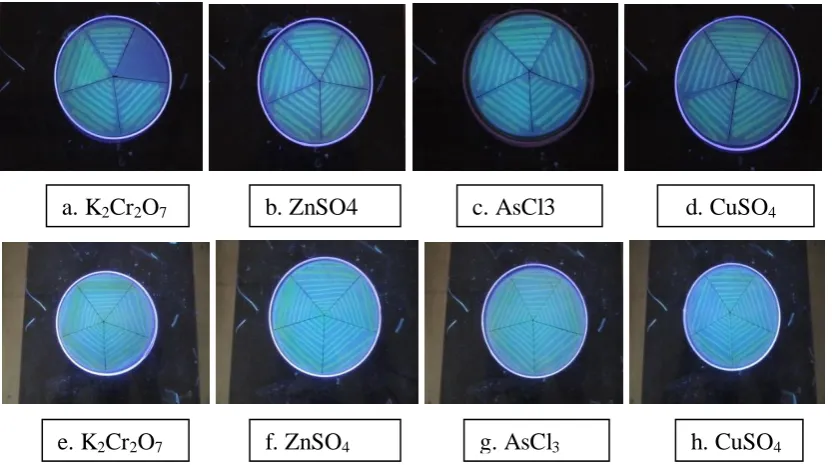
The fluorescent Pseudomonas strains under study, showed fluorescence under UV light when observed under UV-Transilluminator. The overnight grown isolates in King’s B broth inoculated with different concentrations of heavy metals were used for streak plating and plates were observed for fluorescence under UV-light. The bacterial cultures got fluorescence after 24 hrs of incubation for all concentrations of heavy metals ( 100ug/ml to 300ug/ml), while decrease in the fluorescence was found after 48 hrs of incubation [ fig. 6 (a-h)].
Fig. 6 (a-h): Qualitative measurement of fluorescence of FP3 and FP4 through digital photography of plates under UV-light
3.7. Effect of heavy metals on PGPR activity
The plant growth promotion activity of the isolates FP3 and FP4 was analyzed by incorporating the heavy metals for Indol acetic acid (IAA) production and phosphate solubilization tests and it is found that both the isolates showed pink colour development that is IAA production as well as halo zone formation after 24 hrs of incubation at 280 C. However, activity of these isolates to produce halo zone on Pikovskaya’s media and indole acetic acid production was reduced as compared to control. It clearly indicated that the
K2Cr2O7 AsCl3 HgCl2 Pb(NO3)2
250 ug/ml 180 ug/ml 140 ug/ml 110 ug/ml
e. K2Cr2O7 f. ZnSO4 g. AsCl3 h. CuSO4
[image:9.595.188.398.71.130.2] [image:9.595.92.509.326.559.2]www.wjpr.net Vol 4, Issue 06, 2015.
2250 isolates under study were found to be resistant to the heavy metals ZnSO4, CuSO4, K2Cr2O7and AsCl3.
The presence of higher concentration of heavy metals in the soil disturbs the soil beneficial microflora. The heavy metal contamination in the soil reduce the growth as well as plant growth promotional activity of the soil bacteria. However, metal resistant plant growth promoting bacteria improved the plant growth and yield. Many workers suggested that the soil bacteria enhanced the plant growth and mimics the toxic effects of heavy metals on plants.[10] Osborne et al., (2010) studied the metal tolerance concentration of plant growth promoting rhizobacteria strains and found that they were able to survive till 300 mg/l on cadmium amended minimal medium.
In the present study, metal resistant PGPR strains FP3 and FP4 were isolated and studied for their heavy metal tolerance capacity. According to Cazorla et al. 2002, Pseudomonas strains were found resistant to Cu. These results were found to be similar to this study. Filali et al., (1999) studied bacteria isolated from wastewater such as, Psuedomonas aeroginosa, Klebsiella pneumoniae, Proteus mirabilis and Staphylococcus and found to be resistant to heavy metals and antibiotics.[13] Microbial tolerance to heavy metal is due to detoxifying mechanism developed by resistant microorganisms such as metal reduction, metal efflux etc., but presence of very high concentration of heavy metals, exert inhibitory action on microorganisms by blocking the essential functional groups.
According to Carlot et al., (2002) the Pseudomonas sp. (SP1), isolated from hydrocarbon contaminated soil, was found to be a potential heavy metals tolerant bacteria and efficient in producing plant growth promoting (PGP) compounds. This result was found to be similar to this study, as the isolate FP3 and FP4 were found resistant to the heavy metals - Zinc sulphate (ZnSO4), Potassium dichromate (K2Cr2O7), Copper sulphate (CuSO4) and Arsenic chloride (AsCl3), as well as competent in producing plant growth promoting (PGP) compounds.
www.wjpr.net Vol 4, Issue 06, 2015.
2251 4. CONCLUSION
The sewage sludge, industrial waste and long term use of chemical fertilizers in agriculture, contaminated the agricultural soil by heavy metal toxicity which cause threats to the environment and health because of their toxicity and non-biodegrability. The soil microorganism suffer from direct or indirect impacts of the heavy metals. Microorganisms with the ability to tolerate and reduce heavy metal compounds can be used for detoxification of contaminated environment. The heavy metal resistant bacteria could be a potential representative for reducing heavy metal toxicity.
Remediation of heavy metal compounds by microorganisms has drawn great attention today for its potential applications in industry. Metal resistant soil bacteria also enhance the plant growth as well reduced the heavy metal toxicity. The selection of such microorganisms, having both traits viz., metal tolerant capacity and competent in producing plant growth promoting (PGP) compounds could be proved useful to speed up agriculture productivity. Hence, these competent isolates under study could be used efficiently in metal containing soil also for increasing crop yield.
ACKNOWLEDGEMENT
ASD gratefully acknowledges Rajiv Gandhi Biotechnology Centre, Laxminarayan Institute of Technology Campus, Rashtrasant Tukdoji Maharaj Nagpur University, Nagpur, Maharashtra, India, for providing all infrastructural facilities for this research work.
REFERENCES
1. Bell FG, Bullock ST, Halbich TJ, Lindsay P. Environmental impacts associated with an abandoned mine in the Witbank Coalfield, South Africa. Inter. J. of Coal Geology, 2001; 45: 195–216.
2. Schwartz C, Gerard E, Perronnet K, Morel JL. Measurement of in situ phytoextraction of zinc by spontaneous metallophytes growing on a former smelter site. Sci. of the total
Environ., 2001; 279: 215–221.
3. Passariello B, Giuliano V, Quaresima S, Barbaro M, Caroli S, Forte G, Garelli G, Iavicoli I. Evaluation of the environmental contamination at an abandoned mining site. Microchemical J., 2002; 73: 245–250.
4. Virender S, Chauhan PK, Rohini K, Tejpal D, Vinod K. isolation and characterization of pseudomonas resistant to heavy metals contaminants. July – August Article 030, 2010; 3:
www.wjpr.net Vol 4, Issue 06, 2015.
2252 5. Dowdy RH, Volk VV. Movement of heavy metals in soils. In: D.W. Nelsenetal.
Chemical Mobility and Reactivity in Soil Systems, 1983; 229-240. 6. Wasi S, Jeelani G, Ahmad M. Chemosphere, 2008; 71:1348–1355.
7. Deshwal VK, Kumar P. Effect of heavy metals on growth and PGPR activity of pseudomonads. J. of Academia and Industrial Research (JAIR), 2013; 2 : 286-290.
8. Narasimhulu K, Sreenivasa PS, Vinod AV. Isolation and identification of bacterial strains and study of their resistance to heavy metals and antibiotics. J Microbial BiochemTechnol, 2010; 2: 074-076.
9. Ramyasmruthi S, Pallavi O, Pallavi S, Tilak K, Srividya S. Chitinolytic and secondary metabolite producing Pseudomonas fluorescens isolated from Solanaceae rhizosphere effective against broad spectrum fungal phytopathogens. Asian. J. Plant Sci. Res., 2012;
1st ed. 2: 16-24.
10.Belimov AA, Kunakova AM, Safronova VI, Stepanok VV, Yudkin LY, Alekseev YV, Kozhemyakov AP. Employment of rhizobacteria for the inoculation of barley plants cultivated in soil contaminated with lead and cadmium. Microbiol. (Moscow), 2004; 73: 99-106.
11.Osborne WJ, Saravanan VS, Mukherjee A, Chandrasekaran N.. Impact of Vetiveria zizanioides rhizosphere bacterial isolates on PGPR traits and cadmium resistance. J. Ecobiotechnol., 2010; 2(1): 34-42.
12.Cazorla FM, Arrebola E, Sesma A, Pérez-García A, Codina JC, Murillo J, de Vicente A. Copper resistance in Pseudomonas syringae strains isolated from mango is encoded mainly by plasmids. Bacteriol., 2002; 92(8): 909-916.
13.Filali BK, Taoufik J, Zeroual Y, Dzairi FZ, Talbi M, and Blaghen M . Waste water bacterial isolates resistant to heavy metals and antibiotics. Current Microbiology., 1999; 41: 151-156.