TE
AM
FL
Y
Large-Scale
Software Architecture
A Practical Guide using UML
Jeff Garland
CrystalClear Software Inc.
Richard Anthony
Large-Scale
Software Architecture
A Practical Guide using UML
Jeff Garland
CrystalClear Software Inc.
Richard Anthony
Copyright#2003 by John Wiley & Sons Ltd, The Atrium, Southern Gate, Chichester, West Sussex PO19 8SQ, England
Telephone (+44) 1243 779777
Email (for orders and customer service enquiries): [email protected] Visit our Home Page on www.wileyeurope.com or www.wiley.com
All Rights Reserved. No part of this publication may be reproduced, stored in a retrieval system or transmitted in any form or by any means, electronic, mechanical, photocopying, recording, scanning or otherwise, except under the terms of the Copyright, Designs and Patents Act 1988 or under the terms of a licence issued by the Copyright Licensing Agency Ltd, 90 Tottenham Court Road, London W1T 4LP, UK, without the permission in writing of the Publisher, with the exception of any material supplied specifically for the purpose of being entered and executed on a computer system, for exclusive use by the purchaser of the publication. Requests to the Publisher should be addressed to the Permissions Department, John Wiley & Sons Ltd, The Atrium, Southern Gate, Chichester, West Sussex PO19 8SQ, England, or emailed to [email protected], or faxed to (+44) 1243 770571.
Neither the authors nor John Wiley & Sons, Ltd accept any responsibility or liability for loss or damage occasioned to any person or property through using the material, instructions, methods or ideas contained herein, or acting or freraining from acting as a result of such use. The authors and publisher expressly disclaim all implied warranties, including merchantability or fitness for any particular purpose. There will be no duty on the authors or publisher to correct any errors or defects in the software.
Designations used by companies to distinguish their products are often claimed as trademarks. In all instances where John Wiley & Sons, Ltd is aware of a claim, the product names appear in capital or all capital letters. Readers, however, should contact the appropriate companies for more complete information regarding trademarks and registration.
This publication is designed to provide accurate and authoritative information in regard to the subject matter covered. It is sold on the understanding that the Publisher is not engaged in rendering professional services. If professional advice or other expert assistance is required, the services of a competent professional should be sought.
Other Wiley Editorial Offices
John Wiley & Sons Inc., 111 River Street, Hoboken, NJ 07030, USA Jossey-Bass, 989 Market Street, San Francisco, CA 94103-1741, USA Wiley-VCH Verlag GmbH, Boschstr. 12, D-69469 Weinheim, Germany
John Wiley & Sons Australia Ltd, 33 Park Road, Milton, Queensland 4064, Australia
John Wiley & Sons (Asia) Pte Ltd, 2 Clementi Loop #02-01, Jin Xing Distripark, Singapore 129809 John Wiley & Sons Canada Ltd, 22 Worcester Road, Etobicoke, Ontario, Canada M9W 1L1
Library of Congress Cataloging-in-Publication Data
(to follow)
British Library Cataloguing in Publication Data
A catalogue record for this book is available from the British Library ISBN 0 470 84849 9
Typeset in 101
2/13pt Sabon by Keytec Typesetting, Bridport, Dorset
Printed and bound in Great Britain by Biddles Ltd, Guildford and Kings Lynn
Contents
Preface xi
Acknowledgments xvii
1
Introduction
1
1.1 What is Software Architecture 1
1.1.1 What software architecture is not 4 1.1.2 Attributes of software architecture 5 1.1.3 Definitions of other key architecture-related terms 7
1.1.4 Other types of architectures 8
1.2 Why Architect? 10
1.3 Architectural Viewpoint Summary 12
1.4 Other Software Architecture Approaches 16
1.4.1 The 4+1 Views 16
1.4.2 RM-ODP viewpoints 17
1.4.3 Bass architectural structures
1.4.4 Hofmeister software architecture views 1.5 Recommended Reading
2
Roles of the Software Architect
21
2.1 Relationship to other key roles in development organization 25
Role: project management 25
Role: development team managers 25
Role: system architect/chief engineer 26
Role: chief software engineer 26
Role: hardware architect 27
Role: network architect 27
Role: technical leads of each release 28
Role: data architect 28
Role: systems engineering leads 28
Role: software systems engineering lead 29 2.2 Skills and Background for the Architect 29 2.3 Injecting Architecture Experience 31 2.4 Structuring the Architecture Team 32 2.5 Traps and Pitfalls Associated with the Role of Software Architect 33 2.5.1 Clear definition of leadership 34 2.5.2 Reporting structure for the software architect 34 2.5.3 Geographical location of software architect and technical leads 35 2.5.4 Architecture team size and composition 36 2.5.5 Software architect lifecycle participation 36
2.6 Recommended Reading 37
3
Software Architecture and the Development
Process
39
3.1 Overview of Iterative Development 39
3.1.1 Overall process phases 40
3.1.2 Lifecycle stages 41
3.1.3 Architecture and agile processes 43 3.1.4 Start early, refine constantly 47
3.2 Requirements Management 48
3.2.1 Use cases and requirements engineering 48 3.2.2 Additional requirements that impact architecture 49
3.2.3 Requirements tracing 49
3.3 Management of the Technology Roadmap 50
3.3.1 External software products 50
3.3.2 Software technology management traps and pitfalls 53 3.3.3 Organizational technology roadmap 54
3.4 Effective Technical Meetings 55
3.4.1 Informal technical meetings 55
3.4.2 Peer reviews and inspections 56
3.4.3 Design reviews 57
3.4.4 Design communication meetings 57
3.4.5 Management meetings 57
3.4.6 Vendor presentations 58
3.4.7 Distributed technical meetings 58 3.5 Traps and Pitfalls of the Software Architecture Process Activities 59
The out-of-touch architect 59
Analysis paralysis 60
Design for reuse 60
Use cases 60
Schedule 60
3.6 Computer-Aided Software Engineering (CASE) Tools 61
3.7 Recommended Reading 62
4
Example System Overview
63
4.1 System Overview 64
4.2 Overview of System Interfaces 64
4.3 Constraints 67
4.4 Major Operational Requirements and Software Requirements 67
5
UML Quick Tour
69
5.1 UML Diagram Summary 69
5.2 General Diagramming Conventions 72
5.2.1 General UML features: stereotypes, tagged values, multi-instance 73
5.2.2 View labels 74
5.3 The Diagrams 75
5.3.1 Component instance diagrams 75
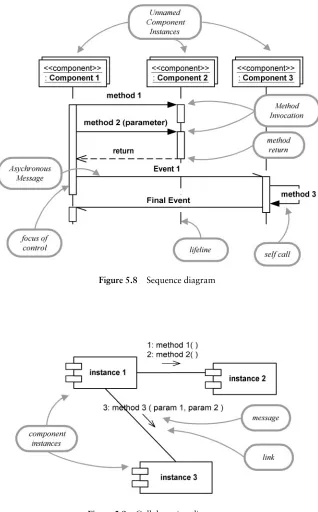
5.3.2 Class and subsystem diagrams 76 5.3.3 Interaction (sequence and collaboration) diagrams 77
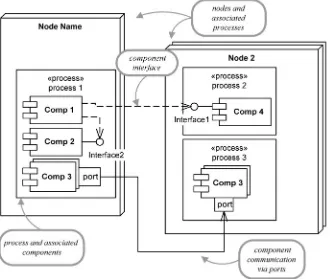
5.3.4 Deployment diagrams 79
5.3.5 Statechart diagrams 80
5.3.6 Activity diagrams 81
5.4 Managing Complexity 81
5.4.1 Use Case focused modeling 82
5.4.2 Element focused modeling 82
5.4.3 Level of detail 83
5.4.4 Controlling the number of models 83 5.4.5 Use Supplemental Textural Information 85
5.5 Recommended Reading 85
6
System Context and Domain Analysis
87
6.1 Conceptual Diagrams 87
6.2 Context Viewpoint 89
6.3 Domain Analysis Techniques 94
6.3.1 A formal analysis technique 95
6.3.2 Other techniques for finding domain entities 98
6.3.3 Analysis shortcuts 100
6.4 Analysis Viewpoints 101
6.4.1 Analysis Interaction Viewpoint 101
6.4.2 Analysis Focused Viewpoint 103
6.4.3 Analysis Overall Viewpoint 105
6.4.4 Candidate subsystem identification 107
6.5 Recommended Reading 108
7
Component Design and Modeling
111
7.1 Overview 111
7.1.1 Component-based development 111
7.1.2 Terminology 112
7.1.3 Communication and interfaces 115
7.1.4 Finding components 115
7.1.5 Qualities of component design 116
7.2 Component Viewpoint 116
7.2.1 Component communication 117
7.2.2 Component interfaces 118
7.2.3 Message-based component modeling 121 7.2.4 Combining interfaces and messaging 124 7.2.5 Comparison of interfaces and messaging 127 7.2.6 Mechanism and performance annotations 128 7.3 Component Interaction Viewpoint 131 7.3.1 Component to Component Interactions 131
7.4 Component State Modeling 133
7.5 Modeling Highly Configurable Component Architectures 137
7.6 Recommended Reading 137
8
Subsystem Design
139
8.1 Terminology 139
8.2 Modeling Subsystems, Interfaces, and Layers 141 8.2.1 Subsystem Interface Dependency Viewpoint 141 8.2.2 Enhancing the Subsystem Dependency Views with layers
8.2.3 Top-level Dependencies 144
8.2.4 The Layered Subsystem Viewpoint 146 8.3 Mapping Subsystems and Layers to Implementation 151 8.3.1 Subsystems, layers, and build trees 151 8.3.2 Subsystems and components
8.4 Recommended Reading 154
9
Transaction and Data Design
155
9.1 Logical Data Architecture 155
9.1.1 Logical data model stability 157 9.1.2 Effects of the stable logical data model 158
9.2 Logical Data Viewpoint 159
9.2.1 Logical Data View example 160
9.2.2 Logical Data View for messaging 9.3 Data Model Design – Other Considerations
9.3.1 Data models and layers 164
9.3.2 Data models and reflection 165
9.3.3 Mapping objects to relational database 166
9.4 Transaction Design 169
9.4.1 Transaction concepts 170
9.4.2 Modeling transaction dynamics 171 9.4.3 Transactions and interface design 173
9.5 Recommended Reading 174
10
Process and Deployment Design
177
10.1 Physical Data Viewpoint 178
10.1.1 Modeling other storage attributes 179 10.1.2 Detailed physical storage modeling 181
10.2 Process Viewpoint 183
10.2.1 Processes and components 186 10.2.2 Process and component management 186
10.2.3 Process State Viewpoint 189
10.3 Deployment Viewpoint 193
10.3.1 Scalable node design 194
10.3.2 Backup/archive design 199
10.4 Recommended Reading 199
11
Architecture Techniques
201
11.1 Architecture Development Techniques 201 11.1.1 Commonality and variability analysis 202
11.1.2 Design for change 203
11.1.3 Generative programming techniques 204 11.1.4 Building a skeleton system 205
11.1.5 Prototyping 206
11.1.6 Interface development – Design by Contract 206 11.1.7 Architectural description languages 208
11.1.8 Architecture evaluation 208
11.2 Software Partitioning Strategies – Separation of Concerns 208
11.2.1 Functional decomposition 209
11.2.2 Isolate donfiguration data 210
11.2.3 Isolate hardware-specific components 210 11.2.4 Isolate time-critical components 211 11.2.5 Separate domain implementation model from human interface 211 11.2.6 Separate domain implementation model from implementation
technology 211
11.2.7 Separate main function from monitoring 212 11.2.8 Separate fault recovery processing 212 11.2.9 Adaptation of external interfaces 213 11.3 Software Changeability and Dependency Management 213 11.3.1 The stable dependencies principle (SDP) 214 11.3.2 Acyclic dependencies principle 215 11.3.3 Interface Separation Principle 216
11.4 Using Architectural Patterns 216
11.5 Integration Strategies 218
11.5.1 Data-only integration 219
11.5.2 Executable integration 220
11.6 Establishing Architecture to Support Development 221 11.6.1 Configuration and change management 221
11.6.2 Build management 222
11.6.3 Continuous integration 222
11.6.4 Anticipate multi-language development 223 11.6.5 Anticipate tactical development (scripting) 224
11.7 Recommended Reading 225
12
Applying the Viewpoints
227
12.1 Bottom-Up Architecture Development 227 12.2 Top-Down Architecture Development 229
12.3 Message Protocol and Interface Development 231 12.4 Reengineering Existing Systems 233
12.5 Documenting the Architecture 233
12.6 Conclusions 235
12.6.1 Becoming an architect 235
12.6.2 State of the Practice 237
12.6.3 Looking forward 238
12.6.4 Final thoughts 240
12.7 Recommended Reading 241
Appendix: Summary of Architectural Viewpoints
243
Bibliography
251
Index
257
Preface
The purpose of this book is to describe practical representations and techni-ques for the development of large-scale software architectures. The goal is to enable other software architects, developers, and managers to become more effective as a direct result of our experiences on several large-scale software development projects. We describe the techniques and architectural represen-tations we have utilized successfully.
This book is intended to be a practical guide. Our goal is to be brief. We cover only the essential information to guide software architects in defining the software architecture, providing pointers to further reading in lieu of detailed descriptions of this literature. Ideally, we can help software develop-ment teams avoid the common practice of capturing the architecture after the software has been developed instead of utilizing the architecture as a tool to guide the software development.
The Unified Modeling Language (UML) is used throughout this book. We reduce the myriad of UML constructs to a precious few that we have found to be most useful. Leveraging the recent IEEE 1471 standard for software intensive systems, we describe several architectural viewpoints that are helpful in the development and documentation of software architectures. After read-ing this book, you will understand these viewpoints and techniques that will improve the modeling of your system’s software architecture.
apply to smaller projects and embedded systems. A typical large-scale soft-ware project will include:
• Large quantities of source code (typically millions of lines)
• Large numbers of developers (potentially hundreds, often geographically distributed)
• High complexity of interaction between components
• Extensive use of off-the-shelf components
• Multiple programming languages
• Multiple persistence mechanisms (files, relational databases, object data-bases)
• Multiple hardware platforms
• Distribution of components over several hardware platforms
• High concurrency
Dealing with the complexity of large-scale systems can be a challenge for even the most experienced software designers and developers. Large software systems contain millions of elements, which interact to achieve the system functionality. The interaction of these elements is far from obvious, especially given the artifacts created for a typical software project. These artifacts are especially critical as new team members are added and at different phases of the project. These phases include development, integration, testing and main-tenance of the system. Even more challenging, however, these elements must be understood and modified as the required functionality of the system evolves. To do this correctly requires an understanding of how the elements interact as well as the underlying principles of the design.
Unfortunately, humans are ill equipped to manage complexity. Human short-term memory can typically hold between five and nine items simulta-neously. Communication among team members is critical to cooperation and yet often uses imprecise language that frequently creates miscommunication. Providing a shared language of discussion can greatly enhance communica-tion. Recently software has begun to develop some of the complexity manage-ment methods similar to those utilized in other engineering domains. These include the UML, object-modeling techniques, Design Patterns, and use of pre-fabricated software components and frameworks.
Architecture-based development is often recommended as a technique for
dealing with the complexity of large-scale projects. However, there is still little agreement about how to develop and describe software architecture effectively. The agreement usually ends with the use of UML for design, although this is not universal either. The UML provides a huge set of constructs for describing the software architecture, and includes many extensibility features. However, this flexibility creates a large number of possibilities for software architecture representation. In addition, most of the books and articles on software architecture and UML do not address large-scale development. The literature typically doesn’t provide guidelines on how to get started in the definition of the software architecture, and doesn’t provide specific representations which convey appropriate information to the stakeholders in a software architecture. This book is an attempt to meet these needs, which are critical to the software architect and the software development team.
Some areas where this book will provide practical guidance include:
• Modeling of architectural constructs, including components, subsystems, dependencies, transactions, and interfaces
• Modeling of environmental elements, including processes, nodes, and
physical databases
• Insight into useful techniques for development of software architectures
• Various software architecture development processes
• Roles and responsibilities of the software architect and the architecture team
• Traps and pitfalls of architecture development
• Utilization of reusable and off-the-shelf software frameworks and compo-nents
• Addressing non-functional requirements such as performance and
main-tainability
This book does not purport to describe the best or only way to represent software architecture. Some systems may require additional representations from the ones shown in this book, and others may require only a subset of those shown here. However, most software development projects could benefit from at least some of the techniques and architecture representations de-scribed here.
In this book, we stick closely to the UML without major extensions. In some cases, this results in some limitations in formality or model semantics. Regardless of these limitations, these viewpoints have helped us solve complex problems in large systems. Note that over the course of several projects, the views described within were upgraded to utilize the UML. In many cases, we were using ad-hoc notations before the UML had reached its current state. In addition, future changes to the UML and the associated profiles may allow for improvements of the architecture views described in the book. Any that we are aware of are highlighted. Finally, although the focus is on modeling architecture with the UML, we discuss other representations where appro-priate.
While a major portion of the book focuses on the application of the UML to software architecture, we also discuss therole of the software architectand how architecture development fits within the software development process. We have applied the architectural viewpoints described within on several projects across different organizations and within different development processes. Large projects tend to utilize relatively formal processes for which the described viewpoints fit nicely. However, we have also used these view-points and techniques on projects using highly iterative and agile processes. We believe that architecture-based development does not need to imply heavy-weight processes.
Theintended audience for this book includes those practitioners who are currently in the role of software architect, those who are currently software developers or designers and who will soon be in this role, and developers working on large-scale software development who want to better understand successful techniques for software architecture. We have assumed the reader has a working knowledge of the UML and at least a few years experience as a software developer or designer. Experience in the role of software architect or on a software architecture team would allow the reader to gain even more from reading this book.
Thisbook is organizedto provide general information and overview in the first chapters and discussion of specific architectural viewpoints in the later chapters. Chapter 1 provides our view of what ‘software architecture’ means. Chapters 2–3 discuss roles and process related to architecture. Chapter 4 gives an overview of a banking system example we use to illustrate the various viewpoints in the later chapters. Chapter 5 summarizes the UML diagrams and the viewpoints described in later chapters. Chapters 6–10 discuss and describe the various viewpoints of software architecture. Chapter 11 describes architecture development techniques and principles.
At the end of each chapter is arecommended readinglist of key books and
papers. These references contain additional information on the topics covered in that chapter. Many of the books, papers, and Web page references in the recommended readings provide detail in areas where we only touch lightly. This list is intended to contain the information we have found most useful. The books and papers are summarized in the Bibliography. URLs can be found at the book’s web site.
Chapter 1 introduces the definition of software architecture and other
terms. In addition, the UML-based architecture viewpoints are introduced and compared with other contemporary architecture methods.
Chapter 2 describes therole of the software architect. This includes topics such as the skills and background required to be an effective software architect, the ways an organization can support the architect, and the organi-zation and structure of the software architecture team.
Chapter 3 discusses how software architecture relates to the overall soft-ware development process and describes processes for the development of software architecture. Topics include the creation of an effective review process, development of software infrastructure, technology roadmap man-agement, process traps and pitfalls, and a brief discussion on tools.
Chapter 4 gives an overview of the banking system example that will be used to illustrate the architectural viewpoints described in the remainder of the book.
Chapter 5 provides a quick overview of the UML diagrams and concepts
used in later chapters to build architectural viewpoints.
Chapter 6 provides an overview of representations and techniques for defining system context and performingdomain analysis. Included is a discus-sion of conceptual diagrams, context views, and views used for domain analysis.
Chapter 7 explains architecture representations to facilitate component development. This includes the Component View, Component Interaction View, and Component State Views. Component messaging and interfaces are also discussed.
Chapter 8 discusses subsystem and layer representations. These views
include the Layered Subsystem View and the Subsystem Interface Dependency View. These views serve as some of the fundamental diagrams utilized for software architecture.
Chapter 9 describestransaction and logical data modeling. This includes a discussion of mapping designs to relational databases.
Chapter 10 discusses representations for the modeling of physical system
constructs, including nodes, databases, and process. These include Physical Data Views, Process Views, and Deployment Views.
Chapter 11 describes varioustips and techniques essential to the develop-ment of software architectures. This includes architectural patterns, system partitioning, legacy and COTS utilization, and design techniques.
Chapter 12 puts it all together and has somefinal remarks. This includes some thoughts on becoming a software architect.
The Appendix providessummariesof all thearchitectural viewpoints. This book provides a useful addition to the growing set of literature on software architecture in that it is a concise collection of key information, it is focused on large-scale software architecture, and it provides a set of key informative architectural viewpoints utilizing UML. We hope you will enjoy this book and find it to contain much of the key information required by the software architect. We welcome comments and discussion on this book at our website,http://www.largescalesoftwarearchitecture.info/.
Jeff Garland
Richard Anthony
Acknowledgments
We would like to thank the many individuals that helped make this book possible.
Our reviewers gave up their own valuable time to provide us very useful input that helped us to improve the overall quality of the book. These reviewers included Brad Appleton, Thomas Bichler, David DeLano, Robert Hanmer, Ralph Johnson (and his Software Architecture Class Participants), Patrick McDaid, Robert Nord, Micki Tugenberg, and Eoin Woods.
Thanks also to Linda Rising for inspiring us and helping us get this project started. In addition, we would like to thank our editor, Gaynor Redvers-Mutton. Without her enthusiasm and support, this book would not have been possible.
TE
AM
FL
Y
1
Introduction
1.1 What is Software Architecture?
The many web pages and books on software architecture have provided dozens, if not hundreds, of definitions of software architecture and related terms. Given this plethora of definitions, we must settle on a set of key definitions for the purposes of communicating software architecture concepts. What follows are some key definitions required for a discussion of software architecture. Additional definitions can be found in the recommended read-ings located at the end of this chapter.
The Institute of Electrical and Electronic Engineers (IEEE) recently issued a recommended practice regarding Software Architecture: IEEE 1471. The definitions we provide in this book are closely aligned with IEEE 1471. These include definitions of system, stakeholder, architect, architecture, architectural views, and architectural viewpoints. IEEE 1471 defines the following key terms:
• Systemis a set of components that accomplishes a specific function or set of functions.
• Architectural Descriptionis a set of products that document the architec-ture.
• Architectural Viewis a representation of a particular system or part of a system from a particular perspective.
• Architectural Viewpoint is a template that describes how to create and use an architectural view. A viewpoint includes a name, stakeholders, concerns addressed by the viewpoint, and the modeling and analytic conventions.
The IEEE definitions are intentionally general, to cover many types of software architecture, and are not specific enough to provide detailed gui-dance to architects and developers of large-scale systems. As such, a large portion of the book is devoted to the description of specific architectural viewpoints, defined in the UML, which can be applied to many different large-scale development projects. In addition, most of these viewpoints can also be applied to smaller development efforts. In this book, these viewpoints are illustrated as architectural views for an example system introduced in Chapter 4.
TheSystem Architectureis the set of entities, the properties of those entities, and relationships among them that define structure of the system. The Soft-ware Architecture is the set of software components, subsystems, relation-ships, interactions, the properties of each of these elements, and the set of guiding principles that together constitute the fundamental properties and constraints of a software system or set of systems.
Software Architectingrefers to the analysis, design, documentation, review, approval, and other related activities concerned with the definition and management of the software architecture.Architectural Viewsprovide repre-sentations of the architecture that can be used to guide construction, manage, explore, train personnel, test, and perform other engineering tasks related to creation and maintenance of the software system. Some uses for views include:
• Capturing the design decisions both early on, and as enhancements are
made
• Capturing information about the runtime environment for the software
• Providing constraints on the lower-level design and implementation
• Providing input to the structure of the development organization
• Designing the system to meet the software reliability, availability, main-tainability, and performance requirements
• Facilitating communication among the project teams
• Communicating the software capabilities and constraints to various devel-opers, testers, and others
For each of these views there is a group of associated Stakeholders. The stakeholders may include project and program managers, development team managers and technical leads, system engineers, the test organization, and individual developers. This group of stakeholders may be building the early versions of the software, or may be making maintenance modifications to software that has existed for some time. The architectural views are used to communicate with the stakeholders and, as such, must be carefully crafted to communicate the appropriate information at the appropriate level of detail to the set of associated stakeholders for that view.
While the definition of software architecture terminology provided above is useful, the definitions are still somewhat fuzzy since some of the terms used in the definitions are not themselves clearly defined. The following sections of this chapter will help refine and clarify these definitions.
Architecting software is primarily about software design – design in the large. Thus, the focus of architecture is on the arrangement of the larger aspects of software systems such as subsystems and components rather than classes and objects. To model software systems in the large requires examining both the static or build-time view and the dynamic or runtime behaviors of the software.
Another way of thinking about software architecture is to think about some of the typical questions that can be answered by views of the architecture:
• What are the subsystems or components of the software?
• What are the responsibilities of the components?
• What are the interfaces provided/consumed by these subsystems or
com-ponents?
• What subsystems or components are impacted by a change to the
soft-ware?
• How much retesting is required if we change this component?
• What components are involved in installing this change?
• How are parts of the system to be physically distributed?
• How will a change impact the performance of the system?
• What development teams are impacted by a change to this interface?
• How much effort is involved in the development of this functionality? Since the software architecture being defined is often part of an even larger system, it is often useful to concentrate on the subset of the system for which a particular architecture is being defined. Examples of this type of system subset include a set of components being developed by a particular development team or a set of components that will be developed rather than purchased. This subset of the system can be referred to as thesystem under design. This means that even though only part of a larger system is being designed, any external entities can be considered external to the system under design. This approach allows architectural definition to focus on the parts of the system that are critical and delay concerns about parts of the system which are not yet defined.
1.1.1 What software architecture is not
The software architecture does not include the hardware, network, or physical plant architecture. As such, the software architecture description is not intended to convey the complete description of the system, only the software within that system and any context needed to create the software. As an example, information such as hardware model number, hardware configura-tion informaconfigura-tion, routers, or LAN cards is not the focus in software architec-ture views. Other views, tables, or documents may be used to specify this type of information. However, this type of information should be included or referenced if it influences the software design.
In general, the software architecture description should not duplicate information found in other sources, such as requirements documents or marketing information. Duplication causes extra rework when these other documents change.
The software architecture description must be kept at the appropriate level of detail. The team that defines the architecture must keep each view at the right level of detail and avoid showing more than one level of detail in a particular view, unless the reasons for doing so are clear and agreed upon in advance.
Low-level implementation details should not be included in the software architecture description. For example, a context or subsystem view should not include details about the implementation mechanism for a particular interface. In addition, descriptions of specific implementation mechanisms such as compiler optimizations, shared versus static libraries, COTS class or method names, or file format should not be included in the software architecture views.
1.1.2 Attributes of software architecture
Many different attributes or qualities are of interest in software architecture. These qualities are important because they impact the design and development of many different parts of the software. Some of these qualities include:
• Cultural adaptability – support for multiple languages and cultural
differences
• Security – prevent unauthorized access
• Data integrity – does not corrupt or provide bad data
• Maintainability characteristics
s Portability – can software be ported to other platforms
s Changeability – ability to add new functions and change existing
functions
j Fragility – changes to fragile software tend to break existing
functions
j Rigidity – software is difficult to change even in simple ways
j Duplication – software with duplication strewn throughout is
more difficult to maintain because it is larger and because change is not localized
s Understandability – can the software be understood so that changes
can be made
s Debugging support – support for multiple levels of online debugging
• Testability – software can be tested effectively (impacts changeability)
• Usability – a measure of the effectiveness of the human interface
• Operational system aspects:
s Availability – percentage of the time system is functioning
s Manageability – ability to inspect and manage executing components s Upgradeability – can system be upgraded while running, how difficult
are upgrade procedures
s Reliability – ability to perform required functions over specified
period of time
s Recoverability – time required to recover from a failure
• Performance
s Response – is the response fast enough for normal and extreme usage
scenarios
s Scalability – system capacity/throughput can be increased or
de-creased as necessary
s Capacity/Throughput – handle heavy loads and still maintain
re-sponse
• Safety – system does not create hazards in the real world
All of these attributes of the architecture are typical concerns for the architecture team. Members of the architecture team need to constantly evaluate the software architecture to determine if it meets the desired goals with respect to these characteristics. At first blush, this evaluation seems straightfor-ward, but it is not. Increasing one attribute often results in a non-linear decrease in a different attribute. For example, an increase in modifiability might reduce performance. An increase in changeability might negatively impact testability. In addition, the requirements with respect to these properties are not easy to specify. Many of these attributes can only be assessed qualitatively given current tools and practice. Architects must constantly prioritize and manage the trade-offs between these attributes for a given project.
Some of these properties also imply that architects are concerned with implementation mechanisms. For example, mechanisms involving data persis-tence, transactions, and component error handling often need consistent approaches in order to meet the architectural goals. This often means coping with how to integrate legacy components alongside new components.
To a large extent, the practice of software architecture is the attempt to balance a series of fuzzy trade-offs for the system stakeholders over what are
often immensely complex systems. Looking at the whole system at once is simply not possible. Architects need tools to break down problems and reason about the parts, the interaction of the parts, and how the entire system fits together.
1.1.3 Definitions of other key architecture-related terms
The following are a few other definitions that are required for understanding the discussions in the remainder of the book. We recommend the reader rely on the recommended readings for a complete set of architecture-related definitions. Terms that are associated with a particular aspect of software architecture, for example terms associated with the analysis and design process, are defined in the appropriate sections later in this book.
The following terms will provide a clearer understanding of concepts key to large-scale software architecture:
Architectural Patterns – define a general set of element types and their interactions. Examples of Architectural Patterns include Pipes and Filters,
Model–View–Controller, andReflection.
Architectural Style – As the term coined by Garlan and Shaw, it is an idiomatic pattern of system organization. For example, a client–server system is an architectural style. Many of the original architectural styles have been reformulated as patterns.
Build Systems – Development teams typically employ a set of tools that facilitate the translation of a large source code base into a set of libraries and executables in an orderly manner. This usually involves interacting with configuration management tools as well as tools such as the ‘Make’ utility that utilizes software dependencies to perform incremental builds.
Commercial Off-the-Shelf (COTS) Products – These include software compo-nents that are purchased from software vendors or obtained from open source. Some authors use the term ‘common’ in place of the term commercial to prevent confusion with using the term ‘commercial’ for open source software.
Component – A construct that groups implementation constructs and pro-vides/consumes a set of interfaces. A component is a modular and easily
replaceable implementation construct. The UML definition includes execu-table processes, applets, EJB, and code libraries as part of the component definition. Some authors further categorize components to include conceptual or logical components. However, we define views only in terms of the runtime aspects of components.
Domain – A domain is an area of concern. For example, the ‘problem domain’ defines the ‘what’ aspect of the system under design. The ‘solution domain’ is the ‘how’ aspect. A large complex problem is often broken into sub-domains that address only one aspect of the larger problem.
Model– A representation used to understand or document one or more aspects of a problem or solution. With the UML, the model is often kept in a tool that will support the creation of multiple views. In this case, the tool can provide the ability to keep a series of partial views of a complex model consistent.
Top-Level Software Architecture Description – The set of views of the system that encompass the highest-level perspective of the software. This perspective tends to focus on subsystems and components as documented in the top-level software design document.
Subsystem– A collection of classes and components that are grouped to form a development package. These subsystems need to be defined in such a way as to facilitate having them assigned to different, possibly geographically diverse, development teams.
1.1.4 Other types of architectures
Architecture is used in conjunction with many adjunct terms such as technical architecture, business architecture, enterprise architecture, reference architec-ture, product line architecarchitec-ture, and information architecture. To some extent, all these ‘architectures’ have confused and obscured the definition of software architecture. The following list will briefly describe some of these in order to clarify how they relate to software architecture:
Enterprise Architectureis generally defined in terms of its constituent architec-tures. These include the business architecture, application architecture, tech-nology architecture, software infrastructure architecture, and information architecture. The enterprise architecture provides the vision and consistent
principles that cross all the constituent architecture types and addresses objectives such as security, flexibility, make versus buy decisions, and reuse.
The Business Architecture defines the key business strategies, organization, goals, and related business processes. The software architecture should be complementary with the business architecture. We must remember that the final goal of most software is to make the business successful, not simply to produce an elegant software design.
At the enterprise level, the Application Architecturemay be more of a set of guidelines on how the various software architectures should be constructed consistently across the enterprise. For a specific product, the application architecture is the software architecture for that product.
The Technology/Infrastructure Architecture refers to the network connectiv-ity, hardware upon which the software runs, network routers, operating systems, and other technologies that facilitate the communication among the distributed software components and support the execution environment of the software.
TheData Architecture, sometimes referred to as the Information Architecture, refers to how the data is structured, stored, and handled either in the enterprise or for a particular project. The definition of the data architecture involves the specification of the number and type of databases, the logical and physical database design, the allocation of data to servers, the strategy for data replication and archival, as well as the strategy and design of a data warehouse.
The U.S. Army’s Joint Technical Architecture – Army (JTA-Army) provides the following definition:
A Technical Architecture is the minimal set of rules governing the
arrangement, interaction, and interdependence of the parts or elements that together may be used to form an information system. Its purpose is to ensure that a conformant system satisfies a specified set of require-ments. It is the build code for the Systems Architecture being constructed to satisfy Operational Architecture requirements.
A Product-line Architecture is used to define a set of products that are developed by a company or organization within the company. The similarities within that set of products allow for sharing of design and implementation
information among the various teams developing the products. In this way, the products can be more consistent in the way they are designed, developed, tested, supported, and in their appearance to the end user. In addition, these products can be developed in a more cost-effective manner, due to the design and implementation reuse potential.
The termReference Architecturerefers to the definition of an architecture for a particular application domain. An example domain might be satellite ground control systems or telecommunications switch network management. The reference architecture describes the high-level set of elements involved in applica-tions from a particular domain along with their interacapplica-tions. These elements must intentionally be left at a high level to apply to a large number of systems for that particular domain. Reference architectures are often used to focus on subsystem definition rather than application process level definition. Reference architecture definitions also provide an excellent framework for development of a specific system in that application domain and can save the software architects a significant amount of time rediscovering these elements. In addition, the naming conventions used in the reference architecture provide a common language for architects and application developers to communicate. The func-tional and interface definitions provided in the reference architecture also provide an opportunity for third-party COTS products to be developed that can be used by software architects for significant portions of the final system.
The techniques and many of the architectural views described in this book can also be used for developing product-line, data, and reference architectures.
1.2 Why Architect?
It has become standard practice in the software industry to engage in a process of software analysis and design along with coding. This design facilitates understanding the structure of the developed software. Architecting simply recognizes the need to focus on the bigger picture of the software design and to provide guidance to the development team designers. At the software architecture level, we’re more interested in the subsystems, components, and interfaces than in the classes and methods.
According to Hofmeister, software architecture:
provides a design plan – a blueprint of the system, and that it is an abstraction to help manage the complexity of the system. . . . The purpose of the software architecture is not only to describe the important
10 Introduction
TE
AM
FL
Y
aspects for others, but to expose them so that the architect can reason about the design.
As described earlier in this chapter, the software architecture is a place to capture early design decisions, provide constraints on the lower-level design and implementation, and provide the organizational structure for the develop-ment team. Getting the architecture defined well up front saves a great deal of pain and trouble throughout the development process. The goal is that a well-defined architecture will produce a system that will be easier to design, develop, and maintain.
A good architectural representation (sometimes any meaningful architectural representation) is often missing completely from projects that have been under development for some time. Often the role of the software architect is to capture the existing architecture, then make recommendations for improvements for future releases. We have been in this position, and it can be quite frustrating. Major design changes may be required to repair the damage from the lack of a software architecture, but convincing management to make these changes may be an impossible task. Our hope is that the emphasis on good software architecture practices will allow the software architect to get the architecture right up front. In this way, the architect will not be the victim of a bad architecture and can avoid playing catch-up to try to fix a bad architecture.
Here is a list of some of the uses for the software architecture description:
Trainingis essential for new team members. Anyone who has been assigned to an existing software project can appreciate the need for a well-documented software architecture to quickly bring developers up to speed. In addition, this information can be used to train customers, managers, testers, and operations personnel for the software system. New architects will likely need to be trained since most teams do not stay the same over the full life of a system.
Making modifications to the system must be done carefully so existing functionality is not broken. A common maintenance need is to describe the impact or scope of a change and hence the regression testing required to ensure correctness of the change. This process should start with a careful analysis of the existing software architecture, which includes the static and dynamic aspects of the system.
Testers need to understand the system and its interfaces, at both the subsystem level and the component level, to perform white box testing. In addition, key process interactions are captured in the architecture views. Finally, each
interface should have associated performance information that can be verified by the test organization.
Ensuring architectural attributes such as testability, reliability, availability, maintainability, and performance is another important use of the architectural description. To reason about these attributes of software, there is a need to explore and document these attributes of the software structure.
Verification of requirements – Architectural modeling will often expose missing, invalid, or inconsistent requirements.
Project management – When the architecture moves beyond the preliminary state, project managers can use the information to structure the development organizations and identify work to be performed by specific development teams. Project managers can use the architecture to identify interface elements to be negotiated among the development teams. This can be useful when contract or project negotiations need to take place to reduce functionality or move functionality to a later build.
Operating a system – Large systems such as telephone switches that support 24 × 7 operations often require human operators to run and interact with the system. Some of these may be users, but others will perform system adminis-tration functions. The operations staff often needs an understanding of the software structure to perform their job.
1.3 Architectural Viewpoint Summary
The following summarizes the architectural viewpoints described in later chapters. These viewpoints are built by applying the various UML diagram types to specific architecture development tasks. Each viewpoint has specific modeling goals and stakeholders. Additionally, we have used the IEEE 1471 framework to describe the rationale for each of the viewpoints. These descrip-tions should assist those attempting to apply these viewpoints. Appendix A provides a detailed summary of these viewpoints.
The viewpoints in Table 1.1 provide a set of highly abstracted software descriptions. The Context View provides a summary of the system boundary and the external entities that interact with the system. The analysis views provide an abstract set of entities focused on modeling the problem rather than the solution.
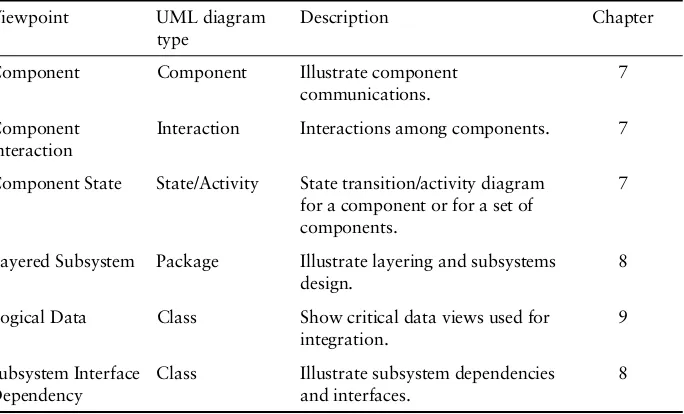
Table 1.2 describes a set of viewpoints targeted at describing the software design. The Component, Component Interaction, and Component State Views provide a mapping of the logical runtime structures, their functionality, and their intercommunications. The Subsystem Interface Dependency View provides a
Table 1.1 Conceptual and analysis viewpoint summary
Viewpoint UML diagram type
Description Chapter
Analysis Focused Class Describe system entities in response to a scenario. Often referred to as a view of participating classes or VOPC.
6
Analysis Interaction Interaction Interaction diagram between objects for analysis.
6
Analysis Overall Class Combination of all classes from all focused analysis viewpoints.
6
Context Use Case Show the external system actors and the system under design.
[image:34.536.89.431.383.590.2]6
Table 1.2 Logical design viewpoints
Viewpoint UML diagram type
Description Chapter
Component Component Illustrate component communications.
7
Component Interaction
Interaction Interactions among components. 7
Component State State/Activity State transition/activity diagram for a component or for a set of components.
7
Layered Subsystem Package Illustrate layering and subsystems design.
8
Logical Data Class Show critical data views used for integration.
9
Subsystem Interface Dependency
Class Illustrate subsystem dependencies and interfaces.
8
visualization of subsystem dependencies and interfaces. The Layered Subsystem View provides a highly abstracted view of all the subsystems. Finally, the Logical Data View provides a description of data models shared between components.
The final set of viewpoints (Table 1.3) is focused on the environment and physical aspects of the software, such as database deployment, that can impact architectural qualities of the system. The Deployment View shows the map-ping of hardware and software for distributed systems. The Physical Database View illustrates the physical deployment structures of databases. The Process View shows the execution threads of the system and often the mapping to components. The Process State View shows the dynamic states for a process.
Why These Viewpoints – Isn’t This Too Many? Where are the others?
So why this particular set of viewpoints? These viewpoints are based on our architectural development experiences on several large-scale projects. These projects are from different domains, including telecommunications, finan-cial systems, and others. We have spent a large amount of time over the years trying to apply various techniques to the real-world work of develop-ing and communicatdevelop-ing software architectures. In our experience, the view-points discussed here have broad application across many types of systems.
Many of the ideas incorporated in the viewpoints precede the UML. We have reworked our previously ad-hoc notations to utilize the UML. Several of the viewpoints in this book highlight the utilization of parts of the UML not frequently discussed in the current literature, with the majority of articles focused on the modeling of classes and objects. With only a couple
Table 1.3 Environment/Physical viewpoint summary
Viewpoint UML diagram type
Description Chapter
Deployment Deployment Mapping of software to hardware for distributed systems.
10
Physical Data Deployment Physical view of a particular database. 10
Process Deployment Show the processes of a particular system instance.
10
of exceptions, all of the viewpoints focus on constructs larger than the class and object, such as components and subsystems.
In these days of Agile Methods, it might be inferred from the number of viewpoints described here that a heavyweight process needs to be employed. This is not the case. The viewpoints should be used only where they provide useful benefit to the project. In addition, there is no requirement that a particular viewpoint be maintained. A viewpoint can be sketched on a whiteboard, information absorbed by the participants, understanding gained, and then the whiteboard erased. This is discussed further in Chapter 5.
Obviously missing from these viewpoints is a staple of software archi-tects: the UML use case diagram. This does not imply that we oppose the application of use cases for requirements definition. Rather, we leave out use case diagrams, for several reasons. First, in our experience they do not contribute greatly to the understanding of the software architecture. Second, non-experts are frequently confused by the meaning of the use case diagrams. Often the relationship lines are interpreted as data flow. A simple list of use cases avoids these issues and serves as an excellent tool for requirements management. Finally, we focus less on use cases here since there is already a large body of literature on use cases.
Another frequently cited ‘architectural view’ missing here is the imple-mentation or code view. These views use the UML notations to provide a pictorial view of the source files and dependencies. In our experience, these views are inferior to using tables or performing analysis of the source code. Automated tools and build systems are an essential part of creating large systems. These systems often provide the ability to analyze and understand the details of the implementation far better than UML diagrams.
Often, overall views of large software systems become overwhelming. An overall view usually requires architecture-size paper to print, which necessarily limits distribution and use. As a result, we sometimes describe a single viewpoint that covers both a ‘focused’ and ‘overall’ variation of a view. In these cases, a series of focused views is often developed as the basis for an overall view. However, if the stakeholders and intent of the focused and overall perspectives are different a new viewpoint is created. The idea of focusing a view is critical to enabling development of large systems. In Chapter 5, in the discussion of managing model complexity, we describe the focusing principles that underlie the derivation of many of these viewpoints. Specific projects might create other viewpoints using these principles.
Frequently several views will be used together. For example, in the design of
components and interfaces it is common to create a Component View, a Component Interaction View, and a Component State View. A series of interaction views is then used to elaborate the details of the Component View and validate the component structure. The state view describes the overall dynamics of a collection of components without showing the details of the sequencing of operations.
1.4 Other Software Architecture Approaches
Much of the current literature uses different meanings for the term architec-tural view. In the following sections, therefore, the term view does not always match IEEE 1471. The following sections will briefly map our approach to several of the other current software architecture approaches.
1.4.1 The 4+1 Views
One architecture approach, the 4+1 Views described by Philippe Kruchten, has become a widespread approach for architecture representation. This scheme defines several key views of a system.
• Logical View – This is the logical representation of the key packages and subsystems within the software system under design. It omits any imple-mentation or physical details.
• Process View – This view will define how the various operating system threads, tasks, or processes communicate with one another.
• Deployment View – This defines the way the actual processes are instantiated and deployed on the physical hardware.
• Implementation View – This view describes how the actual software is implemented and usually includes concepts such as the actual source code, the directory structure of the code, and the library structure of the system.
• Use-Case View – This view contains the body of use cases that must be defined to understand the behavior of the system.
Obviously, since the 4+1 views preceded IEEE 1471, they do not meet the definition of views as specified in the standard. The 4+1 views are more
closely aligned with an IEEE 1471 viewpoint. The 4+1 views describe a collection of representations that provide guidance for software architects. These views tend to be more suggestive than proscriptive. As a result, they have been applied differently in various papers and books.
However, in large part, the viewpoints we discuss are within the spirit of the 4+1 views. Most of the architecture viewpoints described in this book would fit within the definitions of the Logical, Deployment, and Process views of the 4+1 Views (Table 1.4). For example, the subsystem dependency view maps to the Logical View. None of the viewpoints described in this book fit in the Implementation View.
1.4.2 RM-ODP viewpoints
The Reference Model for Open Distributed Processing (RM-ODP) is an ISO standard that provides a framework for the development of standards-related distributed processing. RM-ODP defines the important properties of distrib-uted systems to be openness, integration, flexibility, modularity, federation, manageability, provisioning of quality of service, security, and transparency. In addition, a set of viewpoints are also defined. The RM-ODP viewpoint definition roughly corresponds to the IEEE 1471 definition. The five view-points described by RM-ODP are:
• Enterprise viewpoint – looks at the system in the context of such factors as the business requirements and policies as well as the scope and purpose of the system. RM-ODP deals with enterprise-related information, such as organizational structure, that may affect the system.
Table 1.4 Approximate Mapping to 4 +1 Views
4 +1 View Our Viewpoints
Logical View Subsystem Interface Dependency, Layered Subsystem, Component, Component Interaction, Component State, Logical Data
Process View Process, Process State
Deployment View Deployment and Physical Data
Implementation View None – see box
Use Case View None – see box
No Equivalent in 4 +1 Context and Analysis
• Information viewpoint – refers to the structure of the information, how it changes, how it flows, and the logical divisions between independent functions.
• Computational viewpoint – focuses on the decomposition of the system into entities and their interfaces.
[image:39.536.105.452.216.593.2]• Engineering viewpoint – deals with the interaction between distributed system objects and how this interaction is supported.
Table 1.5 Comparison to Bass architectural structures
Structure name
Description Our viewpoints
Module Structure
Units of work that have associated products and are assigned to development teams.
No direct mapping, but subsystems are used for this purpose.
Conceptual Abstractions of functional
requirements used to understand the problem.
No direct mapping here. Analysis views perform a similar role, but not from using functional requirements.
Process Physical process or threads in the system.
Process View.
Physical A mapping of hardware to software. Deployment View.
Uses Defines dependencies between modules.
Subsystem Interface Dependency.
Calls Specifies the invocation relationship between functional procedures or sub-procedures.
Component Interaction views provide similar information. However, we are more concerned with interactions between higher-level entities.
Data Flow The sending of data between entities. Not covered.
Control Flow
This indicates which program, module, or system states become active after another has completed some task.
Component State. Also similar is the Process State.
Class Structure
Traditional objected-oriented class structures.
Used in the Analysis and Logical Data.
No Mapping Context, Layered Subsystem, Physical Data
• Technology viewpoint – defines the hardware and software components that make up the system.
Several of our viewpoints are similar to the Engineering, Technology, and Computational viewpoints, but our viewpoints have slightly different con-cerns and stakeholders.
1.4.3 Bass architectural structures
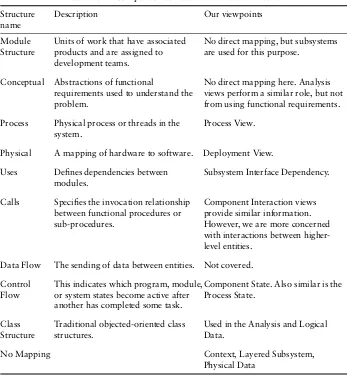
Bass et al. define several ‘architectural structures’ or views of the software architecture. Bass does not use the UML, but still has significant conceptual overlap with our viewpoints. For example, the ideas of process and deploy-ment viewpoints are similar to the process and physical structures. Table 1.5 compares our set of viewpoints against those defined by Bass.
1.4.4 Hofmeister software architecture views
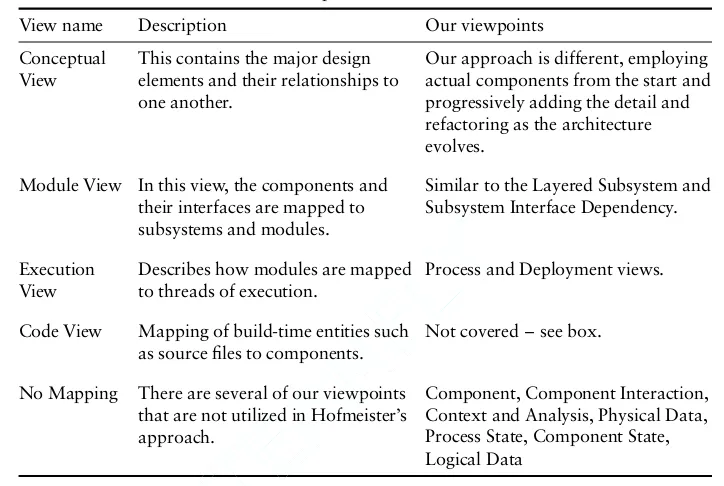
In a recent software architecture book, Hofmeister et al. utilize four UML-based views: the conceptual, module, execution, and code views. These views share some similar concepts and stereotypes with the views we define (Table 1.6). For example, there are similar uses of layering and subsystem modeling. Hofmeister provides an extremely detailed method for protocol development that goes beyond our technique.
1.5 Recommended Reading
IEEE 1471 (2000) describes a framework for the development of software architecture descriptions. This document defines many terms, including archi-tecture and archiarchi-tecture description.
A good source of information on Enterprise architecture is the web site for Enterprise-Wide IT Architecture (EWITA).
Information on application/software architecture can be found on the Bredemeyer web site.
Definitions of technology/infrastructure architecture, business architecture, information/data architecture can be found on The Open Group Architectural Framework (TOGAF) web site. This site also contains description of architec-ture qualities.
The Army technical architecture (2000), also referred to as the Joint Technical Architecture – Army (JTA-Army), is available on the web.
David Parnas (1972) was one of the first to recognize the importance of software structure in his seminal paper on decomposing systems into modules.
Shaw and Garlan (1996) coined the term architectural style.
Hofmeister et al. (1999) and Bosch (2000) have good discussions of
product-line and reference architectures.
The Reference Model for Open Distributed Processing (RM-ODP) is defined in ISO/IEC DIS 10746-1:1995. A book on the subject by Putman (2000) has a complete description of the structuring approaches, viewpoints, and transparencies.
The 4+1 Views of architecture are described in the paper by Philippe Kruchten (1995). There are later discussions in the book by Kruchten (1998) and in the UML User Guide (Boochet al., 1999).
[image:41.536.96.458.86.329.2]Robert Martin coined the terms ‘Fragility’ and ‘Rigidity’ to describe changeability aspects of software. A paper describing these terms can be found at the Object Mentor web site.
Table 1.6 Comparison to Hofmeister views
View name Description Our viewpoints
Conceptual View
This contains the major design elements and their relationships to one another.
Our approach is different, employing actual components from the start and progressively adding the detail and refactoring as the architecture evolves.
Module View In this view, the components and their interfaces are mapped to subsystems and modules.
Similar to the Layered Subsystem and Subsystem Interface Dependency.
Execution View
Describes how modules are mapped to threads of execution.
Process and Deployment views.
Code View Mapping of build-time entities such as source files to components.
Not covered – see box.
No Mapping There are several of our viewpoints that are not utilized in Hofmeister’s approach.
Component, Component Interaction, Context and Analysis, Physical Data, Process State, Component State, Logical Data
20 Introduction
TE
AM
FL
Y
2
Roles of the Software
Architect
This chapter will provide an understanding of the role of the software architect and how this role relates to other key roles on the development team. In addition, the skills required for the software architect, key approaches for leading the software architecture team, and traps and pitfalls associated with the software architect are discussed. In keeping with the philosophy of providing a practical guide, many of the detailed definitions and discussions are left to the recommended reading at the end of the chapter.
The importance of a good software architect should not be underestimated. There are plenty of examples of projects gone awry for lack of good leader-ship. Lack of someone filling the architect role is sometimes part of the story. Of course good architects can fail in a non-supportive environment. A poor architect that is out of touch, however, can quickly drive a project to ruin.
The software architect should be instrumental in the development of a ‘shared vision’ for the software. What is a shared vision? At a basic level the development team must have an idea in their minds about what the final product will be, the effect the software will have, and the goals of the organization. The architecture will reflect and define a large part of the vision.
must always be prepared to communicate and interact with other team members about the overall vision.
Defining and communicating this technical vision includes the following activities:
• Analysis of the problem domain
• Risk management
• Requirements management
• Interface design
• Technology roadmap management
• Determination of implementation approaches
• Definition of an architecture that meets the system requirements
• Definition of an architecture that meets goals of the organization
• Definition of an architecture that meets the project budget and schedule
• Oversight of the mapping from the architecture to the design and
implementation
• Communication of the software architecture to technical and non-techni-cal audiences
• Maintenance of the software architecture throughout the project lifecycle
Although the exact roles and responsibilities vary somewhat by project and organization, the following are typical:
Requirementstend to be a topic that consumes much of the attention of the software architect. This is because the architect is typically responsible for understanding and managing the non-functional system requirements such as maintainability, performance, testability, reusability, reliability, and availabil-ity. In addition, the architect must often review and approve both the requirements provided by the system-level systems engineering organization and the designs produced by the development teams. The software architect participates in reviews of these development work products. Often the architect will work directly with customers, marketing, and support organiza-tions as well on the formulation of requirements.
Technical risk assessment and management is another crucial role for the architect. The architect should use his or her experience to provide manage-ment and other stakeholders with information about the key technical risks of the proposed software. A risk reduction plan, either formal or informal, to address these risks is the responsibility of the architect. The architect needs to be capable of assessing the impact of requirements changes on the system as well as the risk of the proposed changes.
Analysis of the problem domainis an important role. This is especially true if the task is to create a product line, framework, or family of products. The architect needs to be able to dissect problems into component parts and structure solutions that can meet the needs of the organization.
Design of the overall software structure as well as critical components, interfaces, and policies is the direct responsibility of the architect. The software architect should also provide a set of design guidelines to the development team as well as input to the development of coding style guides. The software architect is the final authority on issues such as design/develop-ment style, interface negotiation and definition, and requiredesign/develop-ment modifica-tions.
The software architect serves as a reviewer and approver of many different project deliverables. These including subsystem designs, interface definition documents, coding style guidelines, and system engineering work products. In addition to reviewing, the software architect also approves many of these documents. The software architect also reviews and approves software deliv-eries and associated documentation. Examples of these associated documents should include test reports and updated design documents that accompany the delivery.
Mentoringof designers and developers is another key role. Since the software architect is an expert developer and designer it is critical to share this knowledge and experience with other team members. This can be done in a number of different ways, including developing and teaching classes, indivi-dual help sessions, a