Future Directions in Technological Support for Language Documentation
Daan van Esch Google
Ben Foley
The University of Queensland, ARC Centre of Excellence for
the Dynamics of Language [email protected]
Nay San Stanford University, Australian National University,
ARC Centre of Excellence for the Dynamics of Language [email protected]
Abstract
To reduce the annotation burden placed on lin-guistic fieldworkers, freeing up time for deeper linguistic analysis and descriptive work, the language documentation community has been working with machine learning researchers to investigate what assistive role technology can play, with promising early results. This pa-per describes a number of potential follow-up technical projects that we believe would be worthwhile and straightforward to do. We pro-vide examples of the annotation tasks for com-puter scientists; descriptions of the technologi-cal challenges involved and the estimated level of complexity; and pointers to relevant litera-ture. We hope providing a clear overview of what the needs are and what annotation chal-lenges exist will help facilitate the dialogue and collaboration between computer scientists and fieldwork linguists.
1 The Transcription and Annotation Challenge
Language documentation projects typically yield more data than can be reasonably annotated and analyzed by the linguistic fieldworkers that collect the data. For example, transcribing one hour of audio recordings can take 40 hours or more ( Du-rantin et al., 2017), and potentially even longer where the language is severely under-studied or under-described. To reduce the annotation bur-den placed on linguistic fieldworkers, freeing up time for deeper linguistic analysis and descriptive work, the language documentation community has been working with machine learning (ML) re-searchers to investigate what role technology can play. As a result, today enterprising fieldwork lin-guists can use a number of toolkits to help ac-celerate the annotation process by automatically proposing candidate transcriptions. Such toolkits include CoEDL Elpis (Foley et al., 2018), Perse-phone (Adams et al.,2018;Michaud et al.,2018), and SPPAS (Bigi,2015).
2 A Technological Development Roadmap
These toolkits are already showing promising re-sults across a number of languages. Arguably, however, their current incarnation only scratches the surface of what is technically possible, even today. In this paper, we aim to describe a num-ber of potential extensions to these systems, which we believe would be reasonably straightforward to implement, yet which should significantly im-prove the quality and usefulness of the output. Specifically, we look at the annotation steps in the language documentation process beyond just phonemic or orthographic transcription, and de-scribe what assistive role technology can play for many other steps in the language documentation process, such as automatically proposing glossing and translation candidates.
To be clear, this paper does not actually describe complete systems that have been implemented. Rather, our goal is to describe technical projects that we believe would be worthwhile and straight-forward to do. We provide examples of the anno-tation tasks for computer scientists; descriptions of the technological challenges involved and the estimated level of complexity; and pointers to rel-evant literature on both the computational and the linguistic side. Our hope is that this overview of what the needs are and what annotation challenges exist will help facilitate the dialogue and collabo-ration between computer scientists and fieldwork linguists.
graph-ical user interface; for the purposes of this paper, however, we focus on the underlying technology.
For our purposes, we assume there is an au-dio corpus where orthographic transcriptions are available for at least some subset of the recordings. If no orthographic transcriptions exist at all, then there are a number of techniques around audio-only corpus analysis that can be applied, such as those explored in the Zero-Resource Speech Chal-lenges (Dunbar et al.,2017), but those approaches are outside of the scope of this paper.
We also assume that the corpus at hand was cre-ated in a relatively ubiquitous tool for language documentation — e.g. ELAN (Max Planck In-stitute for Psycholinguistics; Brugman and Rus-sel, 2004), Praat (Boersma and Weenink, 2001), or Transcriber (DGA, 2014) — for which there would be a ready-to-use conversion tool to con-vert the corpus into a common format that can be understood by the toolkit. Finally, we assume that the linguist has access to a tool to create keyboards for use on a desktop/laptop system, such as Key-man (SIL), so an appropriate orthography can be used, and that the linguist has access to an entry input method for the International Phonetic Alpha-bet (IPA).
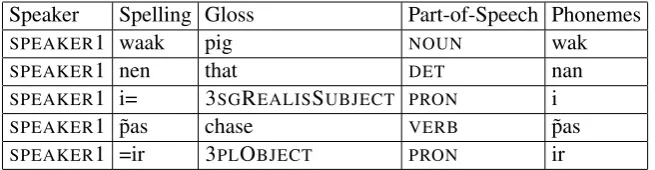
Broadly, we see two areas where automation toolkits for language documentation can make sig-nificant headway still: automatic analysis of ex-isting data in the corpus, and automatic process-ing of unannotated data. To facilitate the discus-sion below, Table 1 briefly walks through a rea-sonably comprehensive set of annotations for an audio recording. Specifically, for each word in our Nafsan example utterance, Table1includes:
• a speaker label to indicate which of the speak-ers in the recording spoke this word
• the orthographic form, or simply spelling, of this word
• an interlinear gloss, which we will describe in further detail below for readers who are unfa-miliar with this practice
• a part-of-speech tag, e.g. using the conven-tions from (Petrov et al.,2012)
• a phonemic transcription, e.g. in the Interna-tional Phonetic Alphabet
In addition, our example annotation shows a
translation of the entire utterance into a single lan-guage.1
3 Analysis of Existing Data
3.1 Text Analytics
In terms of automatic analysis of existing data, there appears to be a significant amount of low-hanging fruit around text-based analytics. Once a language worker has put the effort into preparing a corpus for use in a toolkit, by normalizing and consolidating files, the data becomes suitable for automatic analysis to obtain corpus-wide metrics. For example, a toolkit could easily emit the fol-lowing metrics on the orthographic transcriptions in the corpus:
• the total number of words observed2
• the number of unique words observed
• a frequency-ranked wordlist, with word counts
• the average number of words in each utter-ance, and a histogram of words per utterance
These metrics can also be broken down by speaker, if multiple speakers are present in the cor-pus and speaker annotations are available in the metadata. In that case, a toolkit could also au-tomatically compute statistics such as pointwise mutual information score for the usage of each word by each speaker, or by speaker group, for example if multiple varieties are represented in the corpus. This may point to interesting inter-speaker or inter-variety lexical frequency differ-ences that merit further investigation. Per-speaker lexical analyses could also be used to inform field-work elicitation adjustments, e.g. when some words were not elicited from a particular speaker in the data set. For a literature review describing a large number of automatic analysis options in this space, see (Wieling and Nerbonne,2015).
Frequency-ranked wordlists in particular can also be helpful for quality assurance purposes:
1Fieldwork linguists can, naturally, choose to create this translation in any language. In our example, for expository purposes, we used English.
2
Speaker Spelling Gloss Part-of-Speech Phonemes
SPEAKER1 waak pig NOUN wak
SPEAKER1 nen that DET nan
SPEAKER1 i= 3SGREALISSUBJECT PRON i
SPEAKER1 ˜pas chase VERB ˜pas
[image:3.595.136.464.62.147.2]SPEAKER1 =ir 3PLOBJECT PRON ir
Table 1: Annotations for an example recording in Nafsan (ISO 639 erk), DOI 10.4225/72/575C6E9CC9B6A. Here, the English translation would be “That pig chased them.”
words at the bottom of the list may occur only as one-offhapax legomena, but they may also be misspelled versions of more frequent words. Re-viewing a frequency-ranked list may help find or-thographic inconsistencies in the data set. In fact, an automatic toolkit could also emit additional in-formation around annotation quality, such as:
• a frequency-ranked character list, with point-ers to utterances that contain rarely used char-acters (on the assumption that they may be data entry mistakes)
• words that seem to be misspellings of another word, based on edit distance and/or context
For datasets in languages where comprehensive, clean wordlists are available, a transcription tool with built-in spell-checking or word-completion features would benefit users. If no clean wordlist exists yet, a frequency-based wordlist is a good start and can be human-curated. Going beyond just orthographic words, finite-state technologies may also be needed, especially for morphologi-cally complex languages where stems may have more variations than could ever be covered by a simple wordlist, as is frequently described in the literature; two relevant recent surveys are (Mager et al.,2018;Littell et al.,2018).
If interlinear glosses are available in the corpus, the toolkit could also easily emit a list of all words and their glosses, highlighting words with multi-ple glosses, as these may (but do not necessarily) represent data entry inconsistencies; the same is true for part-of-speech tags.
Where phoneme annotations are present, a forced-alignment with the orthographic transcrip-tion may be carried out to surface any outliers, as these may represent either orthographic or phonemic transcription errors (Jansche,2014). Of course, a phoneme frequency analysis could also be produced and may yield interesting insights.
It should also be straightforward, though the linguistic value of this would remain to be
deter-mined, to apply an unsupervised automatic mor-phemic analyzer like Morfessor (Virpioja et al., 2013).
3.2 Visualization
Language documentation toolkits will benefit from integration with information visualization tools. Visual data analysis can give a linguist a general overview of the nature of a corpus, and narrow in on data to support new, detailed insights. For example, a broad view of a language collec-tion can be given by visualizing metadata from the corpus, representing the activity of the docu-mentation process as a heatmap of the recording dates/times/participants. Date and time visualiza-tions could show patterns within recording loca-tions and events, indicating how long it took to create the corpus, and how old the data is.
Visualizations showing which time spans within a corpus have been annotated on particular annota-tion tiers would allow a linguist to quickly obtain a sense of the state of transcription. A representa-tion of transcriprepresenta-tion state showing what has been transcribed, the types of existing transcriptions, with summaries of metadata, will assist the lan-guage worker to understand the shape of their par-allel layered data, and develop well-constructed corpora. This information could help prevent un-expected data loss when moving from complex multi-tier transcription to other modes of represen-tation (Thieberger,2016).
Detailed visualizations can also represent lin-guistic features of the data, giving the linguist on-demand access to explore a variety of phenom-ena — e.g. using ANNIS (Krause and Zeldes, 2016) — such as compositional structure of lin-guistic units (hierarchical data), associations be-tween words (relational data) and alternative word choices (Culy and Lyding,2010).
fa-cilitate discovery of the data within an archive (Thieberger,2016).
4 Extending Automatic Processing of Unannotated Data
4.1 Audio Analysis
Generally, part of the data set at hand will be missing at least some of the annotation layers in our example above. At the most basic level, it may not be known what parts of an audio col-lection contain human speech, what parts con-tain other types of sound (e.g. only nature or car noise), or are even just quiet. A speech vs. non-speech classifier, known as a voice activity detector or VAD (Ramirez et al., 2007), should be built into the toolkit. One open-source VAD is the WebRTC Voice Activity Detector, with an easy-to-use Python wrapper in (Wiseman,2016). Beyond voice activity detection, speaker identifi-cation or diarization may also be necessary. In this regard, the work recently done as part of the First DIHARD Speech Diarization Challenge (Church et al., 2018) is particularly relevant for fieldwork recordings, which are challenging cor-pora for these technologies.
Practically, entirely unannotated data sets are rare: usually at least the language of the data set is known. Where it isn’t, or where multiple lan-guages exist within a given recording, it will also be helpful to be able to identify the language spo-ken in each part of the audio, based on the record-ing alone, though this is a hard technical chal-lenge (Gonzalez-Dominguez et al., 2014). As a first step, multiple existing recognizers could be executed, and their output could be analyzed to de-termine which one produces the most likely tran-script, using an approach like that by (Demˇsar, 2006).
4.2 Automatic Phonemic and Orthographic Transcription
Once the location(s) and the language(s) of speech within the target audio recordings are known, the relevant audio fragments can be processed by speech recognition systems such as Elpis (Foley et al.,2018) or Persephone (Adams et al., 2018) in order to produce automatic machine hypothe-ses for phonemic and orthographic transcriptions. Today’s Elpis and Persephone pipelines are ma-turing, and are relatively complete packages, but
they could be made easier to use for people with-out backgrounds in speech science.
4.2.1 Pronunciations
For example, Elpis currently requires the lin-guist to provide a machine-readable grapheme-to-phoneme mapping. However, these may al-ready be available from current libraries (Deri and Knight, 2016), derivable from existing databases like Ausphon-Lexicon (Round,2017), or present in regional language collections such as the Aus-tralian Pronunciation Lexicon (Estival et al.,2014) and Sydney Speaks (CoEDL, 2018). These resources could be integrated directly into the toolkit. Elpis currently also offers no sup-port for handling not-a-word tokens like numbers (van Esch and Sproat, 2017), but this could be supported using a relatively accessible grammar framework where the number grammar can be in-duced using a small number of examples (Gorman and Sproat,2016).
4.2.2 Text Corpora
Toolkits should also facilitate easy ingestion of ad-ditional text corpora, which is particularly useful for training large-vocabulary speech recognition systems. For some endangered languages, text corpora such as Bible translations or Wikipedia datasets may be available to augment low-volume data sets coming in from language documentation work. Of course, the content of these sources may not be ideal for use in training conversational systems, but when faced with low-data situations, even out-of-domain data tends to help. As more text data becomes available, it would also be good to sweep language model parameters (such as the n-gram order) automatically on a development set to achieve the best possible result.
4.2.3 Audio Quality Enhancement
In terms of audio quality, it’s worth pointing out that audio recorded during fieldwork is of-ten made in noisy conditions, with intrusive an-imal and bird noises, environmental sounds, or air-conditioners whirring. Noisy corpora may be-come easier to process if automatic denoising and speech enhancement techniques are integrated into the pipeline. Loizou (2013) provides a recent overview of this particular area.
4.2.4 Multilingual Models
(ASR) systems within toolkits such as Elpis and Persephone, multilingual acoustic models can be trained on data sets from multiple languages (Besacier et al., 2014; Toshniwal et al., 2018). This could allow so-called zero-shot model usage, meaning the application of these acoustic models to new languages, without any training data at all in the target language. Of course, the accuracy of such an approach would depend on how sim-ilar the target language is to the languages that were included in the training data for the multilin-gual model. Another approach is simply to reuse a monolingual acoustic model from a similar lan-guage. Either way, these models can be tailored to-wards the target language as training data becomes available through annotation.
4.2.5 Automatic Creation of Part-of-Speech Tags and Interlinear Glosses
Beyond automatically generating hypotheses for phonemic and orthographic transcriptions, it would technically also be relatively straightfor-ward to produce candidate part-of-speech tags or interlinear glosses automatically. Both types of tags tend to use a limited set of labels, as described by e.g. the Universal Part-of-Speech Tagset doc-umentation (Petrov et al., 2012) and the Leipzig Glossing Rules (Comrie et al., 2008). Where words occur without a part-of-speech tag or an in-terlinear gloss in the corpus (for example, because a linguist provided an orthographic transcription but no tag, or because the orthographic transcrip-tion is an automatically generated candidate), a tag could be proposed automatically.
Most straightforwardly, this could be done by re-using an existing tag for that word, if the word was already tagged in another context. Where multiple pre-existing interlinear glosses occur for the same surface form, it would be possible to con-textually resolve these homographs (Mazovetskiy et al., 2018). For part-of-speech tagging, many mature libraries exist, such as the Stanford Part-of-Speech Tagger (Toutanova et al.,2003). However, in both cases, given the limited amount of training data available within small data sets, accuracy is likely to be low, and it may be preferable to simply highlight the existing set of tags for a given word for a linguist to resolve. Surfacing these cases to a linguist may even bring up an annotation quality problem that can be fixed (if, in fact, there should have been only one tag for this form).
Deriving interlinear glosses or part-of-speech
tags for new surface forms that have not previously been observed could be significantly harder, de-pending on the target language. Achieving reason-able accuracy levels will require the use of mor-phological analyzers in many languages, e.g. as in (Arkhangeskiy et al., 2012). In polysynthetic languages in particular, development of such ana-lyzers would be a challenging task (Mager et al., 2018;Littell et al.,2018), though see (Haspelmath, 2018) for a cautionary note on the term polysyn-thetic.
4.2.6 Automatic Machine Translation (MT)
Many language documentation workflows involve the translation of sentences from the target-language corpus into some other target-language, such as English, to make the content more broadly ac-cessible. In effect, this creates a parallel cor-pus which can be used for training automatic ma-chine translation (MT) systems. These MT sys-tems could then, in turn, be used to propose trans-lation candidates for parts of the corpus that are still lacking these translations: this may be be-cause the linguist did not yet have time to trans-late their transcriptions, or because only machine-generated hypotheses are available for the tran-scriptions (in which case the cascading-error ef-fect typically causes accuracy of translations to be lower). Such candidate translations would still re-quire human post-editing, but for limited-domain applications, machine translations may be suffi-ciently accurate to accelerate the annotation pro-cess. Of course, where other parallel corpora exist (e.g. bilingual story books, or religious material like the Bible), these can also be used as train-ing data. In addition, any existtrain-ing biltrain-ingual word lexicons (like dictionaries) can also help in build-ing machine translation systems, as in ( Klemen-tiev et al.,2012).
to enhance ASR quality (Anastasopoulos and Chi-ang,2018).
5 Putting structured data and models to work more broadly
A toolkit designed to facilitate transcription and annotation efforts can benefit language workers and language communities beyond just the an-notation output. Structured data sets used in these toolkits are ripe for conversion into formats needed for various other tasks, such as dictionary creation, e.g. Electronic Text Encoding and Inter-change (TEI, 2018), or for dictionary publishing pipelines, as in Yinarlingi (San and Luk, 2018). Exported data could be formatted for import into a range of dictionary/publishing applications such as lexicon apps for mobile devices or ePub for-mat (Gavrilis et al.,2013) for publishing on a wide range of devices such as smartphones, tablets, computers, or e-readers. Automatically generated pronunciations, word definitions, part-of-speech information and example sentences could easily be included. For difficult work such as automatic lemmatization, the output could be presented in a simple interface for human verification/correction before publication (Liang et al.,2014).
For languages to thrive in the digital domain, some technologies are considered essential: a standardized encoding; a standardized orthogra-phy; and some basic digital language resources, such as a corpus and a spell checker (Soria,2018). If toolkits make it easy to create structured data sets and models for these languages, then these re-sources can also be applied outside the fields of language documentation, lexicography, and other linguistic research fields.
For example, Australia has a vibrant community-owned Indigenous media broad-casting sector. For these users, there is potential to re-use the ASR models to generate closed cap-tions (subtitles) for the broadcast material. ASR transcription and translation technologies could be used to enrich the output of these Indigenous community media broadcasters, which would yield a significant improvement in the accessibil-ity of broadcast content. Another option would be to facilitate the creation of smartphone keyboards with predictive text in the target languages, using toolkits like Keyman (SIL).
Language archives like PARADISEC could also benefit by applying these models, once created, on
existing content for the same language that may have been contributed by other linguists, or that may have come in through other avenues. It may even be possible for these archives to offer web-based services to language communities, e.g. to allow them to use machine translation models for a given language in a web-based interface. Linguists could archive their models alongside their corpus; for some collections, the published models may inherit the same access permissions as the train-ing data used in their creation, while some models may be able to be published under less restrictive conditions.
5.1 Data Set Availability
In general, to support the development of language technologies like the ones we described earlier, it is critical that software engineers are aware of, and have access to data sets reflecting the diversity of endangered languages. Already, data sets are available for a range of languages, and in formats suitable for ASR, text-to-speech synthesis (TTS) and other tasks on the Open Speech and Language Resources website (Povey, 2018). The addition of ML-ready data sets for more endangered lan-guages would enable software engineers, whose primary concern may not be the language docu-mentation process, to be involved in developing and refining speech tools and algorithms. How-ever, access protocols and licenses in place for ex-isting data sets can prohibit experimental develop-ment. Recording corpora specifically for the pur-poses of enabling ML experiments would avoid potentially lengthy negotiations of access rights.
6 Reaching more languages
Extending the reach of a toolkit beyond the (typ-ically) few languages which are used when build-ing and testbuild-ing is critical. Applybuild-ing technology to more diverse use cases encourages a tool to be-come more robust. With more use cases, a com-munity of support can grow. A community of users, contributors and developers around a toolkit is important to encourage potential participants (Foley,2015), and to reduce the burden of support on individual developers.
differ-ent levels of users, are all important (albeit labor-intensive) methods of promoting and encouraging language technology to reach more languages.
7 Conclusion
Speech and language technology toolkits, de-signed specially for users without backgrounds in speech science, have the potential for signifi-cant impact for linguists and language communi-ties globally. Existing toolkits can be enhanced with richer feature sets, and connection with work-flow processes, helping language documentation workers. These toolkits enable language docu-mentation workers to focus on deeper linguistic research questions, by presenting the results of au-tomated systems in ways that let language experts easily verify and correct the hypotheses, yielding annotation speed-ups. At the same time, mak-ing these technologies and the structured data they help produce more widely available would benefit language communities in many ways.
Most of the technologies described here are readily available and easily implemented, while others are still highly experimental in their appli-cation and potential benefits for Indigenous lan-guages. With language technology as a whole making rapid progress, and with an increasing amount of dialogue between fieldwork linguists and computer scientists, it is an exciting time to be working on computational methods for language documentation, with many advances that look to be within reach for the near future.
Acknowledgments
We would like to thank all the participants in the Transcription Acceleration Project (TAP), run by the Centre of Excellence for the Dynamics of Lan-guage, for many fruitful discussions on how tech-nology could be applied in the language documen-tation context to assist fieldwork linguists. We would like to add a special word of thanks to Nick Thieberger, who provided the Nafsan example, and who offered valuable input on a draft version of this paper. We would also like to thank Zara Maxwell-Smith and Nicholas Lambourne for all of their insightful suggestions and contributions.
References
Oliver Adams, Trevor Cohn, Graham Neubig, Hilaria Cruz, Steven Bird, and Alexis Michaud. 2018. Eval-uating phonemic transcription of low-resource tonal
languages for language documentation. In Proceed-ings of LREC 2018.
Antonis Anastasopoulos and David Chiang. 2018. Leveraging translations for speech transcription in low-resource settings.CoRR, abs/1803.08991.
Timofey Arkhangeskiy, Oleg Belyaev, and Arseniy Vy-drin. 2012. The creation of large-scale annotated corpora of minority languages using uniparser and the eanc platform. In Proceedings of COLING
2012: Posters, pages 83–92. The COLING 2012
Or-ganizing Committee.
Sameer Bansal, Herman Kamper, Karen Livescu, Adam Lopez, and Sharon Goldwater. 2018. Low-resource speech-to-text translation. CoRR, abs/1803.09164.
Laurent Besacier, Etienne Barnard, Alexey Karpov, and Tanja Schultz. 2014. Automatic speech recog-nition for under-resourced languages: A survey.
Speech Commun., 56:85–100.
Brigitte Bigi. 2015. SPPAS: Multi-lingual approaches to the automatic annotation of speech. The Phoneti-cian, 111-112(ISSN:0741-6164):54–69.
Paul Boersma and David Weenink. 2001. Praat, a sys-tem for doing phonetics by computer. 5:341–345.
Hennie Brugman and Albert Russel. 2004. Annotating multi-media/multi-modal resources with ELAN. In
Proceedings of LREC 2004.
Kenneth Church, Christopher Cieri, Alejandrina Cristia, Jun Du, Sriram Ganapathy, Mark Liberman, and Neville Ryant. 2018. The First DIHARD Speech Diarization Challenge. https://coml.lscp.ens.fr/dihard/index.html.
CoEDL. 2018. Sydney Speaks Project.
http://www.dynamicsoflanguage.edu.au/sydney-speaks.
Bernard Comrie, Martin Haspelmath, and Balthasar Bickel. 2008. The Leipzig glossing rules: Con-ventions for interlinear morpheme-by-morpheme glosses.
Chris Culy and Verena Lyding. 2010. Visualizations for exploratory corpus and text analysis. In Proceed-ings of the 2nd International Conference on Corpus
Linguistics CILC-10, pages 257–268.
Janez Demˇsar. 2006. Statistical comparisons of classi-fiers over multiple data sets. J. Mach. Learn. Res., 7:1–30.
DGA. 2014. TranscriberAG: a tool for seg-menting, labeling and transcribing speech. http://transag.sourceforge.net.
Ewan Dunbar, Xuan-Nga Cao, Juan Benjumea, Julien Karadayi, Mathieu Bernard, Laurent Besacier, Xavier Anguera, and Emmanuel Dupoux. 2017. The zero resource speech challenge 2017. CoRR, abs/1712.04313.
Gautier Durantin, Ben Foley, Nicholas Evans, and Janet Wiles. 2017. Transcription survey.
Daan van Esch and Richard Sproat. 2017. An ex-panded taxonomy of semiotic classes for text nor-malization. InProceedings of Interspeech 2017.
Dominique Estival, Steve Cassidy, Felicity Cox, and Denis Burnham. 2014. Austalk: an audio-visual corpus of australian english. In Proceedings of
LREC 2014.
Ben Foley. 2015. Angkety map digital resource report. Technical report.
Ben Foley, Josh Arnold, Rolando Coto-Solano, Gau-tier Durantin, T. Mark Ellison, Daan van Esch, Scott Heath, Frantiˇsek Kratochv´ıl, Zara Maxwell-Smith, David Nash, Ola Olsson, Mark Richards, Nay San, Hywel Stoakes, Nick Thieberger, and Janet Wiles. 2018. Building Speech Recognition Systems for Language Documentation: The CoEDL Endangered Language Pipeline and Inference System. In Pro-ceedings of the 6th International Workshop on Spo-ken Language Technologies for Under-resourced
Languages (SLTU 2018).
Dimitris Gavrilis, Stavros Angelis, and Ioannis Tsou-los. 2013. Building interactive books using EPUB and HTML5. InAmbient Media and Systems, pages 31–40, Cham. Springer International Publishing.
Javier Gonzalez-Dominguez, Ignacio Lopez-Moreno, and Hasim Sak. 2014. Automatic language identifi-cation using long short-term memory recurrent neu-ral networks. InProceedings of Interspeech 2014.
Kyle Gorman and Richard Sproat. 2016. Minimally su-pervised number normalization. Transactions of the
Association for Computational Linguistics, 4:507–
519.
Jiatao Gu, Hany Hassan, Jacob Devlin, and Victor O.K. Li. 2018. Universal neural machine translation for extremely low resource languages. In Proceed-ings of the 2018 Conference of the North Ameri-can Chapter of the Association for Computational Linguistics: Human Language Technologies,
Vol-ume 1 (Long Papers), pages 344–354. Association
for Computational Linguistics.
Martin Haspelmath. 2018. The last word on polysyn-thesis: A review article. 22:307–326.
Felix Hieber, Tobias Domhan, Michael Denkowski, David Vilar, Artem Sokolov, Ann Clifton, and Matt Post. 2017. Sockeye: A toolkit for neural machine translation.CoRR, abs/1712.05690.
Martin Jansche. 2014. Computer-aided quality assur-ance of an icelandic pronunciation dictionary. In
Proceedings of the Ninth International Conference
on Language Resources and Evaluation (LREC’14),
Reykjavik, Iceland. European Language Resources Association (ELRA).
Melvin Johnson, Mike Schuster, Quoc V. Le, Maxim Krikun, Yonghui Wu, Zhifeng Chen, Nikhil Thorat, Fernanda Vi´egas, Martin Wattenberg, Greg Corrado, Macduff Hughes, and Jeffrey Dean. 2017. Google’s multilingual neural machine translation system: En-abling zero-shot translation. Transactions of the As-sociation for Computational Linguistics, 5:339–351.
Alexandre Klementiev, Ann Irvine, Chris Callison-Burch, and David Yarowsky. 2012. Toward statisti-cal machine translation without parallel corpora. In
Proceedings of the 13th Conference of the European Chapter of the Association for Computational
Lin-guistics, EACL ’12, pages 130–140, Stroudsburg,
PA, USA. Association for Computational Linguis-tics.
Philipp Koehn, Hieu Hoang, Alexandra Birch, Chris Callison-Burch, Marcello Federico, Nicola Bertoldi, Brooke Cowan, Wade Shen, Christine Moran, Richard Zens, Chris Dyer, Ondrej Bojar, Alexandra Constantin, and Evan Herbst. 2007. Moses: Open source toolkit for statistical machine translation. In
The Annual Conference of the Association for Com-putational Linguistics.
Thomas Krause and Amir Zeldes. 2016. Annis3: A new architecture for generic corpus query and vi-sualization. Digital Scholarship in the Humanities, 31(1):118–139.
Y Liang, K Iwano, and Koichi Shinoda. 2014. Simple gesture-based error correction interface for smart-phone speech recognition. pages 1194–1198.
Patrick Littell, Anna Kazantseva, Roland Kuhn, Aidan Pine, Antti Arppe, Christopher Cox, and Marie-Odile Junker. 2018. Indigenous language technolo-gies in canada: Assessment, challenges, and suc-cesses. In Proceedings of the 27th International
Conference on Computational Linguistics, pages
2620–2632. Association for Computational Linguis-tics.
Philipos C. Loizou. 2013. Speech Enhancement:
The-ory and Practice, 2nd edition. CRC Press, Inc.,
Boca Raton, FL, USA.
Minh-Thang Luong, Eugene Brevdo, and Rui Zhao. 2017. Neural machine translation (seq2seq) tutorial.
Manuel Mager, Ximena Gutierrez-Vasques, Gerardo Sierra, and Ivan Meza. 2018. Challenges of lan-guage technologies for the indigenous lanlan-guages of the Americas.
Gleb Mazovetskiy, Kyle Gorman, and Vitaly Nikolaev. 2018. Improving homograph disambiguation with supervised machine learning. InLREC.
Alexis Michaud, Oliver Adams, Trevor Anthony Cohn, Graham Neubig, and S´everine Guillaume. 2018. In-tegrating automatic transcription into the language documentation workflow: Experiments with Na data and the Persephone toolkit.
Robert ¨Ostling and J¨org Tiedemann. 2017. Neural ma-chine translation for low-resource languages. CoRR, abs/1708.05729.
Slav Petrov, Dipanjan Das, and Ryan McDonald. 2012. A universal part-of-speech tagset. In Proceed-ings of the Eight International Conference on
Lan-guage Resources and Evaluation (LREC’12),
Istan-bul, Turkey. European Language Resources Associ-ation (ELRA).
Dan Povey. 2018. Open speech and language re-sources. http://www.openslr.org.
The Language Archive Max Planck Institute for Psy-cholinguistics. ELAN. https://tla.mpi.nl/tools/tla-tools/elan/.
J. Ramirez, J. M., and J. C. 2007. Voice activity de-tection. fundamentals and speech recognition system robustness. InRobust Speech Recognition and Un-derstanding. I-Tech Education and Publishing.
Erich R. Round. 2017. The AusPhon-Lexicon project: Two million normalized segments across 300 Aus-tralian languages.
Nay San and Ellison Luk. 2018. Yinarlingi: An R package for testing Warlpiri lexicon data. https://github.com/CoEDL/yinarlingi.
SIL. Keyman: Type to the world in your language. https://keyman.com/.
Claudia Soria. 2018. Digital Language Sur-vival Kit. http://www.dldp.eu/en/content/digital-language-survival-kit.
TEI. 2018. Guidelines for electronic text encoding and interchange. http://www.tei-c.org/P5/.
Nick Thieberger. 2016. Language documen-tation tools and methods summit report.
https://docs.google.com/document/d/1p2EZufVIm2fOQy4aIZ100jnZjfcuG-Bb9YKiXMggDRQ.
Shubham Toshniwal, Tara N. Sainath, Ron J. Weiss, Bo Li, Pedro J. Moreno, Eugene Weinstein, and Kanishka Rao. 2018. Multilingual speech recog-nition with a single end-to-end model. 2018 IEEE International Conference on Acoustics, Speech and
Signal Processing (ICASSP), pages 4904–4908.
Kristina Toutanova, Dan Klein, Christopher D. Man-ning, and Yoram Singer. 2003. Feature-rich part-of-speech tagging with a cyclic dependency network.
InProceedings of the 2003 Conference of the North
American Chapter of the Association for Computa-tional Linguistics on Human Language Technology
- Volume 1, NAACL ’03, pages 173–180,
Strouds-burg, PA, USA. Association for Computational Lin-guistics.
Sami Virpioja, Peter Smit, Stig-Arne Gr¨onroos, and Mikko Kurimo. 2013. Morfessor 2.0: Python Imple-mentation and Extensions for Morfessor Baseline. Technical report.
Martijn Wieling and John Nerbonne. 2015. Advances in dialectometry. Annual Review of Linguistics, 1(1):243–264.