Automatic Arabic Text Summarization Based on Fuzzy Logic
Lamees M. Al Qassem The Emirates ICT Innovation Center Electrical and Computer Engineering Department,
Khalifa University, Abu Dhabi, UAE
Di Wanga
The Emirates ICT Innovation Center Khalifa University,
Abu Dhabi, UAE. [email protected]
Hassan Barada Electrical and Computer Engineering Department,
Khalifa University, Abu Dhabi, UAE
Ahmad Al Rubaiea, Nawaf Al Moosaa The Emirates ICT Innovation Center
Khalifa University, Abu Dhabi, UAE.
{ahmad.al-rubaie,nawaf.almoosa}@ku.ac.ae
Abstract
The unprecedented growth in the amount of online information available in many lan-guages to users and businesses, including news articles and social media, has made it diffi-cult and time consuming for users to iden-tify and consume sought after content. Hence, automatic text summarization for various lan-guages to generate accurate and relevant sum-maries from the huge amount of information available is essential nowadays. Techniques and methodologies for automatic Arabic text summarization are still immature due to the in-herent complexity of the Arabic language in terms of both structure and morphology. This work attempts to improve the performance of Arabic text summarization. We propose a new Arabic text summarization approach based on a new noun extraction method and fuzzy logic. The proposed summarizer is evaluated using EASC corpus and benchmarked against pop-ular state of the art Arabic text summariza-tion systems. The results indicate that our pro-posed Fuzzy logic approach with noun extrac-tion outperforms existing systems.
1 Introduction
In the recent two decades, the exponential growth in the amount of information like email, online news articles, reports, social media content and memos, introduced new challenges and made it harder for users to sift through and extract the key information they need. Hence, a smart sys-tem that can automatically identify important in-formation from vast amount of data and generate
concise summaries from these identified data is highly demanded nowadays. Automatic accurate text summarization is the key to addressing this challenge. Text summarization is the process of conveying important information from the original text source(s). The summary is typically no longer than half of the original text(s) and usually sig-nificantly less than that (Das and Martins,2007). Techniques for automatic text summarization for widely-used and relatively simple-grammar lan-guages such as English are mature. However, lit-tle work has been done for Arabic summarization (Al Qassem et al.,2017) due to the complexity of the language in terms of both structure and mor-phology. Nevertheless, Arabic summarization sys-tems are highly needed nowadays. There are more than 300 million Arabic speakers in the world, and Arabic is an official language in the United Na-tions (Nenkova et al.,2011) and 22 other countries (Al-Shalabi et al., 2009). Therefore, researchers are working on improving Arabic text summa-rization methods and developing real world sys-tems. A smart system is needed to automatically generate summaries from Arabic texts and deliver these summaries to the user, either directly or on-demand. The generated summaries need to be co-herent, readable, grammatically correct, and com-prise the key information of the original texts. This requires an in-depth study to achieve better pre-processing for Arabic text and a better methodol-ogy to extract the main information and generate a more accurate summary.
Arabic summarization system with better accuracy than the current state of the art. The system has been applied to generate summaries from online news in real time and delivers the summary in-stantly to the right users who just need it. The pa-per is organized as follows. The state of art for text summarization (mainly English and Arabic summarization systems) is discussed in Section2. Our proposed summarization system is described in Section 3. The evaluation and comparison re-sults are explained in Section4. Our conclusion is given in Section5.
2 Related Work
The first automatic summarization system was proposed by (Luhn, 1958). Luhn came up with the assumption that says the more frequent the word appears in the text the more important it is; excluding the very common words (called stop words). Ten years later, (Edmundson, 1969) ex-panded Luhns work by adding more features, such as resemblance to the title feature (the vocabulary overlap between the title and the sentence) and the position feature (the relevant position of the sen-tence within the text). The results showed that the word frequency is set to be the least impor-tant feature. It is imporimpor-tant to note that the author assigned weights to the features subjectively; thus, these assigned weights could be imprecise and un-certain. In 1995, (Kupiec et al.,1995) developed a trainable document summarizer to automatically train the weights of the features using a corpus instead of defining the weights subjectively. The evaluation results agreed with Edmundsons results (Edmundson,1969). As a conclusion, both work claimed that the best combination of features is made of the position feature, key word feature, and the title feature.
Although a lot of work has been done for text summarization for English, the work for Arabic summarization is very recent and limited. Lakhas (Douzidia and Lapalme,2004) considered one of the first known Arabic text summarization system that was evaluated and compared to English sys-tems. The system produces a summary of size of 10 words only and translates it to English. The authors claimed that the translation process is the reason for the bad evaluation scores. Using TF-IDF (term frequency-inverse document frequency) as the main feature to score sentences is a com-mon method in Arabic summarization systems.
TF-IDF is the ratio of the frequency of a term in a document over its frequency in a corpus. TF-IDF is a good indicator of the importance of a word in a document and a topic, and hence high-lights the importance of the corresponding sen-tence. (Haboush et al., 2012) used TF-IDF on clustered word roots and obtained competitive ac-curacy. (Al-Radaideh and Afif,2009) developed a system that focuses on the inner product between TF in a sentence and the document frequency DF for each extracted noun. ACBTSS and AQBTSS (El-Haj et al., 2009) are two most recent sys-tems that used TF-IDF with Vector Space Model (VSM). Semantic connectedness among sentences and documents is another important factor when generating summaries with minimum redundancy. LCEAS system (Sarmini, 2015) used lexical co-hesion to identify important topics and text entail-ment to remove redundancy. Their system outper-formed (Haboush et al.,2012), (Al-Radaideh and Afif,2009), Sakhr, AQBTSS (El-Haj et al.,2009), Gen-Summ (El-Haj et al.,2010) and LSA-Summ (El-Haj et al., 2010), by containing more signif-icant sentences and less redundancy. In recent work, more features/indicators are researched to represent the importance of sentences. Therefore, deciding which features to use and the weights for these features become a hard task and more re-search is needed. Some rere-searchers followed the machine learning approach and modeled the sum-marization process as a classification problem (i.e. the sentences are classified as summary and non-summary sentences). The work in (Boudabous et al.,2010) and (Belkebir and Guessoum,2015) includes examples of systems that followed the machine learning approach. In (Boudabous et al.,
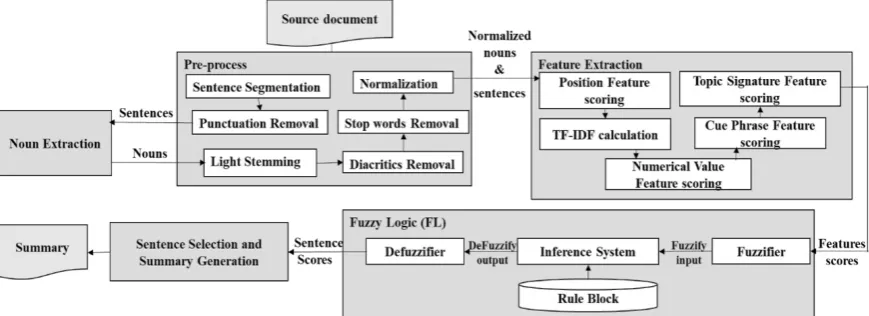
summa-Figure 1: System Architecture.
rizer. The results showed that their proposed ap-proach outperformed the baseline summarizer and MS word 2007 summarizer. (Yadav and Meena,
2016) used fuzzy logic along with WordNet syn-onyms and bushy path, a graph-based method, to improve the performance of extractive text sum-marization system. The WordNet synonyms is used for the semantic similarity of the text; bushy path is used for the relationship between differ-ent parts of the text; finally, fuzzy logic is used to solve the issue of uncertainty and vagueness re-lated to the weights for different features of the sentences. The system generated three summaries from the three approaches and then selected the sentences that appeared in all summaries to form the final summary. The three approaches were evaluated and compared against the proposed ap-proach using ROUGE-1 and ROUGE-2. The re-sults showed that the proposed approach outper-formed the other three approaches. In addition, the evaluation results showed that the fuzzy logic ap-proach outperformed the bushy path and the Word-Net synonyms methods. (Sarmini,2015) proposed an Arabic text summarizer based on fuzzy logic and genetic algorithm. The genetic algorithm was used to select the optimal member functions of the selected features. The fuzzy system is used to score the sentences. To sum up, all reviewed sys-tems claimed that using fuzzy logic improved the performance of the summarization systems and the quality of the summaries. Fuzzy logic ap-proaches handled the issues related to the uncer-tainty, imprecision and vagueness of determining the importance of different features using machine learning approaches, leading to better summaries.
3 Proposed Fuzzy Logic Arabic Summarizer
Condensing all the discussions and comparisons in the literature review, we propose an Arabic summarization system with five main components (pre-processing, noun extraction, features extrac-tion, fuzzy logic, sentence selection) to generate the final summary. Figure 1 shows the five compo-nents in the proposed system. The first two steps in the proposed system are Pre-processing and Noun extraction. Pre-processing prepares the text be-fore sentences are further treated and summarized. Noun extraction extracts the nouns from the text output of the pre-processor. From the state of art noun words are considered to carry important information than other words (Al Qassem et al.,
[image:3.595.80.515.68.226.2]method has been explained in our previous paper (Al Qassem et al.,2018) and will not be repeated here due to the size limit of the paper. After that the feature extraction module extracts key features (sentence position, TF-IDF, cue phrase, topic sig-nature and numerical data) representing the impor-tance of the sentences. Finally, the extracted fea-tures/scores are input into the fuzzy logic module to generate the final scores of the sentences. The sentence’ score indicates how important a sen-tence is within the whole article. The sensen-tences with the highest scores are selected to form the fi-nal summary. In our system we used five features based on the discussion and experimental results from the state of art (Ferreira et al.,2013;Fattah and Ren,2009); they are: (1) Sentence position: this is just the position of the sentence within the full text; (2) TF-IDF: it is calculated for the ex-tracted nouns only as a feature that indicates the importance accumulation of the extracted nouns in a sentence; (3) Cue phrases: they are phrases that give a good indication about the content of this sentence such as in conclusion, the most important ... etc., and defined as positive cue phrases ( Fer-reira et al.,2013). (Haboush et al.,2012) claimed that the existence of these cue phrases increases the probability for a sentence to be selected. On the contrary, there are list of phrases that give a detailed explanation or indicates redundant infor-mation like in other words and for example. These phrases are called negative cue phrases (Fattah and Ren, 2009). In our system, we use both types of cue phrases to either increase or decrease the im-portance score of the sentences. The two other features are: (4) Topic Signature: each topic has a list of topic signature words used across all doc-uments within this topic but not frequently used across other topics(the score of the sentence that contains topic signature words is supposed to in-crease); and finally (5) Numerical Data: sentences that contain numbers are more likely to be added to the summary because numbers refer to impor-tant information like money transaction, dates, ad-dress ... etc. (Ferreira et al., 2013; Fattah and Ren, 2009). The final score of the sentences is calculated by combining all the features. The linear combination of all features (feature-weight equation) is usually used for the final score. The main challenge in this step is assigning a weight for each feature. As discussed previously, not all features are equally important and different
fea-tures should be given different weights represent-ing their importance and contribution to generate a high quality summary. Therefore, we use fuzzy logic. At this stage the features extracted from the sentence are inputs to the fuzzy logic system, and the sentence final score is the output. According to (H¨ullermeier,2011), fuzzy logic can contribute in solving issues related to uncertainty, vagueness, ambiguity, and imprecision that result from in-complete and imprecise information. Fuzzy logic provides the ability to map rules using concept (e.g. long vs short, big vs small) rather than num-bers (numerical data). Furthermore, representing gradual concepts is a key feature of fuzzy logic compared with machine learning that failed to do so (H¨ullermeier, 2011). Fuzzy logic is transpar-ent, data-driven and makes use of available expert knowledge (for model initialization) to generate a robust model. It is considered an approximate reasoning solution that can be initialized from ex-pert knowledge and optimized from data with very strong reasoning capabilities (Megala et al.,2014). Finally, the sentences with highest scores from the fuzzy logic system are selected to form the sum-mary. The sentences in the summary are ordered by their original position in the article. The pro-posed Arabic summarization system can gener-ate different sizes of the summaries based on user choice. Our observations and evaluation of the generated model are aligned with our hypothesis, in that the first few sentences represent the main ideas. This is expected in news articles that tend to be relatively short; important words repeat more frequently within the text and cue phrases are used to attract the attention of the reader.
4 System Evaluation
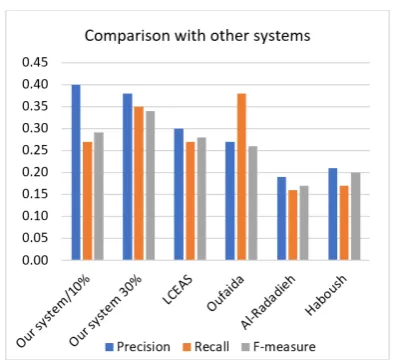
Figure 2: Performance comparison with other systems in the literature.
corpus as each document has five reference sum-maries.
We compared our system with the state of art systems (LCEAS 2015 (Al-Khawaldeh and Samawi, 2015), (Al-Radaideh and Afif, 2009), (Haboush et al.,2012) and (Oufaida et al.,2014)). Figure 2 below illustrates the comparison of ROUGE-2 results for our summarizer and the other systems. The 30% summary size represents the reference summaries that are neither too long nor too short, the 10% summary size represents the shortest summary. As shown in the Figure, the ROUGE-2 scores for LCEAS (Al-Khawaldeh and Samawi,2015), (Al-Radaideh and Afif,2009) and (Haboush et al.,2012) are less than 0.3 for re-call and less than 0.2 for precision, where the best scores were obtained by LCEAS. The F-measure for LCEAS system is approximately 0.22. To compare our system against these three systems, we use the ROUGE results when the summary size is 10% from the proposed Arabic summarization system (the smallest possible size). The average ROUGE-2 recall, precision and F-measure scores for our system are 0.27, 0.40 and 0.29, respec-tively. Our system outperformed the three sys-tems in F-measure scores despite the fact that these systems were compared against our worst-case re-sults.
Furthermore, LCEAS was compared against Sakhr, AQBTSS (El-Haj et al.,2009), Gen-Summ and LSA-Summ (El-Haj et al.,2010). The authors claimed that LCEAS outperformed all these three systems. Since our fuzzy logic summarizer out-performed LCEAS, it is our logical assumption
System
Average Recall
Average Precision
Average F-measure ROUGE- ROUGE-
ROUGE-1 2 1 2 1 2
Oufaida
(2014) 0.41 0.38 0.37 0.27 0.36 0.26 Our Sys
10% 0.34 0.27 0.51 0.40 0.37 0.29 Our Sys
[image:5.595.82.281.62.242.2]30% 0.45 0.35 0.48 0.38 0.44 0.34
Table 1: ROUGE evaluation results for our system and Oufaida system.
that our system will outperform these three sys-tems too.
For (Oufaida et al.,2014), the system was evalu-ated using ROUGE-N (N=1 and 2) and EASC cor-pus.
The generated summary size of a document is equal to its reference summary. The EASC has five summaries per article. Consequently, the system generated five summaries per doc-ument and computed their average ROUGE-N scores. The system ROUGE-1 and ROUGE-2 scores are shown in Table 1. We compared our system against Oufaida using the ROUGE-results obtained for the summary sizes 30% and 10%, which are the percentages used in the state of art methods for our fair comparison. In the real world application, this percentage can be changed and adjusted by users based on the requirements. The less the percentage is, the more concise the sum-mary is but some information might be missed. On the contrary, summary with higher percentage of length provides more information (sentences) but the summary takes more human beings time to read (hence not a very efficient summary). Ac-cording to both summary sizes 10% and 30% and ROUGE-N (N=1,2) results, our system outper-formed Oufaidas.
5 Conclusion
proaches and methodologies and proposed our ap-proach by using fuzzy logic for a more accurate and efficient Arabic summarization system. Fuzzy logic is still very recent in English summarization and showed improvement in the quality of the gen-erated summaries. We compared our summarizer against five state of the art Arabic text summariz-ers that reported good results. The results showed that fuzzy logic improved the performance of the summarization system. The system is able to cre-ate very short summaries containing the most im-portant ideas, and performed better than five state of art Arabic summarization systems. The future work might be looking into better Arabic prepro-cessing, (e.g. http://arabicnlp.pro/alp/) for more accurate Arabic summarizer.
References
F Al-Khawaldeh and V Samawi. 2015. Lexical co-hesion and entailment based segmentation for ara-bic text summarization (lceas). The World of Com-puter Science and Information Technology Journal (WSCIT), 5(3):51–60.
Lamees Al Qassem, Di Wang, and Hassan Barada. 2018. Noun extraction tool for anlp applications. In2018 IEEE 12th International Conference on Se-mantic Computing (ICSC), pages 308–309. IEEE.
Lamees Mahmoud Al Qassem, Di Wang, Zaid Al Mah-moud, Hassan Barada, Ahmad Al-Rubaie, and Nawaf I Almoosa. 2017. Automatic arabic sum-marization: a survey of methodologies and systems. Procedia Computer Science, 117:10–18.
Q Al-Radaideh and Mohammad Afif. 2009. Arabic text summarization using aggregate similarity. In International Arab conference on information tech-nology (ACIT2009), Yemen.
Riyad Al-Shalabi, Ghassan Kanaan, Bashar Al-Sarayreh, Khalid Khanfar, Ali Al-Ghonmein, Hamed Talhouni, Salem Al-Azazmeh, et al. 2009. Proper noun extracting algorithm for arabic lan-guage. InInternational conference on IT, Thailand.
Riadh Belkebir and Ahmed Guessoum. 2015. A super-vised approach to arabic text summarization using adaboost. InNew Contributions in Information Sys-tems and Technologies, pages 227–236. Springer.
Mohamed Mahdi Boudabous, Mohamed H´edi Maaloul, and Lamia Hadrich Belguith. 2010. Digital learning for summarizing arabic documents. In International Conference on Natural Language Processing, pages 79–84. Springer.
Dipanjan Das and Andr´e FT Martins. 2007. A survey on automatic text summarization. Literature Survey
for the Language and Statistics II course at CMU, 4(192-195):57.
Fouad Soufiane Douzidia and Guy Lapalme. 2004. Lakhas, an arabic summarization system. Proceed-ings of DUC2004.
Harold P Edmundson. 1969. New methods in au-tomatic extracting. Journal of the ACM (JACM), 16(2):264–285.
Mahmoud El-Haj, Udo Kruschwitz, and Chris Fox. 2009. Experimenting with automatic text summari-sation for arabic. InLanguage and Technology Con-ference, pages 490–499. Springer.
Mahmoud El-Haj, Udo Kruschwitz, and Chris Fox. 2010. Using mechanical turk to create a corpus of arabic summaries.
Mohamed Abdel Fattah and Fuji Ren. 2009. Ga, mr, ffnn, pnn and gmm based models for automatic text summarization. Computer Speech & Language, 23(1):126–144.
Rafael Ferreira, Luciano de Souza Cabral, Rafael Dueire Lins, Gabriel Pereira e Silva, Fred Freitas, George DC Cavalcanti, Rinaldo Lima, Steven J Simske, and Luciano Favaro. 2013. Assessing sentence scoring techniques for extractive text summarization. Expert systems with applications, 40(14):5755–5764.
Ahmad Haboush, Maryam Al-Zoubi, Ahmad Momani, and Motassem Tarazi. 2012. Arabic text summa-rization model using clustering techniques. World of Computer Science and Information Technology Journal (WCSIT) ISSN, pages 2221–0741.
Eyke H¨ullermeier. 2011. Fuzzy sets in machine learn-ing and data minlearn-ing. Applied Soft Computing, 11(2):1493–1505.
J Kupiec, J Pedersen, and F Chen. 1995. A trainable document summarizer. dans les actes de acm special interest group on information retrieval (sigir), 68– 73.
Hans Peter Luhn. 1958. The automatic creation of lit-erature abstracts. IBM Journal of research and de-velopment, 2(2):159–165.
S Santhana Megala, A Kavitha, and A Marimuthu. 2014. Enriching text summarization using fuzzy logic. International Journal of Computer Science and Information Technologies, 5(1):863–867.
Ani Nenkova, Kathleen McKeown, et al. 2011. Auto-matic summarization. Foundations and TrendsR in Information Retrieval, 5(2–3):103–233.
Mohamad Sarmini. 2015. Design and implementation of hybrid syntactic-fuzzy genetic system for extrac-tive arabic text summarization. International Jour-nal of Computer Science and Engineering in Arabic, 6:69–98.
Ladda Suanmali, Naomie Salim, and Mo-hammed Salem Binwahlan. 2009. Feature-based sentence extraction using fuzzy inference rules. In 2009 International Conference on Signal Processing Systems, pages 511–515. IEEE.