Representation Learning for Answer Selection
with LSTM-Based Importance Weighting
Andreas R ¨uckl´e†andIryna Gurevych†‡
†Ubiquitous Knowledge Processing Lab (UKP)
Department of Computer Science, Technische Universit¨at Darmstadt ‡Ubiquitous Knowledge Processing Lab (UKP-DIPF)
German Institute for Educational Research www.ukp.tu-darmstadt.de
Abstract
We present an approach to non-factoid answer selection with a separate component based on
BiLSTMto determine the importance of segments in the input. In contrast to other recently proposed attention-based models within the same area, we determine the importance while assuming the independence of questions and candidate answers. Experimental results show the effectiveness of our approach, which outperforms several state-of-the-art attention-based models on the recent non-factoid answer selection datasets InsuranceQA v1 and v2. We show that it is possible to perform effective importance weighting for answer selection without relying on the relatedness of questions and answers. The source code of our experiments is publicly available.1
1
Introduction
Answer selection is an important subtask of question answering (QA) that enables choosing one final answer from a list of candidate answers in regard to the input question (Feng et al., 2015; Wang and Nyberg, 2015). QA itself can be divided into factoid QA, which enables the retrieval of facts, and non-factoid QA, which enables finding of complex answer texts (e.g. descriptions, opinions, or explanations). Answer selection for non-factoid QA is especially difficult because we usually deal with user-generated content, for example questions and answers extracted from community question answering platforms or FAQ websites. As a consequence, candidate answers are complex multi-sentence texts with detailed information. Two examples are shown in Figures 2 and 3.
To deal with this challenge, recent approaches employ attention-based neural networks to focus on segments within the candidate answer that are most related to the question (Tan et al., 2016; Wang et al., 2016). For scoring, dense vector representations of the question and the candidate answer are learned and the distance between the vectors is measured. With attention-based models, segments with a stronger focus are treated as more important and have more influence on the resulting representations.
Using the relatedness between a candidate answer and the question to determine the importance is intuitive for correct candidate answers because the most important segments of both texts are expected to be strongly related. However, we also deal with a large number of incorrect candidate answers where the most important segments are usually dissimilar to the question. In such cases, the relatedness does not correlate with the actual importance. Thus, different methods for determining the importance could lead to better representations, especially when dealing with incorrect candidate answers.
In this work, we therefore determine the importance of segments in questions and candidate answers with a method that assumes the independence of both items. Our approach usesCNNandBiLSTM for representation learning and employs a separate network component based onBiLSTMfor importance weighting. Our general concept is similar to self-attention mechanisms that have recently been integrated
to models for natural language inference and sentiment classification (Lin et al., 2017; Liu et al., 2016). They however employ feedforward components to derive importance values and deal with classification problems. In contrast, we directly compare learned representations with a similarity measure and derive the importance using a separateBiLSTM, which was motivated by the effectiveness of stacked models in answer selection (Tan et al., 2016; Wang and Nyberg, 2015).
We evaluate our approach on two non-factoid answer selection datasets that contain data from a community question answering platform: InsuranceQA v1 and InsuranceQA v2. In comparison to other state-of-the-art representation learning approaches with attention, our approach achieves the best results and significantly outperforms various strong baselines. An additional evaluation on the factoid QA dataset WikiQA demonstrates that our approach is well-suited for other scenarios that deal with shorter texts. In general, we show that it is possible to perform effective importance weighting in non-factoid answer selection without relying on the relatedness of questions and candidate answers.
2
Related Work
Earlier work in answer selection relies on handcrafted features based on semantic role annotations (Shen and Lapata, 2007; Surdeanu et al., 2011), parse trees (Wang and Manning, 2010; Heilman and Smith, 2010), tree kernels (Moschitti et al., 2007; Severyn and Moschitti, 2012), discourse structures (Jansen et al., 2014), and external resources (Yih et al., 2013).
More recently, researchers started using deep neural networks for answer selection. Yu et al. (2014), for example, propose a convolutional bigram model to classify a candidate answer as correct or incorrect. Similar but more enhanced, Severyn and Moschitti (2015) use aCNN with additional dense layers to capture interactions between questions and candidate answers, a model that is also part of a combined approach with tree kernels (Tymoshenko et al., 2016). And Wang and Nyberg (2015) incorporate stacked BiLSTMsto learn a joint feature vector of a question and a candidate answer for classification.
Answer selection can also be formulated as a ranking task where we learn dense vector representations of questions and candidate answers and measure the distance between them for scoring. Feng et al. (2015) use such an approach and compare different models based onCNN with different similarity measures. Based on that, models with attention mechanisms were proposed. Tan et al. (2016) apply an attentive
BiLSTM component that performs importance weighting before pooling based on the relatedness of
segments in the candidate answer to the question. Dos Santos et al. (2016) introduce a two-way attention mechanism based on a learned measure of similarity between questions and candidate answers. And Wang et al. (2016) propose novel ways to integrate attention inside and before aGRU.
In this work, we use a different method for importance weighting that determines the importance of segments in the texts while assuming the independence of questions and candidate answers. This is related to previous work in other areas of NLP that incorporate self-attention mechanisms. Within natural language inference, Liu et al. (2016) derive the importance of each segment in a short text based on the comparison to a average-pooled representation of the text itself. Parikh et al. (2016) determine intra-attention with a feedforward component and combine the importance of nearby segments. And Lin et al. (2017) propose a model that derives multiple attention vectors with matrix multiplications. Within factoid QA, Li et al. (2016) weight the importance of each token in a question with a feedforward network and perform sequence labeling.
In contrast to those, we apply this concept to answer selection, we directly compare vector representa-tions of quesrepresenta-tions and candidate answers, and we use a separateBiLSTMfor importance weighting.
3
Representation Learning for Answer Selection
BiLSTM
Concat Mul X
Matmul
α = softmax Unpooled
representation P
Weighted unpooled representation
Final representation r
Q
/A
w
ord e
m
be
ddi
ngs
w|
… …
…
… …
…
(1)
(3) (4) (5)
Q BiLSTM
Concat
… …
[image:3.595.123.463.69.260.2]…
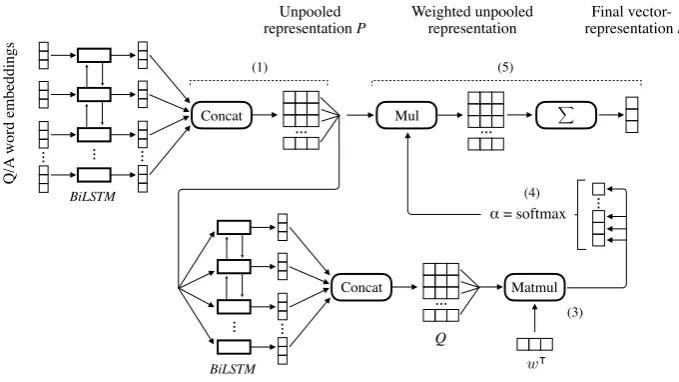
Figure 1: The network structure ofLW withBiLSTM to learn the unpooled representation (LWBiLSTM).
Numbers in parentheses refer to the related Equations.
Basic BiLSTM Model The best-performing models for representation learning in non-factoid answer selection are usually based onBiLSTMs(Tan et al., 2016; Dos Santos et al., 2016). Thus, we build our own approach on a variation of such model. To obtain a representation for an input text we apply anLSTM on the concatenatedd-dimensional word embeddingsE ∈Rl×dof the input text with lengthlin forward direction and in backward direction. As a result, we obtain two matricesH→, H←∈Rl×cthat contain
the state vectors of each recurrence (cis theLSTMcell size). We define the unpooled representationP as the row-wise concatenation of both matrices and create a fixed-size dense vector representationrof the question or candidate answer by applying 1-max pooling:
Pi= [Hi→, H
←
i ] (1)
rj = max
1<i<l(Pi,j) (2)
whereP ∈Rl×2·candr ∈R2·c.
We can also useCNNfor learning text representations. In this case,P contains the values of all filter operations applied on all n-grams in the input text and the dense vector representationris calculated with 1-max pooling as before. Formal definitions can be found in (Feng et al., 2015; Dos Santos et al., 2016).
LSTM-Based Importance Weighting (LW) The basicBiLSTMmodel is often extended with different attention mechanisms that utilize the relatedness between questions and candidate answers to focus on the most relevant segments of the texts (Tan et al., 2016; Wang et al., 2016; Dos Santos et al., 2016). In contrast, we perform importance weighting while assuming the independence of both items. As a consequence, we do not rely on the relatedness to determine the importance.
Our approachLWis an extension to simple representation learning models and can be used instead of 1-max pooling. We first create an encoding of the importance for each segment in the unpooled representationP of a prior component (e.g. the basicBiLSTM) by applying an additional, separate
BiLSTM. We obtain the concatenated output statesQ∈Rl×2·cof thisBiLSTMwhere theith rowQ
i
contains the state vectors that encode the importance of theith row inP. We then reduce each rowQito
a scalarviand apply softmax on the vectorvto obtain scaled importance values that sum to1.0:
vi =w|Qi (3)
Dataset Train Valid Test Candidates Correct Answers Answer Length Questions Questions Questions per Question per Question in Tokens
InsuranceQA v1 12,887 1,000 3,600 500.0 1.4 96.5
InsuranceQA v2 12,889 1,592 1,625 500.0 1.6 111.8
[image:4.595.87.509.72.138.2]WikiQA 873 126 243 9.8 1.2 25.2
Table 1: Dataset statistics.
wherew ∈ Rc are learned network parameters for the reduction operation, v
i ∈ Ris the (unscaled) importance value of theith segment inP, andα ∈Rl is the resulting importance vector (or attention
vector). Applying softmax is important because we do not want more accumulated importance for longer texts compared to shorter texts. Finally, we reducePto a fixed-size dense vector representationr
according to our importance vectorα:
rj = l X
i=1
αiPi,j (5)
In contrast to average pooling or 1-max pooling, this operation allows different segments in the input to contribute torwith different strengths (having more or less influence onr). A visualization ofLW that
usesBiLSTMto learn the unpooled representationP is shown in Figure 1.
In general, we always use shared network weights to learn the unpooled representationP of questions and candidate answers as it is more effective compared to using separate network weights (Feng et al., 2015). Within the components ofLWwe however use separate network weights, which allows the network to learn different importance weighting behavior for questions and candidate answers. We analyze the impact of this choice later in Section 5.
4
Experimental Setup
Training We define the lossLas follows:
L=max 0, m−s(rq, ra+) +s(rq, ra−)
whererqis the learned question representation,ra+andra−are learned representations of correct and incorrect candidate answers,sis cosine similarity, andmis the desired margin between the similarities. Because such triples are not pre-defined in our datasets, we construct them during training. For a pair of question and correct answer we randomly sample 50 incorrect candidate answers from the whole training set and select the candidate with the highest similarity according to our currently trained model.
Datasets We evaluate our models on the two recent non-factoid answer selection datasets InsuranceQA v1 and InsuranceQA v2 (Feng et al., 2015). In general, both datasets contain more than 15,000 questions and the candidate answers are long multi-sentence texts. Even though InsuranceQA v1 and v2 were crawled from the same community question answering website, they model different setups due to a different sampling strategy that was used to create the candidate answer pools. Whereas in InsuranceQA v1 the pools were created randomly (plus the correct answers), the pools in InsuranceQA v2 were created by querying a search engine to retrieve candidate answers that are lexically similar to the question.2
In addition, we also test our approaches on the factoid answer selection dataset WikiQA, which was constructed by means of crowd-sourcing through the extraction of sentences from Wikipedia articles (Yang et al., 2015). We use this dataset to test our models within the different scenario of factoid answer selection that deals with significantly shorter texts. The dataset statistics are listed in Table 1.
2
Model Valid Test
AttentiveBiLSTM(Tan et al., 2016) 68.9 66,9 IABRNN(Wang et al., 2016) 69.1 67.0 APBiLSTM(Dos Santos et al., 2016) 68.4 69.1
CNN 60.5 58.3
BiLSTM 68.2 65.7
CNN+BiLSTM 68.5 67.3 BiLSTM+BiLSTM 67.5 66.3
LWCNN 70.0 67.9
[image:5.595.72.284.70.204.2]LWBiLSTM 70.9 70.0*
Table 2: Experimental results on InsuranceQA v1 (accuracy). * = significant improvement against our other models (p <0.05, Wilcoxon test).3
Model Valid Test
APBiLSTM(reimplementation) 32.2 31.9
CNN 24.4 24.4
BiLSTM 32.4 31.1
CNN+BiLSTM 33.0 31.4 BiLSTM+BiLSTM 31.2 32.0
LWCNN 33.5 33.7
[image:5.595.320.514.92.204.2]LWBiLSTM 35.4 36.9*
Table 3: Experimental results on InsuranceQA v2 (accuracy). * = significant improvement against all other models (p <0.05, Wilcoxon test).
Models and Baselines We evaluateLWwithBiLSTM (LWBiLSTM) andCNN (LWCNN) to learn the
unpooled representations. As baselines we employBiLSTM andCNN with 1-max pooling and the stacked variantsCNN+BiLSTMandBiLSTM+BiLSTM, which use aBiLSTM with 1-max pooling to process the unpooled representationP of the prior component.
A comparison against the stacked models is particularly important because they employ the same components asLWCNNandLWBiLSTM, but use a different network structure.
Neural Network Setup We performed grid search over several hyperparameter combinations and found the optimal choices to be similar to hyperparameters of previous work. The cell size of allLSTMsis 141 (each direction), and the number of filters for allCNNsis 400 with size 3. The only exception is
CNN+BiLSTMwith 282 filters and a cell size of 282. We use the Adam optimizer (Kingma and Ba,
2015) with a learning rate of4·10−4and a marginm= 0.2. We initialize the word embeddings with off-the-shelf 100-dimensional uncased GloVe embeddings (Pennington et al., 2014) and optimize them further during training. Dropout of0.3was applied on the representations before comparison.
We chose different hyperparameters for WikiQA, which we do not list here due to space restrictions. Details can be found in our public source code repository.
5
Experimental Results
InsuranceQA v1 Our evaluation on InsuranceQA v1 allows us to compare our approach against a broad list of recently published attention-based models. Table 2 shows the results of our evaluation where we measure the ratio of correctly selected answers (accuracy). We observe that by addingLWto either
CNN orBiLSTM we can significantly improve the answer selection performance by9.6%and4.3%
respectively. This clearly shows thatLWis effective and can be used to extend basic models to learn better representations of questions and candidate answers. Additionally,LW models are more effective than stacked models due to the different network structure that we use to explicitly learn importance weights. Stacked models are less effective because they need to carry the full representation through all components. Overall,LWBiLSTMsignificantly outperforms all our other tested models.LWBiLSTMalso achieves the
best results compared to other state-of-the-art representation learning approaches with attention such as the two-way attention modelAPBiLSTM, which derives attention from a learned measure of similarity between
questions and answers. This clearly shows that we can successfully perform importance weighting without relying on the relatedness of questions and answers.
It is important to mention that Wang and Jiang (2017) very recently experimented with a novel
3
Model MAP MRR
APCNN(Dos Santos et al., 2016) 0.6886 0.6957 ABCNN(Yin et al., 2016) 0.6921 0.7127 IABRNN(Wang et al., 2016) 0.7341 0.7418
CNN 0.6204 0.6365
BiLSTM 0.6174 0.6310
CNN+BiLSTM 0.6560 0.6737 BiLSTM+BiLSTM 0.6735 0.6789
LWCNN 0.7102 0.7240
LWBiLSTM 0.6941 0.7039
Table 4: Experimental results on WikiQA com-pared to recent approaches with attention.
Model InsuranceQA WikiQA
V1 V2 MAP MRR
LWCNN/ shared 67.8 34.0 0.6992 0.7112 LWCNN/ sep. 67.9 33.7 0.7102 0.7240
LWBiLSTM/ shared 68.5 36.1 0.6854 0.6954 LWBiLSTM/ sep. 70.0 36.9 0.6941 0.7039
Table 5: Experimental results with shared vs. sepa-rateLWweights.
method that achieves state-of-the-art results on the InsuranceQA v1 dataset.4Instead of learning dense vector representations, they classify pairs of questions and candidate answers with a compare-aggregate model that performs comparisons on the word level, aggregates this information withCNN, and uses additional layers to determine the classification result. Because their approach is not learning dense vector representations, we did not directly compare against it. It would however be possible to use our approach in their framework to compare segments of weighted unpooled representations.
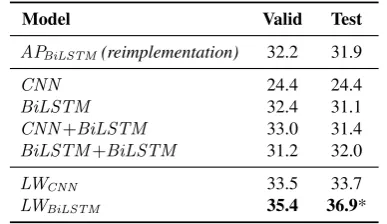
InsuranceQA v2 The evaluation on InsuranceQA v2 allows us to compare our models within a more realistic answer selection scenario due to the different creation of candidate answer pools. Because there are no previously published results, we re-implemented Attentive Pooling withBiLSTM (APBiLSTM) as
proposed by Dos Santos et al. (2016) for a better comparison.5We report the experimental results in Table 3. Similar to our previous findings,LWsignificantly improves the answer selection performance ofCNN
andBiLSTM. In contrast,APBiLSTMonly achieves minor improvements againstBiLSTM. We expect
this to be an effect of the more realistic candidate answer pools where all incorrect candidates are lexically similar to the question. BecauseAPBiLSTMuses an explicitly learned measure of similarity between
questions and candidate answers to determine the importance, it assigns high scores to lexically similar incorrect candidate answers. On the other hand, our experimental results suggest thatLWis not affected by this issue. As a consequence, our best modelLWBiLSTMsignificantly outperforms all other approaches,
showing that importance weighting without relying on the relatedness of questions and answers is very effective within the realistic answer selection scenario of InsuranceQA v2.
Since our best observed accuracy on this dataset is significantly lower than on InsuranceQA v1, we tried to determine the actual usefulness of our approach. We manually labeled the first 100 incorrectly selected answers ofBiLSTM andLWBiLSTMfor correctness, where a candidate answer is correct if it
contains the information that was requested in the question. In the case ofLWBiLSTM,50answers were
labeled as correct, and forBiLSTMthe number of correct labels is44. The improvement ofLWBiLSTMis
often driven by a sharp question focus, which enables to better retrieve answers that contain the requested information. These numbers indicate that the actual usefulness of our models is higher than the reported accuracy scores. The primary issue is the number of missing labels in the dataset, which is a result of the different sampling strategy and the lack of manual relevance annotations. We however did not notice any particular consequences from this situation beyond under-estimating the model performance.
WikiQA Experiments on WikiQA allow us to test our proposed approach within a different scenario that deals with considerably shorter texts. Following Yang et al. (2015), we measure MAP and MRR within our evaluation. The results are listed in Table 4.
Similar to our results on both InsuranceQA datasets, the addition ofLW substantially improves the answer selection performance. Neither the reduced length of the answers nor the significantly reduced
4
They evaluated many different variations of their approach and achieve a maximum accuracy of 74.3%.
Figure 2: A visualization of the attention weights ofLWBiLSTM andAPBiLSTM for a question and a
correct answer. Red colors visualize the relative importance.
size of the training data has a noticeable influence on the performance. Compared to the stacked models, the performance increase ofLWmodels is also considerable. Even though our best modelLWCNNdoes
not achieve state-of-the-art results on this dataset (the best results are currently achieved by Wang and Jiang (2017) with0.7433MAP), we note that it performs on the same level as other top-performing attention-based models. This suggests that our approach can be suitably applied to scenarios that are different to non-factoid answer selection.
Separate vs. Shared LW Network Weights To measure the impact of our choice to use separateLW parameters for questions and candidate answers, we re-ran all experiments with shared parameters and provide a comparison in Table 5.
We observe that using separateLW parameters leads to improvements in5 out of6cases, where
LWBiLSTMobtains the biggest gains of up to 1.5% accuracy. This suggests that learning separate
parame-ters for the importance weighting of questions and candidate answers can lead to better representations. Even though this is intuitive because questions and answers are different types of texts, previous work has shown that using separate network parameters usually results in performance declines (Feng et al., 2015). However, since we still use shared parameters to learn the unpooled representations and only use separate parameters inLW, our approach does not suffer from the same optimization issues.
6
Analysis
Importance Weights We qualitatively analyzed the importance weights ofLWBiLSTMandAPBiLSTM
using an end-to-end QA framework with attention visualization (R¨uckl´e and Gurevych, 2017) and configured it to use InsuranceQA v2. In general, we oberserved that for pairs of questions and correct candidate answers, the most important segments determined byLWBiLSTMandAPBiLSTMare very similar.
An example is given in Figure 2. We also noticed two important attributes ofLW that contribute to the previously reported improvements.
First, for incorrect candidate answers with high lexical similarity to the question,LWBiLSTMoften
focusses on segments that happen to be unrelated and thus creates dissimilar representations (desired). In contrast,APBiLSTM, by design, focusses on similar segments and creates similar representations
(undesired). An example is shown in Figure 3, where our approach strongly focusses on a segment within the question that corresponds to the wordwhen. This requires candidate answers to have a similar focus in order to achieve a high score (e.g. by describing a date).6 Since this is not the case for the presented incorrect candidate answer, the representations are dissimilar and the score is low. This allowsLW to better handle incorrect candidate answers.
And second, we found thatLWBiLSTMvery strongly focusses on few highly relevant segments that are
well-suited to describe the overall topic of the text. This leads to representations that are strongly based on individual aspects and allows the model to filter out noise more effectively because irrelevant segments
6
Figure 3: A visualization of the attention weights ofLWBiLSTM andAPBiLSTMfor a question and an
incorrect candidate answer (with high lexical similarity). Red colors visualize the relative importance.
receive lower relative importance. We quantitatively analyzed this property by measuring the strength of the importance weights for all answers in InsuranceQA v2. For each individual question/answer pair (correct or incorrect) we determined the maximum values of the importance weights withLWBiLSTM
andAPBiLSTM. Interestingly,LWBiLSTMderives at least one importance weight greater or equal0.10
within77%of all answers, and one importance weight greater or equal0.20within24%of all answers.7
APBiLSTMon the other hand does not apply such a strong focus (0%of cases; a very small number). As
a consequence,LWcan better ignore irrelevant content because it strongly focusses on few important segments within the relatively long texts found in InsuranceQA v2.
Error Analysis and Limitations The most common error we observed is related to important aspects of the question that are not addressed in the selected answer. The question“What is a renters insurance declaration page?”, for example, contains the aspects what (question type), renters insurance, and
declaration page. WhenLWBiLSTMfails, it usually selects an answer that differs in only one aspect. For
the previous question, our approach selects an answer that describes what theauto insurancedeclaration page is (a similar topic). The reason is the inability ofLWto focus on all important aspects of the question separately. This can also be observed in our previous example in Figure 2, where our approach focusses on the aspectscoverandwater damagebut ignoreshomeowners insurance. In this case our approach would not be able to effectively differentiate between candidate answers that write aboutrenters insurance
instead ofhomeowners insurance.
To tackle this issue, future work could add a separate classification step after ranking that discards any top-ranked answers that do not cover all aspects of the question.
7
Conclusion
In this work, we presented an approach to non-factoid answer selection that determines the importance of segments within questions and answers while assuming the independence of both items. Our experimental results on the two non-factoid answer selection datasets InsuranceQA v1 and v2 show that our approach is effective and substantially outperforms various strong baselines and different state-of-the-art attention-based approaches. Our additional evaluation on WikiQA demonstrates that our proposed approach is also suitable for different scenarios with shorter texts. We showed that it is possible to perform effective importance weighting for answer selection without relying on the relatedness of questions and answers.
Acknowledgements
This work has been supported by the German Research Foundation as part of the QA-EduInf project (grant GU 798/18-1 and grant RI 803/12-1). We gratefully acknowledge the support of NVIDIA Corporation with the donation of the Tesla K40 GPU used for this research. Some calculations for this research were conducted on the Lichtenberg high performance computer of the TU Darmstadt.
References
Dos Santos, C., M. Tan, B. Xiang, and B. Zhou (2016). Attentive Pooling Networks. arXiv preprint.
Feng, M., B. Xiang, M. R. Glass, L. Wang, and B. Zhou (2015). Applying deep learning to answer selection: A study and an open task. In2015 IEEE Workshop on Automatic Speech Recognition and Understanding (ASRU), pp. 813–820.
Heilman, M. and A. N. Smith (2010). Tree edit models for recognizing textual entailments, paraphrases, and answers to questions. InHuman Language Technologies: The 2010 Annual Conference of the North American Chapter of the Association for Computational Linguistics, pp. 1011–1019. Association for Computational Linguistics.
Jansen, P., M. Surdeanu, and P. Clark (2014). Discourse complements lexical semantics for non-factoid answer reranking. InProceedings of the 52nd Annual Meeting of the Association for Computational Linguistics (ACL), pp. 977–986. Association for Computational Linguistics.
Kingma, D. P. and J. L. Ba (2015). Adam: a Method for Stochastic Optimization. In3rd International Conference on Learning Representations (ICLR).
Li, P., W. Li, Z. He, X. Wang, Y. Cao, J. Zhou, and W. Xu (2016). Dataset and Neural Recurrent Sequence Labeling Model for Open-Domain Factoid Question Answering. Arxiv preprint.
Lin, Z., M. Feng, C. N. Dos Santos, M. Yu, B. Xiang, B. Zhou, and Y. Bengio (2017). A Structured Self-attentive Sentence Embedding. 5th International Conference on Learning Representations (ICLR).
Liu, Y., C. Sun, L. Lin, and X. Wang (2016). Learning Natural Language Inference using Bidirectional LSTM model and Inner-Attention. Arxiv preprint.
Moschitti, A., S. Quarteroni, R. Basili, and S. Manandhar (2007). Exploiting syntactic and shallow semantic kernels for question answer classification. InProceedings of the 45th Annual Meeting of the Association of Computational Linguistics (ACL), pp. 776–783. Association for Computational Linguistics.
Parikh, A. P., O. T¨ackstr¨om, D. Das, and J. Uszkoreit (2016). A Decomposable Attention Model for Natural Language Inference. InProceedings of the 2016 Conference on Empirical Methods in Natural Language Processing (EMNLP), pp. 2249–2255. Association for Computational Linguistics.
Pennington, J., R. Socher, and C. Manning (2014). Glove: Global vectors for word representation. In
Proceedings of the 2014 Conference on Empirical Methods in Natural Language Processing (EMNLP), pp. 1532–1543. Association for Computational Linguistics.
R¨uckl´e, A. and I. Gurevych (2017). End-to-end non-factoid question answering with an interactive visualization of neural attention weights. InProceedings of the 55th Annual Meeting of the Association for Computational Linguistics-System Demonstrations (ACL), pp. 19–24. Association for Computational Linguistics.
Severyn, A. and A. Moschitti (2012). Structural relationships for large-scale learning of answer re-ranking. InProceedings of the 35th International ACM SIGIR Conference on Research and Development in Information Retrieval (SIGIR), pp. 741–750. ACM.
Severyn, A. and A. Moschitti (2015). Learning to rank short text pairs with convolutional deep neural net-works. InProceedings of the 38th International ACM SIGIR Conference on Research and Development in Information Retrieval (SIGIR), pp. 373–382. ACM.
Surdeanu, M., M. Ciaramita, and H. Zaragoza (2011). Learning to rank answers to non-factoid questions from web collections. Computational Linguistics 37(2), 351–383.
Tan, M., C. Dos Santos, B. Xiang, and B. Zhou (2016). Improved representation learning for question answer matching. InProceedings of the 54th Annual Meeting of the Association for Computational Linguistics (ACL), pp. 464–473. Association for Computational Linguistics.
Tymoshenko, K., D. Bonadiman, and A. Moschitti (2016). Convolutional neural networks vs. convolution kernels: Feature engineering for answer sentence reranking. InProceedings of the 2016 Conference of the North American Chapter of the Association for Computational Linguistics: Human Language Technologies (NAACL-HLT), pp. 1268–1278. Association for Computational Linguistics.
Wang, B., K. Liu, and J. Zhao (2016). Inner attention based recurrent neural networks for answer selection. InProceedings of the 54th Annual Meeting of the Association for Computational Linguistics (ACL), pp. 1288–1297. Association for Computational Linguistics.
Wang, D. and E. Nyberg (2015). A long short-term memory model for answer sentence selection in question answering. InProceedings of the 53rd Annual Meeting of the Association for Computational Linguistics and the 7th International Joint Conference on Natural Language Processing (ACL-IJCNLP), pp. 707–712. Association for Computational Linguistics.
Wang, M. and C. Manning (2010). Probabilistic tree-edit models with structured latent variables for textual entailment and question answering. InProceedings of the 23rd International Conference on Computational Linguistics (COLING), pp. 1164–1172.
Wang, S. and J. Jiang (2017). A Compare-Aggregate Model for Matching Text Sequences. 5th Interna-tional Conference on Learning Representations (ICLR).
Yang, Y., W.-t. Yih, and C. Meek (2015). Wikiqa: A challenge dataset for open-domain question answering. In Proceedings of the 2015 Conference on Empirical Methods in Natural Language Processing (EMNLP), pp. 2013–2018. Association for Computational Linguistics.
Yih, W.-T., M.-W. Chang, C. Meek, and A. Pastusiak (2013). Question answering using enhanced lexical semantic models. InProceedings of the 51st Annual Meeting of the Association for Computational Linguistics (ACL), pp. 1744–1753. Association for Computational Linguistics.
Yin, W., H. Sch¨utze, B. Xiang, and B. Zhou (2016). Abcnn: Attention-based convolutional neural network for modeling sentence pairs.Transactions of the Association of Computational Linguistics (TACL) 4, 259–272.