Creating a Test Collection for Citation-based IR Experiments
Anna Ritchie University of Cambridge
Computer Laboratory 15 J J Thompson Avenue Cambridge, CB3 0FD, U.K.
Simone Teufel University of Cambridge
Computer Laboratory 15 J J Thompson Avenue Cambridge, CB3 0FD, U.K.
Stephen Robertson Microsoft Research Ltd
Roger Needham House 7 J J Thomson Avenue Cambridge, CB3 0FB, U.K.
Abstract
We present an approach to building a test collection of research papers. The ap-proach is based on the Cranfield 2 tests but uses as its vehicle a current conference; research questions and relevance judge-ments of all cited papers are elicited from conference authors. The resultant test col-lection is different from TREC’s in that it comprises scientific articles rather than newspaper text and, thus, allows for IR experiments that include citation informa-tion. The test collection currently con-sists of 170 queries with relevance judge-ments; the document collection is the ACL Anthology. We describe properties of our queries and relevance judgements, and demonstrate the use of the test collection in an experimental setup. One potentially problematic property of our collection is that queries have a low number of relevant documents; we discuss ways of alleviating this.
1 Introduction
We present a methodology for creating a test collec-tion of scientific papers that is based on the Cran-field 2 methodology but uses a current conference as the main vehicle for eliciting relevance judgements from users, i.e., the authors.
Building a test collection is a long and expensive process but was necessary as no ready-made test col-lection existed on which the kinds of experiments
with citation information that we envisage could be run. We aim to improve term-based IR on scien-tific articles with citation information, by using in-dex terms from the citing article to additionally de-scribe the cited document. Exactly how to do this is the research question that our test collection should help to address.
This paper is structured as follows: Section 2 mo-tivates our proposed experiments and, thereby, our test collection. Section 3 discusses the how test col-lections are built and, in particular, our own. Sec-tion 4 briefly describes the practicalities of compil-ing the document collection and the processcompil-ing we perform to prepare the documents for our experi-ments. In Section 5, we show that our test collection can be used with standard IR tools. Finally, Sec-tion 6 discusses the problem of the low number of relevant documents judged so far and two ways of alleviating this problem.
2 Motivation
The idea of using terms external to a document, coming from a ‘citing’ document, has been bor-rowed from web-based IR. When one paper cites another, a link is made between them and this link structure is analogous to that of the web: “hyper-links ... provide semantic linkages between ob-jects, much in the same manner that citations link documents to other related documents” (Pitkow and Pirolli, 1997). Link structure, particularly anchor text, has been used to advantage in web-based IR. While web pages are often poorly self-descriptive (Brin and Page, 1998) anchor text is often a higher-level description of the pointed-to page. (Davison,
2000) provides a good discussion of how well an-chor text does this and provides experimental results in support. Thus, beginning with (McBryan, 1994), there is a trend of propagating anchor text along its hyperlink to associate it with the linked page, as well as the page in which it is found. Google, for ex-ample, includes anchor text as index terms for the linked page (Brin and Page, 1998). The TREC Web tracks have also shown that using anchor text im-proves retrieval effectiveness for some search tasks (Hawking and Craswell, 2005).
This idea has already been applied to citations and scientific articles (Bradshaw, 2003). In Bradshaw’s experiment, scientific documents are indexed by the text that refers to them in documents that cite them. However, unlike in experiments with previous col-lections, we need both the citing and the cited article as full documents in our collection. The question of how to identify citation ‘anchor text’ and its extent is a matter for research; this requires the full text of the citing article. Previous experiments and test col-lections have had only limited access to the content of the citing article: Bradshaw had access only to a fixed window of text around the citation, as provided by CiteSeer’s ‘citation context’; in the GIRT collec-tions (Kluck, 2003), a dozen or so content-bearing information fields (e.g., title, abstract, methodologi-cal descriptors) represent each document and the full text is not available. Additionally, in Bradshaw’s ex-periment, no access is given to the text of the cited
article itself so that the influence of a term-based IR model cannot be studied and so that documents can only be indexed if they have been cited at least once. A test collection containing full text for many cit-ing and cited documents, thus, has advantages from a methodological point of view.
2.1 Choosing a Genre
When choosing a scientific field to study, we looked for one that is practicable for us to compile the doc-ument collection (freely available machine-readable documents; as few as possible document styles), while still ensuring good coverage of research top-ics in an entire field. Had we chosen the medical field or bioinformatics, the prolific number of jour-nals would have been a problem for the practical document preparation.
We also looked for a relatively self-contained
field. As we aim to propagate referential text to cited papers as index terms, references from documents in the collection to other documentswithinthe col-lection will be most useful. We call these internal
references. While it is impossible to find or create a collection of documents with only internal refer-ences, we aim for as high a proportion of internal references as possible.
We chose the ACL (Association for Computa-tional Linguistics) Anthology1, a freely available
digital archive of computational linguistics research papers. Computational linguistics is a small, ho-mogenous research field and the Anthology contains the most prominent publications since the beginning of the field in 1960, consists of only 2 journals, 7 conferences and 5 less important publications, such as discontinued conferences and a series of work-shops, resulting in only 7000 papers2.
With the ACL Anthology, we expect a high pro-portion of internal references within a relatively compact document collection. We empirically mea-sured the proportion of collection-internal ences. We found a proportion of internal refer-ences to all referrefer-ences of 0.33 (the in-factor). We wanted to compare this number to a situation in another, larger field (genetics) but no straightfor-ward comparison is possible, as there are very many genetics journals and quality of journals probably plays a larger role in a bigger field. We tried to simulate a similar collection to the 9 main jour-nals+conferences in the Anthology, by considering 10 journals in genetics with a range of impact fac-tors3, resulting in an in-factor of 0.17 (dropping to
0.14 if only 5 journals are considered). Thus, our hypothesis that the Anthology is reasonably self-contained, at least in comparison with other possible collections, was confirmed.
The choice of computational linguistics has the added benefit that we are familiar with the domain; we can interpret the subject matter better than we would be able to in the medical domain. This should be of use to us in our eventual experiments.
1http://www.aclweb.org/anthology/
2This is our estimate, after substracting non-papers such as
letters to the editor, tables of contents etc. The Anthology is growing by∼500 papers per year.
3Journal impact factor is a measure of the frequency with
3 Building Test Collections
To turn our document collection into a test col-lection, a parallel set of search queries and rele-vance judgements is needed. There are a number of alternative methods for building a test collec-tion. For TREC, humans devise queries specifically for a given set of documents and make relevance judgements on pooled retrieved documents from that set (Harman, 2005). Theirs is an extremely labour-intensive and expensive process and an unrealistic option in the context of our project.
The Cranfield 2 tests (Cleverdon et al., 1966) in-troduced an alternative method for creating a test collection, specifically for scientific texts. The method was subject to criticism and has not been employed much since. Nevertheless, we believe this method to be worth revisiting for our current situa-tion. In this section, we describe in turn the Cran-field 2 method and our adapted method. We discuss some of the original criticisms and their bearing on our own work, then describe our returns thus far.
3.1 The Cranfield 2 Test Collection
The Cranfield 2 tests (Cleverdon et al., 1966) were a comparative evaluation of indexing language de-vices. From a base collection of 182 (high speed aerodynamics and aircraft structures) papers, the Cranfield test collection was built by asking the au-thors to formulate the research question(s) behind their work and to judge how relevant each reference in their paper was to each of their research questions, on a 5-point scale. Referenced documents were ob-tained and added to the base set. Authors were also asked to list additional relevant papers not cited in their paper. The collection was further expanded in a second stage, using bibliographic coupling to search for similar papers to the referenced ones and employing humans to search the collection for other relevant papers. The resultant collection comprised 1400 documents and 221 queries (Cleverdon, 1997). The principles behind the Cranfield technique are:
• Queries: Each paper has an underlying research
question or questions; these constitute valid search queries.
• Relevant documents: A paper’s reference list is
a good starting point for finding papers relevant to its research questions.
• Judges: The paper author is the person best
qualified to judge relevance.
3.2 Our Anthology Test Collection
We altered the Cranfield design to fit to a fixed, existing document collection. We designed our methodology around an upcoming conference and approached the paper authors at around the time of the conference, to maximize their willingness to par-ticipate and to minimise possible changes in their perception of relevance since they wrote the paper. Due to the relatively high in-factor of the collection, we expected a significant proportion of the relevance judgements gathered in this way to be about Anthol-ogy documents and, thus, useful as evaluation data.
Hence, the authors of accepted papers for ACL-2005 and HLT-EMNLP-ACL-2005 were asked, by email, for their research questions and relevance judge-ments for their references. We defined a 4-point relevance scale, c.f. Table 1, since we felt that the distinctions between the Cranfield grades were not clear enough to warrant 5. Our guidelines also in-cluded examples of referencing situations that might fit each category. Personalized materials for partic-ipation were sent, including a reproduction of their paper’s reference list in their response form. This meant that invitations could only be sent once the paper had been made available online.
We further deviated from the Cranfield methodol-ogy by deciding not to ask the authors to try to list additional references that could have been included in their reference list. An author’s willingness to name such references will differ more from author to author than their naming of original references, as referencing is part of a standardized writing process. By asking for this data, the consistency of the data across papers will be degraded and the status of any additional references will be unclear. Furthermore, feedback from an informal pilot study conducted on ten paper authors confirmed that some authors found this task particularly difficult.
Grade Description
4 The reference is crucially relevant to the problem. Knowledge of the contents of the referred work will be fun-damental to the reader’s understanding of your paper. Often, such relevant references are afforded a substantial amount of text in a paper e.g., a thorough summary.
3 The reference is relevant to the problem. It may be helpful for the reader to know the contents of the referred work, but not crucial. The reference could not have been substituted or dropped without making significant additions to the text. A few sentences may be associated with the reference.
2 The reference is somewhat (perhaps indirectly) relevant to the problem. Following up the reference probably would not improve the reader’s understanding of your paper. Alternative references may have been equally appropriate (e.g., the reference was chosen as a representative example from a number of similar references or included in a list of similar references). Or the reference could have been dropped without damaging the informativeness of your paper. Minimal text will be associated with the reference.
1 The reference is irrelevant to this particular problem.
Table 1: Relevance Scale
measure co-author agreement on the relevance task. This is an interesting research question, as it is not at all clear how much even close collaborators would agree on relevance, but we do not address this here.
We plan to expand the collection in a second stage, in line with the Cranfield 2 design. We will reapproach contributing authors after obtaining re-trieval results on our collection (e.g., with a stan-dard IR engine) and ask them to make additional rel-evance judgements on these papers.
3.3 Criticisms of Cranfield 2
Both Cranfield 1 (Cleverdon, 1960) and 2 were sub-ject to various criticisms; (Sp¨arck Jones, 1981) gives an excellent account of the tests and their criticisms. The majority were criticisms of the test collection paradigm itself and are not pertinent here. How-ever, thesource-document principle(i.e., the use of queries created from documents in the collection) at-tracted particular criticisms. The fundamental con-cern was that the way in which the queries were cre-ated led to “an unnaturally close relation” between the terms in the queries and those used to index the documents in the colection (Vickery, 1967); any such relationship might have created a bias towards a particular indexing language, distorting the com-parisons that were the goal of the project.
In Cranfield 1, system success was measured by retrieval of source documents alone, criticized for being an over-simplification and a distortion of ‘real-life’ searching. The evaluation procedure was changed for Cranfield 2 so that source documents were excluded from searches and, instead, retrieval
of other relevant documents was used to measure success. This removed the problem that, usually, when a user searches, there is no source document for their query. Despite this, Vickery notes that there were “still verbal links between sought document and question” in the new method: each query author was asked to judge the relevance of the source doc-ument’s references and “the questions ... were for-mulatedafterthe cited papers had been read and has possibly influenced the wording of his question”.
While adapting the Cranfield 2 method to our needs, we have tried to address some of the crit-icisms, e.g., that authors’ relevance judgements change over time. Nevertheless, we still have source-document queries and must consider the as-sociated criticisms. Firstly, our test collection is not intended for comparisons of indexing languages. Rather, we aim to compare the effect of adding ex-tra index terms to a base indexing of the documents. The source documents will have no influence on the base indexing of a document above that of the other documents. The additional index terms, com-ing from citations to that document, will generally be ‘chosen’ by someone other than the query author, with no knowledge of the query terms4. Also, our
documents will be indexed fully automatically, fur-ther diminishing the scope of any subconscious hu-man influence.
Thus, we believe that the suspect relationship be-tween queries and indexing is negligible in the
con-4The exception to this is self-citation. This (very indirectly)
text of our work, as opposed to the Cranfield tests, and that the source-document principle is sound.
3.4 Returns and Analysis
Out of around 500 invitations sent to conference au-thors, 85 resulted in research questions with rele-vance judgements being returned; 235 queries in to-tal. Example queries are:
• Do standard probabilistic parsing techniques,
developed for English, fare well for French and does lexicalistion help improve parsing results?
• Analyze the lexical differences between genders
engaging in telephone conversations.
Of the 235 queries, 18 were from authors whose co-authors had also returned data and were dis-carded (for retrieval purposes); we treat co-author data on the same paper as ‘the same’ and keep only the first authors’. 47 queries had no relevant Anthology-internal references and were discarded. Another 15 had only relevant Anthology references not yet included in the archive5; we keep these for
the time being. This leaves 170 unique queries with at least 1 relevant Anthology reference and an aver-age of 3.8 relevant Anthology references each. The average in-factor across queries is 0.42 (similar to our previously estimated Anthology in-factor)6.
Our average number of judged relevant docu-ments per query is lower than for Cranfield, which had an average of 7.2 (Sp¨arck Jones et al., 2000). However, this is the final number for the Cran-field collection, arrived at after the second stage of relevance judging, which we have not yet car-ried out. Nevertheless, we must anticipate a po-tentially low number of relevant documents per query, particularly in comparison to, e.g., the TREC ad hoc track (Voorhees and Harman, 1999), with 86.8 judged relevant documents per query.
4 Document Collection and Processing The Anthology documents are distributed in PDF, a format designed to visually render printable docu-ments, not to preserve editable text. So the PDF col-lection must be converted into a fully textual format.
5HLT-NAACL-2004 papers, e.g., are listed as ‘in process’. 6We cannot directly compare this to Cranfield’s in-factor as
we do not have access to the documents.
IXML XML XML
PDF XMLStructure
Presentational
Structure Logical
Pre−ProcesssorPTX TemplatePTX List ParserReference ProcessorCitation
XML + Reference
List + Citations
[image:5.612.313.542.56.122.2]OmniPage
Figure 1: Document Processing Pipeline
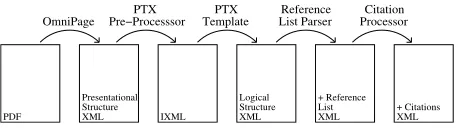
A pipeline of processing stages has been developed in the framework of a wider project, illustrated in Figure 1.
Firstly, OmniPage Pro 147, a commercial PDF
processing software package, scans the PDFs and produces an XML encoding of character-level page layout information. AI algorithms for heuristically extracting character information (similar to OCR) are necessary since many of the PDFs were created from scanned paper-copies and others do not contain character information in an accessible format.
The OmniPage output describes a paper as text blocks with typesetting information such as font and positional information. A pre-processor (Lewin et al., 2005) filters and summarizes the OmniPage out-put into Intermediate XML (IXML), as well as cor-recting certain characteristic errors from that stage. A journal-specific template converts the IXML to a logical XML-based document structure (Teufel and Elhadad, 2002), by exploiting low-level, presenta-tional, journal-specific information such as font size and positioning of text blocks.
Subsequent stages incrementally add more de-tailed information to the logical representation. The paper’s reference list is annotated in more detail, marking up individual references, author names, ti-tles and years of publication. Finally, a citation pro-cessor identifies and marks up citations in the doc-ument body and their constituent parts, e.g., author names and years.
5 Preliminary Experimentation
We expect that our test collection, built for our cita-tion experiments, will be of wider value and we in-tend to make it publicly available. As a sanity check on our data so far, we carried out some preliminary experimentation, using standard IR tools: the Lemur Toolkit8, specifically Indri (Strohman et al., 2005),
its integrated language-model based search engine, and the TREC evaluation software, trec eval9.
5.1 Experimental Set-up
We indexed around 4200 Anthology documents. This is the total number of documents that have, at the time of writing, been processed by our pipeline (24 years of CL journal, 25 years of ACL proceed-ings, 14 years of assorted workshops), plus another
∼90 documents for which we have relevance
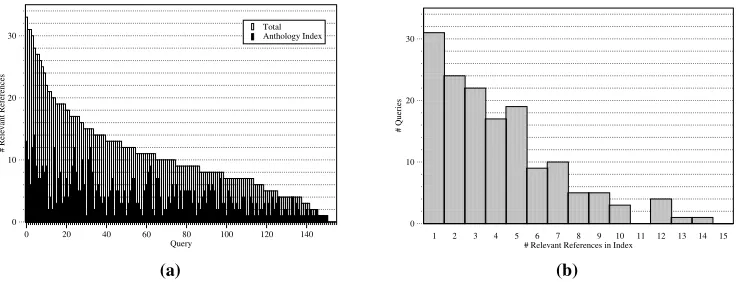
judge-ments that are not currently available through the Anthology website but should be incorporated into the archive in the future. The indexed documents do not yet contain annotation of the reference list or ci-tations in text. 19 of our 170 queries have no relevant references in the indexed documents and were not included in these experiments. Thus, Figure 2 shows the distribution of queries over number of relevant Anthology references, for a total of 151 queries.
Our Indri index was built using default parameters with no optional processing, e.g., stopping or stem-ming, resulting in a total of 20117410 terms, 218977 unique terms and 2263 ‘frequent’10 terms.
We then prepared an Indri-style query file from the conference research questions. The Indri query language is designed to handle highly complex queries but, for our very basic purposes, we created simple bag-of-words queries by stripping all punctu-ation from the natural language questions and using Indri’s#combineoperator over all the terms. This means Indri ranks documents in accordance with query likelihood. Again, no stopping or stemming was applied.
Next, the query file was run against the Anthology index using IndriRunQuery with default parameters and, thus, retrieving 1000 documents for each query. Finally, for evaluation, we converted the Indri’s ranked document lists to TREC-style top results file and the conference relevance judgements compiled into a TREC-style qrels file, including only judge-ments corresponding to references within the in-dexed documents. These files were then input to trec eval, to calculate precision and recall metrics.
9http://trec.nist.gov/trec eval/trec eval.8.0.tar.gz 10Terms that occur in over 1000 documents.
2 3 4 5 6 7 8 9 10 11 12 13 14
Threshhold (# Relevant References in Index) 0
0.05 0.1 0.15 0.2
[image:6.612.354.498.55.157.2]Precision at 5 Documents
Figure 3:Effect of Thresholding on P at 5 Docs
5.2 Results and Discussion
Out of 489 relevant documents, 329 were retrieved within 1000 (per query) documents. The mean av-erage precision (MAP) was 0.1014 over the 151 queries. This is the precision calculated at each rele-vant document retrieved (0.0, if that document is not retrieved), averaged over all relevant documents for all queries, i.e., non-interpolated. R-precision, the precision after R (the number of relevant documents for a query) documents are returned, was 0.0965. The average precision at 5 documents was 0.0728.
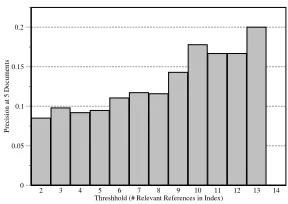
We investigated the effect of excluding queries with lower than a threshold number of judged rel-evant documents. Figure 3 shows that precision at 5 documents increases as greater threshold values are applied. Similar trends were observed with other evaluation measures, e.g., MAP and R-precision in-creased to 0.2018 and 0.1528, respectively, when only queries with 13 or more relevant documents were run, though such stringent thresholding does result in very few queries. Nevertheless, these trends do suggest that the present low number of relevant documents has an adverse effect on retrieval results and is a potential problem for our test collection.
We also investigated the effect of including only authors’ main queries, as another potential way of objectively constructing a ‘higher quality’ query set. Although, this decreased the average in-factor of rel-evant references, it did, in fact, increase the average absolute number of relevant references in the index. Thus, MAP increased to 0.1165, precision at 5 doc-uments to 0.1016 and R-precision to 0.1201.
These numbers look poor in comparison to the performance of IR systems at TREC but, impor-tantly, they are not intended as performance results. Their purpose is to demonstrate that such numbers
(a) (b)
0 20 40 60 80 100 120 140
Query 0
10 20 30
# Relevant References
Total Anthology Index
1 2 3 4 5 6 7 8 9 10 11 12 13 14 15 # Relevant References in Index
0 10 20 30
# Queries
[image:7.612.123.494.70.211.2](a) (b)
Figure 2:(a)Relevant References Per Query and(b)Distribution of Queries over Number of Relevant References
rather than to evaluate the performance of some new retrieval system or strategy.
A second point for consideration follows directly from the first: our experiments were carried out on a new test collection and “different test collec-tions have different intrinsic difficulty” (Buckley and Voorhees, 2004). Thus, it is meaningless to compare statistics from this data (from a different domain) to those from the TREC collections, where queries and relevance judgements were collected in a different way, and where there are very many rele-vant documents.
Thirdly, our experiments used only the most basic techniques and the results could undoubtedly be im-proved by, e.g., applying a simple stop-list. Never-theless, this notion of intrinsic difficulty means that it may be the case that evaluations carried out on this collection will produce characteristically low preci-sion values.
Low numbers do not necessarily preclude our data’s usefulness as a test collection, whose purpose is to facilitate comparative evaluations. (Voorhees, 1998) states that “To be viable as a laboratory tool, a [test] collection must reliably rank different re-trieval variants according to their true effectiveness” and defends the Cranfield paradigm (from criticisms based on relevance subjectivity) by demonstrating that the relative performance of retrieval runs is sta-ble despite differences in relevance judgements. The underlying principle is that it is not the absolute pre-cision values that matter but the ability to compare these values for different retrieval techniques or sys-tems, to investigate their relative benefits. A test
col-lection with low precision values will still allow this. It is known that all evaluation measures are un-stable for very small numbers of relevant documents (Buckley and Voorhees, 2000) and there are issues arising from incomplete relevance information in a test collection (Buckley and Voorhees, 2004). This makes the second stage of our test collection com-pilation even more indispensable (asking subjects to judge retrieved documents), as this will increase the number of judged relevant documents, as well as bridging the completeness gap.
There are further possibilities of how the prob-lem could be countered. We could exclude queries with lower than a threshold number of relevant docu-ments (after the second stage). Given the respectable number of queries we have, we might be able to af-ford this luxury. We could add relevant documents from outside the Anthology to our collection. This is least preferable methodologically: using the An-thology has the advantage that it has a real identity and was created for real reasons outside our experi-ments. Furthermore, the collection ‘covers a field’, i.e., it includes all important publications and only those. By adding external documents to the collec-tion, it would lose both these properties.
6 Conclusions and Future Work
have sanity-checked the usability of our data by running the queries through a retrieval system and evaluating the results using standard software. The collection currently has a low number of judged relevant documents and further experimentation is needed to determine if this poses a real problem.
We plan a second stage of collecting relevance judgements, in line with the original Cranfield de-sign, whereby authors who have contributed queries will be asked to judge the relevance of documents in retrieval rankings from standard IR models and, ide-ally, from our eventual citation-based experiments.
Nevertheless, our test collection is likely to suffer from incomplete relevance information. The bpref measure (Buckley and Voorhees, 2004) gauges re-trieval effectiveness solely on the basis of judged documents and is more stable to differing levels of completeness than measures such as MAP, R-precision or R-precision at fixed document cutoffs. Thus, bpref may offer a solution to the incomplete-ness problem and we intend to investigate its poten-tial use in our future evaluations.
When finished, we hope our test collection will be a generally useful IR resource. In particular, we expect the collection to be useful for experimenta-tion with citaexperimenta-tion informaexperimenta-tion, for which there is cur-rently no existing test collection with the properties that ours offers.
Acknowledgements Thanks to the reviewers for
their useful comments and to Karen Sp¨arck Jones for many instructive discussions.
References
Shannon Bradshaw. 2003. Reference directed indexing: Redeeming relevance for subject search in citation in-dexes. InResearch and Advanced Technology for Dig-ital Libraries (ECDL), pages 499–510.
Sergey Brin and Lawrence Page. 1998. The anatomy of a large-scale hypertextual Web search engine. Com-puter Networks and ISDN Systems, 30(1–7):107–117. Chris Buckley and Ellen Voorhees. 2000. Evaluating evaluation measure stability. InResearch and Devel-opment in Information Retrieval (SIGIR).
Chris Buckley and Ellen Voorhees. 2004. Retrieval eval-uation with incomplete information. InResearch and development in information retrieval (SIGIR). Cyril Cleverdon, Jack Mills, and Michael Keen. 1966.
Factors determining the performance of indexing sytems, volume 1. design. Technical report, ASLIB Cranfield Project.
Cyril Cleverdon. 1960. Report on the first stage of an in-vestigation into the comparative efficiency of indexing systems. Technical report, ASLIB Cranfield Project. Cyril Cleverdon. 1997. The Cranfield tests on index
lan-guage devices. InReadings in information retrieval, pages 47–59. Morgan Kaufmann Publishers Inc. Brian D. Davison. 2000. Topical locality in the web.
InResearch and Development in Information Retrieval (SIGIR), pages 272–279.
Eugene Garfield. 1972. Citation analysis as a tool in journal evaluation.Science, 178 (4060):471–479. Donna Harman. 2005. The TREC test collections. In
Ellen Voorhees and Donna Harman, editors, TREC Experiment and Evaluation in Information Retrieval, chapter 2. MIT Press.
David Hawking and Nick Craswell. 2005. The very large collection and web tracks. In Ellen Voorhees and Donna Harman, editors,TREC: Experiment and Eval-uation in Information Retrieval, chapter 9. MIT Press. Michael Kluck. 2003. The GIRT data in the evaluation of CLIR systems - from 1997 until 2003. InCLEF, pages 376–390.
Ian Lewin, Bill Hollingsworth, and Dan Tidhar. 2005. Retrieving hierarchical text structure from typeset sci-entific articles - a prerequisite for e-science text min-ing. InUK e-Science All Hands Meeting.
Oliver McBryan. 1994. GENVL and WWWW: Tools for taming the web. InWorld Wide Web Conference. James Pitkow and Peter Pirolli. 1997. Life, death, and
lawfulness on the electronic frontier. InHuman Fac-tors in Computing Systems.
Karen Sp¨arck Jones, Steve Walker, and Stephen Robert-son. 2000. A probabilistic model of information retrieval: development and comparative experiments -parts 1 and 2. Information Processing and Manage-ment, 36(6):779–840.
Karen Sp¨arck Jones. 1981. The Cranfield tests. In Karen Sp¨arck Jones, editor,Information Retrieval Ex-periment, chapter 13, pages 256–284. Butterworths. Trevor Strohman, Donald Metzler, Howard Turtle, and
W. Bruce Croft. 2005. Indri: a language-model based search engine for complex queries. Technical report, University of Massachusetts.
Simone Teufel and Noemie Elhadad. 2002. Collection and linguistic processing of a large-scale corpus of medical articles. InLanguage Resources and Evalu-ation Conference (LREC).
B. C. Vickery. 1967. Reviews of CLEVERDON, C. W., MILLS, J. and KEEN, E. M. the Cranfield 2 report.
Journal of Documentation, 22:247–249.
Ellen Voorhees and Donna Harman. 1999. Overview of the eighth Text REtrieval Conference (TREC 8). In
Text REtrieval Conference (TREC).