Reducing Weight Undertraining
in Structured Discriminative Learning
Charles Sutton, Michael Sindelar,
and
Andrew McCallum
Department of Computer Science
University of Massachusetts Amherst
Amherst, MA 01003 USA
{
casutton,mccallum
}
@cs.umass.edu
,
[email protected]
Abstract
Discriminative probabilistic models are very popular in NLP because of the latitude they afford in designing features. But training involves complex trade-offs among weights, which can be dangerous: a few highly-indicative features can swamp the contribution of many individually weaker features, causing their weights to be undertrained. Such a model is less robust, for the highly-indicative features may be noisy or missing in the test data. To ameliorate thisweight undertraining, we intro-duce several newfeature baggingmethods, in which separate models are trained on subsets of the original features, and combined using a mixture model or a product of experts. These methods include the logarithmic opinion pools used by Smith et al. (2005). We evaluate fea-ture bagging on linear-chain conditional ran-dom fields for two natural-language tasks. On both tasks, the feature-bagged CRF performs better than simply training a single CRF on all the features.
1 Introduction
Discriminative methods for training probabilistic models have enjoyed wide popularity in natural language pro-cessing, such as in part-of-speech tagging (Toutanova et al., 2003), chunking (Sha and Pereira, 2003), named-entity recognition (Florian et al., 2003; Chieu and Ng, 2003), and most recently parsing (Taskar et al., 2004). A discriminative probabilistic model is trained to maxi-mize the conditional probabilityp(y|x)of output labels
y given input variables x, as opposed to modeling the joint probabilityp(y,x), as in generative models such as
the Naive Bayes classifier and hidden Markov models. The popularity of discriminative models stems from the great flexibility they allow in defining features: because the distribution over input featuresp(x)is not modeled,
it can contain rich, highly overlapping features without making the model intractable for training and inference.
In NLP, for example, useful features include word bi-grams and tribi-grams, prefixes and suffixes, membership in domain-specific lexicons, and information from semantic databases such as WordNet. It is not uncommon to have hundreds of thousands or even millions of features.
But not all features, even ones that are carefully engi-neered, improve performance. Adding more features to a model can hurt its accuracy on unseen testing data. One well-known reason for this is overfitting: a model with more features has more capacity to fit chance regulari-ties in the training data. In this paper, however, we focus on another, more subtle effect: adding new features can cause existing ones to beunderfit. Training of discrimi-native models, such as regularized logistic regression, in-volves complex trade-offs among weights. A few highly-indicative features can swamp the contribution of many individually weaker features, even if the weaker features, taken together, are just as indicative of the output. Such a model is less robust, for the few strong features may be noisy or missing in the test data.
This effect was memorably observed by Dean Pomer-leau (1995) when training neural networks to drive vehi-cles autonomously. Pomerleau reports one example when the system was learning to drive on a dirt road:
The network had no problem learning and then driving autonomously in one direction, but when driving the other way, the network was erratic, swerving from one side of the road to the other. . . . It turned out that the network was basing most of its predictions on an easily-identifiable ditch, which was always on the right in the training set, but was on the left when the vehicle turned around. (Pomerleau, 1995)
The network had features to detect the sides of the road, and these features were active at training and test time, although weakly, because the dirt road was difficult to
detect. But the ditch was so highly indicative that the network did not learn the dependence between the road edge and the desired steering direction.
A natural way of avoiding undertraining is to train sep-arate models for groups of competing features—in the driving example, one model with the ditch features, and one with the side-of-the-road features—and then average them into a single model. This is same idea behind log-arithmic opinion pools, used by Smith, Cohn, and Os-borne (2005) to reduce overfitting in CRFs. In this pa-per, we tailor our ensemble to reduce undertraining rather than overfitting, and we introduce several new combina-tion methods, based on whether the mixture is taken ad-ditively or geometrically, and on a sequence or per-transition basis. We call this general class of methods
feature bagging, by analogy to the well-known bagging algorithm for ensemble learning.
We test these methods on conditional random fields (CRFs) (Lafferty et al., 2001; Sutton and McCallum, 2006), which are discriminatively-trained undirected models. On two natural-language tasks, we show that feature bagging performs significantly better than train-ing a strain-ingle CRF with all available features.
2 Conditional Random Fields
Conditional random fields(CRFs) (Lafferty et al., 2001; Sutton and McCallum, 2006) are undirected graphical models of a conditional distribution. LetGbe an undi-rected graphical model over random vectors y and x. As a typical special case, y = {yt} andx = {xt} for
t = 1, . . . , T, so thatyis a labeling of an observed
se-quence x. For a given collection C = {{yc,xc}} of
cliques inG, a CRF models the conditional probability of an assignment to labelsygiven the observed variables
xas:
pΛ(y|x) =
1
Z(x)
!
c∈C
Φ(yc,xc), (1)
whereΦis a potential function and the partition function
Z(x) = "y
#
c∈CΦ(yc,xc) is a normalization factor
over all possible label assignments.
We assume the potentials factorize according to a set of features{fk}, which are given and fixed, so that
Φ(yc,xc) = exp
$ %
k
λkfk(yc,xc)
&
(2)
The model parameters are a set of real weightsΛ ={λk}, one weight for each feature.
Many applications have used thelinear-chain CRF, in which a first-order Markov assumption is made on the hidden variables. In this case, the cliques of the condi-tional model are the nodes and edges, so that there are feature functionsfk(yt−1, yt,x, t)for each label
transi-tion. (Here we write the feature functions as potentially
● ● ● ●
●
●
0 2 4 6 8 10
0.50
0.55
0.60
0.65
0.70
0.75
Alpha
Accuracy
[image:2.612.320.521.84.268.2]Strong feature present Strong feature removed
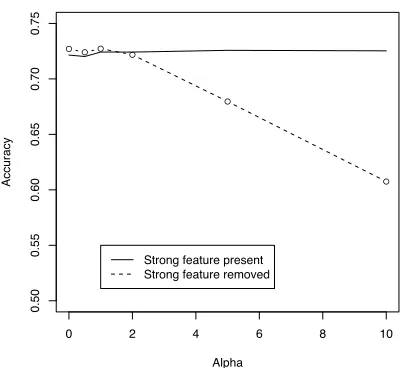
Figure 1: Effect of a single strong feature drowning out weaker features in logistic regression on synthetic data. Thex-axis indicates the strength of the strong feature. In
the top line, the strong feature is present at training and test time. In the bottom line, the strong feature is missing from the training data at test time.
depending on the entire input sequence.) Feature func-tions can be arbitrary. For example, a feature function
fk(yt−1, yt,x, t)could be a binary test that has value 1 if
and only ifyt−1has the label “adjective”,ythas the label
“proper noun”, andxtbegins with a capital letter. Linear-chain CRFs correspond to finite state machines, and can be roughly understood as conditionally-trained hidden Markov models (HMMs). This class of CRFs is also a globally-normalized extension toMaximum En-tropy Markov Models(McCallum et al., 2000) that avoids the label bias problem (Lafferty et al., 2001).
Note that the number of state sequences is exponential in the input sequence lengthT. In linear-chain CRFs, the partition functionZ(x), the node marginalsp(yi|x), and the Viterbi labeling can be calculated efficiently by vari-ants of the dynamic programming algorithms for HMMs.
3 Weight Undertraining
(Linear-chain conditional random fields are the generalization of logistic regression to sequence data.)
Consider random variablesx1. . . xn, each distributed
as independent standard normal variables. The output
y is a binary variable whose probability depends on all
the xi; specifically, we define its distribution as y ∼ Bernoulli(logit("ixi)). The correct decision boundary
in this synthetic problem is the hyperplane tangent to the weight vector(1,1, . . . ,1). Thus, ifnis large, eachxi
contributes weakly to the outputy. Finally, we include a highly indicative feature xS = α"ixi +N(µ =
0, σ2 = 0.04). This variable alone is sufficient to
deter-mine the distribution ofy. The variableαis a parameter of the problem that determines how strongly indicative
xS is; specifically, whenα = 0, the variablexS is
ran-dom noise.
We choose this synthetic model by analogy to Pomer-leau’s observations. The xi correspond to the side of
the road in Pomerleau’s case—the weak features present at both testing and training—andxS corresponds to the
ditch—the strongly indicative feature that is corrupted at test time.
We examine how badly the learned classifier is de-graded when xS feature is present at training time but
missing at test time. For several values of the weight pa-rameterα, we train a regularized logistic regression
clas-sifier on 1000 instances withn= 10weak variables. In
Figure 1, we show how the amount of error caused by ablatingxS at test time varies according to the strength of xS. Each point in Figure 1 is averaged over 100 randomly-generated data sets. When xS is weakly in-dicative, it does not affect the predictions of the model at all, and the classifier’s performance is the same whether it appears at test time or not. WhenxSbecomes strongly
indicative, however, the classifier learns to depend on it, and performs much more poorly whenxSis ablated, even
though exactly the same information is available in the weak features.
4 Feature Bagging
In this section, we describe the feature bagging method. We divide the set of features F = {fk} into a collec-tion of possibly overlapping subsetsF ={F1, . . . FM},
which we callfeature bags. We train individual CRFs on each of the feature bags using standard MAP training, yielding individual CRFs{p1, . . . pM}.
We average the individual CRFs into a single com-bined model. This averaging can be performed in several ways: we can average probabilities of entire sequences, or of individual transitions; and we can average using the arithmetic mean, or the geometric mean. This yields four combination methods:
1. Per-sequence mixture. The distribution over label
sequencesygiven inputsxis modeled as a mixture of the individual CRFs. Given nonnegative weights {α1, . . . αm}that sum to 1, the combined model is
given by
pSM(y|x) =
M
%
i=1
αipi(y|x). (3)
It is easily seen that if the sequence model is de-fined as in Equation 3, then the pairwise marginals are mixtures as well:
pSM(yt, yt−1|x) = M
%
i=1
αipi(yt, yt−1|x). (4)
The probabilities pi(yt, yt−1|x) are pairwise
marginal probabilities in the individual mod-els, which can be efficiently computed by the forward-backward algorithm.
We can perform decoding in the mixture model by maximizing the individual node marginals. That is, to predictytwe compute
yt∗= arg maxy
t
pSM(yt|x) = arg max
yt
%
i
αipi(yt|x),
(5) where pi(yt|x) is computed by first running forward-backward on each of the individual CRFs. In the results here, however, we compute the maximum probability sequence approximately, as follows. We form a linear-chain distribution
pAPPX(y|x) = #tpSM(yt|yt−1,x), and compute the
most probable sequence according topAPPX by the Viterbi algorithm. This is approximate becausepSM is not a linear-chain distribution in general, even when all the components are. However, the dis-tribution pAPPX does minimize the KL-divergence
D(pSM"q)over all linear-chain distributionsq. The mixture weights can be selected in a variety of ways, including equal voting, as in traditional bag-ging, or EM.
2. Per-sequence product of experts.These are the log-arithmic opinion pools that have been applied to CRFs by (Smith et al., 2005). The distribution over label sequences y given inputs x is modeled as a product of experts (Hinton, 2000). In a product of experts, instead of summing the probabilities from the individual models, we multiply them together. Essentially we take a geometric mean instead of an arithmetic mean. Given nonnegative weights {α1, . . . αm}that sum to 1, the product model is
p(y|x)∝ M
!
i=1
The combined model can also be viewed as a condi-tional random field whose features are the log prob-abilities from the original models:
p(y|x)∝exp
'M %
i=1
αilogpi(y|x)
(
(7)
By substituting in the CRF definition, it can be seen that the model in Equation 7 is simply a single CRF whose parameters are a weighted average of the original parameters. So feature bagging using the product method does not increase the family of mod-els that are considered: standard training of a single CRF on all available features could potentially pick the same parameters as the bagged model.
Nevertheless, in Section 5, we show that this feature bagging method performs better than standard CRF training.
The previous two combination methods combine the individual models by averaging probabilities of en-tire sequences. Alternatively, in a sequence model we can average probabilities of individual transitions
pi(yt|yt−1,x). Computing these transition
proba-bilities requires performing probabilistic inference in each of the original CRFs, because pi(yt|yt−1,x) =
"
y\yt,yt+1p(y|yt−1,x).
This yields two other combination methods:
3. Per-transition mixture. The transition probabilities are modeled as
pTM(yt|yt−1,x) = M
%
i=1
αipi(yt|yt−1,x) (8)
Intuitively, the difference between per-sequence and per-transition mixtures can be understood genera-tively. In order to generate a label sequenceygiven an input x, the per-sequence model selects a mix-ture component, and then generates y using only that component. The per-transition model, on the other hand, selects a component, generatesy1from
that component, selects another component, gener-atesy2from the second component giveny1, and so
on.
4. Per-transition product of experts. Finally, we can combine the transition distributions using a product model
pSP(yt|yt−1,x)∝ M
!
i=1
p(yt|yt−1,x)αi (9)
Each transition distribution is thus—similarly to the per-sequence case—an exponential-family distribu-tion whose features are the log transidistribu-tion proba-bilities from the individual models. Unlike the
per-sequence product, there is no weight-averaging trick here, because the probabilities p(yt|yt−1,x)
are marginal probabilities.
Considered as a sequence distribution p(y|x),
the per-transition product is a locally-normalized maximum-entropy Markov model (McCallum et al., 2000). It would not be expected to suffer from label bias, however, because each of the features take the future into account; they are marginal probabilities from CRFs.
Of these four combination methods, Method 2, the per-sequence product of experts, is originally due to Smith et al. (2005). The other three combination methods are as far as we know novel. In the next section, we compare the four combination methods on several sequence label-ing tasks. Although for concreteness we describe them in terms of sequence models, they may be generalized to arbitrary graphical structures.
5 Results
We evaluate feature bagging on two natural language tasks, named entity recognition and noun-phrase chunk-ing. We use the standard CoNLL 2003 English data set, which is taken from Reuters newswire and consists of a training set of 14987 sentences, a development set of 3466 sentences, and a testing set of 3684 sentences. The named-entity labels in this data set corresponding to peo-ple, locations, organizations and other miscellaneous en-tities. Our second task is noun-phrase chunking. We use the standard CoNLL 2000 data set, which consists of 8936 sentences for training and 2012 sentences for test-ing, taken from Wall Street Journal articles annotated by the Penn Treebank project. Although the CoNLL 2000 data set is labeled with other chunk types as well, here we use only the NP chunks.
As is standard, we compute precision and recall for both tasks based upon the chunks (or named entities for CoNLL 2003) as
P= # correctly labeled chunks
# labeled chunks
R= # correctly labeled chunks
# actual chunks
We report the harmonic mean of precision and recall as
F1= (2P R)/(P+R).
sets, we trained the individual CRFs with a Gaussian prior on parameters with varianceσ2= 10.
For the named entity task, we use two feature bags based upon character ngrams and lexicons. Both bags contain a set of baseline features, such as word identity and regular expressions (Table 4). The ngram CRF in-cludes binary features for character ngrams of length 2, 3, and 4 and word prefixes and suffixes of length 2, 3, and 4. The lexicon CRF includes membership features for a variety of lexicons containing people names, places, and company names. The combined model has 2,342,543 features. The mixture weightαis selected using the de-velopment set.
For the chunking task, the two feature sets are selected based upon part of speech and lexicons. Again, a set of baseline features are used, similar to the regular expres-sions and word identity features used on the named entity task (Table 4). The first bag also includes part-of-speech tags generated by the Brill tagger and the conjunctions of those tags used by Sha and Pereira (2003). The second bag uses lexicon membership features for lexicons con-taining names of people, places, and organizations. In ad-dition, we use part-of-speech lexicons generated from the entire Treebank, such as a list of all words that appear as nouns. These lists are also used by the Brill tagger (Brill, 1994). The combined model uses 536,203 features. The mixture weightα is selected using 2-fold cross
valida-tion. The chosen model had weight0.55on the lexicon
model, and weight0.45on the ngram model.
In both data sets, the bagged model performs better than the single CRF trained with all of the features. For the named entity task, bagging improves performance from85.45%to86.61%, with a substantial error
reduc-tion of8.32%. This is lower than the best reported results for this data set, which is89.3%(Ando and Zhang, 2005), using a large amount of unlabeled data. For the chunking task, bagging improved the performance from94.34%to
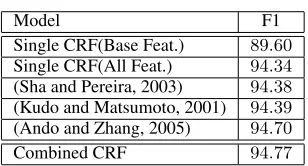
94.77%, with an error reduction of7.60%. In both data sets, the improvement is statistically significant (McNe-mar’s test;p <0.01).
On the chunking task, the bagged model also outper-forms the models of Kudo and Matsumoto (2001) and Sha and Pereira (2003), and equals the currently-best re-sults of (Ando and Zhang, 2005), who use a large amount of unlabeled data. Although we use lexicons that were not included in the previous models, the additional fea-tures actually do not help the original CRF. Only with feature bagging do these lexicons improve performance.
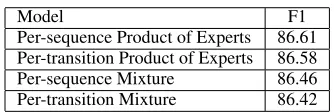
Finally, we compare the four bagging methods of Sec-tion 4: pre-transiSec-tion mixture, pre-transiSec-tion product of experts, and per-sequence mixture. On the named en-tity data, all four models perform in a statistical tie, with no statistically significant difference in their performance (Table 1). As we mentioned in the last section, the
de-Model F1
[image:5.612.343.510.57.113.2]Per-sequence Product of Experts 86.61 Per-transition Product of Experts 86.58 Per-sequence Mixture 86.46 Per-transition Mixture 86.42
Table 1: Comparison of various bagging methods on the CoNLL 2003 Named Entity Task.
Model F1
Single CRF(Base Feat.) 81.52
Single CRF(All Feat.) 85.45
Combined CRF 86.61
Table 2: Results for the CoNLL 2003 Named Entity Task. The bagged CRF performs significantly better than a single CRF with all available features (McNemar’s test;
p <0.01).
coding procedure for the per-sequence mixture is approx-imate. It is possible that a different decoding procedure, such as maximizing the node marginals, would yield bet-ter performance.
6 Previous Work
In the machine learning literature, there is much work on ensemble methods such as stacking, boosting, and bag-ging. Generally, the ensemble of classifiers is generated by training on different subsets of data, rather than dif-ferent features. However, there is some literature within unstructured classified on combining models trained on feature subsets. Ho (1995) creates an ensemble of de-cision trees by randomly choosing a feature subset on which to grow each tree using standard decision tree learners. Other work along these lines include that of Bay (1998) using nearest-neighbor classifiers, and more re-cently Bryll et al (2003). Also, in Breiman’s work on ran-dom forests (2001), ensembles of ranran-dom decision trees are constructed by choosing a random feature at each node. This literature mostly has the goal of improving accuracy by reducing the classifier’s variance, that is, re-ducing overfitting.
Model F1 Single CRF(Base Feat.) 89.60
Single CRF(All Feat.) 94.34
(Sha and Pereira, 2003) 94.38
(Kudo and Matsumoto, 2001) 94.39
(Ando and Zhang, 2005) 94.70
[image:6.612.109.263.55.138.2]Combined CRF 94.77
Table 3: Results for the CoNLL 2000 Chunking Task. The bagged CRF performs significantly better than a sin-gle CRF (McNemar’s test;p <0.01), and equals the re-sults of (Ando and Zhang, 2005), who use a large amount of unlabeled data.
wt=w
wtbegins with a capital letter
wtcontains only capital letters
wtis a single capital letter
wtcontains some capital letters and some lowercase
wtcontains a numeric character
wtcontains only numeric characters
wtappears to be a number
wtis a string of at least two periods
wtends with a period
wtcontains a dash
wtappears to be an acronym
wtappears to be an initial
wtis a single letter
wtcontains punctuation
wtcontains quotation marks
Pt=P
All features for timet+δfor allδ∈[−2,2]
Table 4: Baseline features used in all bags. In the above
wtis the word at positiont,Ptis the POS tag at position
t, w ranges over all words in the training data, and P
ranges over all chunk tags supplied in the training data. The “appears to be” features are based on hand-designed regular expressions.
There is less work on ensembles of sequence models, as opposed to unstructured classifiers. One example is Altun, Hofmann, and Johnson (2003), who describe a boosting algorithm for sequence models, but they boost instances, not features. In fact, the main advantage of their technique is increased model sparseness, whereas in this work we aim to fully usemorefeatures to increase accuracy and robustness.
Most closely related to the present work is that on log-arithmic opinion pools for CRFs (Smith et al., 2005), which we have called per-sequence mixture of experts in this paper. The previous work focuses on reducing over-fitting, combining a model of many features with several simpler models. In contrast, here we apply feature bag-ging to reduce feature undertraining, combining several models with complementary feature sets. Our current positive results are probably not due to reduction in
over-fitting, for as we have observed, all the models we test, including the bagged one, have 99.9% F1 on the train-ing set. Now, feature undertraintrain-ing can be viewed as a type of overfitting, because it arises when a set of fea-tures is more indicative in the training set than the test-ing set. Understandtest-ing this particular type of overfitttest-ing is useful, because it motivates the choice of feature bags that we explore in this work. Indeed, one contribution of the present work is demonstrating how a careful choice of feature bags can yield state-of-the-art performance.
Concurrently and independently, Smith and Osborne (2006) present similar experiments on the CoNLL-2003 data set, examining a per-sequence mixture of experts (that is, a logarithmic opinion pool), in which the lexi-con features are trained separately. Their work presents more detailed error analysis than we do here, while we present results both on other combination methods and on NP chunking.
7 Conclusion
Discriminatively-trained probabilistic models have had much success in applications because of their flexibil-ity in defining features, but sometimes even highly-indicative features can fail to increase performance. We have shown that this can be due to feature undertrain-ing, where highly-indicative features prevent training of many weaker features. One solution to this is feature bag-ging: repeatedly selecting feature subsets, training sepa-rate models on each subset, and averaging the individual models.
On large, real-world natural-language processing tasks, feature bagging significantly improves perfor-mance, even with only two feature subsets. In this work, we choose the subsets based on our intuition of which features are complementary for this task, but automati-cally determining the feature subsets is an interesting area for future work.
Acknowledgments
[image:6.612.84.289.219.403.2]References
Yasemin Altun, Thomas Hofmann, and Mark Johnson. 2003. Discriminative learning for label sequences via boosting. InAdvances in Neural Information Process-ing Systems (NIPS*15).
Rie Ando and Tong Zhang. 2005. A high-performance semi-supervised learning method for text chunking. In
Proceedings of the 43rd Annual Meeting of the Asso-ciation for Computational Linguistics (ACL’05), pages 1–9, Ann Arbor, Michigan, June. Association for Com-putational Linguistics.
Stephen D. Bay. 1998. Combining nearest neighbor classifiers through multiple feature subsets. InICML ’98: Proceedings of the Fifteenth International Con-ference on Machine Learning, pages 37–45. Morgan Kaufmann Publishers Inc.
Leo Breiman. 2001. Random forests. Machine Learn-ing, 45(1):5–32, October.
Eric Brill. 1994. Some advances in transformation-based part of speech tagging. In AAAI ’94: Proceedings of the twelfth national conference on Artificial intelli-gence (vol. 1), pages 722–727. American Association for Artificial Intelligence.
Robert Bryll, Ricardo Gutierrez-Osuna, and Francis Quek. 2003. Attribute bagging: improving accuracy of classifier ensembles by using random feature sub-sets.Pattern Recognition, 36:1291–1302.
Hai Leong Chieu and Hwee Tou Ng. 2003. Named en-tity recognition with a maximum entropy approach. In Walter Daelemans and Miles Osborne, editors, Pro-ceedings of CoNLL-2003, pages 160–163. Edmonton, Canada.
Radu Florian, Abe Ittycheriah, Hongyan Jing, and Tong Zhang. 2003. Named entity recognition through clas-sifier combination. InProceedings of CoNLL-2003.
G.E. Hinton. 2000. Training products of experts by mini-mizing contrastive divergence. Technical Report 2000-004, Gatsby Computational Neuroscience Unit.
T. K. Ho. 1995. Random decision forests. InProc. of the 3rd Int’l Conference on Document Analysis and Recognition, pages 278–282, Montreal, Canada, Au-gust.
T. Kudo and Y. Matsumoto. 2001. Chunking with sup-port vector machines. InProceedings of NAACL-2001.
J. Lafferty, A. McCallum, and F. Pereira. 2001. Con-ditional random fields: Probabilistic models for seg-menting and labeling sequence data. Proc. 18th Inter-national Conf. on Machine Learning.
Andrew McCallum, Dayne Freitag, and Fernando Pereira. 2000. Maximum entropy Markov models for information extraction and segmentation. InProc. 17th International Conf. on Machine Learning, pages 591–598. Morgan Kaufmann, San Francisco, CA. Joseph O’Sullivan, John Langford, Rich Caruana, and
Avrim Blum. 2000. Featureboost: A meta learning algorithm that improves model robustness. In Interna-tional Conference on Machine Learning.
Dean Pomerleau. 1995. Neural network vision for robot driving. In M. Arbib, editor,The Handbook of Brain Theory and Neural Networks.
Fei Sha and Fernando Pereira. 2003. Shallow pars-ing with conditional random fields. In Proceedings of HLT-NAACL 2003. Association for Computational Linguistics.
Andrew Smith and Miles Osborne. 2006. Using gazetteers in discriminative information extraction. In
CoNLL-X, Tenth Conference on Computational Natu-ral Language Learning.
Andrew Smith, Trevor Cohn, and Miles Osborne. 2005. Logarithmic opinion pools for conditional random fields. In Proceedings of the 43rd Annual Meet-ing of the Association for Computational LMeet-inguistics (ACL’05), pages 18–25, Ann Arbor, Michigan, June. Association for Computational Linguistics.
Charles Sutton and Andrew McCallum. 2006. An in-troduction to conditional random fields for relational learning. In Lise Getoor and Ben Taskar, editors, Intro-duction to Statistical Relational Learning. MIT Press. To appear.
Ben Taskar, Dan Klein, Michael Collins, Daphne Koller, and Chris Manning. 2004. Max-margin parsing. In
Empirical Methods in Natural Language Processing (EMNLP04).