Compositional Distributional Semantics Models
in Chunk-based Smoothed Tree Kernels
Nghia The PhamUniversity of Trento
Lorenzo Ferrone
University of Rome “Tor Vergata”
Fabio Massimo Zanzotto University of Rome “Tor Vergata”
Abstract
The field of compositional distributional semantics has proposed very interesting and reliable models for accounting the distributional meaning of simple phrases. These models however tend to disregard the syntactic structures when they are ap-plied to larger sentences. In this paper we propose the chunk-based smoothed tree kernels (CSTKs) as a way to exploit the syntactic structures as well as the reliabil-ity of these compositional models for sim-ple phrases. We experiment with the rec-ognizing textual entailment datasets. Our experiments show that our CSTKs per-form better than basic compositional dis-tributional semantic models (CDSMs) re-cursively applied at the sentence level, and also better than syntactic tree kernels. 1 Introduction
A clear interaction between syntactic and semantic interpretations for sentences is important for many high-level NLP tasks, such as question-answering, textual entailment recognition, and semantic tex-tual similarity. Systems and models for these tasks often use classifiers or regressors that exploit con-volution kernels (Haussler, 1999) to model both interpretations.
Convolution kernels are naturally defined on spaces where there exists a similarity function be-tween terminal nodes. This feature has been used to integrate distributional semantics within tree kernels. This class of kernels is often referred to as
smoothed tree kernels(Mehdad et al., 2010; Croce et al., 2011), yet, these models only use distribu-tional vectors for words.
Compositional distributional semantics models (CDSMs) on the other hand are functions map-ping text fragments to vectors (or higher-order ten-sors) which then provide a distributional meaning
for simple phrases or sentences. Many CDSMs have been proposed for simple phrases like non-recursive noun phrases or verbal phrases (Mitchell and Lapata, 2008; Baroni and Zamparelli, 2010; Clark et al., 2008; Grefenstette and Sadrzadeh, 2011; Zanzotto et al., 2010). Non-recursive phrases are often referred to as chunks (Abney, 1996), and thus, CDSMs are good and reliable models for chunks.
In this paper, we present the chunk-based smoothed tree kernels(CSTK) as a way to merge the two approaches: the smoothed tree kernels and the models for compositional distributional se-mantics. Our approach overcomes the limitation of the smoothed tree kernels which only use vec-tors for words by exploiting reliable CDSMs over chunks. CSTKs are defined over a chunk-based syntactic subtrees where terminal nodes are words or word sequences. We experimented with CSTKs on data from the recognizing textual entailment challenge (Dagan et al., 2006) and we compared our CSTKs with other standard tree kernels and standard recursive CDSMs. Experiments show that our CSTKs perform better than basic compo-sitional distributional semantic models (CDSMs) recursively applied at the sentence level and better than syntactic tree kernels.
The rest of the paper is organized as follows. Section 2 describes the CSTKs. Section 3 ports on the experimental setting and on the re-sults. Finally, Section 4 draws the conclusions and sketches the future work.
2 Chunk-based Smoothed Tree Kernels
This section describes the new class of kernels. We first introduce the notion of the chunk-based syntactic subtree. Then, we describe the recursive formulation of the class of kernels. Finally, we in-troduce the basic CDSMs we use and we inin-troduce two instances of the class of kernels.
2.1 Notation and preliminaries S hhhhh ( ( ( ( ( NP XXXX DT the:d NN rock:n NN band:n VP XXXX VBZ holds:v NP XXXX PRP its:p JJ final:j NN concert:n Figure 1: Sample Syntactic Tree
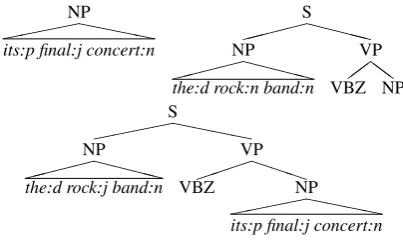
AChunk-based Syntactic Sub-Treeis a subtree of a syntactic tree where each non-terminal node dominating a contiguous word sequence is col-lapsed into a chunk and, as usual in chunks (Ab-ney, 1996), the internal structure is disregarded. For example, Figure 2 reports some chunk-based syntactic subtrees of the tree in Figure 1. Chunks are represented with a pre-terminal node dominat-ing a triangle that covers a word sequence. The first subtree represents the chunk covering the sec-ond NP and the node dominates the word sequence
its:d final:n concert:n. The second subtree repre-sents the structure of the whole sentence and one chunk, that is the first NP dominating the word sequence the:d rock:n band:n. The third subtree again represents the structure of the whole sen-tence split into two chunks without the verb.
NP
```` its:p final:j concert:n
S XXXX NP XXXX
the:d rock:n band:n
VP ZZ VBZ NP S ```` NP XXXX
the:d rock:j band:n
[image:2.595.79.281.461.581.2]VP PPP VBZ NP ```` its:p final:j concert:n Figure 2: Some Chunk-based Syntactic Sub-Trees of the tree in Figure 1
In the following sections, generic trees are de-noted with the lettertandN(t)denotes the set of non-terminal nodes of tree t. Each non-terminal noden∈N(t)has a labelsnrepresenting its
syn-tactic tag. As usual for constituency-based parse trees, pre-terminal nodes are nodes that have a sin-gle terminal node as child. Terminal nodes of trees are words denoted withw:poswherew is the ac-tual token andposis its postag. The structure of these trees is represented as follows. Given a tree
t,ci(n)denotesi-th child of a nodenin the set of
nodesN(t). The production rule headed in node nisprod(n), that is, given the nodenwithm chil-dren,prod(n)is:
prod(n) =sn→sc1(n). . . scm(n)
Finally, for a node nin N(t), the function d(n)
generates the word sequence dominated by the non-terminal node n in the tree t. For example,
d(VP)in Figure 1 isholds:v its:p final:j concert:n.
Chunk-based Syntactic Sub-Trees (CSSTs) are instead denoted with the letter τ. Differently from trees t, CSSTs have terminal nodes that can represent subsequences of words of the original sentence. The explicit syntactic structure of a CSST is the structure not falling in chunks and it is represented ass(τ). For example,s(τ3)is:
S HH NP VP ZZ VBZ NP
whereτ3is the third subtree of Figure 2.
Given a treet, the setS(t)is defined as the set containing all the relevant CSSTs of the tree t. As for the tree kernels (Collins and Duffy, 2002), the setS(t) contains all CSSTs derived from the subtrees of t such that if a node n belongs to a subtreets, all the siblings ofnintbelongs tots.
In other words, productions of the initial subtrees are complete. A CSST is obtained by collapsing in a single terminal nodes a contiguous sequence of words dominated by a single non-terminal node. For example:
NP PPP DT NN HH NN rock:n NN band:n is collapsed into:
NP aaa ! ! ! DT NN:X PPP rock:n band:n
Finally, w→n ∈ Rm represent the distributional
vectors for wordswnandf(w1. . . wk)represents
2.2 Smoothed Tree Kernels on Chunk-based Syntactic Trees
As usual, a tree kernel, although written in a re-cursive way, computes the following general equa-tion:
K(t1, t2) = X
τi∈ S(t1)
τj∈ S(t2)
λ|N(τi)|+|N(τj)|K
F(τi, τj)
(1) In our case, the basic similarity KF(ti, tj) is
de-fined to take into account the syntactic structure and the distributional semantic part. Thus, we de-fine it as follows in line with what done with sev-eral other smoothed tree kernels:
KF(τi, τj) =δ(s(τi),s(τj))
Y
a∈P T(τi)
b∈P T(τj)
hf(a), f(b)i
where δ(s(τi),s(τj)) is the Kroneker’s delta
function between the the structural part of two chunk-based syntactic subtrees, P T(τ) are the nodes in τ directly covering a chunk or a word, and h→x,→yi is the cosine similarity between the two vectors →x and →y. For example, given the chunk-based subtreeτ3in Figure 2 and
τ4 =
S
XXXX
NP
XXXX
the:d orchestra:n
VP
aa ! !
VBZ NP
PPP
its:p show:n
the similarity KF(τ3, τ4) is:
hf(the:d orchestra:n), f(the:d rock:n band:n)i · hf(its:p show:n), f(its:p final:j concert:n)i.
The recursive formulation of the Chunk-based Smoothed Tree Kernel (CSTK) is a bit more com-plex but very similar to the recursive formulation of the syntactic tree kernels:
K(t1, t2) =
X
n1∈N(t1)
n2∈N(t2)
C(n1, n2) (2)
whereC(n1, n2) =
hf(d(n1)), f(d(n2))i iflabel(n1)=label(n2) andprod(n1)6=prod(n2)
hf(d(n1)), f(d(n2))i
+Qnc(n1)
j=1 (1 +C(cj(n1), cj(n2)))
−Qnc(n1)
j=1 hf(d(cj(n1))), f(d(cj(n2)))i ifn1, n2 are not pre-terminals and
prod(n1) =prod(n2)
0 otherwise
where nc(n1) is the lenght of the production prod(n1).
2.3 Compositional Distributional Semantic Models and two Specific CSTKs
To define specific CSTKs, we need to introduce the basic compositional distributional semantic models (CDSMs). We use two CDSMs: the Ba-sic Additive model (BA) and teh Full Additive model (FA). We thus define two specific CSTKs: the CSTK+BA that is based on the basic additive model and the CSTK+FA that is based on the full additive model. We describe the two CDSMs in the following.
The Basic Additive model (BA) (introduced in (Mitchell and Lapata, 2008)) computes the disti-butional semantics vector of a pair of wordsa =
a1a2 as:
ADD(a1, a2) =αa→1+βa→2
where α and β weight the first and the second word of the pair. The basic additive model for word sequencess = w1. . . wk is recursively
de-fined as follows:
fBA(s) =
(→
w1 ifk= 1
αw→1+βfBA(w2. . . wk) ifk >1
The Full Additive model (FA) (used in (Gue-vara, 2010) for adjective-noun pairs and (Zanzotto et al., 2010) for three different syntactic relations) computes the compositional vector→a of a pair us-ing two linear tranformationsARandBR
respec-tively applied to the vectors of the first and the second word. These matrices generally only de-pends on the syntactic relationR that links those two words. The operation follows:
RR RRTWS
RTE1 RTE2 RTE3 RTE5 Average RTE1 RTE2 RTE3 RTE5 Average
Add 0.541 0.496 0.507 0.520 0.516 0.560 0.538 0.643 0.578 0.579
FullAdd 0.512 0.516 0.507 0.569 0.526 0.571 0.608 0.643 0.643 0.616
TK 0.561 0.552 0.531 0.54 0.546 0.608 0.627 0.648 0.630 0.628
CSTK+BA 0.553 0.545 0.562 0.568 0.557† 0.626 0.616 0.648 0.628 0.629†
[image:4.595.73.288.269.376.2]CSTK+FA 0.543 0.550 0.574 0.576 0.560† 0.628 0.616 0.652 0.630 0.631†
Table 1: Task-based analysis: Accuracy on Recognizing Textual Entailment (†is different from both ADD and FullADD with a stat.sig. ofp >0.1.)
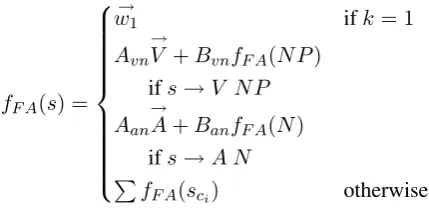
The full additive model for word sequences s =
w1. . . wk, whose node has a production rules→
sc1. . . scmis also defined recursively:
fF A(s) =
→
w1 ifk= 1
Avn
→
V +BvnfF A(NP)
ifs→V NP Aan
→
A+BanfF A(N)
ifs→A N P
fF A(sci) otherwise
where Avn, Bvn are matrices used for verb and
noun phrase interaction, andAan, Banare used for
adjective, noun interaction.
3 Experimental Investigation
3.1 Experimental set-up
We experimented with the Recognizing Textual Entailment datasets (RTE) (Dagan et al., 2006). RTE is the task of deciding whether a long text T entails a shorter text, typically a single sen-tence, called hypothesisH. It has been often seen as a classification task (see (Dagan et al., 2013)). We used four datasets: RTE1, RTE2, RTE3, and RTE5, with the standard split between training and testing. The dev/test distribution for RTE1-3, and RTE5 is respectively 567/800, 800/800, 800/800, and 600/600 T-H pairs.
Distributional vectors are derived with DISSECT (Dinu et al., 2013) from a cor-pus obtained by the concatenation of ukWaC (wacky.sslmit.unibo.it), a mid-2009 dump of the English Wikipedia (en.wikipedia.org) and the British National Corpus (www.natcorp.ox.ac.uk), for a total of about 2.8 billion words. We collected a 35K-by-35K matrix by counting co-occurrence of the 30K most frequent content lemmas in the corpus (nouns, adjectives and verbs) and all the content lemmas occurring in the datasets
within a 3 word window. The raw count vectors were transformed into positive Pointwise Mutual Information scores and reduced to 300 dimensions by Singular Value Decomposition. This setup was picked without tuning, as we found it effective in previous, unrelated experiments.
We built the matrices for the full additive mod-els using the procedure described in (Guevara, 2010). We considered only two relations: the Adjective-Noun and Verb-Noun. The full addi-tive model falls back to the basic additional model when syntactic relations are different from these two.
To build the final kernel to learn the clas-sifier, we followed standard approaches (Dagan et al., 2013), that is, we exploited two models: a model with only a rewrite rule feature space (RR) and a model with the previous space along with a token-level similarity feature (RRTWS). The two models use our CSTKs and the stan-dard TKs in the following way as kernel func-tions: (1) RR(p1, p2) = κ(ta1, ta2) + κ(tb1, tb2); (2) RRT W S(p1, p2) = κ(ta1, ta2) + κ(tb1, tb2) +
(T W S(a1, b1)·T W S(a2, b2) + 1)2whereT W S is a weighted token similarity (as in (Corley and Mihalcea, 2005)).
3.2 Results
the constituency-based tree representation of the tree, without the intervening collapsing step de-scribed in 2.2. These three models are the base-line against which we compare the CSTK models where the collapsing procedure is done via Basic Additive (CSTK + BA, again withα=β = 1) and FullAdditive (CSTK + FA), as described in sec-tion 2.2, again, with the aforemensec-tioned restric-tion on the relarestric-tion considered. For RR models we have that CSTK+BA and CSTK+FA both achieve higher accuracy than ADD and FullAdd, with a statistical significante greater than93.7%, as com-puted with the sign test. Specifically we have that CSTK+BA has an average accuracy7.94%higher than ADD and5.89%higher than FullADD, while CSTK+FA improves on ADD and FullADD by
8.52%and6.46%, respectively. The same trend is visible for the RRTS model, again both models are statistically better than ADD and FullADD, in this case we have that CSTK+BA is 8.63%more ac-curate then ADD and2.11%more than FullADD, CSTK+FA is respectively8.98%and2.43%more accurate than ADD and FullADD. As for the TK models we have that both CSTK models achieve again an higher average accuracy: for RR models CSTK+BA and CSTK+FA are respectively2.01%
and0.15%better than TK, while for RRTS models the number are 2.54% and0.47%. These results though are not statistically significant, as is the difference between the two CSTK models them-selves.
4 Conclusions and Future Work
In this paper, we introduced a novel sub-class of the convolution kernels in order exploit reli-able compositional distributional semantic mod-els along with the syntactic structure of sen-tences. Experiments show that this novel sub-class, namely, the Chunk-based Smoothed Tree Kernels (CSTKs), are a promising solution, per-forming significantly better than a naive recursive application of the compositional distributional se-mantic models. We experimented with CSTKS equipped with the basic additive and the full addi-tive CDSMs but these kernels are definitely open to all the CDSMs.
Acknowledgments
We acknowledge ERC 2011 Starting Independent Research Grant n. 283554 (COMPOSES).
References
Steven Abney. 1996. Part-of-speech tagging and par-tial parsing. In G.Bloothooft K.Church, S.Young, editor, Corpus-based methods in language and speech. Kluwer academic publishers, Dordrecht.
Marco Baroni and Roberto Zamparelli. 2010. Nouns are vectors, adjectives are matrices: Representing adjective-noun constructions in semantic space. In
Proceedings of the 2010 Conference on Empirical Methods in Natural Language Processing, pages 1183–1193, Cambridge, MA, October. Association for Computational Linguistics.
Stephen Clark, Bob Coecke, and Mehrnoosh Sadrzadeh. 2008. A compositional distributional model of meaning. Proceedings of the Second Symposium on Quantum Interaction (QI-2008), pages 133–140.
Michael Collins and Nigel Duffy. 2002. New rank-ing algorithms for parsrank-ing and taggrank-ing: Kernels over discrete structures, and the voted perceptron. In Pro-ceedings of ACL02.
Courtney Corley and Rada Mihalcea. 2005. Measur-ing the semantic similarity of texts. InProc. of the ACL Workshop on Empirical Modeling of Seman-tic Equivalence and Entailment, pages 13–18. As-sociation for Computational Linguistics, Ann Arbor, Michigan, June.
Danilo Croce, Alessandro Moschitti, and Roberto Basili. 2011. Structured lexical similarity via con-volution kernels on dependency trees. In Proceed-ings of the Conference on Empirical Methods in Natural Language Processing, EMNLP ’11, pages 1034–1046, Stroudsburg, PA, USA. Association for Computational Linguistics.
Ido Dagan, Oren Glickman, and Bernardo Magnini. 2006. The pascal recognising textual entailment challenge. In Quionero-Candela et al., editor,
LNAI 3944: MLCW 2005, pages 177–190. Springer-Verlag, Milan, Italy.
Ido Dagan, Dan Roth, Mark Sammons, and Fabio Mas-simo Zanzotto. 2013. Recognizing Textual Entail-ment: Models and Applications. Synthesis Lectures on Human Language Technologies. Morgan & Clay-pool Publishers.
Georgiana Dinu, Nghia The Pham, and Marco Baroni. 2013. DISSECT: DIStributional SEmantics Com-position Toolkit. In Proceedings of ACL (System Demonstrations), pages 31–36, Sofia, Bulgaria.
Emiliano Guevara. 2010. A regression model of adjective-noun compositionality in distributional se-mantics. In Proceedings of the 2010 Workshop on GEometrical Models of Natural Language Seman-tics, pages 33–37, Uppsala, Sweden, July. Associa-tion for ComputaAssocia-tional Linguistics.
David Haussler. 1999. Convolution kernels on discrete structures. Technical report, University of Califor-nia at Santa Cruz.
Yashar Mehdad, Alessandro Moschitti, and Fabio Mas-simo Zanzotto. 2010. Syntactic/semantic struc-tures for textual entailment recognition. InHuman Language Technologies: The 2010 Annual Confer-ence of the North American Chapter of the Associa-tion for ComputaAssocia-tional Linguistics, HLT ’10, pages 1020–1028, Stroudsburg, PA, USA. Association for Computational Linguistics.
Jeff Mitchell and Mirella Lapata. 2008. Vector-based models of semantic composition. In Proceedings of ACL-08: HLT, pages 236–244, Columbus, Ohio, June. Association for Computational Linguistics. Fabio Massimo Zanzotto, Ioannis Korkontzelos,