UWB: Machine Learning Approach to Aspect-Based Sentiment Analysis
Tom´aˇs Brychc´ınNTIS – New Technologies for the Information Society, Faculty of Applied Sciences, University of West Bohemia, Univerzitn´ı 8, 306 14 Plzeˇn
Czech Republic [email protected]
Michal Konkol NTIS – New Technologies for the Information Society, Faculty of Applied Sciences, University of West Bohemia, Univerzitn´ı 8, 306 14 Plzeˇn
Czech Republic [email protected]
Josef Steinberger Department of Computer Science and Engineering, Faculty of Applied Sciences, University of West Bohemia, Univerzitn´ı 8, 306 14 Plzeˇn
Czech Republic [email protected] Abstract
This paper describes our system partici-pating in the aspect-based sentiment anal-ysis task of Semeval 2014. The goal was to identify the aspects of given tar-get entities and the sentiment expressed to-wards each aspect. We firstly introduce a system based on supervised machine learning, which is strictly constrained and uses the training data as the only source of information. This system is then ex-tended by unsupervised methods for latent semantics discovery (LDA and semantic spaces) as well as the approach based on sentiment vocabularies. The evaluation was done on two domains, restaurants and laptops. We show that our approach leads to very promising results.
1 Introduction
The majority of current sentiment analysis ap-proaches tries to detect the overall polarity of a sentence (or a document) regardless of the target entities (e.g. restaurants) and their aspects (e.g. food, price). By contrast, the ABSA (aspect based sentiment analysis) task is concerned with identi-fying the aspects of given target entities and esti-mating the sentiment polarity for each mentioned aspect.
The aspect scenario can be decomposed into two tasks: aspect extraction and aspect sentiment classification (Liu, 2012).
The task of aspect extraction is to recognize aspects of the entity and more generally can be seen as an information extraction task. The ba-sic approach is finding frequent nouns and noun This work is licensed under a Creative Commons At-tribution 4.0 International Licence. Page numbers and pro-ceedings footer are added by the organisers. Licence de-tails: http://creativecommons.org/licenses/ by/4.0/
phrases (Liu et al., 2005; Blair-Goldensohn et al., 2008; Moghaddam and Ester, 2010; Long et al., 2010). Aspect extraction can be also seen as a special case of the general information extrac-tion problem. The most dominant methods are based on sequential learning (e.g. HMM – Hidden Markov Models (Rabiner, 2010) or CRF – Condi-tional Random Fields (Lafferty et al., 2001)). An-other group of methods use topic models (Mei et al., 2007; Titov and McDonald, 2008; Blei et al., 2003).
Aspect sentiment classification determines whether the opinions on different aspects are positive, negative, or neutral. While lexicon-based approaches use a list of aspect-related sentiment phrases as the core resource (Ding et al., 2008; Hu and Liu, 2004), the key issue for learning methods is to determine the scope of each sentiment expression, i.e., whether it covers the aspect in the sentence (Jiang et al., 2011; Boiy and Moens, 2009).
The most of the research in aspect-level senti-ment analysis has been done in English, however, there were some attempts to tackle the aspect-level task in other languages (e.g. in Czech (Steinberger et al., 2014)).
The rest of the article is organized as follows. In Section 2, we summarize the ABSA shared task (Pontiki et al., 2014). Then, we give a description of our participating system (Section 3). In Section 4, we discuss our results in the task. We partic-ipated with both the constrained and the uncon-strained variants of the system.
2 The ABSA task
Datasets consisting of customer reviews with human-authored annotations identifying the men-tioned aspects of the target entities and the senti-ment polarity of each aspect were provided. The experiments were run in two domains: restaurant and laptop reviews.
Each team could submit two versions of sys-tems – constrained and unconstrained. The con-strained system uses only the training data and other resources (such as lexicons) for training. The unconstrained system can use additional data.
We use another definition of these types, which is not against the rules. Our constrained systems are based purely on ABSA training data, with-out any external knowledge such as dictionaries or rules. Our unconstrained systems use additional dictionaries, rule-based extensions and unlabeled data. From our point of view, hand-crafted dictio-naries and rules are external knowledge and thus it is the same as adding external data.
The task consists of the four subtasks.
2.1 Subtask 1: Aspect term extraction
Given a set of sentences with pre-identified enti-ties (restaurants or laptops), the task is to identify the aspect terms present in the sentence and return a list containing all the distinct aspect terms.
I liked the service and the staff, but not the food.
→ {service, staff, food}
2.2 Subtask 2: Aspect term polarity
For a given set of aspect terms within a sentence, the task is to determine the polarity of each aspect term: positive, negative, neutral or conflict (i.e., both positive and negative).
I hated their fajitas, but their salads were great.
→ {fajitas: negative, salads: positive}
2.3 Subtask 3: Aspect category detection Given a predefined set of aspect categories, the task is to identify the aspect categories discussed in a given sentence. Aspect categories are typi-cally coarser than the aspect terms of Subtask 1, and they do not necessarily occur as terms in the given sentence.
For example, the following categories were de-fined for the restaurants’ domain: food, service, price, ambience and anecdotes/miscellaneous.
The restaurant was expensive, but the menu was great.→ {price, food}
2.4 Subtask 4: Aspect category polarity Given a set of pre-identified aspect categories, the task is to determine the polarity (positive, nega-tive, neutral or conflict) of each aspect category.
The restaurant was expensive, but the menu was great.→ {price: negative, food: positive}
3 System description
We use machine learning approach to all subtasks. For aspect term extraction we use CRF. For the other three tasks we use the Maximum Entropy classifier. We use the Brainy (Konkol, 2014) im-plementation of these algorithms.
During the data preprocessing, we use simple word tokenizer based on regular expressions. All tokens are lowercased for tasks 2 and 4.
We will firstly describe all the features used in this paper because the tasks share some of them. These features are then referenced in the descrip-tions of individual subtasks.
Words (W) – Word occurrence on a given posi-tion in the context window.
Bag of Words (BoW) – Occurrence of a word in a sentence (or context window).
Bigrams (B) – Bigram occurrence on a given po-sition in the context window.
Bag of Bigrams (BoB) – Occurrence of a bigram in a sentence (or context window).
Tf-idf – Term frequency–inverse document fre-quency for all tokens in the sentence.
Learned Dictionary (LD) – Dictionary of terms based on training data.
Suffixes (S) – Suffix of a word (2-4 characters).
Sentiment Dictionary (SD) – Dictionary created using semi-automatic triangulation method (Steinberger et al., 2012). The score is nor-malized.
Senti Wordnet (SW) – See (Baccianella et al., 2010).
LDA – See Section 3.1.
Word Clusters (WC) – See Section 3.2. Cluster occurrence on a given position in the context window.
We use two features that are not in common use in similar tasks – Latent Dirichlet Allocation and word clusters based on semantic spaces. Both these features use large amount of unlabeled data to discover latent semantics. We downloaded the restaurant reviews fromhttp://opentable. com. This corpus consists of 409,665 reviews (documents) with about 27 million words. The
opentablecorpus is used as the training data for these features. Unfortunately, we did not find any large corpus for laptop domain, thus presented un-supervised features are used in restaurant domain only.
We devote the following two subsections to de-scribe these features. Then we introduce our ap-proach to the individual tasks.
3.1 Latent Dirichlet Allocation
The Latent Dirichlet Allocation (LDA) (Blei et al., 2003) is a topic model that is assumed to provide useful information for particular subtasks. We use LDA implementation from the MALLET (McCal-lum, 2002) software package. For each experi-ment we always train the 400 topics LDA (no sig-nificant difference was observed between different numbers of topics) with 1,000 iterations of Gibbs sampling. The hyperparameters of Dirichlet dis-tributions were initially set toα = 50/K, where K is the number of topics andβ = 0.1. This set-ting is recommended by (Griffiths and Steyvers, 2004). The topic probabilities are directly used as new features to the classifier.
3.2 Word clusters
We use same approach as presented in (Brychc´ın and Konop´ık, 2014), where word clusters derived from semantic spaces improved language model-ing. As recommended by these authors, we use COALS (Correlated Occurrence Analogue to Lex-ical Semantics) (Rohde et al., 2004) and HAL (Hyperspace Analogue to Language) (Lund and Burgess, 1996) for representing the word mean-ing and the Repeated Bisection algorithm for clus-tering. Similar approach has been already used for sentiment analysis in (Habernal and Brychc´ın, 2013) and (Brychc´ın and Habernal, 2013).
The parameters of semantic spaces are set as follows. For both semantic spaces we use a four-word context window (in both directions). HAL uses a matrix consisting of 50,000 columns, which keeps the largest amount of information. COALS uses a matrix with only 14,000 columns (as
rec-ommended by the authors of the algorithm). The SVD reduction was not used in our experiments.
Implementation of the HAL, COALS algo-rithms is available in an open source package S-Space (Jurgens and Stevens, 2010). For cluster-ing, we use the implementation from the CLUTO software package (Karypis, 2003). As a measure of the similarity between two words, we use the cosine similarity of word vectors.
For both semantic spaces the word vectors are clustered into four different depths: 100, 500, 1,000, and 5,000 clusters (i.e. eight different clus-ter sets). The occurrences of particular clusclus-ters represent additional features to the classifiers. 3.3 Aspect term extraction
Our approach for aspect term extraction is based on Conditional Random Fields (CRF). The choice was based on similarity with the named entity recognition task, where CRF are regarded as the current state of the art (Konkol and Konop´ık, 2013). We use the BIO model for representing as-pect terms (Ramshaw and Marcus, 1999).
The constrained feature set consists of:W, BoW, B, LD, S. It is extended by WC for the uncon-strained case.
3.4 Aspect term polarity
During the detection of the aspect term polarities, the words affecting the sentiment of the aspect term are assumed to be close in most of cases. Thus we use a context window of 10 words in both directions around the target aspect term. We as-sume the further the word or bigram is from the target aspect term, the lower impact it has on the polarity label. To model this assumption we use a weight for each word and bigram feature taken from the Gaussian distribution according to the distance from the aspect term. The mean is set to 0 and the variance is optimized on training data. As a feature set for the constrained approach we use onlyBoW, BoB and for the unconstrained ap-proach we useBoC, SD, SWabove that.
3.5 Aspect category detection
Aspect category detection is based on a set of bi-nary Maximum Entropy classifiers, one for each class. The final decision is simply assembled from decisions of individual classifiers.
Team Const. Rank P[%] R[%] F1[%] Rank ACC[%]
Aspect
terms Restaurants
Best – 1. 85.35 82.71 84.01 1. 80.95
UWB U 7. 82.70 76.28 79.36 4. 77.69
UWB C 12. 83.28 70.28 76.23 12. 72.13
Average – 14-15. 76.74 67.26 70.78 18. 69.15
Semeval Baseline – – – – 47.15 – 64.28
Laptops
Best – 1. 84.80 66.51 74.55 1. 70.49
UWB U – – – – 4. 66.67
UWB C 14. 77.33 49.54 60.39 10. 62.54
Average – 14. 68.97 50.45 56.20 16. 59.01
Semeval Baseline – – – – 35.64 – 51.07
Aspect categories
Best – 1. 91.04 86.24 87.58 1. 82.92
UWB U 4. 84.36 78.93 81.55 8. 72.78
UWB C 5. 85.09 77.37 81.04 9. 72.78
Average – 11. 76.00 72.26 73.79 12-13. 69.51
[image:4.595.90.508.61.280.2]Semeval Baseline – – – – 63.89 – 65.66
Table 1: Comparison of our constrained (C) and unconstrained (U) system with Semeval baseline, best and average results. P, R, and F1 denote the precision, recall and F-measure, respectively, used for
measuring aspect term and category detection. ACC denotes the accuracy, used for measuring aspect term and category sentiment polarity detection.
3.6 Aspect category polarity
For this task we always take the whole sentence into account. We cannot take a limited window as we do not know where exactly the category is mentioned in the sentence. Moreover, it can be at several positions. To distinguish between differ-ent categories we again use standalone Maximum Entropy classifier for each category.
The constrained feature set consists of: BoW, BoB, Tf-Idf. It is extended byBoC, LDA, SD, SW
for the unconstrained case.
4 Results
The ABSA task was a competition between re-search teams from around the world. There were 21 to 32 submitted systems for individual tasks.
We have submitted both constrained (no ex-ternal knowledge, dictionaries or rules) and un-constrained systems for all tasks, except uncon-strained system for aspect term extraction in the laptops domain.
Table 1 shows results of our systems (UWB) and compares them with the best and average sys-tems as well as with the Semeval baseline. The average system is not any particular system. It is represented by average rank and metrics (metrics are averaged separately).
Our systems performed quite well. In all
tasks, we outperform the Semeval baseline sys-tem. Moreover, we are always above average (F-measure and accuracy) in all tasks. We were three times in the fourth place and our unconstrained systems were always in top ten.
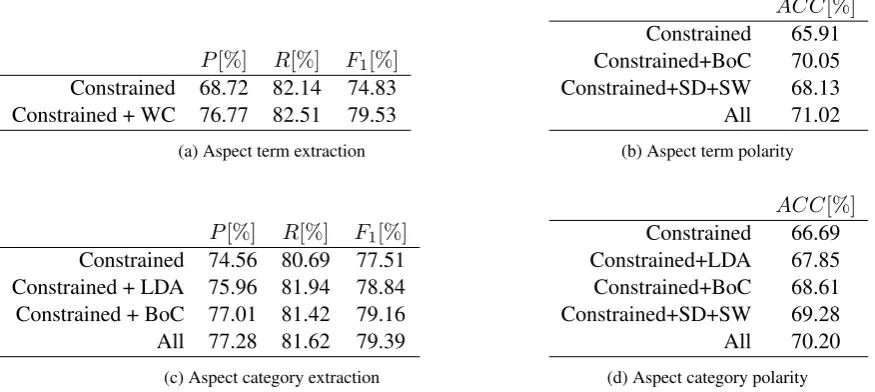
Table 2 presents the 10-fold cross-validation re-sults on restaurant training data. We can clearly see, that any of our extension (LDA, clusters, sen-timent vocabularies) brings at least some improve-ment.
5 Conclusion
This paper covers our participation in the ABSA task of Semeval 2014. The ABSA task consists of 4 subtasks. For each subtask we propose both constrained (no external knowledge) and uncon-strained approach. The conuncon-strained versions of our system are based purely on machine learning techniques. The unconstrained versions extend the constrained feature set by LDA, semantic spaces and sentiment dictionaries.
P[%] R[%] F1[%]
Constrained 68.72 82.14 74.83 Constrained + WC 76.77 82.51 79.53
(a) Aspect term extraction
ACC[%]
Constrained 65.91 Constrained+BoC 70.05
Constrained+SD+SW 68.13
All 71.02
(b) Aspect term polarity
P[%] R[%] F1[%]
Constrained 74.56 80.69 77.51 Constrained + LDA 75.96 81.94 78.84 Constrained + BoC 77.01 81.42 79.16 All 77.28 81.62 79.39
(c) Aspect category extraction
ACC[%]
Constrained 66.69
Constrained+LDA 67.85
Constrained+BoC 68.61
Constrained+SD+SW 69.28
All 70.20
[image:5.595.72.510.66.262.2](d) Aspect category polarity
Table 2: 10 fold cross-validation results on the restaurants training data for individual features. P,R, and F1 denote the precision, recall and F-measure, respectively, used for measuring aspect term and
category detection. ACCdenotes the accuracy, used for measuring aspect term and category sentiment polarity detection.
Acknowledgements
This work was supported by grant no. SGS-2013-029 Advanced computing and information systems, by the European Regional Development Fund (ERDF) and by project “NTIS - New Tech-nologies for Information Society”, European Cen-tre of Excellence, CZ.1.05/1.1.00/02.0090, and by project MediaGist, EU’s FP7 People Programme (Marie Curie Actions), no. 630786.
References
Stefano Baccianella, Andrea Esuli, and Fabrizio Sebas-tiani. 2010. Sentiwordnet 3.0: An enhanced lexical resource for sentiment analysis and opinion mining. In Nicoletta Calzolari (Conference Chair), Khalid Choukri, Bente Maegaard, Joseph Mariani, Jan Odijk, Stelios Piperidis, Mike Rosner, and Daniel Tapias, editors,Proceedings of the Seventh Interna-tional Conference on Language Resources and Eval-uation (LREC’10), Valletta, Malta, may. European Language Resources Association (ELRA).
Sasha Blair-Goldensohn, Kerry Hannan, Ryan McDon-ald, Tyler Neylon, George Reis, and Jeff Reynar. 2008. Building a sentiment summarizer for lo-cal service reviews. InProceedings of WWW-2008 workshop on NLP in the Information Explosion Era. David M. Blei, Andrew Y. Ng, and Michael I. Jordan. 2003. Latent dirichlet allocation. Journal of Ma-chine Learning Research, 3:993–1022.
Erik Boiy and Marie-Francine Moens. 2009. A machine learning approach to sentiment analysis
in multilingual web texts. Information retrieval, 12(5):526–558.
Tom´aˇs Brychc´ın and Ivan Habernal. 2013. Un-supervised improving of sentiment analysis using global target context. In Proceedings of the In-ternational Conference Recent Advances in Natu-ral Language Processing RANLP 2013, pages 122– 128, Hissar, Bulgaria, September. INCOMA Ltd. Shoumen, BULGARIA.
Tom´aˇs Brychc´ın and Miloslav Konop´ık. 2014. Seman-tic spaces for improving language modeling. Com-puter Speech & Language, 28(1):192 – 209. Xiaowen Ding, Bing Liu, and Philip S. Yu. 2008. A
holistic lexicon-based approach to opinion mining. InProceedings of the Conference on Web Search and Web Data Mining.
Thomas L. Griffiths and Mark Steyvers. 2004. Find-ing scientific topics. Proceedings of the National Academy of Sciences of the United States of Amer-ica, 101(Suppl 1):5228–5235, April.
Ivan Habernal and Tom´aˇs Brychc´ın. 2013. Semantic spaces for sentiment analysis. In Text, Speech and Dialogue, volume 8082 of Lecture Notes in Com-puter Science, pages 482–489, Berlin Heidelberg. Springer.
Minqing Hu and Bing Liu. 2004. Mining and summa-rizing customer reviews. InProceedings of the tenth ACM SIGKDD international conference on Knowl-edge discovery and data mining, KDD ’04, pages 168–177, New York, NY, USA. ACM.
sen-timent classification. InProceedings of the 49th An-nual Meeting of the Association for Computational Linguistics.
David Jurgens and Keith Stevens. 2010. The s-space package: An open source package for word space models. InIn Proceedings of the ACL 2010 System Demonstrations.
George Karypis. 2003. Cluto - a clustering toolkit.
Michal Konkol and Miloslav Konop´ık. 2013. Crf-based czech named entity recognizer and consolida-tion of czech ner research. In Ivan Habernal and V´aclav Matouˇsek, editors, Text, Speech and Dia-logue, volume 8082 ofLecture Notes in Computer Science, pages 153–160. Springer Berlin Heidel-berg.
Michal Konkol. 2014. Brainy: A machine learn-ing library. In Leszek Rutkowski, Marcin Ko-rytkowski, Rafa Scherer, Ryszard Tadeusiewicz, Lotfi A. Zadeh, and Jacek M. Zurada, editors, Artifi-cial Intelligence and Soft Computing, volume 8468 of Lecture Notes in Computer Science. Springer Berlin Heidelberg.
John Lafferty, Andrew McCallum, and Fernando Pereira. 2001. Conditional random fields: Prob-abilistic models for segmenting and labeling se-quence data. InProceedings of International Con-ference on Machine Learning.
Bing Liu, Minqing Hu, and Junsheng Cheng. 2005. Opinion observer: Analyzing and comparing opin-ions on the web. In Proceedings of International Conference on World Wide Web.
Bing Liu. 2012.Sentiment Analysis and Opinion Min-ing. Morgan & Claypool Publishers.
Chong Long, Jie Zhang, and Xiaoyan Zhu. 2010. A review selection approach for accurate feature rating estimation. InProceedings of Coling 2010: Poster Volume.
Kevin Lund and Curt Burgess. 1996. Producing high-dimensional semantic spaces from lexical co-occurrence. Behavior Research Methods Instru-ments and Computers, 28(2):203–208.
Andrew Kachites McCallum. 2002. Mallet: A ma-chine learning for language toolkit.
Qiaozhu Mei, Xu Ling, Matthew Wondra, Hang Su, and ChengXiang Zhai. 2007. Topic sentiment mix-ture: modeling facets and opinions in weblogs. In
Proceedings of International Conference on World Wide Web.
Samaneh Moghaddam and Martin Ester. 2010. Opin-ion digger: an unsupervised opinOpin-ion miner from unstructured product reviews. In Proceeding of the ACM conference on Information and knowledge management.
Maria Pontiki, Dimitrios Galanis, John Pavlopou-los, Harris Papageorgiou, Ion AndroutsopouPavlopou-los, and Suresh Manandhar. 2014. Semeval-2014 task 4: Aspect based sentiment analysis. InProceedings of the International Workshop on Semantic Evaluation (SemEval 2014), Dublin, Ireland.
Lawrence Rabiner. 2010. A tutorial on hidden markov models and selected applications in speech recogni-tion. InProceedings of the IEEE, pages 257–286. Lance A Ramshaw and Mitchell P Marcus. 1999. Text
chunking using transformation-based learning. In
Natural language processing using very large cor-pora, pages 157–176. Springer.
Douglas L. T. Rohde, Laura M. Gonnerman, and David C. Plaut. 2004. An improved method for deriving word meaning from lexical co-occurrence.
Cognitive Psychology, 7:573–605.
Josef Steinberger, Mohamed Ebrahim, Maud Ehrmann, Ali Hurriyetoglu, Mijail Kabadjov, Polina Lenkova, Ralf Steinberger, Hristo Tanev, Silvia Vzquez, and Vanni Zavarella. 2012. Creating sentiment dictio-naries via triangulation. Decision Support Systems, 53(4):689 – 694.
Josef Steinberger, Tom´aˇs Brychc´ın, and Michal Konkol. 2014. Aspect-level sentiment analysis in czech. In Proceedings of the 5th Workshop on Computational Approaches to Subjectivity, Senti-ment and Social Media Analysis, Baltimore, USA, June. Association for Computational Linguistics. Ivan Titov and Ryan McDonald. 2008. Modeling