Proceedings of the 7th Joint Conference on Lexical and Computational Semantics (*SEM), pages 1–10
Resolving Event Coreference with Supervised Representation Learning
and Clustering-Oriented Regularization
Kian Kenyon-Dean School of Computer Science
McGill University kian.kenyon-dean
@mail.mcgill.ca
Jackie Chi Kit Cheung School of Computer Science
McGill University [email protected]
Doina Precup School of Computer Science
McGill University [email protected]
Abstract
We present an approach to event coreference resolution by developing a general framework for clustering that uses supervised representa-tion learning. We propose a neural network architecture with novel Clustering-Oriented Regularization (CORE) terms in the objective function. These terms encourage the model to create embeddings of event mentions that are amenable to clustering. We then use agglom-erative clustering on these embeddings to build event coreference chains. For both within-and cross-document coreference on the ECB+ corpus, our model obtains better results than models that require significantly more pre-annotated information. This work provides in-sight and motivating results for a new general approach to solving coreference and clustering problems with representation learning.
1 Introduction
Event coreference resolution is the task of deter-mining which event mentions expressed in lan-guage refer to the same real-world event in-stances. The ability to resolve event coreference has improved the quality of downstream tasks such as automatic text summarization ( Vander-wende et al., 2004), questioning-answering ( Be-rant et al.,2014), headline generation (Sun et al., 2015), and text-mining in the medical domain (Ferracane et al.,2016).
Event mentions are comprised of an action component (or, head) and surrounding arguments. Consider the following passages, drawn from two different documents; the heads of the event men-tions are in boldface and the subscripts indicate mention IDs:
(1) The president’sspeechm1shockedm2the
au-dience. Heannouncedm3 several new
con-troversial policies.
(2) The policies proposedm4 by the president
will not surprisem5 those who followedm6
hiscampaignm7.
In this example,m1,m3, andm4form a chain of coreferent event mentions (underlined), because they refer to the same real-world event in which the president gave a speech. The other four are singletons, meaning that they all refer to separate events and do not corefer with any other mention. This work investigates how to learn useful rep-resentations of event mentions. Event mentions are complex objects, and both the event mention heads and the surrounding arguments are impor-tant for the event coreference resolution task. In our example above, the head words of mentions
m2,shocked, andm5,surprise, are lexically sim-ilar, but the event mentions do not corefer. This task therefore necessitates a model that can cap-ture the distributional relationships between event mentions and their surrounding contexts.
We hypothesize that prior knowledge about the task itself can be usefully encoded into the rep-resentation learning objective. For our task, this prior means that the embeddings of corefential event mentions should have similar embeddings to each other (a “natural clustering”, using the termi-nology ofBengio et al. (2013)). With this prior, our model creates embeddings of event mentions that are directly conducive for the clustering task of building event coreference chains. This is con-trary to the indirect methods of previous work that rely on pairwise decision making followed by a separate model that aggregates the sometimes in-consistent decisions into clusters (Section2).
We demonstrate these points by proposing a method that learns to embed event mentions into a space that is tuned specifically for clustering. The representation learner is trained to predict which event cluster the event mention belongs to,
using an hourglass-shaped neural network. We propose a mechanism to modulate this training by introducing Clustering-Oriented Regulariza-tion (CORE) terms into the objective function of the learner; these terms impel the model to pro-duce similar embeddings for coreferential event mentions, and dissimilar embeddings otherwise.
Our model obtains strong results on within-and cross-document event coreference resolution, matching or outperforming the system of Cybul-ska and Vossen(2015) on the ECB+ corpus on all six evaluation measures. We achieve these gains despite the fact that our model requires signifi-cantly less pre-annotated or pre-detected informa-tion in terms of the internal event structure. Our model’s improvements upon the baselines show that our supervised representation learning frame-work creates new embeddings that capture the ab-stract distributional relations between samples and their clusters, suggesting that our framework can be generalized to other clustering tasks1.
2 Related Work
The recent work on event coreference can be cat-egorized according to the assumed level of event representation. In the predicate-argument align-ment paradigm (Roth and Frank, 2012; Wolfe et al.,2013), links are simply drawn between pred-icates in different documents. This work only con-siders cross-document event coreference (Wolfe et al.,2013,2015), and no within-document coref-erence. At the other extreme, the ACE and ERE datasets annotate rich internal event structure, with specific taxonomies that describe the annotated events and their types (Linguistic Data Consor-tium,2005,2016). In these datasets, only within-document coreference is annotated.
The creators of the ECB (Bejan and Harabagiu, 2008) and ECB+ (Cybulska and Vossen, 2014), annotate events according to a level of abstraction between that of the predicate-argument approach and the ACE approach, being most similar to the TimeML paradigm (Pustejovsky et al., 2003). In these datasets, both within-document and cross-document coreference relations are annotated. We use the ECB+ corpus in our experiments because it solves the lack of lexical diversity found within the ECB by adding 502 new annotated documents, providing a total of 982 documents.
1All code used in this paper can be found here:
https://github.com/kiankd/events
Previous work on model design for event coref-erence has focused on clustering over a linguis-tically rich set of features. Most models require a pairwise-prediction based supervised learning step which predicts whether or not a pair of event men-tions is coreferential (Bagga and Baldwin, 1999; Chen et al., 2009; Cybulska and Vossen, 2015). Other work focuses on the clustering step itself, aggregating local pairwise decisions into clusters, for example by graph partitioning (Chen and Ji, 2009). There has also been work using non-parametric Bayesian clustering techniques (Bejan and Harabagiu, 2014;Yang et al., 2015), as well as other probabilistic models (Lu and Ng,2017). Some recent work uses intuitions combining rep-resentation learning with clustering, but does not augment the loss function for the purpose of building clusterable representations (Krause et al., 2016;Choubey and Huang,2017).
3 Event Coreference Resolution Model We formulate the task of event coreference resolu-tion as creating clusters of event menresolu-tions which refer to the same event. For the purposes of this work, we define an event mention to be a set of to-kens that correspond to theactionof some event. Consider the sentence below (borrowed from Cy-bulska and Vossen(2014)):
(3) On Monday Lindsay Lohanchecked into re-hab in Malibu, California after a carcrash.
Our model would take, as input, feature vectors (see Section4) extracted from the two event men-tions (in bold) independently. In this paper, we use the gold-standard event mentions provided by the dataset, and leave mention detection to other work.
3.1 Model Overview
Our approach to resolving event coreference con-sists of the following steps:
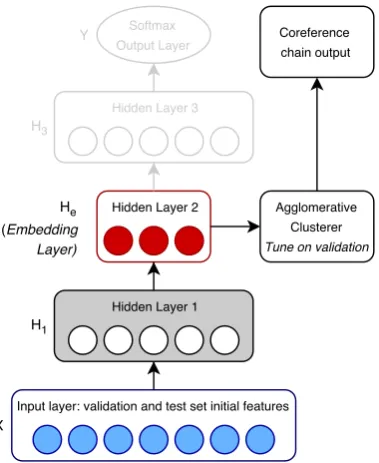
1. Train a supervised neural network model which learns event mention embeddings by predicting the event cluster in the training set to which the mention belongs (Figure1).
Figure 1: Our supervised representation learning model during the training step. Dashed arrows indicate contri-butions to the loss function.
Figure 2: Our trained model at inference time, used for validation tuning and final testing. Note thatH3andY
are not used in this step.
3.2 Supervised Representation Learning
We propose a representation learning framework based on training a multi-layer artificial neural net-work, with one layer He chosen to be the embed-ding layer. In the training set, there are a certain number of event mentions, each of which belongs to some gold standard cluster, makingCtotal
non-singleton clusters in the training set. The network is trained as if it were encountering a C+1-class
classification problem, where the class of an event mention corresponds to a single output node, and all singleton mentions belong to classC+12.
When using this model to cluster a new set of mentions, the final layer’s output will not be di-rectly informative since the output node structure corresponds to the clusters within the training set. However, we hypothesize that the trained model will have learned to capture the abstract distribu-tional relationships between event mentions and clusters in the intermediate layer He. We thus use the activations in Heas the embedding of an event mention for the clustering step (see Figure2). A similar hourglass-like neural architecture design has been successful in automatic speech
recogni-2If each singleton mention (i.e., a mention that does not
corefer with anything else) had its own class then the model would be confronted with a classification problem with thou-sands of classes, many of which would only have one sample; this is much too ill-posed, so we merge all singletons together during the training step.
tion (Gr´ezl et al.,2007;Gehring et al.,2013), but has not to our knowledge been used to pre-train embeddings for clustering.
3.3 Categorical-Cross-Entropy (CCE)
Using CCE as the loss function trains the model to correctly predict a training set mention’s corre-sponding cluster. With model predictionyicas the probability that sampleibelongs to classc, and
in-dicator variabletic= 1if sampleibelongs to class c (else tic = 0), we have the mean categorical-cross entropy loss over a randomly sampled train-ing input batchX:
(1)
LCCE =−
1
|X| |X| X
i=1
CX+1
c=1
ticlog(yic)
3.4 Clustering-Oriented Regularization (CORE)
[image:3.595.79.240.63.292.2]to the cosine-distance functiond:
d(e~1, ~e2) =
1 2
1− e~1·e~2 ||e~1||||e~2||
(2)
Given input batch X, we create two setsS and
D, where S is the set of all pairs (a, b) of men-tions inXthat belong to the same cluster, andDis the set of all pairs(c, d)inXthat belong to differ-ent clusters. Note that all vector embeddingse~i = He(i); i.e., they are obtained by feeding the event mention i’s features through to embedding layer
He. We now define the following Attractive and RepulsiveCORE terms.
3.4.1 Attractive Regularization
The first desirable property for the embeddings is that mentions that belong to the same cluster should have low cosine distance between each oth-ers’ embeddings, since the agglomerative cluster-ing algorithm uses cosine distance to make coref-erence decisions.
Formally, for all pairs of mentionsaandbthat
belong to the same cluster, we would like to min-imize the distance between their embeddings e~a and e~b. We call this “attractive” regularization because we want to attract embeddings closer to each other by minimizing their distanced(e~a, ~eb) so that they will be as similar as possible.
(3)
Lattract = 1
|S|
X
(a,b)∈S
d(e~a, ~eb)
3.4.2 Repulsive Regularization
The second desirable property is that the embed-dings corresponding to mentions that belong to different clusters should have high cosine distance between each other. Thus, for all pairs of mentions
canddthat belong to different clusters, the goal is
to maximize their distanced(e~c, ~ed). This is “re-pulsive” because we train the model to push away the embeddings from each other to be as distant as possible.
(4)
Lrepulse= 1− 1
|D|
X
(c,d)∈D
d(e~c, ~ed)
3.5 Loss Function
Equation 5 below shows the final loss function3.
The attractive and repulsive terms are weighted by
3Note that, while we present Equations3and4as
sum-mations over pairs from the input batch, the computation is actually reasonable when written in terms of matrix multipli-cations. The most expensive operation multiplying the em-bedded batch of input samples times its transpose.
hyperparameter constantsλ1andλ2respectively:
(5)
L=LCCE+λ1Lattract+λ2Lrepulse
By adding these regularization terms to the loss function, we hypothesize that the new embeddings of test set mentions (obtained by feeding-forward their features into the trained model) will exem-plify the desired properties represented by the loss function, thus assisting the agglomerative cluster-ing task in produccluster-ing correct coreference-chains.
3.6 Agglomerative Clustering
Agglomerative clustering is a non-parametric “bottom-up” approach to hierarchical clustering, in which each sample starts as its own cluster, and at each step, the two most similar clusters are merged, where similarity between two clus-ters is measured according to some similarity met-ric. After each merge, clustering similarities are recomputed according to a preset criterion (e.g., single- or complete-linkage). In our models, clus-tering proceeds until a pre-determined similarity threshold,τ, is reached. We tuned τ on the
vali-dation set, doing grid search forτ ∈[0,1]to max-imize B3 accuracy4. Preliminary experimentation
led us to use cosine-similarity (see cosine distance in Equation 2) to measure vector similarity, and single-linkage for clustering decisions.
We experimented with two initialization schemes for agglomerative clustering. In the first scheme, each event mention is initialized as its own cluster, as is standard. In the second, we initialized clusters using the lemma-δ baseline defined byUpadhyay et al. (2016). This baseline merges all event mentions with the same head lemma that are in documents with document-level similarity that is higher than a thresholdδ.
Upad-hyay et al. showed that it is a strong indicator of event coreference, so we experimented with ini-tializing our clustering algorithm in this way. We call this model variant CORE+CCE+LEMMA, and describe the parameter tuning procedures in more detail in Section5.
4 Feature Extraction
We extract features that do not require the pre-processing step of event-template construction to represent the context (unlikeCybulska and Vossen
4We optimize with B3 F1-score because the other
1.action checked into, crash 2.time On Monday
3.location rehab in Malibu, California 4.participant Lindsay Lohan(human)
[image:5.595.80.283.61.133.2]car(non-human)
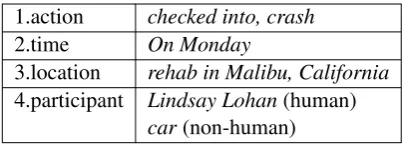
Table 1: An event template of the sentence in Ex-ample3, borrowed fromCybulska and Vossen(2014;
2015). Our model only requires as input theaction, not thetime,location, norparticipantarguments.
(2015), see Table1); instead, we represent the sur-rounding context by using the tokens in the gen-eral vicinity of the event’s action. We thus only require the event’s action – which is what we de-fine as an event mention – to be previously de-tected, not all of its arguments. We motivate this by arguing that it would be preferable to build high quality coreference chains without event template features since since extracting event templates can be a difficult process, with the possibility of errors cascading into the event coreference step.
4.1 Contextual
Inspired by the approach of Clark and Manning (2016) in the entity coreference task, we extract, for the token sets below, (i) the token’sword2vec word embedding (Mikolov et al., 2013) (or aver-age if there are multiple); and, (ii) the one-hot count vector of the token’s lemma5(or sum if there
are multiple), for each event mention,em: • the first token ofem;
• the last token ofem; • all tokens in theem;
• each of the two tokens precedingem; • each of the two tokens followingem; • all of the five tokens precedingem;
• all of the five tokens followingem; • all of the tokens inem’s sentence. 4.2 Document
It is necessary to include features that character-ize the mention’s document, hoping that the model learns a latent understanding of relations between documents. We extract features from the event mention’s document by building lemma-based TF-IDF vector representations of the document. We use log normalization of the raw term frequency
5This is a500-dimensional vector where the first499
en-tries correspond to the499most frequently occurring lemmas in the training set, and the500thentry indicates if the lemma
is not in that set of most frequently occurring lemmas.
of token lemma t in document d, ft,d, where TFt = 1 + log(ft,d). For the IDF term we use smoothed inverse document frequency, withN as
the number of documents and nt as the number of documents that contain the lemma, we have IDFt= log(1 +nNt). By performing a component-wise multiplication of the IDF vector with each row in term-frequency matrix TF, we create TF-IDF vectors of each document in the training and test sets (with length corresponding to the number of unique lemmas in the training set). We com-press these vectors to 100dimensions with prin-cipal component analysis fitted onto the train set document vectors, which is used to transform the validation and test set document vectors.
4.3 Comparative
We include comparative features to relate a men-tion to the other menmen-tions in its document and to the mentions in the set of documents the model would be requested to extract event coreference chains from. This is motivated by the fact that coreference decisions must be informed by the re-lationship mentions have with each other. Firstly, we encode the position of the mention in its doc-ument with specific binary features indicating if it is first or last; for example, if there were five mentions and it were the third, this feature would correspond to the vector[0,35,0].
Next, we define two sets of mentions we would like to compare with: the first contains all men-tions in the same document as the current mention
em, and the second contains all mentions in the
data we are asked to cluster. For each of these sets, we compute: the average word overlap and aver-age lemma overlap (measured by harmonic simi-larity) betweenemand each of the other mentions
in the set. We thus add two feature vector entries for each of the sets: the average word overlap be-tween emand the other mentions in the set, and
the average lemma overlap between em and the other mentions in the set.
5 Experimental Design
validation set6for hyperparameter tuning.
Following Cybulska and Vossen, we used the portion of the corpus that has been manually re-viewed and checked for correctness. Some pre-vious work (Yang et al., 2015; Upadhyay et al., 2016;Choubey and Huang, 2017) do not appear to have followed this guideline from the corpus creators, as they report different corpus statis-tics compared to those reported byCybulska and Vossen. As a result, those papers may report re-sults on a data set with known annotation errors.
5.1 Evaluation Measures
Since there is no consensus in the coreference res-olution literature on the best evaluation measure, we present results obtained according to six differ-ent measures, as is common in previous work. We use the scorer presented byPradhan et al. (2014). In this task, the term “coreference chain” is syn-onymous with “cluster”.
MUC (Vilain et al., 1995). Link-level mea-sure which counts the minimum number of link changes required to obtain the correct clustering from the predictions; it does not account for cor-rectly predicted singletons.
B3 (Bagga and Baldwin, 1998). Mention-level
measure which computes precision and recall for each individual mention, overcoming the singleton problem of MUC, but can problematically count the same coreference chain multiple times.
CEAF-M (Luo, 2005). Mention-level measure which reflects the percentage of mentions that are in the correct coreference chains. Note that preci-sion and recall are the same in this measure since we use pre-annotated mentions.
CEAF-E(Luo,2005). Entity-level measure com-puted by aligning predicted with the gold chains, not allowing one chain to have more than one alignment, overcoming the problem of B3.
BLANC (Luo et al., 2014). Computes two F-scores in terms of the pairwise quality of corefer-ence decisions and non-corefercorefer-ence decisions, and averages these scores together for the final results.
CoNLL. The mean of MUC, B3, and CEAF-E.
5.2 Models
We compare our representation-learning model variants to three baselines: a deterministic
lemma-6Topics 2, 5, 12, 18, 21, 23, 34, 35 (randomly chosen).
based baseline, a lemma-δ baseline, and an unsu-pervised baseline which clusters the originally ex-tracted features. We also compare with the results ofCybulska and Vossen(2015).
5.2.1 Baselines
LEMMA. This algorithm clusters event mentions which share the same head word lemma into the same coreference chains across all documents.
LEMMA-δ. Proposed byUpadhyay et al. (2016), this method provides a difficult baseline to beat. A δ-similarity threshold is introduced, and we
merge two mentions with the same head-lemma if and only if the cosine-similarity between the TF-IDF vectors of their corresponding documents is greater thanδ. Thisδparameter is tuned to
maxi-mize B3 performance on the validation set, which
we found occurs whenδ= 0.67.
UNSUPERVISED. This is the result obtained by agglomerative clustering over the original un-weighted features. Again, we optimize theτ
sim-ilarity threshold over the validation set.
5.2.2 Sentence Templates (CV2015)
Cybulska and Vossen(2015) propose a model that uses sentence-level event templates (see Table1), requiring more annotated information than our models. See (Vossen and Cybulska,2017) for fur-ther elaboration of this model. To our knowledge, this is the best previous model on ECB+ using the same data and evaluation criteria as our work.
5.2.3 Representation Learning.
We test four different model variants:
• CCE: uses only categorical-cross-entropy in the loss function (Equation1);
• CORE: uses only clustering-oriented regular-ization; i.e., the attract and repulse terms (Equa-tions3and4);
• CORE+CCE: includes
categorical-cross-entropy and the attract and repulse terms (Equation5);
• CORE+CCE+LEMMA: initializes the agglom-erative clustering with clusters computed by lemma-δ (with a differently tuned value of δ
Model λ1 λ2 B3 τ
Baselines
UNSUPERVISED - - 0.590 0.657
LEMMA - - 0.597
-LEMMA-δ - - 0.612
-Model Variants
CORE+CCE+L 2.0 0.0 0.678 0.843 CORE+CCE 2.0 2.0 0.663 0.776 2.0 1.0 0.666 0.773 2.0 0.1 0.665 0.843 2.0 0.0 0.669 0.843 0.0 2.0 0.662 0.710 CORE 2.0 2.0 0.631 0.701 1.0 1.0 0.625 0.689
CCE - - 0.644 0.853
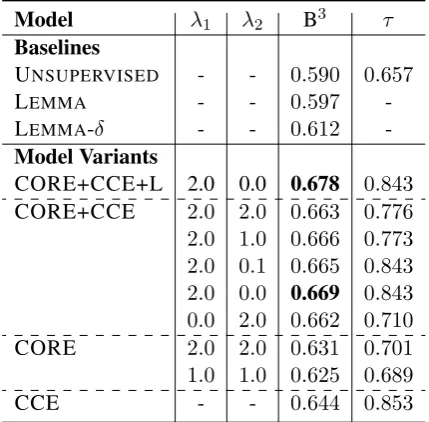
Table 2: Model comparison based on validation set B3 accuracy with optimized τ cluster-similarity
threshold. For CORE+CCE+LEMMA (indicated as
CORE+CCE+L) we tuned toδ= 0.89; for LEMMA-δ
we tuned toδ= 0.67.
5.3 Hyper-parameter Tuning
For the representation learning models, we per-formed a non-exhaustive hyper-parameter search optimized for validation set performance. We keep the following parameters constant across the model variants:
• 1000neurons in H1 and H3;250neurons in He, the embedding layer (see Figure1);
• Softmax output layer withC+ 1units;
• ReLU activation functions for all neurons;
• Adamgradient descent (Kingma and Ba,2014);
• 25%dropout between each layer;
• Learning rate of 0.00085 (times 10−1 for
CORE);
• Randomly sampled batches of 272 mentions, where a batch is forced to contain pairs of coref-erential and non-corefcoref-erential mentions.
Models are trained for 100 epochs. At each epoch, we optimize τ (our agglomerative
clus-tering similarity threshold) using a two-pass ap-proach: we first test 20 different settings of τ,
thenτ is further optimized around the best value
from the first pass. For CORE+CCE+LEMMA, we tune theδparameter of the lemma-δclustering
approach to the validation set by testing 100 dif-ferent values ofδ; these differentδvalues
initial-ize the clusters, and we then continue clustering by testing validation results obtained when using the similarities between the embeddings created by CORE+CCE for different values ofτ.
Some of the results of hyperparameter tuning on the validation set are shown in Table2. Inter-estingly, we observe that CORE+CCE performs slightly better withλ2 = 0; i.e., without repulsive
regularization. This suggests that enforcing rep-resentation similarity is more important than en-forcing division, although we cannot conclusively state that repulsive regularization would not be useful for other tasks. Nonetheless, for test set results we use the optimal hyperparameter config-urations found during this validation-tuning step; e.g., for CORE+CCE we setλ1 = 2andλ2= 0.
6 Results
Table 3 presents the performance of the models for combined within- and cross-document event coreference. Results for these models are obtained with the hyper-parameter settings that achieved optimal accuracy during validation-tuning.
Firstly, we observe that CORE+CCE offers marked improvements upon the UNSUPERVISED baseline, CORE model, and CCE model. From these results we conclude: (i) supervised represen-tation learning provides more informative embed-dings than the original feature vectors; and, (ii) that combining Clustering-Oriented Regulariza-tion with categorical-cross-entropy is better than just using one or the other, indicating that our in-troduction of these novel terms into the loss func-tion is a useful contribufunc-tion.
We also note that CORE+CCE+LEMMA (which obtains the best validation set results) beats the strong LEMMA-δ baseline. Our model
of-fers marked improvements or roughly equivalent scores in each evaluation measure except BLANC, where the baseline offers a 3 point F-score im-provement. This is due to the very high precision of the baseline, whereas CORE+CCE+LEMMA seems to trade precision for recall.
[image:7.595.74.289.63.274.2]re-MUC B3 CM CE BLANC CONLL
Model R P F R P F F R P F R P F F
Baselines
LEMMA 66 58 62 66 58 62 51 87 39 54 64 61 63 61
LEMMA-δ 55 68 61 61 80 69 59 73 60 66 62 80 67 66
UNSUPERVISED 39 63 48 55 81 66 51 72 49 58 57 58 58 57
Previous Work
CV2015 43 77 55 58 86 69 58 - - 66 60 69 63 64
Model Variants
CCE 66 63 65 69 60 64 50 59 63 61 69 56 59 63
CORE 58 58 58 66 58 62 44 53 53 53 66 54 56 57
CORE+CCE 62 70 66 67 69 68 56 73 64 68 68 59 62 67
[image:8.595.74.528.64.199.2]CORE+CCE+LEMMA 67 71 69 71 67 69 58 71 67 69 72 60 64 69
Table 3: Combined within- and cross-document test set results on ECB+. Measures CM and CE stand for mention-based CEAF and entity-mention-based CEAF, respectively.
MUC B3 CM CE BLANC CONLL
Model R P F R P F F R P F R P F F
Baselines
LEMMA-δ 41 77 53 86 97 92 85 92 82 87 65 86 71 77
UNSUPERVISED 32 36 34 85 86 85 74 80 78 79 65 55 57 66
Model Variants
CCE 44 49 46 87 89 88 79 82 80 81 67 67 67 72
CORE 55 32 40 89 70 78 65 64 79 71 75 54 56 63
CORE+CCE 43 68 53 87 95 91 84 90 82 86 67 76 70 76
CORE+CCE+LEMMA 57 69 63 90 94 92 86 90 86 88 73 78 75 81
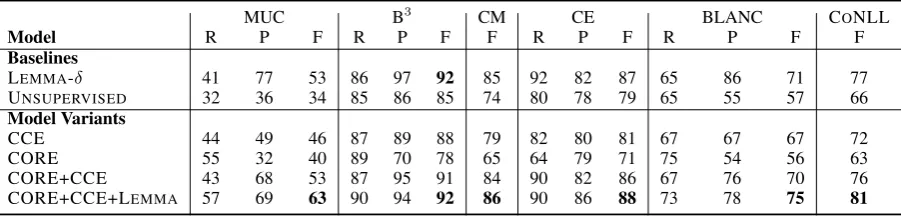
Table 4: Within-document test set results on ECB+. Note that LEMMAis equivalent to LEMMA-δin the
within-document setting.Cybulska and Vossen(2015) did not report the performance of their model in this setting.
sults suggest that high quality coreference chains can be built without necessitating event templates.
In Table 4, we see the performance of our models on within-document coreference resolu-tion in isolaresolu-tion. These results are obtained by cutting all links drawn across documents for the gold standard chains and the predicted chains. We observe that, across all models, scores on the mention- and entity-based measures are substantially higher than the link-based mea-sures (e.g., MUC and BLANC). The usefulness of CORE+CCE+LEMMA (which initializes the clustering with the lemma-δ predictions and then
continues to cluster with CORE+CCE) is exem-plified by the improvements or matches in ev-ery measure when compared to both LEMMA-δ
and CORE+CCE. The most vivid improvement here is observed with the10point improvement in MUC over both models as well as the4and5point improvements in BLANC respectively, where the higher recall entails that CORE+CCE+LEMMA confidently predicts coreference links that would otherwise have been false negatives.
7 Conclusions and Future Work
We have presented a novel approach to event coreference resolution by combining supervised representation learning with non-parametric clus-tering. We train an hourglass-shaped neural net-work to learn how to represent event mentions in a useful way for an agglomerative clustering al-gorithm. By adding the novel Clustering-Oriented Regularization (CORE) terms into the loss func-tion, the model learns to construct embeddings that are easily clusterable; i.e., the prior that em-beddings of samples belonging to the same cluster should be similar, and those of samples belonging to different clusters should be dissimilar.
[image:8.595.76.527.250.359.2]Future work involves applying our model to au-tomatically annotated event mentions and other event coreference datasets, and extending this framework toward a full end-to-end system that does not rely on manual feature engineering at the input level. Additionally, our model may be use-ful for other clustering tasks, such as entity coref-erence and document clustering. Lastly, we seek to determine how CORE and its imposition of a clusterable latent space structure may or may not assist in improving the quality of latent represen-tations in general.
Acknowledgements
This work was funded with grants from the Natu-ral Sciences and Engineering Research Council of Canada (NSERC) and the Fonds de recherche du Qu´ebec - Nature et Technologies (FRQNT). We thank the anonymous reviewers for their helpful comments and suggestions.
References
Amit Bagga and Breck Baldwin. 1998. Algorithms for scoring coreference chains. In The first in-ternational conference on language resources and evaluation workshop on linguistics coreference, vol-ume 1, pages 563–566.
Amit Bagga and Breck Baldwin. 1999. Cross-document event coreference: Annotations, exper-iments, and observations. In Proceedings of the Workshop on Coreference and its Applications, pages 1–8. ACL.
Cosmin Adrian Bejan and Sanda Harabagiu. 2014. Un-supervised Event Coreference Resolution. Compu-tational Linguistics, 40(2):311–347.
Cosmin Adrian Bejan and Sanda M Harabagiu. 2008. A Linguistic Resource for Discovering Event Struc-tures and Resolving Event Coreference. InLREC.
Yoshua Bengio, Aaron Courville, and Pascal Vincent. 2013. Representation learning: A review and new perspectives. IEEE transactions on pattern analysis and machine intelligence, 35(8):1798–1828.
Jonathan Berant, Vivek Srikumar, Pei-Chun Chen, Abby Vander Linden, Brittany Harding, Brad Huang, Peter Clark, and Christopher D Manning. 2014. Modeling Biological Processes for Reading Comprehension. In Proceedings of the 2014 Con-ference on EMNLP, pages 1499–1510.
Zheng Chen and Heng Ji. 2009. Graph-based event coreference resolution. InProceedings of the 2009 Workshop on Graph-based Methods for NLP, pages 54–57. ACL.
Zheng Chen, Heng Ji, and Robert Haralick. 2009. A Pairwise Event Coreference Model, Feature Impact and Evaluation for Event Coreference Resolution. InProceedings of the workshop on events in emerg-ing text types, pages 17–22. ACL.
Prafulla Kumar Choubey and Ruihong Huang. 2017. Event coreference resolution by iteratively un-folding inter-dependencies among events. arXiv preprint arXiv:1707.07344.
Kevin Clark and Christopher D Manning. 2016. Im-proving Coreference Resolution by Learning Entity-Level Distributed Representations. arXiv preprint arXiv:1606.01323.
Agata Cybulska and Piek Vossen. 2014. Using a sledgehammer to crack a nut? Lexical diversity and event coreference resolution. InLREC, pages 4545– 4552.
Agata Cybulska and Piek Vossen. 2015. Translating Granularity of Event Slots into Features for Event Coreference Resolution. InProceedings of the 3rd Workshop on EVENTS at the NAACL-HLT, pages 1– 10.
Elisa Ferracane, Iain Marshall, Byron C Wallace, and Katrin Erk. 2016. Leveraging coreference to iden-tify arms in medical abstracts: An experimental study. EMNLP, pages 86–95.
Jonas Gehring, Yajie Miao, Florian Metze, and Alex Waibel. 2013. Extracting deep bottleneck features using stacked auto-encoders. In Acoustics, Speech and Signal Processing (ICASSP), 2013 IEEE Inter-national Conference on, pages 3377–3381. IEEE.
Frantisek Gr´ezl, Martin Karafi´at, Stanislav Kont´ar, and Jan Cernocky. 2007. Probabilistic and bottle-neck features for LVCSR of meetings. In Acoustics, Speech and Signal Processing, 2007. ICASSP 2007. IEEE International Conference on, volume 4, pages IV–757. IEEE.
Diederik Kingma and Jimmy Ba. 2014. Adam: A method for stochastic optimization. arXiv preprint arXiv:1412.6980.
Sebastian Krause, Feiyu Xu, Hans Uszkoreit, and Dirk Weissenborn. 2016. Event linking with sentential features from convolutional neural networks. In
Proceedings of the 20th SIGNLL Conference on Computational Natural Language Learning, pages 239–249.
Linguistic Data Consortium. 2005. ACE (Automatic Content Extraction) English Annotation Guidelines for Events. Version 5.4.3 2005.07.01.
Linguistic Data Consortium. 2016. Rich ERE Annota-tion Guidelines Overview. V4.2.
16th IEEE International Conference on, pages 113– 118. IEEE.
Xiaoqiang Luo. 2005. On coreference resolution per-formance metrics. In Proceedings of the confer-ence on Human Language Technology and EMNLP, pages 25–32. ACL.
Xiaoqiang Luo, Sameer Pradhan, Marta Recasens, and Eduard H Hovy. 2014. An Extension of BLANC to System Mentions. InACL (2), pages 24–29.
Tomas Mikolov, Ilya Sutskever, Kai Chen, Greg S Cor-rado, and Jeff Dean. 2013. Distributed representa-tions of words and phrases and their compositional-ity. InAdvances in neural information processing systems, pages 3111–3119.
Sameer Pradhan, Xiaoqiang Luo, Marta Recasens, Ed-uard H Hovy, Vincent Ng, and Michael Strube. 2014. Scoring coreference partitions of predicted mentions: A reference implementation. InACL (2), pages 30–35.
James Pustejovsky, Jos´e M Castano, Robert Ingria, Roser Sauri, Robert J Gaizauskas, Andrea Set-zer, Graham Katz, and Dragomir R Radev. 2003. TimeML: Robust specification of event and tempo-ral expressions in text. New directions in question answering, 3:28–34.
Michael Roth and Anette Frank. 2012. Aligning predi-cate argument structures in monolingual comparable texts: A new corpus for a new task. InProceedings of the First Joint Conference on Lexical and Com-putational Semantics-Volume 1: Proceedings of the main conference and the shared task, and Volume 2: Proceedings of the Sixth International Workshop on Semantic Evaluation, pages 218–227. ACL.
Rui Sun, Yue Zhang, Meishan Zhang, and Donghong Ji. 2015. Event-driven headline generation. In Pro-ceedings of ACL, pages 462–472.
Shyam Upadhyay, Nitish Gupta, Christos Christodoulopoulos, and Dan Roth. 2016. Re-visiting the Evaluation for Cross Document Event
Coreference. InCOLING.
Lucy Vanderwende, Michele Banko, and Arul Menezes. 2004. Event-centric summary generation.
Working notes of DUC, pages 127–132.
Marc Vilain, John Burger, John Aberdeen, Dennis Con-nolly, and Lynette Hirschman. 1995. A model-theoretic coreference scoring scheme. In Proceed-ings of the 6th conference on Message understand-ing, pages 45–52. ACL.
Piek Vossen and Agata Cybulska. 2017. Identity and granularity of events in text. arXiv preprint arXiv:1704.04259.
Travis Wolfe, Mark Dredze, and Benjamin Van Durme. 2015. Predicate argument alignment using a global
coherence model. InProceedings of the 2015 Con-ference of NAACL: Human Language Technologies, pages 11–20.
Travis Wolfe, Benjamin Van Durme, Mark Dredze, Nicholas Andrews, Charley Beller, Chris Callison-Burch, Jay DeYoung, Justin Snyder, Jonathan Weese, Tan Xu, et al. 2013. PARMA: A Predicate Argument Aligner. InACL (2), pages 63–68.