A Multiple Autonomous Agent System
for Negotiating Valued Information
Exchange on the Web.
Larry O’Neill,
BA (mod) MSISS
A dissertation submitted to the University of
Dublin, Trinity College, in partial fulfilment
for the degree of Master of Science in
Computer Science.
Declaration
I, the undersigned, declare this work has not previously been submitted as an exercise for a
degree at this or any other University, and that, unless otherwise stated, it is entirely my own
work.
______________________________
Larry O’Neill,
September 2000.
Permission to Lend and/or Copy
I, the undersigned, agree that the Trinity College Library may lend and/or copy this dissertation
upon request.
______________________________
Larry O’Neill,
Acknowledgements
.
Many thanks are due to my supervisor Mr Padraig Cunningham for his help, humour and
feedback throughout the project. Also, to my friends, family and fellow NDS classmates, thanks
Summary.
The amount of detailed personal information being recorded electronically about individuals is
growing rapidly. The increasing commercial pervasiveness of the Internet is a major factor in
this growth. This information has a significant economic value yet it is only relatively recently
that data subjects have begun to expect and receive some reward for the surrender and/or use of
their information. It is considered likely that this trend will continue, producing a growing
uneasiness over the erosion of personal privacy. In time, legislation or acceptable practice may
oblige data users who wish to gather consumer information, to pay data subjects to provide that
information.
The mechanics and logistics of data subjects supplying their own information to data users
necessitates an automated system to carry out the transactions. Any such system has to be able
to cope with the widest variety possible of data formats and quantities. It should allow the data
sellers to specify at a very fine-grained level which information should be sold as what price. It
should allow data users to stipulate what type of ‘souls’ they are seeking, how many and how
much they want to spend.
This dissertation describes a system called the Soul Seller System that attempts to provide such
facilities. The system is based on mobile agent technology called Aglets. Data subjects provide
information about themselves via a web page. This data is passed to a selling Aglet (a ‘soul
seller’) that then represents the data subject in transactions with the ‘soul buyers’, other Aglets
who each represent a data user seeking information. When initially created, both types of Aglets
dispatch themselves to a central Aglet server, the ‘marketplace’ where soul buyers and sellers
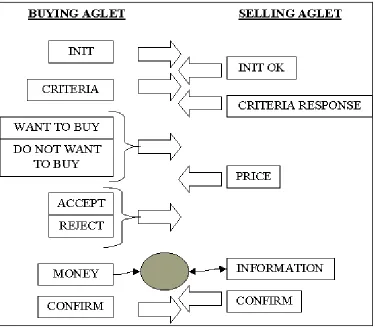
can meet each other. A conversation is initiated where soul buyers tell soul sellers what
information they are seeking. The soul sellers respond with the price this information would
cost. If the price is considered suitable, money and information are exchanged. Both data
subjects and data users can track what transactions have been carried out in their name via a web
page.
While the Soul Seller System works well on a small scale, problems are experienced when
attempts are made to scale it up. This is due to the limit on the number of Aglets that can be run
on just one Aglet server. Two possible solutions include using a database to represent the soul
sellers or to permit multiple marketplaces thereby enlarging the capacity of the system. It is
concluded that basing the transactions exclusively on Aglets is useful when developing a
Table of Contents.
TABLE OF CONTENTS. IV
TABLE OF FIGURES. VI
1 INTRODUCTION. 1
1.1 INTRODUCTION TO THE PROBLEM DOMAIN. 1 1.2 AIMS AND OBJECTIVES OF THE PROJECT. 2
1.3 STRUCTURE OF THE REPORT. 2
2 REVIEW OF THE PROBLEM DOMAIN. 4
2.1 NOT QUITE BIG BROTHER. 4
2.2 PERSONAL INFORMATION HAS AN ECONOMIC VALUE. 5 2.3 DATA SUBJECTS WILL INCREASINGLY DEMAND RECOMPENSE. 6
2.3.1 PERSONAL INTELLECTUAL PROPERTY. 7
2.3.2 ECONOMIC AND MARKET THEORY. 7
2.3.3 PRIVACY, LAW AND ACCEPTABLE PRACTICE. 8
2.3.4 BETTER SOURCE OF INFORMATION FOR DATA USERS. 10
2.3.5 THE PARTICLIZED MARKET. 11
2.3.6 DISCUSSION. 12
2.4 REQUIREMENT FOR A SOLUTION. 12
3 REVIEW OF AGENT TECHNOLOGIES. 14
3.1 SOFTWARE AGENTS. 14
3.1.1 DEFINING AGENTS. 14
3.1.2 ISSUES AFFECTING ALL AGENTS. 15
3.2 MOBILE AGENTS. 16
3.2.1 BENEFITS OF MOBILE AGENTS. 17
3.2.2 DRAWBACKS OF MOBILE AGENTS. 18
3.2.3 JAVA AND MOBILE AGENT DEVELOPMENT. 19
3.3 AGENT DEVELOPMENT ENVIRONMENTS. 20
3.4 AGLETS. 21
3.4.1 AGLET BACKGROUND. 21
3.4.2 THE AGLET ENVIRONMENT. 22
3.4.3 AGLET SECURITY MODEL. 23
3.4.4 AGLET PATTERNS. 24
3.5 XML. 25
4 DESIGN. 26
4.1 PROBLEM REVIEW. 26
4.1.1 REQUIREMENTS OF DATA SUBJECTS. 26
4.1.2 REQUIREMENTS OF DATA USERS. 26
4.1.4 WEB / DATABASE SOLUTION. 27
4.1.5 WEB / AGENT BASED SOLUTION. 28
4.1.6 CHOICE OF SOLUTION. 28
4.2 DESIGN PROCESS. 29
4.3 DESIGN OUTLINE. 29
4.4 DESIGN DECISIONS. 32
4.4.1.1 One or multiple marketplaces. 32 4.4.1.2 Serialised objects. 33 4.4.1.3 Information Representation. 33 4.4.1.4 Transaction repudiation. 34 4.4.1.5 Enforcement of usage policies. 34 4.4.1.6 Honesty and / or Accuracy of Seller Information. 35 4.4.1.7 Potential Problem with Buyers. 35 4.4.1.8 Coping with Failure. 35 4.4.1.9 Exchanging Money between Aglets. 36
5 IMPLEMENTATION. 37
5.1 SOUL SELLER. 37
5.2 SOUL BUYER. 40
5.3 MARKETPLACE. 42
5.3.1 CONVERSATION PROCESS. 44
5.3.2 THE RATING / SCORING PROCESS. 46
5.3.3 CALCULATING THE PRICE. 47
5.3.4 CHOOSING WHICH SOULS TO BUY. 47
5.3.5 THE ESCROW AGLET. 48
5.4 IMPLEMENTATION AND DEVELOPMENT ENVIRONMENT. 48
6 EVALUATION, FUTURE WORK AND CONCLUSIONS. 49
6.1 EVALUATION. 49
6.2 FUTURE WORK. 50
6.2.1 ALLOW EXTERNAL AGLET DEVELOPMENT. 50
6.2.2 GENERIC DTD READER. 51
6.2.3 IMPROVED CLIENT FUNCTIONALITY. 51
6.2.3.1 Information Editing. 51 6.2.3.2 Ongoing and Automated Provision of Information. 51 6.2.3.3 One (or n) Shot Email Addresses. 51 6.2.3.4 More Flexible Price Negotiation. 52 6.2.3.5 More Sophisticated Pattern Matching. 52
6.2.4 IMPROVED MARKETPLACE SERVICES. 52
6.2.4.1 Transaction Tracking. 52 6.2.4.2 Usage Policy Enforcement. 52 6.2.4.3 Reputation Facility. 53 6.2.4.4 Multiple Marketplaces. 53
6.3 CONCLUSIONS. 53
GLOSSARY 55
Table of Figures.
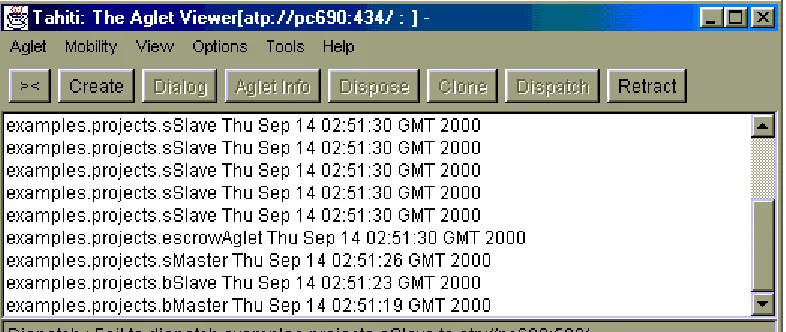
FIGURE 3.1 THE TAHITI AGLET SERVER.
...22
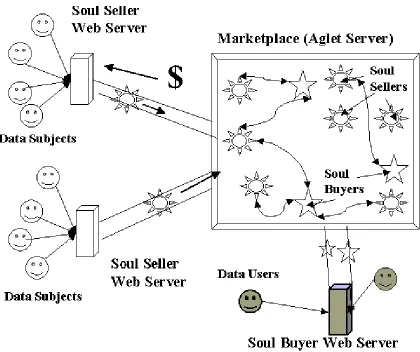
FIGURE 4.1 DESIGN DIAGRAM OF THE SYSTEM
...30
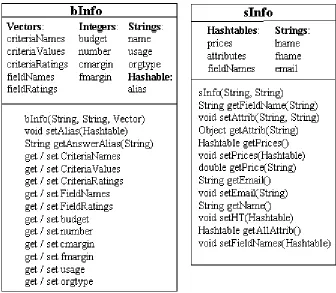
FIGURE 4.2 OBJECT DESCRIPTIONS OF THE OBJECT PASSED TO THE BUYING AND SELLING AGLETS, RESPECTIVELY.
...31
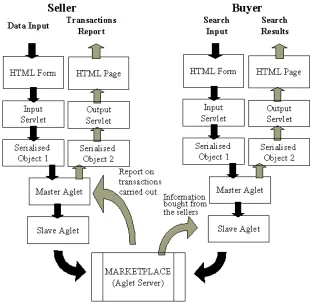
FIGURE 4.3 HOW INFORMATION FLOWS TO, FROM AND BETWEEN BUYERS AND SELLERS.
...32
FIGURE 5.1 CYCLE OF CONTROL THROUGH THE SYSTEM.
...38
FIGURE 5.2 SCREENSHOT OF THE SOUL SELLER INFORMATION ENTRY WEB PAGE
...39
FIGURE 5.3 SCREENSHOT OF THE SOUL BUYER SEARCH ENTRY WEB PAGE
...41
FIGURE 5.4 SCREENSHOT OF THE WEB PAGE RETURNING RESULTS TO A DATA USER.
...42
1 Introduction.
“You cannot think about thinking, without thinking about thinking about something.”
Seymour A. Papert, MIT Media Lab
1.1 Introduction to the Problem Domain.
The general problem domain being addressed is the area of consumer profiling. Competition is
forcing businesses to develop relationships with individual consumers. Where once marketing
and product offerings were made to large groups of consumers, now the trend is increasingly to
tailor both marketing and products to individuals. Some Internet based firms such as
Amazon.com can offer customised recommendations to individual customers based on what they
have bought before. It is known as mass-customisation. In order to develop this sort of
relationship with a consumer, some information must be known about them in advance.
Traditionally, acquiring individual consumer information was often no more sophisticated than
purchasing a mailing list from a database-marketing firm. This situation has been transformed
by two developments:
1) There is a requirement for a much greater level of detailed knowledge about consumers
to do business on a mass-customised basis.
2) The increased connectivity of consumers allows new methods of obtaining information
about and from consumers.
It is the contention of this dissertation that consumers will not only be increasingly incentivised
to provide information about themselves but that they will come to expect and demand
recompense for doing so. If this is true then some mechanism will be required to get data from
consumers to businesses and to get the compensation or reward from the businesses to the
consumer. Schemes such as supermarket loyalty points, with their associated discount or cash
back benefits, are only suitable for tracking certain types of information and in certain situations.
Similarly, online consumer profiling such as Amazon’s only captures a small subset of possible
useful information. The ideal solution is to have all information about a person available, but
available at a possibly high price. The origin and control over usage of that information must
reside with the consumer himself. This work is intended to address the logistical problems
inherent in such a system. It does this by providing an application that facilitates data subjects
1.2 Aims and Objectives of the Project.
There are four objectives for the overall work:
1) To establish that there is a requirement for an application that will allow ordinary consumers
to sell information about themselves, such as transaction data, to commercial (or otherwise)
data users.
2) To create an application that fulfils the requirements described. The application must
provide data subjects with an easy to use, flexible method of providing the information about
themselves, which they are willing to sell. Conversely the application must also allow data
users the ability to search for their target type of data subject and purchase specific
information from them. This must be done without compromising the private nature of the
data subject’s information.
3) To create a suitable information representation structure that can deal with different data
formats, data types and volumes.
4) To test the suitability of agent technology for this application.
1.3 Structure of the Report.
Chapter 1 gives a brief introduction to the problem area being addressed, leading on to the aims
and objectives of the project.
Chapter 2 discusses the problem area in more detail, building up the evidence for the assertion
that the Soul Seller application is already or soon will be required. Some current methods of
data collection and the rise in data mining are examined. An argument is made that personal
information has a significant economic value and evidence is used to support this claim. It is
then posited that data subjects will increasingly seek incentives to surrender or permit use of
their personal information. A number of arguments are advanced in support of this. The
logistical problems involved in bringing data subjects and users into contact in order to carry out
exchanges are identified. Finally, the likely characteristics of a solution to these logistical
problems are considered.
Chapter 3 reviews agent and related technologies. The contentious issue of exactly defining just
what are agents, is discussed and largely dismissed as being unnecessary. The issues that affect
all types of agents are then examined. The subset of agent research known as mobile agents is
then addressed. Rothermel’s taxonomy of agent mobility is used to distinguish between the
varying kinds of mobile agent. The advantages and disadvantages of agent mobility are
identified along with the reasons for the selection of Java as the most common development
language for mobile agents. Different agent development environments are briefly examined.
patterns. XML is then briefly discussed as a possible enabler of greater information
interoperability.
Chapter 4 deals with the design phase of the project. The problem domain is reviewed from the
point of view of identifying user requirements. Alternative options to using agents as the basis
for development are examined. The unusual characteristics of the problem domain are discussed
in the context of their influence over the design process. The design outline is then given,
highlighting the different components of the system. Lastly, individual design decisions and
issues are discussed.
Chapter 5 provides the particulars of the implementation of the system, broken down into the
three major sections - Seller, Buyer and Marketplace. Specific details discussed include the
structure of the buyer-seller conversation, the use of the escrow agent, the calculation of the
matching statistic and how the selection of sellers to buy from is made.
Chapter 6 evaluates the work and how successful it is in meeting the project objectives. The
2 Review of the Problem Domain.
“Civilization is the progress toward a society of privacy."
Ayn Rand, ‘The Fountainhead’
The features and issues of the problem domain are discussed in this chapter. Assertions are
made as to the likely developments in the domain and these are supported by a number of
arguments. The motivation for the application developed is thus shown.
2.1 Not Quite Big Brother.
The notion that information about practically every move and transaction we make is stored in
some perfectly cross-referenced and easily accessible, omnipotent computer, is one of
Hollywood’s favourite conceits. This is evident from films such as ‘The Net’, ‘Hackers’ and
‘Sneakers’. Apart from being a useful, if somewhat lazy, plot device, it preys nicely on the
paranoia of those not au fait with the power of information technology and on the interest of
those who are. Typically in such films, the identity, financial, medical or other records of the
hero or heroine can be easily erased or edited with a few keystrokes by the bad guys, for their
presumably evil purposes. Anyone who has ever changed address and tried to inform the
various relevant utilities, financial and retail companies of the fact, soon experiences the rather
more mundane, frustrating reality of instant information updates.
The Hollywood all knowing computer fallacy, however, is only partly untrue. A vast amount of
information about ordinary people is held by all sorts of organisations. Every time a credit card
is used, a bank transaction made, a loyalty bonus point earned or a web site visited, data accrues
on some computer. Unlike the Hollywood fantasy, this information is certainly not centrally
maintained, cross-referenced and accessible by some shadowy ‘Big Brother’ like organisation
controlling the masses. It is held in quite isolated data pockets by companies that merely wish to
sell more goods and services. By engaging in a practice known as data mining, where patterns
in stored transaction data are identified and then exploited, companies can raise sales, cut
inventories, reduce costs and identify new products and markets. The oft-quoted example given
is that of grocery chain store that noticed a pattern occurring on Friday evenings, when there
were high sales of both baby nappies and six packs of beer to young males. By moving the
Data mining is not of course possible without the raw transaction data. Shops initially gathered
this through Point of Sale (POS) systems that stored information about each product purchase
made. POS systems did not however allow multiple purchases over time to be tracked. Shops
had no way of knowing if the buyer of one basket of goods one week was the same buyer of
another the next. The solution was to introduce loyalty card schemes. Shoppers registered with
the scheme, were issued with a numbered electronic swipe card and could then accrue valuable
loyalty points for every purchase made, as long as it was registered against their scheme number.
Ostensibly, this was to gain competitive advantage by rewarding customer loyalty, but the real
benefit was in the amount of customer information it generated. Such schemes are not cheap to
set up or run. Substantial initial investment is required as well as the ongoing costs of redeeming
the loyalty points earned, which can be between 1% and 2% of turnover. Nevertheless,
supermarkets, airlines, bookshops and web sites happily bear the cost, because the return on their
investment is high. The personal information they gain for the cost of some money off vouchers,
free flights or percentage discounts is a veritable goldmine. Not only can businesses improve
their own operational efficiency, they can understand their customers better, meet their needs
better and build a real sustainable competitive advantage [D'Arcy, 1995]
2.2 Personal Information Has an Economic Value.
Before justifying this statement, it is worth considering just what is personal information. For
the purposes of this work, personal information is any sort of information about a person that is
specific and unique to him or her. A person’s name, address, phone number, likes and dislikes,
sports team preferences, shopping habits, job description and credit history can be classed as
personal information. Ryanair’s summer timetable; Manchester United’s Premiership statistics;
the number of mobile phones in Ireland are evidently examples of non-personal information.
Not all of a person’s personal information is of interest or value to any one person or entity but
all of it is of potential interest to someone or entity. The fact that a person does not list
‘gardening’ in their leisure pursuits is useful to a gardening centre because knowing this can
save the company the cost of sending that person an unwanted garden catalogue.
Is it justified to claim that personal information has an intrinsic economic value? It is the
contention of this dissertation that it is. It costs money to gather and maintain. It provides
benefits to its holder. It is treated as an asset by regularity authorities. For example:
• The U.S. Securities and Exchange Commission ruled [Lumeria, 2000] that companies that gave away ‘free’ shares to people who registered with their web sites, requiring disclosure of
name and contact information were actually selling shares. Something of value (the
information) was being exchanged for the shares.
• Companies sometimes buy other companies for their personal information databases. In 1999 online advertising delivery company DoubleClick bought the off line database direct
marketer Abacus Direct for $1 billion. This was primarily for their 2 billion record Abacus
Alliance Database of consumer catalogue transactions. DoubleClick intended to match up
their online consumer data with the acquired company’s ‘real world’ consumer databases,
until controversy over privacy concerns made them curtail the plan.
• It is entirely common practice for many Internet companies to provide free access to services in return for consumers surrendering a certain amount of information about themselves.
There are numerous examples of such companies including Hotmail.com, Email.com,
guru.com and RealTimeQuotes.com.
• The sole raison d’étre of some companies is to facilitate the exchange of personal information. Mailing list brokers purchase collections of personal information, slice and
dice them into appropriate formats and sell them on to companies looking for new potential
customers. Typical sources of the mailing lists are magazine subscription lists, conference
attendance lists and the customer lists of other companies. According to Direct Line
Marketing, an Irish direct marketing company, mailing lists are sold at an average cost of
£150 per thousand names and addresses for a single use. So at a bare minimum a name and
address is worth 15 pence each time it is used.
Therefore, it would seem a reasonable assertion that personal information has an economic
value. Users will determine what is and is not useful information, while the market will set the
price paid. Data subjects may set whatever price they like for the information but it is up to data
users to choose whether to pay that amount.
2.3 Data Subjects Will Increasingly Demand Recompense.
Two reasonable assertions have been made with regard to personal information:
1) Commercial organisations are gathering an ever-increasing range and volume of data
about individual consumers.
2) This personal information has an inherent economic value to a variety of entities.
A third, much less easily justified assertion is required to fully explain the motivation for this
will or should accrue to that person. There are a number of arguments of varying strength that
can be made in support of this:
2.3.1 Personal Intellectual Property.
The argument here is a quasi moral / legal one. It is based on the assumption that because the
information about a person originates from that person, they own, in some legal or moral sense,
the rights to that information. The information should be given the same legal copyright
protection as, say, a song or a novel. This argument may be viewed as somewhat weak. After
all, information about someone is not created in the same way as an artistic work. The copyright
protection afforded to a song is partly to encourage creative works and partly to protect their
creator’s livelihoods. The sort of personal information at issue here is just a side effect of
normal transactions. Indeed, in the case of a consumer’s grocery shopping patterns, the actual
consumer could probably not describe those patterns in a useful way. It is only by the use of a
supermarket’s POS system can that information be captured. The privacy argument puts
forward a much stronger case for the protection of personal information. However, the actual
rights and wrongs of the situation may not be the issue, the perceived rights and wrongs and
public opinion may be the real driver of this argument.
2.3.2 Economic and Market Theory.
David McCourt of the McKinsey consulting group devised a theory of market surplus to identify
which of the participant sectors (producers, retailers or consumers) in a market has the greatest
degree of power. Essentially in any market, there is a finite amount of profit or surplus over
costs, which is competed for by each sector of the market. The theory does not relate to the
competition within the same sector of the market, for example between different producers, but
to competition between sectors. Each sector tries to maximise the value added in its part of the
market process.
Better access to better information is one means by which one market sector can gain advantage
over others. The Stock Exchange is seen as an equitable and fair market where neither buyers
nor sellers have an inherent advantage. Equality is maintained between both groups by forcing
them to operate using the same publicly available information. Any party privy to additional
non-public information is specifically disallowed from operating in the market as this ‘inside
information’ confers an unfair advantage. However, in the insurance market for instance, there
and size of their risks, than the consumers know about the insurance companies, for example the
speed of their claims handling. Customers are thus not equipped to make the best choice of
policy for them, but insurance companies can price the policies in a way advantageous to them.
The market surplus would then be primarily with the companies.
Most markets for normal goods and services operate in this way, with built in information
imbalances. It is generally true that producer companies are large entities with greater resources
available to them than the individual customers they serve. These resources allow them to both
gather information about their customers and to dispense ‘favourable’ information about
themselves via advertising. Producers can carry out extensive market research to find out
information about the consumers and their preferences. Advertising on the other hand pushes
non-objective information to the buyers influencing them to be more sympathetic towards the
advertiser. An information imbalance thus results, giving the producer side of the market an
advantage over the consumer part of the market.
The argument in favour of data subjects being paid a fee for the use of information about them
thus states that because this information gives additional advantage to the data user (the producer
or retail segment), the consumer or data subject should be compensated.
2.3.3 Privacy, Law and Acceptable Practice.
The essence of this argument is that the right to privacy affords people the right to choose freely
under what circumstances and to what extent they will expose themselves, their attitudes and
their behaviour to others [Westin, 1967]. So the fact a person subscribes to a certain magazine
should not be revealed to others unless the subscriber has given permission for this information
to be shared. Permission to share or use is a key concept in this area.
The legal right to privacy is by no means a universally accepted or defined right. Some
jurisdictions do not even explicitly mention it in their constitutions or laws. However, the
national courts in most of those countries have found the right in other provisions
[Privacy-International, 1999]. There are also International Agreements on Human Rights such as Article
12 of the 1948 Universal Declaration of Human Rights, which declared, “No one should be
subject to arbitrary interference with his privacy, family, home or correspondence.” It was only
in the 1960’s and 1970’s that the notion of the right to privacy was linked to the computer
domain. The growing availability of sophisticated and powerful information technology led to
concerns about its surveillance potential. The ability of computer systems to search and cross
and immediate than ever was possible with purely paper-based systems. In 1970, the Land of
Hesse in Germany was the first to introduce Data Protection legislation. Since then similar
legislation has been introduced and harmonised across Europe with the introduction of the 1995
Directive on Data Protection [European-Parliament, 1995].
This directive defines the duty of care organisations (whether governments, companies or
whatever) must take with the data they hold on computer as well as the rights of people (“data
subjects”) to have access to the information held about them. In particular all data must be: • Obtained fairly and lawfully;
• Used only for the original specified purpose; • Adequate, relevant and not excessive to purpose; • Accurate and up to date;
• Accessible to the subject; • Kept secure; and
• Destroyed after its purpose is completed.
It is not difficult to see how the strict implementation of such laws would quickly have a
profound effect on Internet companies hoping to capture and use the personal information about
their customers. In deed, this has been a source of conflict between the E.U and the United
States. The conflict arose because under the terms of the directive member States have an
obligation to ensure that personal information relating to European citizens can only be exported
to countries that have an “adequate level of protection.” The United States has no similar
protective legislation. Eventually, under a ‘Safe Harbour’ agreement, export of information was
allowed from Europe to America if the organisations using the information undertook to adhere
to the terms of the directive.
While there may be no similar data protection legislation in the United States (other than for
minors), there is a great deal of private concern over the increased loss of privacy from the rise
of an all-encompassing Internet based economy. There is much evidence of a growing general
awareness amongst web users of the threat to privacy from online profiling. Quite a number of
privacy rights promoting organisations such as www.privacy.org, www.epic.org (the electronic
privacy information centre) and www.privacyplace.net have been established. They are joining
longer established organisations such as the American Civil Liberties Union (ACLU) and the
Electronic Frontier Foundation (EFF) in a bid to inform, raise awareness and gain support for
There is a trend amongst commercial web sites to display their privacy policies, stating what can
and cannot be done with the information gathered from customers and visitors. There is
however no legal enforcement of these policies. If the policies are infringed, the customer has
no right to compensation. Even if they had it would be irrelevant as the policies can be changed
at will. The U.S. Federal Trade Commission (FTC) reported to the U.S. Congress on Online
Privacy [Pitofsky, 2000]. In the report the FTC recommended the introduction of regulation of
consumer oriented web sites to protect the privacy of their users. Whether this recommendation
is adopted or not commercial pressures may eventually lead to a tightening of the actual privacy
practices of Internet companies. Mention has already been made of the controversy over the
DoubleClick plan to cross-reference their online database data with the Abacus ‘real world’
database data which eventually forced a climb down, at least until ‘proper privacy standards’ are
in place. It remains to be seen if a similar backlash will affect Amazon who very recently
changed their privacy policy to allow the resale of customer data to third parties in the event of
the company being sold. Certainly if the digital chattering classes at the popular online
discussion site, SlashDot.com, are in anyway representative of the general online population
(unlikely), Amazon may have a problem. Already the aforementioned Electronic Privacy
Information Centre has discontinued their book selling agreement with Amazon.
So, while technological advances in computing power and data mining may be expanding the
data acquisition options available to data users, legislation whether domestic or imported and
commercial pressures, restrict them. In order to gain the full benefit of the personal information
they possess or can obtain, the privacy argument contends that organisations will increasingly
have to obtain the permission of the data subject. Data subjects will need to be enticed to give
that permission. A recent survey of web users [Andersen, 2000] found that three-quarters of
respondents would reveal additional personal information in return for some reward. Hence,
recompense will be paid for the use of personal information.
2.3.4 Better Source of Information for Data Users.
The fourth argument in support of recompensing data subjects for the use of information about
them is that obtaining the information directly from them will result in better quality
information. The theory is that who would know a person’s opinions, feelings or behaviour
better than the person himself would?
This may be true for certain types of information but is unlikely to be true for all. There are two
problems with this hypothesis, the first with accuracy and the second with honesty. In the
what groceries they bought last month? This problem could be applicable to many categories of
desirable information. Alternatively, the data subject may know the required information
accurately but be unwilling to share it, perhaps because it is embarrassing. Hence an inaccurate
answer might be given. Alternatively, an answer might be given that the data subject wants the
questioner to believe about them. The act of asking a question affects the answer given. This is
the well-known Hawthorne Effect. Indeed, by paying for such information there may even be an
increased distortion. Nevertheless, for certain types of personal information there is no other
way than to approach the originator of the information. How else can opinions be obtained?
Future technology such as personal digital assistants (PDAs) or web avatars will make possible
the capture and storage of detailed transaction information by data subjects. Access to these
personal databases on an ongoing basis would provide the very best source of information
possible. After all, disintermediation, cutting out the middleman, has long been one of the
promises of the Internet. By going to the source, data users would no longer have to rely on
retailers and market data bureaux for data that may have already been filtered or adulterated in
inappropriate ways. The direct marketing industry standard response rate for unsolicited postal
mailings is only 1%, i.e. 99 out of 100 junk mails are wasted. Any innovations that can help cut
this cost would be very much welcomed.
2.3.5 The Particlized Market.
‘Mass customisation’, ‘One to one marketing’ and ‘Particlized markets’ are all business
buzzwords highlighting the fact that markets are becoming increasingly fractured. Whereas once
businesses could rely on there being no more than a few clear cut divisions in any market, there
may now be hundreds. Popular music is a good example. Dance music used to be a single,
clearly defined market segment, now it has splintered into a few dozen subdivisions - garage,
trance, hard-core and so on. The same phenomenon is repeated across markets as diverse as
computers and cars. Dell famously builds their PCs to individual customer specifications.
BMW have started to the same thing with their cars. Wacker and Taylor in their book about the
future of business [Wacker, 1997] state that mass marketing, pushing the same message to a
large group of people, was appropriate to an era of mass production. But now, markets are being
increasingly ‘particalized’ – broken down to smaller and smaller sized markets until there will
only be single individual sized markets. Marketers will have to come to individuals for their
information, that is the only way they will be able to get to know them sufficiently well to sell to
2.3.6 Discussion.
The contention that organisations will be willing to pay compensation to consumers to obtain
their information is a fundamental assumption of this dissertation. Arguments have been
presented in support of the validity of this assumption. While none of the arguments may be
wholly convincing on their own, collectively they represent at the very least a reasonable case.
It is apparent that the benefits and advantages of the Internet bring with it the necessity to
sacrifice some personal privacy to make full use of it. As Wacker and Taylor point out, to be
willing to sacrifice some privacy is not to be willing to sacrifice it all. In privacy as in most
things, the rarer it becomes the more people value it.
2.4 Requirement for a Solution.
If the assertions made so far are accepted, inevitable questions arise. How could such
transactions be carried out? What mechanism or system would be necessary? How would it
work?
If a manual method of operation is considered, immediate problems can be foreseen.
• How will initial contact made with someone whose contact details are not already available? This is the availability or cold calling problem.
• How will the actual information be transferred? A telephone conversation might be suitable for obtaining simple opinion information but how would detailed shopping pattern data be
exchanged in conversation? This is the detail or granularity problem.
• What type of incentive will be used to induce the surrender of personal information or permission to use it? Will the incentive offered be sufficient to justify the time and effort to
(a) make a decision about whether to accept or reject the incentive and (b) find and transfer
the information? This is the assessment cost problem.
It is very difficult to imagine any manual mode of operation being acceptable to either buyer or
seller of the information. The logistical problems are just too great to overcome. It is perhaps
why much personal information is presently gathered from data agglomerators such as magazine
subscription lists. Ideally, a solution should at least address the three issues mentioned above.
That is, the solution should have the characteristics of:
Availability: The information should be optionally available to data buyers with which the data
Granularity: It must be possible to ask for and grant permission for very specific pieces of
information and also to define precisely how it could be used. For example, a data subject may
permit use of his email address for a once off commercial email but not permit transfer of his
physical address to a third party. Distinctions may also be made by the sellers between different
buyers. A data subject may be more likely to give their details to a charity organisation than to a
direct marketing company.
Autonomy: The process should not require the involvement of humans as much as possible.
Thus, inconvenience to the data subject is avoided, as they do not have to constantly assess what
information they wish to reveal, how and to whom. A once off policy would be set that would
then be applied to all requests on the data subject’s behalf. This would also apply to the
payment of incentives. From the data users (or collectors) point of view an automated method is
far more efficient, faster and accurate.
What is being sought is an agent to represent data subjects in their transactions with data users.
Wacker and Taylor refer to such an entity as a ‘privacy agent’ describing its task as being “To
make sure you get paid for the information you give up about yourself.” The use of the term
‘Agent’ here is coincidental to the typical computer science or AI meaning of the term. Petrie in
[Petrie, 1996] and others refer to the fact that the label ‘Agent’ is overloaded for a variety of
contexts. It is used here in the same sense as, say, a literary agent or real estate agent. That is,
agent means someone/something that represents another. It is (mostly) coincidental that
‘Agents’, in the computer science sense, are used as part of the solution proposed in this
3 Review of Agent Technologies.
“Knowledge always desires increase; it is like fire, which must first be kindled by some external agent, but which will afterward propagate it."
Johnson.
In this chapter, a review is made of the various technologies used in the application and its
development. These include software agents, Java, agent development environments, IBM’s
Aglet technology and XML.
3.1 Software Agents.
3.1.1 Defining Agents.
Agent research became a ‘hot topic’ for computer science in the early 1990’s. Linked with the
hype surrounding all things connected to the Internet, ‘agents’ became a buzzword in the popular
computing press around 1994. Agents were being touted as ‘the next big thing’ in computer
science. A 1994 Ovum report entitled “Intelligent Agents: the New Revolution in Software”
[Ovum, 1994] predicted that the market for agent software and products in the USA and Europe
would be worth $3.9 billion by the year 2000. Obviously, this has not happened. Failing to live
up to the hyperbole surrounding a research field does not mean the research field itself has
failed. [Nwana, 1999] remarks that the field has clearly matured since this time, with the
publication of certain key papers, the establishment of several annual conferences and
workshops, the founding of agent standardisation initiatives such as the Foundation for
Intelligent Physical Agents (FIPA) and the launching of dedicated Agent journals.
Even a cursory examination of the literature from the study of agents would reveal that it is
traditional, if not in fact ritual, to refer to the lack of consensus agreement amongst researchers
on what the generic term “agent” means. Some [Wooldridge, 1995] dismiss this as hardly mattering; others [Franklin, 1996] and [Bradshaw, 1997] extensively review, seeking to find
common ground amongst the agent community. There is, however, little consensus amongst
agent researchers about the nature of agents and agency. It may be useful to remember that there
is no shared common definition of intelligence amongst the AI community, yet it continues to
expand as a research field. Russell and Norvig make the insightful observation that “The notion
of an agent is meant to be a tool for analysing systems, not an absolute characterization that
This dissertation therefore does not intend to present a full discussion on what an agent may or
may not be. There are plenty of papers that fulfil that need, such as [Nwana, 1996]. For the
purposes of this work the following definition has been adopted from [MEITA, 1998] “An
independent software program that runs on behalf of a network user.” In the context of this
work, “selling” agents operate on behalf of the data subjects while “buying” agents act on behalf
of the data users.
3.1.2 Issues Affecting All Agents.
Nwana and Ndumu in their rather gloomy review [Nwana, 1999] of the progress or otherwise of
agent research identify a number of challenges that affect multi-agent systems but this analysis
can be applied to all types of agents, whether ‘intelligent’, ‘autonomous’, ‘mobile’ or
‘information retrieval’. They define the issues and give their assessment of the progress made in
resolving them.
The Information Discovery Problem: Some method is required to discover what relevant
agent resources exist and where they are located i.e. an agent equivalent of a domain name
server. This would need to map resources to physical addresses in an automated fashion and,
crucially, be kept up to date. Nwana & Ndumu maintain that there is little work addressing the
general form of the problem within the context of a truly open environment.
The Communication Problem: Agents from different sources need to share a common
communication language and protocol in order to inter-operate. General-purpose content
languages like Knowledge Interchange Format (KIF) have been developed but the agent
community, in Nwana & Ndumu’s view, do not take them or initiatives like FIPA entirely
seriously.
The Ontology Problem: Ontologies specify the vocabulary used in a particular domain. This
allows two agents, used in a travel environment for example, to agree on a common definition of
a flight, an airfare or a cancellation. Domain specific ontologies are being created but there is no
standardisation between them – ontologies are not addressed in KQML or FIPA ACL. This is a
key issue in the context of this dissertation. Although ignored by Nwana & Ndumu, XML
(eXtensible Mark up Language) may be go someway towards addressing this issue. XML is
discussed later.
The Legacy Software Problem: In order for agents to be useful in the real world they will have
to interact with existing systems based on older technologies that possibly were never designed
communicate with the agent. Their concern is that little effort is made towards automating this
task.
The Reasoning and Co-ordination Problem: Agents that hope to carry out useful real world
tasks such as the well known travel booking example needs to be able to reason, plan and satisfy
constraints in order to carry out their tasks. Nwana & Ndumu believe this to be one area
adequately tackled by current agent researchers.
The Monitoring Problem: All of the above problems crop up again when the issue of post-plan
monitoring is considered. Agents need to be able to monitor the external environment, evaluate
changes in that environment, determine if the changes are relevant to their situation and take
appropriate action if they are. The lack of suitably rich ontologies means that while some
domain and application specific approaches have been taken no general-purpose total solution is
possible.
In an interesting aside, the papers’ authors observe that the key ingredient in the successful agent
projects they highlight is that in each case there were real world problems to be solved. They
speculate that much of the current agent research does not address real problems. Furthermore,
they opine that much research is too concerned with the ‘theoretical’ aspects of agents and not
enough with solving actual problems.
3.2 Mobile Agents.
Mobile agents are defined by as agents that “Can travel to multiple locations in the network”
[MEITA, 1998]. Alternatively, Nwana defines them as “Computational software processes
capable of roaming wide area networks (WANs) such as the WWW, interacting with foreign
hosts, gathering information on behalf of its owner and coming ‘back home’ having performed
the duties set by its user.” Essentially, the agent program can start execution at one location,
suspend itself at an arbitrary point, transfer both its code and data and/or state to another location
and resume execution from the same point in the code with the saved data and/or state,
depending on whether weak or strong mobility is required.
As with general software agents, not all of what are claimed to be mobile agents are actually
proper mobile agents. [Rothermel, 1997] created a taxonomy of mobility to distinguish between
its different degrees.
Remote Execution / Code on Demand: This is where an agent program is transferred to a
remote note before it is activated. This transfer only happens once and the code runs until
destination initiates the transfer of the program code. This is really code mobility rather than
agent mobility.
Weak Migration: This is where only the agent code and its data can be transferred at an
arbitrary point in its execution.
Strong Migration: This is where the agent code, with its complete state can be transferred at an
arbitrary point in its execution.
Strong migration, while very attractive from the programmer’s point of view, is difficult to
achieve as few languages can externalise state at a high level. Telescript and AgentTcl are able
to do this. However consider capturing and transferring the complete agent state of a
multi-threaded agent – this could be a very expensive operation. Hence weak migration, where only
the data state is transferred, was developed. This transfers the onus to the programmer to ensure
all the relevant execution state of the agent is made consistent and captured in the program’s
variables. Weak migration is the type of mobility used in many Agent Development
Environments and Toolkits such as the Aglets Software Development Kit (ASDK) from IBM
and Concordia from Mitsubishi.
3.2.1 Benefits of Mobile Agents.
What benefits does allowing processes to migrate give? Nwana gives some of the potential
benefits of mobile agents including:
Reduced communication costs: For example it is much more efficient to transfer a small
program to an image repository (such as satellite photographs) to filter and choose appropriate
images rather than transferring all of the images back to base to pick them. This benefit is
particularly relevant to the ‘Soul Seller’ application.
Support for local clients with limited resources: Clients with only a relatively small amount of
memory and processing power, for example mobile devices such as cellular phones and PDAs,
could make use of mobile agents for more complex operations beyond their local capabilities.
Asynchronous computing: The mobile agents can be initiated and perform their task while their
owner does something else. They may operate when their home host is not even connected to
the network. In the ‘Soul Seller’ application this allows information searches to be initiated, a
period of time spent disconnected can pass and the results can still be collected when a
connection is next made.
Radical rethinking of the design process: Agent orientated design represents an opportunity to
radically rethink the general design process.
In his analysis of mobile agents [Harrison, 1995] finds that while there is no individual
advantage of mobile agents that cannot also be done by other means, there is no one technique
that supplies all the advantages of mobile agents.
A further advantage not mentioned by Nwana or Harrison but experienced during the course of
the project is increased security of information. This may seem paradoxical, given that security
is often a key problem with mobile agents but in certain circumstances, it can be true.
Confidential information is more secure if it does not have to travel over a network to be
reviewed. The use of, properly vetted, mobile agents can ensure that such information does not
leave its ‘home base’ while still being available for inspection. By inspecting the code of the
agent, it can be verified that it returns to its sender with only the information it is allowed to have
and nothing more.
3.2.2 Drawbacks of Mobile Agents.
In almost every analysis of mobile agent systems, the key drawback identified is security but this
is by no means the only drawback. Rothermel identifies three main issues with mobile agents:
agent security mechanisms, control structures and transactional support. [Wayner, 1995] lists
the following major challenges: transportation, authentication, secrecy, security and agents
spending their owners money to which Nwana adds performance issues and the problem of
interoperability amongst differently created agents.
Rothermel identifies four areas where security issues can arise. These are (1) inter-agent
security, (2) agent-host security, (3) inter-host security and (4) security between hosts and
unauthorised third parties. Existing cryptographic techniques can be used in areas (1), (3) and
(4) but area (2) is new and specific to mobile code systems. Security between agents and hosts
is a two way street. Agent servers or hosts need to be protected from malicious or
malfunctioning agents while agents themselves have to be protected from malicious or
malfunctioning hosts. The first problem is usually addressed by what is known as the Sandbox
security model – all potential dangerous procedure or method calls are restricted, similar to how
security is implemented in Java Applets. Alternatively, server administrators could also choose
to allow all operations but only accept agents from highly trusted sources. This approach
obviously restricts the ‘openness’ of the agent system. Nor is it fully protective of the host, as a
The second problem of protecting mobile agents from malicious hosts is a lot more interesting
and is specific to mobile agents. [Hohl, 1998] identifies twelve separate types of attack that
hosts could carry out. These are spying out code, data, control flow or the interaction with other
agents, manipulation of code, data, control flow or the interaction with other agents, incorrect
execution of code, masquerade attacks, denial of execution and returning wrong results of
system calls issued by the agent.
Four research directions for resolving these problems are suggested by Rothermel:
The organisational approach: Only run agents on trusted hosts – such as other hosts on the
organisation’s intranet. This restricts the openness of the system.
The reputation approach: Only run agents on hosts with good reputations. This has the same
problem with restricting openness as well as introducing a burden of maintaining reputation
information.
The manipulation detection approach: Use mechanisms to detect manipulation of data or
execution of code. This does not prevent ‘spying’ attacks.
Black-box protection approach: Use code obfuscating techniques to prevent the attacker
seeing what is being done by the agent code. The agent would be protected but only for a certain
time interval as the attacker would eventually analyse the code. After the expiration period, the
agent and its data would become invalid.
[Hohl, 1998] adds a fifth possible approach, that of using mobile cryptography. Encrypted
programs are programs that consist of operations on encrypted data. This has the advantage of
not being time-limited (given sufficiently strong encryption) but it cannot be used in all
programs as only polynomial and rational functions can be used with this technique. Ultimately,
the problem of completely protecting agents from their host servers is intractable; hosts must
always have the option to terminate the execution of an agent for which there is no remedy.
3.2.3 Java and Mobile Agent Development.
Mobile agents usually use an interpreted language for mobility and security reasons. While
executable binaries could be used and would generally be more efficient, they would be tied to
specific platforms. Java is widely adopted for writing mobile agent systems [Versteeg, 1998]
not only because it is an interpreted language but also because it provides many of the facilities
necessary for building mobile agent systems. These include object serialisation, networking
• Object Serialisation: This allows an object to be written to a serialised stream and for a
serialised stream to be read into an object. This means for example an object could be
written to a file, the file could be transferred to another machine and the object recreated
from the file. This is obviously a very useful mechanism for agent migration. One
drawback of the Java Virtual Machine architecture is that it does not allow access to
programs to directly access or manipulate the execution states for security reasons. This
means that the agent heap cannot be serialised and hence strong migration, as mentioned
previously, is not possible.
• Multithreading: Java not allows the use of multithreaded programs but supports them with
built in synchronisation primitives. Each agent can therefore run in its own process or thread
which is essential for allowing an agent to execute autonomously of any other agents at the
same location.
• Security: Java’s security is one of the key features that has made it so successful. The Java
Security Manager mechanism allows untrusted programs, such as applets to be executed
safely. For each application, it is possible to create a customised, very fine-grained security
policy using the Security Manager. It allows differentiation between individual operations
so that, for example, an application may be allowed to accept an incoming socket requests
but could not make its own outgoing socket request. For dealing with untrusted agents
migrating to a host, this feature is essential.
Other programming languages such as Telescript or AgentTcl provide more facilities specifically
aimed at agent development such as support for strong migration and better resource control.
Java, however, remains the language of choice for most agent development, possibly due to
greater number of developers already with Java experience.
3.3 Agent Development Environments.
A number of Agent Development Environments (ADE) and toolkits are now available that make
the creation and deployment of mobile agents a great deal easier. Versteeg evaluates four such
systems; IBM’s Aglets, ObjectSpace’s Voyager, Mitsubishi’s Concordia and General Magic’s
Odyssey. Other toolkits available include Panasonic’s Beegent and Plangent, the FIPA backed
Grasshopper system and Stanford University’s Java Agent Template (JATlite).
With the exception of JATlite, most ADEs or agent toolkits have several features in common.
JATlite does not provide inbuilt abilities to migrate agents from one host to another. The
executes the agents in a security-controlled sandbox. The toolkits provide different API classes
(which therefore make the agents from one toolkit incompatible with those from another)
containing some base class from which all mobile agents are derived. This base class provides a
common interface to all mobile agents. Agent migration is also similar amongst the toolkits. A
method is supplied that when invoked causes the agent to migrate to another host. As only weak
migration is supported, methods are provided that can be called just before migration or after
arrival. Therefore the agents can have their states saved before migration and can be initialised
again when it arrives. The toolkits also provide several mechanisms for the agents to
communicate with each other. Messages can be synchronous, asynchronous, multicast and
future reply, though not all toolkits support all of them.
In the choice of which ADE to use, Aglets was chosen as the most suitable. Voyager and
Odyssey at the time of development were no longer being supported by their creators. Beegent
and Plangent had only recently been introduced and hence there was little research available
about them. Concordia was also considered but IBM’s Aglets toolkit was chosen as it had the
simplest API that still covered all the essential features such as mobility and messaging. It also
has good supporting tools and documentation as well as a small but active development
community.
3.4 Aglets.
3.4.1 Aglet Background.
Danny B. Lange created the concept of ‘Aglets’ while working as a visiting scientist as IBM’s
Tokyo Research Laboratory [Lange, 1998]. Aglets are Java objects that can migrate from one
Aglet-enabled host to another Aglet-enabled host on a network. An Aglet Software
Development Kit (ASDK) was available as a free download from IBM’s Aglets site [IBM,
2000]. IBM announced in August 2000 that the Aglet source code would henceforth be
available under an Open Source type license. The ASDK consists of the Application
Programming Interface, documentation, example code and an Aglet server called Tahiti.
Version 1.0.3 was used in the development of the ‘Soul Seller’ application. Although a more up
to date version was available, it had a time-limited license that was due to expire during the
course of development.
3.4.2 The Aglet Environment.
The Lange book gives a thorough overview of the Aglet development environment. An ‘Aglet’
is a Java program that inherits from the Aglet class. The Aglet class provides methods that allow
an Aglet to carry out actions such as dispatching itself to another location, sending and receiving
messages to and from other Aglets and disposing of itself. The Aglet model that underlies the
Aglet API relies on several abstractions. Aglets run on an Aglet server. A server is a process
engine of which several can run on a single machine or network node. The Aglet server can host
several contexts. A context is a stationary object that provides a uniform execution environment
for one or more Aglets. Each Aglet has its own proxy, which both shields the Aglet from direct
access of its public methods and provides location transparency for the Aglet. An Aglet has a
[image:29.595.103.496.337.503.2]globally unique identifier. The identifier cannot change during the lifetime of the Aglet.
Figure 3.1 The Tahiti Aglet Server.
Three more elements are necessary to fully understand Aglets: Aglet Operations, Aglet Events
and Aglet Messages. Aglet operations consist of creation, cloning, dispatching, retraction,
activation/deactivation and disposal. These are self-explanatory. The Aglet event relies on
listeners to fire particular actions once an event is caught. The three kinds of listeners are
mobility listeners (catches changes in Aglet location), persistence listeners (catches changes in
the activation/deactivation state of the Aglet) and clone listeners (catches cloning events). All of
these listeners can be customised to carry out various types of action depending on the event
being caught. Lastly, Aglet messages can be synchronous, asynchronous, multi- or single cast,
require a reply or not. Messages are not sent to Aglets themselves (which can change address)
but to their proxy (which cannot). Location transparency is thus provided. Messages can be of
atomic argument, such as a Boolean or an integer or an argument table such as a key-value pair
hashtable. The Aglet messages model while simple to use, is sophisticated. It also provides a
message prioritisation facility.
3.4.3 Aglet Security Model.
Aglet servers allow execution of Aglet code from their own local code bases as well as those
from other Aglet servers that have migrated to the server. All the potential mobile agent
problems discussed previously also apply to Aglets. The Aglet security model supports security
policies, which relate permissions (what can and cannot be done) to the principals of the system.
The notion of a principal is important. In the general definition, a principal is any entity whose
identity may be authenticated by any system the principal may try to access. Specifically to
Aglets a principal is a program, person, company or other legal entity that originated, controls or
is responsible for some constituent part of the overall Aglet system. Karjoth, Lange and Oshima
[Karjoth, 1997] list the principals in the Aglet security model:
Aglet: An instantiation of an Aglet program.
Aglet Manufacturer: The author of the Aglet program. Maybe a human, a company or similar.
Aglet Owner: The initiator of the Aglet program, the person or company that launched the
program.
Context: The interpreter that executes the Aglets.
Context Manufacturer: The author of the context program or product that the Aglet is running
in.
Context Master: The owner or administrator of the context program or product.
Domain Authority: The owner or administrator of the domain or group of contexts.
Each principal can define their own security policy, but the key policies are defined by the Aglet
owner and the context master. These define respectively what can be done by the specific Aglet
anywhere and what can be done by any Aglet within in the specific context. There is a hierarchy
of security policies so that an Aglet owner can be overridden by the context master and the
context master by the domain authority and so on. Hence, in a conflict between Aglet and
context policies the context master’s policy would prevail. For example an Aglet’s security
policy may allow it to have only read and write access to all files in a certain directory, but the
File permission: Aglets can be granted or denied read or write access to the local file system,
whether named files or entire directories.
Network permission: Aglets can be granted or denied access to network resources. For
example, an Aglet may be allowed to connect to certain hosts but not others. A blacklist of
known rogue hosts could thus be maintained.
AWT permission: Defines whether Aglets can open a window or not.
Context permission: Defines whether methods provided by the context can be invoked. For
example, an Aglet might be allowed to create (or dispatch or clone) some types of Aglet but not
others.
Aglet permission: Defines what methods can be carried out on an Aglet. For example an Aglet
can be given permission to carry out the dispose() method on another Aglet owned by a named
principal, but may have no permission to interfere with other Aglets.
System permission: This was proposed as part of the Aglet security model but has not yet been
implemented in any available ASDK. It defines permissions for systems resources such as
memory or CPU usage.
The security of the Aglets used in the ‘Soul Seller’ application is obviously a key issue. It can
be seen that the level of security control offered by the Aglet system is fine grained. Security
policies are easily implemented by allocating permissions to principals. All of the Aglets owned
by person A might be granted full file access right while those from an another, untrusted or
unknown person may only be granted read rights. It is unfortunate that it was not possible to
implement the system permissions proposed as this could prevent ‘denial of service’ type attacks
where a large number of Aglets are dispatched to a server and overwhelm its resources. The
reason for this is that Java provides no way of limiting access to processor or memory resources
to certain objects or threads.
3.4.4 Aglet Patterns.
Lange states in his book on Aglets that one of the goals in creating the Aglet API was that it
would be lightweight, adding that it was tempting to call it the RISC of mobile agents. While
this has benefits in terms of ease of learning and efficiency it does mean some omissions have
been made such as the lack of built-in support for any agent communication languages such as
ACL. A developer working with Aglets has to do a certain amount of wheel reinventing. Lange
aimed to counteract some of these omissions using design patterns, several of which are
Originating from object-orientated design, design patterns take solutions to frequently occurring
software design problems and try to reapply and reuse them in new applications. In the context
of agent and specifically Aglet applications, design patterns are particularly useful. Three
general types of patterns are described: travelling, task and interaction. Of the task patterns the
most useful for the Soul Seller application was the Master-Slave pattern. In this pattern, a
master Aglet is created whose purpose is to delegate tasks to the slave Aglets it creates. The
slave Aglet can then (optionally) change location, carry out the task and return the result to its
master. This pattern was found to be a particularly useful method of handling the agents
required to represent buyers and sellers in the application.
3.5 XML.
The eXtensible Mark-up Language (XML) is a standard originally proposed by the World Wide
Web consortium. It is not a language in itself but a language for creating languages. It is
actually a subset of the Standard General Mark-up Language (SGML). It is designed to make it
easy to exchange structured documents over the Internet. The format of XML documents is
thoroughly discussed in [Bryan, 1997].
The significance of XML is that it allows documents to be not just machine-readable but
machine understandable. A domain’s terms and documents can be standardised so that entities
can exchange information in a correct format without ever having to agree on anything other
than the appropriate Document Type Definition to use. For the purposes of this dissertation, the
exchange of personal profile information can only occur if both buyer and seller of the
information use a both a common language for negotiation and exchange standard formatted
documents. XML was not ultimately used in the implementation of the application although a
servlet was designed that could generate buyer and seller version HTML forms from a common
XML document. It was also considered as the format that data entered from the HTML forms
would be stored in. The problem was that only Java version 1.1.8 could be used with Aglets
while Java’s support for XML did not begin until version 1.2 and 1.3.
With the exception of XML, knowledge all of the topics covered in this chapter was necessary in
developing the Soul Seller application. The next chapter will show how all these different