Proceedings of the 12th International Workshop on Semantic Evaluation (SemEval-2018), pages 928–934
300-sparsans at SemEval-2018 Task 9:
Hypernymy as interaction of sparse attributes
Gábor BerendDepartment of Informatics University of Szeged
Árpád tér 2, H6720 Szeged, Hungary
Márton Makrai Institute for Linguistics Hungarian Academy of Sciences Benczúr u. 33, H1068 Budapest, Hungary
Péter Földiák Secret Sauce Partners 657 Mission Suite 410, San Francisco CA 94105
Abstract
This paper describes 300-sparsans’ participa-tion in SemEval-2018 Task 9:Hypernym Dis-covery, with a system based on sparse coding and a formal concept hierarchy obtained from word embeddings. Our system took first place in subtasks(1B) Italian(allandentities),(1C) Spanish entities, and(2B) music entities. 1 Introduction
Natural language phenomena are extremely sparse by their nature, whereas continuous word em-beddings employ dense representations of words. Turning these dense representations into a much sparser form can help in focusing on most salient parts of word representations (Faruqui et al., 2015; Berend, 2017; Subramanian et al., 2018).
Sparsity-based techniques often involve the coding of a large number of signals over the same dictionary (Rubinstein et al., 2008). Sparse, over-complete representations have been motivated in various domains as a way to increase separability and interpretability (Olshausen and Field, 1997) and stability in the presence of noise.
Non-negativity has also been argued to be ad-vantageous for interpretability (Faruqui et al., 2015; Fyshe et al., 2015; Arora et al., 2016). As Subramanian et al. (2018) illustrates this in the language domain, where sparse features are inter-preted as lexical attributes, “to describe the city of Pittsburgh, one might talk about phenomena typical of the city, like erratic weather and large bridges. It is redundant and inefficient to list neg-ative properties, like the absence of the Statue of Liberty”. Berend (2018) utilizes non-negative sparse coding for word translation by training
sparse word vectors for the two languages such that coding bases correspond to each other.
Here we apply sparse feature pairs to hypernym extraction. The role of an attribute pair hi, ji ∈ φ(q)×φ(h)(where q is the query word,his the hypernym candidate, and φ(w) is the index of a non-zero component in the sparse representations ofw) is similar tointeraction termsin regression, see section 2 for details.
Sparse representation is related to hypernymy in various natural ways. One of them is through For-mal concept Analysis (FCA). The idea of acquir-ing concept hierarchies from a text corpus with the tools of Formal concept Analysis (FCA) is relatively new (Cimiano et al., 2005). Our sub-missions experiment with formal concept analysis tool by Endres et al. (2010). See the next section for a description of formal concept lattices, and how hypernyms can be found in them.
Another natural formulation is related to hier-archical sparse coding(Zhao et al., 2009), where trees describe the order in which variables “enter the model” (i.e., take non-zero values). A node may take a non-zero value only if its ancestors also do: the dimensions that correspond to top level nodes should focus on “general” meaning compo-nents that are present in most words. Yogatama et al. (2015) offer an implementation that is effi-cient for gigaword corpora. Exploiting the corre-spondence between the variable tree and the hy-pernym hierarchy offers itself as a natural choice.
The task (Camacho-Collados et al., 2018) eval-uated systems on their ability to extract hypernyms for query words in five subtasks (three languages, English, Italian, and Spanish, and two domains,
medical and music). Queries have been catego-rized as concepts or entities. Results were reported for each category separately as well as in com-bined form, thus resulting in5×3combinations. Our system took first place in subtasks(1B) Ital-ian (all and entities), (1C) Spanish entities, and (2B) music entities. Detailed results for our system appear in section 3. Our source code is available online1.
1.1 Formal concept analysis
Formal concept Analysis (FCA) is the mathemati-zation ofconceptand conceptual hierarchy (Gan-ter and Wille, 2012; Endres et al., 2010). In FCA terminology, acontextis a set ofobjectsO, a set of attributes A, and a binary incidence relation I ⊆ O × A between members ofO and A. In our application,Iassociates a wordw∈ Oto the indices of its non-zero sparse coding coordinates i∈ A. FCA finds formalconcepts, pairshO, Aiof object sets and attribute sets (O ⊆ O, A ⊆ A) such thatAconsists of the shared attributes of ob-jects in O (and no more), and O consists of the objects inOthat have all the attributes inA(and no more). (There is a closure-operator related to each FCA context, for whichO andAare closed sets iffhO, Aiis a concept.)Ois called the extent andAis the intent of the concept.
There is an order defined in the context: if hA1, B1i and hA2, B2i are concepts in C,
hA1, B1iis asubconceptofhA2, B2iifA1 ⊆A2
which is equivalent toB1 ⊇B2. The concept
or-der forms a lattice. The smallest concept whose extent contains a word is said tointroducethe ob-ject. We expect thathwill be a hypernym ofqiff n(q) ≤n(h)wheren(w)denotes the node in the concept lattice that introducesw.
The closedness of extents and intents has an im-portant structural consequence. Adding attributes to A (e.g. responses of additional neurons) will very probably grow the model. However, the orig-inal concepts will be embedded as a substructure in the larger lattice, with their ordering relation-ships preserved.
2 Our approach
Now we describe our system that is based on sparse non-negative word representations and FCA besides more traditional features.
1https://github.com/begab/fca_
hypernymy
We use the popular skip-gram (SG) approach (Mikolov et al., 2013) to train d = 100 di-mensional dense distributed word representations for each sub-corpus. The word embeddings are trained over the text corpora provided by the shared task organizers with the default training pa-rameters ofword2vec(w2v), i.e. a window size of 10 and 25 negative samples for each positive context.
We derivedmulti-token units by relying on the
word2phrasesoftware accompanying the w2v toolkit. An additional source for identifying multi-token units in the training corpora was the list of potential hypernyms released for each subtask by the shared task organizers.
Given the dense embedding matrix Wx ∈
Rd×|Vx|, for some subcorpus of the shared task
x∈ {1A,1B,1C,2A,2B}, where|Vx|is the size of the vocabulary anddis set to 100. As a subse-quent step, we turnWx into sparse word vectors akin to Berend (2017) by solving for
min D∈C,α∈R≥0k
Dα−WxkF +λkαk1, (1)
whereCrefers to the convex set ofRd×kmatrices
consisting ofd-dimensional columns vectors with norm at most1, andα contains the sparse coeffi-cients for the elements of the vocabulary. The only difference compared to Berend (2017) is that here we ensure a non-negativity constraint over the el-ements ofα.
For the elements of the vocabulary we ran the formal concept analysis tool of Endres et al. (2010)2. In order to keep the size of the DAG out-putted by the FCA algorithm manageable, we only included the query words and those hypernyms in the analysis which occur in the training dataset for the corpora. As we will see in the next section, this restriction turns out to be very useful.
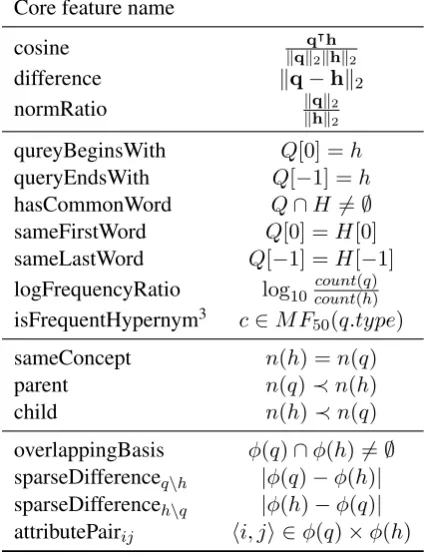
Next, we determine a handful of features for a pair of expressions(q, h) consisting of a query q and its potential hypernym h. Table 1 pro-vides an overview of the features employed for a pair (q, h). We denote with q and h the 100-dimensional dense vectorial representations of q and h. Additionally, we denote with Q and H the sequence of tokens constituting the query and hypernym phrases. Finally, we refer to the set of basis vectors (in the FCA terminology, attributes)
2www.compsens.uni-tuebingen.de/pub/
Core feature name
cosine kqk2kq|hhk2
difference kq−hk2
normRatio kqk2
khk2
qureyBeginsWith Q[0] =h queryEndsWith Q[−1] =h hasCommonWord Q∩H 6=∅ sameFirstWord Q[0] =H[0] sameLastWord Q[−1] =H[−1]
logFrequencyRatio log10countcount((qh)) isFrequentHypernym3 c∈M F
50(q.type)
sameConcept n(h) =n(q)
parent n(q)≺n(h)
child n(h)≺n(q)
overlappingBasis φ(q)∩φ(h)6=∅
[image:3.595.71.285.69.347.2]sparseDifferenceq\h |φ(q)−φ(h)| sparseDifferenceh\q |φ(h)−φ(q)| attributePairij hi, ji ∈φ(q)×φ(h)
Table 1: The features employed in our classifier. M F50(q.type)refers to the set of top-50 most fre-quent hypernyms for a given query type.
which are assigned non-zero weights in the recon-struction of the vectorial representation ofqandh asφ(q)andφ(h). It is also considered as a feature (isFrequentHypernym) whether a particular candidate hypernymhbelongs to the top-50 most frequent hypernyms for the category ofq(i.e. con-cept or entity). Modeling the two categories sep-arately played an important role in the success of our systems.
Three additional features are defined for in-corporating the concept lattice output by FCA. With n(w) denoting the concept that introduces w, i.e. the most specific location within the DAG forw, our features indicate whethern(q)(1) coin-cides with that ofh, (2) is the parent (immediate successor) for that ofh, or (3) is the child (imme-diate predictions) for that ofh. Parents, and even the inverse relation, proved to be more predictive than the conceptually motivated q ≤ h. In Ta-ble 1, n1 ≺ n2 denotes that n1 is an immediate
predecessor ofn2. We will see in post-evaluation ablation experiments, where we refer to the above three features as theFCAfeatures, that they were not useful in our submissions.
3At submission time, this feature did not work properly.
TheattributePairijs above, our most im-portant features, are indicator features for every possible interaction term between the sparse co-efficients inα. That means that for a pair of words (q, h)we definedφ(q)×φ(h), i.e. candidates get
assigned with the Cartesian product derived from the indices of the non-zero coefficients inα. Note that this feature template inducesk2features, with kbeing the number of basis vectors introduced in the dictionary matrixDaccording to Eq. 1.
In order to rank potential hypernym candidates over the test set we trained a logistic regression classifier for concepts and entities utilizing the
sklearnpackage (Pedregosa et al., 2011)4with the regularization parameter defaulting to1.0.
For each appropriate (q, h) pair of words for whichhis a hypernym ofq, we generated a num-ber ofnegative samples(q, h0), such that the
train-ing data does not includeh0 as a valid hypernym forq. For a given queryq, belonging to either of theconceptorentitycategory, we sampledh0from those hypernyms which were included as a valid hypernym in the training data with respect to some q0 6=qquery phrase.
When making predictions for the hypernyms of a query, we relied on our query type sensitive lo-gistic regression model to determine the ranking of the hypernym candidates. In our official submis-sion we treated such phrases to rank which were included in the training data for being a proper hy-pernym at least once.
After the appropriate model ranked the hyper-nym candidates, we selected the top 15 ranked candidates and applied a post-ranking heuristic over them, i.e. reordered them according to their background frequency from the training corpus. Our assumption here is that more frequent words tend to refer to more general concepts and more general hypernymy relations potentially tend to be more easily detectable than more specialized ones.
3 Results
3.1 Our submissions
Our submissions were based on k = 200 dimen-sional sparse vectors computed from unit-normed 100-dimensional dense vectors withλ =.3. The sum of the two dimensions motivates our group name. For training the regression model with neg-ative samples, 50 false hypernyms were sampled for each queryqin the training dataset. One of our
without attribute pairs with attribute pairs
[image:4.595.74.296.286.458.2]MAP MRR P@1 P@3 P@5 P@15 MAP MRR P@1 P@3 P@5 P@15 1A offic 8.6 18.0 13.0 8.9 8.2 7.9 8.9 19.4 14.9 9.3 8.6 8.1 1A reprd 9.07 18.7 13.5 9.4 8.8 8.5 9.2 19.9 14.9 9.5 8.7 8.4 1B offic 9.4 19.9 13.2 9.5 9.3 8.8 12.1 25.1 17.6 12.9 11.7 11.2 1B reprd 9.2 19.5 12.8 8.9 8.9 8.7 12.8 26.7 18.9 13.6 12.4 11.9 1C offic 12.5 25.9 16.6 13.6 12.6 11.5 17.9 37.6 27.8 19.7 17.1 16.3 1C reprd 12.9 26.0 16.2 13.9 13.0 11.9 18.3 38.4 28.5 20.2 17.4 16.6 2A offic 15.0 32.2 24.8 17.7 15.8 11.6 20.8 40.6 31.6 23.5 21.4 17.1 2A reprd 15.1 32.4 24.4 18.0 16.2 11.8 21.5 43.7 35.6 25.3 21.8 17.0 2B offic 19.1 36.7 27.2 23.0 20.1 15.4 29.5 46.4 33.0 31.9 28.9 27.7 2B reprd 21.5 40.9 29.6 25.6 22.1 18.0 30.4 46.8 33.8 31.8 29.5 28.9
Table 2: Our submissions results: official and those that can bereproduced with the code in the project repo (with theisFrequentHypernymfeature being turned off).
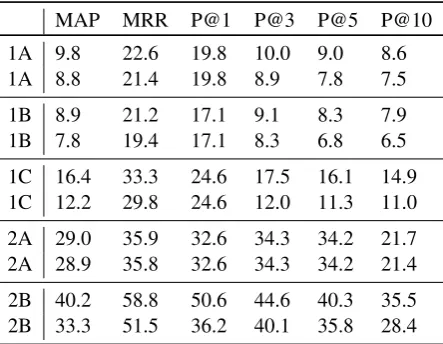
MAP MRR P@1 P@3 P@5 P@10 1A 9.8 22.6 19.8 10.0 9.0 8.6 1A 8.8 21.4 19.8 8.9 7.8 7.5 1B 8.9 21.2 17.1 9.1 8.3 7.9 1B 7.8 19.4 17.1 8.3 6.8 6.5 1C 16.4 33.3 24.6 17.5 16.1 14.9 1C 12.2 29.8 24.6 12.0 11.3 11.0 2A 29.0 35.9 32.6 34.3 34.2 21.7 2A 28.9 35.8 32.6 34.3 34.2 21.4 2B 40.2 58.8 50.6 44.6 40.3 35.5 2B 33.3 51.5 36.2 40.1 35.8 28.4
Table 3: Baseline results, most frequent training hypernyms. We (upper) consider the most fre-quent hypernym in the given query type (concept or entity). For comparison, we also show theMFH
baseline provided by the organizers (lower) that is based on the most frequent hypernyms in general.
submissions involved attribute pairs, the other not. Both submissions used the conceptually motivated but practically harmful FCA-based features.
Table 2 shows submission results. The figures that can be reproduced with the code in the project repo (reprd) is slightly different from our official submissions (offic) for two reasons: because the implementation of isFreqHyp contained a bug, and because of the natural randomness in negative sampling. For reproducibility, we report result without theisFreqHypfeature. The ran-domness introduced by negative sampling is now factored out by random seeding.
Train Test
1A 975(4) 0.41% 1055(4) 0.38% 1B 709(1) 0.14% 767(2) 0.26% 1C 776(2) 0.26% 625(2) 0.32% 2A 442(58) 11.60% 433(67) 13.40% 2B 366(21) 5.43% 341(17) 4.75%
(a) concept
Train Test
1A 379(142) 27.26% 344(99) 22.35% 1B 249(41) 14.14% 205(26) 11.26% 1C 184(38) 17.12% 328(45) 12.06%
2A 0(0) — 0(0) —
[image:4.595.307.525.288.503.2]2B 79(34) 30.09% 102(40) 28.17% (b) entity
Table 4: Number of in-vocabulary (and out-of-vocabulary, OOV) queries per query type. The ra-tio of the latter is also shown.
3.2 Query type sensitive baselining
candidate filtering off candidate filtering on
[image:5.595.74.297.261.326.2]k ns MAP MRR P@1 P@3 P@5 P@15 MAP MRR P@1 P@3 P@5 P@15 200 50 6.5 14.9 13.1 7.4 6.1 5.5 12.1 25.4 18.9 12.9 11.6 10.9 200 all 6.9 15.8 14.1 7.6 6.3 5.8 13.0 27.1 19.9 14.2 12.5 11.8 300 50 6.9 15.8 13.9 7.6 6.4 5.9 12.1 25.7 19.5 13.0 11.5 11.0 300 all 8.0 17.8 15.4 8.9 7.4 6.8 13.5 28.0 21.1 14.5 12.9 12.3 1000 50 9.0 20.0 17.2 9.8 8.3 7.7 13.3 28.1 21.3 13.8 12.6 12.3 1000 all 11.6 26.1 22.5 12.5 10.8 10.0 13.6 27.2 19.4 13.9 13.2 12.8
Table 5: Post evaluation results on the 1A dataset investigating the effect of various hyperparameter choices. kandnsdenotes the number of basis vectors and negative samples generated during training per each positive(q, h)pair. Best results obtained for each metric are marked as bold.
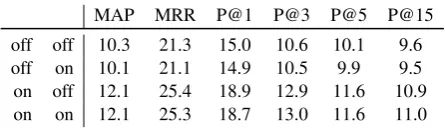
MAP MRR P@1 P@3 P@5 P@15 off off 10.3 21.3 15.0 10.6 10.1 9.6 off on 10.1 21.1 14.9 10.5 9.9 9.5 on off 12.1 25.4 18.9 12.9 11.6 10.9 on on 12.1 25.3 18.7 13.0 11.6 11.0 Table 6: Ablation experiments, on the 1A dataset with k = 200, ns = 50 (and the implementa-tion ofisFreqHypfixed). The first two columns indicate whether attributePairij and FCA-derived features are utilized, respectively.
3.3 Post-evaluation analysis
After the evaluation closed, we conducted ablation experiments the results of which are included in Table 6. In these experiments, we investigated the contribution of the features derived from sparse attribute pairs and FCA. These ablation experi-ments corroborate the importance of features de-rived from sparse attribute pairs and reveal that turning off FCA-based features does not hurt per-formance at all. For this reason – even though our official shared task submission included FCA-related features – we no longer employed them in our post-evaluation experiments.
Table 5 includes the detailed behavior of our model on subtask 1A with respect three distinct factors, that is
1. the number of basis vectors employed during sparse coding (k∈ {200,300,1000}),
2. the number of negative training samples per positive sample (ns∈ {50, all}),
3. candidate filtering being turned on/off. In our original submission we generated 50 neg-ative samples (ns) generated per query q during
[image:5.595.305.533.264.344.2]MAP MRR P@1 P@3 P@5 P@15 1A 76.1 92.2 92.2 82.3 76.4 71.6 1B 71.2 93.4 93.4 78.5 70.9 65.7 1C 81.0 95.9 95.9 87.2 81.7 76.4 2A 72.6 89.6 89.6 81.0 75.3 64.1 2B 95.4 98.8 98.8 97.3 96.0 93.7
Table 7: Test results of an oracle system which uses candidate filtering.
training. In our post evaluation experiments we in-vestigated the effects of generating more negative samples, i.e. we regarded all the valid hypernyms over the training set – not being a proper hyper-nym forq – ash0 upon the creation of the (q, h0) negative training instances. This latter strategy is referenced asns=allin Table 5.
In our official submission we regarded only those hypernyms as potential candidates to rank during test time which occurred at least once as a correct hypernym in the training data. We call this strategy as candidate filtering. Historically, we applied this restriction to speed up the FCA algorithm because this way the size of the concept lattice could be made smaller. As there are valid hypernyms on the test set which never occurred in the training data, our official submission would not be able to obtain a perfect score even in theory. Ta-ble 7 contains the best possiTa-ble metrics on the test set that we could achieve when candidate filtering is applied. In our post evaluation experiments we also investigated the effects of turning this kind of filtering step off. As Table 5 illustrates, however, our scores degrade after turning candidate filtering off.
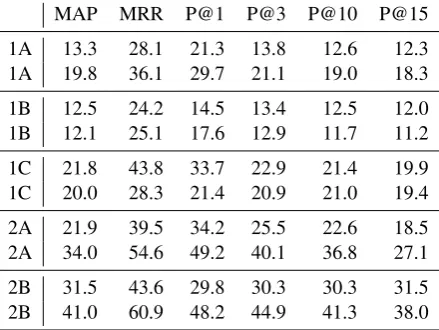
sug-MAP MRR P@1 P@3 P@10 P@15 1A 13.3 28.1 21.3 13.8 12.6 12.3 1A 19.8 36.1 29.7 21.1 19.0 18.3 1B 12.5 24.2 14.5 13.4 12.5 12.0 1B 12.1 25.1 17.6 12.9 11.7 11.2 1C 21.8 43.8 33.7 22.9 21.4 19.9 1C 20.0 28.3 21.4 20.9 21.0 19.4 2A 21.9 39.5 34.2 25.5 22.6 18.5 2A 34.0 54.6 49.2 40.1 36.8 27.1 2B 31.5 43.6 29.8 30.3 30.3 31.5 2B 41.0 60.9 48.2 44.9 41.3 38.0
Table 8: Post evaluation results for the different subtasks usingk= 1000, ns= 50and hypernym candidate filtering. Upper: our system, lower: subtask winner.
gest that it is advantageous to apply sparse repre-sentation of more expressive power (i.e. a higher number of basis vectors). Generating more nega-tive samples also provides some additional perfor-mance boost. These previous observations hold ir-respective whether candidate filtering is employed or not, however, their effects are more pronounced when hypernym candidates are not filtered.
Finally, we report our post-evaluation results for all the subtasks and compare them to the official scores of the best performing systems in Table 8. It can be seen from these enhanced results for cat-egory “all” (concepts and entities mixed) that we would win (1B) Italian and (1C) Spanish. Our post-evaluation system – which only differs from our participating system that it fixes the calcula-tion of a features, does not rely on FCA-based fea-tures and usesk= 1000– would also place third in the rest of the subtasks.
4 Conclusion
In this paper we experimented with the integration of sparse word representations into the task of hy-pernymy discovery. We strived to utilize sparse word representations in two ways, i.e. via build-ing concept lattices usbuild-ing formal concept analy-sis and modeling the hypernymy relation with the help of interaction terms. While our former ap-proach for deriving formal concepts from sparse word representations was not successful, the inter-action terms derived from sparse word representa-tions proved to be highly beneficial.
Acknowledgements
We would like to thank András Kornai for use-ful comments on negative sampling. This re-search was supported by the project Integrated program for training new generation of scientists in the fields of computer science, no. EFOP-3.6.3-VEKOP-16-2017-0002. The project has been sup-ported by the European Union and co-funded by the European Social Fund.
References
Sanjeev Arora, Yuanzhi Li, Yingyu Liang, Tengyu Ma, and Andrej Risteski. 2016. Linear algebraic struc-ture of word senses, with applications to polysemy. arXiv:1601.03764v1.
Gábor Berend. 2017. Sparse coding of neural word em-beddings for multilingual sequence labeling. Trans-actions of the Association for Computational Lin-guistics, 5:247–261.
Gábor Berend. 2018. Towards cross-lingual utiliza-tion of sparse word representautiliza-tions. InMSZNY2018, XVI. Magyar Számítóg´pes Nyelvészeti Konferencia.
Jose Camacho-Collados, Claudio Delli Bovi, Luis Espinosa-Anke, Sergio Oramas, Tommaso Pasini, Enrico Santus, Vered Shwartz, Roberto Navigli, and Horacio Saggion. 2018. SemEval-2018 Task 9: Hypernym Discovery. In Proceedings of the 12th International Workshop on Semantic Evalu-ation (SemEval-2018), New Orleans, LA, United States. Association for Computational Linguistics. Philipp Cimiano, Andreas Hotho, and Steffen Staab.
2005. Learning concept hierarchies from text cor-pora using formal concept analysis. Journal Artifi-cial Intelligence Research (JAIR), 24:305–339. Dominik Endres, Peter Földiák, and Uta Priss. 2010.
An Application of Formal Concept Analysis to Se-mantic Neural Decoding. Annals of Mathematics and Artificial Intelligence, 57(3-4):233–248. Re-viewed.
Manaal Faruqui, Jesse Dodge, Sujay Jauhar, Chris Dyer, Ed Hovy, and Noah Smith. 2015. Retrofitting word vectors to semantic lexicons. InProceedings of NAACL 2015. Best Student Paper Award.
Alona Fyshe, Leila Wehbe, Partha P Talukdar, Brian Murphy, and Tom M Mitchell. 2015. A composi-tional and interpretable semantic space. In Proceed-ings of the 2015 Conference of the North American Chapter of the Association for Computational Lin-guistics: Human Language Technologies, pages 32– 41.
Tomas Mikolov, Kai Chen, Greg Corrado, and Jeffrey Dean. 2013. Efficient estimation of word represen-tations in vector space. InInternational Conference on Learning Representations (ICLR 2013).
Bruno A Olshausen and David J Field. 1997. Sparse coding with an overcomplete basis set: A strategy employed by v1? Vision research, 37(23):3311– 3325.
F. Pedregosa, G. Varoquaux, A. Gramfort, V. Michel, B. Thirion, O. Grisel, M. Blondel, P. Prettenhofer, R. Weiss, V. Dubourg, J. Vanderplas, A. Passos, D. Cournapeau, M. Brucher, M. Perrot, and E. Duch-esnay. 2011. Scikit-learn: Machine learning in Python. Journal of Machine Learning Research, 12:2825–2830.
Ron Rubinstein, Michael Zibulevsky, and Michael Elad. 2008. Efficient implementation of the k-svd algorithm and the batch-omp method. Department of Computer Science, Technion, Israel, Tech. Rep.
Anant Subramanian, Danish Pruthi, Harsh Jhamtani, Taylor Berg-Kirkpatrick, and Eduard Hovy. 2018. Spine: Sparse interpretable neural embeddings. AAAI.
Dani Yogatama, Manaal Faruqui, Chris Dyer, , and Noah A. Smith. 2015. Learning word representa-tions with hierarchical sparse coding. InICML. Pre-vious version in NIPS Deep Learning and Represen-tation Learning Workshop 2014.