178
Flexibly-Structured Model for Task-Oriented Dialogues
Lei Shu1 ∗, Piero Molino2 , Mahdi Namazifar2, Hu Xu1, Bing Liu1 , Huaixiu Zheng2 , Gokhan Tur2
1Department of Computer Science, University of Illinois at Chicago
2Uber AI,
1{lshu3, hxu48, liub}@uic.edu,
2{piero, mahdin, huaixiu.zheng, gokhan}@uber.com
Abstract
This paper proposes a novel end-to-end ar-chitecture for task-oriented dialogue systems. It is based on a simple and practical yet very effective sequence-to-sequence approach, where language understanding and state track-ing tasks are modeled jointly with a struc-tured copy-augmented sequential decoder and a multi-label decoder for each slot. The pol-icy engine and language generation tasks are modeled jointly following that. The copy-augmented sequential decoder deals with new or unknown values in the conversation, while the multi-label decoder combined with the se-quential decoder ensures the explicit assign-ment of values to slots. On the generation part, slot binary classifiers are used to improve performance. This architecture is scalable to real-world scenarios and is shown through an empirical evaluation to achieve state-of-the-art performance on both the Cambridge Restau-rant dataset and the Stanford in-car assistant dataset1.
1 Introduction
A traditional task-oriented dialogue system is of-ten composed of a few modules, such as natural language understanding, dialogue state tracking, knowledge base (KB) query, dialogue policy en-gine and response generation. Language under-standing aims to convert the input to some prede-fined semantic frame. State tracking is a critical component that models explicitly the input seman-tic frame and the dialogue history for producing KB queries. The semantic frame and the correspond-ing belief state are defined in terms of informable slots values and requestable slots. Informable slot values capture information provided by the user
∗
Work mostly performed as an intern at Uber AI Labs 1The code is available at https://github.com/
uber-research/FSDM
so far, e.g.,{price=cheap, food=italian} indicat-ing the user wants a cheap Italian restaurant at this stage. Requestable slots capture the information re-quested by the user, e.g.,{address, phone}means the user wants to know the address and phone num-ber of a restaurant. Dialogue policy model decides on the system action which is then realized by a language generation component.
To mitigate the problems with such a classic modularized dialogue system, such as the error propagation between modules, the cascade effect that the updates of the modules have and the expensiveness of annotation, end-to-end training
of dialogue systems was recently proposed (Liu
and Lane, 2018; Williams et al., 2017; Lowe et al., 2017; Li et al., 2018; Liu et al., 2018;
Budzianowski et al., 2018; Bordes et al., 2017;
Wen et al.,2017b;Serban et al.,2016, among oth-ers). These systems train one whole model to read the current user’s utterance, the past state (that may contain all previous interactions) and generate the current state and response.
There are two main approaches for modeling the belief state in end-to-end task-oriented dialogue systems in the literature: thefully structured ap-proach based on classification (Wen et al.,2017b,a),
and thefree-formapproach based on text
occurrence of words in users’ utterances that are not present in the KB at training time, while at the same time providing the right amount of inductive bias to allow generalization.
Recently, a free-form approach called TSCP (Two Stage Copy Net) (Lei et al.,2018) was pro-posed. This approach does not integrate any infor-mation about the KB in the model architecture. It has the advantage of being readily adaptable to new domains and changes in the content of the KB as well as solving the out-of-vocabulary word prob-lem by generating or copying the relevant piece of text from the user’s utterances in its response generation. However, TSCP can produce invalid states (see Section 4). Furthermore, by putting all slots together into a sequence, it introduces an unwanted (artificial) order between different slots since they are encoded and decoded sequentially. It could be even worse if two slots have overlap-ping values, like departure and arrival airport in a travel booking system. As such, the unnecessary order of the slots makes getting rid of the invalid states a great challenge for the sequential decoder. As a summary, both approaches to state tracking have their weaknesses when applied to real-world applications.
This paper proposes the Flexibly-Structured Dialogue Model (FSDM) as a new end-to-end task-oriented dialogue system. The state tracking com-ponent of FSDM has the advantages of both fully structured and free-form approaches while address-ing their shortcomaddress-ings. On one hand, it is still struc-tured, as it incorporates information about slots in KB schema; on the other hand, it is flexible, as it does not use information about the values con-tained in the KB records. This makes it easily adapt-able to new values. These desiradapt-able properties are achieved by a separate decoder for each informable slot and a multi-label classifier for the requestable slots. Those components explicitly assign values to slots like the fully structured approach, while also preserving the capability of dealing with out-of-vocabulary words like the free-form approach. By using these two types of decoders, FSDM produces only valid belief states, overcoming the limitations of the free-form approach. Further, FSDM has a new module called response slot binary classifier that adds extra supervision to generate the slots that will be present in the response more precisely before generating the final textual agent response (see Section3for details).
The main contributions of this work are
1. FSDM, a task-oriented dialogue system with a new belief state tracking architecture that overcomes the limits of existing approaches and scales to real-world settings;
2. a new module, namely the response slot bi-nary classifier, that helps to improve the per-formance of agent response generation;
3. FSDM achieves state-of-the-art results on both the Cambridge Restaurant dataset (Wen et al.,2017b) and the Stanford in-car assistant dataset (Eric et al.,2017) without the need for fine-tuning through reinforcement learning
2 Related Work
Our work is related to end-to-end task-oriented di-alogue systems in general (Liu and Lane, 2018;
Williams et al.,2017;Lowe et al.,2017;Li et al.,
2018;Liu et al.,2018;Budzianowski et al.,2018;
Bordes et al.,2017;Hori et al.,2016;Wen et al.,
2017b;Serban et al.,2016, among others) and those that extend the Seq2Seq (Sutskever et al.,2014) ar-chitecture in particular (Eric et al.,2017;Fung et al.,
2018;Wen et al.,2018). Belief tracking, which is necessary to form KB queries, is not explicitly
per-formed in the latter works. To compensate, Eric
et al.(2017);Xu and Hu(2018a);Wen et al.(2018) adopt a copy mechanism that allows copying in-formation retrieved from the KB to the generated
response. Fung et al.(2018) adopt Memory
Net-works (Sukhbaatar et al.,2015) to memorize the re-trieved KB entities and words appearing in the dia-logue history. These models scale linearly with the size of the KB and need to be retrained at each up-date of the KB. Both issues make these approaches less practical in real-world applications.
Our work is also akin to modularly connected end-to-end trainable networks (Wen et al.,2017b,a;
Liu and Lane,2018;Liu et al.,2018;Li et al.,2018;
Zhong et al.,2018). Wen et al.(2017b) includes belief state tracking and has two phases in training: the first phase uses belief state supervision, and then the second phase uses response generation supervision.Wen et al.(2017a) improvesWen et al.
Word Copy Distribution
Input Encoder Agent Response Decoder
Informable Slot Values Decoder Requestable Slots Decoder Response Slots Decoder
Knowledge Base Query
Knowledge
Base 0 1 0 0 0
GRUH GRUH GRUH GRUH GRUH GRUH GRUH What cusine do you prefer?
END_A
cheap END_price north END_area END_food END_B
I like italian. what is the address? END_U
At-1 Bt-1 Ut
GRUA GRUA GRUA
At
GRUI GRUI
The address of name_slot is address_slot. END_A
food italian italian END_food
GRUI GRUI
price cheap cheap END_price
GRUI GRUI
area north north END_area
GRUR
name 0
GRUR
address 1
GRUR
food 0
? ?
?
GRUS
name_slot 1
GRUS
address_slot 1
GRUS
food_slot 0
?
italia n
chea p
northnam e
addr ess
addr ess_
slot
?
nam e_sl
ot food Generated Informable Slot Values
Generated Requestable
Slots
Generated Response
[image:3.595.107.492.63.355.2]Slots START
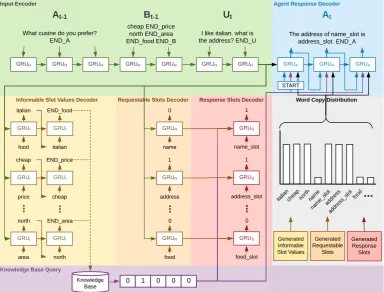
Figure 1: FSDM architecture illustrated by a dialogue turn from the Cambridge Restaurant dataset with the follow-ing components: an input encoder (green), a belief state tracker (yellow for the informable slot values, orange for the requestable slots), a KB query component (purple), a response slot classifier (red), a component that calculates word copy probability (grey) and a response decoder (blue). Attention connections are not drawn for brevity.
Lei et al.(2018) decode the belief state as well as the response in a free-form fashion, but it tracks the informable slot values without an explicit as-signment to an informable slot. Moreover, the ar-bitrary order in which informable slot values and requestable slots are encoded and decoded suggests that the sequential inductive bias the architecture provides may not be the right one.
Other works (Jang et al.,2016;Henderson et al.,
2014;Bapna et al.,2017;Kobayashi et al.,2018;
Xu and Hu,2018b) focus on the scalability of DST to large or changing vocabularies. Rastogi et al.
(2017) score a dynamically defined set of candi-dates as informable slot values.Dernoncourt et al.
(2016) addresses the problem of large vocabularies with a mix of rules and machine-learned classifiers.
3 Methodology
We propose a fully-fledged task-oriented dialogue system called Flexibly-Structured Dialogue Model (FSDM), which operates at the turn level. Its over-all architecture is shown in Figure1, which illus-trates one dialogue turn. Without loss of generality, let us assume that we are on thet-th turn of a
dia-logue. FSDM has three (3) inputs: agent response and belief state of thet−1-th turn, and user utter-ance of thet-th turn. It has two (2) outputs: the belief state for thet-th turn that is used to query the KB, and the agent response of thet-th turn based on the query result. As we can see, belief track-ing is the key component that turns unstructured user utterance and the dialogue history into a KB-friendly belief state. The success of retrieving the correct KB result and further generating the correct response to complete a task relies on the quality of the produced belief state.
FSDM contains five (5) components that work together in an end-to-end manner as follows: (1) The input is encoded and the last hidden state of the encoder serves as the initial hidden state of the belief state tracker and the response decoder; (2) Then, the belief state tracker generates a belief state
Bt = {It, Rt}, where Itis the set of constraints
used for the KB query generated by the informable slots value decoder and Rt is the user requested
returned in a one-hot vectordt; (4) The response
slot binary classifier predicts which slots should appear in the agent response St; (5) Finally, the agent response decoder takes in the KB outputdt, a
word copy probability vectorPccomputed fromIt, Rt,Sttogether with an attention on hidden states of the input encoder and the belief decoders, and generates a responseAt.
3.1 Input Encoder
The input contains three parts: (1) the agent re-sponse At−1, (2) the belief state Bt−1 from the (t−1)-th turn and (3) the current user utteranceUt.
These parts are all text-based and concatenated, and then consumed by the input encoder. Specifically, the belief stateBt−1is represented as a sequence
of informable slot names with their respective val-ues and reqval-uestable slot names. As an example, the sequencehcheap, end price, italian, end food, address, phone, end beliefiindicates a state where the user informed cheap and Italian as KB query constraints and requested the address and phone number.
The input encoder consists of an embedding layer followed by a recurrent layer with Gated
Recurrent Units (GRU) (Cho et al., 2014). It
maps the input At−1 ◦ Bt−1 ◦ Ut (where ◦
de-notes concatenation) to a sequence of hidden vec-tors{hEi |i = 1, . . . ,|At−1◦Bt−1 ◦Ut|}so that hE
i = GRUH(eAt−1◦Bt−1◦Ut) whereeis the
em-bedding function that maps from words to vectors. The output of the input encoder is its last hidden state hE
l , which is served as the initial state for
the belief state and response decoders as discussed next.
3.2 Informable Slot Value Decoder
The belief state is composed of informable slot valuesItand the requestable slotsRt. We describe the generation of the former in this subsection and the latter in the next subsection.
The informable slot values track information provided by the user and are used to query the KB. We allow each informable slot to have its own decoder to resolve the unwanted artificial depen-dencies among slot values introduced by TSCP (Lei et al.,2018). As an example of artificial de-pendency, ‘italian; expensive’ appears a lot in the training data. During testing, even when the gold informable value is ‘italian; moderate’, the decoder may still generate ‘italian; expensive’. Modeling
one decoder for each slot exactly associates the values with the corresponding informable slot.
The informable slot value decoder consists of GRU recurrent layers with a copy mechanism as
shown in the yellow section of Figure 1. It is
composed of weight-tied GRU generators that take the same initial hidden statehEl , but have differ-ent start-of-sdiffer-entence symbols for each unique in-formable slot. This way, each inin-formable slot value decoder is dependent on the encoder’s output, but it is also independent of the values generated for the other slots. Let{kI}denote the set of informable slots. The probability of thejthwordP(yjkI)being generated for the slotkIis calculated as follows: (1) calculate the attention with respect to the input encoded vectors to obtain the context vectorckjI, (2) calculate the generation scoreφg(yjkI)and the
copy scoreφc(ykjI)based on the current step’s
hid-den statehkjI, (3) calculate the probability using the copy mechanism:
ckjI =Attn(h kI j−1,{h
E i}), hkjI =GRUI
(ckjI◦e
yjkI
), hkj−I1
,
φg(yk
I
j ) =W KI g ·h
kI j , φc(yk
I
j ) =tanh(W KI c ·h
yjkI
)·hkjI,
yjkI∈At−1∪Bt−1∪Ut,
P(yjkI|yk
I
j−1, hk
I
j−1) =Copy
φc(yk
I
j ), φg(yk
I
j )
,
(1)
where for each informable slotkI,yk0I =kI and
hk0I = hEl , eyjkI is the embedding of the cur-rent input word (the one generated at the previous step), andWgKI andWcKI are learned weight ma-trices. We follow (Gu et al.,2016) and (Bahdanau et al.,2015) for the copy Copy(·,·)and attention Attn(·,·)mechanisms implementation respectively.
The loss for the informable slot values decoder is calculated as follows:
LI =− 1 |{kI}|
1
|YkI
|
X
kI
X
j
logP(ykjI =z kI
j |y kI
j−1, h
kI
j−1),
(2)
whereYKIis the sequence of informable slot value
decoder predictions andzis the ground truth label.
3.3 Requestable Slot Binary Classifier
multi-label requestable slots classifier to perform binary classification for each slot. This greatly re-solves the issues of TSCP that uses a single decoder with each step having unconstrained vocabulary-size choices, which may potentially lead to generat-ing non-slot words. Similar to the informable slots decoders, such a separate classifier also eliminates the undesired dependencies among slots.
Let{kR}denote the set of requestable slots. A single GRU cell is used to perform the classifica-tion. The initial statehEl is used to pay attention to the input encoder hidden vectors to compute a context vectorckR. The concatenation ofckRand
ekR, the embedding vector of one requestable slot
kR, is passed as input and hEl as the initial state to the GRU. Finally, a sigmoid non-linearity is ap-plied to the product of a weight vectorWR
y and the
output of the GRUhkR to obtainykR, which is the probability of the slot being requested by the user.
ckR=Attn(hEl,{h E i }), hkR=GRUR
(ckR◦ekR), hEl
,
ykR =σ(WyR·h kR
).
(3)
The loss function for all requestable slot binary classifiers is:
LR
=− 1 |{kR}|
X
kR
zkRlog(ykR) + (1−zkR) log(1−ykR).
(4)
3.4 Knowledge Base Query
The generated informable slot valuesIt={Yk
I } are used as constraints of the KB query. The KB is composed of one or more relational tables and each entity is a record in one table. The query is performed to select a subset of the entities that satisfy those constraints. For instance, if the in-formable slots are{price=cheap, area=north}, all the restaurants that have attributes of those fields equal to those values will be returned. The output of this component, the one-hot vectordt, indicates
the number of records satisfying the constraints.dt
is a five-dimensional one-hot vector, where the first four dimensions represent integers from 0 to 3 and the last dimension represents 4 or more matched records. It is later used to inform the response slot binary classifier and the agent response decoder.
3.5 Response Slot Binary Classifier
In order to incorporate all the relevant informa-tion about the retrieved entities into the response,
FSDM introduces a new response slot binary classi-fier. Its inputs are requestable slots and KB queried result dt and the outputs are the response slots to appear in the agent response. Response slots are the slot names that are expected to appear in a de-lexicalized response (discussed in the next subsection). For instance, assume the requestable slot in the belief state is “address” and the KB query returned one candidate record. The response slot binary classifier may predict name slot, ad-dress slot and area slot, which are expected to ap-pear in an agent response as “name slot is located in address slot in the area slot part of town”2.
The response slots{kS}map one-to-one to the requestable slots{kR}. The initial state of each response slot decoder is the last hidden state of the corresponding requestable slot decoder. In this case, the context vectorckSis obtained by paying attention to all hidden vectors in the informable slot value decoders and requestable slots classifiers. Then, the concatenation of the context vectorckS, the embedding vector of the response slotekS and
the KB query vectordtare used as input to a single GRU cell. Finally, a sigmoid non-linearity is ap-plied to the product of a weight vectorWS
y and the
output of the GRUhkSto obtain a probabilityykS
for each slot that is going to appear in the answer.
ckS =Attn(hkR, {hkiI|k
I
∈KI, i≤ |YkI|} ∪ {hkR|kR∈KR}),
hkS =GRUS
(ckS◦ekS◦dt), hk
R ,
ykS =σ(WyS·h kS
).
(5)
The loss function for all response slot binary clas-sifiers is:
LS=− 1 |{kS}|
X
kS
zkSlog(ykS) + (1−zkS) log(1−ykS).
(6)
3.6 Word Copy Probability and Agent
Response Decoder
Lastly, we introduce the agent response decoder. It takes in the generated informable slot values, requestable slots, response slots, and KB query re-sult and generates a (de-lexicalized) response. We adopt a copy-augmented decoder (Gu et al.,2016) as architecture. The canonical copy mechanism only takes a sequence of word indexes as inputs but
does not accept the multiple Bernoulli distributions we obtain from sigmoid functions. For this reason, we introduce a vector of independent word copy probabilitiesPC, which is constructed as follows:
PC(w) =
ykR, ifw=kR, ykS, ifw=kS, 1, ifw∈It,
0, otherwise,
(7)
where if a word w is a requestable slot or a
re-sponse slot, the probability is equal to their binary classifier output; if a word appears in the generated informable slot values, its probability is equal to1; for the other words in the vocabulary the probabil-ity is equal to0. This vector is used in conjunction with the agent response decoder prediction proba-bility to generate the response.
The agent response decoder is responsible for generating a de-lexicalized agent response. The response slots are substituted with the values of the results obtained by querying the KB before the response is returned to the user.
Like the informable slot value decoder, the agent response decoder also uses a copy mechanism, so it has a copy probability and generation probabil-ity. Consider the generation of thejth word. Its generation scoreφgis calculated as:
cAjE=Attn(h A j−1,{h
E i}), cAjB=Attn(h
A j−1,{h
kI i |k
I∈
KI, i≤ |YkI|} ∪ {hkR|kR∈KR})∪ {hkS|kS∈KS}),
hAj =GRUA
(cAjE◦c
AB
j ◦e A
j ◦dt), hAj−1
,
φg(yjA) =W A g ·h
A j,
(8)
wherecAjEis a context vector obtained by attending
to the hidden vectors of the input encoder,cAjB is a context vector obtained by attending to all hidden vectors of the informable slot value decoder, re-questable slot classifier and response slot classifier, andWgAis a learned weight matrix. The concate-nation of the two context vectorscAjE andcAjB, the
embedding vectoreA
j of the previously generated
word and the KB query output vectordtis used as input to a GRU. Note that the initial hidden state is
hA
0 =hEl . The copy scoreφcis calculated as:
φc(yAj) =
PC(yA
j)·tanh(WcA·hy
A j)·hA
j,
ifyA
j ∈It∪KR∪KS, PC(yA
j),otherwise,
(9)
whereWcAis a learned weight matrix. The final
CamRest: restaurant reservation
dialogue split train: 408 dev: 136 test: 136 # of keys informable: 3 requestable: 7 response: 7 database record 99
KVRET: navigation, weather, calendar scheduling dialogue split train: 2425 dev: 302 test: 302
[image:6.595.306.525.63.143.2]# of keys informable: 10 requestable: 12 response: 12 database record 284
Table 1: Dataset
probability is:
P(yAj|yjA−1, hAj−1) =Copy(φg(yAj), φc(yjA)). (10)
Letzdenote the ground truth de-lexicalized agent response. The loss for the agent response decoder is calculated as follows whereYAis the sequence of agent response decoder prediction:
LA
=− 1 |YA|
X
j
logP(yAj =z A j|y
A j−1, h
A
j−1). (11)
3.7 Loss Function
The loss function of the whole network is the sum of the four losses described so far for the in-formable slot valuesLI, requestable slotLR,
re-sponse slotLS and agent response decoders LA,
weighted byαhyperparameters:
L=αILI+αRLR+αSLS+αALA. (12)
The loss is optimized in an end-to-end fashion, with all modules trained simultaneously with loss gradi-ents back-propagated to their weights. In order to do so, ground truth results from database queries are also provided to the model to compute thedt,
while at prediction time results obtained by using the generated informable slot valuesItare used.
4 Experiments
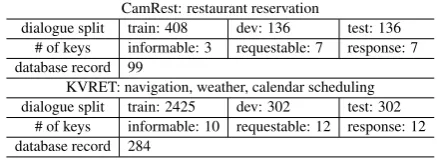
We tested the FSDM on the Cambridge Restaurant dataset (CamRest) (Wen et al.,2017b) and the Stan-ford in-car assistant dataset (KVRET) (Eric et al.,
2017) described in Table1.
4.1 Preprocessing and Hyper-parameters
We use NLTK (Bird et al.,2009) to tokenize each sentence. The user utterances are precisely the original texts, while all agent responses are de-lexicalized as described in (Lei et al.,2018). We obtain the labels for the response slot decoder from the de-lexicalized response texts. We use 300-dimensional GloVe embeddings (Pennington et al.,
Dataset CamRest KVRET
Method Inf P Inf R Inf F1 Req P Req R Req F1 Inf P Inf R Inf F1 Req P Req R Req F1
TSCP/RL† 0.970 0.971 0.971 0.983 0.935 0.959 0.936 0.874 0.904 0.725 0.485 0.581 TSCP† 0.970 0.971 0.971 0.983 0.938 0.960 0.934 0.890 0.912 0.701 0.435 0.526 FSDM/Res 0.979 0.984 0.978 0.994 0.947 0.967 0.918 0.930 0.925 0.812 0.993 0.893 FSDM 0.983* 0.986* 0.984* 0.997* 0.952 0.974* 0.92 0.935* 0.927* 0.819* 1.000* 0.900*
Table 2: Turn-level performance results. Inf: Informable,Req: Requestable, P: Precision,R: Recall. Results marked with†are computed using available code, and all the other ones are reported from the original papers. ∗ indicates the improvement is statistically significant withp= 0.05.
Dataset CamRest KVRET Method BLEU EMR SuccF1 BLEU EMR SuccF1
NDM 0.212 0.904 0.832 0.186 0.724 0.741 LIDM 0.246 0.912 0.840 0.173 0.721 0.762 KVRN 0.134 - - 0.184 0.459 0.540 TSCP 0.253 0.927 0.854 0.219 0.845 0.811 TSCP/RL† 0.237 0.915 0.826 0.195 0.809 0.814 TSCP† 0.237 0.913 0.841 0.189 0.833 0.81 FSDM/St 0.245 - 0.847 0.204 - 0.809 FSDM/Res 0.251 0.924 0.855 0.209 0.834 0.815
[image:7.595.76.524.61.130.2]FSDM 0.258* 0.935* 0.862* 0.215 0.848* 0.821*
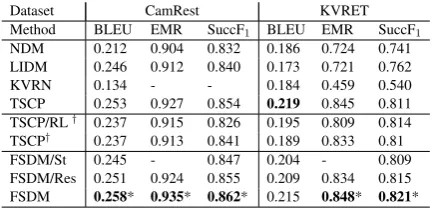
Table 3: Dialogue level performance results. SuccF1:
Success F1 score, EMR: Entity Match Rate. Results
marked with†are computed using available code, and all the other ones are reported from the original papers. ∗indicates the improvement is statistically significant withp= 0.05.
user msg what is the date and time of
my next meeting and who will be attending it ?
belief state
GOLD informable slot (event=meeting), requestable slot (date, time, party) TSCP ‘meeting’ ‘hEOS Z1i’ ‘date’ ‘;’ ‘party’
FSDM event=meeting date=True time=True party = True
agent response GOLD your next meeting is with
party SLOT on the date SLOT at time SLOT. TSCP your next meeting is at time SLOT
on date SLOT at time SLOT . FSDM you have a meeting on date SLOT
at time SLOT with party SLOT
Table 4: Example of generated belief state and response for calendar scheduling domain
in GloVe are initialized to be the average of all other embeddings plus a small amount of random noise to make them different from each other.
We optimize both training and model hyperpa-rameters by running Bayesian optimization over the product of validation set BLEU, EMR, and SuccF1
using skopt3. The model that performed the best on
the validation set uses Adam optimizer (Kingma
and Ba, 2015) with a learning rate of 0.00025
for minimizing the loss in Equation12 for both
datasets. We apply dropout with a rate of 0.5 after
3https://scikit-optimize.github.io/
the embedding layer, the GRU layer and any linear layer for CamRest and 0.2 for KVRET. The dimen-sion of all hidden states is 128 for CamRest and 256 for KVRET. Loss weightsαI,αR,αS,αAare 1.5, 9, 8, 0.5 respectively for CamRest and 1, 3, 2, 0.5 for KVRET.
4.2 Evaluation Metrics
We evaluate the performance concerning belief state tracking, response language quality, and task completion. For belief state tracking, we report precision, recall, and F1score of informable slot
values and requestable slots. BLEU (Papineni et al.,
2002) is applied to the generated agent responses for evaluating language quality. Although it is a poor choice for evaluating dialogue systems (Liu et al., 2016), we still report it in order to com-pare with previous work that has adopted it. For task completion evaluation, the Entity Match Rate (EMR) (Wen et al.,2017b) and Success F1 score
(SuccF1) (Lei et al.,2018) are reported. EMR
eval-uates whether a system can correctly retrieve the user’s indicated entity (record) from the KB based on the generated constraints so it can have only a score of 0 or 1 for each dialogue. The SuccF1
score evaluates how a system responds to the user’s requests at dialogue level: it is F1score of the
re-sponse slots in the agent rere-sponses.
4.3 Benchmarks
We compare FSDM with four baseline methods and two ablations.
NDM (Wen et al., 2017b) proposes a modu-lar end-to-end trainable network. It applies de-lexicalization on user utterances and responses.
LIDM(Wen et al.,2017a) improves over NDM by employing a discrete latent variable to learn underlying dialogue acts. This allows the system to be refined by reinforcement learning.
[image:7.595.73.290.194.299.2]It does not perform belief state tracking.
TSCP/RL(Lei et al.,2018) is a two-stage Copy-Net which consists of one encoder and two copy-mechanism-augmented decoders for belief state
and response generation. TSCPincludes further
parameter tuning with reinforcement learning to increase the appearance of response slots in the generated response. We were unable to replicate the reported results using the provided code4, hy-perparameters, and random seed, so we report both the results from the paper and the average of 5 runs on the code with different random seeds (marked with†).
FSDM is the proposed method and we report
two ablations: inFSDM/Stthe whole state
track-ing is removed (informable, requestable and re-sponse slots) and the answer is generated from the
encoding of the input, while inFSDM/Res, only
the response slot decoder is removed.
4.4 Result Analysis
At the turn level, FSDM and FSDM/Res perform better than TSCP and TSCP/RL on belief state tracking, especially on requestable slots, as shown
in Table2. FSDM and FSDM/Res use independent
binary classifiers for the requestable slots and are capable of predicting the correct slots in all those cases. FSDM/Res and TSCP/RL do not have any additional mechanism for generating response slot, so FSDM/Res performing better than TSCP/RL shows the effectiveness of flexible-structured belief state tracker. Moreover, FSDM performs better than FSDM/Res, but TSCP performs worse than TSCP/RL. This suggests that using RL to increase the appearance of response slots in the response decoder does not help belief state tracking, but our response slot decoder does.
FSDM performs better than all benchmarks on the dialogue level measures too, as shown in
Table 3, with the exception of BLEU score on
KVRET, where it is still competitive. Comparing TSCP/RL and FSDM/Res, the flexibly-structured belief state tracker achieves better task completion than the free-form belief state tracker. Furthermore, FSDM performing better than FSDM/Res shows the effectiveness of the response slot decoder for task completion. The most significant performance improvement is obtained on CamRest by FSDM, confirming that the additional inductive bias helps to generalize from smaller datasets. More
impor-4https://github.com/WING-NUS/sequicity
tantly, the experiment confirms that, although mak-ing weaker assumptions that are reasonable for real-world applications, FSDM is capable of performing at least as well as models that make stronger lim-iting assumptions which make them unusable in real-world applications.
4.5 Error Analysis
We investigated the errors that both TSCP and FSDM make and discovered that the sequential nature of the TSCP state tracker leads to the mem-orization of common patterns that FSDM is not subject to. As an example (Table4), TSCP often generates “date; party” as requestable slots even if only “party” and “time” are requested like in “what time is my next activity and who will be attending?” or if “party”, “time” and “date” are requested like in “what is the date and time of my next meeting and who will be attending it?”. FSDM produces correct belief states in these examples.
FSDM misses some requestable slots in some conditions. For example, consider the user’s ut-terance: “I would like their address and what part of town they are located in”. The ground-truth re-questable slots are ‘address’ and ‘area’. FSDM only predicts ‘address’ and misses ‘area’, which suggests that the model did not recognize ‘what part of town’ as being a phrasing for requesting ‘area’. Another example is when the agent
pro-poses “the name SLOT is moderately priced and in the area SLOT part of town . would you like their location ?” and the user replies “i would like the location and the phone number, please”. FSDM predicts ‘phone’ as a requestable slot, but misses ‘address’, suggesting it doesn’t recognize the connection between ‘location’ and ‘address’. The missing requestable slot issue may propagate to the agent response decoder. These issues may arise due to the use of fixed pre-trained embeddings and the single encoder. Using separate encoders for user utterance, agent response and dialogue history or fine-tuning the embeddings may solve the issue.
5 Conclusion
with state-of-the-art models, while at the same time providing a more practical solution for real-world applications.
Acknowledgments
We would like to thank Alexandros Papangelis, Janice Lam, Stefan Douglas Webb and SIGDIAL reviewers for their valuable comments.
References
Dzmitry Bahdanau, Kyunghyun Cho, and Yoshua Ben-gio. 2015. Neural machine translation by jointly learning to align and translate. In International Conference on Learning Representations, San Diego, California, USA.
Ankur Bapna, G¨okhan T¨ur, Dilek Z. Hakkani-T¨ur, and Larry P. Heck. 2017. Towards zero-shot frame semantic parsing for domain scaling. In INTER-SPEECH.
Steven Bird, Ewan Klein, and Edward Loper. 2009. Natural Language Processing with Python. O’Reilly Media, Inc.
Antoine Bordes, Y-Lan Boureau, and Jason Weston. 2017. Learning end-to-end goal-oriented dialog. In
International Conference on Learning Representa-tions, Toulon, France.
Pawe Budzianowski, Iigo Casanueva, Bo-Hsiang Tseng, and Milica Gai. 2018. Towards end-to-end multi-domain dialogue modelling. Technical Report CUED/F-INFENG/TR.706, Cambridge University.
Kyunghyun Cho, Bart van Merrienboer, C¸ aglar G¨ulc¸ehre, Dzmitry Bahdanau, Fethi Bougares, Hol-ger Schwenk, and Yoshua Bengio. 2014. Learning phrase representations using RNN encoder-decoder for statistical machine translation. InEMNLP, pages 1724–1734. ACL.
Franck Dernoncourt, Ji Young Lee, Trung H. Bui, and Hung H. Bui. 2016. Robust dialog state tracking for large ontologies. InIWSDS, volume 427 of Lec-ture Notes in Electrical Engineering, pages 475–485. Springer.
Mihail Eric, Lakshmi Krishnan, Francois Charette, and Christopher D. Manning. 2017. Key-value retrieval networks for task-oriented dialogue. In SIGDIAL Conference, pages 37–49. Association for Compu-tational Linguistics.
Pascale Fung, Chien-Sheng Wu, and Andrea Madotto. 2018. Mem2seq: Effectively incorporating knowl-edge bases into end-to-end task-oriented dialog sys-tems. InACL (1), pages 1468–1478. Association for Computational Linguistics.
Jiatao Gu, Zhengdong Lu, Hang Li, and Victor O. K. Li. 2016. Incorporating copying mechanism in sequence-to-sequence learning. InACL (1). The As-sociation for Computer Linguistics.
Matthew Henderson, Blaise Thomson, and Steve J. Young. 2014. Robust dialog state tracking using delexicalised recurrent neural networks and unsu-pervised adaptation. 2014 IEEE Spoken Language Technology Workshop (SLT), pages 360–365. Takaaki Hori, Hai Wang, Chiori Hori, Shinji Watanabe,
Bret Harsham, Jonathan Le Roux, John R. Hershey, Yusuke Koji, Yi Jing, Zhaocheng Zhu, and Takeyuki Aikawa. 2016. Dialog state tracking with attention-based sequence-to-sequence learning. InSLT, pages 552–558. IEEE.
Youngsoo Jang, Jiyeon Ham, Byung-Jun Lee, Young-jae Chang, and Kee-Eung Kim. 2016. Neural di-alog state tracker for large ontologies by attention mechanism. 2016 IEEE Spoken Language Technol-ogy Workshop (SLT), pages 531–537.
Diederik P Kingma and Jimmy Ba. 2015. Adam: A method for stochastic optimization. InInternational Conference on Learning Representations, San Diego, California, USA.
Yuka Kobayashi, Takami Yoshida, Kenji Iwata, Hi-roshi Fujimura, and Masami Akamine. 2018. Out-of-domain slot value detection for spoken dialogue systems with context information. 2018 IEEE Spo-ken Language Technology Workshop (SLT), pages 854–861.
Wenqiang Lei, Xisen Jin, Min-Yen Kan, Zhaochun Ren, Xiangnan He, and Dawei Yin. 2018. Sequic-ity: Simplifying task-oriented dialogue systems with single sequence-to-sequence architectures. InACL. Xiujun Li, Sarah Panda, Jingjing Liu, and Jianfeng Gao.
2018. Microsoft dialogue challenge: Building end-to-end task-completion dialogue systems. volume abs/1807.11125.
Bing Liu and Ian Lane. 2018. End-to-end learning of task-oriented dialogs. InProceedings of the NAACL-HLT.
Bing Liu, Gokhan Tur, Dilek Hakkani-Tur, Pararth Shah, and Larry Heck. 2018. Dialogue learning with human teaching and feedback in end-to-end train-able task-oriented dialogue systems. InNAACL. Chia-Wei Liu, Ryan Lowe, Iulian Serban, Michael
Noseworthy, Laurent Charlin, and Joelle Pineau. 2016. How NOT to evaluate your dialogue system: An empirical study of unsupervised evaluation met-rics for dialogue response generation. InEMNLP, pages 2122–2132. The Association for Computa-tional Linguistics.
the ubuntu dialogue corpus. Dialogue and Dis-course, 8(1):31–65.
Kishore Papineni, Salim Roukos, Todd Ward, and Wei-Jing Zhu. 2002. Bleu: a method for automatic eval-uation of machine translation. InACL, pages 311– 318. ACL.
Jeffrey Pennington, Richard Socher, and Christopher D. Manning. 2014. Glove: Global vectors for word rep-resentation. InEMNLP, pages 1532–1543. ACL. Osman Ramadan, Paweł Budzianowski, and Milica
Ga-sic. 2018. Large-scale multi-domain belief track-ing with knowledge shartrack-ing. InProceedings of the 56th Annual Meeting of the Association for Compu-tational Linguistics (Volume 2: Short Papers), pages 432–437.
Abhinav Rastogi, Dilek Hakkani-Tur, and Larry Heck. 2017. Scalable multi-domain dialogue state track-ing. InProceedings of IEEE ASRU.
Liliang Ren, Kaige Xie, Lu Chen, and Kai Yu. 2018. Towards universal dialogue state tracking. In Pro-ceedings of the 2018 Conference on Empirical Meth-ods in Natural Language Processing, pages 2780– 2786.
Iulian Vlad Serban, Alessandro Sordoni, Yoshua Ben-gio, Aaron C. Courville, and Joelle Pineau. 2016. Building end-to-end dialogue systems using gener-ative hierarchical neural network models. InAAAI, pages 3776–3784. AAAI Press.
Sainbayar Sukhbaatar, Arthur Szlam, Jason Weston, and Rob Fergus. 2015. End-to-end memory net-works. InNIPS, pages 2440–2448.
Ilya Sutskever, Oriol Vinyals, and Quoc V. Le. 2014. Sequence to sequence learning with neural networks. InNIPS, pages 3104–3112.
Haoyang Wen, Yijia Liu, Wanxiang Che, Libo Qin, and Ting Liu. 2018. Sequence-to-sequence learning for task-oriented dialogue with dialogue state represen-tation. pages 3781–3792.
Tsung-Hsien Wen, Yishu Miao, Phil Blunsom, and Steve J. Young. 2017a. Latent intention dialogue models. InICML, volume 70 ofProceedings of Ma-chine Learning Research, pages 3732–3741. PMLR. Tsung-Hsien Wen, David Vandyke, Nikola Mrkˇsi´c, Milica Gasic, Lina M Rojas Barahona, Pei-Hao Su, Stefan Ultes, and Steve Young. 2017b. A network-based end-to-end trainable task-oriented dialogue system. In Proceedings of the 15th Conference of the European Chapter of the Association for Com-putational Linguistics: Volume 1, Long Papers, vol-ume 1, pages 438–449. ACL.
Jason D. Williams, Kavosh Asadi, and Geoffrey Zweig. 2017. Hybrid code networks: practical and efficient end-to-end dialog control with supervised and rein-forcement learning. InACL (1), pages 665–677. As-sociation for Computational Linguistics.
Puyang Xu and Qi Hu. 2018a. An end-to-end approach for handling unknown slot values in dialogue state tracking. InACL (1), pages 1448–1457. Association for Computational Linguistics.
Puyang Xu and Qi Hu. 2018b. An end-to-end approach for handling unknown slot values in dialogue state tracking. InProceedings of the 56th Annual Meet-ing of the Association for Computational LMeet-inguistics (Volume 1: Long Papers), pages 1448–1457. Associ-ation for ComputAssoci-ational Linguistics.