Stating the Obvious:
Extracting Visual Common Sense Knowledge
Mark Yatskar1, Vicente Ordonez2, Ali Farhadi1,2
1Computer Science & Engineering, University of Washington, Seattle, WA 2Allen Institute for Artificial Intelligence (AI2), Seattle, WA
[my89, ali]@cs.washington.edu, [email protected]
Abstract
Obtaining common sense knowledge using current information extraction techniques is extremely challenging. In this work, we in-stead propose to derive simple common sense statements from fully annotated object detec-tion corpora such as the Microsoft Common Objects in Context dataset. We show that many thousands of common sense facts can be extracted from such corpora at high quality. Furthermore, using WordNet and a novel sub-modular k-coverage formulation, we are able to generalize our initial set of common sense assertions to unseen objects and uncover over 400k potentially useful facts.
1 Introduction
How can we discover that bowls can hold broc-coli, that if a knife touches a cake then a person is probably cutting cake, or that cutlery can be on dining tables? We propose to leverage the effort of computer vision researchers in creating large scale datasets for object detection and use these resources instead to extract symbolic representations of visual common sense. The knowledge we compile is phys-ical, not commonly covered in text and more exhaus-tive than what people can usually produce.
Our focus is particularly on visual common sense, defined as the information about spatial and func-tional properties of entities in the world. We pro-pose to extract three types of knowledge from the Microsoft Common Objects in Context dataset (Lin et al., 2014) (MS-COCO), consisting of 300,000 images, covering 80 objects, with object segments
and natural language captions. First, we find spa-tial relations, e.g. holds(bed, dog), from outlines of co-occurring objects. Next, we construct entail-ment rules like holds(bed, dog) ⇒ laying-on(dog, bed) by associating spatial relations with text in captions. Finally, we uncover general facts such asholds(furniture, domestic animal), applicable to object types not present in MS-COCO by using WordNet (Miller, 1995) and a novel submodular k-coverage formulation.
Evaluations using crowdsourcing show our meth-ods can discover many thousands of high qual-ity explicit statements of visual common sense. While some of this knowledge can be potentially ex-tracted from text (Vanderwende, 2005), we found that from our top 100 extracted spatial relations, e.g. holds(bed, dog), only 4 are present in some form in theAtLocationrelations in the popular Con-ceptNet (Speer and Havasi, 2013) knowledge base. This shows that the knowledge we derive provides complimentary information for other more general knowledge bases. Such common sense facts have proved useful for query expansion (Kotov and Zhai, 2012; Bouchoucha et al., 2013) and could benefit en-tailment (Dagan et al., 2010), grounded enen-tailment (Bowman et al., 2015), or visual recognition tasks (Zhu et al., 2014).
2 Related Work
Common sense knowledge has been predominately created directly from human input or extracted from text (Lenat et al., 1990; Liu and Singh, 2004; Carl-son et al., 2010). In contrast, our work is focused on visual common sense extracted from images
a touches b btouches a
a holds b binside a a besides b bbesides a
a above b bunder a bon a
a disconnected from b
bdisconnected froma
Less than 10 % of pixels from a overlap with b.
The angle between the centroid of a and the centroid of b lies between 315° and 45°, or 135° and 225°.
The angle between the centroid of a and the centroid of b lies between 225° and 315°, or 45° and 135°. The entire extents of object b are inside the extents of object a.
There is more than 50% of pixels in object b overlapping with the extents of object a.
[image:2.612.81.292.60.333.2]No intersection
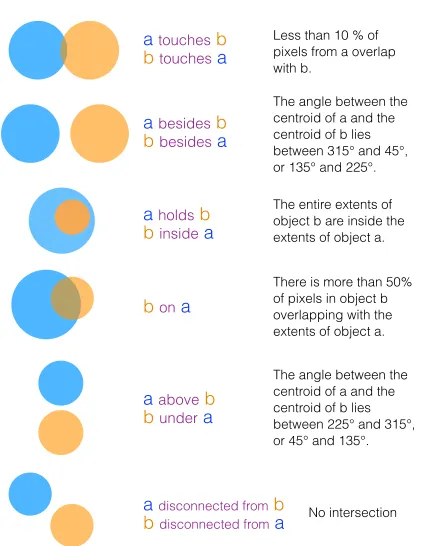
Figure 1: We define 6 types of unique relationships:
{touches, above, besides, holds, on, disconnected}.
tated with regions and descriptions.
There has also been recent interest in the vi-sion community to build databases of visual com-mon sense knowledge. Efforts have focused on a small set of relations, such as similar to or part of (Chen et al., 2013). Webly supervised tech-niques (Divvala et al., 2014; Chen et al., 2013) have also been used to test whether a particular object-relation-object triplet occurs in images (Sadeghi et al., 2015). In contrast, we use seven spatial relations and allow natural language relations that represent a larger array of higher level semantics. We also lever-age existing efforts on annotating large scale imlever-age datasets instead of relying on the noisy outputs of a computer vision system.
On a technical level, our methods for extracting common sense facts from images rely on Pointwise-Mutual Information (PMI), analogous to other rule extraction systems based on text (Lin and Pantel, 2001; Schoenmackers et al., 2010). We view ob-jects as an analogy for words, images as documents, and object-object configurations as typed bigrams. Our methods for generalizing relations are inspired
by work that tries to predict a class label for an im-age given a hierarchy of concepts (Deng et al., 2012; Ordonez et al., 2013; Ordonez et al., 2015). Yet our work is the first to deal with visual relations be-tween pairs of concepts in the hierarchy by using a sub-modular formulation that maximizes the amount of coverage of subordinate categories while avoid-ing contradictions with an initial set of discovered common-sense assertions.
3 Methods
We assume the availability of an object-level anno-tated image dataset D containing a set of images with textual descriptions. Each object in an image must be annotated with: (1) a mask or polygon out-lining the extents of the object, and (2) the category of the object from a set of categoriesV and (3) an overall description of the image.
We produce three types of common sense facts, each with an associated scoring function: (1) Object-object relationships implicitly encoded in the relative configurations between objects in the anno-tated image data, i.e. on(bed, dog) (sec 3.1) , (2) Entailment relations encoded in the relationships be-tween object-object configurations and textual de-scriptions i.e. on(bed, dog)⇒ laying-on(bed, dog) (sec 3.2), and (3) Generalized relations induced by using the semantic hierarchy of concepts in Word-Net, i.e.on(furniture , domestic-animal) (sec 3.3).
3.1 Mining Object-Object Relations
Our objective in this section is to score and rank a set of relations S1 = {r(o1, o2)}, where r is a
object-object relation ando1, o2 ∈ V, using a
func-tion γ1 : S1 → R. First, we define a vocabulary
Rof object-object relations between pairs of anno-tated objects. Our relations are inspired by Region Connection Calculus (Randell et al., 1992), and the Visual Dependency Grammar of (Elliott et al., 2014; Elliott and de Vries, 2015), details in Figure 1.
For every image, we record the instances of each of these object-object relationsr(o1, o2)between all
co-occurring objects inD1. We use Point-wise
Mu-tual Information (PMI) to estimate the evidence for
1For symmetric relations likeabove(o
holds(person, o2)
holds(person, tie)
holds(person, toothbrush)
holds(person, cellphone)
holds(person, baseball glove)
holds(person, remote)
…
holds(person, bench)
holds(person, dining table)
holds(person, car)
holds(o1, person)
holds(bus, person)
holds(train, person)
holds(airplane, person)
holds(boat, person)
holds(tv, person)
…
holds(dining table, person)
holds(cell phone, person)
holds(chair, person)
r(o1, frisbee)
touches(dog, frisbee)
touches(person, frisbee)
holds(dog, frisbee)
holds(person, frisbee)
besides(umbrella, frisbee)
…
besides(person, frisbee)
above(car, frisbee)
above(person, frisbee)
r(o1, o2)
holds(pizza, broccoli)
holds(person, tie)
holds(dining table, sandwich)
holds(dining table, broccoli)
holds(dining table, pizza)
…
holds(cell_phone, person)
above(person, bus)
above(bicycle, car)
[image:3.612.76.542.62.193.2]Quality
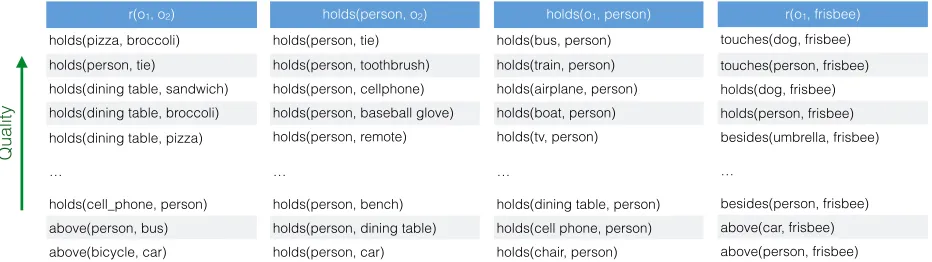
Figure 2: Example of our extracted object-object relations. The first column contains the overall 3 best and worst relations ranked by PMI, the following columns show similar results for the queries: what does a person hold? what holds a person?, and what interacts with a frisbee?
each relationship triplet:
γ1(r(o1, o2)) =logpp[r[]rp([(o1o, o2)]
1, o2)], (1)
We estimate these probabilities by counting object-object-relation co-ocurrences using existen-tial quantifiers for every image. This means every image can at most contribute one to the count of r(o1, o2)so that we do not exacerbate the results by
images with many identical object types taken from unusual viewpoints. In Figure 2, we provide exam-ples of our extracted object-object relations.
3.2 Mining Entailment Relations
In this section we combine our relation-based tu-ples mined from visual annotations (section 2) with more than400k textual descriptions included in MS-COCO. We generate a set of entailments S2 =
{r(o1, o2) ⇒ z}, where r(o1, o2) is an element
from S1 and z is a consequent obtained from
tex-tual descriptions. Similarly as in the previous sec-tion, we rank the relations in S2 using a function
γ2 :S2 →R.
We start by generating an exhaustive list of can-didate consequentsz. We first pre-process the im-age captions with the part-of-speech tagger and lem-matizer from the Stanford Core NLP toolkit (Man-ning et al., 2014), and remove stop words. Then we generate a list of n-length skipgrams in each caption. The set of n-skipgrams are filtered based on predefined lexical patterns2, and redundancies
2hnoun, verbi,hnoun,*, verb,*, nouni,hnoun,*, preposition,
*, nouni,hnoun,*, verb, preposition,*,nouni
are removed3. Skipgrams, z, are then paired with
co-occurring relations, r(o1, o2), removing pairs
with the disconnected-from spatial relation (see Fig-ure 1). Pairs are scored with the conditional proba-bility:
γ2(r(o1, o2)⇒z) = PP[z, r[r(o(o1, o2)]
1, o2)] (2)
The consequent z can take the form q, q(o1),
q(o2), or q(o1, o2), by performing a simple
align-ment with the argualign-ments in the antecedent. We perform this alignment by mapping the object cat-egories in the antecedent r(o1, o2) to WordNet
synsets, and matching any word in z to any word in the gloss set of the predicate arguments o1 and
o2. The unmatched words in z form the relation,
whereas matched words form arguments. We pro-duce the form q if there are no matches, q(o1),
or q(o2) when one argument word matches, and
q(o1, o2)when both match. Examples of discovered
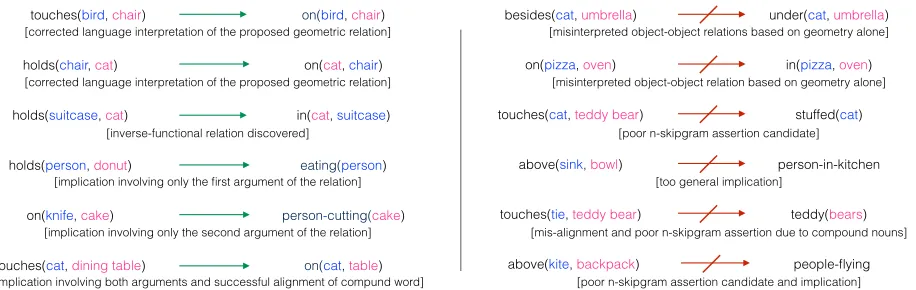
entailments are in Figure 3.
3.3 Generalizing Relations using WordNet
In this section we present an approach to general-ize an initial set of relations,S, to objects not found in the original vocabulary V. Using WordNet we construct a supersetGcontaining all possible parent relations for the relations inS by replacing their ar-gumentso1, o2by all their possible hypernyms. Our
objective is to select a subset T from G that con-tains high quality and diverse generalized relations. 3hnoun,*, verb, *, nouni are collapsed to hnoun,*, verb,
holds(chair,cat) on(cat, chair)
holds(suitcase,cat) in(cat, suitcase)
holds(person, donut) eating(person)
on(knife,cake) person-cutting(cake)
touches(cat, dining table) on(cat,table)
touches(bird, chair) on(bird,chair) besides(cat, umbrella) under(cat, umbrella)
touches(cat, teddy bear) stuffed(cat)
above(sink, bowl) person-in-kitchen
touches(tie, teddy bear) teddy(bears)
above(kite, backpack) people-flying
on(pizza, oven) in(pizza,oven)
[misinterpreted object-object relations based on geometry alone]
[misinterpreted object-object relation based on geometry alone]
[poor n-skipgram assertion candidate]
[too general implication]
[mis-alignment and poor n-skipgram assertion due to compound nouns]
[poor n-skipgram assertion candidate and implication] [corrected language interpretation of the proposed geometric relation]
[corrected language interpretation of the proposed geometric relation]
[inverse-functional relation discovered]
[implication involving only the first argument of the relation]
[implication involving only the second argument of the relation]
[image:4.612.84.542.59.204.2][implication involving both arguments and successful alignment of compund word]
Figure 3: Left: correctly identified entailment relations and right: failure cases.
Note that elements inGcan be too general and con-tradict statements inSwhile others could be correct but add little new knowledge. To balance these con-cerns, we formulate the selection as an optimization problem by maximizing a fitness functionL:
max
T L(T), such that|T|=k, andT ⊆G, (3)
L(T) =λlog(1+ψ(T))+X t∈T
log(1+φ(t, S)), (4)
whereψis acoverage term that computes the total number of facts implied through hyponym relation-ships by the elements inT. The second termφis a consistencyterm that measures the compatibility of a generalized relationtwith the relations inS. We assume that if a relation is missing from S, then it is false (this corresponds to a closed world assump-tion over the domain ofS). Thus, φis the ratio of the scores of relations inS consistent with relation t(i.e. evidence for tbased onS), and a value that is proportional to the number of missing relations fromS(i.e. the amount of counter-evidence). More concretely:
φ(t, S) =
P
s:t⇒s∧s∈Sγ(s)
µ·(1 +Ps:t⇒s∧s/∈S1)·d(t, S), (5)
where µ is a constant and d is the product of the WordNet distances of the synsets involved in t to their nearest synset in S. This penalizes relations that are far away from categories in S. The opti-mization defined in Equation 3 is an instance of the submodular k-coverage problem. We use a greedy algorithm that adds elements toT that maximizeL, which due to the submodular nature of the problem approximates the solution up to a constant factor.
4 Experimental Setup
Object-Object Relations: We filter out from the ini-tial set of candidate relations the ones that occur less than 20 times. We extract more than 3.1k unique statements (6k including symmetric spatial relations). Entailment Relations: We use skipgrams of length 2-6 allowing at most 6 skips, filter can-didates such that they occur at least 5 times, and return the top 10 most likely entailments per spa-tial relation. Overall, 6.3k unique statements are ex-tracted (10k including symmetric relations). Gen-eralized Relations: We optimize Equation 4 only for object-object relations because the closed world assumption makes counts for implications sparse. The parameterµis set to the average of the scores, λ= 0.05andk= 200.
5 Evaluation
We evaluated the quality of the common sense we derive on Amazon Mechanical Turk. Annotators are presented with possible facts and asked to grade statements on a five point scale. Each fact was eval-uated by 10 workers and we normalize their average responses to a scale from 0 to 1. Figure 4 shows plots of quality vs. coverage, where coverage means the top percent of relations sorted by our predicted quality scores.
Quality
0.20 0.30 0.40 0.50 0.60 0.70 0.80 0.90 1.00
Coverage
0% 20% 40% 60% 80% 100%
all [3,120] person [426] animal [477] vehicle [636] furniture [438] random relations
(a) Object-object relations
Quality
0.20 0.30 0.40 0.50 0.60 0.70 0.80 0.90 1.00
Coverage
0% 20% 40% 60% 80% 100%
all [3,000] person [1,325] animal [1,241] vehicle [659] furniture [468] random
(b) Entailment relations
Quality
0.20 0.30 0.40 0.50 0.60 0.70 0.80 0.90 1.00
Coverage
0% 20% 40% 60% 80% 100% generalizd obj-obj relations [200] randomly generalized obj-obj relations
[image:5.612.82.535.61.226.2](c) Generalizations
Figure 4: Quality of extracted common sense, as judged by people. Legends show total relations covered at 100% for a few high level types in MS-COCO.
Entailment Relations Turkers were instructed to assign the lowest score when they could not un-derstand the consequent of the entailment relation. As a baseline, 1000 randomly sampled implications that meet our patterns have a quality of 0.33. Fig-ure 4b shows that extracting high quality entailment is harder than object-object relations likely because supposition and consequent need to coordinate. Re-lations involving furniture are rated higher and man-ual inspection revealed that many relations about furniture imply stative verbs or spatial terms.
Generalized Relations To evaluate
generaliza-tions, Figure 4c, we also present users with defini-tions4. As a baseline, 200 randomly sampled
gen-eralizations from our 3k object-object relations have a quality of 0.53. Generalizations we find are high quality and cover over 400k objects facts not present in MS-COCO. Examples from the 200 we derive in-clude:holds(dining-table, cutlery),holds(bowl, edi-ble fruit) oron(domestic animal, bed).
6 Conclusion
In this work, we use an existing object detection dataset to extract 16k common sense statements about annotated categories. We also show how to generalize using WordNet and induced hundreds of thousands of facts aboutunseenobjects. The infor-mation we extracted is visual, large scale and good quality. It has the potential to be useful for both vi-sual recognition and entailment applications.
4sometimes rules involve abstract concepts, for example vessel, any object that can be used as a container
7 Acknowledgments
The authors would like to thank Hannaneh Ha-jishirzi, Yejin Choi, and Luke Zettlemoyer for help-ful comments on the draft and the reviewers for use-ful feedback. We also thank Ani Kembhavi, and Roozbeh Mottaghi for helping to formalize visual common sense and Mechanical Turkers who helped evaluate output.
References
Arbi Bouchoucha, Jing He, and Jian-Yun Nie. 2013. Di-versified query expansion using conceptnet. In Pro-ceedings of the 22nd ACM international conference on Conference on information & knowledge manage-ment, CIKM ’13, pages 1861–1864, New York, NY, USA. ACM.
Samuel R Bowman, Gabor Angeli, Christopher Potts, and Christopher D Manning. 2015. A large annotated corpus for learning natural language inference. arXiv preprint arXiv:1508.05326.
Andrew Carlson, Justin Betteridge, Bryan Kisiel, Burr Settles, Estevam R Hruschka Jr, and Tom M Mitchell. 2010. Toward an architecture for never-ending lan-guage learning. InAAAI Conference on Artificial In-telligence, volume 5, page 3.
Xinlei Chen, Ashish Shrivastava, and Arpan Gupta. 2013. Neil: Extracting visual knowledge from web data. InInternational Conference on Computer Vision (ICCV), pages 1409–1416. IEEE.
Jia Deng, Jonathan Krause, Alexander C Berg, and Li Fei-Fei. 2012. Hedging your bets: Optimiz-ing accuracy-specificity trade-offs in large scale visual recognition. InConference on Computer Vision and Pattern Recognition (CVPR), pages 3450–3457. IEEE. Santosh Divvala, Ali Farhadi, and Carlos Guestrin. 2014. Learning everything about anything: Webly-supervised visual concept learning. InProceedings of the IEEE Conference on Computer Vision and Pattern Recognition, pages 3270–3277.
Desmond Elliott and Arjen P de Vries. 2015. Describ-ing images usDescrib-ing inferred visual dependency repre-sentations. Association for Computational Linguistics (ACL).
Desmond Elliott, Victor Lavrenko, and Frank Keller. 2014. Query-by-example image retrieval using visual dependency representations. InInternational Confer-ence on Computational Linguistics (COLING), pages 109–120, August.
Alexander Kotov and ChengXiang Zhai. 2012. Tapping into knowledge base for concept feedback: Leverag-ing conceptnet to improve search results for difficult queries. In Proceedings of the Fifth ACM Interna-tional Conference on Web Search and Data Mining, WSDM ’12, pages 403–412, New York, NY, USA. ACM.
Douglas B Lenat, Ramanathan V. Guha, Karen Pittman, Dexter Pratt, and Mary Shepherd. 1990. Cyc: toward programs with common sense. Communications of the ACM, 33(8):30–49.
Dekang Lin and Patrick Pantel. 2001. Dirt@ sbt@ dis-covery of inference rules from text. In Proceedings of the seventh ACM SIGKDD international conference on Knowledge discovery and data mining, pages 323– 328. ACM.
Tsung-Yi Lin, Michael Maire, Serge Belongie, James Hays, Pietro Perona, Deva Ramanan, Piotr Doll´ar, and C Lawrence Zitnick. 2014. Microsoft coco: Common objects in context. InComputer Vision–ECCV 2014, pages 740–755. Springer.
Hugo Liu and Push Singh. 2004. Conceptnet: A prac-tical commonsense reasoning tool-kit. BT technology journal, 22(4):211–226.
Christopher D. Manning, Mihai Surdeanu, John Bauer, Jenny Finkel, Steven J. Bethard, and David McClosky. 2014. The Stanford CoreNLP natural language pro-cessing toolkit. InAnnual Meeting of the Association for Computational Linguistics (ACL): System Demon-strations, pages 55–60.
George A Miller. 1995. Wordnet: a lexical database for english. Communications of the ACM, 38(11):39–41. Vicente Ordonez, Jia Deng, Yejin Choi, Alexander C
Berg, and Tamara Berg. 2013. From large scale image
categorization to entry-level categories. In Interna-tional Conference on Computer Vision (ICCV), pages 2768–2775. IEEE.
Vicente Ordonez, Wei Liu, Jia Deng, Yejin Choi, Alexan-der C. Berg, and Tamara L. Berg. 2015. Predicting entry-level categories. International Journal of Com-puter Vision, pages 1–15.
David A Randell, Zhan Cui, and Anthony G Cohn. 1992. A spatial logic based on regions and connection. In In-ternational Conference on Knowledge Representation and Reasoning.
Fereshteh Sadeghi, Santosh K Divvala, and Ali Farhadi. 2015. Viske: Visual knowledge extraction and question answering by visual verification of relation phrases. InConference on Computer Vision and Pat-tern Recognition (CVPR), pages 1456–1464.
Stefan Schoenmackers, Oren Etzioni, Daniel S Weld, and Jesse Davis. 2010. Learning first-order horn clauses from web text. InEmpirical Methods in Natural Lan-guage Processing (EMNLP), pages 1088–1098. Robert Speer and Catherine Havasi. 2013.
Concept-net 5: A large semantic Concept-network for relational knowl-edge. InThe Peoples Web Meets NLP, pages 161–176. Springer.
Lucy Vanderwende. 2005. Volunteers created the web. InProceedings of the 2005 AAAI Spring Sympo-sium, Knowledge Collection from Volunteer Contribu-tors. American Association for Artificial Intelligence, March.