Proceedings of NAACL-HLT 2018, pages 185–192
Practical Application of Domain Dependent Confidence Measurement for
Spoken Language Understanding Systems
Mahnoosh Mehrabani David Thomson∗ Benjamin Stern
Interactions LLC, Murray Hill, NJ, USA
{mahnoosh, bstern}@interactions.com
Abstract
Spoken Language Understanding (SLU), which extracts semantic information from speech, is not flawless, specially in practical applications. The reliability of the output of an SLU system can be evaluated using a semantic confidence measure. Confidence measures are a solution to improve the quality of spoken dialogue systems, by rejecting low-confidence SLU results. In this study we discuss real-world applications of confidence scoring in a customer service scenario. We build confidence models for three major types of dialogue states that are considered as different domains: how may I help you, number cap-ture, and confirmation. Practical challenges to train domain-dependent confidence models, including data limitations, are discussed, and it is shown that feature engineering plays an important role to improve performance. We explore a wide variety of predictor features based on speech recognition, intent classifica-tion, and high-level domain knowledge, and find the combined feature set with the best rejection performance for each application. 1 Introduction
The purpose of an SLU system is to interpret the meaning of a speech signal (De Mori et al.,2008). SLU systems use Automatic Speech Recognition (ASR) to convert speech signal to the text of what was spoken (hypothesis), followed by semantic meaning extraction from the ASR hypothesis us-ing Natural Language Processus-ing (NLP). Seman-tic information that can be extracted from an utter-ance include the intent of speaker, as well as any entities such as names, products, numbers, places, etc., where depending on the application, one or more of these information are of importance.
While SLU systems have achieved considerable success during the past few decades, errors are
in-∗This work was done while at Interactions LLC.
evitable in real applications due to a number of factors including noisy speech conditions, speaker variations such as accent, speaking style, inherent ambiguity of human language, lack of enough in-domain training data, etc. With the rise of virtual assistants and their increasing utilization from ev-eryday voice inquiries on smart phones and voice commands in smart home scenarios to customer service applications, it is crucial to keep the accu-racy of SLU systems above an acceptable thresh-old. Therefore, to keep the natural flow of conver-sation between human and automatic agent, using human agents when automatic system fails to pro-vide an accurate response improves user satisfac-tion. However, the question is: “how do we know that SLU system failed?”
A confidence score is a scalar quantity that mea-sures the reliability of an automatic system. In the literature, several studies have applied ASR-based feature vectors to train statistical models that predict word and/or utterance level confi-dence scores for ASR systems (Wessel et al.,2001;
Jiang, 2005; Yu et al., 2011; White et al., 2007;
Williams and Balakrishnan, 2009), and SLU sys-tems (Hazen et al.,2002). Furthermore, semantic-based features have been applied in predicting confidence measures for spoken dialogue systems (San-Segundo et al., 2001;Sarikaya et al., 2005;
Higashinaka et al.,2006;Jung et al.,2008), as well as other applications such as machine translation (Gandrabur et al.,2006).
The purpose of this study, is to show the impor-tance of confidence modeling in real-world SLU applications, discuss practical challenges to train confidence models, and create a guideline to build efficient confidence models. We build domain-dependent semantic confidence models to improve the rejection of unreliable SLU results. Such re-jection process is designed to maintain a high ac-curacy, while minimizing the number of rejected
utterances. Our experiments are based on improv-ing rejection performance for three different types of dialogue states in a customer service scenario: opening (i.e., how may I help you), number cap-ture (e.g., phone or account number), and confir-mation (i.e., yes/no).
The contributions of this study are:
1. Building efficient confidence models based on domain-dependent feature engineering with limited labeled data for training, which makes confidence modeling process scalable for real applications.
2. Proposing an evaluation methodology for practical applications of rejection confidence scoring, based on which an operating point can be selected to balance cost vs. accuracy.
3. Comparing linear and nonlinear confidence models with limited training data, and proposing time-efficient nonlinear features that improve performance.
2 Problem Formulation
In this study we focus on improving confidence measure for SLU systems, where the input is a speech waveform and the output is the seman-tic information extracted from speech. We con-sider the semantic output of SLU system to be ei-ther true (i.e., all the relevant information required for the application is extracted correctly) or false. Confidence scorec ∈ Rin this context is a
num-ber associated with every pair of input utterance
x ∈ X and estimated semantic output yˆ ∈ Y,
which computes how likely is the output of SLU system (yˆ) to be equal to the reference output (y).
When probabilistic models are used, posterior probability P(y|x) can be applied as confidence
score. However, proper normalization of posterior probabilities is important to obtain a reliable confi-dence score (Jiang,2005). In this study, we define the SLU confidence measure as P(ˆy = y|x, y).
A statistical model is trained to predict the se-mantic correctness of SLU system. The posterior probability from this binary classifier is applied as confidence measure. While training a confidence model requires data, it outperforms unsupervised approaches. The features that are used to train the confidence model are functions of the input and output of SLU system:f(x, y).
2.1 System Layout
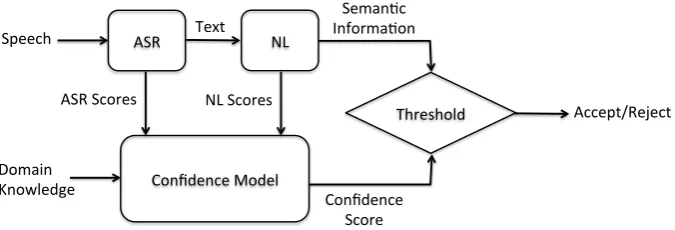
Figure1illustrates the components of SLU system we used for our experiments including rejection based on confidence score. The main components of any SLU system are ASR and NL. However, we do not accept all the outputs of SLU system. A confidence model is used to decide wether or not the extracted semantic information by SLU sys-tem is accurate. The confidence model produces a score based on several predictor features including ASR scores, NL scores, and domain knowledge. If the confidence score is higher than a threshold, SLU result is accepted. The semantic information of rejected (i.e., more challenging) utterances is extracted by human labelers.
2.2 Evaluation Methodology
The performance of SLU system with an ac-cept/reject backend, shown in Figure 1, can not simply be evaluated based on the accuracy of the output. An essential component of such system, is rejection confidence scoring, which depends on both confidence score and confidence threshold. Confidence modeling can be formulated as a bi-nary classification problem, and be evaluated us-ing standard measures such as Receiver Operat-ing Characteristic (ROC) curve, or area under the curve (AUC). However, in a practical application, business objectives have to be considered in per-formance evaluations. In a virtual intelligent cus-tomer service scenario, it is important to maximize customer satisfaction while minimizing the cost. Customer satisfaction is directly related to the ac-curacy, and accuracy can be improved by using higher confidence threshold. Nevertheless, with a higher confidence threshold, more utterances that are labeled by the automated system are rejected and this will increase the cost of manual labeling. Therefore, there is a trade-off between cost (i.e., the number of rejected utterances) and precision (i.e., the accuracy of accepted utterances).
NL#
Seman)c# Informa)on# Text#
Confidence#Model# ASR#Scores#
Domain#
Knowledge# Confidence#
Score#
Threshold# ASR#
Accept/Reject# ##Speech#
[image:3.595.131.469.63.178.2]NL#Scores#
Figure 1: Flowchart of SLU system used for our experiments with an accept/reject backend based on confidence score to ensure the highest accuracy.
the error rate. If a FA-Rej plot has lower rejection rates at all FA rates compared to another plot, it shows a performance improvement.
2.3 Practical Challenges
The main challenge to build confidence models for a real-world application is data limitation. To train a confidence model, a dataset is required with true labels for each sample. In a customer service scenario, semantic information that should be cap-tured, including intents, products, etc., vary from one client to the other. Furthermore, there are sev-eral dialog turns/states for each client with differ-ent intdiffer-ent sets. Our experimdiffer-ents show that train-ing domain-dependent confidence models signif-icantly improves performance. This makes the data preparation even more challenging, since cre-ating labeled data for a large number of applica-tions/clients is expensive. Therefore, in this study we focus on improving confidence measurement with minimum data.
We show the importance of feature engineer-ing to select the best predictive feature set from a combination of ASR and NLP features, as well as using domain knowledge to improve perfor-mance of confidence models for each domain. In this context, domain is defined as a group of di-alog states with similar intent types. We show that with low amounts of training data, Maxi-mum Entropy (MaxEnt) model with a linear fea-ture function is the most efficient classifier. We also apply several other classifiers including neu-ral networks and random forest and compare per-formance for different feature sets. However due to train data limitations, nonlinear classifiers do not significantly outperform MaxEnt. Another ad-vantage of MaxEnt is lower runtime, which is very important in practical applications.
2.4 Data Specification
We present results on three different types of dia-logue states, which are widely used for customer service applications in automatic spoken dialogue systems. Our data is selected from real conver-sations between enterprise customers and the au-tomatic agent. The first dialogue state is the re-sponse to an open-ended question, asking “how may I help you”. For the remaining of this paper we call this dataset: “opening”. In this dialogue state, the user is prompted to explain why they are calling customer service using natural language. The second dataset is based on a “number capture” dialogue state, where the system prompts users to provide an identification number, such as phone or account number. The third dataset is a “confirma-tion” dialogue state, where the user is prompted to confirm some information.
“Opening”, “number capture”, and “confirma-tion” datasets include approximately 15k, 11k, and 10k utterances, respectively. We use 10-fold cross validation for evaluation with a baseline MaxEnt model. These datasets were labeled manually to create the reference intents for each utterance. The “Opening” dataset consists of a large number of intents due to speakers being allowed to use an open language. Furthermore, an “opening” utter-ance might have more than one intent. For in-stance, if the speaker says: “I would like to talk to a live agent about my bill”, the intent will be “live-agent/billing”. In addition to intents, other semantic information such as products are also ex-tracted from “opening” utterances.
speak-ers do not provide a number, such as “don’t-have” (i.e., speaker does not have an account number) or “live-agent” (i.e., speaker would like to talk to a live agent). The main intents for “confirmation” dataset are: “true” and “false”. A few other in-tents such as “live-agent” were also considered for this dialogue state. We used a statistical language model and intent classifier for “opening” and “confirmation” datasets, while a Speech Recogni-tion Grammar SpecificaRecogni-tion (SRGS), which is a rule-based language model that also provides the intent was used for “number capture”. Note that our objective in this study is to improve rejection based on confidence modeling without any modi-fications in the SLU (i.e., ASR and NL) system.
3 Combining ASR and NL Features
During speech recognition, several scores are cre-ated that can be aggregcre-ated at word or utterance level and be applied to estimate ASR confidence. Since speech understanding process is a combina-tion of speech recognicombina-tion and natural language understanding of ASR hypothesis, additional se-mantic information and intent classification scores can also be used to predict the semantic confidence measure associated with a spoken utterance.
3.1 ASR Features
Previous studies have used a variety of speech recognition predictor features, such as posterior probabilities, acoustic and language model scores, n-best and lattice related scores, etc., to esti-mate the ASR confidence for different applica-tions (Jiang, 2005; Yu et al., 2011;White et al.,
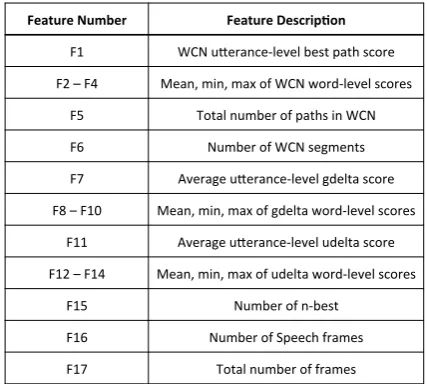
2007; Williams and Balakrishnan, 2009; Hazen et al., 2002; San-Segundo et al., 2001). We ex-amined several feature sets to achieve the best per-formance on rejecting the utterances with inaccu-rate semantic interpretation for “opening”, “num-ber capture”, and “confirmation” domains. Partic-ularly, two groups of ASR predictor features were applied: scores extracted from Word Confusion Network (WCN) (i.e., a compact representation of lattice (Mangu et al.,2000)), and delta scores that are based on comparing the best path score to an alternative path. Williams et al. (Williams and Balakrishnan, 2009) showed the effectiveness of these two feature types to estimate the probability of correctness for each item in an ASR n-best list. The WCN feature set that we used includes utterance-level best path score, as well as
statis-Feature'Number' Feature'Descrip0on'
F1# WCN#u(erance.level#best#path#score#
F2#–#F4# Mean,#min,#max#of#WCN#word.level#scores#
F5# Total#number#of#paths#in#WCN#
F6# Number#of#WCN#segments#
F7# Average#u(erance.level#gdelta#score#
F8#–#F10# Mean,#min,#max#of#gdelta#word.level#scores#
F11# Average#u(erance.level#udelta#score#
F12#–#F14# Mean,#min,#max#of#udelta#word.level#scores#
F15# Number#of#n.best#
F16# Number#of#Speech#frames#
[image:4.595.309.523.63.255.2]F17# Total#number#of#frames#
Table 1: List of ASR features
tics of word-level scores such as mean, min, max (adding standard deviation did not improve the re-sults), total number of different paths in WCN, and number of segments in WCN. Delta feature set in-cludes two categories: gdelta and udelta. Gdelta score is the log likelihood difference between the best path and the best path through garbage model (i.e., a filler model that is trained with non-speech and extraneous speech), while udelta is the log likelihood difference between the best path and best possible path without any language model constraint (if hopping from phone to phone was allowed). We used average utterance-level gdelta and udelta, as well as min, max, and mean of the word-level gdelta and udelta scores. Our best ASR feature set is a combination of WCN and delta fea-ture sets with the addition of a few more feafea-tures including number of speech frames, total number of frames, and number of n-best. Table1 summa-rizes the ASR features that were used for confi-dence modeling in all three domains.
3.2 Semantic Features and NL Scores
perfor-mance for an SLU system, especially with lim-ited training data. A number of studies have ap-plied semantic features for confidence prediction (San-Segundo et al., 2001;Sarikaya et al., 2005;
Higashinaka et al., 2006; Jung et al., 2008). In this study, we identify domain-dependent features and show that semantic features based on domain knowledge for “opening” and “number capture” domains, as well as using statistical intent classi-fier scores for “opening” and “confirmation” dia-logue states considerably improve performance.
Opening Dialogue State: Confidence
predic-tor features based on word distribution and word identity have been previously studied (Yu et al.,
2011;Huang et al.,2013). In this study, we cre-ated word distributions using a separate training dataset. Next, we tested various methods of cre-ating predictor features based on the most com-mon words in each application. For “opening” dataset this type of predictor features improved performance, and the best results were achieved by using the occurrence of top 450 words via a bag of words feature vector. Larger and smaller number of words were also tested, which deteri-orated the performance. Furthermore, we tested using the word scores from WCN instead of bi-nary occurrence vector, which did not improve the performance. Features based on significant or top words did not improve performance for “number capture” and “confirmation” datasets, which can be due to more limited vocabulary in those do-mains compared to “opening”.
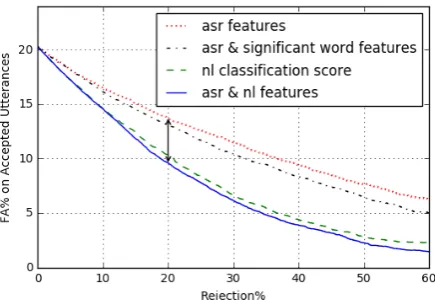
We also applied the top three intent scores from classifier as additional confidence predictor fea-tures, which significantly improved the results. For “opening” application, an SVM model was used to classify intents. Intent scores in this con-text are the raw scores computed based on clas-sifier’s decision function. Figure2shows the FA-Rej results of using NL features in addition to ASR features. As shown, compared to the best perfor-mance with ASR features, using significant words feature vector improves the performance. The best performance is achieved by combining ASR fea-tures with intent classifier scores. Our experi-ments show that when intent classification scores are used, adding the significant word feature vec-tor deteriorates rejection performance. Figure 2
also shows the result of using the top intent score as final confidence measure for rejection, which has better performance than ASR features.
How-Figure 2: FA-Rej plots on“opening” dataset
ever, if intent classification scores are not avail-able, the combination of ASR features and top word features obtains the best results.
Number Capture Dialogue State: The impact
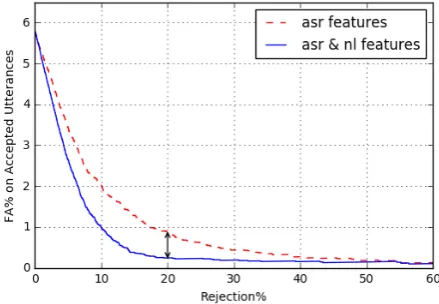
[image:5.595.307.525.64.214.2]Figure 3: FA-Rej plots on “number capture” dataset
rejection performance, and performance improve-ment (i.e., the difference between the number of utterances that have to be rejected to obtain a spe-cific FA on accepted utterances) is higher at lower FA rates. This is especially of importance when the system is expected to have a high accuracy.
Confirmation Dialogue State: The result of in-tegrating NL classification scores with ASR scores for “confirmation” dataset is compared to using ASR scores in Figure4. As shown, considerable improvement is achieved by using intent classifi-cation scores. Due to the high accuracy of “con-firmation” domain compared to the other domains, using other semantic features did not improve the performance.
Table2summarizes effective semantic and NL features for each domain. Relative performance improvement using the best semantic feature set in addition to ASR features at 20% rejection rate (i.e. when 80% of utterances are accepted based on confidence score) is shown in Table3. As shown, while “confirmation” dialogue state achieves the highest accuracy compared to other applications, it has the highest relative improvement by using NL scores in addition to ASR scores. The differ-ence in FA rates at 20% rejection when using ASR features versus using both ASR and NL features is illustrated by arrows in Figures 2-4.
4 Confidence Models
[image:6.595.305.525.66.218.2]So far we have explored a variety of features using MaxEnt classifier with a linear feature function. In this section, we apply nonlinear feature functions with MaxEnt, as well as nonlinear models. Pre-vious studies have shown the success of MaxEnt models for confidence prediction (Yu et al.,2011;
Figure 4: FA-Rej plots on “confirmation” dataset
Feature(s)* Applica0on(s)*
NL#classifica*on#scores# Opening,#Confirma*on#
Occurrence#of#top#words# Opening#
Intent#category# Number#Capture#
Length#of#digit#sequence# Number#Capture#
Occurrence#of#“oh”# Number#Capture#
Comparing#1st#and#2nd#intents# Number#Capture#
Table 2: List of domain-dependent semantic features
Opening' Number'Capture' Confirma2on' Performance'
Improvement' 29.98%%% 27.92%%% 72.46%%%
Table 3: Relative performance improvement on ac-cepted utterances at 20% rejection
White et al., 2007). The principle of maximum entropy states that given a set of training sam-ples (xi, yi), the best estimation of the
distribu-tionp(y|x)subject to a set of constraints is the one
with the largest entropy (Jaynes,1957). A typical constraint is that the empirical average from the training samples for each feature functionfj(x, y)
should match the expected value. The MaxEnt dis-tribution with this constraint can be characterized with a log-linear form (White et al.,2007):
p(y|x) = exp( P
jλjfj(x, y))
P
yexp(
P
jλjfj(x, y)) (1)
In this study,xis in fact a confidence predictor
feature vector ~x, and y is a binary random
As our baseline classifier, we used MaxEnt with a linear predictor feature functionf. Philips et al.
(Phillips et al., 2006) applied a number of meth-ods to use nonlinear relations in data to improve performance of a MaxEnt classifier, from which we evaluated quadratic function and product of features. Furthermore, we tested binning, where bins were defined based on the Cumulative Dis-tribution Function (CDF) of each continuous fea-ture, which did not improve performance. In ad-dition to the nonlinear feature functions proposed in previous studies, we used a logarithmic func-tion of predictor features: f(x) = ln(|x|+),
where is a very small number used to prevent
the log of zero. We also applied nonlinear models such as Neural Networks (NN) and Random For-est. The best NN performance was achieved using a feedforward fully-connected network with one hidden layer, and Adam (Kingma and Ba, 2014) optimizer. Due to limited training data, DNN with larger number of hidden layers did not show any improvements.
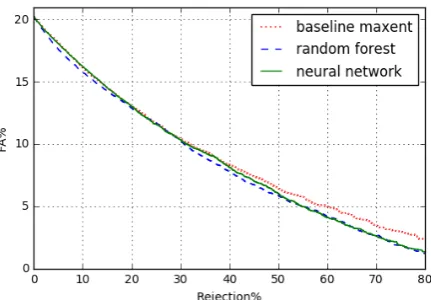
Our experiments showed that performance im-provement using nonlinear methods is limited due to data limitation, and depends on the domain and the feature set. As shown in Figure 5 us-ing logarithmic function of features that we pro-posed in this study, in addition to linear features improves the rejection performance for “number capture” when ASR features are used. The ad-vantage of logarithmic features is time efficiency in both training and runtime compared to previ-ously used nonlinear features. Figure6illustrates the performance improvement in low FA when ap-plying nonlinear classifiers on “opening” dataset with the largest feature dimension (ASR features combined with top word features described in3.2). However, with the best predictor feature set for each domain, nonlinear methods did not improve performance.
5 Discussion and Conclusions
The focus of this study was on the practical ap-plication of confidence measurement in rejecting unreliable SLU outputs with an important impact on the quality of spoken dialogue systems by re-prompting or using human annotations for chal-lenging (e.g., noisy or vague) utterances. We per-formed a comprehensive feature engineering to identify the best set of features to train statisti-cal semantic confidence models for three
[image:7.595.307.525.64.213.2]com-Figure 5: FA-Rej plots on “number capture” dataset with MaxEnt linear and nonlinear features
Figure 6: FA-Rej plots on “opening” dataset with base-line MaxEnt, random forest, and neural networks
[image:7.595.309.525.265.415.2]References
Renato De Mori, Fr´ed´eric Bechet, Dilek Hakkani-Tur, Michael McTear, Giuseppe Riccardi, and Gokhan Tur. 2008. Spoken language understanding. IEEE Signal Processing Magazine, 25(3).
Simona Gandrabur, George Foster, and Guy Lapalme. 2006. Confidence estimation for nlp applications. ACM Transactions on Speech and Language Pro-cessing (TSLP), 3(3):1–29.
Timothy J Hazen, Stephanie Seneff, and Joseph Po-lifroni. 2002. Recognition confidence scoring and its use in speech understanding systems. Computer Speech & Language, 16(1):49–67.
Ryuichiro Higashinaka, Katsuhito Sudoh, and Mikio Nakano. 2006. Incorporating discourse features into confidence scoring of intention recognition results in spoken dialogue systems. Speech Communication, 48(3):417–436.
Po-Sen Huang, Kshitiz Kumar, Chaojun Liu, Yifan Gong, and Li Deng. 2013. Predicting speech recog-nition confidence using deep learning with word identity and score features. In Acoustics, Speech and Signal Processing (ICASSP), 2013 IEEE Inter-national Conference on, pages 7413–7417. IEEE.
Edwin T Jaynes. 1957. Information theory and statisti-cal mechanics. Physical review, 106(4):620.
Hui Jiang. 2005. Confidence measures for speech recognition: A survey. Speech communication, 45(4):455–470.
Sangkeun Jung, Cheongjae Lee, and Gary Geunbae Lee. 2008. Using utterance and semantic level con-fidence for interactive spoken dialog clarification. JCSE, 2(1):1–25.
Diederik Kingma and Jimmy Ba. 2014. Adam: A method for stochastic optimization. arXiv preprint arXiv:1412.6980.
Lidia Mangu, Eric Brill, and Andreas Stolcke. 2000. Finding consensus in speech recognition: word er-ror minimization and other applications of confu-sion networks. Computer Speech & Language, 14(4):373–400.
Steven J Phillips, Robert P Anderson, and Robert E Schapire. 2006. Maximum entropy modeling of species geographic distributions. Ecological mod-elling, 190(3):231–259.
Rub´en San-Segundo, Bryan Pellom, Kadri Hacioglu, Wayne Ward, and Jos´e M Pardo. 2001. Confidence measures for spoken dialogue systems. In Acous-tics, Speech, and Signal Processing, 2001. Proceed-ings.(ICASSP’01). 2001 IEEE International Confer-ence on, volume 1, pages 393–396. IEEE.
Ruhi Sarikaya, Yuqing Gao, Michael Picheny, and Hakan Erdogan. 2005. Semantic confidence mea-surement for spoken dialog systems. IEEE Transac-tions on Speech and Audio Processing, 13(4):534– 545.
Frank Wessel, Ralf Schluter, Klaus Macherey, and Hermann Ney. 2001. Confidence measures for large vocabulary continuous speech recognition. IEEE Transactions on speech and audio processing, 9(3):288–298.
Christopher White, Jasha Droppo, Alex Acero, and Ju-lian Odell. 2007. Maximum entropy confidence esti-mation for speech recognition. InAcoustics, Speech and Signal Processing, 2007. ICASSP 2007. IEEE International Conference on, volume 4, pages IV– 809. IEEE.
Jason D Williams and Suhrid Balakrishnan. 2009. Esti-mating probability of correctness for asr n-best lists. In Proceedings of the SIGDIAL 2009 Conference: The 10th Annual Meeting of the Special Interest Group on Discourse and Dialogue, pages 132–135. Association for Computational Linguistics.