Distractor Generation for Multiple Choice Questions Using Learning to
Rank
Chen Liang1, Xiao Yang2, Neisarg Dave1, Drew Wham3, Bart Pursel3, C. Lee Giles1 1Information Sciences and Technology
2Computer Science and Engineering 3Teaching and Learning with Technology
Pennsylvania State University
{cul226,xuy111,nud83,fcw5014,bkp10}@psu.edu, [email protected]
Abstract
We investigate how machine learning mod-els, specifically ranking modmod-els, can be used to select useful distractors for multiple choice questions. Our proposed models can learn to select distractors that resemble those in ac-tual exam questions, which is different from most existing unsupervised ontology-based and similarity-based methods. We empiri-cally study feature-based and neural net (NN) based ranking models with experiments on the recently released SciQ dataset and our MCQL dataset. Experimental results show that feature-based ensemble learning methods (random forest and LambdaMART) outper-form both the NN-based method and unsuper-vised baselines. These two datasets can also be used as benchmarks for distractor generation.
1 Introduction
Multiple choice questions (MCQs) are widely used as an assessment of students’ knowledge and skills. A MCQ consists of three elements: (i)stem, the question sentence; (ii)key, the correct answer; (iii) distractors, alternative answers used to dis-tract students from the correct answer. Among all methods for creating good MCQs, finding rea-sonable distractors is crucial and usually the most time-consuming. We here investigate automatic
distractor generation (DG), i.e., generating dis-tractors given the stem and the key to the ques-tion. We focus on the case where distractors are not limited to single words and can be phrases and sentences.
Rather than generate trivial wrong answers, the goal of DG is to generate plausible false an-swers - good distractors. Specifically, a “good” distractor should be at least semantically related to the key (Goodrich, 1977), grammatically cor-rect given the stem, and consistent with the se-mantic context of the stem. Taking these
cri-terion into consideration, most existing methods for DG are based on various similarity measures. These include WordNet-based metrics (Mitkov and Ha,2003), embedding-based similarities (Guo et al., 2016; Kumar et al., 2015; Jiang and Lee, 2017), n-gram co-occurrence likelihood (Hill and Simha, 2016), phonetic and morphological simi-larities (Pino and Eskenazi,2009), structural simi-larities in an ontology (Stasaski and Hearst,2017), a thesaurus (Sumita et al., 2005), context simi-larity (Pino et al., 2008), context-sensitive infer-ence (Zesch and Melamud, 2014), and syntactic similarity (Chen et al.,2006). Then distractors are selected from a candidate distractor set based on a weighted combination of similarities, where the weights are determined by heuristics.
In contrast to the above-mentioned similarity-based methods, we apply learning-similarity-based ranking models to select distractors that resemble those in actual exam MCQs. Specifically, we propose two types of models for DG: feature-based and NN-based models. Our models are able to take existing heuristics as features and learn from these ques-tions a function beyond a simple linear combina-tion. Learning to generate distractors has been pre-viously explored in a few studies. Given a blanked question, Sakaguchi et al.(2013) use a discrimi-native model to predict distractors andLiang et al. (2017) apply generative adversarial nets. They view DG as a multi-class classification problem and use answers as output labels while we use them as input. Other related work (Welbl et al., 2017) uses a random forest. However, with the re-ported binary classification metrics, the quality of the top generated distractors is not quantitatively evaluated. Here we conduct a more comprehen-sive study on various learning models and devise ranking evaluation metrics for DG.
Machine learning of a robust model usually requires large-scale training data. However, to
the best of our knowledge, there is no bench-mark dataset for DG, which makes it difficult to directly compare methods. Prior methods were evaluated on different question sets col-lected from textbooks (Agarwal and Mannem, 2011), Wikipedia (Liang et al., 2017), ESL cor-puses (Sakaguchi et al., 2013), etc. We propose to evaluate DG methods with two datasets: the re-cently released SciQ dataset (Welbl et al., 2017) (13.7K MCQs) and the MCQL dataset (7.1K MCQs) that we made. These two datasets can be used as benchmarks for training and testing DG models. Our experimental results show that feature-based ensemble learning methods (random forest and LambdaMART) outperform both the NN-based method and unsupervised baselines for DG.
2 Learning to Rank for Distractor Generation
We solve DG as the following ranking problem: Problem. Given a candidate distractor setDand a MCQ datasetM={(qi, ai,{di1, ..., dik})}Ni=1, whereqi is the question stem,ai is the key,Di =
{di1...dik} ⊆ Dare the distractors associated with qi and ai, find a point-wise ranking function r:
(qi, ai, d) → [0,1]for d ∈ D, such that
distrac-tors inDiare ranked higher than those inD −Di.
This problem formulation is similar to “learning to rank” (Liu et al.,2009) in information retrieval. To learn the ranking function, we investigate two types of models: feature-based models and NN-based models.
2.1 Feature-based Models 2.1.1 Feature Description
Given a tuple(q, a, d), a feature-based model first transforms it to a feature vector φ(q, a, d) ∈ Rd
with the functionφ. We design the following
fea-tures for DG, resulting in a 26-dimension feature vector:
• Emb Sim. Embedding similarity between q
anddand the similarity betweenaandd. We
use the average GloVe embedding ( Penning-ton et al.,2014) as the sentence embedding. Embeddings have been shown to be effec-tive for finding semantically similar distrac-tors (Kumar et al.,2015;Guo et al.,2016).
• POS Sim. Jaccard similarity between aand d’s POS tags. The intuition is that ditractors
might also be noun phrases if the key is a noun phrase.
• ED. Edit distance betweenaandd. This
mea-sures the spelling similarity and is useful for cases such as selecting “RNA” as a distractor for “DNA”.
• Token Sim. Jaccard similarities between q
andd’s tokens,aandd’s tokens, andqanda’s tokens. This feature is motivated by the ob-servation that distractors might share tokens with the key.
• Length.aandd’s character and token lengths
and the difference of lengths. This feature is designed to explore whether distractors and the key are similar in terms of lengths.
• Suffix. The absolute and relative length ofa
andd’s longest common suffix. The key and
distractors often have common suffixes. For example, “maltose”, “lactose”, and “suctose” could be good distractors for “fructose”.
• Freq. Average word frequency in a and d. Word frequency has been used as a proxy for words’ difficulty levels (Coniam,1997). This feature is designed to select distractors with a similar difficulty level as the key.
• Single. Singular/plural consistency ofaand d. This checks the consistency of singular vs. plural usage, which will select grammatically correct distractors given the stem.
• Num. Whether numbers appear in aand d.
This feature will cover cases where distrac-tors and keys contain numbers, such as “90 degree”, “one year”, “2018”, etc.
• Wiki Sim. If a and d are Wikipedia en-tities, we calculate their Wiki embedding similarity. The embedding is trained us-ing word2vec (Mikolov et al., 2013) on Wikipedia data with each Wiki entity treated as an individual token. This feature is a com-plement to Emb Sim where sentence embed-ding is a simple average of word embedembed-dings. 2.1.2 Classifiers
classification model; (iii) LambdaMART (Burges, 2010): a gradient boosted tree based learning-to-rank model. To train these models, following pre-vious notations, we use Di as positive examples
and sample fromD −Dito get negative examples.
2.2 NN-based Models
Based on the recently proposed method IR-GAN (Wang et al., 2017), we propose an adver-sarial training framework for DG. Our framework consists of two components: a generatorGand a
discriminatorD.Gis a generative model that aims to capture the conditional probability of generat-ing distractors given stems and answersP(d|q, a). D is a discriminative model that estimates the probability that a distractor sample comes from the real training data rather thanG.
Assume that the discriminator is based on an ar-bitrary scoring function fφ(d, q, a) ∈ R
parame-terized byφ, then the objective forDis to
maxi-mize the following log-likelihood:
max
φ Ed∼Ptrue(d|q,a)[log(σ(fφ(d, q, a)))]
+Ed∼Pθ(d|q,a)[log(1−σ(fφ(d, q, a)))] (1)
where σ is the sigmoid function. For the
gen-erator G, we choose another scoring function fθ(d, q, a) ∈Rparameterized byθ, evaluate it on
every possible distractordigiven a(q, a)pair, and
sample generated distractors based on the discrete probability after applying softmax:
pθ(di|q, a) =
exp(τ ·fθ(di, q, a)) P
jexp(τ ·fθ(dj, q, a)) (2)
whereτ is a temperature hyper-parameter.
In practice, since the total size of distractors is large, it is very time-consuming to evaluate on ev-ery possible di. Following the common practice
as in (Wang et al.,2017;Cai and Wang,2018), we uniformly sampleKcandidate distractors for each (q, a)pair and evaluatefθon eachdi,∀i∈[1, K].
The objective forGis to “fool”Dso thatD
mis-classifies distractors generated byGas positive:
min
θ Ed∼Pθ(d|q,a)[log(1−σ(fφ(d, q, a)))] (3)
The training procedure follows a two-player minimax game, whereD andGare alternatively
optimized towards their own objective.
The scoring function fφ and fθ can take
arbi-trary forms. IRGAN utilizes a convolutional
neu-Dataset |D| # MCQs # Train # Valid # Test Avg. # Dis
SciQ 22379 13679 11679 1000 1000 3
MCQL 16446 7116 5999 554 563 2.91
Table 1: Dataset Statistics.
ral network based model to obtain sentence em-beddings and then calculates the cosine similari-ties. However, such a method ignores the word-level interactions, which is important for the DG task. For example, if the stem asks “which physi-cal unit”, good distractors should be units. There-fore, we adopt the Decomposable Attention model (DecompAtt) (Parikh et al., 2016) proposed for Natural Language Inference to measure the simi-larities betweenqandd. We also consider the
sim-ilarities betweena andd. Since they are usually
short sequences, we simply use the cosine similar-ity between summed word embeddings. As such, the scoring function is defined as a linear combi-nation of DecompAtt(d,q) and Cosine(d,a).
2.3 Cascaded Learning Framework
To make the ranking process more efficient and effective, we propose a cascaded learning frame-work, a multistage ensemble learning framework that has been widely used for computer vision ( Vi-ola and Jones, 2001). We experiment with 2-stage cascading, where the first 2-stage ranker is a simple model trained with part of the features in Sec.2.1.1and the second stage ranker can be any aforementioned ranking model. Such cascading has two advantages: (i) The candidate size is sig-nificantly reduced by the first stage ranker, which allows the use of more expensive features and complex models in the second stage; (ii) The sec-ond stage ranker can learn from more challenging negative examples since they are top predictions from previous stage, which can make the learning more effective.
3 Experiments
3.1 Datasets
O level and college level.
For SciQ, we follow the original train/valid/test splits. For MCQL, we randomly divide the dataset into train/valid/test with an approximate ratio of 10:1:1. We convert the dataset to lowercase, filter out the distractors such as “all of them”, “none of them”, “both A and B”, and keep questions with at least one distractor. We use all the keys and dis-tractors in the dataset as candidate distractor set
D. Table 1 summarizes the statistics of the two datasets after preprocessing. |D|is the number of
candidate distractors. # MCQs is the total num-ber of MCQs. # Train/Valid/Test is the numnum-ber of questions in each split of the dataset. Avg. # Dis is the average number of distractors per question.
3.2 Experiment Settings
We use Logistic Regression (LR) as the first stage ranker. As for the second stage, we compare LR, Random Forest (RF), LambdaMART (LM), and the proposed NN-based model (NN). Specifically, we set C to 1 for LR, use 500 trees for RF, and
500 rounds of boosting for LM. For first stage training, the number of negative samples is set to be equal to the number of distractors, which is 3 for most questions. And we sample 100 neg-ative samples for second stage training. More details can be found in the supplementary mate-rial. In addition, we also study the following un-supervised baselines that measure similarities be-tween the key and distractors: (i) pointwise mutual information (PMI) based on co-occurrences; (ii) edit distance (ED), which measures the spelling similarity; and (iii) GloVe embedding similarity (Emb Sim). For evaluation, we report top re-call (R@10), precision (P@1, P@3), mean aver-age precision (MAP@10), normalized discounted cumulative gain (NDCG@10), and mean recipro-cal rank (MRR).
3.3 Experimental Results
First Stage Ranker The main goal of the first stage ranker is to reduce the candidate size for the later stage while achieving a relatively high re-call. Figure 1 shows the Recall@K for the first stage ranker on the two datasets. Validation set is used for choosing topKpredictions for later stage
training. We empirically set K to 2000 for SciQ
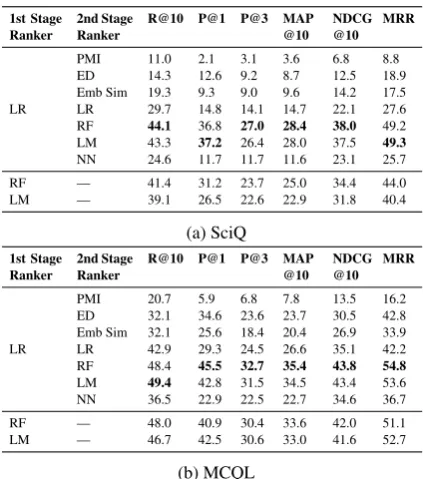
and 2500 for MCQL to get a recall of about 90%. Distractor Ranking Results Table 2 lists the ranking results for DG. From the table we observe
500 1000 1500 2000 2500 3000 3500
K
75 80 85 90 95
Recall@K SciQ - Valid
[image:4.595.308.525.62.180.2]SciQ - Test MCQL - Valid MCQL - Test
Figure 1: Recall@K for the first stage ranker.
1st Stage
Ranker 2nd StageRanker R@10 P@1 P@3 MAP@10 NDCG@10 MRR
LR
PMI 11.0 2.1 3.1 3.6 6.8 8.8 ED 14.3 12.6 9.2 8.7 12.5 18.9 Emb Sim 19.3 9.3 9.0 9.6 14.2 17.5 LR 29.7 14.8 14.1 14.7 22.1 27.6 RF 44.1 36.8 27.0 28.4 38.0 49.2 LM 43.3 37.2 26.4 28.0 37.5 49.3
NN 24.6 11.7 11.7 11.6 23.1 25.7 RF — 41.4 31.2 23.7 25.0 34.4 44.0 LM — 39.1 26.5 22.6 22.9 31.8 40.4
(a) SciQ
1st Stage
Ranker 2nd StageRanker R@10 P@1 P@3 MAP@10 NDCG@10 MRR
LR
PMI 20.7 5.9 6.8 7.8 13.5 16.2 ED 32.1 34.6 23.6 23.7 30.5 42.8 Emb Sim 32.1 25.6 18.4 20.4 26.9 33.9 LR 42.9 29.3 24.5 26.6 35.1 42.2 RF 48.4 45.5 32.7 35.4 43.8 54.8
LM 49.4 42.8 31.5 34.5 43.4 53.6 NN 36.5 22.9 22.5 22.7 34.6 36.7 RF — 48.0 40.9 30.4 33.6 42.0 51.1 LM — 46.7 42.5 30.6 33.0 41.6 52.7
[image:4.595.308.520.226.466.2](b) MCQL
Table 2: Ranking results (%) for DG.
# SciQ MCQL
1 Emb Sim (a,d) Emb Sim (a,d) 2 Freqd Token Sim (a,d)
3 Freqa ED
4 Wiki Sim Suffix
5 Emb Sim (q,d) Suffix / len(d)
6 Suffix Freqa
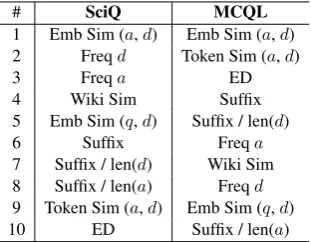
[image:5.595.104.260.62.183.2]7 Suffix / len(d) Wiki Sim 8 Suffix / len(a) Freqd 9 Token Sim (a,d) Emb Sim (q,d) 10 ED Suffix / len(a)
Table 3: Top 10 important features.
Feature Analysis We conduct a feature analy-sis to have more insights on the proposed feature set. Feature importance is calculated by “mean de-crease impurity” using RF. It is defined as the total decrease in node impurity, weighted by the proba-bility of reaching that node, averaged over all trees of the ensemble. Table3lists the top 10 important features for SciQ and MCQL datasets. We find that: (i) the embedding similarity between aand dis the most important feature, which shows
em-beddings are effective at capturing semantic rela-tions betweenaandd. (ii) String similarities such
as Token Sim, ED, and Suffix are more important in MCQL than those in SciQ. This is consistent with the observation that ED has relatively good performance as seen in Table 2b. (iii) The set of top 10 features is the same for SciQ and MCQL, regardless of order.
Effects of Cascaded Learning Since we choose the top 2000 for SciQ and 2500 for MCQL from first stage, the ranking candidate size is reduced by 91% for SciQ and 85% for MCQL, which makes the second stage learning more efficient. To study whether cascaded learning is effective, we exper-iment with RF and LM without 2-stage learning, as shown as the bottom two rows in Table2. Here we sample 100 negative samples for training mod-els in order to make a fair comparison with other methods using 2-stage learning. We can see that the performance is better when cascaded learning is applied.
4 Conclusion
We investigated DG as a ranking problem and applied feature-based and NN-based supervised ranking models to the task. Experiments with the SciQ and the MCQL datasets empirically show that ensemble learning models (random forest and LambdaMART) outperform both the NN-based
method and unsupervised baselines. The MCQL data is publicly available upon request. The two datasets can be used as benchmarks for further DG research. Future work will be to design a user in-terface to implement the proposed models to help teachers with DG and collect more user data for model training.
Acknowledgments
We gratefully acknowledge partial support from the Pennsylvania State University Center for On-line Innovation in Learning and helpful comments from the reviewers.
A Training and Implementation Details
Feature-based Models. We use the implemen-tations of scikit-learn (Pedregosa et al.,2011) for logistic regression and random forest experiments. For LambdaMART experiments, we use the XG-Boost library (Chen and Guestrin, 2016). For both SCIQ and MCQL datasets we train with 500 rounds of boosting, step size shrinkage of 0.1, maximum depth of 30, minimum child weight of 0.1 and minimum loss reduction of 1.0 for parti-tion. For calculating Wiki Sim features, we use a Wikipedia dump of Oct. 2016. Part of speech tags are calculated with NLTK (Bird and Loper,2004). The logistic regression used for the first stage ranker is based on features including: Emb Sim, POS Sim, ED, Token Sim, Length, Suffix, and Freq. Models for the second stage ranker is based on all features described in Sec.2.1.1.
NN-based Models. Our NN-based models are implemented with TensorFlow (Abadi et al., 2016). When training the generator, we first uni-formly selectK = 512candidates and then sam-ple 16 distractors according to Equation 2. The temperatureτ is set to 5. Our scoring functions are
based on Decomposable Attention Model (Parikh et al.,2016). The word embeddings are initialized using the pre-trained GloVe (Pennington et al., 2014) (840B tokens), and the embedding size is 300. Our model is optimized using Adam algo-rithm (Kingma and Ba,2015) with a learning rate of1e-4and a weight decay of1e-6.
Since the sampling process inGis not
References
Mart´ın Abadi, Paul Barham, Jianmin Chen, Zhifeng Chen, Andy Davis, Jeffrey Dean, Matthieu Devin, Sanjay Ghemawat, Geoffrey Irving, Michael Isard, et al. 2016. Tensorflow: A system for large-scale machine learning. InOSDI, volume 16, pages 265– 283.
Manish Agarwal and Prashanth Mannem. 2011. Auto-matic gap-fill question generation from text books. InBEA, pages 56–64. ACL.
Steven Bird and Edward Loper. 2004. Nltk: the nat-ural language toolkit. In Proceedings of the ACL 2004 on Interactive poster and demonstration ses-sions, page 31. ACL.
Leo Breiman. 2001. Random forests. Machine learn-ing, 45(1):5–32.
Chris J.C. Burges. 2010. From ranknet to lambdarank to lambdamart: An overview. Technical report.
Liwei Cai and William Yang Wang. 2018. Kbgan: Ad-versarial learning for knowledge graph embeddings. InNAACL. ACL.
Chia-Yin Chen, Hsien-Chin Liou, and Jason S Chang. 2006. Fast: an automatic generation system for grammar tests. InProceedings of the COLING/ACL on Interactive presentation sessions, pages 1–4. ACL.
Tianqi Chen and Carlos Guestrin. 2016. Xgboost: A scalable tree boosting system. InKDD, pages 785– 794. ACM.
David Coniam. 1997. A preliminary inquiry into using corpus word frequency data in the automatic genera-tion of english language cloze tests. Calico Journal, 14(2-4):15–33.
Ian Goodfellow, Jean Pouget-Abadie, Mehdi Mirza, Bing Xu, David Warde-Farley, Sherjil Ozair, Aaron Courville, and Yoshua Bengio. 2014. Generative ad-versarial nets. InNIPS, pages 2672–2680.
Hubbard C Goodrich. 1977. Distractor efficiency in foreign language testing. TESOL Quarterly, pages 69–78.
Qi Guo, Chinmay Kulkarni, Aniket Kittur, Jeffrey P. Bigham, and Emma Brunskill. 2016. Questimator: Generating knowledge assessments for arbitrary top-ics. InIJCAI, pages 3726–3732.
Jennifer Hill and Rahul Simha. 2016. Automatic generation of context-based fill-in-the-blank exer-cises using co-occurrence likelihoods and google n-grams. InBEA@NAACL, pages 23–30. ACL.
Shu Jiang and John Lee. 2017. Distractor gen-eration for chinese fill-in-the-blank items. In
BEA@EMNLP, pages 143–148. ACL.
Diederik P Kingma and Jimmy Ba. 2015. Adam: A method for stochastic optimization. InICLR.
Girish Kumar, Rafael E Banchs, and Luis Fernando D’Haro Enriquez. 2015. Revup: Automatic gap-fill question generation from educational texts. InBEA. ACL.
Chen Liang, Xiao Yang, Drew Wham, Bart Pursel, Re-becca Passonneau, and C. Lee Giles. 2017. Distrac-tor generation with generative adversarial nets for automatically creating fill-in-the-blank questions. In
Proceedings of the Knowledge Capture Conference, page 33. ACM.
Tie-Yan Liu et al. 2009. Learning to rank for informa-tion retrieval. Foundations and TrendsR in
Infor-mation Retrieval, 3(3):225–331.
Tomas Mikolov, Ilya Sutskever, Kai Chen, Greg S Cor-rado, and Jeff Dean. 2013. Distributed representa-tions of words and phrases and their compositional-ity. InNIPS, pages 3111–3119.
Ruslan Mitkov and Le An Ha. 2003. Computer-aided generation of multiple-choice tests. In
BEA@NAACL, pages 17–22. ACL.
Ankur Parikh, Oscar T¨ackstr¨om, Dipanjan Das, and Jakob Uszkoreit. 2016. A decomposable attention model for natural language inference. In EMNLP, pages 2249–2255. ACL.
Fabian Pedregosa, Ga¨el Varoquaux, Alexandre Gram-fort, Vincent Michel, Bertrand Thirion, Olivier Grisel, Mathieu Blondel, Peter Prettenhofer, Ron Weiss, Vincent Dubourg, et al. 2011. Scikit-learn: Machine learning in python. Journal of machine learning research, 12(Oct):2825–2830.
Jeffrey Pennington, Richard Socher, and Christopher Manning. 2014. Glove: Global vectors for word representation. InEMNLP, pages 1532–1543. ACL.
Juan Pino and Maxine Eskenazi. 2009. Semi-automatic generation of cloze question distractors effect of students’ l1. InSLaTE, pages 65–68.
Juan Pino, Michael Heilman, and Maxine Eskenazi. 2008. A selection strategy to improve cloze ques-tion quality. InProceedings of the Workshop on In-telligent Tutoring Systems for Ill-Defined Domains. 9th International Conference on Intelligent Tutoring Systems., pages 30–42.
Keisuke Sakaguchi, Yuki Arase, and Mamoru Ko-machi. 2013. Discriminative approach to fill-in-the-blank quiz generation for language learners. InACL, volume 2, pages 238–242. ACL.
Katherine Stasaski and Marti A Hearst. 2017. Multiple choice question generation utilizing an ontology. In
Eiichiro Sumita, Fumiaki Sugaya, and Seiichi Ya-mamoto. 2005. Measuring non-native speak-ers’ proficiency of english by using a test with automatically-generated fill-in-the-blank questions. InBEA, pages 61–68. ACL.
Paul Viola and Michael Jones. 2001. Rapid object de-tection using a boosted cascade of simple features. InCVPR, volume 1, pages 511–518. IEEE.
Jun Wang, Lantao Yu, Weinan Zhang, Yu Gong, Yinghui Xu, Benyou Wang, Peng Zhang, and Dell Zhang. 2017. Irgan: A minimax game for unifying generative and discriminative information retrieval models. InSIGIR, pages 515–524. ACM.
Johannes Welbl, Nelson F. Liu, and Matt Gardner. 2017. Crowdsourcing multiple choice science ques-tions. InProceedings of the 3rd Workshop on Noisy User-generated Text, NUT@EMNLP, pages 94–106. ACL.