Proceedings of NAACL-HLT 2018, pages 1528–1538
SHAPED: Shared-Private Encoder-Decoder for Text Style Adaptation
Ye Zhang∗ UT Austin
Nan Ding Radu Soricut
Google AI
{dingnan,rsoricut}@google.com
Abstract
Supervised training of abstractive language generation models results in learning condi-tional probabilities over language sequences based on the supervised training signal. When the training signal contains a variety of writ-ing styles, such models may end up learn-ing an ’average’ style that is directly influ-enced by the training data make-up and can-not be controlled by the needs of an applica-tion. We describe a family of model archi-tectures capable of capturing both generic lan-guage characteristics via shared model param-eters, as well as particular style characteristics via private model parameters. Such models are able to generate language according to a specific learned style, while still taking advan-tage of their power to model generic language phenomena. Furthermore, we describe an ex-tension that uses a mixture of output distribu-tions from all learned styles to perform on-the-fly style adaptation based on the textual input alone. Experimentally, we find that the pro-posed models consistently outperform models that encapsulate single-style or average-style language generation capabilities.
1 Introduction
Encoder-decoder models have recently pushed forward the state-of-the-art performance on a va-riety of language generation tasks, including ma-chine translation (Bahdanau et al.,2015;Wu et al., 2016; Vaswani et al., 2017), text summariza-tion (Rush et al.,2015;Nallapati et al.,2016;See et al.,2017), dialog systems (Li et al.,2016; As-ghar et al.,2017), and image captioning (Xu et al., 2015;Ranzato et al.,2015;Liu et al.,2017). This framework consists of an encoder that reads the input data and encodes it as a sequence of vectors, which is in turn used by a decoder to generate
an-∗Work done as an intern at Google AI.
other sequence of vectors used to produce output symbols step by step.
The prevalent approach to training such a model is to update all the model parameters using all the examples in the training data (over multiple epochs). This is a reasonable approach, under the assumption that we are modeling a single underly-ing distribution in the data. However, in many ap-plications and for many natural language datasets, there exist multiple underlying distributions, char-acterizing a variety of language styles. For in-stance, the widely-used Gigaword dataset (Graff and Cieri, 2003) consists of a collection of arti-cles written by various publishers (The New York Times, Agence France Presse, Xinhua News, etc.), each with its own style characteristics. Training a model’s parameters on all the training examples results in an averaging effect across style charac-teristics, which may lower the quality of the out-puts; additionally, this averaging effect may be completely undesirable for applications that re-quire a level of control over the output style. At the opposite end of the spectrum, one can choose to train one independent model per each underly-ing distribution (assumunderly-ing we have the appropri-ate signals for identifying them at training time). This approach misses the opportunity to exploit common properties shared by these distributions (e.g., generic characteristics of a language, such as noun-adjective position), and leads to models that are under-trained due to limited data availability per distribution.
In order to address these issues, we propose a novel neural architecture called SHAPED (shared-private encoder-decoder). This architecture has both shared encoder/decoder parameters that are updated based on all the training examples, as well as private encoder/decoder parameters that are up-dated using only examples from their correspond-ing underlycorrespond-ing traincorrespond-ing distributions. In addition
to learning different parametrization between the shared model and the private models, we jointly learn a classifier to estimate the probability of each example belonging to each of the underlying train-ing distributions. In such a setttrain-ing, the shared parameters (’shared model’) are expected to learn characteristics shared by the entire set of training examples (i.e., language generic), whereas each private parameter set (’private model’) learns par-ticular characteristics (i.e., style specific) of their corresponding training distribution. At the same time, the classifier is expected to learn a probabil-ity distribution over the labels used to identify the underlying distributions present in the input data. At test time, there are two possible scenarios. In the first one, the input signal explicitly contains in-formation about the underlying distribution (e.g., the publisher’s identity). In this case, we feed the data into the shared model and also the cor-responding private model, and perform sequence generation based on a concatenation of their vec-tor outputs; we refer to this model as the SHAPED model. In a second scenario, the information about the underlying distribution is either not available, or it refers to a distribution that was not seen dur-ing traindur-ing. In this case, we feed the data into the shared model and all the private models; the output distribution of the symbols of the decoding sequence is estimated using a mixture of distribu-tions from all the decoders, weighted according to the classifier’s estimates for that particular exam-ple; we refer to this model as the Mix-SHAPED model.
We test our models on the headline-generation task based on the aforementioned Gigaword dataset. When the publisher’s identity is presented as part of the input, we show that the SHAPED model significantly surpasses the performance of the shared encoder-decoder baseline, as well as the performance of private models (where one in-dividual, per-publisher model is trained for each in-domain style). When the publisher’s identity is not presented as part of the input (i.e., not pre-sented at run-time but revealed at evaluation-time for measurement purposes), we show that the Mix-SHAPED model exhibits a high level of classifi-cation accuracy based on textual inputs alone (ac-curacy percentage in the 80s overall, varying by individual publisher), while its generation accu-racy still surpasses the performance of the base-line models. Finally, when the publisher’s identity
is unknown to the model (i.e., a publisher that was not part of the training dataset), we show that the Mix-SHAPED model performance far surpasses the shared model performance, due to the ability of the Mix-SHAPED model to perform on-the-fly adaptation of output style. This feat comes from our model’s ability to perform two distinct tasks: match the incoming, previously-unseen input style to existing styles learned at training time, and use the correlations learned at training time between input and output style characteristics to generate style-appropriate token sequences.
2 Related Work
Encoder-Decoder Models for Structured Output Prediction
Encoder-decoder architectures have been success-fully applied to a variety of structure prediction tasks recently. Tasks for which such architec-tures have achieved state-of-the-art results include machine translation (Bahdanau et al., 2015; Wu et al.,2016;Vaswani et al.,2017), automatic text summarization (Rush et al., 2015;Chopra et al., 2016;Nallapati et al., 2016; Paulus et al., 2017; Nema et al.,2017), sentence simplification ( Filip-pova et al., 2015; Zhang and Lapata, 2017), dia-log systems (Li et al., 2016,2017;Asghar et al., 2017), image captioning (Vinyals et al.,2015;Xu et al.,2015;Ranzato et al.,2015;Liu et al.,2017), etc. By far the most used implementation of such architectures is based on the original sequence-to-sequence model (Sutskever et al., 2014), aug-mented with its attention-based extension ( Bah-danau et al., 2015). Although our SHAPED and Mix-SHAPED model formulations do not depend on a particular architecture implementation, we do make use of the (Bahdanau et al.,2015) model to instantiate our models.
Domain Adaptation for Neural Network Models
for image recognition tasks, their proposal uses CNNs for encoding an image into a feature rep-resentation, and also for reconstructing the input sample. It also makes use of a private encoder for each domain, and a shared encoder for both the source and the target domain. The approach we take in this paper shares this idea of model parametrization according to the domain/style, but goes further with the Mix-SHAPED model, per-forming on-the-fly adaptation of the model out-puts. Other CNN-based domain adaptation meth-ods for object recognition tasks are presented in (Long et al., 2016;Chopra et al.,2013;Tzeng et al.,2015;Sener et al.,2016).
For NLP tasks,Peng and Dredze (2017) take a multi-task approach to domain adaptation and se-quence tagging. They use a shared encoder to rep-resent instances from all of the domains, and use a domain projection layer to project the shared layer into a domain-specific space. They only consider the supervised domain-adaptation case, in which labeled training data exists for the target domain. Glorot et al. (2011) use auto-encoders for learn-ing a high-level feature extraction across domains for sentiment analysis, while Zhou et al. (2016) employ auto-encoders to directly transfer the ex-amples across different domains also for the same sentiment analysis task. Hua and Wang (2017) perform an experimental analysis on domain adap-tation for neural abstractive summarization.
An important requirement of all the methods in the related work described above is that they re-quire access to the (unlabeled) target domain data, in order to learn a domain-invariant representa-tion across source and target domains. In contrast, our Mix-SHAPED model does not need access to a target domain or style at training time, and in-stead performs the adaptation on-the-fly, accord-ing to the specifics of the input data and the corre-lations learned at training time between available input and output style characteristics. As such, it is a more general approach, which allows adapta-tion for a much larger set of target styles, under the weaker assumption that there exists one or more styles present in the training data that can act as representative underlying distributions.
3 Model Architecture
Generally speaking, a standard encoder-decoder model has two components: an encoder that takes as input a sequence of symbols x =
(x1, x2, ..., xTx) and encodes them into a set of
vectorsH= (h1, h2, ..., hTx),
H=fenc(x), (1)
wherefencis the computation unit in the encoder; and, a decoder that generates output symbols at each time stamp t, conditioned on H as well as
the decoder inputsy1:t−1,
st=fdec(y1:t−1,H), (2)
where fdec is the computation unit in the de-coder. Instantiations of this framework in-clude the widely-used attention-based sequence-to-sequence model (Bahdanau et al., 2015), in whichfenc andfdec are implemented by an RNN architecture using LSTM (Hochreiter and Schmid-huber,1997) or GRU (Chung et al.,2014) units. A more recent instantiation of this architecture is the Transformer model (Vaswani et al., 2017), built using self-attention layers.
3.1 SHAPED: Shared-private encoder-decoder
The abstract encoder-decoder model described above is usually trained over all examples in the training data. We call such a model a shared
encoder-decoder model, because the model pa-rameters are shared across all training and test instances. Formally, the shared encoder-decoder consists of the computation units fencs and fdecs .
Given an instance x, it generates a sequence of
vectorsSs = (ss1, ...ssT)by:
Hs=fencs (x), sst =fdecs (y1:t−1,Hs). (3)
The drawback of the shared encoder-decoder is that it fails to account for particular properties of each style that may be present in the data. In order to capture such particular style characteris-tics, a straightforward solution is to train a pri-vate model for each style. Assuming a style set
D = {D1, D2..., D|D|}, such a solution implies that each style has its own private encoder com-putation unit and decoder comcom-putation unit. At both training and testing time, each private en-coder and deen-coder only process instances that be-long to their own style. Given an instance abe-long with its style (x, z) wherez ∈ {1, . . . ,|D|}, the private encoder-decoder generates a sequence of vectorsSz = (sz1, ...szT)by:
D1
[image:4.595.75.279.62.213.2]D2
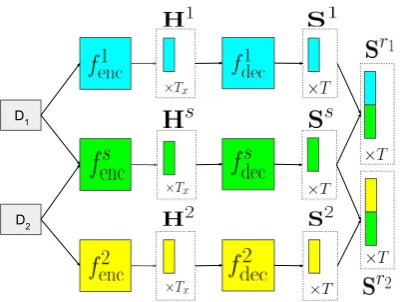
Figure 1: Illustration of the SHAPED model using two stylesD1andD2.D1articles pass through the
private encoderf1
encand decoderfdec1 . D2articles
pass through the private encoderfenc2 and decoder fdec2 . Both of them also go through the shared
en-coderfs
decand decoderfdecs .
Although the private encoder/decoder models do preserve style characteristics, they fail to take into account the common language features shared across styles. Furthermore, since each style is rep-resented by a subset of the entire training set, such private models may end up as under-trained, due to limited number of available data examples.
In order to efficiently capture both common and unique features of data with different styles, we propose the SHAPED model. In the SHAPED model, each data-point goes through both the shared encoder-decoder and its corresponding pri-vate encoder-decoder. At each step of the decoder, the output from private and shared ones are con-catenated to form a new vector:
srz
t = [szt, sst], (5)
that contains both private features for stylez and
shared features induced from other styles, as il-lustrated in Fig1. The output symbol distribution over tokensot∈V (whereV is the output
vocab-ulary) at steptis given by:
p(ot|x, y1:t−1, z) =Softmax(g(srtz)), (6)
where g is a multi-layer feed-forward
network that maps srz
t to a vector of
size |V|. Given N training examples
(x(1),y(1), z(1)), . . . ,(x(N),y(N), z(N)), the conditional probability of the output y(i) given
articlex(i)and its stylez(i)∈ {1, . . . ,|D|}is:
p(y(i)|x(i), z(i)) =Y
t
p(ot=yt(i)|x(i),y
(i)
1:t−1, z(i)).
(7) At inference time, given an articlexwith stylez,
we feed x into fencs , fdecs , fencz , fdecz (Eq. 3-4) and
obtain symbol distributions at each step t using Eq.6. We sample from the distribution and obtain a symbolotwhich will be used as the estimatedyt
and fed to the next steps.
3.2 The Mix-SHAPED Model
One limitation of the above model is that it can only handle test data containing an explicit style label fromD={D1, D2..., D|D|}. However, there is frequently the case that, at test time, the style label is not present as part of the input, or that the input style is not part of the modeled setD.
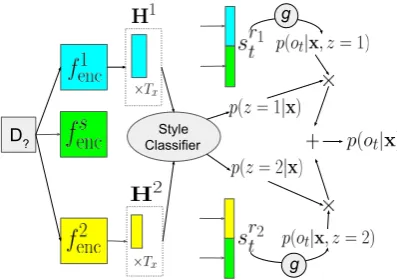
We treat both of these cases similarly, as a case of modeling an unknown style. We first describe our treatment of such a case at run-time. We use a latent random variable z ∈ {1, . . . ,|D|}to
de-note the underlying style of a given input. When generating a token at stept, the output token
dis-tribution takes the form of a mixture of SHAPED (Mix-SHAPED) model outputs:
p(ot|x,y1:t−1) =
|D|
X
d=1
p(ot|x,y1:t−1, z =d)p(z=d|x),
(8)
wherep(ot|x,y1:t−1, z =d)is the output symbol
distribution of SHAPED decoderd, evaluated as
in Eq. 6. Fig.2 contains an illustration of such a model. In this formulation, p(z|x) denotes the style conditional probability distribution from a trainable style classifier.
The joint data likelihood of target sequence y
and target domain labelzfor input sequencexis:
p(y, z|x) =p(y|z,x)·p(z|x) (9)
Training the Mix-SHAPED model involves mini-mizing a loss function that combines the negative log-likelihood of the style labels and the negative log-likelihood of the symbol sequences (see the model in Fig3):
LossMix-SHAPED =−
N
X
i=1
logp(z(i)|x(i))
−
N
X
i=1
logp(y(i)|x(i), z(i)).
D?
Style
Classifier
g
[image:5.595.314.519.66.361.2]g
Figure 2: Decoding data with unknown style using a Mix-SHAPED model. The data is run through all encoders and decoders. The output of private encoders is fed into a classifier that estimates style distribution. The output symbol distribution is a mixture over all decoder outputs.
At run-time, if the styledof the input is available andd∈ D, we decode the sequence using Eq.6. This also corresponds to the casep(z=d|x) = 1 and 0 for all other styles, and reduces Eq. 8 to Eq. 6. If the style of the input is unknown (or known, but with d0 6∈ D), we decode the
se-quence using Eq.8, in which case the mixture over SHAPED models given byp(z|x) is approximat-ing the desired output style.
4 Model Instantiation
As an implementation of the encoder-decoder model, we use the attention-based sequence-to-sequence model from (Bahdanau et al., 2015), with an RNN architecture using GRU units (Chung et al., 2014). The input token sequences are first projected into an embedding space via an embedding matrix E, resulting in a sequence of vectors as input representations.
The private and shared RNN cells generate a sequence of hidden state vectors Hz = {hzj},
z ∈ {1, ...,|D|} and Hs = {hsj}, for j ∈ {1, ..., Tx}. At each step in the encoder, hzj and
hsj are concatenated to form a new output vector hrz
j = [hzj, hsj]. The final state of each encoder
is used as the initial state of the corresponding de-coder. At time steptin the decoder, the private and shared RNN cell first generate hidden state vec-tors{szt}, z ∈ {1, ...,|D|}andsst, thensst is
con-catenated with eachsz
t to form new vectors{srtz}
(z∈ {1, ...,|D|}).
We apply the attention mechanism onsrz
t , using
Style Classifier
CAT SOFTMAX
D1
D2
D1
Style
Classifier
Figure 3: Training a Mix-SHAPED model. (a) Each example is fed to all private encoders
fenc1 , fenc2 , whose outputs are concatenated and fed
to a style classifier. (b) The D1 examples only
use fenc1 , fdec1 , fencs , fdecs to decode texts. Private
encoder-decoders of other styles are not used.
attention weights calculated as:
qrz
tj =vatanh(Wahjrz +Uasrtz), (11)
which are normalized to a probability distribution:
αrz
tj =
exp(qrz
tj)
PTx
i=1exp(qtirz)
(12)
Context vectors are computed using normalized attention weights:
crz
t = Tx X
j=1
αrz
tjhrjz (13)
Given the context vector and the hidden state vec-tors, the symbol distribution at steptis:
p(ot|x,y1:t, z) =softmax(g([crtz, srtz])) (14)
The attention weights inWa, Ua, andva, as well
as the embedding matrixEand vocabularyV are
[image:5.595.79.278.68.208.2]5 Quantitative Experiments
We perform a battery of quantitative experiments, designed to answer several main questions: 1) Do the proposed model improve generation perfor-mance over alternative approaches? 2) Can a style classifier built using an auxiliary loss provide a re-liable estimate on text style? 3) In the case of un-known style, does the Mix-SHAPED model im-prove generation performance over alternative ap-proaches? 4) To what extent do our models cap-ture style characteristics as opposed to, say, con-tent characteristics?
We perform our experiments using text sum-marization as the main task. More precisely, we train and evaluate headline generation models us-ing the publicly-available Gigaword dataset (Graff and Cieri,2003;Napoles et al.,2012).
5.1 Headline-generation Setup
The Gigaword dataset contains news articles from seven publishers: Agence France-Presse (AFP), Associated Press Worldstream (APW), Central News Agency of Taiwan (CNA), Los Ange-les Times/Washington Post Newswire Service (LTW), New York Times (NYT), Xinhua News Agency (XIN), and Washington Post/Bloomberg Newswire Service (WPB). We pre-process this dataset in the same way as in (Rush et al.,2015), which results in articles with average length 31.4 words, and headlines with average length 8.5 words.
We consider the publisher identity as a proxy for style, and choose to model as in-domain styles the setD={AFP, APW, NYT, XIN}, while hold-ing out CNA and LTW for out-of-domain style testing. This results in a training set containg the followcontaing number of (article, headline) in-stances: 993,584 AFP, 1,493,758 APW, 578,259 NYT, and 946,322 XIN. For the test set, we sam-ple a total number of 10,000 in-domain examsam-ples from the original Gigawords test dataset, which include 2,886 AFP, 2,832 APW, 1,610 NYT, and 2,012 XIN. For out-of-domain testing, we ran-domly sample 10,000 LTW and 10,000 CNA test data examples. We remove the WPB articles due to their small number of instances.
5.1.1 Experimental Setup
We compare the following models:
• A Shared encoder-decoder model (S) trained on all styles inD;
• A suite of Private encoder-decoder models (P), each one trained on a particular style fromD={AFP, APW, NYT, XIN};1
• A SHAPED model (SP) trained on all styles in D; at test time, the style of test data is provided to the model; the article is only run through its style-specific private network and shared network (style classifier is not needed);
• A Mix-SHAPED model (M-SP) trained on all styles inD; at test time, the style of arti-cle is not provided to the model; the output is computed using the mixture model, with the estimated style probabilities from the style classifier used as weights.
When testing on the out-of-domain styles CNA/LTW, we only compare the Shared (S) model with the Mix-SHAPED (M-SP) model, as the others cannot properly handle this scenario.
As hyper-parameters for the model instantia-tion, we used 500-dimension word embeddings, and a three-layer, 500-dimension GRU-cell RNN architecture; the encoder was instantiated as a bi-directional RNN. The lengths of the input and out-put sequences were truncated to 40 and 20 tokens, respectively. All the models were optimized using Adagrad (Duchi et al.,2011), with an initial learn-ing rate of 0.01. The trainlearn-ing procedure was done over mini-batches of size 128, and the updates were done asynchronously across 40 workers for 5M steps. The encoder/decoder word embedding and the output projection matrices were tied to minimize the number of parameters. To avoid the slowness from the softmax operator over large vo-cabulary sizes, and also mitigate the impact of out-of-vocabulary tokens, we applied a subtokeniza-tion method (Wu et al., 2016), which invertibly transforms a native token into a sequence of subto-kens from a limited vocabulary (here set to 32K).
Comparison with Previous Work In the next
section, we report our main results using the in-domain and out-of-in-domain (w.r.t. the selected publisher styles) test sets described above, since these test sets have a balanced publisher style fre-quency that allows us to measure the impact of our style-adaptation models. However, we also report
1We also tried to warm-start a private model using the best
AFP/APW/XIN/NYT Test Rouge-1 Rouge-2 Rouge-L P 39.14±0.47 19.74±0.48 36.42±0.46
S 39.32±0.26 19.63±0.24 36.51±0.26
SP 40.34±0.26 20.38±0.25 37.52±0.25
[image:7.595.87.278.61.126.2]M-SP 40.10±0.25 20.21±0.26 37.30±0.26
Table 1: ROUGE F1 scores on the combined AFP/APW/XIN/NYT in-domain test set.
here the performance of our Shared (S) baseline model (with the above hyper-parameters) on the original 2K test set used in (Rush et al., 2015). On that test set, our S model obtains 30.13 F1 ROUGE-L score, compared to 28.34 ROUGE-L obtained by the ABS+ model (Rush et al.,2015), and 30.64 ROUGE-L obtained by the words-lvt2k-1sent model (Nallapati et al.,2016). This compar-ison indicates that our S model is a competitive baseline, making the comparisons against the SP and M-SP models meaningful when using our in-domain and out-of-in-domain test sets.
5.1.2 Main Results
The Rouge scores for the in-domain testing data are reported in Table 1 (over the combined AFP/APW/XIN/NYT testset) and Fig. 4a (over individual-style test sets). The numbers indicate that the SP and M-SP models consistently outper-form the S and P model, supporting the conclusion that the S model loses important characteristics due to averaging effects, while the P models miss the opportunity to efficiently exploit the training data. Additionally, the performance of SP is con-sistently better than M-SP in this setting, which in-dicates that the style label is helpful. As shown in Fig. 4b, the style classifier achieves around 80% accuracy overall in predicting the style under the M-SP model, with some styles (e.g., XIN) being easier to predict than others. The performance of the classifier is directly reflected in the quantita-tive difference between the SP and M-SP models on individual-style test sets (see Fig.4a, where the XIN style has the smallest difference between the two models).
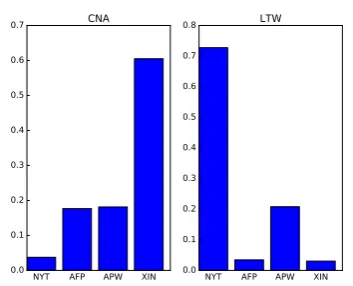
The evaluation results for the out-of-domain scenario are reported in Table2. The numbers in-dicate that the M-SP model significantly outper-forms the S model, supporting the conclusion that the M-SP model is capable of performing on-the-fly adaptation of output style. This conclusion is further strengthened by the style probability dis-tributions shown in Fig 5: they indicate that, for
P S SPM-SP
16.4 16.6 16.8 17.0 17.2 17.4 ROUGE-L (%) NYT
P S SPM-SP
39.4 39.6 39.8 40.0 40.2 40.4 40.6 AFP
P S SPM-SP
33.0 33.2 33.4 33.6 33.8 34.0 34.2 34.4 APW
P S SPM-SP
51.5 52.0 52.5 53.0 53.5 XIN
(a) Rouge-L scores on headline generation, shown sepa-rately on four in-domain styles.
NYT AFP APW XIN 0.0 0.1 0.2 0.3 0.4 0.5 0.6 0.7 0.8 NYT
NYT AFP APW XIN 0.0 0.1 0.2 0.3 0.4 0.5 0.6 0.7 0.8 AFP
NYT AFP APW XIN 0.0 0.1 0.2 0.3 0.4 0.5 0.6 0.7 0.8 APW
NYT AFP APW XIN 0.0 0.1 0.2 0.3 0.4 0.5 0.6 0.7 0.8 0.9 XIN
(b) Average estimated probability distribution by the M-SP model over the four styles, for each in-domain target style in the test set.
Figure 4: Experimental results on the headline gen-eration task, for in-domain styles.
the out-of-domain CNA style, the output mixture is heavily weighted towards the XIN style (0.6 of the probability mass), while for the LTW style, the output mixture weights heavily the NYT style (0.72 of the probability mass). This result is likely to reflect true style characteristics shared by these publishers, since both CNA and XIN are produced by Chinese news agencies (from Taiwan and main-land China, respectively), while both LTW and NYT are U.S. news agencies owned by the same media corporation.
5.1.3 Experiment Variants
Model capacity In order to remove the
[image:7.595.316.516.64.212.2] [image:7.595.318.502.251.387.2]CNA Test LTW Test
Rouge-1 Rouge-2 Rouge-L Rouge-1 Rouge-2 Rouge-L S 40.73±0.21 17.75±0.18 37.70±0.20 27.08±0.19 8.97±0.15 25.01±0.17
[image:8.595.119.482.61.121.2]M-SP 42.00±0.20 19.48±0.21 39.24±0.22 27.79±0.19 9.31±0.18 25.60±0.17
Table 2: ROUGE F1 scores on out-of-domain style test sets CNA and LTW.
NYT AFP APW XIN 0.0
0.1 0.2 0.3 0.4 0.5 0.6
0.7 CNA
NYT AFP APW XIN 0.0
0.1 0.2 0.3 0.4 0.5 0.6 0.7
0.8 LTW
Figure 5: Estimated style probabilities over the four in-domain styles AFP/APW/XIN/NYT, for out-of-domain styles CNA and LTW.
original dimensions (the ROUGE-L score of the triple-size S model is 36.61, compared to 36.51 obtained of the original S model).
Style embedding A competitive approach to
modeling different styles is to directly encode the style information into the embedding space. In (Johnson et al., 2016), the style label is con-verted into a one-hot vector and is concatenated with the word embedding at each time step in the S model. The outputs of this model are at 36.68 ROUGE-L, slightly higher than the baseline S model, but significantly lower than the SP model performance (37.52 ROUGE-L).
Another style embedding approach is to aug-ment the S model with continuous trainable style embeddings for each predefined style label, sim-ilar to (Ammar et al., 2016). The resulting out-puts achieve 37.2 ROUGE-L, which is better than the S model with one-hot style embedding, but still worse than the SP method (statistically signif-icant at p-value=0.025 using paired t-test). How-ever, neither of these approaches apply to the cases when the style is out-of-domain or unknown dur-ing testdur-ing. In contrast, such cases are handled nat-urally by the proposed M-SP model.
Ensemble model Another question is whether
the SP model simply benefits from ensembling
multiple models rather than style adaptation. To answer this question, we apply a uniform mix-ture over the private model output along with the shared model output, rather than using the learnt probability distribution from the style classi-fier. The ROUGE-1/2/L scores are 39.9/19.7/37.0. They are higher than the S model but significantly lower than the SP model and the M-SP model (p-value 0.016). This result confirms that the infor-mation that the style classifier encodes is benefi-ciary, and leads to improved performance.
Style vs. Content Previous experiments
indi-cate that the SP and M-SP models have superior generation accuracy, but it is unclear to what ex-tent the difference comes from improved modeling of style versus modeling of content. To clarify this issue, we performed an experiment in which we replace the named entities appearing in both arti-cle and headline with corresponding entity tags, in effect suppressing almost completely any content signal. For instance, given an input such as “China called Thursday on the parties involved in talks on North Korea’s nuclear program to show flexibil-ity as a deadline for implementing the first steps of a breakthrough deal approached.”, paired with goldtruth output “China urges flexibility as NKo-rea deadline approaches”, we replaced the named entities with their types, and obtained: “LOC 0 called Thursday on the ORG 0 involved in NON 2 on LOC 1 ’s NON 3 to show NON 0 as a NON 1 for implementing the first NON 4 of a NON 5 ap-proached .”, paired with “LOC 0 urges NON 0 as LOC 1 NON 1 approaches.”
Under this experimental conditions, both the SP and M-SP models still achieve significantly better performance compared to the S baseline. On the combined AFP/APW/XIN/NYT in-domain test set, the SP model achieves 61.70 ROUGE-L and M-SP achieves 61.52 ROUGE-L, compared to 60.20 ROUGE-L obtained by the S model. On the CNA/LTW out-of-domain test set, M-SP achieves 60.75 ROUGE-L, compared to 59.47 ROUGE-L by the S model.
[image:8.595.84.261.165.308.2]indi-article the org 2 is to forge non 1 with the org 3 located in loc 2 , loc 1 , the per 0 of the loc 0 org 4 said tuesday .
title loc 0 org 0 to forge non 0 with loc 1 org 1 output by S org 0 to org 1 in non 0
output by M-SP loc 0 org 0 to forge non 0 with loc 1 org 1
article loc 0 - born per 0 per 0 will pay non 1 here next month to per 1 , the org 2 ( org 1 ) per 1 who per 1 perished in an non 2 in february , the org 3 said thursday .
title per 0 to pay non 0 to late org 1 org 0 output by S per 0 to visit org 0 in non 0
[image:9.595.79.520.62.219.2] [image:9.595.310.503.275.422.2]output by M-SP per 0 to pay non 0 to org 1 org 0
Table 3: Examples of input article (and groundtruth title) and output generated by S and M-SP. Named entities in the training instances (both article and title) are replaced the entity type.
cates the ability of style adaptation benifiting sum-marization. For instance, we find that both CNA and XIN make more frequent use of the style pat-tern “xxx will/to [verb] yyy. . ., zzz said ???day”
(about 15% of CNA articles contain this pattern, while only 2% of LTW articles have it). From Table 3, we can see that the S model sometimes misses or misuses the verb in its output, while the M-SP model does a much better job at capturing both the verb/action as well as other relations (via prepositions, etc.)
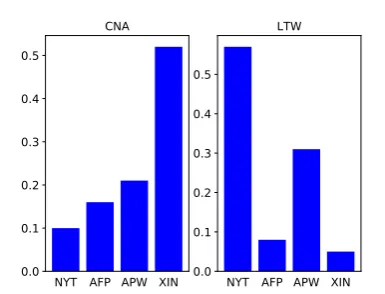
Fig. 6 shows the estimated style probabili-ties over the four styles AFP/APW/XIN/NYT for CNA and LTW, under this experiment condition. We observe that, in this version as well, CNA is closely matching the style of XIN, while LTW is matching that of NYT. The distribution is similar to the one in Fig.5, albeit a bit flatter as a result of content removal. As such, it supports the con-clusion that the classifier indeed learns style (in addition to content) characteristics.
6 Conclusion
In this paper, we describe two new style-adaptation model architectures for text sequence generation tasks, SHAPED and Mix-SHAPED. Both versions are shown to significantly outper-form models that are either trained in a manner that ignores style characteristics (and hence ex-hibit a style-averaging effect in their outputs), or models that are trained single-style.
The latter is a particularly interesting result, as a model that is trained (with enough data) on a single-style and evaluated on the same style would be expected to exhibit the highest performance. Our results show that, even for single-style models
NYT AFP APW XIN 0.0
0.1 0.2 0.3 0.4 0.5
CNA
NYT AFP APW XIN 0.0
0.1 0.2 0.3 0.4 0.5
LTW
Figure 6: Estimated style probabilities over the four in-domain styles AFP/APW/XIN/NYT, for out-of-domain styles CNA and LTW, after named entities in the article and summary are replaced with entity tags.
trained on over 1M examples, their performance is inferior to the performance of SHAPED models on that particular style.
References
Waleed Ammar, George Mulcaire, Miguel Ballesteros, Chris Dyer, and Noah A. Smith. 2016. Many lan-guages, one parser.TACL4:431–444.
Nabiha Asghar, Pascal Poupart, Xin Jiang, and Hang Li. 2017. Deep active learning for dialogue genera-tion. InProceedings of the 6th Joint Conference on Lexical and Computational Semantics (*SEM 2017). pages 78–83.
D. Bahdanau, K. Cho, and Y. Bengio. 2015. Neural machine translation by jointly learning to align and translate. InProceedings of ICLR.
Konstantinos Bousmalis, George Trigeorgis, Nathan Silberman, Dilip Krishnan, and Dumitru Erhan. 2016. Domain separation networks. InAdvances in Neural Information Processing Systems. pages 343– 351.
Sumit Chopra, Michael Auli, Alexander M Rush, and SEAS Harvard. 2016. Abstractive sentence summa-rization with attentive recurrent neural networks. In HLT-NAACL. pages 93–98.
Sumit Chopra, Suhrid Balakrishnan, and Raghuraman Gopalan. 2013. Dlid: Deep learning for domain adaptation by interpolating between domains. In ICML workshop on challenges in representation learning. volume 2.
Junyoung Chung, Caglar Gulcehre, KyungHyun Cho, and Yoshua Bengio. 2014. Empirical evaluation of gated recurrent neural networks on sequence model-ing. arXiv preprint arXiv:1412.3555.
Hal Daum´e III. 2009. Frustratingly easy domain adap-tation. arXiv preprint arXiv:0907.1815.
John Duchi, Elad Hazan, and Yoram Singer. 2011. Adaptive subgradient methods for online learning and stochastic optimization. Journal of Machine Learning Research12(Jul):2121–2159.
Katja Filippova, Enrique Alfonseca, Carlos Col-menares, Lukasz Kaiser, and Oriol Vinyals. 2015. Sentence compression by deletion with lstms. In Proceedings of the 2015 Conference on Empir-ical Methods in Natural Language Processing (EMNLP’15).
Xavier Glorot, Antoine Bordes, and Yoshua Bengio. 2011. Domain adaptation for large-scale sentiment classification: A deep learning approach. In Pro-ceedings of the 28th international conference on ma-chine learning (ICML-11). pages 513–520.
David Graff and C Cieri. 2003. English gigaword cor-pus. Linguistic Data Consortium.
Sepp Hochreiter and J¨urgen Schmidhuber. 1997. Long short-term memory. Neural computation 9(8):1735–1780.
Xinyu Hua and Lu Wang. 2017. A pilot study of do-main adaptation effect for neural abstractive summa-rization. arXiv preprint arXiv:1707.07062.
Melvin Johnson, Mike Schuster, Quoc V. Le, Maxim Krikun, Yonghui Wu, Zhifeng Chen, Nikhil Tho-rat, Fernanda B. Vi´egas, Martin Wattenberg, Greg Corrado, Macduff Hughes, and Jeffrey Dean. 2016.
Google’s multilingual neural machine translation system: Enabling zero-shot translation. CoRR abs/1611.04558. http://arxiv.org/abs/ 1611.04558.
Young-Bum Kim, Karl Stratos, and Ruhi Sarikaya. 2016. Frustratingly easy neural domain adaptation. InProceedings of the 26th International Conference on Computational Linguistics (COLING).
Jiwei Li, Will Monroe, Alan Ritter, Michel Galley, Jianfeng Gao, and Dan Jurafsky. 2016. Deep rein-forcement learning for dialogue generation. arXiv preprint arXiv:1606.01541.
Jiwei Li, Will Monroe, Tianlin Shi, Alan Ritter, and Dan Jurafsky. 2017. Adversarial learning for neural dialogue generation. arXiv preprint arXiv:1701.06547.
Siqi Liu, Zhenhai Zhu, Ning Ye, Sergio Guadarrama, and Kevin Murphy. 2017. Optimization of im-age description metrics using policy gradient meth-ods. InInternational Conference on Computer Vi-sion (ICCV).
Mingsheng Long, Han Zhu, Jianmin Wang, and Michael I Jordan. 2016. Unsupervised domain adaptation with residual transfer networks. In Ad-vances in Neural Information Processing Systems. pages 136–144.
Ramesh Nallapati, Bowen Zhou, Caglar Gulcehre, Bing Xiang, et al. 2016. Abstractive text summa-rization using sequence-to-sequence RNNs and be-yond. InProceedings of CoNLL.
Courtney Napoles, Matthew Gormley, and Benjamin Van Durme. 2012. Annotated gigaword. In Pro-ceedings of the Joint Workshop on Automatic Knowl-edge Base Construction and Web-scale KnowlKnowl-edge Extraction. Association for Computational Linguis-tics, pages 95–100.
Preksha Nema, Mitesh Khapra, Anirban Laha, and Balaraman Ravindran. 2017. Diversity driven atten-tion model for query-based abstractive summariza-tion. arXiv preprint arXiv:1704.08300.
Romain Paulus, Caiming Xiong, and Richard Socher. 2017. A deep reinforced model for abstractive sum-marization.arXiv preprint arXiv:1705.04304.
Marc’Aurelio Ranzato, Sumit Chopra, Michael Auli, and Wojciech Zaremba. 2015. Sequence level training with recurrent neural networks. CoRR abs/1511.06732.
Alexander M. Rush, Sumit Chopra, and Jason Weston. 2015. A neural attention model for abstractive sen-tence summarization. In Proceedings of EMNLP. pages 379–389.
Abigail See, Peter J Liu, and Christopher D Manning. 2017. Get to the point: Summarization with pointer-generator networks. InProceedings of ACL.
Ozan Sener, Hyun Oh Song, Ashutosh Saxena, and Sil-vio Savarese. 2016. Learning transferrable represen-tations for unsupervised domain adaptation. In Ad-vances in Neural Information Processing Systems. pages 2110–2118.
Ilya Sutskever, Oriol Vinyals, and Quoc V Le. 2014. Sequence to sequence learning with neural net-works. InAdvances in neural information process-ing systems. pages 3104–3112.
Eric Tzeng, Judy Hoffman, Trevor Darrell, and Kate Saenko. 2015. Simultaneous deep transfer across domains and tasks. InProceedings of the IEEE In-ternational Conference on Computer Vision. pages 4068–4076.
Ashish Vaswani, Noam Shazeer, Niki Parmar, Jakob Uszkoreit, Llion Jones, Aidan N Gomez, Lukasz Kaiser, and Illia Polosukhin. 2017. Attention is all you need. InAdvances in Neural Information Pro-cessing Systems.
Oriol Vinyals, Alexander Toshev, Samy Bengio, and Dumitru Erhan. 2015. Show and tell: A neural im-age caption generator. In Proceedings of the IEEE conference on computer vision and pattern recogni-tion. pages 3156–3164.
Yonghui Wu, Mike Schuster, Zhifeng Chen, Quoc V. Le, Mohammad Norouzi, Wolfgang Macherey, Maxim Krikun, Yuan Cao, Qin Gao, Klaus Macherey, Jeff Klingner, Apurva Shah, Melvin Johnson, Xiaobing Liu, ukasz Kaiser, Stephan Gouws, Yoshikiyo Kato, Taku Kudo, Hideto Kazawa, Keith Stevens, George Kurian, Nishant Patil, Wei Wang, Cliff Young, Jason Smith, Ja-son Riesa, Alex Rudnick, Oriol Vinyals, Greg Cor-rado, Macduff Hughes, and Jeffrey Dean. 2016.
Google’s neural machine translation system: Bridg-ing the gap between human and machine transla-tion. CoRR abs/1609.08144. http://arxiv.
org/abs/1609.08144.
Kelvin Xu, Jimmy Ba, Ryan Kiros, Aaron Courville, Ruslan Salakhutdinov, Richard Zemel, and Yoshua Bengio. 2015. Show, attend and tell: Neural image caption generation with visual attention. In Proc. of the 32nd International Conference on Machine Learning (ICML).
Xingxing Zhang and Mirella Lapata. 2017. Sen-tence simplification with deep reinforcement learn-ing.arXiv preprint arXiv:1703.10931.