Proceedings of NAACL-HLT 2018, pages 439–443
Pragmatically Informative Image Captioning
with Character-Level Inference
Reuben Cohn-Gordon , Noah Goodman , and Chris Potts
Stanford University
{reubencg, ngoodman, cgpotts}@stanford.edu
Abstract
We combine a neural image captioner with a Rational Speech Acts (RSA) model to make a system that is pragmatically informative: its objective is to produce captions that are not merely true but also distinguish their inputs from similar images. Previous attempts to combine RSA with neural image captioning require an inference which normalizes over the entire set of possible utterances. This poses a serious problem of efficiency, previously solved by sampling a small subset of possible utterances. We instead solve this problem by implementing a version of RSA which oper-ates at the level of characters (“a”,“b”,“c”, . . . ) during the unrolling of the caption. We find that the utterance-level effect of referential captions can be obtained with only character-level decisions. Finally, we introduce an au-tomatic method for testing the performance of pragmatic speaker models, and show that our model outperforms a non-pragmatic baseline as well as a word-level RSA captioner.
1 Introduction
The success of automatic image captioning (Farhadi et al.,2010;Mitchell et al.,2012; Karpa-thy and Fei-Fei, 2015; Vinyals et al., 2015) demonstrates compellingly that end-to-end statis-tical models can align visual information with lan-guage. However, high-quality captions are not merely true, but also pragmatically informative
in the sense that they highlight salient properties and help distinguish their inputs from similar im-ages. Captioning systems trained on single images struggle to be pragmatic in this sense, producing either very general or hyper-specific descriptions.
In this paper, we present a neural image caption-ing system1that is apragmatic speakeras defined by the Rational Speech Acts (RSA) model (Frank and Goodman, 2012;Goodman and Stuhlm¨uller,
1The code is available at https://github.com/
[image:1.595.309.525.203.317.2]reubenharry/Recurrent-RSA
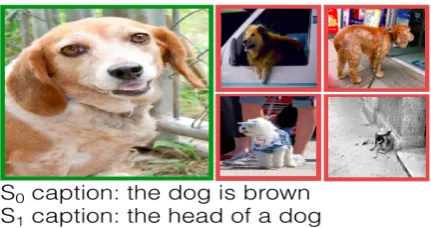
Figure 1: Captions generated by literal (S0) and prag-matic (S1) model for the target image (in green) in the presence of multiple distractors (in red).
2013). Given a set of images, of which one is the
target, its objective is to generate a natural lan-guage expression which identifies the target in this context. For instance, the literal caption in Fig-ure1could describe both the target and the top two distractors, whereas the pragmatic caption men-tions something that is most salient of the target. Intuitively, the RSA speaker achieves this by rea-soning not only about what is true but also about what it’s like to be a listener in this context trying to identify the target.
This core idea underlies much work in refer-ring expression generation (Dale and Reiter,1995; Monroe and Potts,2015;Andreas and Klein,2016; Monroe et al., 2017) and image captioning (Mao et al., 2016a; Vedantam et al., 2017), but these models do not fully confront the fact that the agents must reason about all possible utterances, which is intractable. We fully address this prob-lem by impprob-lementing RSA at the level of charac-ters rather than the level of utterances or words: the neural language model emits individual char-acters, choosing them to balance pragmatic infor-mativeness with overall well-formedness. Thus, the agents reason not about full utterances, but rather only about all possible character choices, a very small space. The result is that the information encoded recurrently in the neural model allows us
to obtain global pragmatic effects from local de-cisions. We show that such character-level RSA speakers are more effective than literal captioning systems at the task of helping a reader identify the target image among close competitors, and outper-form word-level RSA captioners in both efficiency and accuracy.
2 Bayesian Pragmatics for Captioning
In applying RSA to image captioning, we think of captioning as a kind of reference game. The
speaker andlistener are in a shared context con-sisting of a set of images W, the speaker is
pri-vately assigned a target imagew⇤ 2 W, and the
speaker’s goal is to produce a caption that will en-able the listener to identify w⇤. U is the set of
possible utterances. In its simplest form, the lit-eral speaker is a conditional distributionS0(u|w)
assigning equal probability to all true utterances
u 2 U and0to all others. The pragmatic listener
L0is then defined in terms of this literal agent and
a priorP(w)over possible images:
L0(w|u)/
S0(u|w)⇤P(w) P
w02WS0(u|w0)⇤P(w0) (1)
The pragmatic speakerS1 is then defined in terms
of this pragmatic listener, with the addition of a ra-tionality parameter↵ > 0governing how much it takes into account theL0distribution when
choos-ing utterances.P(u)is here taken to be a uniform distribution overU:
S1(u|w)/
L0(w|u)↵⇤P(u) P
u02UL0(w|u0)↵⇤P(u0) (2)
As a result of this back-and-forth, theS1speaker is
reasoning not merely about what is true, but rather about a listener reasoning about a literal speaker who reasons about truth.
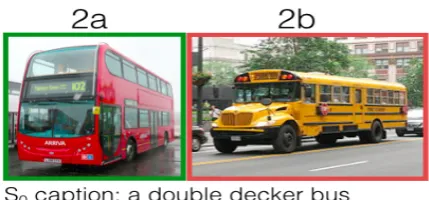
To illustrate, consider the pair of images 2a and 2b in Figure2. Suppose thatU ={bus,red bus}. Then the literal speaker S0 is equally likely to
produce bus andred bus when the left image 2a is the target. However, L0 breaks this
symme-try; because red bus is false of the right bus,
L0(2a|bus) = 13 and L0(2b|bus) = 23. The S1
speaker therefore ends up favoring red buswhen trying to convey 2a, so that S1(red bus|2a) = 34
[image:2.595.308.523.62.162.2]andS1(bus|2a) = 14.
Figure 2: Captions for the target image (in green).
3 Applying Bayesian Pragmatics to a Neural Semantics
To apply the RSA model to image captioning, we first train a neural model with a CNN-RNN archi-tecture (Karpathy and Fei-Fei,2015;Vinyals et al., 2015). The trained model can be considered an
S0-style distribution P(caption|image) on top of
which further listeners and speakers can be built. (Unlike the idealized S0 described above, a
neu-ralS0will assign some probability to untrue
utter-ances.)
The main challenge for this application is that the space of utterances (captions) U will be very
large for any suitable captioning system, making the calculation ofS1intractable due to its
normal-ization over all utterances. The question, there-fore, is how best to approximate this inference. The solution employed by Monroe et al. (2017) andAndreas and Klein(2016) is to sample a small subset of probable utterances from the S0, as an
approximate prior upon which exact inference can be performed. While tractable, this approach has the shortcoming of only considering a small part of the true prior, which potentially decreases the extent to which pragmatic reasoning will be able to apply. In particular, if a useful caption never appears in the sampled prior, it cannot appear in the posterior.
3.1 Step-Wise Inference
Inspired by the success of the “emittor-suppressor” method of Vedantam et al. (2017), we propose an incremental version of RSA. Rather than performing a single inference over utterances, we perform an inferencefor each step of the unrolling of the utterance.
char-acters constituting the caption so far and uis the
next character of the caption. This is now ourS0:
given a partially generated caption and an image, it returns a distribution over which character should next be added to the caption. The advantage of using a character-level LSTM over a word-level one is thatU is much smaller for the former (⇡30 vs. ⇡20,000), making the ensuing RSA model much more efficient.
We use thisS0 to define an L0 which takes a
partial caption and a new character, and returns a distribution over images. TheS1, in turn, given a
target image w⇤, performs an inference over the
set of possible characters to determine which is best with respect to the listener choosingw⇤.
At timestep t of the unrolling, the listenerL0
takes as its prior over images theL0posterior from
timestep (t 1). The idea is that as we proceed with the unrolling, theL0 priors on which image
is being referred to may change, which in turn should affect the speaker’s actions. For instance, the speaker, having made the listener strongly in favor of the target image, is less compelled to con-tinue being pragmatic.
3.2 Model Definition
In our incremental RSA, speaker models take both a target image and a partial caption pc. Thus,
S0 is a neurally trained conditional distribution S0t(u|w,pct), wheretis the current timestep of the
unrolling anduis a character.
We define theLt0in terms of theS0t as follows,
whereipis a distribution over images representing theL0 prior:
L0t(w|u,ipt,pct)/S0t(u|w,pct)⇤ipt(w) (3)
Given anSt
0andLt0, we defineS1tandLt1as:
S1t(u|w,ipt,pct)/
S0t(u|w,pct)⇤L0t(w|u,ipt,pct)↵ (4)
Lt1(w|u,ipt,pct)/
Lt0(w|u,ipt,pct)⇤S0t(u|w,pct) (5)
Unrolling To perform greedy unrolling (though in practice we use a beam search) for either S0
or S1, we initialize the state as a partial caption pc0 consisting of only the start token and a
uni-form prior over the imagesip0. Then, for t > 0,
we use our incremental speaker modelS0orS1to
generate a distribution over the subsequent charac-terSt(u|w,ipt,pct), and add the characteruwith
highest probability density topct, giving uspct+1.
We then run our listener modelL1onu, to obtain a
distributionipt+1 =Lt1(w|u,ipt, pct)over images that theL0can use at the next timestep.
This incremental approach keeps the inference itself very simple, while placing the complexity of the model in the recurrent nature of the unrolling.2 While our S0 is character-level, the same
incre-mental RSA model works for a word-levelS0,
giv-ing rise to a word-levelS1. We compare character
and wordS1s in section4.2.
As well as being incremental, these definitions of St1 and Lt1 differ from the typical RSA
de-scribed in section 2in thatSt
1 andLt1 draw their
priors fromS0t andLt0 respectively. This
general-izes the scheme put forward forS1byAndreas and
Klein(2016). The motivation is to have Bayesian speakers who are somewhat constrained by the
S0 language model. Without this, other methods
are needed to achieve English-like captions, as in Vedantam et al.(2017), where their equivalent of theS1is combined in a weighted sum with theS0.
4 Evaluation
Qualitatively, Figures 1 and 2 show how the S1
captions are more informative than theS0, as a
re-sult of pragmatic considerations. To demonstrate the effectiveness of our method quantitatively, we implement an automatic evaluation.
4.1 Automatic Evaluation
To evaluate the success of S1 as compared to S0, we define a listener Leval(image|caption) /
PS0(caption|image), wherePS0(caption|image)is
the total probability ofS0 incrementally
generat-ing caption given image. In other words, Leval
uses Bayes’ rule to obtain from S0 the posterior
probability of each imagewgiven a full captionu.
The neural S0 used in the definition of Leval
must be trained on separate data to the neuralS0
used for the S1 model which produces captions,
since otherwise this S1 production model
effec-tively has access to the system evaluating it. As Mao et al. (2016b) note, “a model might
‘com-2The move from standard to incremental RSA can be
municate’ better with itself using its own language than with others”. In evaluation, we therefore split the training data in half, with one part for training the S0 used in the caption generation model S1
and one part for training theS0used in the caption
evaluation modelLeval.
We say that the caption succeeds as a referring expression if the target has more probability mass under the distribution Leval(image|caption) than
any distractor.
Dataset We train our production and evaluation models on separate sets consisting of regions in the Visual Genome dataset (Krishna et al.,2017) and full images in MSCOCO (Chen et al.,2015). Both datasets consist of over 100,000 images of common objects and scenes. MSCOCO provides captions for whole images, while Visual Genome provides captions for regions within images.
Our test sets consist of clusters of 10 images. For a given cluster, we set each image in it as the target, in turn. We use two test sets. Test set 1 (TS1) consists of 100 clusters of images, 10 for each of the 10 most common objects in Visual Genome.3 Test set 2 (TS2) consists of regions in Visual Genome images whose ground truth cap-tions have high word overlap, an indicator that they are similar. We again select 100 clusters of 10. Both test sets have 1,000 items in total (10 potential target images for each of 100 clusters).
Captioning System Our neural image caption-ing system is a CNN-RNN architecture4 adapted to use a character-based LSTM for the language model.
Hyperparameters We use a beam search with
width 10 to produce captions, and a rationality pa-rameter of↵= 5.0for theS1.
4.2 Results
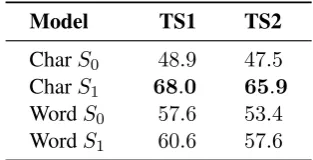
As shown in Table1, the character-levelS1obtains
higher accuracy (68% on TS1 and 65.9% on TS2) than the S0 (48.9% on TS1 and 47.5% on TS2),
demonstrating thatS1is better thanS0at referring.
Advantage of Incremental RSA We also
ob-serve that 66% percent of the times in which the
S1 caption is referentially successful and theS0
3Namely,man,person,woman,building,sign,table,bus,
window,sky, andtree.
4https://github.com/yunjey/
pytorch-tutorial/tree/master/tutorials/ 03-advanced/image_captioning
Model TS1 TS2
CharS0 48.9 47.5
CharS1 68.0 65.9
WordS0 57.6 53.4
[image:4.595.337.494.62.142.2]WordS1 60.6 57.6
Table 1: Accuracy on both test sets.
caption is not, for a given image, theS1caption is
not one of the top 50S0captions, as generated by
the beam search unrolling atS0. This means that
in these cases the non-incremental RSA method ofAndreas and Klein(2016) could not have gen-erated the S1 caption, if these top 50S0 captions
were the support of the prior over utterances.
Comparison to Word-Level RSA We compare
the performance of our character-level model to a word-level model.5 This model is incremental in precisely the way defined in section3.2, but uses a word-level LSTM so thatu 2U are words andU
is a vocabulary of English. It is evaluated with an
Leval model that also operates on the word level.
Though the wordS0performs better on both test
sets than the characterS0, the characterS1
outper-forms the word S1, demonstrating the advantage
of a character-level model for pragmatic behavior. We conjecture that the superiority of the character-level model is the result of the increased number of decisions where pragmatics can be taken into account, but leave further examination for future research.
Variants of the Model We further explore the effect of two design decisions in the character-level model. First, we consider a variant of S1
which has a prior over utterances determined by an LSTM language model trained on the full set of captions. This achieves an accuracy of 67.2% on TS1. Second, we consider our standardS1 but
with unrolling such that theL0prior is drawn
uni-formly at each timestep rather than determined by theL0posterior at the previous step. This achieves
an accuracy of 67.4% on TS1. This suggests that neither this change ofS1norL0priors has a large
effect on the performance of the model.
5Here, we use greedy unrolling, for reasons of efficiency
due to the size ofUfor the word-level model, and set↵= 1.0 from tuning on validation data. For comparison, we note that greedy character-levelS1achieves an accuracy of 61.2% on
5 Conclusion
We show that incremental RSA at the level of char-acters improves the ability of the neural image captioner to refer to a target image. The incre-mental approach is key to combining RSA with language models: as utterances become longer, it becomes exponentially slower, for a fixed n,
to subsample n% of the utterance distribution
and thenperform inference (non-incremental ap-proach). Furthermore, character-level RSA yields better results than word-level RSA and is far more efficient.
Acknowledgments
Many thanks to Hiroto Udagawa and Poorvi Bhar-gava, who were involved in early versions of this project. This material is based in part upon work supported by the Stanford Data Science Initiative and by the NSF under Grant No. BCS-1456077. This work is also supported by a Sloan Founda-tion Research Fellowship to Noah Goodman.
References
Jacob Andreas and Dan Klein. 2016. Reasoning about pragmatics with neural listeners and speakers. In Proceedings of the 2016 Conference on Empirical Methods in Natural Language Processing, pages 1173–1182. Association for Computational Linguis-tics.
Xinlei Chen, Hao Fang, Tsung-Yi Lin, Ramakr-ishna Vedantam, Saurabh Gupta, Piotr Doll´ar, and C Lawrence Zitnick. 2015. Microsoft COCO cap-tions: Data collection and evaluation server. arXiv preprint arXiv:1504.00325.
Robert Dale and Ehud Reiter. 1995. Computational interpretations of the Gricean maxims in the gener-ation of referring expressions. Cognitive Science, 19(2):233–263.
Ali Farhadi, Mohsen Hejrati, Mohammad Amin Sadeghi, Peter Young, Cyrus Rashtchian, Julia Hockenmaier, and David Forsyth. 2010. Every pic-ture tells a story: Generating sentences from images. InEuropean Conference on Computer Vision, pages 15–29. Springer.
Michael C. Frank and Noah D. Goodman. 2012. Pre-dicting pragmatic reasoning in language games. Sci-ence, 336(6084):998.
Noah D Goodman and Andreas Stuhlm¨uller. 2013. Knowledge and implicature: Modeling language un-derstanding as social cognition. Topics in Cognitive Science, 5(1):173–184.
Andrej Karpathy and Li Fei-Fei. 2015. Deep visual-semantic alignments for generating image descrip-tions. In Proceedings of the IEEE Conference on Computer Vision and Pattern Recognition, pages 3128–3137.
Ranjay Krishna, Yuke Zhu, Oliver Groth, Justin John-son, Kenji Hata, Joshua Kravitz, Stephanie Chen, Yannis Kalantidis, Li-Jia Li, David A Shamma, et al. 2017. Visual genome: Connecting language and vision using crowdsourced dense image anno-tations. International Journal of Computer Vision, 123(1):32–73.
Junhua Mao, Jonathan Huang, Alexander Toshev, Oana Camburu, Alan L. Yuille, and Kevin Murphy. 2016a. Generation and comprehension of unambiguous ob-ject descriptions. InProceedings of the IEEE Con-ference on Computer Vision and Pattern Recogni-tion, pages 11–20. IEEE.
Junhua Mao, Jonathan Huang, Alexander Toshev, Oana Camburu, Alan L Yuille, and Kevin Murphy. 2016b. Generation and comprehension of unambiguous ob-ject descriptions. pages 11–20.
Margaret Mitchell, Jesse Dodge, Amit Goyal, Kota Ya-maguchi, Karl Stratos, Xufeng Han, Alyssa Mensch, Alex Berg, Tamara Berg, and Hal Daume III. 2012.
Midge: Generating image descriptions from com-puter vision detections. InProceedings of the 13th Conference of the European Chapter of the Associa-tion for ComputaAssocia-tional Linguistics, pages 747–756. Association for Computational Linguistics.
Will Monroe, Robert X. D. Hawkins, Noah D. Good-man, and Christopher Potts. 2017. Colors in context: A pragmatic neural model for grounded language understanding. Transactions of the Association for Computational Linguistics, 5:325–338.
Will Monroe and Christopher Potts. 2015. Learning in the Rational Speech Acts model. InProceedings of 20th Amsterdam Colloquium, Amsterdam. ILLC.
Ramakrishna Vedantam, Samy Bengio, Kevin Murphy, Devi Parikh, and Gal Chechik. 2017. Context-aware captions from context-agnostic supervision. arXiv preprint arXiv:1701.02870.