Proceedings of NAACL-HLT 2018, pages 1057–1068
Author Commitment and Social Power:
Automatic Belief Tagging to Infer the Social Context of Interactions
Vinodkumar Prabhakaran Stanford University [email protected]
Premkumar Ganeshkumar Agolo, Inc.
Owen Rambow Elemental Cognition, Inc. [email protected]
Abstract
Understanding how social power structures af-fect the way we interact with one another is of great interest to social scientists who want to answer fundamental questions about hu-man behavior, as well as to computer scien-tists who want to build automatic methods to infer the social contexts of interactions. In this paper, we employ advancements in extra-propositional semantics extraction within NLP to study how author commitment reflects the social context of an interactions. Specifi-cally, we investigate whether the level of com-mitment expressed by individuals in an orga-nizational interaction reflects the hierarchical power structures they are part of. We find that subordinates use significantly more instances of non-commitment than superiors. More im-portantly, we also find that subordinates at-tribute propositions to other agents more of-ten than superiors do — an aspect that has not been studied before. Finally, we show that en-riching lexical features with commitment la-bels captures important distinctions in social meanings.
1 Introduction
Social power is a difficult concept to define, but is often manifested in how we interact with one an-other. Understanding these manifestations is im-portant not only to answer fundamental questions in social sciences about power and social inter-actions, but also to build computational models that can automatically infer social power struc-tures from interactions. The availability and ac-cess to large digital repositories of naturally occur-ring social interactions and the advancements in natural language processing techniques in recent years have enabled researchers to perform large scale studies on linguistic correlates of power, such as words and phrases (Bramsen et al.,2011; Gilbert, 2012), linguistic coordination ( Danescu-Niculescu-Mizil et al.,2012), agenda control (
Tay-lor et al.,2012), and dialog structure (Prabhakaran and Rambow,2014).
Another area of research that has recently gar-nered interest within the NLP community is the modeling of author commitment in text. Ini-tial studies in this area were done in process-ing hedges, uncertainty and lack of commit-ment, specifically focused on scientific text ( Mer-cer et al., 2004; Di Marco et al., 2006; Farkas et al.,2010). More recently, researchers have also looked into capturing author commitment in non-scientific text, e.g., levels of factuality in newswire (Saur´ı and Pustejovsky, 2009), types of commit-ment of beliefs in a variety of genres including conversational text (Diab et al.,2009;Prabhakaran et al.,2015). These approaches are motivated from an information extraction perspective, for instance in aiding tasks such as knowledge base popula-tion.1 However, it has not been studied whether
such sophisticated author commitment analysis can go beyond what is expressed in language and reveal the underlying social contexts in which lan-guage is exchanged.
In this paper, we bring together these two lines of research; we study how power relations corre-late with the levels of commitment authors express in interactions. We use the power analysis frame-work built byPrabhakaran and Rambow(2014) to perform this study, and measure author commit-ment using the committed belief tagging frame-work introduced by (Diab et al.,2009) that distin-guishes different types of beliefs expressed in text. Our contributions are two-fold — statistical anal-ysis of author commitment in relation with power, and enrichment of lexical features with commit-ment labels to aid in computational prediction of power relations. In the first part, we find that
au-1The BeSt track of the 2017 TAC-KBP evaluation aimed
thor commitment is significantly correlated with the social power relations between their partici-pants — subordinates use more instances of non-commitment, a finding that is in line with sociolin-guistics studies in this area. We also find that sub-ordinates use significantly more reported beliefs (i.e., attributing beliefs to other agents) than su-periors. This is a new finding; to our knowledge, there has not been any sociolinguistics studies in-vestigating this aspect of interaction in relation with power. In the second part, we present novel ways of incorporating the author commitment in-formation into lexical features that can capture im-portant distinctions in word meanings conveyed through the belief contexts in which they occur; distinctions that are lost in a model that conflates all occurrences of a word into one unit.
We first describe the related work in computa-tional power analysis and computacomputa-tional model-ing of cognitive states in Section2. In Section3, we describe the power analysis framework we use. Section4 formally defines the research questions we are investigating, and describes how we obtain the belief information. In Section 5, we present the statistical analysis of author commitment and power. Section6presents the utility of enriching lexical features with belief labels in the context of automatic power prediction. Section 7concludes the paper and summarizes the results.
2 Related Work
The notion of belief that we use in this paper (Diab et al., 2009; Prabhakaran et al., 2015) is closely related to the notion of factuality that is captured in FactBank (Saur´ı and Pustejovsky,2009). They capture three levels of factuality, certain (CT), probable (PB), and possible (PS), as well as the underspecified factuality (Uu). They also record the corresponding polarity values, and the source of the factuality assertions to distinguish between factuality assertions by the author and those by the agents/sources introduced by the author. While FactBank offers a finer granularity, they are an-notated on newswire text. Hence, we use the corpus of belief annotations (Prabhakaran et al., 2015) that is obtained on online discussion fo-rums, which is closer to our genre.
Automatic hedge/uncertainty detection is a very closely related task to belief detection. The be-lief tagging framework we use aims to capture the cognitive states of authors, whereas hedges are
lin-guistic expressions that convey one of those cog-nitive states — non-committed beliefs. Automatic hedge/uncertainty detection has generated active research in recent years within the NLP commu-nity. Early work in this area focused on detect-ing speculative language in scientific text ( Mer-cer et al., 2004;Di Marco et al., 2006;Kilicoglu and Bergler, 2008). The open evaluation as part of the CoNLL shared task in 2010 to detect uncer-tainty and hedging in biomedical and Wikipedia text (Farkas et al.,2010) triggered further research on this problem in the general domain (Agarwal and Yu,2010;Morante et al.,2010;Velldal et al., 2012;Choi et al.,2012). Most of this work was aimed at formal scientific text in English. More recent work has tried to extend this work to other genres (Wei et al.,2013;Sanchez and Vogel,2015) and languages (Velupillai, 2012; Vincze, 2014), as well as building general purpose hedge lexi-cons (Prokofieva and Hirschberg, 2014). In our work, we use the lexicons from (Prokofieva and Hirschberg,2014) to capture hedges in text.
com-putational power analysis to perform a large scale data-oriented study on how author commitment in text reveals the underlying power relations.
There is a large body of literature in the so-cial sciences that studies power as a soso-cial con-struct (e.g., (French and Raven,1959;Dahl,1957; Emerson,1962;Pfeffer,1981;Wartenberg,1990)) and how it relates to the ways people use lan-guage in social situations (e.g., (Bales et al.,1951; Bales,1970;O’Barr,1982;Van Dijk,1989; Bour-dieu and Thompson,1991;Ng and Bradac,1993; Fairclough, 2001; Locher, 2004)). Recent years have seen growing interest in computationally an-alyzing and detecting power and influence from interactions. Early work in computational power analysis used social network analysis based ap-proaches (Diesner and Carley, 2005; Shetty and Adibi,2005;Creamer et al.,2009) or email traffic patterns (Namata et al.,2007). Using NLP to de-duce social relations from online communication is a relatively new area of active research.
Bramsen et al. (2011) and Gilbert (2012) first applied NLP based techniques to predict power re-lations in Enron emails, approaching this task as a text classification problem using bag of words or ngram features. More recently, our work has used dialog structure features derived from deeper di-alog act analysis for the task of power prediction in Enron emails (Prabhakaran and Rambow,2014; Prabhakaran et al., 2012;Prabhakaran and Ram-bow,2013). In this paper, We use the framework of (Prabhakaran and Rambow,2014), but we ana-lyze a novel aspect of interaction that has not been studied before — what level of commitment do the authors express in language.
There has also been work on analyzing power in other genres of interactions. Strzalkowski et al. (2010) and Taylor et al. (2012) concentrate on lower-level constructs calledLanguage Usessuch as agenda control to predict power in Wikipedia talk pages.Danescu-Niculescu-Mizil et al.(2012) study how social power and linguistic coordina-tion are correlated in Wikipedia interaccoordina-tions as well as Supreme Court hearings. Bracewell et al. (2012) andSwayamdipta and Rambow(2012) try to identify pursuit of power in discussion forums. Biran et al. (2012) and Rosenthal (2014) study the problem of predicting influence in Wikipedia talk pages, blogs, and other online forums. Prab-hakaran et al. (2013) study manifestations of power of confidence in presidential debates.
3 Power in Workplace Email: Data and Analysis Framework
The focus of our study is to investigate whether the level of commitment participants express in their contributions in an interaction is related to the power relations they have with other partici-pants, and how it can help in the problem of pre-dicting social power. In this section, we introduce the power analysis framework as well as the data we use in this study.
3.1 Problem
In order to model manifestations of power rela-tions in interacrela-tions, we use our interaction anal-ysis framework from (Prabhakaran and Rambow, 2014), where we introduced the problem of pre-dicting organizational power relations between pairs of participants based on single email threads. The problem is formally defined as follows: given an email threadt, and a related interacting
partic-ipant pair(p1,p2) in the thread, predict whether
p1 is the superior or subordinate ofp2. In this
formulation, arelated interacting participant pair (RIPP)is a pair of participants of the thread such that there is at least one message exchanged within the thread between them (in either direction) and that they are hierarchically related with a supe-rior/subordinate relation.
3.2 Data
We use the same dataset we used in (Prabhakaran and Rambow,2014), which is a version of the En-ron email corpus in which the thread structure of email messages is reconstructed (Yeh and Harnly, 2006), and enriched byAgarwal et al.(2012) with gold organizational power relations, manually de-termined using information from Enron organiza-tional charts. The corpus captures dominance re-lations between 13,724 pairs of Enron employees. As in (Prabhakaran and Rambow, 2014), we use these dominance relation tuples to obtain gold la-bels for thesuperior orsubordinaterelationships between pairs of participants. We use the same train-test-dev split as in (Prabhakaran and Ram-bow,2014). We summarize the number of threads and related interacting participant pairs in each subset of the data in Table1.
4 Research Hypotheses
com-Description Train Dev Test
[image:4.595.91.271.64.114.2]Email threads 18079 8973 9144 # of RIPPs 7510 3578 3920
Table 1: Data Statistics. Row 1: number of threads in subsets of the corpus. Row 2: number of related inter-acting participant pairs in those subsets. RIPP: Related interacting participant pairs
mitment and power relations. Specifically, we want to investigate whether the commitment au-thors express towards their contributions in orga-nizational interactions is correlated with the power relations they have with other participants. So-ciolinguistics studies have found some evidence to suggest that lack of commitment expressed through hedges and hesitations is associated with lower power status (O’Barr, 1982). However, in our study, we go beyond hedge word lists, and analyze different cognitive belief states expressed by authors using a belief tagging framework that takes into account the syntactic contexts within which propositions are expressed.
4.1 Obtaining Belief Labels
We use the committed belief analysis framework introduced by (Diab et al., 2009; Prabhakaran et al., 2015) to model different levels of beliefs expressed in text. Specifically, in this paper, we use the 4-way belief distinction — COMMITTED -BELIEF, NONCOMMITTEDBELIEF, REPORTED -BELIEF, and NONAPPLICABLE— introduced in (Prabhakaran et al., 2015).2 (Prabhakaran et al.,
2015) presented a corpus of online discussion forums with over 850K words, annotating each propositional head in text with one of the four be-lief labels. The paper also presented an automatic belief tagger trained on this data, which we use to obtain belief labels in our data. We describe each belief label and our associated hypotheses below.
Committed belief (CB): the writer strongly be-lieves that the proposition is true, and wants the reader/hearer to believe that. E.g.:
(1) a. John willsubmitthe report. b. I know that John iscapable.
2We also performed analysis and experiments using an
earlier 3-way belief distinction proposed by (Diab et al.,
2009), which also yielded similar findings. We do not report the details of those analyses in this paper.
As discussed earlier, lack of commitment in one’s writing/speech is identified as markers of power-less language. We thus hypothesize:
H. 1. Superiors use more instances of committed belief in their messages than subordinates.
Non-committed belief (NCB): the writer
ex-plicitly identifies the proposition as something which he or she could believe, but he or she hap-pens not to have a strong belief in, for example by using an epistemic modal auxiliary. E.g.:
(2) a. John maysubmitthe report. b. I guess John iscapable.
This class captures a more semantic notion of non-commitment than hedges, since the belief an-notation attempts to model the underlying mean-ing rather than language uses, and hence cap-tures other linguistic means of expressing non-committedness. Following (O’Barr, 1982), we formulate the below hypothesis:
H. 2. Subordinates use more instances of non
committed belief in their messages than superiors.
Reported belief (ROB): the writer attributes be-lief (either committed or non-committed) to an-other person or group. E.g.:
(3) a. Sara says John willsubmitthe report. b. Sara thinks John may becapable. Note that this label is only applied when the writer’s own belief in the proposition is unclear. For instance, if the first example above was Sara knows John will submit the report on-time, the writer is expressing commitment toward the proposition that John will submit the report and it will be labeled as committed belief rather than reported belief. Reported belief captures instances where the writer is in effect limiting his/her com-mitment towards what is stated by attributing the belief to someone else. So, in line with our hy-potheses for non-committed beliefs, we formulate the following hypothesis:
H. 3. Subordinates use more instances of reported beliefs in their messages than superiors.
(4) a. I need John tosubmitthe report. b. Will John becapable?
As per the above definition, requests for informa-tion (i.e., quesinforma-tions) and requests for acinforma-tions are cases where the author is not expressing a belief about the proposition, but rather expressing the de-sire that some action be done. In the study corre-lating power with dialog act tags (Prabhakaran and Rambow,2014), we found that superiors issue sig-nificantly more requests than subordinates. Hence, we expect the superiors to have significantly more non belief expressions in their messages, and for-mulate the following hypothesis:
H. 4. Superiors use more instances of non beliefs in their messages than subordinates.
4.2 Testing Belief Tagger Bias
NLP tools are imperfect and may produce errors, which poses a problem when using any NLP tool for sociolinguistic analysis. More than the mag-nitude of error, we believe that whether the error is correlated with the social variable of interest (i.e., power) is more important; e.g., is the belief-tagger more likely to find ROB false-positives in subordinates text? To test whether this is the case, we performed manual belief annotation on around 500 propositional heads in our corpus. Logistic regression test revealed that the belief-tagger is equally likely to make errors (both false-positives and false-negatives, for all four belief-labels) in sentences written by subordinates as superiors (the null hypothesis accepted atp > 0.05for all eight tests).
5 Statistical Analysis
Now that we have set up the analysis framework and research hypotheses, we present the statistical analysis of how superiors and subordinates differ in their relative use of expressions of commitment.
5.1 Features
For each participant of each pair of related in-teracting participants in our corpus, we aggregate each of the four belief tags:
• CBCount: number of propositional heads tagged as Committed Belief (CB)
• NCBCount: number of propositional heads
tagged as Non Committed Belief (NCB)
• ROBCount: number of propositional heads tagged as Reported Belief (ROB)
• NACount: number of propositional heads tagged as Non Belief (NA)
5.2 Hypotheses Testing
Our general hypothesis is that power relations do correlate with the level of commitment people ex-press in their messages; i.e., at least one of H.1 -H.4is true. In this analysis, each participant of the pair (p1,p2) is a data instance. We exclude the
instances for which a feature value is undefined.3
In order to test whether superiors and subordi-nates use different types of beliefs, we used a lin-ear regression based analysis. For each feature, we built a linear regression model predicting the feature value using power (i.e., superior vs. sub-ordinate) as the independent variable. Since ver-bosity of a participant can be highly correlated with each of these feature values (we found it to be highly correlated with subordinates (Prabhakaran and Rambow, 2014)), we added token count as a control variable to the linear regression.
Our linear regression test revealed significant differences in NCB (b=-.095, t(-8.09), p<.001),
ROB (b=-.083, t(-7.162), p<.001) and NA
(b=.125, t(4.351), p<.001), and no significant
dif-ference in CB (b=.007, t(0.227), p=0.821). Fig-ure 1 pictorially demonstrates these results by plotting the difference between the mean values of each commitment feature (here normalized by to-ken count) of superiors vs. subordinates, as a per-centage of mean feature value of the correspond-ing commitment feature for superiors. Dark bars denote statistically significant differences.
5.3 Interpretation of Findings
The results from our statistical analysis validate our original hypothesis that power relations do correlate with the level of commitment people ex-press in their messages. This finding remains sta-tistically significant (p <0.001) even after
apply-ing the Bonferroni correction for multiple testapply-ing. The results on NCB confirm our hypothesis that subordinates use more non-committedness in their language. Subordinates’ messages contain 48% more instances of non-committed belief than su-periors’ messages, even after normalizing for the length of messages. This is in line with prior soci-olinguistics literature suggesting that people with
3These are instances corresponding to participants who
2.60%
48.29%
65.34%
-8.23% -25%
0% 25% 50% 75%
CBCount NCBCount ROBCount NACount
Re
la
tiv
e
D
iff
er
en
[image:6.595.79.285.61.147.2]ce
Figure 1: Relative difference (RD) between subordi-nates and superiors in their use of different types of commitment (counts normalized by word count of con-tributions). Dark bars: statistical significance atp <
0.05. (RD =(M ean(Subordinates)M ean−(Superiors)M ean(Superiors))∗100).
less power tend to use less commitment, previ-ously measured in terms of hedges. However, in our work, we go beyond hedge dictionaries and use expressions of non-committedness that takes into account the syntactic configurations in which the words appear.
Another important finding is in terms of re-ported belief (ROB). Our results strongly verify the hypothesis H.3 that subordinates use signif-icantly more reported beliefs than superiors. In fact, it obtained the largest magnitude of relative difference (65.3% more) of all features we ana-lyzed. To our knowledge, ours is the first study that analyzed the manifestation of power in au-thors attributing beliefs to others. Our results are in line with the finding in (Agarwal et al.,2014) that “if many more people get mentioned to a per-son then that perper-son is the boss”, because as sub-ordinates report other people’s beliefs to superiors, they are also likely to mention them.
The finding that superiors use more NAs con-firms our hypothesis H.4. As discussed earlier, this is expected since superiors issue more requests (as found by (Prabhakaran and Rambow,2014)), the propositional heads of which would be tagged as NA by the belief tagger. However, our hypothesis H.1is proven false. Being a superior or subordi-nate does not affect how often their messages con-tain CB, which suggests that power differences are manifested only in terms of lack of commitment.
6 Commitment in Power Prediction Our next step is to explore whether we can uti-lize the hedge and belief labels to improve the per-formance of an automatic power prediction sys-tem. For this purpose, we use our POWERPRE
-DICTORsystem (Prabhakaran and Rambow,2014) that predicts the direction of power between a pair of related interacting participants in an email thread. It uses a variety of linguistic and dialog structural features consisting of verbosity features (message count, message ratio, token count, to-ken ratio, and toto-kens per message), positional fea-tures (initiator, first message position, last mes-sage position), thread structure features (number of all recipients and those in theToandCCfields of the email, reply rate, binary features denoting the adding and removing of other participants), di-alog act features (request for action, request for information, providing information, and conven-tional), and overt displays of power, and lexical features (lemma ngrams, part-of-speech ngrams, and mixed ngrams, a version of lemma ngrams with open class words replaced with their part-of-speech tags). The feature sets are summarized in Table2 ((Prabhakaran and Rambow, 2014) has a detailed description of these features).
Set Description
VRB Verbosity (e.g., message count) PST Positional (e.g., thread initiator?) THR Thread structure (e.g., reply rate) DIA Dialog act tagging (e.g., request count) ODP Overt displays of power
LEX Lexical ngrams (lemma, POS, mixed ngrams)
Table 2: POWERPREDICTORsystem: Features used
was in the test set. On randomly checking, we found that they contained non-parsable text such as dumps of large tables, system logs, or unedited dumps of large legal documents.
In order to better interpret how the commitment features help in power prediction, we use a lin-ear kernel SVM in our experiments. Linlin-ear ker-nel SVMs are significantly faster than higher or-der SVMs, and our preliminary experiments re-vealed the performance gain by using a higher or-der SVM to be only marginal. We use the best per-forming feature set from (Prabhakaran and Ram-bow, 2014) as a strong baseline for our experi-ments. This baseline feature set is the combina-tion of thread structure features (THR) and lexical features (LEX). This baseline system obtained an accuracy of 68.8% in the development set.
6.1 Belief Label Enriched Lexical Features
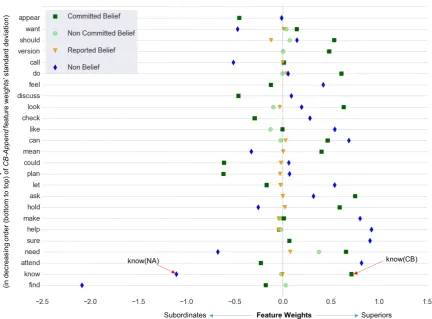
Adding the belief label counts into the SVM di-rectly as features will not yield much performance improvements, as signal in the aggregate counts would be minimal given the effect sizes of dif-ferences we find in Section 5. In this section, we investigate a more sophisticated way of in-corporating the belief tags into the power predic-tion framework. Lexical features are very use-ful for the task of power prediction. However, it is often hard to capture deeper syntactic/semantic contexts of words and phrases using ngram fea-tures. We hypothesize that incorporating belief tags into the ngrams will enrich the representa-tion and will help disambiguate different usages of same words/phrases. For example, let us con-sider two sentences:I need the report by tomorrow vs. If I need the report, I will let you know. The former is likely coming from a person who has power, whereas the latter does not give any such indication. Applying the belief tagger to these two sentences will result in I need(CB) the report ... andIf I need(NA) the report .... Capturing the dif-ference betweenneed(CB)vs. need(NA)will help the machine learning system to make the distinc-tion between these two usages and in turn improve the power prediction performance.
In building the ngram features, whenever we en-counter a token that is assigned a belief tag, we ap-pend the belief tag to the corresponding lemma or part-of-speech tag in the ngram. We call it the Ap-pendversion of corresponding ngram feature. We summarize the different versions of each type of
Feature Configuration in LEXICAL Accuracy
LN+PN+MN(BaseLine) 68.8
LNCBApnd+PN+MN 69.3
LN+PNCBApnd+MN 68.6
LN+PN+MNCBApnd 69.0
[image:7.595.305.526.80.167.2]LNCBApnd+PN+MNCBApnd 69.2
Table 3: Power prediction results using different con-figurations of LEX features. (The full feature set also includes THR.)
ngram features below:
• LN: the original word lemma ngram; e.g.,
i need the.
• LNCBApnd: word lemma ngram with appended
belief tags; e.g.,i need(CB) the.
• PN: the original part-of-speech ngram; e.g., PRP VB DT.
• PNCBApnd: part-of-speech ngram with
ap-pended belief tags; e.g.,PRP VB(CB) DT.
• MN: the original mixed ngram; e.g.,i VB the.
• MNCBApnd: mixed ngram with appended belief
tags; e.g.,i VB(CB) the.
In Table 3, we show the results obtained by in-corporating the belief tags in this manner to the LEXICALfeatures of the original baseline feature set. The first row indicates the baseline results and the following rows show the impact of in-corporating belief tags using theAppendmethod. While theAppendversion of both lemma ngrams and mixed ngrams improved the results, the Ap-pend version of part of speech ngrams reduced the results. The combination of best performing version of each type of ngram obtained slightly lower result than using the Append version of word ngram alone, which posted the overall best performance of 69.3%, a significant improvement (p<0.05) over not using any belief information.
We use the approximate randomization test (Yeh, 2000) for testing statistical significance of the im-provement.
Figure 2: Feature weights of different belief appended versions of 25 propositional heads whose lemma unigrams had the highest standard deviation. Y-axis denotes the propositional heads in decreasing order of standard deviation from bottom to top. X-axis denotes the feature weights.
6.2 Word NGram Feature Analysis
We inspect the feature weights assigned to the LNCBApnd version of lemma ngrams in our best
performing model. Each lemma ngram that con-tains a propositional head (e.g., need) has four possible LNCBApnd ngram versions: need(CB),
need(NCB), need(ROB), andneed(NA). For each lemma ngram, we calculate the standard deviation of weights assigned to differentLNCBApndversions
in the learned model as a measure of variation cap-tured by incorporating belief tags into that ngram.4
Figure 2 shows the feature weights of differ-entLNCBApndversions of twenty five propositional
heads whose lemma unigrams had the highest standard deviation. The y-axis lists propositional heads arranged in the decreasing order of standard deviation from bottom to top, while the x-axis de-notes the feature weights. The markers distinguish the different LNCBApnd versions of each
proposi-tional head — square denotes COMMITTEDBE
-4Not all lemma ngrams have all four versions; we
calcu-lated standard deviation using the versions present.
LIEF, circle denotes NONCOMMITTEDBELIEF, triangle denotes REPORTEDBELIEF, and diamond denotes NONAPPLICABLE. The feature versions with negative weights are associated more with subordinates’ messages, whereas those with pos-itive weights are associated more with superiors’ messages. Since NCB and ROB versions are rare, they rarely get high weights in the model.
7 Conclusion
In this paper, we made two major contributions. First, we presented a large-scale data oriented analysis of how social power relations between participants of an interaction correlate with differ-ent types of author commitmdiffer-ent in terms of their relative usage of hedges and different levels of beliefs — committed belief, non-committed be-lief, reported bebe-lief, and non-belief. We found evidence that subordinates use significantly more propositional hedges than superiors, and that su-periors and subordinates use significantly differ-ent proportions of differdiffer-ent types of beliefs in their messages. In particular, subordinates use signif-icantly more non-committed beliefs than superi-ors. They also report others’ beliefs more often than superiors. Second, we investigated different ways of incorporating the belief tag information into the machine learning system that automati-cally detects the direction of power between pairs of participants in an interaction. We devised a so-phisticated way of incorporating this information into the machine learning framework by append-ing the heads of propositions in lexical features with corresponding belief tags, demonstrating its utility in distinguishing social meanings expressed through the different belief contexts.
This study is based on emails from a single cor-poration, at the beginning of the 21st century. Our findings on the correlation between author com-mitment and power may be reflective of the work culture that prevailed in that organization at the time when the emails were exchanged. It is im-portant to replicate this study on emails from mul-tiple organizations in order to assess whether these results generalize across board. It is likely that be-havior patterns are affected by factors such as eth-nic culture (Cox et al.,1991) of the organization, and the kinds of conversations interactants engage in (for instance, co-operative vs. competitive be-havior (Hill et al., 1992)). We intend to explore this line of inquiry in future work.
Acknowledgments
This paper is partially based upon work supported by the DARPA DEFT program under a grant to Columbia University; all three co-authors were at Columbia University when portions of this work were performed. The views expressed here are those of the author(s) and do not reflect the offi-cial policy or position of the Department of
De-fense or the U.S. Government. We thank Dan Ju-rafsky and the anonymous reviewers for their help-ful feedback.
References
Apoorv Agarwal, Adinoyi Omuya, Aaron Harnly, and Owen Rambow. 2012. A comprehensive gold stan-dard for the Enron organizational hierarchy. In Pro-ceedings of the 50th Annual Meeting of the Associa-tion for ComputaAssocia-tional Linguistics (Volume 2: Short Papers). Association for Computational Linguistics, Jeju Island, Korea, pages 161–165. http://www.
aclweb.org/anthology/P12-2032.
Apoorv Agarwal, Adinoyi Omuya, Jingwei Zhang, and Owen Rambow. 2014. Enron corporation: You’re the boss if people get mentioned to you. In Proceed-ings of the 2014 International Conference on So-cial Computing. ACM, New York, NY, USA, Social-Com ’14, pages 2:1–2:4. https://doi.org/
10.1145/2639968.2640065.
Shashank Agarwal and Hong Yu. 2010. Detecting hedge cues and their scope in biomedical text with conditional random fields. Journal of biomedical in-formatics43(6):953–961.
Robert F. Bales. 1970. Personality and interpersonal behavior. Holt, Rinehart, and Winston (New York).
Robert F. Bales, Fred L. Strodtbeck, Theodore M. Mills, and Mary E. Roseborough. 1951. Channels of communication in small groups. American Soci-ological Reviewpages 16(4), 461–468.
Or Biran, Sara Rosenthal, Jacob Andreas, Kath-leen McKeown, and Owen Rambow. 2012. De-tecting influencers in written online conversations. In Proceedings of the Second Workshop on Lan-guage in Social Media. Association for Compu-tational Linguistics, Montr´eal, Canada, pages 37–
45.http://www.aclweb.org/anthology/
W12-2105.
Pierre Bourdieu and John B. Thompson. 1991. Lan-guage and symbolic power. Harvard University Press.
David B. Bracewell, Marc Tomlinson, and Hui Wang. 2012. A motif approach for identifying pursuits of power in social discourse. InICSC. IEEE Computer Society, pages 1–8.
Philip Bramsen, Martha Escobar-Molano, Ami Patel, and Rafael Alonso. 2011. Extracting Social Power Relationships from Natural Language. InACL. The Association for Computational Linguistics, pages 773–782.
Linda L. Carli. 1990. Gender, language, and influ-ence. Journal of Personality and Social Psychology
Eunsol Choi, Chenhao Tan, Lillian Lee, Cristian Danescu-Niculescu-Mizil, and Jennifer Spindel. 2012. Hedge detection as a lens on framing in the gmo debates: A position paper. In Proceedings of the Workshop on Extra-Propositional Aspects of Meaning in Computational Linguistics. Association for Computational Linguistics, pages 70–79.
Taylor H. Cox, Sharon A. Lobel, and Poppy Lauretta McLeod. 1991. Effects of ethnic group cultural dif-ferences on cooperative and competitive behavior on a group task. Academy of management journal
34(4):827–847.
Germ´an Creamer, Ryan Rowe, Shlomo Hershkop, and Salvatore J. Stolfo. 2009. Segmentation and au-tomated social hierarchy detection through email network analysis. In Haizheng Zhang, Myra Spiliopoulou, Bamshad Mobasher, C. Lee Giles, Andrew Mccallum, Olfa Nasraoui, Jaideep Srivas-tava, and John Yen, editors,Advances in Web Mining and Web Usage Analysis, Springer-Verlag, Berlin, Heidelberg, pages 40–58.
Faye Crosby and Linda Nyquist. 1977. The female register: An empirical study of lakoff’s hypotheses.
Language in Society6(03):313–322.
Robert A. Dahl. 1957. The concept of power. Syst. Res. 2(3):201–215. https://doi.org/10.
1002/bs.3830020303.
Cristian Danescu-Niculescu-Mizil, Lillian Lee, Bo Pang, and Jon Kleinberg. 2012. Echoes of Power: Language Effects and Power Differences in Social Interaction. In Proceedings of the 21st international conference on World Wide Web. ACM, New York, NY, USA, WWW ’12. https:
//doi.org/10.1145/2187836.2187931.
Chrysanne Di Marco, Frederick W. Kroon, and Robert E. Mercer. 2006. Using hedges to classify citations in scientific articles. InComputing attitude and affect in text: theory and applications, Springer, pages 247–263.
Mona Diab, Lori Levin, Teruko Mitamura, Owen Ram-bow, Vinodkumar Prabhakaran, and Weiwei Guo. 2009. Committed Belief Annotation and Tagging. In Proceedings of the Third Linguistic Annotation Workshop. Association for Computational Linguis-tics, Suntec, Singapore, pages 68–73. http://
www.aclweb.org/anthology/W09-3012.
Jana Diesner and Kathleen M. Carley. 2005. Explo-ration of communication networks from the Enron email corpus. InIn Proc. of Workshop on Link Anal-ysis, Counterterrorism and Security, SIAM Interna-tional Conference on Data Mining 2005. pages 21– 23.
Richard M. Emerson. 1962. Power-Dependence Rela-tions. American Sociological Review27(1):31–41.
https://doi.org/10.2307/2089716.
Norman Fairclough. 2001. Language and power. Pearson Education.
Rich´ard Farkas, Veronika Vincze, Gy¨orgy M´ora, J´anos Csirik, and Gy¨orgy Szarvas. 2010. The conll-2010 shared task: Learning to detect hedges and their scope in natural language text. In Proceedings of the Fourteenth Conference on Computational Nat-ural Language Learning. Association for Compu-tational Linguistics, Uppsala, Sweden, pages 1–
12.http://www.aclweb.org/anthology/
W10-3001.
John R. French and Bertram Raven. 1959. The Bases of Social Power. In Dorwin Cartwright, editor, Stud-ies in Social Power, University of Michigan Press, pages 150–167+.
Eric Gilbert. 2012. Phrases that Signal Workplace Hierarchy. In Proceedings of the ACM 2012 con-ference on Computer Supported Cooperative Work. ACM, New York, NY, USA, CSCW ’12, pages 1037–1046.
Charles W.L. Hill, Michael A. Hitt, and Robert E. Hoskisson. 1992. Cooperative versus competitive structures in related and unrelated diversified firms.
Organization Science3(4):501–521.
Ken Hyland. 1998. Hedging in scientific research arti-cles, volume 54. John Benjamins Publishing.
Halil Kilicoglu and Sabine Bergler. 2008. Recogniz-ing speculative language in biomedical research ar-ticles: a linguistically motivated perspective. BMC bioinformatics9(Suppl 11):S10.
Robin Lakoff. 1973. Language and Woman’s Place.
Language in society2(01):45–79.
Miriam A. Locher. 2004. Power and politeness in action: disagreements in oral communica-tion. Language, power, and social process. M. de Gruyter. http://books.google.com/
books?id=Aa32A4gWb8sC.
Robert E. Mercer, Chrysanne Di Marco, and Freder-ick W. Kroon. 2004. The frequency of hedging cues in citation contexts in scientific writing. InAdvances in artificial intelligence, Springer, pages 75–88.
Roser Morante, Vincent Van Asch, and Walter Daele-mans. 2010. Memory-based resolution of in-sentence scopes of hedge cues. InProceedings of the Fourteenth Conference on Computational Nat-ural Language Learning—Shared Task. Association for Computational Linguistics, pages 40–47.
Jr. Galileo Mark S. Namata, Lise Getoor, and Christo-pher P. Diehl. 2007. Inferring organizational titles in online communication. InProceedings of the 2006 conference on Statistical network analysis. Springer-Verlag, Berlin, Heidelberg, ICML’06, pages 179–
181. http://dl.acm.org/citation.cfm?
Sik Hung Ng and James J. Bradac. 1993.Power in lan-guage: Verbal communication and social influence.. Sage Publications, Inc.
William M. O’Barr. 1982. Linguistic evidence: language, power, and strategy in the courtroom. Studies on law and social control. Academic Press. http://books.google.com/books?
id=bqO0PwAACAAJ.
William M. O’Barr and Bowman K. Atkins. 1980. ”women’s language” or ”powerless language”?
Women and Language in Literature and Society.
Jeffrey Pfeffer. 1981. Power in organizations. Pitman, Marshfield, MA.
Vinodkumar Prabhakaran, Tomas By, Julia Hirschberg, Owen Rambow, Samira Shaikh, Tomek Strza-lkowski, Jennifer Tracey, Michael Arrigo, Ru-payan Basu, Micah Clark, Adam Dalton, Mona Diab, Louise Guthrie, Anna Prokofieva, Stephanie Strassel, Gregory Werner, Janyce Wiebe, and Yorick Wilks. 2015. A New Dataset and Evaluation for Be-lief/Factuality. In Proceedings of the Fourth Joint Conference on Lexical and Computational Seman-tics (*SEM 2015). Association for Computational Linguistics, Denver, USA.
Vinodkumar Prabhakaran, Ajita John, and Dor´ee D. Seligmann. 2013. Who Had the Upper Hand? Ranking Participants of Interactions Based on Their Relative Power. In Proceedings of the IJCNLP. Asian Federation of Natural Language Processing, Nagoya, Japan, pages 365–373. http://www.
aclweb.org/anthology/I13-1042.
Vinodkumar Prabhakaran and Owen Rambow. 2013. Written Dialog and Social Power: Manifestations of Different Types of Power in Dialog Behavior. In Proceedings of the IJCNLP. Asian Federation of Natural Language Processing, Nagoya, Japan, pages 216–224. http://www.aclweb.org/
anthology/I13-1025.
Vinodkumar Prabhakaran and Owen Rambow. 2014. Predicting power relations between participants in written dialog from a single thread. In Proceed-ings of the 52nd Annual Meeting of the Associa-tion for ComputaAssocia-tional Linguistics (Volume 2: Short Papers). Association for Computational Linguistics, Baltimore, Maryland, pages 339–344. http://
www.aclweb.org/anthology/P14-2056.
Vinodkumar Prabhakaran, Owen Rambow, and Mona Diab. 2010. Automatic Committed Belief Tagging. In Coling 2010: Posters. Coling 2010 Organizing Committee, Beijing, China, pages 1014–1022.
http://www.aclweb.org/anthology/ C10-2117.
Vinodkumar Prabhakaran, Owen Rambow, and Mona Diab. 2012. Who’s (Really) the Boss? Percep-tion of SituaPercep-tional Power in Written InteracPercep-tions. In24th International Conference on Computational
Linguistics (COLING). Association for Computa-tional Linguistics, Mumbai, India.
Bent Preisler. 1986. Linguistic sex roles in conversa-tion. Berlin: Mouton de Gruyter.
Anna Prokofieva and Julia Hirschberg. 2014. Hedg-ing and speaker commitment. In5th International Workshop on Emotion, Social Signals, Sentiment and Linked Open Data. LREC.
Sara Rosenthal. 2014. Detecting Influencers in Social Media Discussions. XRDS: Crossroads, The ACM Magazine for Students21(1):40–45.
Liliana Mamani Sanchez and Carl Vogel. 2015. A hedging annotation scheme focused on epistemic phrases for informal language. In Proceedings of the IWCS Workshop on Models for Modality Anno-tation. Association for Computational Linguistics, London, UK.
Roser Saur´ı and James Pustejovsky. 2009. Fact-Bank: a corpus annotated with event factuality.
Language Resources and Evaluation 43:227–268. 10.1007/s10579-009-9089-9. http://dx.doi.
org/10.1007/s10579-009-9089-9.
Jitesh Shetty and Jafar Adibi. 2005. Discovering im-portant nodes through graph entropy the case of Enron email database. In Proceedings of the 3rd international workshop on Link discovery. ACM, New York, NY, USA, LinkKDD ’05, pages 74–
81. https://doi.org/http://doi.acm.
org/10.1145/1134271.1134282.
Tomek Strzalkowski, George Aaron Broadwell, Jen-nifer Stromer-Galley, Samira Shaikh, Sarah Tay-lor, and Nick Webb. 2010. Modeling socio-cultural phenomena in discourse. In Proceed-ings of the 23rd International Conference on COL-ING 2010. Coling 2010 Organizing Committee, Beijing, China. http://www.aclweb.org/
anthology/C10-1117.
Swabha Swayamdipta and Owen Rambow. 2012. The Pursuit of Power and Its Manifestation in Written Dialog. 2012 IEEE Sixth Inter-national Conference on Semantic Comput-ing 0:22–29. https://doi.org/http: //doi.ieeecomputersociety.org/10.
1109/ICSC.2012.49.
Sarah M. Taylor, Ting Liu, Samira Shaikh, Tomek Strzalkowski, George Aaron Broadwell, Jennifer Stromer-Galley, Umit Boz, Xiaoai Ren, Jingsi Wu, and Feifei Zhang. 2012. Chinese and American Leadership Characteristics: Discovery and Compar-ison in Multi-party On-Line Dialogues. In ICSC. IEEE Computer Society, pages 17–21.
Erik Velldal, Lilja Øvrelid, Jonathon Read, and Stephan Oepen. 2012. Speculation and negation: Rules, rankers, and the role of syntax. Computa-tional Linguistics38(2):369–410.
Sumithra Velupillai. 2012. Shades of certainty: anno-tation and classification of swedish medical records. Ph.D. thesis, Department of Computer and Systems Sciences, Stockholm University.
Veronika Vincze. 2014.Uncertainty Detection in Hun-garian Texts. In Proceedings of COLING 2014, the 25th International Conference on Computational Linguistics: Technical Papers. Dublin City Univer-sity and Association for Computational Linguistics, Dublin, Ireland, pages 1844–1853. http://www.
aclweb.org/anthology/C14-1174.
Thomas E. Wartenberg. 1990. The forms of power: from domination to transformation. Temple Uni-versity Press. http://books.google.sh/
books?id=yK52QgAACAAJ.
Zhongyu Wei, Junwen Chen, Wei Gao, Binyang Li, Lanjun Zhou, Yulan He, and Kam-Fai Wong. 2013. An empirical study on uncertainty identification in social media context. In Proceedings of the 51st Annual Meeting of the Association for Com-putational Linguistics (Volume 2: Short Papers). Association for Computational Linguistics, Sofia, Bulgaria, pages 58–62. http://www.aclweb.
org/anthology/P13-2011.
Alexander Yeh. 2000. More accurate tests for the statistical significance of result differ-ences. In Proceedings of the 18th confer-ence on Computational linguistics - Volume 2. Association for Computational Linguis-tics, Stroudsburg, PA, USA, COLING ’00, pages 947–953. https://doi.org/http:
//dx.doi.org/10.3115/992730.992783.