409
Procedural Text Generation from a Photo Sequence
Taichi Nishimura1, Atsushi Hashimoto2, Shinsuke Mori3 1Graduate School of Informatics, Kyoto University
2OMRON SINIC X Corporation
3Academic Center for Computing and Media Studies, Kyoto University
[email protected] [email protected]
Abstract
Multimedia procedural texts, such as instruc-tions and manuals with pictures, support peo-ple to share how-to knowledge. In this pa-per, we propose a method for generating a pro-cedural text given a photo sequence allowing users to obtain a multimedia procedural text. We propose a single embedding space both for image and text enabling to interconnect them and to select appropriate words to describe a photo. We implemented our method and tested it on cooking instructions, i.e., recipes. Various experimental results showed that our method outperforms standard baselines.
1 Introduction
A multimedia procedural text, e.g. instruction sen-tences with photos, inspires users to learn a new skill. Some web services, such as Cookpad and Instructables, capitalize on this characteristics al-lowing users to submit photos or video clips in addition to instruction sentences to explain proce-dures better. An automatic system outputting in-struction sentences given a photo sequence sup-ports authors of such services.
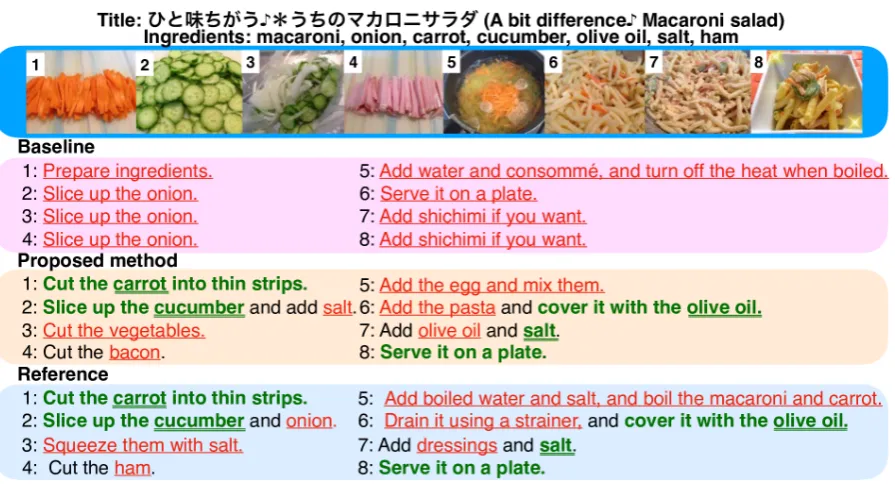
In this paper, we propose a method for gen-erating a procedural text from a photo sequence. As shown in Figure 1, given a photo sequence, it outputs a step consisting of some instruction sentences for each photo. Among various kinds of procedural texts, we take the cooking domain for example because cooking is daily activity and recipe is one of the most familiar procedural texts. Our task may resemble visual storytelling (Huang et al.,2016) sharing the input. The main difference is, however, that the output of our task is a procedural text that should be concise and con-crete allowing its readers to execute it. In cook-ing domain the output, a recipe consistcook-ing of mul-tiple sentences, should have necessary and suffi-cient foods, tools, and actions in the correct
or-Figure 1: An overview of our task. The input is a photo sequence (left). The task is to output a step consisting of instruction sentences (right) for each photo.
der. For this reason procedural text generation seemed to be difficult and was initially solved by formulating it as a retrieval task (Salvador et al.,
2017;Zhu et al.,2019;Chen and Ngo,2016). An-other similar task setting is recipe generation from a photo of the final dish using ingredient predictor (Salvador et al.,2019). This setting may be, how-ever, very difficult or even impossible because a single photo of the final dish does not contain suf-ficient information for its production procedure.
In this background, we focus on procedural text generation from a photo sequence and, as a solu-tion, we propose to incorporate a retrieval method into a generation model. Our method generates a procedural text in two phases. First given a photo sequence, it retrieves relating steps using a joint embedding model, which has been pre-trained on a large amount of image/step pairs available in the Web. Then it generates word sequences referring to these retrieved steps.
[image:1.595.308.524.222.307.2]actions in the recipe case. The result showed that the proposed method verbalizes them more cor-rectly. Some qualitative analyses also suggested that the proposed method generates a suitable pro-cedural text for a given photo sequence.
2 Related Work
Some researchers have been tackling problems to generate a procedural text from various inputs. In cooking domain,Salvador et al.(2019) tried to generate a recipe from an image of a complete dish. Bosselut et al.(2018) and Kiddon et al. as-sumed a title and ingredients as the input. It may be, however, almost impossible to generate a good recipe due to lack of information on mesomorphic states of ingredients.Mori et al.(2014a) generated a procedural text from a meaning representation taking intermediate states into account. Close look at these studies suggests the importance of the in-formation on intermediate processes for a proce-dural text generator to be practical.
Thus we assume a photo sequence as the input. Since authors of multimedia procedural texts at least take a photo at each important step, this set-ting is realistic. Sharing the input and output me-dia the most similar task may be the visual story-telling (Huang et al.,2016). Liu et al.(2017) pro-posed a joint embedding model for image and text to interconnect them. Contrary to this, we propose to generate sentences directly from the vectors in this shared space.
3 Procedural Text Generation
Figure 2 shows an overview of our method. (i) We pre-train the joint embedding model using im-age/text pairs. Then, given a photo sequence, our method repeats the following procedures for each photo: (ii) retrieve the topK nearest steps to the photo in the embedding space, (iii) compute the vector by the encorder from the input photo and the average of theKvectors of the retrieved steps, and (iv) decode a step represented by the photo.
3.1 Joint embedding model
First, (i) we train a joint embedding model based on the two branch networks (Wang et al., 2016), which transform different modality representa-tions, i.e., text and image, into a common feature space using multiple layer perceptrons with non-linear functions. With the resulting joint embed-ding model we can calculate similarity between
a step and an image. In our preliminary experi-ment, the original networks did not achieve a good performance because there are many omissions in procedural texts (Malmaud et al.,2014). To solve this problem, we propose to insert a bi-directional LSTM (biLSTM) to the textual encoder to refer to the preceding and following steps in addition to the current one.
3.2 Procedural text generation assisted by vector retrieval
The input is a photo sequence(v1, v2, . . . , vN).
Each photovnis converted into an image
embed-ding vectorvˆn through the image encoder of the
joint embedding model. For each photo we exe-cute the following procedures.
Image vector enhancement (ii): We retrieve the top K nearest vectors R = (r1, r2, . . . , rK)
among those converted from the steps in the train-ing dataset for the embeddtrain-ing space. Then we cal-culate their average
¯ rn=
1 K
K
∑
k=1
rk, (1)
and concatenate it to the image embedding vector for the photo to haveun= (ˆvn,r¯n).
Encoding (iii): We provide the enhanced image embedding vector to a biLSTM
on= biLSTM(un). (2)
Decoding (iv): We provide an LSTM with the out-put of the encoderon as the initial vector. It
de-codes repeatedly outputting a token in the vocab-ulary including period, beginning of step (⟨step⟩), and its ending (⟨/step⟩) to form a step consisting of multiple sentences. We also use the general atten-tion mechanism (Luong et al.,2015), which helps the model to generate important terms by reciev-ing feedback from retrieved step embeddreciev-ing vec-tors. Based on a hidden vectorhtat decodingt-th
token and the series of retrieved step embedding vectorsR, we calculate the attention weight ofk -th stepat
katt-th token decoding as follows:
atk = ∑Kexp (rkWaht)
j=1exp (rjWaht)
(3)
ct = K
∑
k=1
atkrk (4)
˜
Figure 2: The outline of the proposed method.
where Wa and Wc are trainable parameters.
The probability distribution of the output tokens
p(yt|y<t,on)is calculated as follows:
p(yt|y<t,on) = softmax(Woh˜t+bo), (6)
where Wo is the weight matrix to transform the
size of the vectorh˜tinto the vocabulary size and
bo is a bias weight. In the test phase the model
outputs the token of the highest probability. After decoding, the last hidden state of the decoder is reset to the initial state of the decoder to get ready to generate the next step.
In the training phase, we minimize the sum of the negative log likelihood over all the tokens in the training set
L(θ) =−∑ D
T
∑
t=1
logp(yt|y<t,on;θ), (7)
whereDis the entire training dataset andθis all the parameters and T is the length of target in-struction sentences.
4 Evaluation
In order to evaluate our method, we implemented it and tested it in the cooking domain.
4.1 Parameter setting
We employed ResNet-50 (He et al.,2016) trained with ImageNet (Deng et al., 2009) as the image encoder of the joint embedding model. We re-moved only its last softmax layer. Thus the dimen-sion of the output vector is 2,048. In the joint em-bedding model, we set the dimension of the hidden
train valid test
Demb
# recipes 162,463 18,059 20,104
# steps 5.65 5.57 5.66
# tokens 24.51 24.51 24.40
vocabulary 24,152
Dgen
# recipes 21,039 2,281 2,598
# steps 8.09 8.10 8.10
# tokens 19.35 19.51 19.32
[image:3.595.309.526.292.432.2]vocabulary 11,091
Table 1: Dataset statistics.
image2step step2image
w/o biLSTM 23 24
w/ biLSTM 6 6
Table 2: MedR results.
layer of biLSTM to 1,024, hence the dimension of the output vector is its doubble (2,048) because the bi-directional output vectors are concatenated. Training procedure is the same as the two branch networks (Wang et al., 2016). In our generation model, we set the dimension size of the hidden vector to 512 in both of the biLSTM encoder and the LSTM decoder. To train the model, we freeze the joint embedding weights and all other weights were optimized by Adam (Kingma and Ba,2015) with the initial valueα = 0.001. The number of retrieved stepsKwas set to ten.
4.2 Dataset
Figure 3: Output examples.Word sequences in bold greenare correct instructions, whilethose in underlined red
are incorrect ones.Those double underlinedare correctly verbalized ingredients.
BLEU1 BLEU4 ROUGE-L CIDEr-D
Baseline
Image 27.3 4.2 18.3 13.2
Image + Title 28.6 5.4 17.6 13.1
Image + Title + Ingredient 28.8 6.1 19.4 14.6
Proposed method w/o biLSTM
Image embedding + top1 step embedding 26.7 4.1 17.7 13.8 Image embedding + topKstep embedding 31.4 6.8 21.5 11.7
Proposed method w/ biLSTM
Image embedding 31.0 6.5 21.6 14.9
Image embedding + top1 step embedding 32.9 6.7 21.8 16.4
Image embedding + topKstep embedding 33.4 7.2 20.7 14.9
Table 3: Results of overlap metrics for generated procedural texts by the models and the baselines.
an image is attached to all the steps in a recipe1. To obtain reliable results, we extracted recipes con-sisting of reasonable length (7-10 steps), which are denoted byDgen, for text generation test. We used
the rest,Demb, as the training set for the joint
em-bedding model. The size of Dgen is not enough
to train the joint embedding model and genera-tion model jointly, thus we train each model using
DgenandDembindependently. All tokens
appear-ing less than three times were replaced with the unknown word symbol. Table1shows statistics of the datasets.
4.3 Effect on the joint embedding space
First we check the effect of the biLSTM insertion. We calculated the cosine similarity in the common space for ranking the relevant steps and relevant
1Cookpad Image Dataset contains 3.10 million images
and steps, but some steps lack images.
images and measured image2step and step2image retrieval performance in median rank (MedR). Ta-ble 2 shows the results on a subset of randomly selected 1,000 step-image pairs from the test set. From this result, we see that the insertion of the biLSTM improves the original two branch net-works enabling to refer to the context.
4.4 Results and Discussion
To evaluate our method, we measured overall gen-eration qualities as well as ratios of important terms. We also present some generated examples.
4.4.1 Overlap metrics
[image:4.595.74.523.343.458.2]F T Ac Total Recall 7.9 22.6 19.2 14.8 Baseline Precision 12.3 15.8 17.0 15.4
F1 9.6 18.6 18.0 15.1
Top1 w/ biLSTM
Recall 18.5 24.7 31.6 25.2 Precision 23.8 21.0 21.1 21.9
F1 20.8 22.7 25.3 23.4
TopK
w/ biLSTM
Recall 40.5 29.8 35.9 37.2 Precision 43.6 26.8 32.4 36.1
[image:5.595.75.292.62.186.2]F1 42.0 28.2 34.0 36.6
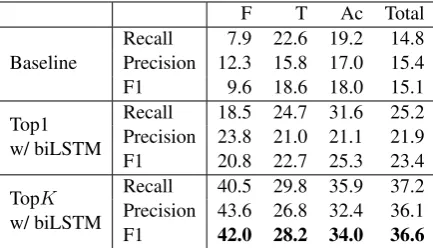
Table 4: The verbalization ratios of important terms.
which are calculated by word2vec (Mikolov et al.,
2013). The results, Table 3, show that the pro-posed method achieves a higher performance than the baselines in these metrics.
4.4.2 Important term verbalization
Traditional overlap metrics do not measure verbal-ization of important terms in the generated proce-dural text. In the cooking domain, they are foods (F), tools (T), and actions (Ac) as the statistics on the flow graph corpus (Mori et al.,2014b) in-dicate. Thus we calculated the ratios of correctly verbalized ones in these categories. Although this is more important than the ordinary overlap met-rics, synonyms and spelling variants prevent us from automatic calculation. Therefore we selected 50 generated recipes randomly from the test set and manually counted numbers of important terms occurring in the generated recipes, in their refer-ences, and both. Table4shows the results. We see that clearly Top1 retrieval outperforms the base-line and TopK is far better than top1 for all the term categories, showing advantages of our image vector enhancement in procedural text generation.
4.4.3 Qualitative analysis
In Figure 3 we present example generated sen-tences by the baseline, those by the proposed method, and their reference. It can be seen that the proposed method is capable of generating recipes which contain the ingredients really shown in the photos, while the baseline tends to just enumerate frequent ingredients in the training set.
5 Conclusion
In this paper, we proposed a method for generat-ing a procedural text from a photo sequence and tested it in the cooking domain. Our main ideas are (1) biLSTM to overcome omissions in the text
side for the joint embedding space, (2) image vec-tor enhancement by topKretrieval, and (3) over-all design for procedural text generation from a photo sequence. Various analyses on experimen-tal results, which are also important contributions of this paper, showed that our method outperforms standard baselines and each one of our ideas con-tributes to it.
The generated sentences have the correspon-dence to the source photos allowing us to generate multimedia procedural texts as a natural extension of our method.
Acknowledgments
We would like to be grateful to Mr. Hirokuni Maeta, Prof. Yoko Yamakata, and Cookpad Inc. for supporting our work. We also thank anony-mous reviewers for useful comments that greatly improved the manuscript.
References
Antoine Bosselut, Asli Celikyilmaz, Xiaodong He, Jianfeng Gao, Po-Sen Huang, and Yejin Choi. 2018. Discourse-aware neural rewards for coherent text generation. InProceedings of the 2018 Conference of the North American Chapter of the Association for Computational Linguistics: Human Language Technologies, pages 173–184.
Jingjing Chen and Chong-Wah Ngo. 2016. Deep-based ingredient recognition for cooking recipe retrieval. InProceedings of the 24th ACM international con-ference on Multimedia, pages 32–41.
Jia Deng, Wei Dong, Richard Socher, Li-Jia Li, Kai Li, and Li Fei-Fei. 2009. Imagenet: A large-scale hierarchical image database. InProceedings of the Conference on Computer Vision and Pattern Recog-nition, pages 248–255.
Jun Harashima, Yuichiro Someya, and Yohei Kikuta. 2017. Cookpad image dataset: An image collec-tion as infrastructure for food research. In Proceed-ings of the 40th International ACM SIGIR Confer-ence on Research and Development in Information Retrieval, pages 1229–1232.
Kaiming He, Xiangyu Zhang, Shaoqing Ren, and Jian Sun. 2016. Deep residual learning for image recog-nition. InProceedings of the Conference on Com-puter Vision and Pattern Recognition, pages 770– 778.
Margaret Mitchell. 2016. Visual storytelling. In Proceedings of the 2016 Conference of the North American Chapter of the Association for Computa-tional Linguistics: Human Language Technologies, pages 1233–1239.
Chlo´e Kiddon, Luke Zettlemoyer, and Yejin Choi. Globally coherent text generation with neural check-list models. In Proceedings of the Conference on Empirical Methods in Natural Language Process-ing, pages 329–339.
Diederik P. Kingma and Jimmy Ba. 2015. Adam: A method for stochastic optimization. InProceedings of the International Conference for Learning Repre-sentations.
Yu Liu, Jianlong Fu, Tao Mei, and Chang Wen Chen. 2017. Let your photos talk: Generating narrative paragraph for photo stream via bidirectional atten-tion recurrent neural networks. In Proceedings of the Thirty-First AAAI Conference on Artificial Intel-ligence, pages 1445–1452.
Thang Luong, Hieu Pham, and Christopher D. Man-ning. 2015. Effective approaches to attention-based neural machine translation. In Proceedings of the Conference on Empirical Methods in Natural Lan-guage Processing, pages 1412–1421.
Jonathan Malmaud, Earl J. Wagner, Nancy Chang, and Kevin Murphy. 2014. Cooking with semantics. In Proceedings of the ACL Workshop on Semantic Parsing, pages 33–38.
Tomas Mikolov, Ilya Sutskever, Kai Chen, Greg Cor-rado, and Jeffrey Dean. 2013. Distributed represen-tations of words and phrases and their composition-ality. InIn Advances in Neural Information Process-ing Systems.
Shinsuke Mori, Hirokuni Maeta, Tetsuro Sasada, Koichiro Yoshino, Atsushi Hashimoto, Takuya Fu-natomi, and Yoko Yamakata. 2014a. Flow-graph2text: Automatic sentence skeleton compila-tion for procedural text generacompila-tion. InProceedings of the 8th International Natural Language Genera-tion Conference, pages 118–122.
Shinsuke Mori, Hirokuni Maeta, Yoko Yamakata, and Tetsuro Sasada. 2014b. Flow graph corpus from recipe texts. InProceedings of the 9th International Conference on Language Resources and Evaluation, pages 2370–2377.
Amaia Salvador, Michal Drozdzal, Xavier Giro i Ni-eto, and Adriana Romero. 2019. Inverse cooking: Recipe generation from food images. In Proceed-ings of the IEEE Conference on Computer Vision and Pattern Recognition, pages 10453–10462.
Amaia Salvador, Nicholas Hynes, Yusuf Aytar, Javier Marin, Ferda Ofli, Ingmar Weber, and Antonio Tor-ralba. 2017. Learning cross-modal embeddings for cooking recipes and food images. InProceedings of the IEEE Conference on Computer Vision and Pat-tern Recognition, pages 3020–3028.
Liwei Wang, Yin Li, Jing Huang, and Svetlana Lazeb-nik. 2016. Learning two-branch neural networks for image-text matching tasks. In Proceedings of the Conference on Computer Vision and Pattern Recog-nition, pages 5005–5013.