25
Proceedings of the Linguistic Resources for Automatic Natural Language Generation Workshop, pages 25– 32, Santiago de Compostela, Spain, September 4, 2017. © 2017 Association for Computational Linguistics
Language Generation from DB Query
Kristina Kocijan*, Božo Bekavac, Krešimir Šojat
*Department of Information and Communication Sciences
Department of Linguistics
Faculty of Humanities and Social Sciences, University of Zagreb
{krkocijan, bbekavac, ksojat}@ffzg.hrAbstract
This paper demonstrates how to generate natu-ral language sentences from the pieces of data found in databases in the domain of flight tick-ets. By using NooJ to add context to specific customer data found in customer data sets, we are able to produce sentences that give a short textual summary of each customer, providing a list of possible suggestions how to proceed. In addition, due to the rich morphology of Croa-tian, we are giving special attention to match-ing gender, number and case information where appropriate. Thus, we are able to pro-vide individualized and grammatically correct text in spite of the customer gender or the num-ber of tickets bought and inquiries made. We believe that such short NL overviews can help ticket sellers get a quicker assessment of the type of a customer and allow for the exchange of information with more confidence and greater speed.
1
Introduction
Ever since we have started using computers for lan-guage processing, lanlan-guage generation, even in its most primitive form as canned text (Jurafsky and Martin, 2000), was an exciting thing to do. Since its early beginnings in the 1950’s, we have made big steps trying to make language generation more adaptable to context i.e. to build systems that can produce a set of appropriate forms and choose the right context-dependent one (Jurafsky and Martin, 2000; Bateman and Zock, 2003; Perera and Nand, 2017; Gatt and Krahmer, 2017). In this paper we will present one such project that maps non-linguis-tic source into the linguisnon-linguis-tic form as described in Bateman and Zock (2003).
For this purpose we are using NooJ, a linguistic development environment software. NooJ is not
new to language generation (Silberztein, 2012). Due to the power of a transducer that it uses, in collabo-ration with variables, it has been used in different transformational projects in a variety of languages; from paraphrasing for Portuguese-English machine translation projects (Barreiro, 2008), generating transformations from Italian frozen sentences (Vie-tri, 2012), or paraphrasing standard Arabic in bio-medical texts (Boujelben et al., 2012) to transfor-mation of English direct transitive sentences (Sil-berztein, 2016a).
This paper focuses on the generation of natural language sentences from databases with records on booking and buying flight tickets. The natural lan-guage that we deal with is Croatian, a South Slavic language with rich inflectional and derivational morphology and relatively free word order. Alt-hough Croatian is basically a SOV language, word order in sentences can vary due to extensive mor-phosyntactic marking of major parts of speech and rules of agreement. Agreement in gender, number and person plays an important role in the project presented here. In this paper we describe the gener-ation of brief summaries of previous customers
’
in-quiries and actual purchase of air flight tickets ex-pressed in the natural language.26
2
Behind the NLG proposed system
Vayre et al. (2017) give a detailed account of proce-dures in the building of NLG systems and point out that it normally consist of typical stages. The proce-dures that are thereby applied can be divided into macro-planning and micro-planning. Macro-plan-ning comprises content selection and document structuring, whereas micro-planning usually refers to the design of syntactic constructions, lexicaliza-tion, generation of referring expression, morpholog-ical adaptation etc. Morphologmorpholog-ical adaptation is one of the procedures applied in the design of overall surface realization. Apart from morphological mod-ifications, this last stage also includes typographical adjustment and formatting and provides the final form of the text.
Morphological adjustment (e.g. generation of in-flected forms through gender/number or verb/sub-ject agreements) is particularly important for the NLG in our system since Croatian is a highly in-flected language with numerous inflectional pat-terns. Paradigms for nominal parts of speech consist of 7 cases in singular and plural, whereas verbs are inflected for person, number and tense. Some verbal forms, i.e. past participles, are also inflected for gen-der. Morphosyntactically, NPs as subjects and verbs as predicates agree in the grammatical categories of person and number, whereas verbs determine the case of NPs as objects. NPs as subjects and verbs as predicates also agree in gender if a verbal form con-sists of an auxiliary verb and a past participle. We can demonstrate this with the following examples:
1. He has bought seven tickets. On je kupi-o sedam karata.
2. She has bought seven tickets. Ona je kupi-la sedam karata.
3. They have bought two tickets. Oni su kupi-li dvije karte.
4. They have bought two tickets. One su kupi-le dvije karte.
As these examples show, the endings of verbal participles are modified according to the subject
’
s number and gender. The subjects in sentences 3 and 4 are the same in English, but they differ in Croatian(in sentence 3 the subject can refer only to mascu-line and mascumascu-line and female gender, whereas the subject in 4 refers solely to feminine).
Sentences 3 and 4 also demonstrate another fea-ture that must be taken into account in the linguistic design of NLG component of our system. Synchron-ically, the number categories in Croatian are singu-lar and plural. However, earlier stages of language development are manifested in noun forms for plu-ral when quantifiers are numbers two, three and four, and all the other numbers ending in these digits (e.g. 52, 23, 134 etc.). Although these nouns are in the plural, their inflected forms are similar to geni-tive singular. In these cases there is an evidence of paucal number. For example:
5. He has bought one ticket. On je kupio jednu kartu.
6. He has bought two / three / four tickets.
On je kupio dvije / tri / četiri karte.
7. He has bought five tickets. On je kupio pet karata.
These linguistic issues were taken into consider-ation in the morphological and syntactic component of our NLG system. A more detailed account is given in section 4.
In the building of the system described in this pa-per, we were also guided by four major choices that NLG systems must or should make, as defined in Jurafsky and Martin (2000) and Reiter and Dale (2000):
Content selection – in this case, our content is already provided for the system (the system is used by ticket sellers only, and ticket buyers have no access to it);
Lexical selection – system is choosing a lexical item provided in the set-up pool of items de-pending on the value of available fields;
27 Discourse structure – system combines
multi-ple sentences providing coherent structure ( in-troducing conjunctions to produce smooth and continuous text).
In order to deal with one of the main problems of NLG, i.e. control of choosing among the provided alternatives of generated text (Bateman and Zock, 2003), we have found the possibility of using the NooJ linguistic environment coupled with Angular JavaScript Framework as the workable option for our domain scenario.
3
Practical usage
Applications that incorporate NLG systems can sig-nificantly speed up the usage of data stored in vari-ous databases. The importance of attending to the presentation of such information to the end user and how it can influence the user’s cognitive load is well justified by Vayre et al. (2017). As mentioned, the NLG system discussed here is used by sales agents employed by a travel agency. Number of infor-mation items and their formatting should not work against them, but rather help them do their job bet-ter, faster and with more confidence. One of the ways to help them in that endeavor is to decrease the linguistic complexity of the text that is automati-cally generated by the system.
The data about customers who buy air tickets ei-ther online, by telephone or e-mails, are stored in the database. Since the interpretation of unprocessed data is difficult and time-consuming, there is a sig-nificant risk of poor quality of service and a poten-tial loss of clients. Agents dealing with a large num-ber of customers on a daily basis need a straightfor-ward representation of their previous activities in order to improve their productivity and to maintain high quality of service. Thus, a system capable of summarizing and presenting relevant data from da-tabases in an easily understandable form is crucial for the overall improvement of agent-customer rela-tionship.
During the processing of customers
’
requests, the system automatically recognizes and classifies cli-ents into four categories – golden, silver, bronze and regular defined in the [Recommendations] subgraph (Figure 1). This categorization is based on their pre-vious activities (booked and / or purchased tickets,intervals, years, amount of money spent etc.). On the basis of these data the system provides infor-mation as to whether a customer is entitled to air tickets at reduced prices or completely free of charge.
Figure 1:The main grammar
Overviews of previous activities and actual pur-chases, i.e. short summaries of customers
’
activities and status as described above, comprise four or five simple and unambiguous sentences in Croatian. These sentences contain all the data relevant for var-ious discounted or special offers for clients, both regular and occasional. The design of the system is discussed in the next section.4
Building the NLG section
Since we are preparing our results to be used in the network environment, we needed to incorporate all the html tags in our output as well. The main gram-mar (Error! Reference source not found.) consists of three main sections (subgraphs) that are connected in a manner to support the following logic:
1. recognize the query results and prepare them for initialization in the <p ng-init> tag [sub-graph: dbQuery];
2. check the user’s gender and generate the ap-propriate gender of a noun, verb and a pro-noun in the user’s description paragraph [subgraph: user];
3. check the user’s gender and prepare the ap-propriate recommendations [subgraph: Rec-ommendations].
28 For the purposes of our project1, we were
inter-ested in the gender field {gender}, total amount of money spent since the first purchase {trosak}, total amount of invoices sent to the user since the first purchase {bills}, total amount of reservations made by the user via web {wReservations}, total number of tickets {NoOfTickets}.
Except for these fields, we needed to add present year {sada}, and formula for calculating the user’s yearly average, i.e. how much s/he spends on tickets per year {vrijednost} and finally, formula for calcu-lating the type of a user {type}. For the second for-mula, we considered how much money the user spends yearly, number of her/his web reservations, bills issued to the user and number of tickets actu-ally bought. All the other database query results are recognized and annotated, but at this point, we are not using them in this project so they will not be fur-ther discussed.
In this grammar, we are using global variables (Silberztein, 2016) to ensure that our query results are available at all levels of the grammar i.e. in the main graph and also in all its subgraphs. We recog-nize them by the sign ‘@’ used before the variable name. The most important one to us was the variable caring the gender value $@G since we needed this information in the following two sections to deter-mine gender dependent forms of a noun, verb and pronoun, as we will show in the following para-graphs.
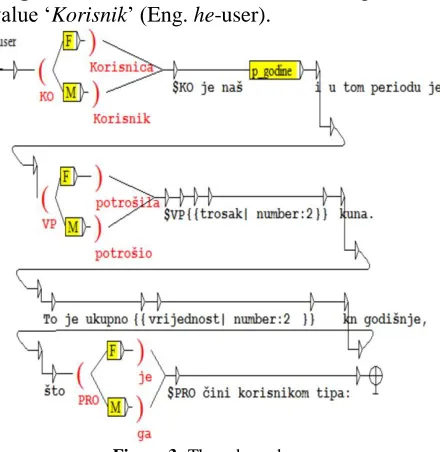
Within the subgraph [user] (Figure 3) we are in-troducing three new variables to determine the cor-rect gender forms of a noun, verb and pronoun. The
1 We believe that each agency will work with its own
pa-rameters that make up their types of different users. Param-eters we chose here are for demonstration purposes only.
[image:4.612.90.526.70.222.2]first variable $KO is given the value ‘Korisnica
’
(Eng. she-user) if the graph with the sub-grammar [F] is validated as true i.e. if the global variable $@G has the value set to feminine <$@G=”F”>. If the variable $@G has the value set to masculine <$@G=”M”> then the variable $KO is given the value ‘Korisnik’ (Eng. he-user).Figure 3: The subgraph user
[image:4.612.318.538.334.560.2]29 correct verb forms. If the constraint <$@G=”F”> is validated, NooJ takes the upper path and uses cor-rect female forms of the main verb. Combination of gender constraints and tense operations allows us to generate correct sentences.
If all the validations check out correctly, there are two possible variants of this paragraph that can ap-pear to the agent – one for the feminine (a) and one for the masculine user (b).
(a) Korisnica je naš član X godina i u tom pe-riod je potrošila Y,00 kuna. To je ukupno Y,00 kn godišnje, što nju čini korisnikom tipa: (Eng. She-user is our member for X years and in that period she-spent Y,00 ku-nas. That is a total of Y,00 kunas per year, which makes her a user of type: )
(b) Korisnik jenaš član X godina i u tom period je potrošio Y,00 kuna. To je ukupno Y,00 kn godišnje, što ga čini korisnikom tipa: (Eng.
He-user is our member for X years and in that period he-spent Y,00 kunas. That is a total of Y,00 kunas per year, which makes
him a user of type: )
In the text, X and Y are replaced by the values cal-culated for each user in real time.
The user subgraph has one additional sub-gram-mar [p_godine] that checks for the number of years the user has been a customer (Figure 4). This check was necessary for two reasons:
if our user is a new user, then s/he is described as a ‘novi član’ (Eng. new user) and we do not use the number of years to describe how long s/he has been the user. This way we have avoided awkward sentences like ‘User has been our member for 0 years.’ ;2
for all the users that have been using the ser-vice for more than a year, we use the full num-ber of years since s/he first used the services provided by the company. However, since the word for ‘year’ in Croatian changes its form depending on the number that precedes it, it was necessary to connect the proper number with the proper word form. Thus, if less than one year has passed since the first contact and today {sad_poc}, there are no years in between
2 Cf. section 2, examples 5,6 and 7.
[image:5.612.317.536.242.421.2]and we consider this person to be the new user. If the last digit is however greater than 0 and lower than 2, the word after the number {god_clan} takes the form ‘godinu’; if it is greater than 1 and lower than 5 it takes the form ‘godine’ and if it is greater than 4 it takes the form ‘godina’. Since NooJ does not sup-port mathematical operations, in order to check the difference between the first contact and to-day, we moved these calculations to the web environment, but used NooJ to prepare the ground for all the possible calculations.
Figure 4: The subgraph p_godine
Similar check was performed in the final subgraph Recommendations (Figure 5).
Figure 5: The subgraph Recommendations
[image:5.612.318.539.462.631.2]30 adopting them to the gender defined within the global variable $@G, while the final choice among offered recommendations will be performed within the web browser using the AngularJS.
Thus, depending on the gender, there are again two possible sets of recommendations that may be generated - (a) for the feminine and (b) for the mas-culine user:
(a) Recom1: Standardna korisnica. Bez pose-bnih ponuda. (Eng. She-Standard user. No special offers.)
Recom2: Brončana korisnica. Ponuditi joj 10% popusta na sljedeću kupovinu unutar 1 godine. (Eng. She-Bronze user. Offer her
10% discount on next purchase within 1 year.)
Recom3: Srebrna korisnica. Ponuditi joj 25 % popusta na sljedeću kupovinu unutar 6 mjeseci. (Eng. She-Silver user. Offer her
25% discount on next purchase within 6 months.)
Recom4: Zlatna korisnica. Ponuditi joj 50% popusta na sljedeću kupovinu unutar 3 mjeseca ili 1 besplatnu kartu unutar 15 dana. (Eng. She-Golden user. Offer her
50% discount on next purchase within 3 months or 1 free ticket within 15 days.)
(b) Recom1: Standardni korisnik. Bez poseb-nih ponuda. (Eng. He-Standard user. No special offers.)
Recom2: Brončani korisnik. Ponuditi mu 10% popusta na sljedeću kupovinu unutar 1 godine. (Eng. He-Bronze user. Offer him
10% discount on next purchase within 1 year.)
Recom3: Srebrni korisnik. Ponuditi mu 25 % popusta na sljedeću kupovinu unutar 6 mjeseci. (Eng. He-Silver user. Offer him
25% discount on next purchase within 6 months.)
Recom4: Zlatni korisnik. Ponuditi mu 50% popusta na sljedeću kupovinu unutar 3 mjeseca ili 1 besplatnu kartu unutar 15 dana. (Eng. He-Golden user. Offer him
[image:6.612.87.511.95.325.2]31
5
Dealing with the control within the Web
environment
There are several calculations that our project re-quires (number of years between user’s first contact and today, user’s average spending, type of the user depending on her/his spending…) in order to gener-ate proper sentences. Since they could not be dealt with inside the NooJ environment, we have opted for AngularJS3 that is considered to be “the most
popular JavaScript MV (model view) solution in the world today” (Smith:Introduction, 2015). Its code allowed us to extend the HTML code with some new attributes that allow for JavaScript type func-tionality.
For this reason, it was necessary to incorporate all the needed AngularJS code in the text generated within NooJ. This is also the reason why all the text that depended on some mathematical calculations was generated and exported to the web environment where the final choice was made based upon the cal-culations (Figure 6).
The left side of Figure 6 shows the entire code prepared within NooJ, but notice that on the right side, not all generated parts of sentences4 are shown.
This was made possible by AngularJS part of the text. In fact, we gave Angular control over the <div> tag which holds our text. We constrained its scope only to this section of the page so it would not inter-fere with other frameworks used originally by the application.
6
Discussion and future work
We have demonstrated the procedure for a fast and straightforward recognition of customers
’
activities, their classification into various categories based on previous activities and the production of help mes-sages for further interaction between a sales agent and a customer.At this time, we have only considered situations when the user is a single private person, male or fe-male. The problem of dealing with the company representatives still needs to be solved. But, if such a user can be distinguished within the database data, the grammar can adequately be extended with new sets of validations that will allow for the generation
3https://angular.io/docs
of new user specific descriptions and appropriate sets of recommendations.
In further work we intend to expand the algo-rithms used so far in order to enable predictions about future needs and desires of a customer. For example, if a customer regularly makes inquiries about flights and tickets using the web page inter-face, but the number of confirmed reservations is ei-ther decreasing or they are not realized at all, this can indicate that functionality of the web page is not satisfactory. This can also indicate that customers actually use web pages of other travel agencies for booking and purchase of air tickets.
Another line of research that we wish to pursue in the future is the generation of automatic reports for sales managers. These reports provide brief sum-marizations of all the activities recorded in the agent-customers interactions and enable quick changes or modifications of business strategies if necessary. By using NLG systems, the time required for the creation of such reports is shortened and it is possible to make quick decisions.
Further, such reports facilitate a better distribu-tion of manpower, i.e. travel agents can direct their attention toward an individual client and her/his par-ticular needs. For example, if the same customer makes online inquiries about flights without confir-mation of reservation over several days, the system should alert a travel agent about these activities.
On the basis of these data, a sales agent can auto-matically generate an offer according to the param-eters of the customer
’
s search, using predefined tex-tual samples. The intervention of sales agents in such cases would be minimal or even not necessary, since the system should be able to automatically make decisions and create offers in the form of short texts using the data stored in the database.To sum up, a quality customer relationship man-agement system nowadays should predict custom-ers
’
wishes and needs and enable appropriate, effi-cient and quick actions.7
Conclusion
This project presents the first steps in the natural language generation for Croatian in the domain of flight tickets. On the basis of data from a database
32 query, we are able to generate a text that gives an agent a quick summary of a customer with possible suggestions on how to proceed in her/his conduct. Such a quick insight should help agents make multi-criteria decisions faster and with more confidence, but within the business approved parameters. By producing natural language text that reduces the cognitive effort, agents can provide better service to their customers and thus upgrade the business re-sults.
Acknowledgments
The authors wish to thank Travel Management Company d.o.o. for providing needed training data for this project.
References
Anabela Barreiro. 2008. ParaMT: a paraphraser for mac-hine translation in Lecture Notes in Computer Science, vol. 5190, Springer-Verlag, pp 202-211.
John Bateman and Michael Zock. 2003. Natural Lan-guage Generation in The Oxford Handook of Compu-tational Linguistics (ed. Ruslan Mitkov), Oxford Uni-versity Press, pp 284-322.
Ines Boujelben, Slim Mesfar, Abdelmajid Ben Hamadou. 2012. Transformational Analysis of Arabic Sentences: Application to Automatically Extracted Biomedical Symptoms in Automatic Processing of Various Levels of Linguistc Phenomena (eds. K. Vučković, B. Beka-vac, M. Silberztein), Newcastle upon Tyne: Cam-bridge Scholars Publishing, pp 182-194.
Albert Gatt and Emiel Krahmer. 2017. Survey of the State of the Art in Natural Language Generation: Core tasks, applications and evaluation.
https://arxiv.org/abs/1703.09902. Date Ac-cessed: May 27, 2017.
Daniel Jurafsky and James H. Martin. 2000. Speech and Language Processing: An introduction to Natural
Language Processing, Computational Linguistics, and Speech Recognition, Prentice Hall, Upper Saddle River, New Jersey.
Rivindu Perera and Parma Nand. 2017. Recent Advances in Natural Language Generation: A Survey and Clas-sification of the Empirical Literature. Computing and Informatics, Vol 36, No 1 (2017), pp 1-32.
Ehud Reiter and Robert Dale. 2000. Building Natural Language Generation Systems. Cambridge UP, Cam-bridge, UK.
Max Silberztein. 2012. Automatic Transformational Analysis and Generation in Automatic Processing of Various Levels of Linguistc Phenomena (eds. K. Vučković, B. Bekavac, M. Silberztein), Newcastle upon Tyne: Cambridge Scholars Publishing, pp 221-231.
Max Silberztein. 2016a. Joe loves Lea: Transformational Analysis of Direct Transitive Sentences in Automatic Processing of Natural-Language Electronic Texts with NooJ. NooJ 2015 (eds. T. Okrut, Y. Hetsevich, M. Sil-berztein, H. Stanislavenka). Communications in Com-puter and Information Science, vol 607. Springer, Cham, pp 55-65.
Max Silberztein. 2016b. Formalizing Natural Lan-guages: The NooJ Approach, Wiley. USA.
Chris Smith. 2015. Angular Basics. http://www.an-gularjsbook.com/. Date Accessed: May 11, 2017.
Jean-Sébastien Vayre, Estelle Delpech, Aude Dufresne and Céline Lemercier. 2017. Communication Medi-ated through Natural Language Generation in Big Data Environments: The Case of Nomao. Journal of Computer and Communications, 5, https://doi.org/10.4236/jcc.2017.56 008, pp 125-148.