Retrofitting Sense-Specific Word Vectors Using Parallel Text
Allyson Ettinger1, Philip Resnik1,3, Marine Carpuat2,3
1Linguistics,2Computer Science,3Institute for Advanced Computer Studies University of Maryland, College Park, MD
{aetting, resnik}@umd.edu, [email protected]
Abstract
Jauhar et al. (2015) recently proposed to learn sense-specific word representations by “retrofitting” standard distributional word rep-resentations to an existing ontology. We ob-serve that this approach does not require an ontology, and can be generalized to any graph defining word senses and relations between them. We create such a graph using transla-tions learned from parallel corpora. On a set of lexical semantic tasks, representations learned using parallel text perform roughly as well as those derived from WordNet, and combining the two representation types significantly im-proves performance.
1 Introduction
Vector space models (VSMs) provide a powerful tool for representing word meanings and modeling the relations between them. While these models have demonstrated impressive success in capturing some aspects of word meaning (Landauer and Du-mais, 1997; Turney et al., 2010; Mikolov et al., 2013; Baroni et al., 2014; Levy et al., 2014), they generally fail to capture the fact that single word forms often have multiple meanings. This can lead to counterintuitive results—for example, it should be possible for the nearest word torockto be stonein
everyday usage, punk in discussions of music, and
crack(cocaine) in discussions about drugs.
In a recent paper, Jauhar et al. (2015) introduce a method for “retrofitting” generic word vectors to createsense-specificvectors using the WordNet se-mantic lexicon (Miller, 1995). From WordNet, they
create a graph structure comprising two classes of relations: form-based relations between each word form and its respective senses, and meaning-based relations between word senses with similar mean-ings. This graph structure is then used to transform a traditional VSM into an enriched VSM, where each point in the space represents a word sense, rather than a word form. This approach is appealing as, un-like with prior sense-aware representations, senses are defined categories in a semantic lexicon, rather than clusters induced from raw text (Reisinger and Mooney, 2010; Huang et al., 2012; Neelakantan et al., 2015; Tian et al., 2014), and the method does not require performing word sense disambiguation (Guo et al., 2014).
In this paper, we observe that the crucial mean-ing relationships in the Jauhar et al. retrofittmean-ing process—the word sense graph—can be inferred based on another widely available resource: bilin-gual parallel text. This observation is grounded in a well-established tradition of using cross-language correspondences as a form of sense annotation (Gale et al., 1992; Diab and Resnik, 2002; Ng et al., 2003; Carpuat and Wu, 2007; Lefever and Hoste, 2010, and others). Using parallel text to define sense dis-tinctions sidesteps the persistent difficulty of identi-fying a single correct sense partitioning based on hu-man intuition, and avoids large investments in hu- man-ual curation or annotation.
We use parallel text and word alignment to in-fer both word sense identities and inter-sense rela-tions required for the sense graph, and apply the approach of Jauhar et al. to retrofit existing word vector representations and create a sense-based
tor space, using bilingual correspondences to define word senses. When evaluated on semantic judgment tasks, the vector spaces derived from this graph per-form comparably to and sometimes better than the WordNet-based space of Jauhar et al., indicating that parallel text is a viable alternative to WordNet for defining graph structure. Combining the output of parallel-data-based and WordNet-based retrofitted VSMs consistently improves performance, suggest-ing that the different sense graph methods make complementary contributions to this sense-specific retrofitting process.
2 Model
Retrofitting. The technique introduced by Jauhar et al. (2015) is based on what we will call a sense graph, which we formulate as follows. Nodes in the sense graph comprise the wordswi in a
vocabu-laryW together with the sensessij for those words.
Labeled, undirected edges include word-sense edges
hwi, si,ji, which connect each word to all of its
pos-sible senses, and sense-sense edges hsij, si0j0i
la-beled with a meaning relationship r that holds be-tween the two senses.
Jauhar et al. use WordNet to define their sense graph. Synsets in the WordNet ontology define the sense nodes, a word-sense edge exists between any word and every synset to which it belongs, and WordNet’s synset-to-synset relations of synonymy, hypernymy, and hyponymy define the sense-sense edges. Figure 1 illustrates a fragment of a WordNet-based sense graph, suppressing edge labels.
Adopting Jauhar et al.’s notation, the original vec-tor space to be retrofitted is defined by the original word-form vectorsuˆifor eachwi∈W, and the goal
is to infer a setV of sense-specific vectorsvij
cor-responding to each sensesij. Jauhar et al. use the
sense graph to define a Markov network with vari-ables for all word vectors and sense vectors, within which each word’s vector uˆi is connected to all of
its sense vectorsvij, and the variables for sense
vec-torsvij andvi0j0 are connected iff the corresponding
senses are connected in the sense graph.
Retrofitting then consists in optimizing the
fol-lowing objective, where α is a sense-agnostic
weight, and βr are relation-specific weights for
types of relations between senses:
C(V) = arg min
V X
i−ij
αkˆui−vijk2
+ X
ij−i0j0
βrkvij−vi0j0k2 (1)
The objective encourages similarity between a word’s vector and its senses’ vectors (first term), as well as similarity between the vectors for senses that are related in the sense graph (second term).
Defining a sense graph from parallel text. Our key observation is that, although Jauhar et al. (2015) assume their sense graph to be an ontology, this
graph can be based onanyinventory of word-sense
and sense-sense relationships. In particular, given a parallel corpus, we can follow the tradition of translation-as-sense-annotation: the senses of an En-glish word type can be defined by different possible translations of that word in another language.
Operationalizing this observation is straightfor-ward, given a word-aligned parallel corpus. If
En-glish word form ei is aligned with Chinese word
form cj, then ei(cj) is a sense of ei in the sense
graph, and there is a word-sense edge hei, ei(cj)i.
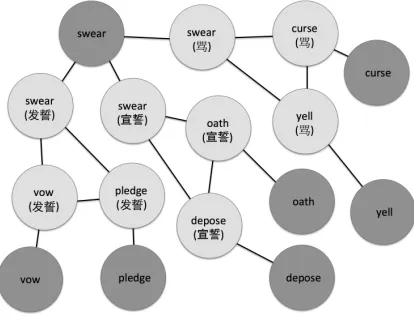
Edges signifying a meaning relation are drawn be-tween sense nodes if those senses are defined by the same translation word. For instance, English senses
swear(发誓) and vow(发誓) both arise via
align-ment to发誓(fashi), so a sense-sense edge will be
drawn between these two sense nodes. See Figure 2 for illustration.
3 Evaluation
Tasks. We evaluate on both the synonym selection and word similarity rating tasks used by Jauhar et al. Synonym selection nicely demonstrates the advan-tages afforded by sense partitioning: if we believe thatspinmeans “make up a story”, then we are not likely to perform well on a question in which the correct synonym istwirl. Word similarity rating, on the other hand, is a classic test of the extent to which vector representations simulate human intuitions of word relations in general.
multi-Figure 1:Illustration of WordNet-based sense graph. Figure 2:Illustration of parallel-text-based sense graph.
sense models (Jauhar et al., 2015, eq. 9) to select the most similar word.1 For similarity rating, we again
mirror Jauhar et al., testing with WS-353 (Finkel-stein et al., 2001), RG-65 (Ruben(Finkel-stein and Good-enough, 1965), MC-30 (Miller and Charles, 1991), and the designated test subset (1000 items) of MEN-3k (Bruni et al., 2014), using avgSim (Jauhar et al., 2015, eq. 8) as the similarity rating, and evaluating model ratings against human similarity ratings via Spearman’s rank correlation coefficient (ρ).2 Initial word representations. We use the word2vec (Mikolov et al., 2013) skip-gram archi-tecture to train 80-dimensional word vectors (in keeping with Jauhar et al.), based on evidence that this model shows consistently strong performance on a wide array of tasks (Baroni et al., 2014; Levy et al., 2015). Training is on ukWaC (Ferraresi et al., 2008), a diverse 2B-word web corpus.3
Sense-graph construction from parallel text. To construct the sense graph per Section 2, we use 1Because it is not clear how multi-word phrases should best
be treated (and this is not a question being investigated here), we filter out any questions containing multi-word phrases for any of the relevant items (probe or possible response), and any questions for which any of the relevant items is completely out of vocabulary (no vectors available) for any of the evaluated models. This leaves 48 items in ESL, 87 items in RD, and 77 items in TOEFL.
2The designated development set of MEN-3k (2000 items)
was used for tuning.
3To alleviate sparsity we lemmatized the ukWaC corpus.
Runs without lemmatization produced weaker results.
∼5.8M lines of segmented Chinese-English
paral-lel text from the DARPA BOLT project and the Broadcast Conversation subset of the segmented Chinese-English parallel data in the OntoNotes
cor-pus (Weischedel et al., 2013).4 We perform word
alignment with the Berkeley aligner (Liang et al., 2006). We filter out noisy alignments using the G-test statistic (Dunning, 1993), with a threshold se-lected during tuning on a development set.
We set α (see Equation 1) to 1.0. Each
sense-sense edge hei(cj), ei0(cj)i has individual weight 0 < βr ≤ 1, computed by obtaining the G-test
statistic for the alignment of ei with cj and for
the alignment of ei0 with cj, running these values
through a logistic function, and averaging. Param-eters for these computations, as well as the G-test statistic threshold below which we filtered out noisy alignments, were selected during tuning on the de-velopment set.
Note that we have not currently incorporated spe-cial treatment for alignments of a single word to a multi-word phrase. This does create the possibil-ity of noisy or uninformative sense annotations (e.g., sense annotations corresponding to parts of aligned Chinese phrases) when such alignments are not fil-tered out by the G-test thresholding.
Experimental conditions. We evaluate the fol-lowing experimental conditions: Skip-gram (SG) uses the un-retrofitted word2vec vectors, Word-4English was lemmatized post-alignment via lookup in the
[image:3.612.320.527.71.231.2] [image:3.612.90.291.73.228.2]Net (WN) retrofits using the WordNet-based sense graph, and Parallel Data (PD) retrofits using the sense graph built from parallel text. We also com-bine the two retrofitting approaches (PD-WN). For synonym selection, we compute maxSim over all sense pairs for WN and PD separately, and select the sense pair with the overall maximum cosine sim-ilarity across the two. For simsim-ilarity rating, we explore two PD-WN combination approaches: for each word pair, we take the avgSim from each sep-arate model, and then we (a) take the average of the values given by the two models (avg), or (b) take the maximum value between the two models (max).
4 Results
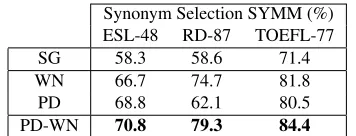
Table 1 shows that combining our new method with Jauhar et al.’s WN retrofitting performs best on synonym selection across all datasets, and both retrofitted models consistently outperform the no-retrofitting model (SG). Error analysis on RD-87, the only set on which WN substantially outperforms PD, suggests that PD’s errors are driven by the large number of lower frequency items that characterize this dataset. Given that WordNet is a hand-curated lexicon while the parallel data mirrors actual us-age, it is not surprising that the latter suffers when it comes to low frequency items.
Error analysis also indicates that PD performs particularly well on the synonym task precisely when one would expect: when the probe and the correct answer have an alignment to the same Chi-nese word form, so that the corresponding sense vec-tors are extremely close in vector space. Occasion-ally, PD yields “the wrong answer for the right rea-son”, choosing an option for which there is indeed a correct alignment that matches an alignment of the probe word. For instance, though the probepassage
is intended to have the answerhallway, PD chooses
ticketbecause bothpassageandtickethave a sense defined by alignment to the Chinese word机票 ( jip-iao), meaning “air ticket”. Though this is a less fre-quent sense ofpassage, it is a reasonable one.
Results on the similarity rating task (presented in Table 2) are less clearly interpretable, top perfor-mance being divided between the PD model and the combined models—with the exception of WS-353. We note that WS-353 is a test set for which human
Synonym Selection SYMM (%) ESL-48 RD-87 TOEFL-77
SG 58.3 58.6 71.4
WN 66.7 74.7 81.8
PD 68.8 62.1 80.5
[image:4.612.338.516.56.124.2]PD-WN 70.8 79.3 84.4
Table 1:Synonym selection task results: accuracy
Word similarity: avgSim SYMM (ρ) WS-353 RG-65 MC-30 MEN-1k
SG .708 .729 .722 .763
WN .610 .725 .750 .739
PD .636 .777 .715 .769
PD-WN (avg) .666 .777 .742 .773
[image:4.612.314.540.155.234.2]PD-WN (max) .630 .731 .758 .756
Table 2:Similarity rating task results
raters were explicitly told to rate relatedness, rather than similarity, while the retrofitting process is in-tended to encourage similarityper se. If we exclude this set from consideration, we can observe that SG is outperformed by at least one sense-specific model in all cases.5
Note that as expected, the amount of training data has an impact on the quality of the alignments and of the sense graph. Retrofitting sense-specific embed-dings using only 300k sentence pairs, which repre-sent about 5% of the total training data, does not give clear benefit over word-form embeddings.
5 Conclusions and future work
Building on Jauhar et al. (2015), we have presented an alternative means of deriving information about senses and sense relations to build sense-specific vector space representations of words, making use of parallel text rather than a manually constructed ontology. We show that this is a viable alterna-tive, producing representations that perform on par with those retrofitted to sense graphs based on Word-Net.6
5We also explored using maxSim for similarity ratings, on
the intuition that when human annotators give similarity judg-ments, they are likely to judge based on senses of the given words that are biased toward the words with which they are paired. However, top performance is similarly scattered when using maxSim for similarity scores and fails to improve over the SG baseline for two of the datasets.
6Sample sense-specific vectors and code for
Based on these results, it would be interesting to evaluate further refinements of the sense graph: alignment-based senses could be clustered, or fur-ther filtered to reduce the impact of alignment noise; new edges could be added using other multilingual resources. Finally, it will be important to evaluate the effectiveness of the retrofitted word embeddings on extrinsic tasks that require disambiguating word meaning in context.
Acknowledgments
The authors would like to thank Sujay Kumar Jauhar for sharing software and data and for helpful dis-cussion. Thanks also to Manaal Faruqui and Pe-ter Turney for help in acquiring evaluation datasets, to Amittai Axelrod for his assistance with data, and to the anonymous reviewers for valuable comments and suggestions. This work was supported in part by an NSF Graduate Research Fellowship under Grant No. DGE 1322106. Any opinions, findings, and conclusions or recommendations expressed are those of the authors and do not necessarily reflect the views of the NSF.
References
Marco Baroni, Georgiana Dinu, and Germ´an Kruszewski. 2014. Don’t count, predict! A systematic compari-son of context-counting vs. context-predicting seman-tic vectors. InProceedings of the 52nd Annual Meet-ing of the Association for Computational LMeet-inguistics, volume 1, pages 238–247.
Elia Bruni, Nam-Khanh Tran, and Marco Baroni. 2014. Multimodal distributional semantics. Journal of Arti-ficial Intelligence Research, 49:1–47.
Marine Carpuat and Dekai Wu. 2007. Improving statisti-cal machine translation using word sense disambigua-tion. InEMNLP-CoNLL, volume 7, pages 61–72. Mona Diab and Philip Resnik. 2002. An unsupervised
method for word sense tagging using parallel corpora. InProceedings of the 40th Annual Meeting on Associ-ation for ComputAssoci-ational Linguistics, pages 255–262. Ted Dunning. 1993. Accurate methods for the statistics
of surprise and coincidence. Computational linguis-tics, 19(1):61–74.
Adriano Ferraresi, Eros Zanchetta, Marco Baroni, and Silvia Bernardini. 2008. Introducing and evaluating ukWaC, a very large web-derived corpus of English. In Proceedings of the 4th Web as Corpus Workshop (WAC-4) Can we beat Google, pages 47–54.
Lev Finkelstein, Evgeniy Gabrilovich, Yossi Matias, Ehud Rivlin, Zach Solan, Gadi Wolfman, and Eytan Ruppin. 2001. Placing search in context: The con-cept revisited. InProceedings of the 10th international conference on World Wide Web, pages 406–414. William A Gale, Kenneth W Church, and David
Yarowsky. 1992. A method for disambiguating word senses in a large corpus. Computers and the Humani-ties, 26(5-6):415–439.
Jiang Guo, Wanxiang Che, Haifeng Wang, and Ting Liu. 2014. Learning sense-specific word embeddings by exploiting bilingual resources. InProceedings of COLING, pages 497–507.
Eric H Huang, Richard Socher, Christopher D Manning, and Andrew Y Ng. 2012. Improving word representa-tions via global context and multiple word prototypes. InProceedings of the 50th Annual Meeting of the Asso-ciation for Computational Linguistics: Long Papers-Volume 1, pages 873–882.
Mario Jarmasz and Stan Szpakowicz. 2004. Roget’s thesaurus and semantic similarity. Recent Advances in Natural Language Processing III: Selected Papers from RANLP, 2003:111.
Sujay Kumar Jauhar, Chris Dyer, and Eduard Hovy. 2015. Ontologically grounded multi-sense represen-tation learning for semantic vector space models. In
Proceedings of NAACL, pages 683–693.
Thomas K Landauer and Susan T Dumais. 1997. A so-lution to plato’s problem: The latent semantic analysis theory of acquisition, induction, and representation of knowledge.Psychological review, 104(2):211. Els Lefever and Veronique Hoste. 2010. Semeval-2010
task 3: Cross-lingual word sense disambiguation. In
Proceedings of the 5th International Workshop on Se-mantic Evaluation, pages 15–20.
Omer Levy, Yoav Goldberg, and Israel Ramat-Gan. 2014. Linguistic regularities in sparse and explicit word representations. InProceedings of the Confer-ence on Natural Language Learning (CoNLLL), pages 171–180.
Omer Levy, Yoav Goldberg, and Ido Dagan. 2015. Im-proving distributional similarity with lessons learned from word embeddings. Transactions of the Associa-tion for ComputaAssocia-tional Linguistics, 3:211–225. Percy Liang, Ben Taskar, and Dan Klein. 2006.
Align-ment by agreeAlign-ment. InProceedings of the main con-ference on Human Language Technology Concon-ference of the North American Chapter of the Association of Computational Linguistics, pages 104–111.
George A Miller and Walter G Charles. 1991. Contex-tual correlates of semantic similarity. Language and Cognitive Processes, 6(1):1–28.
George A Miller. 1995. Wordnet: a lexical database for English. Communications of the ACM, 38(11):39–41. Arvind Neelakantan, Jeevan Shankar, Alexandre Pas-sos, and Andrew McCallum. 2015. Effi-cient non-parametric estimation of multiple embed-dings per word in vector space. arXiv preprint arXiv:1504.06654.
Hwee Tou Ng, Bin Wang, and Yee Seng Chan. 2003. Ex-ploiting parallel texts for word sense disambiguation: An empirical study. In Proceedings of the 41st An-nual Meeting on Association for Computational Lin-guistics, pages 455–462.
Joseph Reisinger and Raymond J Mooney. 2010. Multi-prototype vector-space models of word meaning. In
Human Language Technologies: The 2010 Annual Conference of the North American Chapter of the As-sociation for Computational Linguistics, pages 109– 117.
Herbert Rubenstein and John B Goodenough. 1965. Contextual correlates of synonymy. Communications of the ACM, 8(10):627–633.
Fei Tian, Hanjun Dai, Jiang Bian, Bin Gao, Rui Zhang, Enhong Chen, and Tie-Yan Liu. 2014. A probabilistic model for learning multi-prototype word embeddings. InProceedings of COLING, pages 151–160.
Peter D Turney, Patrick Pantel, et al. 2010. From fre-quency to meaning: Vector space models of semantics.
Journal of Artificial Intelligence Research, 37(1):141– 188.
Peter Turney. 2001. Mining the web for synonyms: PMI-IR versus LSA on TOEFL. InProceedings of the 12th European Conference on Machine Learning.
Ralph Weischedel, Martha Palmer, Mitchell Marcus, Ed-uard Hovy, Sameer Pradhan, Lance Ramshaw, Nian-wen Xue, Ann Taylor, Jeff Kaufman, Michelle Fran-chini, et al. 2013. Ontonotes release 5.0 ldc2013t19.
Linguistic Data Consortium, Philadelphia, PA. XTAG Research Group. 2001. A lexicalized tree