Visual Storytelling
Ting-Hao (Kenneth) Huang1∗, Francis Ferraro2∗, Nasrin Mostafazadeh3, Ishan Misra1, Aishwarya Agrawal4, Jacob Devlin6, Ross Girshick5, Xiaodong He6, Pushmeet Kohli6, Dhruv Batra4, C. Lawrence Zitnick5,
Devi Parikh4, Lucy Vanderwende6, Michel Galley6, Margaret Mitchell6,7
Microsoft Research
1Carnegie Mellon University;[email protected] 2Johns Hopkins University;[email protected]
3University of Rochester 4Virginia Tech 6Microsoft Research;{jdevlin,lucyv,mgalley}@microsoft.com
5Facebook AI Research,7Now at Google Research;[email protected]
Abstract
We introduce the first dataset for sequential vision-to-language, and explore how this data may be used for the task ofvisual storytelling. The first release of this dataset, SIND1 v.1,
includes 81,743 unique photos in 20,211 se-quences, aligned to both descriptive (caption) and story language. We establish several strong baselines for the storytelling task, and motivate an automatic metric to benchmark progress. Modelling concrete description as well as figurative and social language, as pro-vided in this dataset and the storytelling task, has the potential to move artificial intelligence from basic understandings of typical visual scenes towards more and more human-like un-derstanding of grounded event structure and subjective expression.
1 Introduction
Beyond understanding simple objects and concrete scenes lies interpreting causal structure; making sense of visual input to tie disparate moments to-gether as they give rise to a cohesive narrative of events through time. This requires moving from rea-soning about single images – static moments, de-void of context – to sequences of images that depict events as they occur and change. On the vision side, progressing from single images to images in context allows us to begin to create an artificial intelligence (AI) that can reason about a visual moment given
∗
T.H. and F.F. contributed equally to this work.
1
Sequential Images Narrative Dataset. The origi-nal release was made available through Microsoft. Re-lated future releases for Visual Storytelling (VIST) are on visionandlanguage.net/VIST.
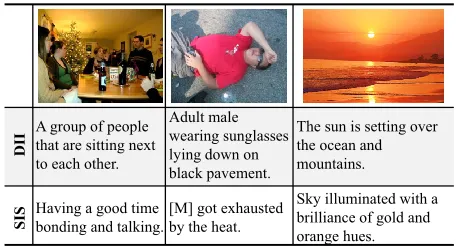
A group of people that are sitting next to each other.
Adult male wearing sunglasses lying down on black pavement.
The sun is setting over the ocean and mountains.
Having a good time bonding and talking.
[M] got exhausted by the heat.
Sky illuminated with a brilliance of gold and orange hues.
DII
[image:1.612.312.540.242.365.2]SIS
Figure 1:Example language difference between descrip-tions for images in isolation (DII) vs. stories for images in sequence (SIS).
what it has already seen. On the language side, pro-gressing from literal description to narrative helps to learn more evaluative, conversational, and abstract language. This is the difference between, for ex-ample, “sitting next to each other” versus “having a good time”, or “sun is setting” versus “sky illumi-nated with a brilliance...” (see Figure 1). The first descriptions capture image content that is literal and concrete; the second requires further inference about what agood time may look like, or what is special and worth sharing about a particular sunset.
We introduce the first dataset of sequential im-ages with corresponding descriptions, which cap-tures some of these subtle but important differ-ences, and advance the task of visual storytelling. We release the data in three tiers of language for the same images: (1) Descriptions of images-in-isolation (DII); (2) Descriptions of
images-in-sequence (DIS); and (3) Stories for
images, the dataset facilitates directly modeling the relationship between literal and more abstract visual concepts, including the relationship between visual imagery and typical event patterns. We additionally propose an automatic evaluation metric which is best correlated with human judgments, and establish sev-eral strong baselines for the visual storytelling task.
2 Motivation and Related Work
Work in vision to language has exploded, with re-searchers examining image captioning (Lin et al., 2014; Karpathy and Fei-Fei, 2015; Vinyals et al., 2015; Xu et al., 2015; Chen et al., 2015; Young et al., 2014; Elliott and Keller, 2013), question an-swering (Antol et al., 2015; Ren et al., 2015; Gao et al., 2015; Malinowski and Fritz, 2014), visual phrases (Sadeghi and Farhadi, 2011), video under-standing (Ramanathan et al., 2013), and visual con-cepts (Krishna et al., 2016; Fang et al., 2015).
Such work focuses on direct, literal description of image content. While this is an encouraging first step in connecting vision and language, it is far from the capabilities needed by intelligent agents for nat-uralistic interactions. There is a significant differ-ence, yet unexplored, between remarking that a vi-sual scene shows “sitting in a room” – typical of most image captioning work – and that the same vi-sual scene shows “bonding”. The latter description is grounded in the visual signal, yet it brings to bear information about social relations and emotions that can be additionally inferred in context (Figure 1). Visually-grounded stories facilitate more evaluative and figurative language than has previously been seen in vision-to-language research: If a system can recognize that colleagues lookbored, it can remark and act on this information directly.
Storytelling itself is one of the oldest known hu-man activities (Wiessner, 2014), providing a way to educate, preserve culture, instill morals, and share advice; focusing AI research towards this task there-fore has the potential to bring about more human-like intelligence and understanding.
3 Dataset Construction
Extracting Photos We begin by generating a list
of “storyable” event types. We leverage the idea that “storyable” events tend to involve some form of
pos-beach (684) breaking up (350) easter (259) amusement park (525) carnival (331) church (243)
building a house (415) visit (321) graduation ceremony (236) party (411) market (311) office (226)
[image:2.612.314.539.146.207.2]birthday (399) outdoor activity (267) father’s day (221)
Table 1:The number of albums in our tiered dataset for the 15 most frequent kinds of stories.
Flickr Album
Story 1
Description for Images in Isolation
& in Sequences
Re-telling
Story 1
Caption in Sequence
Storytelling
Story 2
Story 3
Re-telling
Preferred Photo Sequence
Story 4
Story 5
Figure 2:Dataset crowdsourcing workflow.
session, e.g., “John’sbirthday party,” or “Shabnam’s
visit.” Using the Flickr data release (Thomee et al., 2015), we aggregate 5-grams of photo titles and de-scriptions, using Stanford CoreNLP (Manning et al., 2014) to extract possessive dependency patterns. We keep the heads of possessive phrases if they can be classified as an EVENT in WordNet3.0, relying on manual winnowing to target our collection efforts.2 These terms are then used to collect albums using the Flickr API.3We only include albums with 10 to 50 photos where all album photos are taken within a 48-hour span and CC-licensed. See Table 1 for the query terms with the most albums returned.
The photos returned from this stage are then pre-sented to crowd workers using Amazon’s Mechani-cal Turk to collect the corresponding stories and de-scriptions. The crowdsourcing workflow of devel-oping the complete dataset is shown in Figure 2.
Crowdsourcing Stories In Sequence We develop
a 2-stage crowdsourcing workflow to collect natu-ralistic stories with text aligned to images. The first stage isstorytelling, where the crowd worker selects a subset of photos from a given album to form a photo sequence and writes a story about it (see Fig-ure 3). The second stage isre-telling, in which the worker writes a story based on one photo sequence generated by workers in the first stage.
In both stages, all album photos are displayed in the order of the time that the photos were taken, with a “storyboard” underneath. Instorytelling, by clicking a photo in the album, a “story card” of the photo appears on the storyboard. The worker is
in-2
We simultaneously supplemented this data-driven effort by a small hand-constructed gazetteer.
3
Figure 3: Interface for theStorytellingtask, which con-tains: 1) the photo album, and 2) the storyboard.
D
II
A black frisbee is sitting on top of a roof.
A man playing soccer outside of a white house with a red door.
The boy is throwing a soccer ball by the red door.
A soccer ball is over a roof by a frisbee in a rain gutter.
Two balls and a frisbee are on top of a roof.
A roof top with a black frisbee laying on the top of the edge of it.
A man is standing in the grass in front of the house kicking a soccer ball.
A man is in the front of the house throwing a soccer ball up.
A blue and white soccer ball and black Frisbee are on the edge of the roof top.
Two soccer balls and a Frisbee are sitting on top of the roof top.
A discus got stuck up on the roof.
Why not try getting it down with a soccer ball?
Up the soccer ball goes.
It didn't work so we tried a volley ball.
Now the discus, soccer ball, and volleyball are all stuck on the roof.
DIS
SI
[image:3.612.313.539.74.139.2]S
Figure 4: Example descriptions of images in isolation (DII); descriptions of images in sequence (DIS); and sto-ries of images in sequence (SIS).
structed to pick at least five photos, arrange the or-der of selected photos, and then write a sentence or a phrase on each card to form a story; this appears as a full story underneath the text aligned to each im-age. Additionally, this interface captures the align-ments between text and photos. Workers may skip an album if it does not seem storyable (e.g., a col-lection of coins). Albums skipped by two workers are discarded. The interface of re-telling is simi-lar, but it displays the two photo sequences already created in the first stage, which the worker chooses from to write the story. For each album, 2 work-ers performstorytelling(at $0.3/HIT), and 3 work-ers performre-telling(at $0.25/HIT), yielding a total of 1,907 workers. All HITs use quality controls to ensure varied text at least 15 words long.
Crowdsourcing Descriptions of Images In
Iso-lation & Images In Sequence We also use
crowdsourcing to collect descriptions of isolation (DII) and descriptions of images-in-sequence (DIS), for the photo images-in-sequences with sto-ries from a majority of workers in the first task (as Figure 2). In both DII and DIS tasks, workers are
Data Set #(Txt, Img) Pairs (k) Vocab Size (k) Avg.
#Tok %Abs Frazier Yngve Ppl
Brown 52.1 47.7 20.8 15.2% 18.5 77.2 194.0
DII 151.8 13.8 11.0 21.3% 10.3 27.4 147.0
DIS 151.8 5.0 9.8 24.8% 9.2 23.7 146.8
SIS 252.9 18.2 10.2 22.1% 10.5 27.5 116.0
[image:3.612.72.299.213.353.2]5
Table 2: A summary of our dataset, following the pro-posed analyses of Ferraro et al. (2015), including the Fra-zier and Yngve measures of syntactic complexity. The balanced Brown corpus (Marcus et al., 1999), provided for comparison, contains only text. Perplexity (Ppl) is calculated against a 5-gram language model learned on a generic 30B English words dataset scraped from the web.
man sitting black chatting amount trunk went [female] see woman white large gentleman goers facing got today saw standing two front enjoys sofa bench [male] decided came holding young group folks egg enjoying took really started wearing image shoreline female great time
Desc.-in-Iso. Desc.-in-Seq. Story-in-Seq.
[image:3.612.314.538.230.283.2]man woman standing holding wearing
Table 3:Top words ranked by normalized PMI.
asked to follow the instructions for image caption-ing proposed in MS COCO (Lin et al., 2014) such
asdescribe all the important parts. In DII, we use
the MS COCO image captioning interface.4 In DIS, we use the storyboard and story cards of our
story-telling interface to display a photo sequence, with
MS COCO instructions adapted for sequences. We recruit 3 workers for DII (at $0.05/HIT) and 3 work-ers for DIS (at $0.07/HIT).
Data Post-processing We tokenize all
sto-rylets and descriptions with the CoreNLP tok-enizer, and replace all people names with generic MALE/FEMALE tokens,5 and all identified named entities with their entity type (e.g., location). The data is released astraining,validation, andtest
following an 80%/10%/10% split on the stories-in-sequence albums. Example language from each tier is shown in Figure 4.
4 Data Analysis
Our dataset includes 10,117 Flickr albums with 210,819 unique photos. Each album on average has 20.8 photos (σ= 9.0). The average time span of each album is 7.9 hours (σ= 11.4). Further details of each tier of the dataset are shown in Table 2.6
4
https://github.com/tylin/coco-ui
5
We use those names occurring at least 10,000 times. https://ssa.gov/oact/babynames/names.zip
6
We use normalized pointwise mutual information to identify the words most closely associated with each tier (Table 3). Top words for descriptions-in-isolation reflect an impoverished disambiguat-ing context: References to people often lack so-cial specificity, as people are referred to as simply “man” or “woman”. Single images often do not convey much information about underlying events or actions, which leads to the abundant use of pos-ture verbs (“standing”, “sitting”, etc.). As we turn to descriptions-in-sequence, these relatively uninfor-mative words are much less represented. Finally, top story-in-sequence words include more storytelling elements, such as names ([male]), temporal refer-ences (today) and words that are more dynamic and abstract (went,decided).
5 Automatic Evaluation Metric
Given the nature of the complex storytelling task, the best and most reliable evaluation for assessing the quality of generated stories is human judgment. However, automatic evaluation metrics are useful to quickly benchmark progress. To better understand which metric could serve as a proxy for human eval-uation, we compute pairwise correlation coefficients between automatic metrics and human judgments on 3,000 stories sampled from the SIS training set.
For the human judgements, we again use crowd-sourcing on MTurk, asking five judges per story to rate how strongly they agreed with the statement “If these were my photos, I would like using a story like this to share my experience with my friends”.7 We take the average of the five judgments as the final score for the story. For the automatic metrics, we use METEOR,8 smoothed-BLEU (Lin and Och, 2004), and Skip-Thoughts (Kiros et al., 2015) to compute similarity between each story for a given sequence. Skip-thoughts provide a Sentence2Vec embedding which models the semantic space of novels.
As Table 4 shows, METEOR correlates best with human judgment according to all the correlation co-efficients. This signals that a metric such as ME-TEOR which incorporates paraphrasing correlates best with human judgement on this task. A more
7
Scale presented ranged from “Strongly disagree” to “Strongly agree”, which we convert to a scale of 1 to 5.
8
We use METEOR version 1.5 withhterweights.
METEOR BLEU Skip-Thoughts r 0.22 (2.8e-28) 0.08 (1.0e-06) 0.18 (5.0e-27) ρ 0.20 (3.0e-31) 0.08 (8.9e-06) 0.16 (6.4e-22) τ 0.14 (1.0e-33) 0.06 (8.7e-08) 0.11 (7.7e-24)
Table 4:Correlations of automatic scores against human judgements, with p-values in parentheses.
Beam=10 Greedy -Dups +Grounded
23.55 19.10 19.21 –
Table 6: Captions generated per-image with METEOR scores.
detailed study of automatic evaluation of stories is an area of interest for a future work.
6 Baseline Experiments
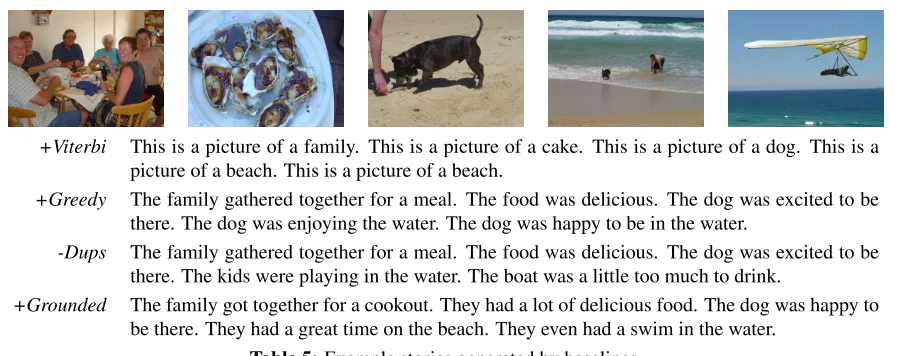
We report baseline experiments on the storytelling task in Table 7, training on the SIS tier and testing on half the SIS validation set (valtest). Example out-put from each system is presented in Table 5. To highlight some differences between story and cap-tion generacap-tion, we also train on the DII tier in iso-lation, and produce captions per-image, rather than in sequence. These results are shown in Table 7.
To train the story generation model, we use a sequence-to-sequence recurrent neural net (RNN) approach, which naturally extends the single-image captioning technique of Devlin et al. (2015) and Vinyals et al. (2014) to multiple images. Here, we encode an imagesequenceby running an RNN over thefc7vectors of each image, in reverse order. This is used as the initial hidden state to the story decoder model, which learns to produce the story one word at a time using softmax loss over the training data vocabulary. We use Gated Recurrent Units (GRUs) (Cho et al., 2014) for both the image encoder and story decoder.
In the baseline system, we generate the story us-ing a simple beam search (size=10), which has been successful in image captioning previously (Devlin et al., 2015). However, for story generation, the re-sults of this model subjectively appear to be very poor – the system produces generic, repetitive, high-level descriptions (e.g., “This is a picture of a dog”).
Beam=10 Greedy -Dups +Grounded
23.13 27.76 30.11 31.42
+Viterbi This is a picture of a family. This is a picture of a cake. This is a picture of a dog. This is a picture of a beach. This is a picture of a beach.
+Greedy The family gathered together for a meal. The food was delicious. The dog was excited to be there. The dog was enjoying the water. The dog was happy to be in the water.
-Dups The family gathered together for a meal. The food was delicious. The dog was excited to be there. The kids were playing in the water. The boat was a little too much to drink.
[image:5.612.83.532.67.245.2]+Grounded The family got together for a cookout. They had a lot of delicious food. The dog was happy to be there. They had a great time on the beach. They even had a swim in the water.
Table 5:Example stories generated by baselines.
This is a predictable result given the label bias prob-lem inherent in maximum likelihood training; recent work has looked at ways to address this issue di-rectly (Li et al., 2016).
To establish a stronger baseline, we explore sev-eral decode-time heuristics to improve the quality of the generated story. The first heuristic is to lower the decoder beam size substantially. We find that using a beam size of 1 (greedy search) significantly increases the story quality, resulting in a 4.6 gain in METEOR score. However, the same effect is not seen for caption generation, with the greedy caption model obtaining worse quality than the beam search model. This highlights a key difference in generat-ing stories versus generatgenerat-ing captions.
Although the stories produced using a greedy search result in significant gains, they include many repeated words and phrases, e.g., “The kids had a great time. And the kids had a great time.” We intro-duce a very simple heuristic to avoid this, where the same content word cannot be produced more than once within a given story. This improves METEOR by another 2.3 points.
An advantage of comparing captioning to story-telling side-by-side is that the captioning output may be used to help inform the storytelling output. To this end, we include an additional baseline where “visually grounded” words may only be produced if they are licensed by the caption model. We define the set of visually grounded words to be those which occurred at higher frequency in the caption training than the story training:
P(w|Tcaption)
P(w|Tstory)
>1.0 (1)
We train a separate model using the caption an-notations, and produce an n-best list of captions for each image in the valtest set. Words seen in at least 10 sentences in the 100-best list are marked as ‘licensed’ by the caption model. Greedy decod-ing without duplication proceeds with the additional constraint that if a word is visually grounded, it can only be generated by the story model if it is licensed by the caption model for the same photo set. This results in a further 1.3 METEOR improvement.
It is interesting to note what a strong effect rel-atively simple heuristics have on the generated sto-ries. We do not intend to suggest that these heuris-tics are therightway to approach story generation. Instead, the main purpose is to provide clear base-lines that demonstrate that story generation has fun-damentally different challenges from caption gener-ation; and the space is wide open to explore for train-ing and decodtrain-ing methods to generate fluent stories.
7 Conclusion and Future Work
References
Stanislaw Antol, Aishwarya Agrawal, Jiasen Lu, Mar-garet Mitchell, Dhruv Batra, C. Lawrence Zitnick, and Devi Parikh. 2015. Vqa: Visual question answer-ing. InInternational Conference on Computer Vision (ICCV).
Jianfu Chen, Polina Kuznetsova, David Warren, and Yejin Choi. 2015. D´ej`a image-captions: A corpus of expressive descriptions in repetition. InProceedings of the 2015 Conference of the North American Chapter of the Association for Computational Linguistics: Hu-man Language Technologies, pages 504–514, Denver, Colorado, May–June. Association for Computational Linguistics.
Kyunghyun Cho, Bart van Merrienboer, Caglar Gulcehre, Fethi Bougares, Holger Schwenk, and Yoshua Ben-gio. 2014. Learning phrase representations using RNN encoder-decoder for statistical machine transla-tion. CoRR.
Jacob Devlin, Hao Cheng, Hao Fang, Saurabh Gupta, Li Deng, Xiaodong He, Geoffrey Zweig, and Margaret Mitchell. 2015. Language models for image caption-ing: The quirks and what works. In Proceedings of the 53rd Annual Meeting of the Association for Com-putational Linguistics and the 7th International Joint Conference on Natural Language Processing (Volume 2: Short Papers), pages 100–105, Beijing, China, July. Association for Computational Linguistics.
Desmond Elliott and Frank Keller. 2013. Image descrip-tion using visual dependency representadescrip-tions. In Pro-ceedings of the 2013 Conference on Empirical Meth-ods in Natural Language Processing, pages 1292– 1302, Seattle, Washington, USA, October. Association for Computational Linguistics.
Hao Fang, Saurabh Gupta, Forrest N. Iandola, Ru-pesh Srivastava, Li Deng, Piotr Doll´ar, Jianfeng Gao, Xiaodong He, Margaret Mitchell, John C. Platt, C. Lawrence Zitnick, and Geoffrey Zweig. 2015. From captions to visual concepts and back. In Com-puter Vision and Pattern Recognition (CVPR).
Francis Ferraro, Nasrin Mostafazadeh, Ting-Hao K. Huang, Lucy Vanderwende, Jacob Devlin, Michel Gal-ley, and Margaret Mitchell. 2015. A survey of cur-rent datasets for vision and language research. In Pro-ceedings of the 2015 Conference on Empirical Meth-ods in Natural Language Processing, pages 207–213, Lisbon, Portugal, September. Association for Compu-tational Linguistics.
Haoyuan Gao, Junhua Mao, Jie Zhou, Zhiheng Huang, Lei Wang, and Wei Xu. 2015. Are you talking to a machine? dataset and methods for multilingual im-age question. In C. Cortes, N.D. Lawrence, D.D. Lee,
M. Sugiyama, R. Garnett, and R. Garnett, editors, Ad-vances in Neural Information Processing Systems 28, pages 2287–2295. Curran Associates, Inc.
Andrej Karpathy and Li Fei-Fei. 2015. Deep visual-semantic alignments for generating image descrip-tions. In The IEEE Conference on Computer Vision and Pattern Recognition (CVPR), June.
Ryan Kiros, Yukun Zhu, Ruslan R Salakhutdinov, Richard Zemel, Raquel Urtasun, Antonio Torralba, and Sanja Fidler. 2015. Skip-thought vectors. In C. Cortes, N.D. Lawrence, D.D. Lee, M. Sugiyama, R. Garnett, and R. Garnett, editors,Advances in Neu-ral Information Processing Systems 28, pages 3276– 3284. Curran Associates, Inc.
Ranjay Krishna, Yuke Zhu, Oliver Groth, Justin Johnson, Kenji Hata, Joshua Kravitz, Stephanie Chen, Yannis Kalanditis, Li-Jia Li, David A Shamma, Michael Bern-stein, and Li Fei-Fei. 2016. Visual genome: Connect-ing language and vision usConnect-ing crowdsourced dense im-age annotations.
Jiwei Li, Michel Galley, Chris Brockett, Jianfeng Gao, and Bill Dolan. 2016. A diversity-promoting objec-tive function for neural conversation models. NAACL HLT 2016.
Chin-Yew Lin and Franz Josef Och. 2004. Automatic evaluation of machine translation quality using longest common subsequence and skip-bigram statistics. In Proceedings of the 42Nd Annual Meeting on Associa-tion for ComputaAssocia-tional Linguistics, ACL ’04, Strouds-burg, PA, USA. Association for Computational Lin-guistics.
Tsung-Yi Lin, Michael Maire, Serge Belongie, James Hays, Pietro Perona, Deva Ramanan, Piotr Doll´ar, and C Lawrence Zitnick. 2014. Microsoft coco: Common objects in context. InComputer Vision–ECCV 2014, pages 740–755. Springer.
Mateusz Malinowski and Mario Fritz. 2014. A multi-world approach to question answering about real-world scenes based on uncertain input. In Z. Ghahra-mani, M. Welling, C. Cortes, N.D. Lawrence, and K.Q. Weinberger, editors,Advances in Neural Information Processing Systems 27, pages 1682–1690. Curran As-sociates, Inc.
Christopher D. Manning, Mihai Surdeanu, John Bauer, Jenny Finkel, Steven J. Bethard, and David McClosky. 2014. The Stanford CoreNLP natural language pro-cessing toolkit. InProceedings of 52nd Annual Meet-ing of the Association for Computational LMeet-inguistics: System Demonstrations, pages 55–60.
Vignesh Ramanathan, Percy Liang, and Li Fei-Fei. 2013. Video event understanding using natural language de-scriptions. InComputer Vision (ICCV), 2013 IEEE In-ternational Conference on, pages 905–912. IEEE. Mengye Ren, Ryan Kiros, and Richard Zemel. 2015.
Ex-ploring models and data for image question answering. In C. Cortes, N.D. Lawrence, D.D. Lee, M. Sugiyama, R. Garnett, and R. Garnett, editors,Advances in Neu-ral Information Processing Systems 28, pages 2935– 2943. Curran Associates, Inc.
Mohammad Amin Sadeghi and Ali Farhadi. 2011. Recognition using visual phrases. InComputer Vision and Pattern Recognition (CVPR), 2011 IEEE Confer-ence on, pages 1745–1752. IEEE.
Bart Thomee, David A Shamma, Gerald Friedland, Ben-jamin Elizalde, Karl Ni, Douglas Poland, Damian Borth, and Li-Jia Li. 2015. The new data and new challenges in multimedia research. arXiv preprint arXiv:1503.01817.
Oriol Vinyals, Alexander Toshev, Samy Bengio, and Du-mitru Erhan. 2014. Show and tell: a neural image caption generator. InCVPR.
Oriol Vinyals, Alexander Toshev, Samy Bengio, and Du-mitru Erhan. 2015. Show and tell: A neural image caption generator. In Computer Vision and Pattern Recognition.
Polly W Wiessner. 2014. Embers of society: Firelight talk among the ju/hoansi bushmen.Proceedings of the National Academy of Sciences, 111(39):14027–14035. Kelvin Xu, Jimmy Ba, Ryan Kiros, Kyunghyun Cho, Aaron Courville, Ruslan Salakhutdinov, Richard Zemel, and Yoshua Bengio. 2015. Show, attend and tell: Neural image caption generation with visual at-tention. arXiv preprint arXiv:1502.03044.