Modeling Semantic Expectation:
Using Script Knowledge for Referent Prediction
Ashutosh Modi1,3Ivan Titov2,4Vera Demberg1,3 Asad Sayeed1,3Manfred Pinkal1,3 1{ashutosh,vera,asayeed,pinkal}@coli.uni-saarland.de
3Universit¨at des Saarlandes, Germany
4 ILLC, University of Amsterdam, the Netherlands
Abstract
Recent research in psycholinguistics has pro-vided increasing evidence that humans predict upcoming content. Prediction also affects per-ception and might be a key to robustness in human language processing. In this paper, we investigate the factors that affect human prediction by building a computational model that can predict upcoming discourse referents based on linguistic knowledge alone vs. lin-guistic knowledge jointly with common-sense knowledge in the form of scripts. We find that script knowledge significantly improves model estimates of human predictions. In a second study, we test the highly controversial hypothesis that predictability influences refer-ring expression type but do not find evidence for such an effect.
1 Introduction
Being able to anticipate upcoming content is a core property of human language processing (Kutas et al., 2011; Kuperberg and Jaeger, 2016) that has re-ceived a lot of attention in the psycholinguistic liter-ature in recent years. Expectations about upcoming words help humans comprehend language in noisy settings and deal with ungrammatical input. In this paper, we use a computational model to address the question of how different layers of knowledge (lin-guistic knowledge as well as common-sense knowl-edge) influence human anticipation.
Here we focus our attention on semantic pre-dictions of discourse referents for upcoming noun phrases. This task is particularly interesting because it allows us to separate the semantic task of
antic-ipating an intended referent and the processing of the actual surface form. For example, in the con-text of I ordered a medium sirloin steak with fries. Later, the waiter brought . . ., there is a strong ex-pectation of a specific discourse referent, i.e., the referent introduced by the object NP of the preced-ing sentence, while the possible referrpreced-ing expression could be either the steak I had ordered, the steak,
our food, or it. Existing models of human predic-tion are usually formulated using the informapredic-tion- information-theoretic concept ofsurprisal. In recent work, how-ever, surprisal is usually not computed for DRs, which represent the relevant semantic unit, but for the surface form of the referring expressions, even though there is an increasing amount of literature suggesting that human expectations at different lev-els of representation have separable effects on pre-diction and, as a consequence, that the modelling of only one level (the linguistic surface form) is in-sufficient (Kuperberg and Jaeger, 2016; Kuperberg, 2016; Zarcone et al., 2016). The present model ad-dresses this shortcoming by explicitly modelling and representing common-sense knowledge and concep-tually separating the semantic (discourse referent) and the surface level (referring expression) expec-tations.
Our discourse referent prediction task is related to the NLP task of coreference resolution, but it substantially differs from that task in the following ways: 1) we use only the incrementally available left context, while coreference resolution uses the full text; 2) coreference resolution tries to identify the DR for a given target NP in context, while we look at the expectations of DRs based only on the context
31
before the target NP is seen.
The distinction between referent prediction and prediction of referring expressions also allows us to study a closely related question in natural language generation: the choice of a type of referring expres-sion based on the predictability of the DR that is intended by the speaker. This part of our work is inspired by a referent guessing experiment by Tily and Piantadosi (2009), who showed that highly pre-dictable referents were more likely to be realized with a pronoun than unpredictable referents, which were more likely to be realized using a full NP. The effect they observe is consistent with a Gricean point of view, or the principle of uniform information den-sity (see Section 5.1). However, Tily and Piantadosi do not provide a computational model for estimat-ing referent predictability. Also, they do not include selectional preference or common-sense knowledge effects in their analysis.
We believe that script knowledge, i.e., common-sense knowledge about everyday event sequences, represents a good starting point for modelling con-versational anticipation. This type of common-sense knowledge includes temporal structure which is par-ticularly relevant for anticipation in continuous lan-guage processing. Furthermore, our approach can build on progress that has been made in recent years in methods for acquiring large-scale script knowl-edge; see Section 1.1. Our hypothesis is that script knowledge may be a significant factor in human an-ticipation of discourse referents. Explicitly mod-elling this knowledge will thus allow us to produce more human-like predictions.
Script knowledge enables our model to generate anticipations about discourse referents that have al-ready been mentioned in the text, as well as anticipa-tions about textually new discourse referents which have been activated due to script knowledge. By modelling event sequences and event participants, our model captures many more long-range depen-dencies than normal language models are able to. As an example, consider the following two alternative text passages:
We got seated, and had to wait for 20 minutes. Then, the waiter brought the ...
We ordered, and had to wait for 20 minutes. Then, the waiter brought the ...
Preferred candidate referents for the object
posi-tion of the waiter brought the ... are instances of thefood,menu, orbillparticipant types. In the con-text of the alternative preceding sentences, there is a strong expectation of instances of amenuand afood
participant, respectively.
This paper represents foundational research in-vestigating human language processing. However, it also has the potential for application in assistant technology and embodied agents. The goal is to achieve human-level language comprehension in re-alistic settings, and in particular to achieve robust-ness in the face of errors or noise. Explicitly mod-elling expectations that are driven by common-sense knowledge is an important step in this direction.
hy-(I)(1)P bather[decided]E washto take a (bath)(2)P bathyesterday afternoon after working out . Once (I)(1)P bather got
back home , (I)(1)P bather[walked]E enter bathroomto (my)(1)P bather(bathroom)(3)P bathroomand first quickly scrubbed
the (bathroom tub)(4)P bathtubby [turning on]E turn water onthe (water)(5)P waterand rinsing (it)(4)P bathtubclean with
a rag . After (I)(1)P batherfinished , (I)(1)P bather[plugged]E close drainthe (tub)(4)P bathtuband began [filling]E fill water
(it)(4)P bathtubwith warm (water)(5)P waterset at about 98 (degrees)(6)P temperature.
Figure 1: An excerpt from a story in the InScript corpus. The referring expressions are in parentheses, and the corresponding discourse referent label is given by the superscript. Referring expressions of the same discourse referent have the same color and superscript number. Script-relevant events are in square brackets and colored in orange. Event type is indicated by the corresponding subscript.
pothesis.
The contributions of this paper consist of:
• a large dataset of human expectations, in a va-riety of texts related to every-day activities. • an implementation of the conceptual distinction
between the semantic level of referent predic-tion and the type of a referring expression. • a computational model which significantly
im-proves modelling of human anticipations. • showing that script knowledge is a significant
factor in human expectations.
• testing the hypothesis of Tily and Piantadosi that the choice of the type of referring expres-sion (pronoun or full NP) depends on the pre-dictability of the referent.
1.1 Scripts
Scripts represent knowledge about typical event sequences (Schank and Abelson, 1977), for exam-ple the sequence of events happening when eating at a restaurant. Script knowledge thereby includes events like order, bring and eat as well as partici-pants of those events, e.g.,menu,waiter,food,guest. Existing methods for acquiring script knowledge are based on extracting narrative chains from text (Chambers and Jurafsky, 2008; Chambers and Juraf-sky, 2009; Jans et al., 2012; Pichotta and Mooney, 2014; Rudinger et al., 2015; Modi, 2016; Ahrendt and Demberg, 2016) or by eliciting script knowledge via Crowdsourcing on Mechanical Turk (Regneri et al., 2010; Frermann et al., 2014; Modi and Titov, 2014).
Modelling anticipated events and participants is motivated by evidence showing that event repre-sentations in humans contain information not only about the current event, but also about previous and future states, that is, humans generate anticipa-tions about event sequences during normal language
comprehension (Sch¨utz-Bosbach and Prinz, 2007). Script knowledge representations have been shown to be useful in NLP applications for ambiguity reso-lution during reference resoreso-lution (Rahman and Ng, 2012).
2 Data: The InScript Corpus
Ordinary texts, including narratives, encode script structure in a way that is too complex and too im-plicit at the same time to enable a systematic study of script-based expectation. They contain interleaved references to many different scripts, and they usually refer to single scripts in a point-wise fashion only, relying on the ability of the reader to infer the full event chain using their background knowledge.
We use the InScript corpus (Modi et al., 2016) to study the predictive effect of script knowledge. In-Script is a crowdsourced corpus of simple narrative texts. Participants were asked to write about a spe-cific activity (e.g., a restaurant visit, a bus ride, or a grocery shopping event) which they personally ex-perienced, and they were instructed to tell the story as if explaining the activity to a child. This resulted in stories that are centered around a specific scenario and that explicitly mention mundane details. Thus, they generally realize longer event chains associated with a single script, which makes them particularly appropriate to our purpose.
(I)(1)decided to take a (bath)(2)yesterday afternoon
after working out . Once (I)(1)got back home , (I)(1)
walked to (my)(1) (bathroom)(3) and first quickly
scrubbed the (bathroom tub)(4) by turning on the
(water)(5) and rinsing (it)(4) clean with a rag .
[image:4.612.122.247.226.313.2]Af-ter (I)(1)finished , (I)(1)plugged XXXXXX
Figure 2: An illustration of the Mechanical Turk exper-iment for the referent cloze task. Workers are supposed to guess the upcoming referent (indicated by XXXXXX
above). They can either choose from the previously acti-vated referents, or they can write something new.
0
5
10
15
20
14
5
1
DR_4 (P_bathtub)
the drain (new DR)
DR_1 (P_bather)
Number of W
or
k
ers
Figure 3: Response of workers corresponding to the story in Fig. 2. Workers guessed two already activated dis-course referents (DR) DR 4 and DR 1. Some of the workers also chose the “new” option and wrote different lexical variants of “bathtub drain”, a new DR correspond-ing to the participant type “the drain”.
types.
The InScript corpus consists of 910 stories ad-dressing 10 scenarios (about 90 stories per scenario). The corpus has 200,000 words, 12,000 verb in-stances with event labels, and 44,000 head nouns with participant instances. Modi et al. (2016) report an inter-annotator agreement of 0.64 for event types and 0.77 for participant types (Fleiss’ kappa).
We use gold-standard event- and participant-type annotation to study the influence of script knowl-edge on the expectation of discourse referents. In addition, InScript provides coreference annotation, which makes it possible to keep track of the men-tioned discourse referents at each point in the story. We use this information in the computational model of DR prediction and in the DR guessing experiment described in the next section. An example of an an-notated InScript story is shown in Figure 1.
3 Referent Cloze Task
We use the InScript corpus to develop computa-tional models for the prediction of discourse
refer-ents (DRs) and to evaluate their prediction accuracy. This can be done by testing how often our models manage to reproduce the original discourse referent (cf. also the “narrative cloze” task by (Chambers and Jurafsky, 2008) which tests whether a verb together with a role can be correctly guessed by a model). However, we do not only want to predict the “cor-rect” DRs in a text but also to model human expec-tation of DRs in context. To empirically assess hu-man expectation, we created an additional database of crowdsourced human predictions of discourse ref-erents in context using Amazon Mechanical Turk. The design of our experiment closely resembles the guessing game of (Tily and Piantadosi, 2009) but ex-tends it in a substantial way.
Workers had to read stories of the InScript corpus
1 and guess upcoming participants: for each target
NP, workers were shown the story up to this NP ex-cluding the NP itself, and they were asked to guess the next person or object most likely to be referred to. In case they decided in favour of a discourse ref-erent already mentioned, they had to choose among the available discourse referents by clicking an NP in the preceding text, i.e., some noun with a specific, coreference-indicating color; see Figure 2. Other-wise, they would click the “New” button, and would in turn be asked to give a short description of the new person or object they expected to be mentioned. The percentage of guesses that agree with the actually re-ferred entity was taken as a basis for estimating the surprisal.
The experiment was done for all stories of the test set: 182 stories (20%) of the InScript corpus, evenly taken from all scenarios. Since our focus is on the effect of script knowledge, we only consid-ered those NPs as targets that are direct dependents of script-related events. Guessing started from the third sentence only in order to ensure that a mini-mum of context information was available. To keep the complexity of the context manageable, we re-stricted guessing to a maximum of 30 targets and skipped the rest of the story (this applied to 12% of the stories). We collected 20 guesses per NP for 3346 noun phrase instances, which amounts to a to-tal of around 67K guesses. Workers selected a
con-1The corpus is available at : http://www.sfb1102.
text NP in 68% of cases and “New” in 32% of cases. Our leading hypothesis is that script knowledge substantially influences human expectation of dis-course referents. The guessing experiment provides a basis to estimate human expectation of already mentioned DRs (the number of clicks on the respec-tive NPs in text). However, we expect that script knowledge has a particularly strong influence in the case of first mentions. Once a script is evoked in a text, we assume that the full script structure, includ-ing all participants, is activated and available to the reader.
Tily and Piantadosi (2009) are interested in sec-ond mentions only and therefore do not make use of the worker-generated noun phrases classified as “New”. To study the effect of activated but not explicitly mentioned participants, we carried out a subsequent annotation step on the worker-generated noun phrases classified as “New”. We presented an-notators with these noun phrases in their contexts (with co-referring NPs marked by color, as in the M-Turk experiment) and, in addition, displayed all par-ticipant types of the relevant script (i.e., the script as-sociated with the text in the InScript corpus). Anno-tators did not see the “correct” target NP. We asked annotators to either (1) select the participant type in-stantiated by the NP (if any), (2) label the NP as un-related to the script, or (3), link the NP to an overt antecedent in the text, in the case that the NP is ac-tually a second mention that had been erroneously labeled as new by the worker. Option (1) provides a basis for a fine-grained estimation of first-mention DRs. Option (3), which we added when we noticed the considerable number of overlooked antecedents, serves as correction of the results of the M-Turk ex-periment. Out of the 22K annotated “New” cases, 39% were identified as second mentions, 55% were linked to a participant type, and 6% were classified as really novel.
4 Referent Prediction Model
In this section, we describe the model we use to predict upcoming discourse referents (DRs).
4.1 Model
Our model should not only assign probabilities to DRs already explicitly introduced in the preced-ing text fragment (e.g., “bath” or “bathroom” for the
cloze task in Figure 2) but also reserve some prob-ability mass for ‘new’ DRs, i.e., DRs activated via the script context or completely novel ones not be-longing to the script. In principle, different variants of the activation mechanism must be distinguished. For many participant types, a single participant be-longing to a specific semantic class is expected (re-ferred to withthe bathtuborthe soap). In contrast, the “towel’ participant type may activate a set of ob-jects, elements of which then can be referred to with
a toweloranother towel. The “bath means” partici-pant type may even activate a group of DRs belong-ing to different semantic classes (e.g., bubble bath
andsalts). Since it is not feasible to enumerate all potential participants, for ‘new’ DRs we only pre-dict their participant type (“bath means” in our ex-ample). In other words, the number of categories in our model is equal to the number of previously introduced DRs plus the number of participant types of the script plus 1, reserved for a new DR not corre-sponding to any script participant (e.g.,cellphone). In what follows, we slightly abuse the terminology and refer to all these categories as discourse refer-ents.
Unlike standard co-reference models, which pre-dict co-reference chains relying on the entire docu-ment, our model is incremental, that is, when pre-dicting a discourse referentd(t) at a given position t, it can look only in the history h(t) (i.e., the
pre-ceding part of the document), excluding the refer-ring expression (RE) for the predicted DR. We also assume that past REs are correctly resolved and as-signed to correct participant types (PTs). Typical NLP applications use automatic coreference reso-lution systems, but since we want to model human behavior, this might be inappropriate, since an au-tomated system would underestimate human perfor-mance. This may be a strong assumption, but for reasons explained above, we use gold standard past REs.
We use the following log-linear model (“softmax regression”):
p(d(t)=d|h(t)) = exp(w
Tf(d, h(t))) P
d0exp(wTf(d0, h(t))) ,
wheref is the feature function we will discuss in the following subsection, ware model parameters,
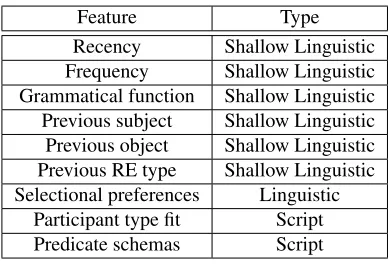
Feature Type Recency Shallow Linguistic Frequency Shallow Linguistic Grammatical function Shallow Linguistic Previous subject Shallow Linguistic Previous object Shallow Linguistic Previous RE type Shallow Linguistic Selectional preferences Linguistic
[image:6.612.88.284.52.184.2]Participant type fit Script Predicate schemas Script Table 1: Summary of feature types
set of categories described above.
Some of the features included in f are a
func-tion of the predicate syntactically governing the unobservable target RE (corresponding to the DR being predicted). However, in our incremental setting, the predicate is not available in the his-tory h(t) for subject NPs. In this case, we use an additional probabilistic model, which esti-mates the probability of the predicate v given the
context h(t), and marginalize out its predictions:
p(d(t)=d|h(t)) =
X
v
p(v|h(t)) exp(w
Tf(d, h(t), v))
P
d0exp(wTf(d0, h(t), v))
The predicate probabilities p(v|h(t)) are computed
based on the sequence of preceding predicates (i.e., ignoring any other words) using the recurrent neural network language model estimated on our training set.2 The expressionf(d, h(t), v)denotes the feature function computed for the referent d, given the
history composed ofh(t)and the predicatev. 4.2 Features
Our features encode properties of a DR as well as characterize its compatibility with the context. We face two challenges when designing our fea-tures. First, although the sizes of our datasets are respectable from the script annotation perspective, they are too small to learn a richly parameterized model. For many of our features, we address this challenge by using external word embeddings3 and
associate parameters with some simple similarity measures computed using these embeddings.
Con-2We used RNNLM toolkit (Mikolov et al., 2011; Mikolov et al., 2010) with default settings.
3We use 300-dimensional word embeddings estimated on Wikipedia with the skip-gram model of Mikolov et al. (2013):
https://code.google.com/p/word2vec/
sequently, there are only a few dozen parameters which need to be estimated from scenario-specific data. Second, in order to test our hypothesis that script information is beneficial for the DR prediction task, we need to disentangle the influence of script information from general linguistic knowledge. We address this by carefully splitting the features apart, even if it prevents us from modeling some interplay between the sources of information. We will de-scribe both classes of features below; also see a sum-mary in Table 1.
4.2.1 Shallow Linguistic Features
These features are based on Tily and Pianta-dosi (2009). In addition, we consider a selectional preference feature.
Recency feature.This feature captures the distance
lt(d)between the positiontand the last occurrence
of the candidate DRd. As a distance measure, we
use the number of sentences from the last mention and exponentiate this number to make the depen-dence more extreme; only very recent DRs will re-ceive a noticeable weight:exp(−lt(d)). This feature
is set to0for new DRs.
Frequency. The frequency feature indicates the
number of times the candidate discourse referentd
has been mentioned so far. We do not perform any bucketing.
Grammatical function. This feature encodes the
dependency relation assigned to the head word of the last mention of the DR or a specialnonelabel if the DR is new.
Previous subject indicator. This binary feature in-dicates whether the candidate DRdis coreferential
with the subject of the previous verbal predicate.
Previous object indicator.The same but for the ob-ject position.
Previous RE type. This three-valued feature indi-cates whether the previous mention of the candidate DRdis a pronoun, a non-pronominal noun phrase,
or has never been observed before.
4.2.2 Selectional Preferences Feature
The selectional preference feature captures how well the candidate DR d fits a given syntactic
po-sition r of a given verbal predicate v. It is
com-puted as the cosine similarity simcos(xTd,xv,r) of
a vector-space representation of the DR xd and a
pred-icate xv,r. The similarities are calculated using a
Distributional Memory approach similar to that of Baroni and Lenci (2010). Their structured vector space representation has been shown to work well on tasks that evaluate correlation with human the-matic fit estimates (Baroni and Lenci, 2010; Baroni et al., 2014; Sayeed et al., 2016) and is thus suited to our task.
The representation xd is computed as an
aver-age of head word representations of all the previ-ous mentions of DRd, where the word vectors are
obtained from the TypeDM model of Baroni and Lenci (2010). This is a count-based, third-order co-occurrence tensor whose indices are a word w0, a second wordw1, and a complex syntactic relationr, which is used as a stand-in for a semantic link. The values for each(w0, r, w1)cell of the tensor are the local mutual information (LMI) estimates obtained from a dependency-parsed combination of large cor-pora (ukWaC, BNC, and Wikipedia).
Our procedure has some differences with that of Baroni and Lenci. For example, for estimating the fit of an alternative new DR (in other words, xd
based on no previous mentions), we use an aver-age over head words of all REs in the training set, a “null referent.” xv,r is calculated as the average
of the top 20 (by LMI)r-fillers forvin TypeDM; in
other words, the prototypical instrument ofrubmay be represented by summing vectors liketowel, soap, eraser, coin. . . If the predicate has not yet been en-countered (as for subject positions), scores for all scenario-relevant verbs are emitted for marginaliza-tion.
4.2.3 Script Features
In this section, we describe features which rely on script information. Our goal will be to show that such common-sense information is beneficial in per-forming DR prediction. We consider only two script features.
Participant type fit
This feature characterizes how well the participant type (PT) of the candidate DRdfits a specific
syn-tactic roler of the governing predicatev; it can be regarded as a generalization of the selectional prefer-ence feature to participant types and also its special-isation to the considered scenario. Given the candi-date DR d, its participant typep, and the syntactic
(I)(1)decided to take a (bath)(2)yesterday afternoon
after working out . (I)(1)was getting ready to go out
and needed to get cleaned before (I)(1)went so (I)(1)
decided to take a (bath)(2). (I)(1) filled the (
bath-tub)(3) with warm (water)(4) and added some (
bub-ble bath)(5). (I)(1)got undressed and stepped into the
(water)(4). (I)(1)grabbed the (soap)(5)and rubbed it
on (my)(1)(body)(7)and rinsed XXXXXX
Figure 4: An example of the referent cloze task. Similar to the Mechanical Turk experiment (Figure 2), our refer-ent prediction model is asked to guess the upcoming DR.
relationr, we collect all the predicates in the
train-ing set which have the participant typepin the posi-tionr. The embedding of the DRxp,ris given by the
average embedding of these predicates. The feature is computed as the dot product ofxp,rand the word
embedding of the predicatev. Predicate schemas
The following feature captures a specific aspect of knowledge about prototypical sequences of events. This knowledge is called predicate schemas in the recent co-reference modeling work of Peng et al. (2015). In predicate schemas, the goal is to model pairs of events such that if a DRdparticipated in the first event (in a specific role), it is likely to partici-pate in the second event (again, in a specific role). For example, in the restaurant scenario, if one ob-serves a phrase John ordered, one is likely to see
John waitedsomewhere later in the document. Spe-cific arguments are not that important (where it is
John or some other DR), what is important is that the argument is reused across the predicates. This would correspond to the ruleX-subject-of-order →
X-subject-of-eat.4 Unlike the previous work, our
dataset is small, so we cannot induce these rules di-rectly as there will be very few rules, and the model would not generalize to new data well enough. In-stead, we again encode this intuition using similari-ties in the real-valued embedding space.
Recall that our goal is to compute a feature
ϕ(d, h(t)) indicating how likely a potential DRdis
to follow, given the historyh(t). For example,
Model
Name FeatureTypes Features Base Shallow
Linguistic Features
Recency, Frequency, Grammatical function,
Previous subject, Previous object Linguistic Shallow
Linguistic Features
+ Linguistic
Feature
Recency, Frequency, Grammatical function,
Previous subject, Previous object
+
Selectional Preferences Script Shallow
Linguistic Features
+ Linguistic
Feature + Script Features
Recency, Frequency, Grammatical function,
Previous subject, Previous object
+
Selectional Preferences +
[image:8.612.71.298.52.299.2]Participant type fit, Predicate schemas Table 2: Summary of model features
ine that the model is asked to predict the DR marked by XXXXXX in Figure 4. Predicate-schema rules can only yield previously introduced DRs, so the scoreϕ(d, h(t)) = 0for any new DRd. Let us use
“soap” as an example of a previously introduced DR and see how the feature is computed. In order to choose which inference rules can be applied to yield “soap”, we can inspect Figure 4. There are only two preceding predicates which have DR “soap” as their object (rubbedandgrabbed), resulting in two poten-tial rulesX-object-of-grabbed→X-object-of-rinsed and X-object-of-rubbed → X-object-of-rinsed. We define the scoreϕ(d, h(t))as the average of the rule
scores. More formally, we can write
ϕ(d, h(t)) = 1
|N(d, h(t))|
X
(u,v,r)∈N(d,h(t))
ψ(u, v, r), (1)
whereψ(u, v, r) is the score for a ruleX-r-of-u →
X-r-of-v, N(d, h(t)) is the set of applicable rules,
and|N(d, h(t))|denotes its cardinality.5 We define ϕ(d, h(t)) as0, when the set of applicable rules is empty (i.e.|N(d, h(t))|= 0).
The scoring function ψ(u, v, r) as a linear func-5In all our experiments, rather than considering all potential predicates in the history to instantiate rules, we take into ac-count only 2 preceding verbs. In other words,uandvcan be interleaved by at most one verb and|N(d, h(t))|is in{0,1,2}.
tion of a joint embeddingxu,v of verbsuandv:
ψ(u, v, r) =αTrxu,v.
The two remaining questions are (1) how to define the joint embeddingsxu,v, and (2) how to estimate
the parameter vectorαr. The joint embedding of two
predicates, xu,v, can, in principle, be any
composi-tion funccomposi-tion of embeddings ofuandv, for example their sum or component-wise product. Inspired by Bordes et al. (2013), we use the difference between the word embeddings:
ψ(u, v, r) =αTr(xu−xv),
where xu and xv are external embeddings of the
corresponding verbs. Encoding the succession re-lation as transre-lation in the embedding space has one desirable property: the scoring function will be largely agnostic to the morphological form of the predicates. For example, the difference between the embeddings ofrinsedandrubbedis very
sim-ilar to that of rinseandrub (Botha and Blunsom,
2014), so the corresponding rules will receive simi-lar scores. Now, we can rewrite the equation (1) as
ϕ(d, h(t)) =αrT(h(t))
P
(u,v,r)∈N(d,h(t))(xu−xv) |N(d, h(t))|
(2)
wherer(h(t)) denotes the syntactic function
corre-sponding to the DR being predicted (object in our example).
As for the parameter vector αr, there are again
a number of potential ways how it can be estimated. For example, one can train a discriminative classifier to estimate the parameters. However, we opted for a simpler approach—we set it equal to the empirical estimate of the expected feature vectorxu,v on the
training set:6
αr= 1 Dr
X
l,t
δr(r(h(l,t)))
X
(u,v,r0)∈N(d(l,t),h(l,t))
(xu−xv), (3)
where l refers to a document in the training set, t
Scenario Human Model Script Model Linguistic Model Tily Model
Accuracy Perplexity Accuracy Perplexity Accuracy Perplexity Accuracy Perplexity
Grocery Shopping 74.80 2.13 68.17 3.16 53.85 6.54 32.89 24.48
Repairing a flat bicycle tyre 78.34 2.72 62.09 3.89 51.26 6.38 29.24 19.08
Riding a public bus 72.19 2.28 64.57 3.67 52.65 6.34 32.78 23.39
Getting a haircut 71.06 2.45 58.82 3.79 42.82 7.11 28.70 15.40
Planting a tree 71.86 2.46 59.32 4.25 47.80 7.31 28.14 24.28
Borrowing book from library 77.49 1.93 64.07 3.55 43.29 8.40 33.33 20.26
Taking Bath 81.29 1.84 67.42 3.14 61.29 4.33 43.23 16.33
Going on a train 70.79 2.39 58.73 4.20 47.62 7.68 30.16 35.11
Baking a cake 76.43 2.16 61.79 5.11 46.40 9.16 24.07 23.67
Flying in an airplane 62.04 3.08 61.31 4.01 48.18 7.27 30.90 30.18
Average 73.63 2.34 62.63 3.88 49.52 7.05 31.34 23.22
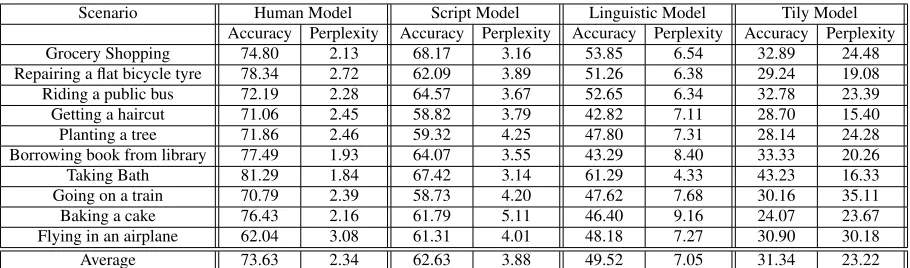
Table 3: Accuracies (in %) and perplexities for different models and scenarios. The script model substantially out-performs linguistic and base models (withp < 0.001, significance tested with McNemar’s test (Everitt, 1992)). As expected, the human prediction model outperforms the script model (withp < 0.001, significance tested by McNe-mar’s test).
[image:9.612.79.534.53.187.2]Model Accuracy Perplexity Linguistic Model 49.52 7.05 Linguistic Model + Predicate Schemas 55.44 5.88 Linguistic Model + Participant type fit 58.88 4.29 Full Script Model (both features) 62.63 3.88 Table 4: Accuracies from ablation experiments.
d(l,t)are the history and the correct DR for this
posi-tion, respectively. The termδr(r0)is the Kronecker
delta which equals1ifr =r0and0, otherwise. Dr
is the total number of rules for the syntactic function
rin the training set:
Dr=X l,t
δr(r(h(l,t)))× |N(d(l,t), h(l,t))|.
Let us illustrate the computation with an example. Imagine that our training set consists of the docu-ment in Figure 1, and the trained model is used to predict the upcoming DR in our referent cloze exam-ple (Figure 4). The training document includes the pairX-object-of-scrubbed→X-object-of-rinsing, so the corresponding term (xscrubbed - xrinsing)
partici-pates in the summation (3) forαobj. As we rely on
external embeddings, which encode semantic simi-larities between lexical items, the dot product of this term and (xrubbed - xrinsed) will be high.7
Conse-quently,ϕ(d, h(t))is expected to be positive ford= “soap”, thus, predicting “soap” as the likely forth-coming DR. Unfortunately, there are other terms
(xu − xv) both in expression (3) for αobj and in
expression (2) forϕ(d, h(t)). These terms may be 7The score would have been even higher, should the pred-icate be in the morphological formrinsingrather thanrinsed. However, embeddings ofrinsingandrinsedwould still be suf-ficiently close to each other for our argument to hold.
irrelevant to the current prediction, as X-object-of-plugged → X-object-of-filling from Figure 1, and may not even encode any valid regularities, as X-object-of-got → X-object-of-scrubbed (again from Figure 1). This may suggest that our feature will be too contaminated with noise to be informative for making predictions. However, recall that inde-pendent random vectors in high dimensions are al-most orthogonal, and, assuming they are bounded, their dot products are close to zero. Consequently, the products of the relevant (“non-random”) terms, in our example (xscrubbed - xrinsing) and (xrubbed
-xrinsed), are likely to overcome the (“random”) noise.
As we will see in the ablation studies, the predicate-schema feature is indeed predictive of a DR and con-tributes to the performance of the full model.
4.3 Experiments
We would like to test whether our model can pro-duce accurate predictions and whether the model’s guesses correlate well with human predictions for the referent cloze task.
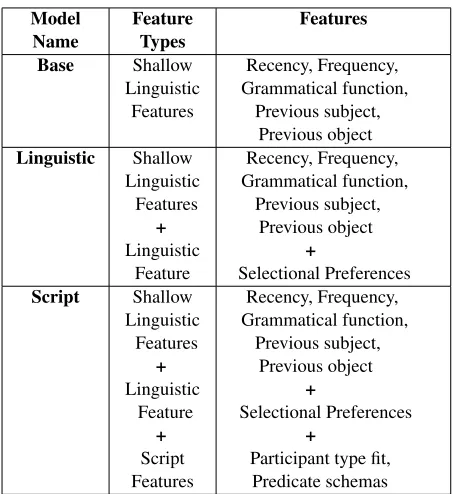
In order to be able to evaluate the effect of script knowledge on referent predictability, we compare three models: our fullScript model uses all of the features introduced in section 4.2; the Linguistic modelrelies only on the ‘linguistic features’ but not the script-specific ones; and theBase modelincludes all the shallow linguistic features. The Base model differs from the linguistic model in that it does not model selectional preferences. Table 2 summarizes features used in different models.
sce-narios), and test (20%, 182 stories from 10 scenar-ios) sets. The feature weights were learned using L-BFGS (Byrd et al., 1995) to optimize the log-likelihood.
Evaluation against original referents. We
[image:10.612.365.487.55.137.2]calcu-lated the percentage of correct DR predictions. See Table 3 for the averages across 10 scenarios. We can see that the task appears hard for humans: their average performance reaches only 73% accuracy. As expected, the Base model is the weakest system (the accuracy of 31%). Modeling selectional pref-erences yields an extra 18% in accuracy (Linguis-tic model). The key finding is that incorporation of script knowledge increases the accuracy by further 13%, although still far behind human performance (62% vs. 73%). Besides accuracy, we use perplex-ity, which we computed not only for all our models but also for human predictions. This was possible as each task was solved by multiple humans. We used unsmoothed normalized guess frequencies as the probabilities. As we can see from Table 3, the perplexity scores are consistent with the accuracies: the script model again outperforms other methods, and, as expected, all the models are weaker than hu-mans.
As we used two sets of script features, capturing different aspects of script knowledge, we performed extra ablation studies (Table 4). The experiments confirm that both feature sets were beneficial.
Evaluation against human expectations. In the
previous subsection, we demonstrated that the in-corporation of selectional preferences and, perhaps more interestingly, the integration of automatically acquired script knowledge lead to improved accu-racy in predicting discourse referents. Now we turn to another question raised in the introduction: does incorporation of this knowledge make our predic-tions more human-like? In other words, are we able to accurately estimate human expectations? This in-cludes not only being sufficiently accurate but also making the same kind of incorrect predictions.
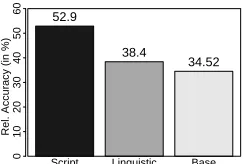
In this evaluation, we therefore use human guesses collected during the referent cloze task as our target. We then calculate the relative accuracy of each computational model. As can be seen in Figure 5, the Script model, at approx. 53% accuracy, is a lot more accurate in predicting human guesses than the Linguistic model and the Base model. We can also
Script Linguistic Base
0
10
20
30
40
50
60 52.9
38.4
34.52
Rel. Accur
[image:10.612.365.488.176.262.2]acy (in %)
Figure 5: Average relative accuracies of different models w.r.t human predictions.
Script Linguistic Base
0.0
0.2
0.4
0.6
0.8
0.5
0.57
0.66
JS Div
ergence
Figure 6: Average Jensen-Shannon divergence between human predictions and models.
observe that the margin between the Script model and the Linguistic model is a lot larger in this evalu-ation than between the Base model and the Linguis-tic model. This indicates that the model which has access to script knowledge is much more similar to human prediction behavior in terms of top guesses than the script-agnostic models.
Now we would like to assess if our predictions are similar as distributions rather than only yield-ing similar top predictions. In order to compare the distributions, we use the Jensen-Shannon divergence (JSD), a symmetrized version of the Kullback-Leibler divergence.
Intuitively, JSD measures the distance between two probability distributions. A smaller JSD value is indicative of more similar distributions. Fig-ure 6 shows that the probability distributions result-ing from the Script model are more similar to human predictions than those of the Linguistic and Base models.
In these experiments, we have shown that script knowledge improves predictions of upcoming ref-erents and that the script model is the best among our models in approximating human referent predic-tions.
5 Referring Expression Type Prediction Model (RE Model)
the choice of the type of referring expression (pro-noun or full NP) depends in part on the predictability of the referent.
5.1 Uniform Information Density hypothesis
The uniform information density (UID) hypothe-sis suggests that speakers tend to convey information at a uniform rate (Jaeger, 2010). Applied to choice of referring expression type, it would predict that a highly predictable referent should be encoded us-ing a short code (here: a pronoun), while an unpre-dictable referent should be encoded using a longer form (here: a full NP). Information density is mea-sured using the information-theoretic measure of the
surprisalSof a messagemi:
S(mi) =−logP(mi|context)
UID has been very successful in explaining a vari-ety of linguistic phenomena; see Jaeger et al. (2016). There is, however, controversy about whether UID affects pronominalization. Tily and Piantadosi (2009) report evidence that writers are more likely to refer using a pronoun or proper name when the ref-erent is easy to guess and use a full NP when readers have less certainty about the upcoming referent; see also Arnold (2001). But other experiments (using highly controlled stimuli) have failed to find an ef-fect of predictability on pronominalization (Steven-son et al., 1994; Fukumura and van Gompel, 2010; Rohde and Kehler, 2014). The present study hence contributes to the debate on whether UID affects re-ferring expression choice.
5.2 A model of Referring Expression Choice
Our goal is to determine whether referent pre-dictability (quantified in terms of surprisal) is cor-related with the type of referring expression used in the text. Here we focus on the distinction be-tween pronouns and full noun phrases. Our data also contains a small percentage (ca. 1%) of proper names (like “John”). Due to this small class size and earlier findings that proper nouns behave much like pronouns (Tily and Piantadosi, 2009), we com-bined pronouns and proper names into a single class of short encodings.
For the referring expression type prediction task, we estimate the surprisal of the referent from each of our computational models from Section 4 as well as the human cloze task. The surprisal of an upcoming discourse referentd(t)based on the previous context
h(t)is thereby estimated as:
S(d(t)) =−logp(d(t)|h(t))
In order to determine whether referent predictability has an effect on referring expression typeover and above other factors that are known to affect the choice of referring expression, we train a logistic regression model with referring expression type as a response variable and discourse referent predictabil-ity as well as a large set of other linguistic factors (based on Tily and Piantadosi, 2009) as explanatory variables. The model is defined as follows:
p(n(t)=n|d(t), h(t)) = exp(v
Tg(n, dt, h(t)))
P
n0exp(vTg(n0, dt, h(t))) ,
where d(t) and h(t) are defined as before, g is the feature function, and v is the vector of model
pa-rameters. The summation in the denominator is over NP types (full NP vs. pronoun/proper noun).
5.3 RE Model Experiments
We ran four different logistic regression models. These models all contained exactly the same set of linguistic predictors but differed in the estimates used for referent type surprisal and residual entropy. One logistic regression model used surprisal esti-mates based on the human referent cloze task, while the three other models used estimates based on the three computational models (Base, Linguistic and Script). For our experiment, we are interested in the choice of referring expression type for those occur-rences of refeoccur-rences, where a “real choice” is possi-ble. We therefore exclude for our analysis reported below all first mentions as well as all first and second person pronouns (because there is no optionality in how to refer to first or second person). This subset contains 1345 data points.
5.4 Results
Estimate Std. Error Pr(>|z|)
Human Script Linguistic Base Human Script Linguistic Base Human Script Linguistic Base (Intercept) -3.4 -3.418 -3.245 -3.061 0.244 0.279 0.321 0.791 <2e-16 *** <2e-16 *** <2e-16 *** 0.00011 ***
recency 1.322 1.322 1.324 1.322 0.095 0.095 0.096 0.097 <2e-16 *** <2e-16 *** <2e-16 *** <2e-16 *** frequency 0.097 0.103 0.112 0.114 0.098 0.097 0.098 0.102 0.317 0.289 0.251 0.262
pastObj 0.407 0.396 0.423 0.395 0.293 0.294 0.295 0.3 0.165 0.178 0.151 0.189
pastSubj -0.967 -0.973 -0.909 -0.926 0.559 0.564 0.562 0.565 0.0838 . 0.0846 . 0.106 0.101 pastExpPronoun 1.603 1.619 1.616 1.602 0.21 0.207 0.208 0.245 2.19e-14 *** 5.48e-15 *** 7.59e-15 *** 6.11e-11 ***
depTypeSubj 2.939 2.942 2.656 2.417 0.299 0.347 0.429 1.113 <2e-16 *** <2e-16 *** 5.68e-10 *** 0.02994 * depTypeObj 1.199 1.227 0.977 0.705 0.248 0.306 0.389 1.109 1.35e-06 *** 6.05e-05 *** 0.0119 * 0.525
[image:12.612.79.536.53.165.2]surprisal -0.04 -0.006 0.002 -0.131 0.099 0.097 0.117 0.387 0.684 0.951 0.988 0.735 residualEntropy -0.009 0.023 -0.141 -0.128 0.088 0.128 0.168 0.258 0.916 0.859 0.401 0.619
Table 5: Coefficients obtained from regression analysis for different models. Two NP types considered: full NP and Pronoun/ProperNoun, with base class full NP. Significance: ‘***’<0.001, ‘**’<0.01, ‘*’<0.05, and ‘.’<0.1.
very recently, the referring expression is more likely to be a pronoun (and not a full NP).
The coefficients for the surprisal estimates of the different models are, however, not significantly dif-ferent from zero. Model comparison shows that they do not improve model fit. We also used the esti-mated models to predict referring expression type on new data and again found that surprisal estimates from the models did not improve prediction accu-racy. This effect even holds for our human cloze data. Hence, it cannot be interpreted as a problem with the models—even human predictability esti-mates are, for this dataset, not predictive of referring expression type.
We also calculated regression models for the full dataset including first and second person pronouns as well as first mentions (3346 data points). The re-sults for the full dataset are fully consistent with the findings shown in Table 5: there was no significant effect of surprisal on referring expression type.
This result contrasts with the findings by Tily and Piantadosi (2009), who reported a significant effect of surprisal on RE type for their data. In order to replicate their settings as closely as possible, we also included residualEntropy as a predictor in our model (see last predictor in Table 5); however, this did not change the results.
6 Discussion and Future Work
Our study on incrementally predicting discourse referents showed that script knowledge is a highly important factor in determining human discourse ex-pectations. Crucially, the computational modelling approach allowed us to tease apart the different fac-tors that affect human prediction as we cannot ma-nipulate this in humans directly (by asking them to “switch off” their common-sense knowledge).
By modelling common-sense knowledge in terms of event sequences and event participants, our model captures many more long-range dependencies than normal language models. The script knowledge is automatically induced by our model from crowd-sourced scenario-specific text collections.
In a second study, we set out to test the hypoth-esis that uniform information density affects refer-ring expression type. This question is highly con-troversial in the literature: while Tily and Piantadosi (2009) find a significant effect of surprisal on refer-ring expression type in a corpus study very similar to ours, other studies that use a more tightly con-trolled experimental approach have not found an ef-fect of predictability on RE type (Stevenson et al., 1994; Fukumura and van Gompel, 2010; Rohde and Kehler, 2014). The present study, while replicating exactly the setting of T&P in terms of features and analysis, did not find support for a UID effect on RE type. The difference in results between T&P 2009 and our results could be due to the different corpora and text sorts that were used; specifically, we would expect that larger predictability effects might be ob-servable at script boundaries, rather than within a script, as is the case in our stories.
Acknowledgments
We thank the editors and the anonymous review-ers for their insightful suggestions. We would like to thank Florian Pusse for helping with the Ama-zon Mechanical Turk experiment. We would also like to thank Simon Ostermann and Tatjana Anikina for helping with the InScript corpus. This research was partially supported by the German Research Foundation (DFG) as part of SFB 1102 ‘Informa-tion Density and Linguistic Encoding’, European Research Council (ERC) as part of ERC Starting Grant BroadSem (#678254), the Dutch National Sci-ence Foundation as part of NWO VIDI 639.022.518, and the DFG once again as part of the MMCI Cluster of Excellence (EXC 284).
References
Simon Ahrendt and Vera Demberg. 2016. Improving event prediction by representing script participants. In
Proceedings of NAACL-HLT.
Jennifer E. Arnold. 2001. The effect of thematic roles on pronoun use and frequency of reference continuation.
Discourse Processes, 31(2):137–162.
Marco Baroni and Alessandro Lenci. 2010. Distribu-tional memory: A general framework for corpus-based semantics. Computational Linguistics, 36(4):673– 721.
Marco Baroni, Georgiana Dinu, and Germ´an Kruszewski. 2014. Don’t count, predict! A systematic compari-son of context-counting vs. context-predicting seman-tic vectors. InProceedings of ACL.
Antoine Bordes, Nicolas Usunier, Alberto Garcia-Duran, Jason Weston, and Oksana Yakhnenko. 2013. Trans-lating embeddings for modeling multi-relational data. InProceedings of NIPS.
Jan A. Botha and Phil Blunsom. 2014. Compositional morphology for word representations and language modelling. InProceedings of ICML.
Richard H. Byrd, Peihuang Lu, Jorge Nocedal, and Ciyou Zhu. 1995. A limited memory algorithm for bound constrained optimization. SIAM Journal on Scientific Computing, 16(5):1190–1208.
Nathanael Chambers and Daniel Jurafsky. 2008. Unsu-pervised learning of narrative event chains. In Pro-ceedings of ACL.
Nathanael Chambers and Dan Jurafsky. 2009. Unsuper-vised learning of narrative schemas and their partici-pants. InProceedings of ACL.
Brian S. Everitt. 1992. The analysis of contingency ta-bles. CRC Press.
Lea Frermann, Ivan Titov, and Manfred Pinkal. 2014. A hierarchical Bayesian model for unsupervised induc-tion of script knowledge. InProceedings of EACL. Kumiko Fukumura and Roger P. G. van Gompel. 2010.
Choosing anaphoric expressions: Do people take into account likelihood of reference? Journal of Memory and Language, 62(1):52–66.
T. Florian Jaeger, Esteban Buz, Eva M. Fernandez, and Helen S. Cairns. 2016. Signal reduction and linguis-tic encoding. Handbook of psycholinguistics. Wiley-Blackwell.
T. Florian Jaeger. 2010. Redundancy and reduction: Speakers manage syntactic information density. Cog-nitive psychology, 61(1):23–62.
Bram Jans, Steven Bethard, Ivan Vuli´c, and Marie Francine Moens. 2012. Skip n-grams and ranking functions for predicting script events. In
Proceedings of EACL.
Gina R. Kuperberg and T. Florian Jaeger. 2016. What do we mean by prediction in language comprehension?
Language, cognition and neuroscience, 31(1):32–59. Gina R. Kuperberg. 2016. Separate streams or
proba-bilistic inference? What the N400 can tell us about the comprehension of events. Language, Cognition and Neuroscience, 31(5):602–616.
Marta Kutas, Katherine A. DeLong, and Nathaniel J. Smith. 2011. A look around at what lies ahead: Pre-diction and predictability in language processing. Pre-dictions in the brain: Using our past to generate a fu-ture.
Tomas Mikolov, Martin Karafi´at, Lukas Burget, Jan Cer-nock`y, and Sanjeev Khudanpur. 2010. Recurrent neu-ral network based language model. InProceedings of Interspeech.
Tomas Mikolov, Stefan Kombrink, Anoop Deoras, Lukar Burget, and Jan Cernocky. 2011. RNNLM-recurrent neural network language modeling toolkit. In Pro-ceedings of the 2011 ASRU Workshop.
Tomas Mikolov, Ilya Sutskever, Kai Chen, Greg S. Cor-rado, and Jeff Dean. 2013. Distributed representations of words and phrases and their compositionality. In
Proceedings of NIPS.
Ashutosh Modi and Ivan Titov. 2014. Inducing neural models of script knowledge. Proceedings of CoNLL. Ashutosh Modi, Tatjana Anikina, Simon Ostermann, and
Manfred Pinkal. 2016. Inscript: Narrative texts anno-tated with script information. Proceedings of LREC. Ashutosh Modi. 2016. Event embeddings for semantic
script modeling. Proceedings of CoNLL.
Haoruo Peng, Daniel Khashabi, and Dan Roth. 2015. Solving hard coreference problems. InProceedings of NAACL.
Karl Pichotta and Raymond J Mooney. 2014. Statistical script learning with multi-argument events. Proceed-ings of EACL.
Altaf Rahman and Vincent Ng. 2012. Resolving com-plex cases of definite pronouns: the Winograd schema challenge. InProceedings of EMNLP.
Michaela Regneri, Alexander Koller, and Manfred Pinkal. 2010. Learning script knowledge with web experiments. InProceedings of ACL.
Hannah Rohde and Andrew Kehler. 2014. Grammati-cal and information-structural influences on pronoun production. Language, Cognition and Neuroscience, 29(8):912–927.
Rachel Rudinger, Vera Demberg, Ashutosh Modi, Ben-jamin Van Durme, and Manfred Pinkal. 2015. Learn-ing to predict script events from domain-specific text.
Proceedings of the International Conference on Lexi-cal and Computational Semantics (*SEM 2015). Asad Sayeed, Clayton Greenberg, and Vera Demberg.
2016. Thematic fit evaluation: an aspect of selectional preferences. InProceedings of the Workshop on Eval-uating Vector Space Representations for NLP (RepE-val2016).
Roger C. Schank and Robert P. Abelson. 1977. Scripts, Plans, Goals, and Understanding. Lawrence Erlbaum Associates, Potomac, Maryland.
Simone Sch¨utz-Bosbach and Wolfgang Prinz. 2007. Prospective coding in event representation. Cognitive processing, 8(2):93–102.
Rosemary J. Stevenson, Rosalind A. Crawley, and David Kleinman. 1994. Thematic roles, focus and the rep-resentation of events. Language and Cognitive Pro-cesses, 9(4):519–548.
Harry Tily and Steven Piantadosi. 2009. Refer effi-ciently: Use less informative expressions for more pre-dictable meanings. InProceedings of the workshop on the production of referring expressions: Bridging the gap between computational and empirical approaches to reference.