Learning to Make Inferences in a Semantic Parsing Task
Kyle Richardson
and
Jonas Kuhn
Institut f¨ur Maschinelle Sprachverarbeitung
University of Stuttgart
{
kyle,jonas.kuhn
}
@ims.uni-stuttgart.de
Abstract
We introduce a new approach to training a semantic parser that uses textual entail-ment judgeentail-ments as supervision. These judgements are based on high-level in-ferences about whether the meaning of one sentence follows from another. When applied to an existing semantic parsing task, they prove to be a useful tool for revealing semantic distinctions and back-ground knowledge not captured in the tar-get representations. This information is used to improve the quality of the seman-tic representations being learned and to acquire generic knowledge for reasoning. Experiments are done on the benchmark Sportscaster corpus (Chen and Mooney, 2008), and a novel RTE-inspired infer-ence dataset is introduced. On this new dataset our method strongly outperforms several strong baselines. Separately, we obtain state-of-the-art results on the orig-inal Sportscaster semantic parsing task.
1 Introduction
Semantic Parsing is the task of automatically translating natural language text to formal mean-ing representations (e.g., statements in a formal logic). Recent work has centered around learning such translations using parallel data, or raw col-lections of text-meaning pairs, often by employ-ing methods from statistical machine translation (Wong and Mooney, 2006; Jones et al., 2012; An-dreas et al., 2013) and parsing (Zettlemoyer and Collins, 2009; Kwiatkowski et al., 2010). Ear-lier attempts focused on learning to map natural language questions to simple database queries for database retrieval using collections of target
ques-tions and formal queries. A more recent focus has been on learning representations using weaker forms of supervision that require minimal amounts of manual annotation effort (Clarke et al., 2010; Liang et al., 2011; Krishnamurthy and Mitchell, 2012; Artzi and Zettlemoyer, 2013; Berant et al., 2013; Kushman et al., 2014).
For example, Liang et al. (2011) train a seman-tic parser in a question-answering domain using thedenotation(or answer) of each question as the sole supervision. Particularly impressive is their system’s ability to learn complex linguistic struc-ture not handled by earlier methods that use more direct supervision. Similarly, Artzi and Zettle-moyer (2013) train a parser that generates higher-order logical representations in a navigation do-main using low-level navigation cues. What is missing in such approaches, however, is an ex-plicit account of entailment (e.g., learning entail-ment rules from such corpora), which has long
been considered one of the basic aims of
se-mantics (Montague, 1970). An adequate seman-tic parser that captures the core aspects of natu-ral language meaning should support inferences about sentence-level entailments (i.e., determining whether the meaning of one sentence follows from another). In many cases, the target representations being learned remain inexpressive, making it diffi-cult to learn the types of semantic generalizations and world-knowledge needed for modeling entail-ment (see discussion in Schubert (2015)).
Attempts to integrate more general knowledge into semantic parsing pipelines have often in-volved additional hand-engineering or external lexical resources (Wang et al., 2014; Tian et al., 2014; Beltagy et al., 2014). We propose a dif-ferent learning-based approach that uses textual inference judgements between sentences as addi-tional supervision to learn semantic
x: pink3 quickly kicks to pink7
y: (latent)
z: {pass( pink3 pink7 ),...}
JzK 2
3 4
1
6
7 8 9
10
11 4
2
3
1
5 6 7 8 9
[image:2.612.115.284.62.184.2]10
Figure 1: The original Sportscaster training setup:
a textxpaired with aset of meaning
representa-tionszderived from events occurring in a 2-d
soc-cer simulator. The goal is to learn a latent
transla-tion,y, from the text to the correct representation.
tions in a semantic parsing task. Our assumption is that differences in sentence realizations provide a strong, albeit indirect, signal about differences in meaning. When paired with entailment judge-ments, this evidence can reveal important semantic distinctions (e.g., sense distinctions, modification) that are not captured in target meaning representa-tions. These judgements can also be used to learn general knowledge about a domain (e.g., meaning postulates or ontological relations).
In this paper, we introduce a novel recognizing textual entailment (RTE) inspired inference task for training and evaluating semantic parsers that extends previous approaches. Our method learns jointly using structured meaning representations (as done in previous approaches) and raw textual inference judgements as the main supervision. In order to learn and model entailment phenomena, we introduce a new method that integrates natu-ral logic (symbolic) reasoning (MacCartney and Manning, 2009) directly into a data-driven seman-tic parsing model.
We perform experiments on the Sportscaster corpus (Chen and Mooney, 2008), which we ex-tend by annotating pairs of sentences in the origi-nal dataset with inference judgements. On a new inference task based on this extended dataset, we achieve an accuracy of 73%, which is an im-provement of 13 percentage points over a strong baseline. As a separate result, part of our ap-proach outperforms previously published results (from around 89% accuracy to 96%) on the origi-nal Sportscaster semantic parsing task.
Entailment
Textt Hypothesish th!!ht Na¨ıve
1.
Pink 3 quickly kicks to pink 7
pass(pink3,pink7)
Pink 3 kicks over to pink 7
pass(pink3,pink7)
Entail Unknown Entail
2.
Purple 10 kicks the ball
kick(purple10)
Purple 10 shoots for the goal
kick(purple10)
Unknown Entail Entail
3.
Pink 10 kicks the ball
kick(pink10)
Pink 10 passes over to pink 7
pass(pink10,pink7)
Unknown Entail Contr.
4.
Purple 7 makes a long kick
kick(purple7)
Purple team scores another goal
playmode(goal l)
Unknown Unknown Contr.
Figure 2: Example sentence pairs and seman-tic representations with textual inference
judge-ments.Na¨ıveentailments are a type of close-world
assumption that result from matching semantic representations and assigning an entailment for matches and a contradiction otherwise.
2 Motivation
In this section, we describe the idea of modeling inference in a semantic parsing task using exam-ples from the Sportscaster domain.
2.1 Problems of Representation
Figure 1 shows a training example from the origi-nal Sportscaster corpus used in Chen and Mooney
(2008), consisting of a textxpaired with a set of
formal meaning representations z. The goal for
training a semantic parser in this setup is to learn
a hidden translationyfrom the text to the correct
representation using such raw pairs as supervision.
In this case, human commentary (i.e.,x) was
col-lected by having participants watch a 2-d
simula-tion of several Robocup1soccer league games and
comment on events in the game.
Rather than hand annotating the verbal sports commentary, sentences were paired with symbolic (logical) representations underlying the original simulator actions (Andr´e et al., 2000). These rep-resentations serve as a proxy for the grounded game context and the denotation of individual
events (shown asJzK). While the representations
capture the general events being discussed, they often fail to capture other aspects of meaning and additional details that the human commentators found to be relevant and expressed verbally.
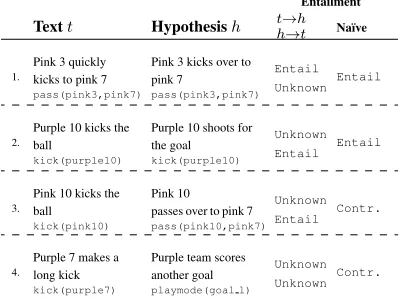
These issues are illustrated in Figure 2, where
[image:2.612.315.517.63.212.2]example sentences are shown with target meaning representations. Sentence-level entailment
judge-ments2 between orderings of text are shown
us-ing a standard 3-way entailment scheme (Cooper et al., 1996; Bentivogli et al., 2011), along with a
na¨ıveinference computed by comparing the target labels. The mismatch between some of the na¨ıve inferences and the actual entailment judgements show that the target representations alone fail to capture certain semantic distinctions. This is re-lated to two problems:
Imprecise labels: The corpus representations fail to account for certain aspects of meaning. For example, the first two sentences in Figure 2 map to the same formal meaning representation (i.e.,
pass(pink3,pink7)) despite having slightly different semantics and divergent entailment pat-terns. This shift in meaning is related to the
adver-bial modifierquickly, which is not explicitly
an-alyzed in the target representation. The same is
true for the modifierlongin example 4, and for all
other forms of modification. For a semantic parser or generator trained on this data, both sentences are treated as having an identical meaning.
As shown in the example 2, other representa-tions fail to capture important sense distincrepresenta-tions, such as the difference between the two senses of
thekick relation. While shooting for the goal
in general entailskicking, such an entailment does
not hold in the reverse direction. Without making this distinction explicit at the representation level, such inferences and distinctions cannot be made.
Missing Domain Knowledge: Since the
logi-cal representations are not based on an underlying logical theory or domain ontology, semantic re-lations between different symbols are not known. For example, computing the entailments in
exam-ple 3 requires knowing that in general, apass
event entails or implies akickevent (i.e., the set
of thingskickingat a given moment includes the
set of peoplepassing). Other such factoids are
in-volved in reasoning about the sentences in
exam-ple 4: purple7is part of thepurple team,
and ascoreevent entails akickevent (but not
conversely).
Our goal is to learn a semantic parser that can capture the inferential properties of language
de-2We adopt the definition ofentailmentused in the RTE
challenges (Dagan et al., 2005): a text T entails a hypothesis H if “typically, a human reading T would infer that H is most likely True”
t: pink3 passes to pink1
a:
h: pink3 quickly kicks
y0: pink3⌘pink3
(rel)
pink3⌘pink3
w vc
(mod)
wquickly
passvkick, pink1v
(infer)
passes to pink1vkicks
(infer)
passes to pink 1#quicklykicks
(infer)
pink3 passes to pink1#pink3quicklykicks
z0: Unknown (=#)
pink3/pink3
pink1/ /vc
[image:3.612.315.513.56.174.2]pass/kick
Figure 3: The inference training setup: an ordered
pair (t, h)annotated with a sentence-level
infer-ence relation z0. The goal is to learn a hidden
alignmentabetweent, h, and a hidden proof (tree)
y0that generates the target inference.
scribed above. Rather than re-annotating the cor-pus and creating a domain ontology from scratch, we use the raw entailment judgements to help im-prove and learn about the existing representations. We show that entailment judgements prove to be a powerful tool for solving the two problems de-scribed above.
2.2 Learning from Entailment
Our approach addresses the problems outlined above by adding pairs of text annotated with in-ference judgements (as shown in Figure 2) to the original Sportscaster data (as shown in Figure 1). While training an ordinary semantic parser, we use such pairs to jointly reason about the Sportscaster concepts/symbols and prove theorems about the target entailments using a simple logical calculus. The idea is that these proofs reveal distinctions not captured in the original representations, and can be used to improve the semantic parser’s internal rep-resentations and acquire knowledge.
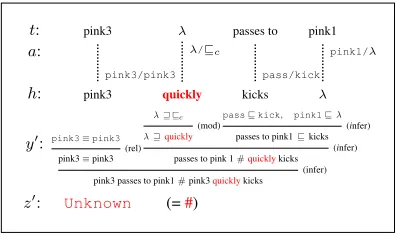
This training setup is illustrated in Figure 3,
where each training instance consists of a text t
and hypothesis h, and an entailment judgement
z0. The goal is to learn a hidden proof y0 that
derives the target entailment by transforming the text into the hypothesis. Such a proof is driven by latent semantic relationships (shown on the top
row iny0andrel) between aligned pairs of
sym-bols (the arc labels ina, delimited by “/”). These
(inferandmod) to compute a global inference. This proof gives rise to several new facts: the
pass symbol is found to forward entail or
im-ply (shown using the set inclusion symbolv) the
kicksymbol. The adverbial modifier, which is
previously unanalyzed, is treated as an entailing
modifiervc, which results in a reverse entailment
or implication (shown using the symbolw) when
inserted (or substituted for the empty symbol ) on the hypothesis side. The first fact can be used for building a domain theory, and the second for assigning more precise labels to modifiers for the semantic parser. The overall effect of inserting the adverbial modifier (shown in red) is then
propa-gated up the proof tree leading to anUncertain
inference (shown using the#symbol).
Computing entailments is driven by learning the correct semantic relations between primitive do-main symbols, as well as the semantic effect of deleting/inserting symbols. We focus on learning the following very broad types of linguistic
in-ferences (Fyodorov et al., 2003):
construction-based inferences, or inferences generated from specific (syntactic) constructions or lexical items
in the language, andlexical-basedinferences, or
inferences generated between words or primitive concepts due to their inherent lexical meaning.
Construction-based inferences are inferences
related to modifier constructions:quickly(pass)
v pass, goal w nice(goal), gets a(free kick)⌘(equivalence)free kick, where the entailments relate to default properties of partic-ular modifiers when they are added or dropped. Lexical-based inferences relate to general infer-ences and implications between primitive
seman-tic symbols or concepts:kickwscore,pass
vkick, andpink1vpink team.
2.3 Outline of Approach
Experiments are done by first training a standard semantic parser on the Sportscaster dataset, then improving this parser using an extended corpus of sentences annotated with entailment judgements. Semantic parsing is done using a probabilistic grammar induction approach (B¨orschinger et al., 2011; Angeli et al., 2012), which we extend to accommodate entailment modeling. The natural logic calculus is used as the underlying logical in-ference engine (MacCartney and Manning, 2009). To evaluate the quality of our resulting seman-tic parser and the acquired knowledge, we run our
system on a held-out set of inference pairs. The
results are compared to thena¨ıveinferences
com-puted by the initial semantic parser.
3 Semantic Parsing
In this section, we describe the technical details behind the semantic parsing. We also describe the underlying natural logic inference engine used for computing inferences, and how to integrate this into a standard semantic parsing pipeline for mod-eling our extended corpus.
3.1 Base Semantic Grammars
Semantic grammars (Allen, 1987) are used to perform the translation between text and logical meaning representations. The rules in these gram-mars are automatically constructed from the tar-get corpus representations using a small set of rule templates, building on B¨orschinger et al. (2011) (henceforth BJJ).
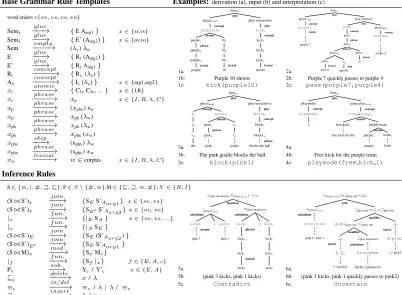
Rule Templates and Extraction Figure 4
shows a set of rule templates in the form of context-free productions, along with
exam-ples from the Sportscaster domain.
Mean-ings representations (MR) are atomic formulae of predicate logic and take the following form:
Rel(xarg1,..,xargN). The production rules break down each representation to smaller parts:
lexicalrules associate MR constituents or symbols
(e.g.,Rel,xarg1 instances) to individual words,
phraserules associate these constituents to word
sequences, concept rules associate phrase rules
to domain concepts, andgluerules combine
con-cepts to build complete MRs.3
Lexical rules are created by breaking down all MRs in a target corpus, and associating each con-stituent with all words in the target corpus. Phrase rules are from (Johnson et al., 2010) and allow ar-bitrary word sequences to be associated with con-stituents as opposed to single words. Such rules
can be used toskipwords that don’t contribute
di-rect meaning to a constituent or are unanalyzed, which is represented using the empty word
sym-bol w. This is shown in the treatment of the
ad-verbialquicklyin the phrasepasses quickly toin
Figure 4.2a.
Glue rules are constructed by marking con-stituent concepts with syntax-semantic roles and
3Capital letters (e.g.,E, A, ..) are used as variables in the
grammar to refer to sets of symbol types, andxis used to
Base Grammar Rule Templates Examples:derivation (a), input (b) and interpretation (c)
word orders ={sv, vs, os, vo}
Semx
glue
! {E Aarg1} x2 {sv,vs}
Semx
glue
! {E’ (Aarg2)} x2 {ov,vo}
Sem empty! ( c) w
E glue! {Rr(Aarg2)}
E’ glue! {RrAarg1}
Rr
concept
! {Rc( c)}
Ax concept! {Ic( c)} x2 {arg1,arg2}
xc
atomic
! {C1cC2c, ...} x2 {I,R}
xc
phrase
! xp x2 {I, R, , C}
xp
phrase
! (xphx) xw
xp
phrase
! xph( w)
xph
phrase
! xph( w)
xph
phrase
! xphx(xw)
xphx
skip
! (xphx) w
xphx phrase! (xphx)xw
xw lexical! w2corpus x2 {I, R, , C}
1a. Semsv glue play-intransitive glue kickr concept kickc kickp kickw lexical shoots playerarg1
concept purple10c atomic 10c 10p 10w lexical 10 purplec phrase purplep purplew lexical purple 2a. Semsv glue play-transitive glue playerarg2 concept purple4c ... purple 4 passr concept passc phrase passp phrase passw lexical to passphx w skip quickly passw lexical passes playerarg1
concept
purple7c atomic ...
purple 7
1b: Purple 10 shoots 2b: Purple 7 quickly passes to purple 4
1c: kick(purple10) 2c: pass(purple7,purple4)
3a. Semsv glue play-intransitive glue blockr concept blockc blocksp phrase
blocks the ball playerarg1
concept pink1c atomic 1c 1p goalie pinkc phrase pinkp pink c p w the 4a. Semvs glue
game-playarg1
concept
free kick lc
atomic purple-teamc atomic teamc team purplec purple free kickc
free kick for the playmode
concept
playmoder
3b: The pink goalie blocks the ball 4b: Free kick for the purple team 3c: block(pink1) 4c: playmode(free kick l)
Inference Rules
S2 {⌘,|,#,w,v}; P2S\ {#,⌘},M2 {v,w,⌘,#};Y2 {R, I}
(S./S’)x
join
! {SES’Aarg1} x2 {sv, vs} (S./S’)x
join
! {SE0S’Aarg2}x2 {ov, vo} |x
f un.
! {|ESA} x2 {sv, vs, ...}
|x
f un.
! {|ASE}
(S./S’)E
join
! {SE(S’Aarg2)} (S./S’)E0
join
! {SES’Aarg1}
(S./M)x
mod.
! {SxMc}
|f
f un.
! {Sf|x} f2 {E, A, c}
Px sub.! Yc/ Y’c x2 {E, A}
vc delete! x/ ⌘c
in/del
! ⌘c/ | / ⌘c
wc insert! /x
5a.
[image:5.612.108.510.62.357.2]⌘play-intransitive(|playerarg1) =|sv function ⌘play-intransitive substitute kickc kickp kickw kicks / kickc phrase kickp kickw lexical kicks |playerarg1 substitute pink1c pink 1 / pink3c atomic pink 3 6a.
⌘playerarg1./wplay-intr.=wsv join
wplay-intr../wc=wplay-intr. modifier
wc insert
/pink2
/pink2
wc./wplay-intr.=wplay-intr. modifier
wplay-intransitive substitute
kick/pass
kicks / passes to wc
insert
/vc / quickly
⌘playerarg1 substitute
pink1/pink1
pink 1 / pink 1
5b. (pink 3 kicks, pink 1 kicks) 6b. (pink 1 kicks, pink 1 quickly passes to pink2) 5c. Contradict 6c. Uncertain
Figure 4: The top are rule templates for building a semantic grammar with examples from the Sportscaster domain. The bottom are templates for encoding natural logic inference rules as
gram-mar rules. Rules in{.}are expanded to all orders. Example derivations are shown on the right (some
derivations are collapsed using dashed lines).
combining these roles according to the structure of the MRs. For example, the constituent symbol
blockin Figure 4.3 is marked as an
intransitive-playrelation andpink1as aplay-argument, both
of which combine to create a well-formed MR. Here we diverge from BJJ, where such abstrac-tions are not used and full MRs are encoded as separate grammar symbols. As in BJJ, word-order rules are used to account for regularities in the or-der in which arguments combine with relations.
c and Atomic Rules In addition to the skip
phrase rules, concept rules are padded with a
new empty concept c, which are used for
mod-eling phrases and modifiers surrounding concept
phrases. For example, inThe pink goalie in
Fig-ure 4.3a, theis treated as a separate phrase that
modifies pink goalie. As described later, these
phrases will get classified according to their effect on entailment using our extended corpus, but in the base semantic grammar get treated as not
con-tributing any additional meaning.
Theatomicrules optionally break down some of the domain symbols to smaller concepts, rather than using the original corpus symbols directly as
in BJJ. For example, the conceptpink3is treated
as consisting of two concepts: pinkand3.
Sim-ilarly, the game symbolfree kick lis broken
down to two concepts:free kickandpurple
team(orl). Unlike in BJJ, some flexibility is
per-mitted in terms of dropping or skipping over some constituent symbols that do not get realized in
sen-tences. For example,playmodein Figure 4.4a is
dropped, since it is not explicitly described in the associated text.
Interpretation Using this grammar, a given sen-tence input will generate a large space of output derivations, each related to a particular semantic
representation. An interpretation of a derivationd
Relation Symbol Definition Examples
forward entail v x⇢y
3 D
2 3 45
6
1 7
8
purple 3vpurple team
reverse entail w x y
equivalence ⌘ x=y
independence # other
alternation | x\y=;,
x[y6=D
Entail:{⌘,v},Contr.:{|},
Unknown:{#,w} D
pass towbad pass to
Join Table:
./ ⌘ v w | #
⌘ ⌘ v w | #
v v v # | #
w w # w # #
| | # | # #
# # # # # #
D
blocks the ball|scores Example Atomic Joins
R S R’=R./S
pink3vpink scoresvshoots pink3 scoresvpink shoots
pink2⌘pink2 defendswblocks pink2 defendswpink2 blocks
kickswpasses on the sidev kicks on the side#passes
Functions on Relations
f R R’=f(R)
x passes to pink2|pink4 x passes to pink2|x passes to pink4
defend/block purple|pink purple defends|pink blocks
pink1 defends|scores pink1 defends|pink1 shoots
Figure 5: Components of the natural logic infer-ence system. The top table shows primitive set-theoretic inference relations with sports examples (right), the middle table defines the join function used for combining these relations, bottom table show examples of functions on these relations.
the rules in our grammar, we can learn the correct interpretations using our training data.
3.2 Entailment Modeling
The base semantic parser described in the previ-ous section makes it possible to translate sentences to formal representations. Entailment modeling aims to discover abstract relations between sym-bols in these representations. For example,
know-ing how the meanknow-ing, ordenotation, of the
sym-bolpurple7in general relates to the meaning of
purple team, or howscorerelates tokick. In this section, we describe our general frame-work used for modeling textual entailment.
Natural Logic Calculus
We use a fragment of the natural logic calculus to model entailment (MacCartney and Manning, 2009; Icard III, 2012). Natural logic derives from work in linguistics on proof-theoretic approaches to semantics (van Benthem, 2008; Moss, 2010). More recently, it has been used in NLP for work on RTE (MacCartney and Manning, 2008; Angeli and Manning, 2014; Bowman et al., 2014).
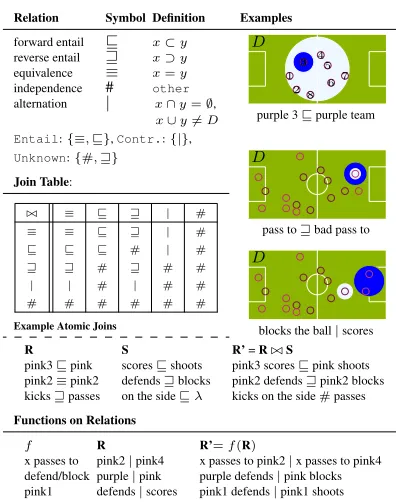
Components of the calculus are shown in Fig-ure 5. A small set of primitive set-theoretic rela-tions are defined, which are used to relate the de-notations of arbitrary lexical items (w.r.t to a
do-main of discourseD). We use a subset of the
orig-inal seven relations to relate symbols (and by ex-tension, word/phrases) in our domain. For exam-ple,purple3(or “purple 3”) has av(or subset)
relation to purple team (or “purple team”),
which is illustrated in Figure 5 using a Venn dia-gram. These primitive relations are then composed using two operations: atomic join rules, or generic inference rules for combining two inference rela-tions to create a new relation (shown in the join table), and function rules, or inference rules as-sociated with particular lexical items that project certain properties onto other relations.
Sentence-level entailment recognition is done by finding an alignment between a text and hy-pothesis pair. Such an alignment transforms the text into the hypothesis by substituting each part of the text with lexical items in the hypothesis, and inserting/deleting other items. Each local trans-formation is marked with a semantic relation, and these relations are composed using the join and function rules. A proof tree records the result of this overall process, and the top-most node shows
the overall inference relation (e.g.,|in Figure 4.5a
orwin Figure 4.6a).
Semantic relations between symbols and func-tions are usually recorded in a semantic lexicon. Since we have no prior knowledge about how sym-bols relate to one another, we learn these relations using the resulting entailment judgements as su-pervision. For example, since we do not know the
exact relation betweenkickandpass, we start
by assuming all semantic relations and find the correct relation by looking into the (latent) proof trees that produce the correct entailments in our training data (e.g., the tree in Figure 3).
All actions in our domain are fixed in time and place, and as such apply to a unique group of ob-jects. For example, if a passing event is being described, the person doing the passing or being passed to at a particular moment must always be a unique individual. Substituting this individual with someone else will always result in a contra-diction (see examples on the bottom of Figure 5). We therefore use a single default function rule that
always projects negations|up the proof tree. See
[image:6.612.103.301.55.306.2]a:
Semsv
play-intr.
steal
steals the ball playerarg1
pink5
5
5
pink
pink
Semvs
playerarg1 pink5
5
5
pink
pink
c
at the goal by
play-intr
defense
good defense
y0:
(⌘playerarg1./#play-intr.) = # =Uncertain
join
(wc./vplay-intran.) = #play-intr.
modifier
vplay-intr.
steal/defense
steals the ball / good defense by substitute
wc
/vc
/ at the goal by insert
⌘playerarg1
pink5/pink5
pink 5 / pink 5 substitute
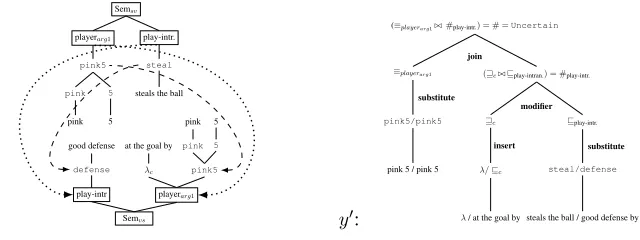
[image:7.612.161.481.57.177.2]((t=“pink 5 steals the ball”,h=“good defense at the goal by pink 5”), z0=Uncertain)
Figure 6: An example produced by our model: (t, h)are the text and hypothesis, z0 is the inference
annotation/relation that holds betweent!h,ais a phrase alignment between both sentences, andy0is
a (simplified) proof tree that generates the target inference.
these types offunctional relations.
Inference Grammar Rules
We encode natural logic operations as production rules and add them to the base semantic gram-mar described in Section 3.1. Rule templates are
shown on the bottom of Figure 4.Substituterules
assign a semantic relation to a pair of symbols:
e.g.,wplay-intr.!kickc / passc, where the
sub-script on the semantic relation is the role of the left concept being substituted. Substitutions oc-cur between symbols with the same role, such as all relation symbols or all argument symbols in a
domain and set of MRs. Function rules project
negations (regardless of role) up a proof tree.Join
rules compose relations using the join function./
and, like the glue rules, are used to construct well-formed MRs.
Substitution rules arbitrarily assign semantic re-lations to pairs of symbols since the correct rela-tion is not known at the start (as discussed previ-ously). This set of relations can be constrained by adding knowledge into the grammar. In our ex-periments, we assume a single negation rule be-tween all arguments of the same semantic type
(e.g.,playerarguments).
Modifiers and Senses We add two concept
sym-bols to the grammar: vc and ⌘c to replace the
c/ wrules in the base grammar. These are used
to classify modifiers (e.g., the adverbial modifier in Figure 2.1) and other expressions that are
unan-alyzed. Themodifierrule allows these to combine
with other symbols to affect entailment in vari-ous ways when added/dropped. With the empty symbol , other symbols can also be arbitrarily
added/dropped via theinsertanddeleterules.
We handle sense distinctions by allowing
rela-tion symbols (e.g.,kick) in the base grammar to
break down into a fixed number of specific senses
in the grammar (e.g.,kick1,kick2, . . . ). Using
the substitution rule, these different senses can be compared in the standard way to account for the semantic distinctions discussed in Section 2.1. In our experiments, we assigned a random number of senses to the most frequent events.
Since the inference grammar is built on top of the base semantic grammar, these additional sense and modifier distinctions can be used for improv-ing the base parser. Figure 8 shows examples of improvements in the semantic parse output after training with the extended corpus.
Construction vs. Lexical The distinction be-tween construction-based and lexical-based infer-ences described in Section 2.2 is the difference be-tween insert/delete and substitution rules in the in-ference grammar rules.
Interpretation A given input will generate a large set of proof trees and an even larger set of semantic relations between different symbols. The crucial aspect of the interpretation of the proof tree is the overall inference relation marked at the root node. These relations are mapped into particular inference judgements as shown in Figure 5.
Tree Alignment
se-mantic grammar and aligning nodes in the result-ing parse trees that have matchresult-ing roles. A strresult-ing is produced by pairing the yield of each match-ing subtree usmatch-ing a delimiter /. Subtrees that do not have a matching role in the other tree or are modifier expressions are isolated and aligned to the empty symbol .
An example tree alignment is shown in
Fig-ure 6a, where the relation nodesplay-intrand
ar-gument1 nodesplayerarg1are aligned. Since there
are no modifiers in the argument subtrees, the yields of the two trees are simply combined to
cre-ate the stringpink 5 / pink 5. The modifier phrase
c is removed from the second relation subtree
and aligned to the empty string: / at the goal
by. The remaining part of the relation subtrees
are then aligned: good defense / steals the ball.
With this input, the standard phrase and concept rules from the base grammar are used to tag each phrase and inference rules are then applied to
gen-erate proofs.4
In our experiments, we use the tags from the se-mantic parse trees used during the alignment step to restrict the space of proofs considered. For ex-ample, we already know from the semantic parser
output in Figure 6a that the text involves asteal
event and the hypothesis adefenseevent, so we
can constrain the search to consider only proofs that involve these two types of events.
3.3 Learning
Semantic parsing and inference computation is performed using a single generative probabilistic framework as shown in Figure 7. A probabilistic context-free grammar (PCFG) transforms input to logical representations and entailment judgements using the grammar rules defined above. Learn-ing reduces to the problem of findLearn-ing the
opti-mal parameters✓for our PCFG given example
in-put/output training pairs{(xi, Zi)}ni=1.
This is done via a EM bootstrapping approach that uses a k-best approximation of grammar
derivations to estimate✓(Angeli et al., 2012). At
each iteration in the EM proceduret = 1. . . T,
a set of k-best derivations is generated for each
input x, D(x) = {(dj, pj)}kj=1, using the
cur-rent parameters✓t. The set ofvalid derivations,
4For readability, substitute rules such asR!X / Y
in many of the proof trees are simplified to the following:
R!X/Y andX/Y !x string/y string, without showing
the full concept/phrase analysis forX, Y. See Figure 4.5a for
a more precise example.
pink 3 kicks kick(pink3)
x y z
input d output
(t, h) y0 z0
(pink 3 kicks,pink 1 kicks) ⌘play-intr(|playerarg1) =|
⌘play intr.
kick/kick
kicks/kicks
|playerarg1
pink3/pink1
pink 3/pink 1
Contradict
judgement
pink3/pink1 kicks/kicks Parsing Model✓
Semantic Grammar
Interpretation
|!
[image:8.612.315.517.57.173.2]Contr-alignment
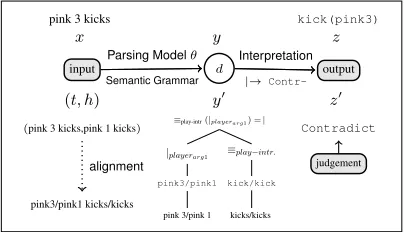
Figure 7: The prediction model: input is mapped
to a hidden derivation dusing a PCFG
(parame-terized by ✓), which is then used to generate an
output semantic representation. In the case of
se-mantic parsing (top),dis a latent semantic parse
tree and the output is a logical representation. For
entailment detection, dis a latent proof tree and
the output is a human judgement about entailment.
C(x, Z) ✓ D(x), includes all derivations that,
when interpreted, are included in the set of
train-ing labelsZ. From this set,C0(x, Z)is computed
by normalizing the probabilities, eachp, to create
a proper probability distribution.
For a given ruleA! , the parameter updates
are computed using these sets of normalized valid derivations. This is given by the following
(unnor-malized) formula (with Dirichlet prior↵):
✓At+1! =↵+
n
X
i=1
X
(d,p)2C0(xi,Zi)
count(d, A! )p
4 Experiments
In this section, we discuss the Sportscaster dataset and our experimental setup.
4.1 Datasets
Sportscaster The Sportscaster corpus (Chen
and Mooney, 2008) consists of 4 simulated Robocup soccer games annotated with human commentary. The English portion includes 1872 sentences paired with sets of logical meaning rep-resentations. On average, each training instance is paired with 2.3 meaning representations. The rep-resentations have 46 different types of concepts, consisting of 22 entity types and 24 event (and event-like) predicate types.
of concepts, the inference grammar described in Section 3.2 encodes around 3,000 inference rules. Since soccer is a topic that most people are famil-iar with, it is also easy to get non-experts to pro-vide judgements about entailment.
Extended Inference Corpus The extended
cor-pus consists of 461 unaligned pairs of texts from the original Sportscaster corpus annotated with sentence-level entailment judgements. We anno-tated 356 pairs using local human judges an
aver-age of 2.5 times5. Following Dagan et al. (2005),
we discarded pairs without a majority agreement, which resulted in 306 pairs (or 85% of the initial set). We also annotated an additional 155 pairs using Amazon Mechanical Turk, which were mit-igated by a local annotator.
In addition to this core set of 461 entailment pairs, we separately experimented with adding un-labeled data (i.e., pairs without inference judge-ments) and ambiguously labelled data (i.e., pairs with multiple inference judgements) to train our
inference grammars (shown in the results asMore
Data) and test the flexibility of our model. This
in-cluded 250 unlabeled pairs taken from the original dataset, as well as 592 (ambiguous) pairs created by deriving new conclusions from the annotated set. This last group was constructed by exploiting the transitive nature of various inference relations and mapping pairs with matching labels in training to{Entail,Unknown}.
4.2 Training and Evaluation
We perform two types of experiments: A se-mantic parsing experiment (Task 1) to test our approach on the original task of generating Sportscaster representations. In addition, we in-troduce an inference experiment (Task 2) to test our approach on the problem of detecting entail-ments/contradictions between sentences.
For the semantic parsing experiment, we follow the original setup of Chen and Mooney (2008). 4-fold cross validation is employed by training on all variations of 3 games and evaluating on a left out game. Each representation produced in the eval-uation phrase is considered correct if it matches exactly a gold representation.
The second experiment imitates an RTE-style evaluation and tests the quality of the back-ground knowledge being learned using our
infer-5We used a version of the elicitation instructions used in
the RTE experiments of Snow et al. (2008)
Task 1: Semantic Parsing MatchF1
(Chen et al., 2010) 0.80
(B¨orschinger et al., 2011) (BJJ) 0.86
(Gaspers and Cimiano, 2014) 0.89
Base Grammar Only 0.96
Inference Grammar (IG) 0.96
IG – More Data 0.96
Task 2: Inference Task Accuracy
Majority Baseline 0.33
RTE classifier 0.52
Na¨ıve Inference 0.60
SVM Flat Classifier 0.64
IG – Lexical Inference Only 0.72
IG – Full 0.73
[image:9.612.331.495.55.204.2]IG – More Data 0.72
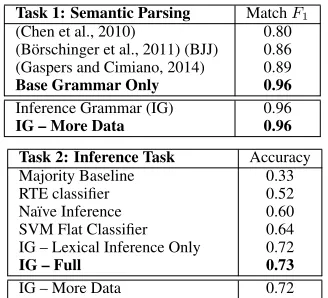
Table 1: Results on the semantic parsing (top) and inference (bottom) cross validation experiments.
ence grammars. Like in the semantic parsing task, we perform cross-validation on the games using both the original data and sentence pairs to jointly train our models, and evaluate on left-out sets of inference pairs. Each proof generated in the eval-uation phrase is considered correct if the resulting inference label matches a gold inference.
We implemented the learning algorithm in Sec-tion 3.3 using the k-best algorithm by Huang and Chiang (2005), with a beam size of 1,000. The base semantic grammars were each trained for 3 iterations and re-trained using the additional infer-ence grammar rules for 10 iterations. Two
Dirich-let priors were used,↵1= 0.05(for lexical rules)
and↵2 = 0.3(for non-lexical rules) throughout.
Lexical rule probabilities were initialized using co-occurrence statistics estimated using an IBM Model1 word aligner (uniform initialization oth-erwise). 5 additional senses were added to the in-ference grammar for the most frequent events.
4.3 Results
The results of both tasks are shown in Table 1. Scores are averaged over all held out test sets.
Task 1: Semantic Parsing We compare the
We also show the performance of our inference grammars on the semantic parsing task after being trained with additional inference sentence pairs. This was done under two conditions: when the in-ference grammar was trained using fully labeled inference data and unlabeled/ambiguously labeled
data (more data). While not fully comparable to
previous results, both cases achieve the same re-sults as the base grammar, indicating that our ad-ditional training setup does not lead to an improve-ment on the original task.
Task 2: Inference Task The main result of
our paper is the performance of our inference grammars on the inference task. For compar-ison, we developed several baselines, including a majority baseline (i.e., guess the most fre-quent inference label from training). We also use an RTE max-entropy classifier that is trained on the raw text inference pairs to make pre-dictions. This classifier uses a standard set of RTE features (e.g., word overlap, word entity co-occurrence/mismatch). Both of these approaches are strongly outperformed by our main inference
grammar (orIG Full).
TheNa¨ıve Inferencebaseline compares the full Sportscaster representations generated by our se-mantic parser for each sentence in a pair and
as-signs an Entailment for representations that
match and a Contradiction otherwise (see
discussion in Section 2.1). This baseline compares the inferential power of the original representa-tions (without background knowledge and more precise labels) to the inferential power of the in-ference grammars. The strong increase in perfor-mance suggests that important distinctions that are not captured in the original representations are in-deed being captured in the inference grammars.
We tested another classification approach using aFlat Classifier, which is a multi-class SVM clas-sifier that makes predictions using features from the input to the inference grammar. Such input in-cludes both sentences in a pair, their parse trees and predicted semantic labels, and the alignment between the sentences. In Figure 6, for exam-ple, this includes all of the information
exclud-ing the proof tree in y0. This baseline aims to
test the effect of using hierarchical, natural logic
inference rules as opposed to aflator linear
rep-resentation of the input, and to see whether our model learns more than the just the presence of important words that are not modeled in the
orig-1a.
Semsv
play-transitive playerarg2
purple6c
6c
6under pressure purplec
purple
passr
passc
passp
passes to playerarg1
purple9c
purple 9
1b.
Semsv
play-transitive playerarg2
vc
vp
under pressure purple6c
purple 6
passr
passc
passp
passes to playerarg1
purple9c
purple 9
2a.
Semsv
play-transitive
playerarg2
purple2c
purple 2
passr
passc
passp
passesoutto playerarg1
purple9c
purple 9
2b. Semsv
play-transitive
playerarg2
purple2c purple 2
passr
passp passw
to passphx
⌘w
out
passw passes playerarg1 purple9c purple 9
3.
Semsv
play-transitive
kickr
kick 1c
kick 1p
shoots for the goal playerarg1
pink7c
pink 7
Semsv
play-transitive
⌘c
⌘p
off
kickr
kickc
kickp
kicks playerarg1
purple10c
[image:10.612.319.496.60.289.2]purple 10
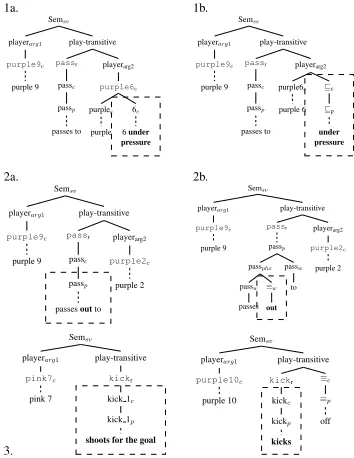
Figure 8: Example semantic parse trees (1,2) be-fore (a) and after (b) training on the extended cor-pus. Example 3 shows two senses learned for the
kickrelation.
inal representations. Features include the particu-lar words/phrases aligned or inserted/deleted, the category of these words/phrases in the parse trees, the rules in both parse trees and between the trees, the types of predicates/arguments in the predicted representations and various combinations of these features. This is also strongly outperformed by our main model, suggesting that the natural logic sys-tem is learning more general inference patterns.
Finally, we also experimented with removing insertions and deletions of modifiers from align-ment inputs to test the effect of only using lex-ical knowledge to solve the entailment problems (Lexical Inference Only). In Figure 6 this involves removing “at the goal” from the alignment in-put and relying only on the grammars knowledge
about howsteal(or “steals the ball”) relates to
defense(or “good defense by”) to make an en-tailment decision. This only slightly reduced the accuracy, which suggests that the real strength of the grammar lies in its lexical knowledge.
Qualitative Analysis Figure 8 shows example
cor-a.
(t, h): (abeautifulpass to,passes to) (gets afree kick,freekick from the) (yet againpasses to,kicks to) (purple 10,purple 10who is out front)
analysis:
vc./⌘play-tran=vplay-tran
modifier
⌘play-tran.
pass/pass
“pass to’/“passes to”
vc
vc/
“a beautiful”/
⌘c./⌘game-play=⌘game-play
modifier
⌘game-play
freekick/freekick
“free kick” / “freekick from the”
⌘c
⌘c/
“gets a”/
vc./⌘play-tran.=vplay-tran
modifier
⌘play-tran.
pass/pass
“passes to”/“kicks to”
vc
vc/
“yet again”/
⌘playerarg2./wc=wplayerarg2
modifier
wc
/vc
/“who is out front”
⌘playerarg2
purple10/purple10
“purple 10”/“purple 10”
generalization: beautiful(X)vX get(X)⌘X yet-again(X)vX Xwout front(X)
b.
(t, h): (pink teamis offsides,purple 9passes) (bad pass..,loses the ball to) (free kick for,steals the ball from) (purple 6kicks to,purple 6kicks)
analysis:
|teamarg1
substitute
pink team/purple9
“pink team’/“purple 9”
vplay-tran
substitute
bad pass/turnover
“bad pass .. picked off by”/“loses the ball to”
|game-play
substitute
free kick/steal
“free kick for”/“steals the ball from”
vplay-tran.
substitute
pass/kick
“kicks to”/“kicks’
[image:11.612.108.505.60.235.2]relation: pink team|purple9 bad passvturnover free kick|steal passvkick
Figure 9: Example construction-based (a) and lexical-based (b) inferences (both defined in Section 2.2) taken from parts of proof trees learned during our experiments. While inferences are computed between
semantic concept symbols (e.g.,purple4,pass,vc), thegeneralizationsin a. show how such
struc-tures can be used to generate lexicalized inference rules.
sense/context error:
1a. t:Pink 9shoots
h:Pink 9shoots for the goal
z0:Entail(predicted:Uncertain) semantic parse error:
1b. t:Purple 8steals the ball back
h:Purple 8 steals the ball frompink 6
z0:Uncertain(predicted:Contr.) alignment/modifier error:
1c. t:A goal for the purple team.
h:And the purple team scoredanothergoal
z0:Uncertain(predicted:Entail)
2. Predicted
Entail Contradict Uncertain
Gold
Entail 141 24 11
Contradict 11 139 17
[image:11.612.104.299.305.498.2]Uncertain 38 22 58
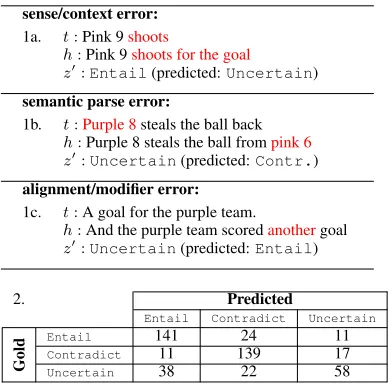
Figure 10: Example inference pairs where our sys-tem fails (1a-c). A confusion matrix is shown in 2.
rectly treat the modifier “under pressure” as a sep-arate constituent. The particular analysis also cap-tures the correct semantics by treating this phrase as forward-entailing, which allows us to predict how the entailment changes if we insert or delete this constituent. Similarly, the parser learns a more fine-grained analysis for the phrase “passes out to” by treating “out” as a type of modifier that does not affect entailment. Example 3 shows how the im-proved model learns to distinguish two senses of
thekickrelation.
On the inference task, one advantage of the nat-ural logic approach is that it is easy to see how our models make entailment decisions by look-ing directly at the resultlook-ing proof trees. Figure 9 shows the types of knowledge learned by our sys-tem and used in proofs. Figure 9a shows example
construction-based inferences, or modifier con-structions. For example, the first example treats the word “beautiful” in “a beautiful pass” as a type of modifier that changes the entailment or im-plication when it is inserted (forward-entails) or deleted (reverse-entails). In set-theoretic terms, this rule says that the set of “beautiful passes” is a subset of the set of all “passes”. The model also learns the semantics of longer phrases, includ-ing how certain types of relative clauses (last ex-ample) affect entailment. Figure 9b show types of lexical-based inferences, or relations between specific symbols. For example, the model learns
that thepink teamis disjoint from a particular
player from the purple team,purple9, and that
alignment) propagate up the processing pipeline. In this case, the semantic parser erroneously pre-dicted that “pink 6” is the first argument of the
stealrelation (a common type of word-order er-ror), and subsequently aligned “Purple 8” to “pink 6”. Similarly, the semantic parse tree for the hy-pothesis in the last (1c) failed to predict “another” as a modifier, which would generate an alignment with the empty string .
To better understand the results, a confusion matrix for our inference grammars on the cross-validation experiments is shown in Figure 10.2. It reveals that our system is worst at predict-ing Uncertain inferences. An informal sur-vey of a portion of the data suggests that this is largely due to the alignment/modifier errors dis-cussed above. This is also reflected in the results that use only lexical inference rules to make pre-dictions, which had a minimal effect on the infer-ence performance.
5 Discussion and Conclusion
We have focused on learning representations for semantic parsing that capture the inferential prop-erties of language. Since the goal of semantic parsing is to generate useful meaning represen-tations, the representations being learned should facilitate entailment and inference. Since entail-ment is also closely tied to how we evaluate and make decisions about representations, we believe that learning methods for semantic parsing should also be able to use such judgements as supervision to influence and guide the learning. We proposed a general framework based on these ideas, which uses textual inference judgements between pairs of sentences and symbolic reasoning as a tool to learn more precise representations. While our ap-proach uses natural logic (MacCartney and Man-ning, 2009) as the underlying reasoning engine, other reasoning frameworks with comparable fea-tures could be used.
Technically, our natural logic inference system is encoded as a PCFG, in which the background rules of the logic are expressed as probabilistic rewrite rules. Learning in this framework reduces to a probabilistic grammatical inference task, in this case using entailment judgements as the pri-mary supervision. These entailments give indi-rect clues about a domain’s denotational seman-tics, and can be used to reason about and find gaps in the target meaning representations. While our
approach focuses on natural language, it closely
relates to work onlearning from entailmentin the
probabilistic logic literature (De Raedt and Kerst-ing, 2004).
Our setup closely follows other work on sit-uated semantic interpretation (as advocated by Mooney (2008)) and other approaches to semantic parsing that use low-level feedback to learn rep-resentations. In real situated learning tasks, how-ever, learners will often find themselves in a situ-ation where they observe two linguistic utterances describing the same situation. Our training setup tries to imitate these types of cases, where being able to reason and learn about entailment directly is essential.
Since capturing inference is our main goal, we also propose using textual entailment as an evalu-ation metric for semantic parsing. As reflected in the results, our inference task (i.e., Task 2) is con-siderably harder than the original semantic pars-ing evaluation (i.e., Task 1). This is not surpris-ing, given that entailment recognition is in general known to involve considerable amounts of lexical and world knowledge (LoBue and Yates, 2011). Since the difference in performance on the orig-inal task is minimal between our base grammars and the inference grammars, one might conclude that the original evaluation does not tell us very much about the quality of the semantic grammar being learned in the same way as our new infer-ence evaluation. We hope that our work pushes others in the direction of using entailment not only as a tool for learning, but for evaluating and com-paring the quality of semantic parsers.
While our current model only handles simple types of inferences relating to inclusion/exclusion, we believe that our overall approach can be used to tackle more complex entailment phenomena. Fu-ture work will focus on extending our method to new datasets and inference phenomena.
Acknowledgments
References
James Allen. 1987.Natural Language Understanding. Benjamin/Cummings Publishing Company, Inc.
Elisabeth Andr´e, Kim Binsted, Kumiko Tanaka-Ishii, Sean Luke, Gerd Herzog, and Thomas Rist. 2000. Three robocup simulation league commentator sys-tems.AI Magazine, 21(1):57.
Jacob Andreas, Andreas Vlachos, and Stephen Clark. 2013. Semantic parsing as machine translation. In
Proceedings of ACL-2013, pages 47–52.
Gabor Angeli and Christopher D Manning. 2014. Nat-uralli: Natural logic inference for common sense reasoning. InProceedings of EMNLP-2014, pages 534–545.
Gabor Angeli, Christopher D Manning, and Daniel Ju-rafsky. 2012. Parsing time: Learning to interpret time expressions. InProceedings of NAACL-2012, pages 446–455.
Yoav Artzi and Luke Zettlemoyer. 2013. Weakly su-pervised learning of semantic parsers for mapping instructions to actions. Transactions of the Associa-tion for ComputaAssocia-tional Linguistics, 1:49–62.
Islam Beltagy, Katrin Erk, and Raymond Mooney. 2014. Semantic parsing using distributional seman-tics and probabilistic logic. InProceedings of ACL-2014, pages 7–12.
Luisa Bentivogli, Peter Clark, Ido Dagan, Hoa Dang, and Danilo Giampiccolo. 2011. The seventh Pas-cal Recognizing Textual Entailment challenge. Pro-ceedings of TAC, 2011.
Jonathan Berant, Andrew Chou, Roy Frostig, and Percy Liang. 2013. Semantic parsing on Freebase from question-answer pairs. InProceedings of EMNLP-2013, pages 1533–1544.
Benjamin B¨orschinger, Bevan K. Jones, and Mark Johnson. 2011. Reducing grounded learning tasks to grammatical inference. InProceedings of EMNLP-2011, pages 1416–1425.
Samuel R Bowman, Christopher Potts, and Christo-pher D Manning. 2014. Recursive neural networks can learn logical semantics. InProceedings of 3rd Workshop on Continuous Vector Space Models and their Compositionality, pages 12–21.
David L. Chen and Raymond J. Mooney. 2008. Learn-ing to sportscast: A test of grounded language acqui-sition. InProceedings of ICML-2008, pages 128– 135.
David L. Chen, Joohyun Kim, and Raymond J. Mooney. 2010. Training a multilingual sportscaster: Using perceptual context to learn language.Journal of Artificial Intelligence Research, 37:397–435.
James Clarke, Dan Goldwasser, Ming-Wei Chang, and Dan Roth. 2010. Driving semantic parsing from the world’s response. InProceedings of CoNLL-10, pages 18–27.
Robin Cooper, Dick Crouch, Jan van Eijck, Chris Fox, Josef van Genabith, Jan Jaspars, Hans Kamp, David Milward, Manfred Pinkal, Massimo Poesio, and Steve Pulman. 1996. Using the framework. Techni-cal Report LRE 62-051 D-16, The FraCaS Consor-tium.
Ido Dagan, Oren Glickman, and Bernardo Magnini. 2005. The PASCAL Recognizing Textual Entail-ment Challenge. In Proceedings of the PASCAL Challenges Workshop on Recognizing Textual En-tailment, pages 1–9.
Luc De Raedt and Kristian Kersting. 2004. Proba-bilistic inductive logic programming. In Algorith-mic Learning Theory, pages 19–36. Springer.
Yaroslav Fyodorov, Yoad Winter, and Nissim Francez. 2003. Order-based inference in natural logic. Logic Journal of IGPL, 11(4):385–416.
Judith Gaspers and Philipp Cimiano. 2014. Learning a semantic parser from spoken utterances. In Pro-ceedings of IEEE-ICASSP, pages 3201–3205.
Liang Huang and David Chiang. 2005. Better k-best parsing. InProceedings of IWPT-2005, pages 53– 64.
Thomas F Icard III. 2012. Inclusion and exclusion in natural language.Studia Logica, 100(4):705–725.
Mark Johnson, Katherine Demuth, Bevan Jones, and Michael J Black. 2010. Synergies in learning words and their referents. In Proceedings NIPS-2010, pages 1018–1026.
Bevan Keeley Jones, Mark Johnson, and Sharon Gold-water. 2012. Semantic parsing with Bayesian Tree Transducers. InProceedings of ACL-2012, pages 488–496.
Jayant Krishnamurthy and Tom M Mitchell. 2012. Weakly supervised training of semantic parsers. In
Proceedings of EMNLP/CoNLL-2012, pages 754– 765.
Nate Kushman, Yoav Artzi, Luke Zettlemoyer, and Regina Barzilay. 2014. Learning to automatically solve algebra word problems. In Proceedings of ACL-2014, pages 271–281.
Tom Kwiatkowski, Luke Zettlemoyer, Sharon Goldwa-ter, and Mark Steedman. 2010. Inducing probabilis-tic CCG grammars from logical form with higher-order unification. InProceedings of EMNLP-2010, pages 1223–1233.
Peter LoBue and Alexander Yates. 2011. Types of common-sense knowledge needed for Recognizing Textual Entailment. InProceedings of ACL/HLT-2011, pages 329–334.
Bill MacCartney and Christopher Manning. 2008. Modeling semantic containment and exclusion in natural language inference. In Proceedings of COLING-2008, pages 521–528.
Bill MacCartney and Christopher D Manning. 2009. An extended model of natural logic. InProceedings of the eighth international conference on computa-tional semantics, pages 140–156.
Bill MacCartney. 2009. Natural Language Infer-ence. Ph.D. thesis, Department of Computer Sci-ence, Stanford University.
Richard Montague. 1970. Universal grammar. Theo-ria, 36(3):373–398.
Ray Mooney. 2008. Learning to connect language and perception. In Proceedings of AAAI-2008, pages 1598–1601.
Lawrence Moss. 2010. Natural logic and seman-tics. InProceedings of 17th Amsterdam Colloquium, pages 71–80.
Lenhart Schubert. 2015. Semantic representation. In
Proceedings of AAAI-2015, pages 4132–4139.
Rion Snow, Brendan O’Connor, Daniel Jurafsky, and Andrew Y Ng. 2008. Cheap and fast—but is it good?: Evaluating non-expert annotations for natu-ral language tasks. InProceedings of EMNLP-2008, pages 254–263.
Ran Tian, Yusuke Miyao, and Takuya Matsuzaki. 2014. Logical inference on dependency-based com-positional semantics. Proceedings of ACL-2014, pages 79–89.
Johan van Benthem. 2008. A brief history of natural logic. Technical Report PP-2008-05, ILLC, Univer-sity of Amsterdam.
Adrienne Wang, Tom Kwiatkowski, and Luke Zettle-moyer. 2014. Morpho-syntactic lexical generaliza-tion for CCG semantic parsing. InProceedings of EMNLP-2014, pages 1284–1295.
Yuk Wah Wong and Raymond J. Mooney. 2006. Learning for semantic parsing with statistical ma-chine translation. InProceedings of HLT/NAACL-2006, pages 439–446.