IIIT at SemEval-2016 Task 11: Complex Word Identification using
Nearest Centroid Classification
Ashish Palakurthi and Radhika Mamidi Kohli Center on Intelligent Systems
IIIT-Hyderabad, India.
[email protected] [email protected]
Abstract
This paper describes the system that was sub-mitted to SemEval2016 Task 11: Complex Word Identification. It presents a preliminary investigation into exploring word difficulty for non-native English speakers. We developed two systems using Nearest Centroid Classifi-cation technique to distinguish complex words from simple words. Optimized over G-score, the presented solution obtained a G-score of 0.67, while the winner achieved a G-score of 0.77 and the average G-score of all the submit-ted systems in the task was 0.56.
1 Introduction
Lexical Simplification aims at improving the read-ability and comprehensibility of text by transform-ing complex text into simple text. Lexical Simpli-fication (Specia et al., 2012; Belder et al., 2010; Horn et al., 2014) is the process of replacing a word in a given context with its simplest substitute to enhance the readability of the text. The process should make sure that while replacing words with other variants, the meaning of the text is preserved. Lexical Simplification (Siddharthan, 2014) is use-ful to a wide variety of target audience like people with aphasia, children and also non-native speakers. Complex Word Identification (Shardlow 2013; Paet-zold 2015) is considered to be the first step in the pipeline of Lexical Simplification. The overall per-formance of a Lexical Simplification system is thus crucially dependent upon Complex Word Identifica-tion. The problem of Complex Word Identification is relatively new in the field of Natural Language
Processing. However, a few approaches have been previously proposed for this task. The simplicity score (Bott et al., 2012) of a word is computed by integrating both, frequency and length of a word. They consider a threshold value and simplify words only if the word’s frequency is lower than the fixed threshold. Matthew Shardlow (2013) explores the frequency thresholding to differentiate between sim-ple and comsim-plex words by experimenting with each threshold value on a particular corpus. However, this approach is not practically convincing. The same author also frames the problem as a machine learn-ing classification problem by designlearn-ing a few fea-tures. We approach the problem at hand on similar lines.
The Complex Word Identification (CWI) task is framed as a binary classification problem. Given a word in a sentence, the task is to predict whether the word is simple or complex. A word is tagged with 0 if it is simple and 1 if the word is found to be complex.1
c(w) =
(
1 if w ∈C 0 if w ∈S
Cis the set of complex words, S is the set of sim-ple words andc(w)represents the class of the word. Here is an example of a sentence taken from the training dataset provided by the organizers.
A frenulum is a small fold of tissue that
se-cures orrestrictsthemotionof a mobile organ in the body.
1Complex: In the context of this shared task, complex words
are the words which are difficult to understand for a non-native English speaker.
In the above example, the task requires a system to spae the words in bold as complex. The remainder of this paper is structured as follows. In Section 2, we describe our systems and Section 3 discusses ex-periments and results. We conclude in Section 4.
2 System Description
We use the Nearest Centroid Classification tech-nique (Manning et al., 2008) for the classification of words using Manhattan and Standardised Eu-clidean distance metrics. This classification method is widely used in Information Retrieval tasks. In this method, each class is represented by the mean of all the training samples belonging to that class in the training data. A new observation is assigned a class label, whose mean is closest to the observation. Given below are the labeled training samples:
(→x−1, y1), ...,(x−→n, yn), yi ∈Y
− →
µc =
1
|Nc|
X
i∈Nc − →xi
ˆ
y=arg minc∈Y||−→µc− −→xi||
where Y is the set of classes,
|Nc|is the number of samples in classc∈Y, µc is the centroid of all samples belonging to class
c, ˆ
yis the class assigned to the new observation.
We submitted two systems for this shared task. Our first system uses the Manhattan distance metric for the Nearest Centroid Classification. The Man-hattan distance function computes the distance to be travelled to get from one data point to another point in a grid-like path. The Manhattan distance between two points is the sum of the differences of their corresponding components. Manhattan distance be-tween two pointsA(x,y)andB(x,y)is defined as:
d(A, B)≡ |Ax−Bx|+|Ay−By|
The distance metric used by System 2 in the train-ing algorithm of the Nearest Centroid Classification was Standardised Euclidean, which is a slight vari-ant of Euclidean distance. Euclidean distance be-tween two points is defined as the sum of the squares of the differences between the corresponding com-ponents of the points. The Standardised Euclidean
distance between two pointsA(x,y)andB(x,y)is de-fined as:
d(A, B)≡ p
(Ax−Bx)2+ (Ay−By)2
V
where, V is the 1-D array of component variances and the numerator is the Euclidean distance between two pointsA(x,y)andB(x,y).
Both, System 1 and System 2 rely on 5 fea-tures to classify the target word as simple or com-plex. An almost similar set of features was pre-viously employed by Matthew Shardlow (2013) to identify complex words using Support Vector Ma-chines. The features we considered for the classifi-cation of words are:
• Unigram Word Probability: We used the
Google Books Ngram Viewer2 to obtain the word probability of the target word in the sen-tence. This information was considered only for the year 2000.
• Length: We considered length of the target
word as a feature because longer words are likely to be complex.
• Number of Senses: A word with higher
num-ber of senses is relatively more ambiguous in comparison to a word with fewer senses. Num-ber of senses of a word was obtained using WordNet3from NLTK4package.
• Syllable Count: A word with higher number
of syllables5is likely to be more difficult to be read.
• CD Count: The number of films in which the
target word had appeared was obtained from the SUBTLEX6corpus.
3 Experiments and Discussions
3.1 Data
We used the joint dataset provided by the task orga-nizers for training. The training and test data con-sisted of 2,237 and 88,221 instances, respectively.
2https://books.google.com/ngrams 3http://www.nltk.org/howto/wordnet.html 4http://www.nltk.org/
5http://www.syllablecount.com/syllables.
Also, the training and test data comprised 200 and 8,929 unique sentences respectively.
3.2 Discussions
We discuss our experiments with respect to the train-ing dataset. Experiments were run with a variety of machine learning algorithms using the Scikit-learn toolkit (Pedregosa et al., 2011). However, the Near-est Centroid Classification algorithm was found to outperform other algorithms like Random Forest and Support Vector Machines significantly over 5-fold cross-validation of the training dataset. We tried nu-merous combinations of features and finalized on the feature set described in the previous section.
There are a few features that we tried during our experimentation but did not include in the final sys-tem, as the results turned comparatively lower with their inclusion during cross-validation. We believe that the features are still worth discussing. They are: 1. Average Word Length of Synonyms: If the length of the given word is greater than the av-erage length of all its synonyms, then the word is tagged as 1, else 0. This gives us a relative estimate on whether people would prefer to use a word more regularly in comparison to its syn-onyms. A similar feature could be tried using frequency or syllables in addition to length of the word. But for our experiments, we only used the length feature.
2. Rank of a Sense: We use the Lesk algorithm from Wordnet to find the sense of a word in the given sentence. We find the correspond-ing sense and the rank of the sense based on frequency using Wordnet. A lower rank of a sense suggests higher frequency of usage of that sense (Christiane Fellbaum, 1998). A higher frequency of a sense indicates that the word is likely to be inferred as simple. The rank of a sense is divided by the total number of senses of the word to get a normalized measure of the feature.
3. Number of Synonyms:Number of synonyms of a given word was considered. This information was obtained using Wordnet.
4. Collocation Score: Collocations are a set of words which occur together frequently. We
find collocations for the target word in each sentence. We calculate a collocation score (C-score) defined as
C-score= C N
where, C is the number of collocations matched in the sentence and N is the total number of to-kens in the sentence. A higher C-score value indicates that the word usage is less ambigu-ous. Collocations7include Noun, Verb, Adjec-tive, Adverb and Conjunction collocations. We believe that the first two features are very crit-ical in differentiating simple words from complex ones as words should be inspected in a relative frame with respect to their synonyms and senses. A com-plex word may have higher number of senses but it does not necessarily imply that a word with higher number of senses is always complex.It is fairly pos-sible that a word (with many senses) in the given sentence may turn out to be the most frequently used sense and hence appear to be simple.
Thresholding based on frequency of a word is a common and effective way to identify complex words. The PLUJAGH team submitted a frequency threshold-based system and it stood first in this shared task when evaluated on F-score. In addi-tion to simple thresholding, it is essential to consider relative frequencies of a word with respect to their synonyms. For example, consider the wordseldest
and oldest. From a manual experiment, we found thateldestis a complex word andoldestis a simple word. The frequency ofoldestis higher than the fre-quency ofeldest. However, the wordunused (from the training dataset provided by organizers) which is less frequent (google ngrams) thaneldestis a simple word. We found 110 words in the training dataset whose frequency is lower than eldest and are still simple. We claim that this may be due to the rela-tively higher frequency/usage ofoldestwith respect to the frequency/usage ofeldest.
In conclusion, it becomes important to speculate words in a relative frame (of fre-quency/senses/length) with respect to their syn-onyms, to improve complex word identification.
7Collocations were collected from
The effectiveness of this hypothesis could have been empirically better visible with the availability of a larger training dataset.
3.3 Evaluation Metric
The official evaluation metric of the task is G-score. It is the harmonic mean of Accuracy (A) and Recall (R).
G-score=2∗A∗R A+R
[image:4.612.128.245.376.504.2]3.4 Results
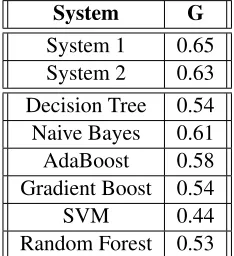
Table 1 shows the average G-score obtained using different classifiers for 5-fold cross-validation on the training data. For experiments using the Near-est Centroid Classification, we explored 24 different distance metrics, of which Manhattan and Standard-ised Euclidean metrics performed the best. Based on G-score, our systems were ranked 15th and 23rd in the task. Our first system was able to beat all the baseline systems including the threshold-based and the lexicon-based systems. Table 2 shows the per-formance of System 1 and System 2 on the test data.
System G
System 1 0.65 System 2 0.63 Decision Tree 0.54 Naive Bayes 0.61 AdaBoost 0.58 Gradient Boost 0.54 SVM 0.44 Random Forest 0.53
Table 1: Cross-validation results on Training Data
System A R G
System 1 0.546 0.879 0.674 System 2 0.465 0.860 0.603 Decision Tree 0.734 0.613 0.668 Naive Bayes 0.404 0.924 0.562 AdaBoost 0.767 0.777 0.772
[image:4.612.89.285.551.683.2]Gradient Boost 0.826 0.705 0.761 SVM 0.837 0.546 0.661 Random Forest 0.794 0.641 0.709
Table 2: Results on Test Data
The reason for choosing the Nearest Centroid Classifier was its consistent and comprehensive dominance over other classifiers tuned over various parameters and different feature combinations dur-ing the 5-fold cross-validation on the joint dataset. The results shown in Table 2 pertain only to the fi-nalized feature set discussed in Section 3. Table 2 also shows the results obtained on the test data using different classifiers with the same set of fea-tures employed for System 1 and System 2. At this point of time, we are not sure about why few clas-sifiers like AdaBoost and Random Forest performed way better than System 1 and System 2 on the test data. A possible reason for the poor performance of the Nearest Centroid Classifier in comparison to other systems could be the imbalance between the training and the test data size. The test data be-ing highly skewed could probably be another reason. AdaBoost8classifier (Table 2) was found to achieve a G-score of 0.772 on test data. This suggests that both, the proposed feature set and the approach pre-sented are competent.
4 Conclusion and Future Work
In this paper, we described a promising approach for identifying complex words for non-native English speakers using Nearest Centroid Classification tech-nique. Our approach is simple in terms of both, fea-tures and the learning algorithms.
We emphasized that words should be inspected in a relative frame with respect to their synonyms and senses. Testing this supposition in depth will be the subject of future work. We further look to improve the system by incorporating phonetic and semantic features. We also look to explore the problem at sentence level, as the complexity of the sentence can influence a person in comprehending a word’s meaning in that sentence.
Acknowledgment
We would like to thank the SemEval-2016 Task 11 organizers, Henry Gustavo Paetzold and Lucia Spe-cia for conducting this interesting shared task. In ad-dition, we thank the anonymous reviewers for their
8For the AdaBoost classifier, the number of estimators used
constructive comments and insights that helped us in improving this manuscript. We are grateful to Hi-mani Chaudhry and Himanshu Sharma.
References
Jan De Belder, Koen Deschacht, and Marie-Francine Moens. 2010. Lexical simplification. In Proceed-ings of ITEC2010: 1st international conference on in-terdisciplinary research on technology, education and communication.
Stefan Bott, Luz Rello, Biljana Drndarevic, Horacio Sag-gion. 2012. Can Spanish Be Simpler? LexSiS: Lex-ical Simplification for Spanish. In Proceedings of COLING, Mumbai, India.
Colby Horn, Cathryn Manduca and David Kauchak. 2014. Learning a Lexical Simplifier Using Wikipedia. InProceedings of the ACL 2014, page pp. 458-463. Christiane Fellbaum. 1998. Wordnet: An Electronic
Lexical Database. Cambridge: MIT Press.
Fabian Pedregosa, Gael Varoquaux, Alexandre Gram-fort, Vincent Michel, Bertrand Thirion, Olivier Grisel, Mathieu Blondel, Peter Prettenhofer, Ron Weiss, Vin-cent Dubourg, Jake Vanderplas , Alexandre Passos, David Cournapeau, Matthieu Brucher, Matthieu Per-rot, Edouard Duchesnay. 2011. Scikit-learn: Machine Learning in Python InJournal of Machine Learning Research, 12, pages 2825–2830.
Michel Jean-Baptiste, Yuan Kui Shen, Aviva P. Aiden, Adrian Veres, Matthew K. Gray, Joseph P. Pickett, Dale Hoiberg, Dan Clancy, Peter Norvig, Jon Orwant, Steven Pinker, Martin A. Nowak, and Erez Lieber-man Aiden. 2011. Quantitative analysis of culture using millions of digitized books, science, 331(6014), pp.176-182.
Christopher Manning, Prabhakar Raghavan, & Hinrich Schutze. 2008. Introduction to information retrieval. Vol. 1. No. 1. Cambridge: Cambridge university press. Gustavo Henrique Paetzold. 2015. Reliable Lexical Sim-plification for Non-Native Speakers. InProceedings of the NAACL-HLT 2015 Student Research Workshop (SRW), page p9.
Gustavo Henrique Paetzold and Lucia Specia. 2016. Se-mEval 2016 Task 11: Complex Word Identification. InProceedings of the 10th International Workshop on Semantic Evaluation (SemEval 2016).
Matthew Shardlow. 2013. A Comparison of Techniques to Automatically Identify Complex Words. In Pro-ceedings of the ACL (Student Research Workshop), page pp103-109.
Advaith Siddharthan. 2014. A Survey of Research on Text Simplification. In ITL-International Journal of Applied Linguistics, page pp165(2):259-298.