RDI_Team at SemEval-2016 Task 3: RDI Unsupervised Framework for
Text Ranking
Ahmed Magooda
1,§, Amr M. Sayed
2,§, Ashraf Y. Mahgoub
1, §, Hany Ahmed
1, §, Mohsen
Rashwan
1, Hazem Raafat
3, Eslam Kamal
4, Ahmad A. Al Sallab
51 RDI, Cairo, Egypt.
2Computer Science Department, Faculty of Computers and Information, Cairo University, Egypt. 3Computer Science Department, Kuwait University, Kuwait
4Microsoft Research, Cairo, Egypt.
5Valeo Inter-branch Automotive Software, Cairo, Egypt.
§ These four authors contributed equally to this work.
[email protected], [email protected], [email protected], [email protected], [email protected], [email protected], [email protected], [email protected]
Abstract
Ranking is an important task in the field of in-formation retrieval. Ranking may be used in different modules in natural language pro-cessing such as search engines. In this paper, we introduce a competitive ranking system which combines three different modules. The system participated in SemEval 2016 question ranking task for the Arabic language. The task is a ranking task that targets reordering results retrieved from search engine. Results reorder-ing is done based on relevancy between search result and the original query issued. The data provided in the competition is in the form of question (query) and 30 question answer pairs retrieved from search engine. For each ques-tion retrieved from the search engine the sys-tem generates a relevancy score that is to be used for ranking. The proposed system came in the third position in the Competition. Since the majority of modules are unsupervised the un-supervised naming was used.
1
Introduction
This paper describes RDI System, the system par-ticipated in SemEval 2016 Community question ranking shared task for the Arabic language (Nakov et al., 2016). The task is a ranking task for medical community questions, whenever a new user wants to submit a new question, the system should retrieve similar questions that are previously answered. Questions retrieved by the search engine are then to be ordered by its relevancy to query question in or-der to reduce redundancy.
The task proceeds as follows, for each query question 30 previously answered question answer pairs are retrieved through a search engine. The aim of the task is to reorder the retrieved 30 question an-swer pairs based on its relevancy to the query ques-tion.
As query expansion and results re-ranking are two major paradigms for search engine enhance-ments, (Mahgoub et al., 2014) used Google syno-nyms and Arabic Wikipedia to expand search que-ries, on the other hand (Abouenour et al., 2010) pro-posed a system that uses Arabic WordNet to expand queries. In this paper we are going to propose a
ranking system which consists of three modules merged with each other to produce a relevancy score. The proposed system managed to achieve the third position in the SemEval 2016 Community question ranking shared task for the Arabic. The 3 modules presented in this system are:
1- TF-IDF based module
2- Language model (LM) based module 3- Wikipedia-based module
The paper is organized as follows: Section 2 in-troduces some related work. Section 3 inin-troduces data used. Section 4 contains proposed system. Sec-tion 5 contains Results obtained. In SecSec-tion 6, some conclusions and perspective are discussed. Section 7 contains future work.
2
Related Work
The community question ranking problem is dif-ferent than ordinary question answering system that aims to generate a satisfactory answer for a specific question. Community question ranking problem aims to find the most suitable answer for a question within a closed set of question answers pool.
(Zongcheng et al. 2012) argued that a question and answer can be considered the same topic distri-bution written in two different languages or written by two different writers. So they proposed extract-ing the latent topics from question and answer, they used the extracted topics to represent the question and answer, alongside measuring how much ques-tion and answer share topics.
(Jeon et al. 2006) used some non-textual features to cover the contextual information of questions and answers, and proposed using language modeling to process these features in order to predict the quality of answers collected from a specific CQA service. (Blooma et al. 2008) used regression to combine textual and non-textual features to generate predic-tive score to identify the best answer.
(Ko et al. 2007) proposed using probabilistic an-swer ranking model to calculate the anan-swer rele-vance and answer similarity. They used logistic re-gression to calculate the correctness score for an an-swer using its relevancy to the question. The authors then improved their work by using probabilistic graphical model so that the correlation between all the answers can be taken into consideration.
3
Data
During the development of the proposed system 4 sets of data were used.
A) Training data provided by SemEval
This data consists of 1030 search queries, each query is accompanied with 30 search engine re-trieved results. Data is manually annotated with rel-evancy score and is marked as relevant or irrelevant. Where relevant annotated questions are questions that are actually relevant to the query question, and irrelevant annotated questions are irrelevant to the query question.
B) Development data provided by SemEval
This data consists of 250 search queries, each query is accompanied with 30 search engine retrieved re-sults. Data is manually annotated as relevant or ir-relevant. Where relevant annotated questions are questions that are actually relevant to the query question, and irrelevant annotated questions are ir-relevant to the query question.
C) Test data provided by SemEval
This data consists of 250 search queries, each query is accompanied with 30 search engine retrieved re-sults. In this case, data has no annotation provided.
D) Crawled data
This data is in the form of question-answer pairs crawled from http://www.altibbi.com. 170,000 question answer pairs were crawled, all of these data samples were considered relevant samples as we considered relevancy between answer text and ques-tion text.
4
Proposed System
This section describes the proposed system in de-tails. As shown in figure 1, three different modules are proposed. First, relevancy between search re-sults retrieved from the search engine and the search query are calculated using three modules. The three relevancy values calculated are then converted into one relevancy score using weighted summation.
Figure 1.Proposed System
4.1
TF-IDF ModuleThis module uses the crawled data as background corpora to calculate the relevancy between the query question and each of the 30 retrieved question answer pairs.
The main idea of the algorithm is that for each query question, cluster the background data into rel-evant and irrelrel-evant classes. The two constructed classes are then used to calculate how much the re-trieved 30 question answer pairs are relevant to the query question. The algorithm flows as follows:
-Crawled data and query question are normalized by removing (non-Arabic words, Numbers, Punctuations and Stop words).
-For the query question, cluster the crawled data into two classes; 1- Relevant and 2- Irrelevant. This can be done by counting the number of common words between the query question and each question answer pair of the crawled data. If the number of common words is more than or equal 3, then this pair is considered relevant, oth-erwise is considered irrelevant.
-For each pair of the retrieved question answer pairs, unigrams, bigrams and trigrams are ex-tracted. For each unigram, bigram and trigram TF-IDF is calculated twice, once using IDF ex-tracted from the relevant class question answer pairs and once using the IDF extracted from the irrelevant class question answer pairs.
-The TF-IDF for the question pair is calculated by weighting the unigram TF-IDF by ω1, bigrams
by ω2 and trigrams by ω3.
-The TF-IDF with relevant class and TF-IDF with irrelevant class are normalized into probability values.
-The relevant probability is then used as the final score for the current question answer pair.
4.2
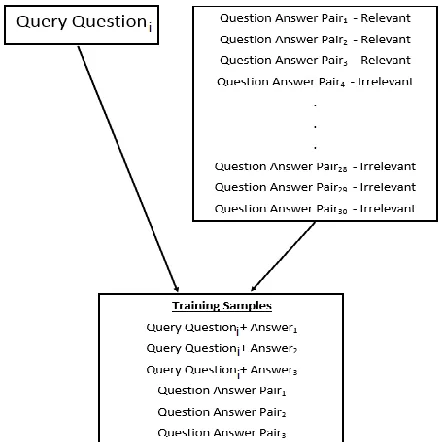
Language Model ModuleThis module utilizes the concept of language mod-eling into the ranking task. A language model was trained using the crawled data alongside the training data provided for the competition that was anno-tated as relevant question answer pair. In our exper-iments, we used the provided training data to reform new training samples as shown in figure.2.
Figure 2. Generating LM training samples
As shown in figure.2, for each query question and its 30 retrieved question answer pairs, to form new text samples, query question text has been appended to answer text of pairs which are annotated as rele-vant. The main idea behind using language model is that, a sentence formed from question and its answer is coherent, so using the answer with the query ques-tion in case the answer is annotated as relevant; will lead to coherent sentence too.
[image:3.612.313.533.296.517.2]samples are essential to feed the language model with more coherent training samples.
Using the previous generated samples a recurrent neural network for language modeling (Mikolov et al., 2011) with the following characteristics was trained;
-1-hidden layer of size 200 neuron and sigmoid activation function.
-Hierarchical Softmax output layer over the whole vocabulary.
This module is the only supervised module used within the system, since human annotation was em-ployed within this module.
4.3
Wikipedia-based moduleThis module uses medical information provided by Arabic-Wikipedia in order to provide better scoring methodology. The intuition behind using Wikipe-dia’s medical terms is to provide higher matching score for those terms present in Wikipedia’s medi-cal tree over other matched terms.
Using the categorization system provided by Wikipedia, about 250,000 medical subcategories where extracted from the Medical category, the list is available for download from the author’s web-site1. These extracted terms are then separated into
three categories: unigrams, bigrams, or more, where each category weighted by a different matching fac-tor.
To assign a total matching score between a query question and a question answer pair, the following steps are applied for each of the 30 retrieved ques-tion answer pairs:
-Top 1500 Most frequent words generated by (Zahran et al., 2015) were removed from both query question and the questions answer pairs. -Find matching terms between the question and
the question answer pair. -For each matching term:
oIf the matching term is a unigram which ex-ists in Wikipedia extracted terms, then in-crement the total matching score by Uni_Wiki_Factor
oElse if the matching term is a unigram which doesn’t exists in Wikipedia extracted terms, then increment the total matching score by Uni_Factor.
1
https://drive.google.com/file/d/0B0FhtCSJsoyoeT-Jkd1FUQksxRmM/view
oRepeat the previous two steps for both: bi-grams and higher n-grams using (Bi_Wiki_Factor, Bi_Factor) for bigrams and (N_Wiki_Factor, N_Factor) for higher order n-grams.
Moreover, values of these matching factors are tuned over a subset of the provided training set and then validated on the development set. The optimum values of the matching factors are
-Uni_Wiki_Factor = 1.5 -Uni_Factor = 1
-Bi_Wiki_Factor = 2 -Bi_Factor = 1 -N_Wiki_Factor = 2 -N_Factor = 1
5
Results
The proposed system achieved the 3rd position in the
Arabic subtask of SemEval 2016 task3.
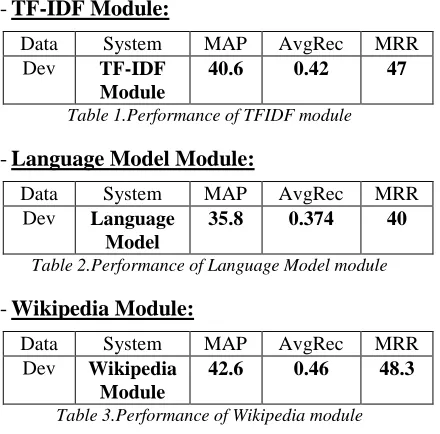
Follows a detailed analysis of the system perfor-mance on development data set, alongside the per-formance of each module on the same data:
-TF-IDF Module:
Data System MAP AvgRec MRR
Dev TF-IDF
Module
[image:4.612.319.539.379.596.2]40.6 0.42 47
Table 1.Performance of TFIDF module
-Language Model Module:
Data System MAP AvgRec MRR
Dev Language
Model
35.8 0.374 40
Table 2.Performance of Language Model module
-Wikipedia Module:
Data System MAP AvgRec MRR
Dev Wikipedia
Module
42.6 0.46 48.3
Table 3.Performance of Wikipedia module
The best parameters used to combine the three mod-ules were inferred from tuning the system over the development data set, the best weights are
α
(TF-IDF) = 0.3γ
(Wikipedia) = 0.75Table 4 shows the performance of the combined system on the development data set:
Data System MAP AvgRec MRR
Dev Combined
System
44.8 0.48 51.1
Table 4.Performance of combined system on developmentdata
Simple as it may seem, the Wikipedia module achieved the best results on development data set compared to the other two modules. This behavior is due to the ability of the Wikipedia module to highlight medical terms and assign it higher weights compared to other matched terms, on the other hand the other two modules neglect this property, as both modules focus on detecting similarity between sen-tences regardless of the domain.
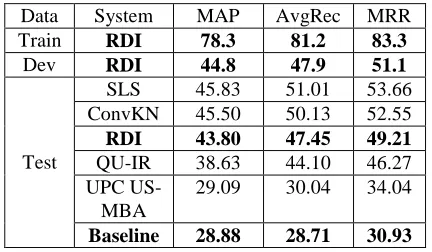
The proposed system also achieved 43.80 Mean Average Precision (MAP) on test set. Follows the final scores achieved on the test set alongside the scores achieved by the other four participants.
Data System MAP AvgRec MRR Train RDI 78.3 81.2 83.3
Dev RDI 44.8 47.9 51.1
Test
SLS 45.83 51.01 53.66 ConvKN 45.50 50.13 52.55
RDI 43.80 47.45 49.21
QU-IR 38.63 44.10 46.27 UPC
US-MBA
29.09 30.04 34.04
[image:5.612.77.293.358.484.2]Baseline 28.88 28.71 30.93
Table 5.Results achieved in SemEval 2016 task3
We can see that the proposed system achieved very good results compared to the baseline system. The system also achieved comparable results to the sys-tems that achieved first and second positions
6
Conclusion
In this paper, we have introduced a combination of different algorithms which can be used in ranking problems. The performance of different systems has been studied. The paper also presented a compari-son with other systems, and the results show that the proposed system is efficient. The results achieved by the proposed system are very promising com-pared with other systems in the competition.
7
Future work
Future work includes the enhancement of the sys-tem using sentence representation in vector space, as well as the combination of this system with other types of features.
We are planning to try sentence representation models like recursive auto encoder (RAE) (Socher et al., 2011) to represent the whole sentence in a vector. Using a model like RAE can facilitate meas-uring similarity between 2 sentence using vector representations for sentences.
The use of weighted sum for merging the pro-posed three modules is a very naive method that also suffers from over fitting. So We are planning to merge the proposed modules by means of machine learning (SVR, Neural Network, etc..) instead of us-ing the naïve weighted sum. We are also plannus-ing to invest some effort to perform more experiments on the language model module since it has contrib-uted the less within the three modules.
References
Socher, R., Pennington, J., Huang, E. H., Ng, A. Y., & Manning, C. D. (2011, July). Semi-supervised recur-sive autoencoders for predicting sentiment distribu-tions. In Proceedings of the Conference on Empirical Methods in Natural Language Processing (pp. 151-161). Association for Computational Linguistics. Zahran, M. A., Magooda, A., Mahgoub, A. Y., Raafat, H.,
Rashwan, M., & Atyia, A. (2015). Word Representa-tions in Vector Space and their ApplicaRepresenta-tions for Ara-bic. In Computational Linguistics and Intelligent Text Processing (pp. 430-443). Springer International Pub-lishing.
Mikolov, T., Karafiát, M., Burget, L., Cernocký, J., & Khudanpur, S. (2010, September). Recurrent neural network based language model. In INTERSPEECH
(Vol. 2, p. 3).
Mikolov, T., Kombrink, S., Burget, L., Černocký, J. H., & Khudanpur, S. (2011, May). Extensions of recurrent neural network language model. In Acoustics, Speech and Signal Processing (ICASSP), 2011 IEEE Interna-tional Conference on (pp. 5528-5531). IEEE.
Nakov, P., Marquez, L., Magdy, W., Moschitti, A., Glass, J. & Randeree, B. (2016). SemEval-2016 Task 3: Community Question Answering. In Proceedings of the 10th International Workshop on Semantic Evalua-tion. San Diego, California. Association for Computa-tional Linguistics.
structure-based approach for enhancing Arabic question/an-swering. International Journal on Information and Communication Technologies
Mahgoub, A. Y., Rashwan, M. A., Raafat, H., Zahran, M. A., & Fayek, M. B. (2014). Semantic query expansion for Arabic information retrieval. ANLP 2014
Ji, Z., Xu, F., Wang, B. and He, B., 2012, October. Ques-tion-answer topic model for question retrieval in com-munity question answering. In Proceedings of the 21st ACM international conference on Information and knowledge management.
J. Jeon, W. Croft, and etc. . a framework to predict the quality of answers with non-textual features. In Proc. SIGIR, 2006.
J. Ko, L. Si, and E. Nyberg. A probabilistic framework for answer selection in question answering. In Proc. NAACL/HLT, 2007.