Joint SIGHUM Workshop on Computational Linguistics for Cultural Heritage, Social Sciences, Humanities and Literature.
Plotting Markson’s “Mistress”
Conor Kelleher
School of Computer Science University College Dublin
Dublin, Ireland
Mark T. Keane
Insight Data Analytics Centre University College Dublin
Dublin, Ireland
Abstract
The post-modern novel “Wittgenstein’s Mistress” by David Markson (1988) pre-sents the reader with a very challenging non-linear narrative, that itself appears to one of the novel’s themes. We present a distant reading of this work designed to complement a close reading of it by David Foster Wallace (1990). Using a combina-tion of text analysis, entity recognicombina-tion and networks, we plot repetitive structures in the novel’s narrative relating them to its critical analysis.
1
Introduction
Certain novels not only cry out for critical in-terpretations but actually try to direct them.
(Wallace, 1990, p. 244) In recent years, a considerable body of research has contrasted the close reading of traditional literary criticism with distant readings based on text and network analytics (e.g., Jänicke et al., 2015; Moretti, 2005, 2013; Serlen, 2010). In this paper, we take the ecumenical position that dis-tant readings can surface unappreciated patterns in a literary work to support close readings (c.f., Coles et al., 2014; Jänicke et al., 2015). For in-stance, a number of distant readings have sup-ported close readings by providing abstractions showing the social networks of characters in-volved in a literary work (Agarwal et al., 2012; Grayson et al., 2016; Elson et al., 2010). The present work has, in part, been inspired by these distant readings, thought it explores phrase repe-tition and association networks. Specifically, we analyse the structure of repetitions in the post-modern novel “Wittgenstein’s Mistress” (1988) by the American author, David Markson to sup-port a close reading of the novel by David Foster Wallace (1990).
1.1 Close Reading “Wittgenstein’s Mistress” David Markson’s (1988) novel “Wittgenstein’s Mistress” (WM) is renowned for it use of an ex-perimental, non-linear narrative structure. The novel deals with the thoughts of a woman – simply known as Kate – who appears to be the last living person on earth. The narrative captures the streamed consciousness of her thoughts about art, her travels though her empty world, and her reflections on the imprecision of language. The novel has no chapters but consists of almost 4,000 short paragraphs many of which are single sentences, exemplified by following excerpt:
Gaetano Donizetti being still another person whom I otherwise might have mixed up with Vincenzo Bellini. Or with Gentile Bellini, who was also Andrea Mantegna’s brother-in-law, being Giovanni Bellini’s brother. Well I did mix him up. With Luigi Cherubini. Music is not my trade.
Although Maria Callas singing in that particu-lar scene has always sent shivers up and down my spine.
When Van Gogh was mad, he actually once tried to eat his pigments.
Well, and Maupassant, eating something much more dreadful than that, poor soul.
The list becomes distressingly longer.
(Markson, 1988, p. 111) One major feature of the narrative is Kate’s re-petitive turn of thought. Regularly, phrases and paragraphs are repeated throughout the novel, or the same entities, people and places are men-tioned over and over again. To the reader the narrative often seems like a long piece of classi-cal music where various motifs and themes are repeated and returned to at definite intervals; but, this structure is almost impossible to grasp be-cause the “musical phrases” are “word phrases”, repetitions of named people (e.g., Maupassant), places (e.g., Rome) and turns-of-phrase (e.g., ‘so
to speak’). Understanding this repetitive stream of consciousness and its significance is perhaps one of the main critical challenges of the novel. In his critical commentary, David Foster Wallace (1990) says:
You could call this technique ‘deep nonsense’, meaning I guess a linguistic flow of strings, strands, loops and quiffs that through the very manner of its formal construction flouts the ordinary cingula of ‘sense’ and through its de-fiance of sense’s limits manages somehow to ‘show’ what cannot ordinarily be ‘expressed’.
(Wallace, 1990, p. 248) One way to think about the current distant read-ing is that it is an attempt to surface the “formal construction” of WM, to better understand its message.
A second major feature of the novel is it con-cern with language itself, or rather many of the concerns raised by Wittgenstein in his early and late philosophy of language. Wallace argues that the book could be viewed as “a weird cerebral
roman a clef” that attempts to dramatise “the very bleak mathematical world (of) Wittgen-stein’s Tractus”; that it tries to show what it would like “if somebody really had to live in a
Tractatusized world” (Wallace p. 246). In par-ticular, Wallace points to the atomistic, inde-pendence of words and what they refer to, in this world, quoting Wittgenstein:
The world is everything that is the case; the world is nothing but a huge mass of data, of logically discrete facts that have no intrinsic
connection to one another. Cf the Tractus 1.2: ‘The world falls apart into facts…’ 1.2.1” ‘Any one fact can be either the case, or not the case, and everything else remains the same’.
(Wallace, 1990, p. 254) Faced with this world where there is no connec-tion between ‘facts’, Wallace points out “that Kate’s textual obsessionis simply to find connec-tions between things, any strands to bind the his-torical facts & empirical data that are all her world comprises” (pp. 254-255).
It is clear that a close reading of WM presents real challenges for anyone attempting to under-stand its structure. Hence, in this paper, have attempted a distant reading using text analytic techniques to surface the novel’s repetition-structures to support Wallace’s critical analysis.
2
Analysing Markson’s Mistress
We believed that the key to the narrative struc-ture of Wittgenstein’s Mistress lies in surfacing the repetitive aspects of the narrative, taking the novel’s short paragraphs as a sort of “fundamen-tal unit of analysis”. Hence, we progressively analysed the text in four distinct ways to surface these repeating structures, exploring:
• Repeated Phrases: generating all n-grams of differential lengths from (2-32) we identified repeating unique, maximal strings of charac-ters in the text (aka repeated phrases) • Named Entities: taking these maximal
n-gram strings, we extracted all the entities mentioned in them, as the narrative often re-lies heavily on repeated references to people, places and things
• Networks of Association: we then used these named entities to build associative networks, on basis of how “close” they were to one another in these repeating text-fragments (see our definitions of “close” in later sec-tion)
• Sequences of Repetitions: finally, we exam-ined whether these networks (clumps of as-sociated entities) occurred in definite se-quences; that is, was there a definite tenden-cy for one cluster to follow another in pat-terned sequences, to determine whether we could sketch the “DNA of the novel”
In the following subsections, we elaborate the specific methods used to perform these different analyses and what we discovered using them.
2.1 Finding Repeated Phrases
Intuitively, reading WM one has a strong sense that certain phases are consistently re-used throughout the text. However, is very hard to get a sense of the scale of this repetition or, in-deed, its structure without resorting to text ana-lytic methods. So, to capture the extent of the repetition we performed an analysis of the nov-el’s repeated phrases.
tokenisation packages and our own n-gram pro-gram). Using this method all possible n-grams were computed from 2-grams up to 32-grams halting the search when no further repetition was found in the gram set. As we looped through n-grams of different window sizes, we retained re-peated n-grams and discarded any that only oc-curred once. Furthermore, across n-gram sets of different sizes we discarded n-grams that had word-sequences that were subsets of longer n-grams, so we ended up with a list of all the unique, maximally-sized n-grams that had been repeated at least two times or more in the novel.
N-gram N
Was it really some other person I was so anxious to discover when I did all of that looking or was it only my own soli-tude that I could not abide ?
32
Although doubtless when I say they are half empty I should really be saying they are half filled since presumably they were totally empty before some-body half filled them
29
Still I find it extraordinary that young men died there in a war that long ago and then died in the same place three thousand years after that
28
Even if a part I have always liked is when Orestes finally comes back after so many years and Electra does not rec-ognize her own brother
26
Then again it is not impossible that they were once filled completely be-coming half empty only when some-body removed half of the books to the basement
[image:3.595.308.520.164.319.2]25
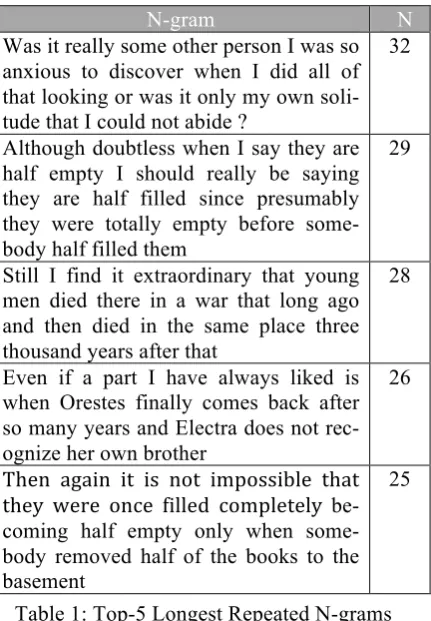
Table 1: Top-5 Longest Repeated N-grams In our n-gram search upto 32-grams, we idetified a large number of unique, maximal n-grams; there were 4,503 phrases, different-sized n-grams that were repeated at least twice in the text (see Tables 1 and 2).
Table 1 shows the top-5 n-grams by length found in the text (i.e., number of words they con-tain), each of which only occurred twice in the novel. Table 2 shows the top-10 most frequently repeating n-grams found in the text. Notably, the most frequent maximal n-grams are typically quite short.
This analysis gives us a first sense of the ex-tent of the repetition in the text, indicating that this repetition is being deployed systematically to achieve some narrative effect. Indeed, of the
3,804 paragraphs in the novel, 3,323 contain at least one or more maximal n-gram with >3 words. In the next sub-section, we get a sense of the systematicity that may lie in this repetition by identifying the named entities involved in these repeated sequences.
N-gram N
now that I think about it 8 There would appear to be no 7 doubtless I would not have 7
Even if I have no 7
When one comes right down to it 6 But be that as it may 6 As a matter of fact the 6 As a matter of fact what 6 And to tell the truth I 6 God the things men used to do 5
Table 2: Top-10 Frequently Repeated N-grams
2.2 Identifying Named Entities
To further analyse the repeated text fragments found in the n-gram analysis, we used the NLTK’s Stanford Named Entity Recogniser (NER) package to find all the named entities mentioned in the set of maximal n-grams; though we needed to manually extend its functionality to remove incorrect identifications and to add miss-ing entities (to deal with problems like “William de Kooning” and “de Kooning” being treated as separate entities). The full text yielded 462 unique entities (from 3,804 paragraphs) and when we searched our maximal n-gram set, we found that 117 of these entities were mentioned in the paragraphs containing repeated phrases (341 paragraphs). We used this set of entities as a basis for examining the repetitions of people, places and things in networks of association.
2.3 Networks of Association
[image:3.595.76.292.246.557.2]revealed that there are definite and distinct repeti-tive-structures of association in the novel.
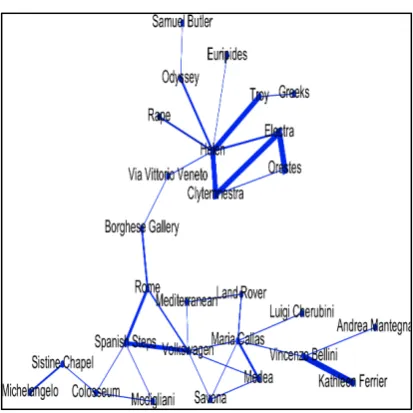
For example, Figure 2 shows one of the smaller networks – which we call the Homeric Network --- showing associations between a variety of Greek-related entities, reflecting references to Homer (e.g., Illiad, Sirens, Odysseus). Note, that the thickness of the link in this network indicates the frequency with which these two entities were repeatedly associated within the paragraphs of the novel. So, for instance, the link between Achilles and Odysseus is thicker because they are mentioned together in paragraphs several times.
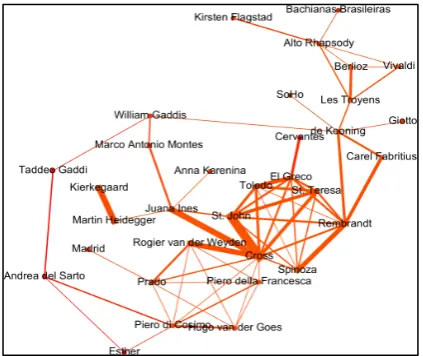
Performing this type of analysis we found five disjoint networks of different sizes between other named entities that we have titled after their dom-inant associations: (i) Paris Network (Figure 1), (ii) Homeric Network (Figure 2), the Rome Net-work (Figure 3), (ii) the Spanish NetNet-work (Figure 4), (iii) the Gallery Network (Figure 5).
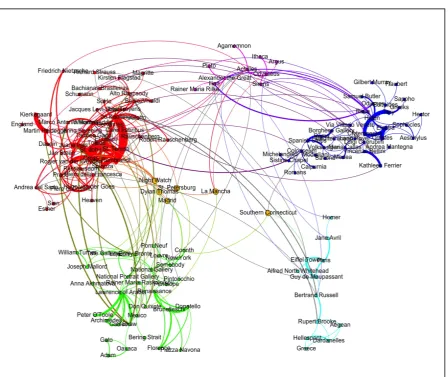
These five networks show Kate’s swirling, re-petitive thoughts about these entities when we define the association very tightly (i.e., same par-agraph mentions). They show a considerable amount of local coherence. However, if we wid-en the definition of “association” to one-paragraph further out, we find that all of these networks become inter-connected. Figure 6 shows the swirling complexity of the associations between all of the named entities as the more lo-cal networks get connected together. Note, again, that the width of the links in this network indicates repeated associations.
This wider definition of association shows that that the original in-paragraph networks are reinforced and expanded with new entities; though they still retain their identity as distinct networks. Figure 6 also shows that there are hub-like entities (e.g., Dylan Thomas, Nightwatch, La Mancha) that play a role in cross-connecting the in-paragraph networks; perhaps indicating that these entities are pivotal in Kate’s thinking (n.b., Markson claimed Dylan Thomas as a major in-fluence). Such hubs could be further elucidated by a pagerank analysis.
3
What Does it All Mean?
[image:4.595.362.480.107.307.2]We began this paper by proposing that Wallace’s close reading of WM could be complemented by a distant reading of the novel. We have shown that a text analytic and network analysis of the repeated mentions of people, places and things in the novel can reveal some definite structures. But, what does it all mean?
Figure 1: The Paris Network
Figure 2: The Homeric Network
[image:4.595.312.519.531.738.2]Figure 4: The Spanish Network
Figure 5: The Gallery Network
Wallace’s (1990) contention was that the repeti-tion in WM reflects Kate’s response to a Trac-tusized world; that she is endeavouring to con-nect things to establish a meaning that is absent. Our distant reading shows the obsessive persis-tence with which Kate pursues this attempt to connect; she appears to run over the same path of association again and again, hoping it becomes reinforced so that it persists as something “real”. This analysis is consistent with one of Wallace’s claims about Kate’s predicament:
…that Kate’s textual obsession is simply to find connections between things, any strands to bind the historical facts & empirical data that are all her world comprises. And always – necessarily – genuine connections elude her. All she can find is an occasional syn-chronicity: the fact that certain names are similar enough to be richly confusing -- Wil-liam Gaddis and Taddeo Gaddi – or that cer-tain lives & events happened to overlap in space & time. And these very thin connections turn out not to be ‘real’, features only of her imagination;
(Wallace, 1990, pp. 254-255)
If one examines the five disjoint networks (Fig-ures 1-5) one notable feature of them is how they are all only partly-thematic, as their themes are often upset by outliers. For instance, the Homer-ic network (Figure 2) has mostly HomerHomer-ic enti-ties, but then Alexander the Great and Plato are thrown in (people associated by place and race but not part of the Homeric tales). Similarly, the Spanish network (Figure 4) has a lot of Spanish-related nodes (e.g., Madrid, El Greco, Prada) but then it veers into outlier sub-networks involving European philosophers and American writers. These structures confirm Wallace’s proposition that Kate’s networks of repetition ultimately lack real coherence and meaning, beyond that which she tries to impose by obsessive repetition. In this way, we see this network analysis as provid-ing a highly complementary readprovid-ing to that of Wallace.
4
The DNA of a Novel
There is one outstanding question that is invited by the current analysis, though we do not have a complete answer to it. Namely, are there definite sequences in the references made to different networks in the novel? That is, is there a tenden-cy for a reference to one network to follow the reference to another, defining a type of higher-level DNA for the novel?
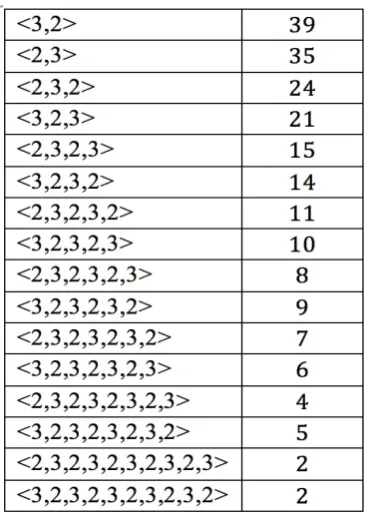
Figure 7 shows the paragraphs of the novel numbered from 1-3804 with each paragraph col-oured on the basis of whether it refers to the Ho-meric (pink, Figure 2) or Rome Networks (blue, Figure 3). It shows a number of interesting prop-erties: (i) these two networks dominate large parts of the novel, even though they are not the largest of the five found, (ii) there are definite sections of the novel where they dominate or fail to be referenced (i.e., the blank, white strips), (iii) references to them form definite banded sequenc-es. To verify the latter point we analysed the fre-quency of these two networks in sequences of different lengths. Table 3 shows that they tend to commonly follow one another, sometimes in quite long sequences.
Figure 6. The Network of Networks in Wittgenstein’s Mistress
Figure 7: Paragraphs Where the Homeric (pink) and Rome Networks (blue) Are Referenced
5
Conclusion
In this paper, we have considered the use of data analytics techniques to provide a distant reading of David Markson’s novel “Wittgenstein’s Mis-tress”. We have tried to address the role of repe-tition in the novel and to pursue evidence for proposals made by David Foster Wallace in his close reading of the text. In the round,
specifi-cally supporting patterns have been found in our analysis. Obviously, more could be done, in par-ticular perhaps around the exploration of the re-peating references to networks we have found; in this respect we are currently examining tech-niques in time-series analysis and sequence in-duction with this question in mind.
This analysis also invites comparative treat-ments of such associative references in other works that (i) are equally concise at the para-graph-level but which lack explicit repetition (e.g., Hemingway) or (ii) aim for similar stream-of-consciousness effects (e.g., Joyce). Such anal-yses could reveal new insights into repeated, as-sociative referencing in diverse literary works.
Acknowledgements
[image:6.595.73.291.502.630.2]Figure 8: Paragraphs Referencing Networks: (i) Paris (cyan), (ii) Homeric (pink), (iii) Rome
(blue), (iv) Spanish (red), (v) Gallery (green)
Table 3: Frequencies of Paragraph Sequences Referencing Homeric (2) & Rome Networks (3)
Reference
Agarwal Apoorv, Augusto Corvalan, Jacob Jensen, and Owen Rambow. 2012, June. Social network analysis of Alice in Wonderland. In Workshop on Computational Linguistics for Literature, pp. 88-96. 2012.
Coles Katharine, Meyer Miriah, Lein Julie Gonnering, McCurdy, Nina. 2014. Empowering Play, Experimenting with Poems: Disciplinary Values and Visualization Development. Proceedings of the Digital Humanities, 2014.
Elson David, Nicholas Dames, and Kathleen R. McKeown. 2010, July. Extracting social networks
from literary fiction. In Proceedings of the 48th annual meeting of the association for computational linguistics (pp. 138-147). Association for Computational Linguistics.
Grayson Siobhan, Wade Karen, Meaney Gerardine. and Greene Derek. 2016. May, The sense and sensibility of different sliding windows in constructing co-occurrence networks from literature. In Computational History and Data-Driven Humanities: 2nd IFIP WG 12.7 International Workshop, Dublin, Ireland, (pp. 65-77). Springer International Publishing.
Grayson, Siobhan, Wade, Karen, Meaney Gerardine, Rothwell Jennie, Mulvany Maria, and Greene Derek. 2016, May. Discovering structure in social networks of 19th century fiction. In 8th ACM Conference on Web Science (pp. 325-326). ACM. Jänicke, Stefan, Greta Franzini, Muhammad Faisal
Cheema, and Gerik Scheuermann.2015. On close and distant reading in digital humanities: A survey and future challenges. Proc. of EuroVis—STARs, pp.83-103.
Markson, David. 1988. Wittgenstein's mistress. Dalkey Archive Press. (Reproduced 1995 with afterword containing Wallace, 1990).
Moretti, Franco. 2005. Graphs, maps, trees: Abstract models for a literary history. Verso Books.
Moretti, Franco. 2013. Distant reading. Verso Books. Serlen, Rachel. 2010. The distant future? Literature
Compass, 7(3), pp.214-225.
[image:7.595.92.279.291.550.2]