Original Article
Effects of different
endometrial preparation on
birthweight of frozen-thawed embryo transfer
Jinli Ding*, Yi Zhang*, Tailang Yin, Jing Yang
Reproductive Medicine Center, Renmin Hospital of Wuhan University, Wuhan, Hubei Province, China. *Equal
con-tributors.
Received October 11, 2015; Accepted December 25, 2015; Epub July 15, 2016; Published July 30, 2016
Abstract: Purposes: To evaluate whether different endometrial preparation have an impact on neonatal birth weight of frozen-thawed embryo transfer. Methods: This was a retrospective study in a university teaching hospital in Wuhan, China from January, 2010 to March, 2013. A total of 528 women receiving frozen-thawed embryo transfer were included in the study, and they were divided into two groups according to the endometrial preparation, namely natural cycle and stimulated cycle. The newborn outcomes were investigated and compared. Results: There were no significant differences in gestational age, average birth weight, preterm birth rate, very preterm birth rate, low birth weight and very low birth weight between natural cycle and stimulated cycle of FET. Multiple linear regression analy-sis showed that birth weight was associated with gestational age, number of newborn and gender. Conclusions: Different endometrial preparation has no difference on neonatal birthweight, regardless of singletons or twins.
Keywords: Natural cycle, stimulated cycle, birthweight, gestational age
Introduction
Cryopreservation of embryos has been a well-established part of assisted reproduction tech-nology (ART) with increasing delivery rates and widely used in assisted reproduction center since frozen-thawed embryo transfer (FET) has been successfully performed during a natural cycle after spontaneous ovulation or stimulat-ed preparation of endometrium [1-6], which provides the possibility of further embryo trans-fers to achieve clinical pregnancy. FET plays an important role in improving cumulative preg-nancy rate and reducing ovarian hyperstimula-tion [6, 7].
Factors effecting the success rate of FET cycle include the quality of the frozen embryo, the stage of the embyro at freezing, the survival rate after thawing and the number of the embryo transferred, storage duration and the technique of the operator [8-12], and numer-ous studies have shown that freezing pro- gramme used, maternal age, fresh embryo or frozen embryo, chronic disease, smoking
sta-tus [10, 13-17] have great effects on birth
weight. A significant factor for implantation suc -cessfully and subsequent pregnancy outcome in FET was the synchronization between embryo development and endometrial maturation. The
influence of the number of implantation, embryo
culture and type of embryos transferred on peri-natal outcome have been reported by many authors. Differences exist in the pregnancy out-come of differernt endometrial preparation [18-21]. But whether different endometrial prepara-tion has various effects on birth weight or ges-tational age of FET? The aim of this retrospec-tive study was to evaluate the effects of differ-ent endometrial preparation on birth weight of FET. The hypothesis was that natural cycle was similar to stimulated cycle on the pregnancy outcomes.
Materials and methods
Study population
under-went the first FET at Renmin Hospital of Wuhan
University from January 2010 to March 2013, and obtained clinical pregnancy were recruited.
Clinical pregnancy was confirmed as gestation -al sac observation under the transvagin-al ultra-sonographic at 5 weeks. Among them, thirty-two patients were lost to follow-up, twenty-four patients were diagnosed hypertensive disor-ders in pregnancy, twenty were diabetes, twen-ty-four were ectopic pregnancy, one patient induced because of fetal congenital heart
dis-ease, and one hundred and fifteen women mis
-carried. Only five hundred and twenty-eight
women gave birth to singletons or twins suc-cessfully. The study protocol was approved by the Institutional Review Board of Renmin
Hospital of Wuhan University.
Treatment regimen
In this study, 0.1 mg/d GnRH-a was adminis -trated at the mid-luteal phase of the previous menstrual cycle, and ovarian stimulation was started 14 days later with a starting dose
vary-ing from 75 to 300 IU/day re-combinant FSH
according to patients’ ovarian reserve and age. 8 000~10 000 IU hCG was administered to
induce final oocyte maturation when there were
three or more larger follicle reached 18 mm in diameter. Oocyte retrieval was performed 36 hours later, and fertilization was conducted according to standard procedures [22]. Good-quality embryo transplantation was performed 3 days after oocyte retrieval, which was asse- ssed according to the Society for Assisted Reproductive Technology embryo grading sys-tem [23]. Surplus embryos of good quality were
cryopreserved by vitrification. The storage dura -Table 1. Demographic information of patients
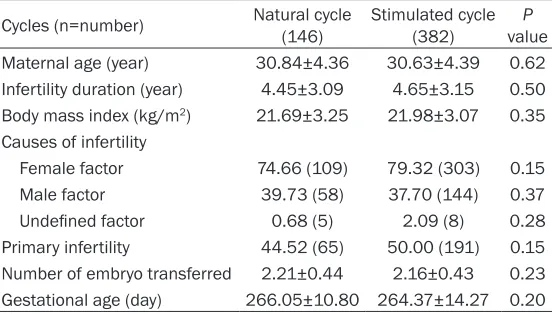
Cycles (n=number) Natural cycle (146) Stimulated cycle (382) valueP Maternal age (year) 30.84±4.36 30.63±4.39 0.62 Infertility duration (year) 4.45±3.09 4.65±3.15 0.50 Body mass index (kg/m2) 21.69±3.25 21.98±3.07 0.35
Causes of infertility
Female factor 74.66 (109) 79.32 (303) 0.15
Male factor 39.73 (58) 37.70 (144) 0.37
Undefined factor 0.68 (5) 2.09 (8) 0.28 Primary infertility 44.52 (65) 50.00 (191) 0.15 Number of embryo transferred 2.21±0.44 2.16±0.43 0.23 Gestational age (day) 266.05±10.80 264.37±14.27 0.20
in natural cycle. Patients were instructed to
monitor urine LH 10th day in their menstrua
-tion. When ovulation was confirmed, ultrasound scan was conducted to confirm ovulation and
endometrial development. Intramuscular injec-tion progesterone in oil 40 mg/d was adminis-tered for all patients 1 day after ovulation, FET was carried out 3 day after the start of proges-terone administration. Patients with irregular menstruation were chosen for the stimulated cycle. Estradiol valerate tablet (Progynova Bayer Schering Pharma, Guangzhou China) was commenced orally 2 mg/d from day 3 to day 5, 4 mg/d from day 6 to day 9 and 6 mg/d from day 10 to the day of the pregnancy test. Then, progesterone in oil was administered 40 mg/d
when the endometrial thickness ≥8 in millime -ter. Also, FET was carried out 3 day after the start of progesterone, and then progesterone in oil was commenced 60 mg/d until the day of the pregnancy test. 2~3 embryos were trans-ferred in each FET cycle depending on the num-ber of preceding cycles and maternal age. Outcome measures
The outcome of the study was gestational age and average birth weight. Preterm birth was birth < 37 weeks of gestation and very preterm birth < 32 weeks of gestation. Low birth weight
was defined as birth weight < 2500 g and very
low birth weight as < 1500 g. Statistical analysis
Statistical analysis was performed by Statistical Package for Social Sciences (SPSS) software. The basic information of patients and new-borns were compared by analysis of variables
tion of frozen-thawed embryo was less one year, and all were
the first time thawing. On the
day of FET, the embryos were thawed rapidly and then trans-ferred to culture medium. The
vitrification and thawing were
performed according to the
instruction (Vitrification Media
VT101, Thawing Media VT102, Kitazato BioPharma Co. Ltd., Shizuoka, Japan), as described previously [18].
[image:2.612.92.368.85.242.2](ANOVA) and categorical variables were
evalu-ated by χ2 tests. Multiple linear regression
anal-ysis was used to evaluate the association between different cycles and birthweight. Value of P < 0.05 was considered statistically signi-
ficant.
Results
[image:3.612.92.528.86.270.2]In the natural cycle group, 146 FET were includ-ed, and 382 FET were included in the stimulat-ed cycle group. The demographic data and
Table 2. Information of singletons
Natural cycle (104) Stimulated cycle (279) P value
Maternal age (year) 30.82±4.36 30.36±4.39 0.36
Infertility duration (year) 4.46±2.98 4.50±3.04 0.91
Body mass index (kg/m2) 21.61±3.13 21.94±3.02 0.35
Gestational age (days) 270.04±9.13 268.58±11.35 0.24
Boy (192) 268.56±10.38 (n=52) 267.30±12.16 (n=140) 0.51
Girl (191) 271.52±7.51 (n=52) 269.88±10.36 (n=139) 0.30
Birth weight 3413.65±443.54 3387.92±536.85 0.66
Boy 3431.15±510.13 3409.00±547.13 0.80
Girl 3396.15±369.40 3366.69±527.40 0.71
Preterm birth 5.77 (6) 8.24 (23) 0.28
Very preterm birth 0.00 (0) 0.72 (2) 0.53
Low birth weight 2.89 (3) 5.02 (14) 0.28
Very low birth weight 0.00 (0) 0.00 (0)
-Preterm: gestational age < 37 weeks; Very preterm: gestational age < 32 weeks; Low birth weight: birth weight < 2500 g; Very Low birth weight: birth weight < 1500 g.
infertility characteristics of both groups were
not significantly different (Table 1).
Data on singletons in terms of birth weight, ges-tational age of both natural cycle and stimulat-ed cycle was detailstimulat-ed in Table 2. There was no
significant difference in terms of maternal age,
body mass index and infertility duration. The preterm delivery rate was 7.57% (29/383), very preterm birth rate 0.52% (2/383) and low birth weight 4.44% (17/383). No very low birth weight was noticed in both group, and no very preterm Table 3. Information of twins
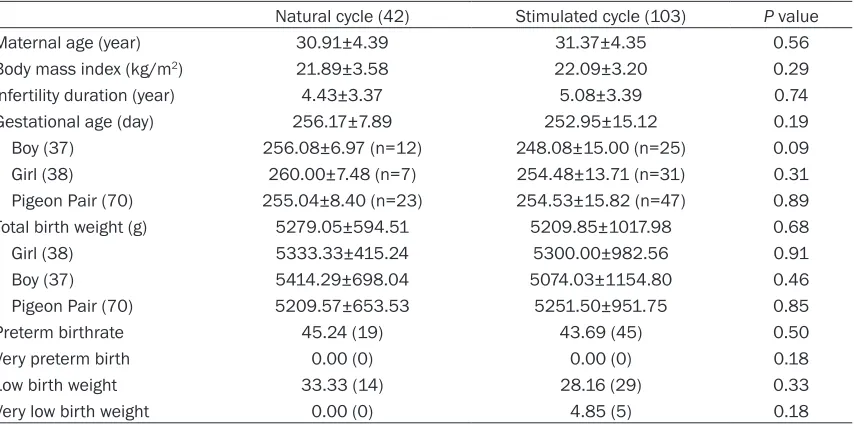
Natural cycle (42) Stimulated cycle (103) P value
Maternal age (year) 30.91±4.39 31.37±4.35 0.56
Body mass index (kg/m2) 21.89±3.58 22.09±3.20 0.29
Infertility duration (year) 4.43±3.37 5.08±3.39 0.74
Gestational age (day) 256.17±7.89 252.95±15.12 0.19
Boy (37) 256.08±6.97 (n=12) 248.08±15.00 (n=25) 0.09
Girl (38) 260.00±7.48 (n=7) 254.48±13.71 (n=31) 0.31
Pigeon Pair (70) 255.04±8.40 (n=23) 254.53±15.82 (n=47) 0.89
Total birth weight (g) 5279.05±594.51 5209.85±1017.98 0.68
Girl (38) 5333.33±415.24 5300.00±982.56 0.91
Boy (37) 5414.29±698.04 5074.03±1154.80 0.46
Pigeon Pair (70) 5209.57±653.53 5251.50±951.75 0.85
Preterm birthrate 45.24 (19) 43.69 (45) 0.50
Very preterm birth 0.00 (0) 0.00 (0) 0.18
Low birth weight 33.33 (14) 28.16 (29) 0.33
Very low birth weight 0.00 (0) 4.85 (5) 0.18
[image:3.612.96.523.326.538.2]birth was noticed in the natural cycle group in contrast to the stimulated cycle group (0.00% vs. 0.72%, P=0.53). The comparison of gesta-tional age (270.04±9.13 vs. 268.58±11.35, P=0.24), birth weight (3413.65±443.54 vs. 3387.92±536.85, P=0.66), preterm birth (5.77% vs. 8.24%, P=0.28) and low birth weight (2.89% vs. 5.02%, P=0.28) showed no statisti-cal difference between the two groups. The newborn sex ratio for all singletons was 192:191, although a trend of higher gestational
age for girls was observed, statistical signifi -cance was not reached (natural cycle, 268.56 ±10.38 vs. 271.52±7.51, P=0.098; stimulated cycle, 267.30±12.16 vs. 269.88±10.36, P=
0.058). No statistical significance was observed
in the birth weight between boys and girls (nat-ural cycle, 3431.15±510.13 vs. 3396.15± 369.40, P=0.689; stimulated cycle, 3409.00± 547.13 vs. 3366.69±527.40, P=0.511). Table 3 showed the information of twins. There
was no significant difference in terms of mater -nal age, body mass index and infertility dura-tion. The preterm delivery rate for twins was 44.14% (64/145), low birth weight 29.66% (43/145) and very low birth weight 3.45% (5/145). No very preterm birth was noticed in both group, and no very low birth weight was noticed in the natural cycle group in contrast to the stimulated cycle group (0.00% vs. 4.85%, P=0.18). When comparing the outcomes of
FET, we found no significant difference in total
birth weight, preterm birth rate, low birth weight between two groups. The newborn sex ratio for twins was 144:146 (boys group, 37; girls group, 38; pigeon Pairs group, 70), no statistical
sig-nificance was observed for gestational age (χ2=1.46, P=0.24) and birth weight (χ2=0.34,
P=0.71) between three groups.
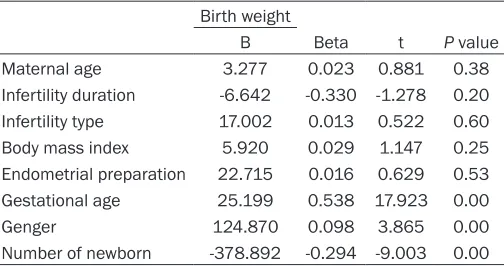
[image:4.612.92.344.84.217.2]Finally, multiple linear regression analysis was used to determine the relationship between birth weight and endometrial preparation cycle, maternal age, BMI, causes of infertil-ity, types of infertilinfertil-ity, gestational age and neonatal gender. As shown in Table 4, birth weight was associated with gestational age, number of new-born and gender.
Discussion
This restrospective study tested an idea regarding the effect of different Table 4. Multiple linear regression analysis
Birth weight
B Beta t P value
Maternal age 3.277 0.023 0.881 0.38
Infertility duration -6.642 -0.330 -1.278 0.20 Infertility type 17.002 0.013 0.522 0.60 Body mass index 5.920 0.029 1.147 0.25 Endometrial preparation 22.715 0.016 0.629 0.53 Gestational age 25.199 0.538 17.923 0.00
Genger 124.870 0.098 3.865 0.00
Number of newborn -378.892 -0.294 -9.003 0.00
endometrial preparation on the newborn out-comes. Our retrospective analysis showed that different endometrial preparation does not
sig-nificantly influence the neonatal birth weight after FET, and this finding was supported by
multiple linear analyses. To our knowledge, this
was the first study focused on the effect of
endometrial preparation on the newborn outcomes.
FET has become an effective way to improve pregnancy outcome, avoiding the presence of
severe OHSS and reducing the cost of ART since it was first reported in 1983. Protocols for
endometrial preparation in FET include the nat-ural cycle and the stimlated cycle. There has been controversy regarding the effect of differ-ent endometrial preparation on pregnancy out-come [18-20]. The natural cycle is a simple and cost-effective protocol for FET for women with regular and ovulatory cycles, but it is tedious to monitor the endometrium to detect the onset of
In our study, multiple linear regression analysis showed that birth weight was associated with the number of newborn, which was in line with accumulating reports showing that a multiple pregnancy is regarded to be one of the factors leading to preterm birth as well as to low birth weight [9, 24-26]. Our results also showed that the pregnancy length was associated with birth weight, which was consistent with earlier stud-ies that preterm birth increased the the risk of low birth weight [27, 28]. ART newborns are reported to have an increased risk of being small for gestational age, preterm birth and low birth weight [24, 25]. In this study, the rates of low birth weight were 4.44% for singletons and 29.66% for twins (P=0.00), and the rates of preterm birth were 7.57% (29/383) for single-tons and 44.14% (64/145) for twins (P=0.00), these outcomes were similar to the results from earlier studies [17, 24, 25]. The total rate of low birth weight was 15.89% (107/673), which was similar to 15.5% of all birth infants worldwide [29].
It was important to adjust the absolute birth weight at least for gestational age and newborn gender when reporting birth weight, and, some confounding factors should be considered, including maternal age, duration and cause of infertility, maternal smoking [13, 16, 17]. Chronic diseases, such as hypertensive disor-ders and diabetes, had been shown to be relat-ed with birth weight, which may affect fetal development, and be associated with reduced fetal growth [15, 30], so, we eliminated these patients in our study. Smoking during pregnan-cy was related to infant birth weight. Few women smoke in the People’s Republic of China, especially during pregnancy, so smoking history was not included in our analysis. No statistical difference was observed in the birth weight of different gender in singletons or twins, when ignoring singletons or twins, a trend of higher birth weight for boys was observed (3092.23±630.09 vs. 3002.63± 626.04, P=0.063) (date was not shown in the table), and the multiple linear regression analy-sis showed that gender was associated with birth weight (P=0.00).
According to Nelson et al, a higher maternal age increased the risk of low birth weight [13], our study showed that there was no correlation between maternal age and birth weight, which
was similar to the results with earlier study [31]. It was probably because pregnant women fol-lowing ART treatment were motivated to reduce daily activity, which contributing to a decrease in the rate of low birth weight in older women [31].
A meta-analysis revealed no significant differ
-ence of one specific approach to prepare the
endometrium for FET in terms of clinical preg-nancy rates or live birth rates [21], and our results showed that there was no differerce for different endometrial preparation on the
new-born outcomes. Since no significant difference
in the pregnancy rate and newborn outcomes was found, the choice for either stimulated cycle or natural cycle in FET should be made based on other factors, such as doctor or patient preference, side-effects of medication, the number of FET, the endometrial environ-ment and the number of canceled cycles. The main limitation of this study was the absence of the long-term follow-up data of new- borns and the limited sample size. So, long-term and more large sample researches were needed.
In conclusion, neonatal birth weight is not influ -enced by the different endometrial preparation
included in our study. However, the influence of
different endometrial preparation on the new-born outcomes still needs further exploration. Acknowledgements
This study was supported by the National Na- tural Science Foundation of China (No. 8140- 1276) and the Fund Project of health and fa-
mily planning commission of Hubei province
(WJ2015MA006).
Disclosure of conflict of interest
None.
Address correspondence to: Jing Yang, Reproduc- tive Medicine Center, Renmin Hospital of Wuhan University, Wuhan, Hubei Province, China. E-mail: [email protected]
References
prepa-ration of the endometrium with exogenous steroids for the transfer of frozen-thawed pre-embryos in patients with anovulatory or irregu-lar cycles. Hum Reprod 1991; 6: 443-445. [2] Cohen J, DeVane GW, Elsner CW, Kort HI,
Massey JB, Norbury SE. Cryopreserved zygotes and embryos and endocrinologic factors in the replacement cycle. Fertil Steril 1988; 50: 61-67.
[3] Schmidt CL, de Ziegler D, Gagliardi CL, Mellon RW, Taney FH, Kuhar MJ, Colon JM, Weiss G. Transfer of cryopreserved-thawed embryos: the natural cycle versus controlled preparation of the endometrium with gonadotropin-releas-ing hormone agonist and exogenous estradiol and progesterone (GEEP). Fertil Steril 1989; 52: 609-616.
[4] Barfield WD. Assisted reproductive technology surveillance-United States. MMWR Surveill Summ 2012; 61: 1-23.
[5] Ferraretti AP, Goossens V, de Mouzon J, Bhat-tacharya S, Castilla JA, Korsak V, Kupka M, Nygren KG, Nyboe Andersen A; European IVF-monitoring (EIM); Consortium for Europe-an Society of HumEurope-an Reproduction Europe-and Em -bryology (ESHRE). Assisted reproductive tech -nology in Europe, 2008: results generated from European registers by ESHRE. Hum Re -prod 2012; 27: 2571-2584.
[6] AlamaP, MeloMA, GarciaG, et al. Higher ongo -ing pregnancy rates in blastocyst transfer of frozen-thawed embryos in natural cycles than in hormone replacement therapy cycles. Fertil Steril 2007; 88: 161.
[7] Eftekhar M, Aflatoonian A, Mohammadian F, Tabibnejad N. Transfer of blastocysts derived from frozen-thawed cleavage stage embryos improved ongoing pregnancy. Arch Gynecol Ob-stet 2012; 286: 511-516.
[8] Yeung WS, Li RH, Cheung TM, Ng EH, Lau EY, Ho PC. Frozen-thawed embryo transfer cycles. Hong Kong Med J 2009; 15: 420-426. [9] Ashrafi M, Jahangiri N, Hassani F, Akhoond
MR, Madani T. The factors affecting the out- come of frozen-thawed embryo transfer cycl. Taiwan J Obstet Gynecol 2011; 50: 159-164. [10] Liu SY, Teng B, Fu J, Li X, Zheng Y, Sun XX.
Ob-stetric and neonatal outcomes after transfer of vitrified early cleavage embryos. Hum Reprod 2013; 28: 2093-100.
[11] Salumets A, Tuuri T, Mäkinen S, Vilska S, Husu L, Tainio R, Suikkari AM. Effect of developmen- tal stage of embryo at freezing on pregnancy outcome of frozen-thawed embryo transfer. Hum Reprod 2003; 189: 1890-1895.
[12] Noyes N, Reh A, McCaffrey C, Tan O, Krey L. Impact of developmental stage at cryopreser-vation and transfer on clinical outcome of fro-zen embryo cycles. Reprod Biomed Online 2009; 19 Suppl 3: 9-15.
[13] Nelson SM, Lawlor DA. Predicting live birth, preterm delivery, and low birth weight in in-fants born from in vitro fertilisation: a prospe- ctive study of 144,018 treatment cycles. PLoS Med 2011; 8: e1000386.
[14] Henningsen AK, Pinborg A, Lidegaard Ø, Vestergaard C, Forman JL, Andersen AN. Peri-natal outcome of singleton siblings born after assisted reproductive technology and sponta-neous conception: Danish national sibling-co-hort study. Fertil Steril 2011; 95: 959-963. [15] Harvey NC, Poole JR, Javaid MK, Dennison EM,
Robinson S, Inskip HM, Godfrey KM, Cooper C, Sayer AA; SWS Study Group. Parental determi-nants of neonatal body composition. J Clin En-docrinol Metab 2007; 92: 523-526.
[16] De Vos A, Janssens R, Van de Velde H, Haentjens P, Bonduelle M, Tournaye H, Verhey -en G. The type of culture medium and the du-ration of in vitro culture do not influence birth -weight of ART singletons. Hum Reprod 2015; 30: 20-27.
[17] Nelissen EC, Van Montfoort AP, Coonen E, Der-haag JG, Geraedts JP, Smits LJ, Land JA, Evers JL, Dumoulin JC. Further evidence that culture media affect perinatal outcome: findings after transfer of fresh and cryopreserved embryos. Hum Reprod 2012; 27: 1966-1976.
[18] Xiao Z, Zhou X, Xu W, Yang J, Xie Q. Natural cycle is superior to hormone replacement therapy cycle for vitrificated-preserved frozen-thawed embryo transfer. Syst Biol Reprod Med 2012; 58: 107-112.
[19] Givens CR, Markun LC, Ryan IP, Chenette PE, Herbert CM, Schriock ED. Outcomes of natural cycles versus progragmmed cycles for 1677 frozen-thawed embryo transfers. Reprod Biomed Online 2009; 19: 380-384.
[20] Sathanandan M, Macnamee MC, Rainsbury P, Wick K, Brinsden P, Edwards RG. Replacement of frozen-thawed embryos in anificial and natu -ral cycles: a prospective semi-randomized study. Hum Reprod 1991; 6: 685-687.
[21] Groenewoud ER, Cantineau AE, Kollen BJ, Macklon NS, Cohlen BJ. What is the optimal means of preparing the endometrium in fro-zen-thawed embryo transfer cycles? A system-aticreview and meta-analysis. Hum Reprod Update 2013; 19: 458-70.
[22] Kastrop PM, Weima SM, Van Kooij RJ, Te Velde ER. Comparison between intracytoplasmic sperm injection and in vitro fertilization (IVF) with high insemination concentration after to-tal fertilization failure in a previous IVF at-tempt. Hum Reprod 1999; 14: 65-69.
[24] Pinborg A, Loft A, Rasmussen S, Schmidt L, Langhoff-Roos J, Greisen G, Andersen AN. Neonatal outcome in a Danish national cohort of 3438 IVF/ICSI and 10,362 nonIVF/ICSI twins born between 1995 and 2000. Hum Re -prod 2004; 19: 435-441.
[25] Pinborg A, Loft A, Nyboe Andersen A. Neonatal outcome in a Danish national cohort of 8602 children born after in vitro fertilization or intra- cytoplasmic sperm injection: the role of twin pregnancy. Acta Obstet Gynecol Scand 2004; 83: 1071-1078.
[26] Sazonova A, Källen K, Thurin-Kjellberg A, Wennerholm UB, Bergh C. Factors affecting obstetric outcome of singletons born after IVF. Hum Reprod 2011; 26: 2878-2886.
[27] Goldenberg RL, Culhane JF, Iams JD, Romero R. Epidemiology and causes of preterm birth. Lancet 2008; 371: 75-84.
[28] Chaman R, Amiri M, Raei M, Ajami ME, Sade-ghian A, Khosravi A. Low Birth Weight and Its Related Risk Factors in Northeast Iran. Iran J Pediatr 2013; 23: 701.
[29] Low Birth weight: Country, regional and global estimates. UNICEF, 2004.
[30] Chang HY, Keyes KM, Lee KS, Choi IA, Kim SJ, Kim KW, Shin YH, Ahn KM, Hong SJ, Shin YJ. Prenatal maternal depression is associated with low birth weight through shorter gesta-tional age in term infants in Korea. Early Hum Dev 2014; 90: 15-20.