RNN for Affects at SemEval-2018 Task 1: Formulating Affect
Identification as a Binary Classification Problem
Aysu Ezen-Can SAS Inst.
Ethem F. Can SAS Inst.
Abstract
Written communication lacks the multimodal features such as posture, gesture and gaze that make it easy to model affective states. Espe-cially in social media such as Twitter, due to the space constraints, the sources of informa-tion that can be mined are even more limited due to character limitations. These limitations constitute a challenge for understanding short social media posts.
In this paper, we present an approach that uti-lizes multiple binary classifiers that represent different affective categories to model Twit-ter posts (e.g., tweets). We train domain-independent recurrent neural network models without any outside information such as af-fect lexicons. We then use these domain-independent binary ranking models to eval-uate the applicability of such deep learning models on the affect identification task. This approach allows different model architectures and parameter settings for each affect cate-gory instead of building one single multi-label classifier. The contributions of this paper are two-folds: we show that modeling tweets with a small training set is possible with the use of RNNs and we also prove that formulating affect identification as a binary classification task is highly effective.
1 Introduction
Social media platforms allow users to share infor-mation, communicate with other users, learn about new products, and get latest news. The impor-tance of social media data is getting larger every day as social media usage grows every year ( Dug-gan,2015). Twitter is one such social media plat-form where users can write short posts as well as share links. Twitter is also used for getting news (Center,2017).
A large body of research has been conducted using Twitter data including analyzing user
inten-tions (Java et al.,2007), determining influence of users (Romero et al., 2011), predicting retweet counts (Can et al.,2013), classifying sentiments of tweets (Jansen et al., 2009;Agarwal et al.,2011;
Neethu and Rajasree, 2013; Kontopoulos et al.,
2013; Pak and Paroubek, 2010). All of these studies have one goal in common: understand-ing/modeling information diffuse in Twitter.
One aspect of modeling social media posts is focusing on emotional states of users. There has been plenty of efforts on determining affective states (Schwarz and Clore,1983) and their effects to human behavior for different domains from ed-ucation (Sidney et al.,2005) to health care (Lisetti et al., 2003). For Twitter, this problem is even more challenging as the information source is lim-ited to the number of characters allowed in a single post and multimodal features (e.g., posture, ges-ture, and eye gaze) are not available.
In this paper, we formulate affect identification task as a binary classification problem and investi-gate the applicability and effectiveness of domain-independent deep learning models as well as fea-tures. Our dataset includes eleven affect categories (i.e., anger, anticipation, disgust, fear, joy, love, optimism, pessimism, sadness, surprise, and trust) for each tweet. The presence of one affect cat-egory in a tweet does not stop another catcat-egory to be present (e.g., joy and optimisim can both be present in a tweet). We represent each affect cat-egory as one class and build binary classifiers for each class. Recurrent neural networks are trained for each affect category and no domain-dependent features such as affect lexicons are used. Our goal is to evaluate a generic model for different affec-tive states.
Binary models have been successfully applied to several applications including action recog-nition in videos (Can and Manmatha, 2013), prediction of whether or not a tweet will be
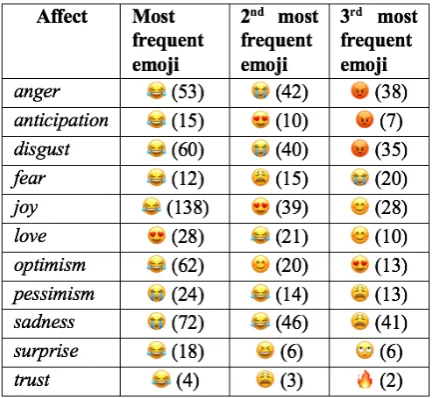
Figure 1: Most frequently used emojis and their counts for each affect category.
retweeted (Hong et al., 2011), and topic classi-fication (Joachims, 1998). In this paper, we de-scribe our approach for affect recognition of En-glish tweets (Task E-c: Detecting Emotions), a subcategory of Task 1 in the SemEval 2018 chal-lenge (Mohammad et al.,2018).
2 Corpus
In this paper, we use English tweets that have been annotated by affect categories (Mohammad et al.,
2018). The dataset contains emojis, hashtags, and the textual content of tweets; however, it does not have user ids. The training, validation, and test splits are done by the task organizers. Figure 1
shows top three mostly used emojis in each class and their frequencies for the training set.
2.1 Breakdown of Emojis to Classes
Due to the importance of visual cues in predicting affective states, we pay attention to a form of vi-sual cues: emojis. Here we present some of our findings based on different affect categories.
• Trust: emojis are not frequently used. Not easy to determine through emojis.
• Sadness: The sobbing face emoji is expect-edly the most common one but interestingly laughing with joy emoji is the second most common. Weary face emoji is also very com-mon in sadness: 56.16% of all weary face emojis are used in this class.
• Anger anddisgust share the same property: the most common emoji is the laughing with joy emoji and the second most common is sobbing face emoji. The fact that a joy emoji being the most commonly used in these af-fective classes is quite interesting and can in-dicate irony. The third most common emoji in these two classes are also the same: rage emoji.
• An emoji that can be intuitively associated with love (heart eyes) actually occurs more injoytweets thanlovetweets.
• An unexpected finding is on fire emoji where
joyandoptimismclasses have a large portion of all fire emojis in the training set (46.7% and 36.7% respectively).
• The affective class that uses most emojis is joy.
3 Methodology
Since each tweet in the data contains eleven af-fect categories (i.e., anger, anticipation, disgust, fear, joy, love, optimism, pessimism, sadness, sur-prise, and trust), we created eleven datasets with the same tweets but with different class informa-tion. For example, the first dataset has one values (i.e., positive) for tweets that show anger and zero (i.e., negative) for those that do not have anger. Other datasets are created in the same way for the remaining affects classes. By building one model for each affect category, we formulated af-fect identification problem as a binary classifica-tion task. Then in testing time, we obtained pre-dictions from every specific model and fused the results to obtain a unique result for each tweet. 3.1 Training Binary Classification Models The advantage of using binary classification mod-els for each affect category is that each model can be trained by itself, enabling different model ar-chitectures and parameters. For example, while one category may benefit from a deeper model, the other affect category can obtain the best results with a shallower model. In this way, the models do not have to be the same for each affect class.
3.2 Model Architecture
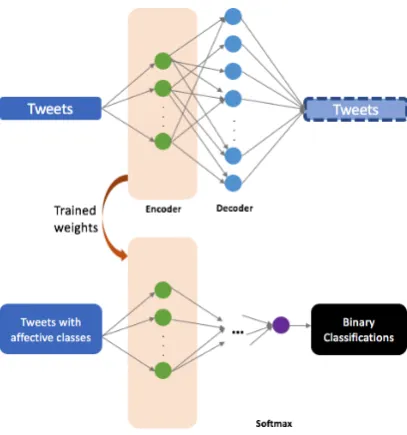
Figure 2: Using the unlabeled tweets for training an auto-encoder and using the trained weights for the af-fect classification process.
which are bi-directional. To be able to build a more generalized model, a dropout of 0.2 is used in each layer. Each bidirectional layer contains 100 neurons and the final encoding layer has 50 neurons.
3.3 Training Auto-Encoder
Because the dataset is not very big, we wanted the classifiers to learn as much information as possi-ble without overfitting it. Therefore, we built an auto-encoder from the tweets’ content (e.g., un-labeled tweets, no affect categories). The goal of the auto-encoder is to get weights that can be used in the classifiers. As shown in Figure 2, we used the trained weights from the auto-encoder to start building binary classifiers. To convert a text-generating auto-encoder into a classifier, we added a softmax layer.
3.4 Features
For modeling affect categories in tweets, we use only the words and emojis. No domain-dependent features, or features that are aware of task in hand (e.g., affect lexicons) are used as our goal is to de-termine how well a generic RNN model can per-form for affect recognition task.
3.4.1 Emojis
To represent emojis as embeddings, we used the pre-trained embeddings from the emoji2vec pack-age (Eisner et al.,2016).
3.4.2 Word Embeddings
For this study, an embedding length of 200 is used. We utilized pre-trained global vectors trained on tweets (Pennington et al.,2014)
3.4.3 Hashtags
Hashtags have a lot of semantic information about the tweets. However, most of that information is neglected if the hashtags cannot be found in the words embeddings. Therefore, we followed a greedy approach for dividing hashtags into their corresponding words.
Once the # is removed, we take the content of the hashtag and search if the content is present in the vocabulary as its entirety. If vocabulary has the hastag content, we use it. If not, more processing is done. Starting from the beggining of the word we keep a pointer, searching for a valid word that from index=0 to index=pointer. Once 0,j indices represent a substring that is a valid word, we con-tinue the recursive search for the rest of the content (i.e., j+1 to the end of the string). The words that are found are added to the list of words that rep-resent the hashtag. Then we use those words and represent them as embeddings.
Because this approach is greedily finding the shortest possible words contained within the hash-tag, it is not guaranteed to represent the correct semantics all the time. For example, the #feel-sadforyou is correctly divided to [‘feel’,“sad’, ‘for’, ‘you’], however, #toniteinasheville (‘tonite in asheville”) becomes [‘tonite’, ‘in’, ‘as’, ‘he’, ‘ville’], which is not correct. Achieving perfect se-mantics would require human labeling, therefore, we used the greedy approach and have observed that utilizing hash tag contents significantly im-proves the effectiveness of the models.
3.5 Results on Validation Set
The accuracies of binary classification models for each affect category are presented in Figure 3. We compare the models’ performances with majority baselines where the percentage of the class value that occurs most is taken as the majority baseline for each class.
4 Results
Figure 3: Accuracies per affect category. Majority baseline of each class is compared to the performance of the RNN classifier for that class.
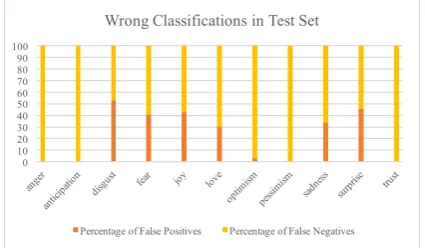
Figure 4: The distribution of false positives and false negatives for observations that are classified incorrectly in the test set.
4.1 Experimental Results
For all of our experiments, we used SAS Deep Learning Toolkit. We utilized an environment with 4 workers, with 24 threads in each worker, and mini-batch size per thread on each worker was 6. Adam optimizer is used in all experiments.
Using the test set, the proposed model achieved a 0.398 accuracy, 0.539 micro-avg F1, and 0.358 macro-avg F1. A random baseline achieves 0.185 accuracy, 0.307 micro-avg F1, and 0.285 macro-avg F1. Compared to the random baseline, the generic RNN model is quite successful at identi-fying affect categories.
4.2 Discussion
Some of the affect categories have very few posi-tive examples, therefore it is very difficult for clas-sifiers to learn nuances of those affects. For exam-ple, surprise and trust categories have 96.05% and 95.15% majority baselines respectively. In other words, only 4-5% of all training set observations have these affect categories as true.
As can be seen in Figure 4, when the num-ber of positive observations are limited, the clas-sifiers tend to make more false negatives. For af-fect categories that have a major class value that is dominant, we experimented with sampling as well where the number of positive and negative examples were equal. However, that made the dataset significantly smaller, further making it dif-ficult for the RNN models to learn distinctions. Rather than using smaller datasets or including external data, we prefer to employ binary mod-els. One of the main advantages of using binary models over multi-label models is to better deal with the uneven distribution of positive examples across classes.
5 Conclusion
Affect identification without visual cues is a chal-lenging task, making the text as the only source of information that can be used for machine learning models. This problem gets more challenging as the text data gets limited by the number of charac-ters in Twitter.
[image:4.595.75.288.271.395.2]References
Apoorv Agarwal, Boyi Xie, Ilia Vovsha, Owen Ram-bow, and Rebecca Passonneau. 2011. Sentiment analysis of twitter data. InProceedings of the work-shop on languages in social media, pages 30–38. Association for Computational Linguistics.
Ethem F Can and R Manmatha. 2013. Formulating action recognition as a ranking problem. In Com-puter Vision and Pattern Recognition Workshops (CVPRW), 2013 IEEE Conference on, pages 251– 256. IEEE.
Ethem F. Can, H¨useyin Oktay, and R. Manmatha. 2013.
Predicting retweet count using visual cues. In Pro-ceedings of the 22Nd ACM International Conference on Information & Knowledge Management, CIKM ’13, pages 1481–1484, New York, NY, USA. ACM.
Pew Research Center. 2017. News use across social media platforms 2017.
Maeve Duggan. 2015. Mobile messaging and social media. Pew Research Center.
Ben Eisner, Tim Rockt¨aschel, Isabelle Augenstein, Matko Boˇsnjak, and Sebastian Riedel. 2016. emoji2vec: Learning emoji representations from their description. arXiv preprint arXiv:1609.08359.
Liangjie Hong, Ovidiu Dan, and Brian D. Davison. 2011. Predicting popular messages in twitter. In
Proceedings of the 20th International Conference Companion on World Wide Web, WWW ’11, pages 57–58, New York, NY, USA. ACM.
Bernard J Jansen, Mimi Zhang, Kate Sobel, and Abdur Chowdury. 2009. Twitter power: Tweets as elec-tronic word of mouth. Journal of the Association for Information Science and Technology, 60(11):2169– 2188.
Akshay Java, Xiaodan Song, Tim Finin, and Belle Tseng. 2007. Why we twitter: understanding mi-croblogging usage and communities. In Proceed-ings of the 9th WebKDD and 1st SNA-KDD 2007 workshop on Web mining and social network analy-sis, pages 56–65. ACM.
Thorsten Joachims. 1998. Text categorization with support vector machines: Learning with many rel-evant features. InEuropean conference on machine learning, pages 137–142. Springer.
Efstratios Kontopoulos, Christos Berberidis, The-ologos Dergiades, and Nick Bassiliades. 2013. Ontology-based sentiment analysis of twitter posts.
Expert systems with applications, 40(10):4065– 4074.
Christina Lisetti, Fatma Nasoz, Cynthia LeRouge, Onur Ozyer, and Kaye Alvarez. 2003. Developing multimodal intelligent affective interfaces for tele-home health care. International Journal of Human-Computer Studies, 59(1-2):245–255.
Saif M. Mohammad, Felipe Bravo-Marquez, Mo-hammad Salameh, and Svetlana Kiritchenko. 2018. Semeval-2018 Task 1: Affect in tweets. In Proceed-ings of International Workshop on Semantic Evalu-ation (SemEval-2018), New Orleans, LA, USA. MS Neethu and R Rajasree. 2013. Sentiment
analy-sis in twitter using machine learning techniques. In
Computing, Communications and Networking Tech-nologies (ICCCNT), 2013 Fourth International Con-ference on, pages 1–5. IEEE.
Alexander Pak and Patrick Paroubek. 2010. Twitter as a corpus for sentiment analysis and opinion mining. InLREc, volume 10.
Jeffrey Pennington, Richard Socher, and Christo-pher D. Manning. 2014. Glove: Global vectors for word representation. InEmpirical Methods in Nat-ural Language Processing (EMNLP), pages 1532– 1543.
Daniel M Romero, Wojciech Galuba, Sitaram Asur, and Bernardo A Huberman. 2011. Influence and passivity in social media. InJoint European Con-ference on Machine Learning and Knowledge Dis-covery in Databases, pages 18–33. Springer.
Norbert Schwarz and Gerald L Clore. 1983. Mood, misattribution, and judgments of well-being: Infor-mative and directive functions of affective states.
Journal of personality and social psychology, 45(3):513.