Attention-Based Convolutional Neural Network
for Machine Comprehension
Wenpeng Yin, Sebastian Ebert, Hinrich Sch¨utze LMU Munich, Germany
wenpeng, [email protected]
Abstract
Understanding open-domain text is one of the primary challenges in NLP. Machine com-prehension benchmarks evaluate a system’s ability to understand text based on the text content only. In this work, we investi-gate machine comprehension on MCTest, a question answering (QA) benchmark. Prior work is mainly based on feature engineer-ing approaches. We come up with a neu-ral network framework, named hierarchical attention-based convolutional neural network (HABCNN), to address this task without any manually designed features. Specifically, we explore HABCNN for this task by two routes, one is through traditional joint mod-eling of document, question and answer, one is through textual entailment. HABCNN em-ploys an attention mechanism to detect key phrases, key sentences and key snippets that are relevant to answering the question. Exper-iments show that HABCNN outperforms prior deep learning approaches by a big margin.
1 Introduction
Machine comprehension is an open-domain question-answering problem which contains factoid questions, but the answers can be derived by extrac-tion or inducextrac-tion of key clues. Figure 1 shows one example in MCTest (Richardson et al., 2013). Each example consists of one document, four associated questions; each question is followed by four answer candidates of which only one is correct. Questions in MCTest have two categories; “one” questions can be answered based on a single sentence from doc-ument where “multiple” questions require several
Figure 1:One example with 2 out of 4 questions in the MCTest. “*” marks correct answer.
sentences. To correctly answer the first question in the example, the two blue sentences are required; for the second question instead, we only need the red sentence. The following observations hold for the whole MCTest. (i) Most of the sentences in the document are irrelevant for a given question. It hints that we need to pay attention to just some key regions. (ii) Answer candidates vary in length and abstraction level and usually do not appear in the document. For example, candidate B for the second question is “outside”, which is one word and does not exist in the document, while the answer candidates for the first question are longer texts with some auxiliary words like “Because” in the text. This requires our system to handle flexible texts via extraction as well as abstraction. (iii) Some questions require multiple sentences to infer the answer, and those vital sentences mostly appear close to each other (we call themsnippet). Hence, our system should be able to make a choice or compromise between potential single-sentence clue
and snippet clue.
Prior work is mostly based on feature engineering. We take the lead in presenting a deep neural network without linguistic feature engineering.
Concretely, we propose HABCNN, a hierarchical attention-based convolutional neural network, to ad-dress this task in two roadmaps. In the first one, we project the document in two different ways, one based on question-attention, one based on answer-attention and then compare the two projected doc-ument representations to determine whether the an-swer matches the question. In the second one, every question-answer pair is reformatted into a statement, then the whole task reduces to textual entailment.
In both roadmaps, convolutional neural network (CNN) is explored to model all types of text. As human beings usually do for such a QA task, our model is expected to be able to detect the key snip-pets, key sentences, and key words or phrases in the document. In order to detect those informative parts required by questions, we explore an attention mechanism to model the document so that in its rep-resentation the required information is emphasized. In practice, instead of imitating human beings in QA task top-down, our system models the document bottom-up, through accumulating the most relevant information from word level to snippet level.
Our approach is novel in three aspects. (i) A doc-ument is modeled by a hierarchical CNN for differ-ent granularity, from word to sdiffer-entence level, then from sentence to snippet level. (ii) In the exam-ple in Figure 1, apparently not all sentences are re-quired given a question, and usually different snip-pets are required by different questions. Hence, the same document should have different represen-tations based on what the question is. To this end, at-tention is incorporated into the hierarchical CNN to guide the learning of dynamic document representa-tions which closely match the information require-ments by questions. (iii) Document representations at sentence and snippet levels both are informative for the question. Therefore a highway network is developed to combine them, enabling our system to make a flexible tradeoff.
[image:2.612.347.504.57.168.2]Overall, we make three contributions. (i) We present a hierarchical attention-based CNN system “HABCNN”. It is, to our knowledge, the first deep learning (DL) based system for this MCTest task.
Figure 2:Illustrations of HABCNN-QAP (top), HABCHH-QP (middle) and HABCNN-TE (bottom). Q, A, S: question, an-swer, statement; D: document
(ii) Prior document modeling systems based on deep neural networks mostly generate generic representa-tion, this work is the first to incorporate attention so that document representation is biased towards the question requirement. (iii) Our HABCNN systems outperform other DL competitors by big margins.
2 Related Work
Existing systems for MCTest are mostly based on manually engineered features, e.g., (Narasimhan and Barzilay, 2015; Sachan et al., 2015; Wang et al., 2015; Smith et al., 2015). In these works, a common route is first to define a loss function based on fea-ture vectors, then the effort focuses on designing ef-fective features based on various rules. Even though this research is groundbreaking for this task, its flex-ibility and capacity for generalization is limited.
DL approaches appeal to increasing interest in analogous tasks. Weston et al., (2015b) introduce memory networks for factoid QA. Memory network framework is extended in (Weston et al., 2015a; Ku-mar et al., 2016) for Facebook bAbI dataset. Peng et al. (2015)’s Neural Reasoner infers over multiple supporting facts to generate an entity answer for a given question and it is also tested on bAbI. All of this work deals with short texts with simple gram-mar, aiming togeneratean answer that is restricted to be one word denoting a location, a person etc.
There is also work on other kinds of QA, e.g., (Iyyer et al., 2014; Hermann et al., 2015). Overall, for open-domain MCTest machine comprehension task, we are the first to use deep neural networks.
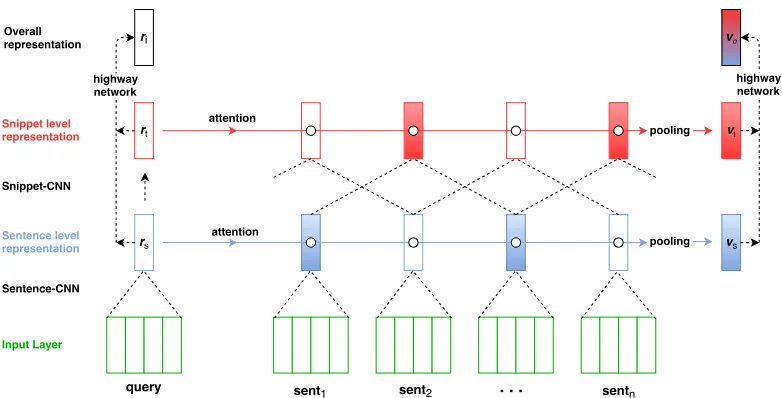
Figure 3:HABCNN. Feature maps for phrase representationspiand the max pooling steps that create sentence representations out of phrase representations are omitted for simplification. Each snippet covers three sentences in snippet-CNN. Symbols◦mean cosine similarity calculation.
Trischler et al. (2016) achieve better performance than HABCNN, but they still use linguistically engi-neered features like Stanford dependencies whereas our approach is more truly end-to-end.
3 Model
We investigate this task by three approaches, illus-trated in Figure 2. (i) We can compute two different document (D) representations in a common space, one based on question (Q) attention, one based on answer (A) attention, and compare them. This ar-chitecture is named HABCNN-QAP (“QAP” means projecting D based on Q and A). (ii) We compute a representation of D based on Q attention (as before), but now we compare it directly with a representa-tion of A. We name this architecture HABCNN-QP. (iii) We treat this QA task as textual entailment (TE), first reformatting Q-A pair into a statement (S), then matching S and D directly. This architecture we name HABCNN-TE. All three approaches are im-plemented in the common framework HABCNN.
3.1 HABCNN
Recall that we use the abbreviations A (answer), Q (question), S (statement), D (document). HABCNN performs representation learning for triple (Q, A, D) in HABCNN-QP and HABCNN-QAP, for tuple (S, D) in HABCNN-TE. For convenience, we use “query” to refer to Q, A, or S uniformly. HABCNN,
depicted in Figure 3, has the following phases. Input Layer. The input is (query, D). Query is two individual sentences (for Q, A) or one sin-gle sentence (for S), D is a sequence of sentences. Words are initialized byd-dimensional pre-trained word embeddings. As a result, each sentence is represented as a feature map with dimensionality of d×s(sis sentence length). In Figure 3, each sen-tence in the input layer is depicted by a rectangle with multiple columns.
Sentence-CNN is used for sentence representa-tion learning from word level. Given a sentence of length swith a word sequence: v1, v2, . . . , vs, let
vectorci ∈Rwdbe the concatenated embeddings of
wwordsvi−w+1, . . . , viwherewis the filter width,
dis the dimensionality of word representations and
0< i < s+w. Embeddings for wordsvi,i <1and
i > s, are zero padding. We then generate the rep-resentationpi ∈Rd1 for thephrasevi−w+1, . . . , vi
using the convolution weightsW∈Rd1×wd:
pi = tanh(W·ci+b) (1)
where biasb∈Rd1. CNN hasd1=s+w−1 ker-nels. Sentence-CNNs for query and all document sentences share the same weights, so that the gener-ated representations are comparable.
feature map denotes a phrase representation (i.e.,pi
in Equation (1)).
For the query and each sentence of D, we doelement-wise 1-max-pooling(“max-pooling” for short) (Collobert and Weston, 2008) over phrase representations to form their representations at this level.
We now treat D as a set of “vital” sentences and “noise” sentences. We proposeattention-poolingto learn the sentence-level representation of D as fol-lows: first identify vital sentences by computing at-tention for each of D’s sentences as the cosine sim-ilarity between its representation and the query rep-resentation, then select thek highest-attention sen-tences to do max-pooling over them. Taking Figure 3 as an example, based on the output of the sentence-CNN layer, k = 2 important sentences with blue color are combined by max-pooling as the sentence-level representationvsof D; the other – white-color
– sentence representations are neglected as they have low attention. (Ifk =all, attention-pooling returns to the common max-pooling in (Collobert and We-ston, 2008).) When the query is (Q, A), this step will be repeated, once for Q, once for A, to compute rep-resentations of D at the sentence level that are biased with respect to Q and A, respectively.
Snippet-CNN.As the example in Figure 1 shows, to answer the first question “why did Grandpa an-swer the door?”, it does not suffice to compare this question only to the sentence “Grandpa answered the door with a smile and welcomed Jimmy in-side”; instead, the snippet “Finally, Jimmy arrived at Grandpa’s house and knocked. Grandpa answered the door with a smile and welcomed Jimmy inside” should be used to compare. To this end, it is nec-essary to stack another CNN layer,snippet-CNN, to learn representations of snippets, i.e., units of one or more sentences. Thus, input to snippet-CNN (resp. sentence-CNN) are sentences (resp. words) and the output is representations of snippets (resp. sentences).
Concretely, snippet-CNN puts all sentence rep-resentations in column sequence as a feature map and conducts another convolution operation over it. With filter width w, this step generates repre-sentation of snippet with wconsecutive sentences. Similarly, we use the same CNN to learn higher-abstraction query representations, treating query as
a document with one sentence, so that the higher-abstraction query representation is in the same space with corresponding snippet representations.
Snippet-Level Representation.For the output of snippet-CNN, each representation is more abstract and denotes bigger granularity. We apply the same attention-pooling process to snippet level represen-tations: attention values are computed as cosine sim-ilarities between query and snippets and the snip-pets with thek largest attention are retained. Max-pooling over thek selected snippet representations then creates the snippet-level representationvtof D.
Two selected snippets are shown as red in Figure 3. Overall Representation. Based on convolution layers at two different granularity, we have derived query-biased representations of D at sentence (vs)
and snippet (vt) levels. In order to create a flexible
choice for open QA, we develop a highway network (Srivastava et al., 2015) to combine the two levels of representations as an overall representationvoof D:
vo= (1−h)vs+hvt (2)
where highway network weightshare learned by h=σ(Whvs+b) (3)
whereWh ∈Rd1×d1. With the same highway
net-work, we can generate the overall query representa-tion,riin Figure 3, by combining query’s
represen-tation at sentence levelrsand at snippet levelrt.
3.2 HABCNN-QP & HABCNN-QAP
HABCNN-QP/QAP computes the representation of D as a projection of D, either based on attention from Q or based on attention from A. We hope that these two projections of the document are close for a correct A and less close for an incorrect A. As we said in related work, machine comprehension can be viewed as an answer selection taskusing the docu-ment D as critical background information. Here, HABCNN-QP/QAP do not compare Q and A di-rectly, but they use Q and A to filter the document differently, extracting what is critical for the Q/A match by attention-pooling. Then they match the two document representations in the new space.
For simplicity, we have used the symbol vo so
far, but in HABCNN-QP/QAP we compute two dif-ferent document representations: voq, for which
which attention is computed with respect to A. ri
also has two versions, one for Q:riq, one for A:ria.
HABCNN-QP and HABCNN-QAP make differ-ent use ofvoq. HABCNN-QAP projects D twice,
once based on attention from Q, once based on at-tention from A and compares the two projected rep-resentations,voq and voa, shown in Figure 2 (top).
HABCNN-QP only utilizes the Q-based projection of D and then compares the projected documentvoq
with the answer representationria, shown in Figure
2 (middle).
3.3 HABCNN-TE
HABCNN-TE treats machine comprehension as tex-tual entailment. We use the statements that are pro-vided in MCTest. Each statement corresponds to a question-answer pair; e.g., the Q/A pair “Why did Grandpa answer the door?” / “Because he saw the insects” (Figure 1) is reformatted into the statement “Grandpa answered the door because he saw the in-sects”. The question answering task is then cast as: “does the document entail the statement?”
For HABCNN-TE, shown in Figure 2 (bottom), the input for Figure 3 is the pair (S, D). HABCNN-TE tries to match S’s representationriwith D’s
rep-resentationvo.
4 Experiments 4.1 Dataset
MCTest1has two subsets. MCTest-160 contains 160
items (70 train, 30 dev, 60 test), each consisting of a document, four questions followed by one correct anwer and three incorrect answers and MCTest-500 500 items (300 train, 50 dev, 150 test).
4.2 Training Setup
Our training objective is to minimize the following ranking loss function:
L(d, a+, a−) = max(0, α+S(d, a−)−S(d, a+))
(4) whereS(·,·)is a matching score between two repre-sentation vectors. Cosine similarity is used through-out.αis a constant.
Multitask learning.Based on work showing that question typing is helpful for QA (Sachan et al.,
1http://requery.microsoft.com/mct
k lr d1 bs w L2 α
[1,3] 0.05 [90, 90] 1 [2,2] 0.0065 0.2
Table 1: Hyperparameters. k: top-kin attention-pooling for both CNN layers; lr: learning rate;d1: number of kernels in CNN layers; bs: mini-batch size;w: filter width;L2:L2 regu-larization;α: constant in loss function.
2015), we stack a logistic regression layer over ques-tion representaques-tion riq, with the purpose that this
subtask can favor the parameter tuning of the whole system, and finally the question is better recognized and answer identification is more accurate.
To be specific, we classify questions into 12 classes: “how”, “how much”, “how many”, “what”, “who”, “where”, “which”, “when”, “whose”, “why”, “will” and “other”. The question label is created by querying for the label keyword in the question. If more than one keyword appears in a question, we adopt the one appearing earlier and the more specific one (e.g., “how much”, not “how”). In case there is no match, the class “other” is assigned. We train with AdaGrad (Duchi et al., 2011) and use 50-dimensional GloVe embeddings (Pennington et al., 2014) to initialize word representations,2kept
fixed during training. Table 1 gives hyperparameter values, tuned on dev.
We consider two evaluation metrics: accuracy
(proportion of questions correctly answered) and
NDCG4(J¨arvelin and Kek¨al¨ainen, 2002). Unlike ac-curacy which evaluates if the question is correctly answered or not, NDCG4, being a measure of
rank-ing quality, evaluates the position of the correct an-swer in our predicted ranking.
4.3 Baseline Systems
(i) Addition. Directly compare question and an-swers without considering the document. Sentence representations are computed by element-wise addi-tion over word representaaddi-tions. (ii)Addition-proj. First compute sentence representations for Q, A and all D sentences as in Addition. Then identify two sentences from D, takingxqandxaas example,
sat-isfying that they are most similar to Q and A, re-spectively. The match score between Q and A is then the cosine similarity ofxq and xa. (iii) NR.
The Neural Reasoner (Peng et al., 2015) has an
MCTest-150 MCTest-500
method acc NDCG4 acc NDCG4
one mul all one mul all one mul all one mul all
Baselines
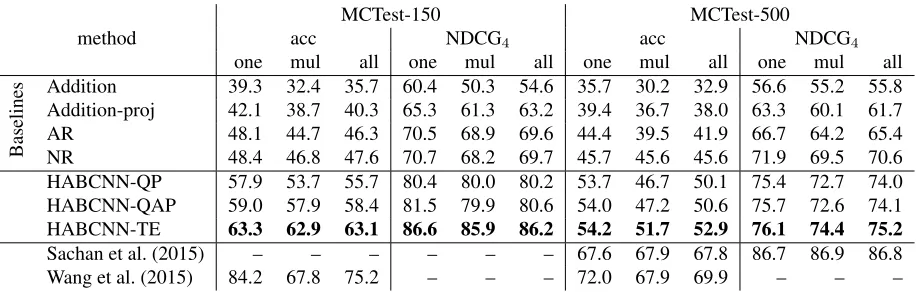
Addition 39.3 32.4 35.7 60.4 50.3 54.6 35.7 30.2 32.9 56.6 55.2 55.8 Addition-proj 42.1 38.7 40.3 65.3 61.3 63.2 39.4 36.7 38.0 63.3 60.1 61.7 AR 48.1 44.7 46.3 70.5 68.9 69.6 44.4 39.5 41.9 66.7 64.2 65.4 NR 48.4 46.8 47.6 70.7 68.2 69.7 45.7 45.6 45.6 71.9 69.5 70.6 HABCNN-QP 57.9 53.7 55.7 80.4 80.0 80.2 53.7 46.7 50.1 75.4 72.7 74.0 HABCNN-QAP 59.0 57.9 58.4 81.5 79.9 80.6 54.0 47.2 50.6 75.7 72.6 74.1 HABCNN-TE 63.3 62.9 63.1 86.6 85.9 86.2 54.2 51.7 52.9 76.1 74.4 75.2
[image:6.612.78.536.59.205.2]Sachan et al. (2015) – – – – – – 67.6 67.9 67.8 86.7 86.9 86.8 Wang et al. (2015) 84.2 67.8 75.2 – – – 72.0 67.9 69.9 – – –
Table 2:Experimental results for one-sentence (one), multiple-sentence (mul) and all cases.
coding layer, multiple reasoning layers and a final answer layer. The input for the encoding layer is a question and the sentences of the document (called facts); each sentence is encoded by a GRU into a vector. In each reasoning layer, NR lets the question representation interact with each fact representation as reasoning process. Finally, all temporary reason-ing clues are pooled as answer representation. (iv) AR. The Attentive Reader (Hermann et al., 2015) is implemented by modeling the whole D as a word sequence – without specific sentence / snippet repre-sentations – using an LSTM. Attention mechanism is implemented at word representation level.
Baselines Addition(-proj) do not involve complex composition and inference. NR and AR are the top-performing deep neural networks for QA.
4.4 Results
Table 2 lists the performance of baselines, HABCNN systems, and two top-performing non-DL systems (Sachan et al. (2015), Wang et al. (2015)) in the first, second, and last block, respectively. Consistently, our HABCNN systems outperform all baselines, especially surpass the two competitive DL systems AR and NR. The margin between our best-performing ABHCNN-TE and NR is 15.5/16.5 (accuracy/NDCG) on MCTest-150 and 7.3/4.6 on MCTest-500. This demonstrates the promise of our architecture in this task.
As said before, both AR and NR systems aim togenerate answers in entity form. Their designs might not suit this machine comprehension task, in which the answers are openly-formed based on sum-marizing or abstracting the clues. To be more spe-cific, AR models D always at word level,
atten-tion is also paid to corresponding word representa-tions, which is applicable for entity-style answers, but is less suitable for comprehension at sentence level or even snippet level. NR contrarily models D in sentence level always, neglecting the discover-ing of key phrases which however compose most of the answers. In addition, the attention of AR system and the question-fact interaction in NR system both bring large numbers of parameters, this potentially constrains their power in a dataset of limited size.
The size of MCTest is quite small. This is the most likely reason for the inferior performance of all deep learning approaches compared to non-deep-learning approaches. If the amount of training data is limited, then it may not be possible to get top per-formance without a large feature engineering effort.3
5 Conclusion
This work takes the lead in presenting a CNN based neural network system for open-domain machine comprehension task. Our systems try to solve this task in a document projection way as well as a tex-tual entailment way. The latter demonstrates slightly better performance. Overall, our architecture, mod-eling dynamic document representation by attention scheme from sentence level to snippet level, shows promising results in this task. In the future, more fine-grained representation learning approaches are expected to model complex answer types and ques-tion types.
Acknowledgments. We thank DFG for support-ing this work (grant SCHU 2246/4-2).
3Please refer to the extended version at
References
Ronan Collobert and Jason Weston. 2008. A unified ar-chitecture for natural language processing: Deep neu-ral networks with multitask learning. InProceedings of ICML, pages 160–167.
John Duchi, Elad Hazan, and Yoram Singer. 2011. Adaptive subgradient methods for online learning and stochastic optimization. The Journal of Machine Learning Research, 12:2121–2159.
Karl Moritz Hermann, Tomas Kocisky, Edward Grefen-stette, Lasse Espeholt, Will Kay, Mustafa Suleyman, and Phil Blunsom. 2015. Teaching machines to read and comprehend. InProceedings of NIPS, pages 1684–1692.
Mohit Iyyer, Jordan Boyd-Graber, Leonardo Claudino, Richard Socher, and Hal Daum´e III. 2014. A neu-ral network for factoid question answering over para-graphs. InProceedings of EMNLP, pages 633–644. Kalervo J¨arvelin and Jaana Kek¨al¨ainen. 2002.
Cu-mulated gain-based evaluation of ir techniques.
ACM Transactions on Information Systems (TOIS), 20(4):422–446.
Ankit Kumar, Ozan Irsoy, Jonathan Su, James Bradbury, Robert English, Brian Pierce, Peter Ondruska, Ishaan Gulrajani, and Richard Socher. 2016. Ask me any-thing: Dynamic memory networks for natural lan-guage processing. InProceedings of ICML.
Karthik Narasimhan and Regina Barzilay. 2015. Ma-chine comprehension with discourse relations. In Pro-ceedings ACL, pages 1253–1262.
Baolin Peng, Zhengdong Lu, Hang Li, and Kam-Fai Wong. 2015. Towards neural network-based reason-ing.CoRR, abs/1508.05508.
Jeffrey Pennington, Richard Socher, and Christopher D Manning. 2014. Glove: Global vectors for word rep-resentation.Proceedings of EMNLP, 12:1532–1543. Matthew Richardson, Christopher JC Burges, and Erin
Renshaw. 2013. Mctest: A challenge dataset for the open-domain machine comprehension of text. In
EMNLP, volume 1, page 2.
Mrinmaya Sachan, Kumar Dubey, Eric P. Xing, and Matthew Richardson. 2015. Learning answer-entailing structures for machine comprehension. In
Proceedings of ACL, pages 239–249.
Ellery Smith, Nicola Greco, Matko Bosnjak, and Andreas Vlachos. 2015. A strong lexical matching method for the machine comprehension test. In Proceedings of EMNLP, pages 1693–1698.
Rupesh K Srivastava, Klaus Greff, and J¨urgen Schmidhu-ber. 2015. Training very deep networks. In Proceed-ings of NIPS, pages 2368–2376.
Adam Trischler, Zheng Ye, Xingdi Yuan, Jing He, Phillip Bachman, and Kaheer Suleman. 2016. A parallel-hierarchical model for machine comprehension on sparse data.arXiv preprint arXiv:1603.08884. Hai Wang, Mohit Bansal, Kevin Gimpel, and David A.
McAllester. 2015. Machine comprehension with syn-tax, frames, and semantics. In Proceedings of ACL-IJCNLP, pages 700–706.
Jason Weston, Antoine Bordes, Sumit Chopra, and Tomas Mikolov. 2015a. Towards ai-complete ques-tion answering: a set of prerequisite toy tasks. arXiv preprint arXiv:1502.05698.