Proceedings of the Workshop on Cognitive Modeling and Computational Linguistics, pages 117–128
117
Frequency vs. Association for Constraint Selection
in Usage-Based Construction Grammar
Jonathan Dunn
University of Canterbury Department of Linguistics
Abstract
A usage-based Construction Grammar (CxG) posits that slot-constraints generalize from common exemplar constructions. But what is the best model of constraint generalization? This paper evaluates competing frequency-based and association-frequency-based models across eight languages using a metric derived from the Minimum Description Length paradigm. The experiments show that association-based models produce better generalizations across all languages by a significant margin.
1 Learning Slot-Constraints
The Construction Grammar paradigm (CxG: Lan-gacker, 2008; Goldberg, 2006) represents gram-mar using a hierarchical inventory of constraint-based constructions. In computational terms, a construction is a possibly non-continuous se-quence in which each unit satisfies some com-bination of lexical, syntactic, and semantic con-straints (e.g., Chang, et al., 2012; Steels, 2004, 2012, 2017). This paper uses computational modelling to approach the problem of how slot-constraints are learned: do frequency-based or association-based models produce better slot-constraints? How can we evaluate the quality of slot-constraints across an entire grammar in order to make such a comparison possible?
Implementations of CxG such as Fluid struction Grammar (FCG) and Embodied Con-struction Grammar (ECG) require the manual specification of constraints using a knowledge rep-resentation framework like FrameNet (e.g., Lavi-ola, et al., 2017; Matos, et al., 2017; van Trijp, 2017; Ziem & Boas, 2017; Dodge, et al., 2017). While these approaches can provide high-quality representations, they cannot model the emergence of slot-constraints because their constraints are defined rather than learned. We instead follow
work that models CxG from a usage-based per-spective: first, generating potential constructions given a corpus (Wible & Tsao, 2010; Forsberg, et al., 2014); second, selecting the optimal set of con-structions, where optimality is measured against a test corpus (Dunn, 2017, 2018a). This provides a model of how syntactic constraints are learned.
Recent work has used the Minimum Descrip-tion Length paradigm (MDL: Rissanen, 1978, 1986; Goldsmith, 2001, 2006) to model the in-teraction between slot-constraints across an entire grammar as a trade-off between memory and com-putation. The grammar which selects the best con-straints will optimize the balance between mem-ory (the encoding size of all constructions) and computation (the encoding size of a test corpus given the grammar). This operationalizes the idea within usage-based theories of grammar that any representation can be stored in memory but that not all representations are worth storing (c.f., Jack-endoff, 2002; O’Donnell, et al., 2011). From a dif-ferent perspective, some constructions prevent the learning of other constructions (Goldberg, 2011; Goldberg, 2016; Perek & Goldberg, 2017).
(1a) [SYN:NOUN— SEM-SYN:TRANSFER[V] — SEM-SYN:ANIMATE[N] — SYN:NOUN] (1b) “He gave Bill coffee.”
(1c) “He gave Bill trouble.” (1d) “Bill sent him letters.”
(2a) [SYN:NOUN— LEX:“give” — SEM-SYN:ANIMATE[N] — LEX:“a hand”]
(2b) “Bill gave me a hand.”
Table 1: Construction Notation and Examples
2 Representing Constructions
Following previous work (Dunn, 2017, 2018a), constructions are represented as a sequence of slot-constraints, as in (1a). Slots are separated by dashes and constraints are defined by both type (Syntactic, Joint Semantic-Syntactic, Lexical) and filler (for example:NOUN, a part-of-speech orAN -IMATE, a semantic domain).
The construction in (1a) contains four slots: two with joint semantic-syntactic constraints and two with simple syntactic constraints. The examples in (1b) to (1d) are tokens of the construction in (1a). Lexical constraints, as in (2a), represent id-iomatic sentences like (2b). These constructions are context-free because any sequence that satis-fies the slot-constraints becomes a token or in-stance of that construction.
The difficulty of modelling slot-constraints is that constructions can overlap: multiple construc-tions in the grammar are allowed to represent a single phrase. For example, (2b) is actually a to-ken of both (1a) and (2a). This makes identifying constructions more difficult because reaching the representation in (1a) does not rule out also reach-ing the representation in (2a). Both could be part of a single speaker’s grammar. For this reason we will use the termextractionrather thanparsingto describe the syntactic analysis that is performed by the algorithms described in this paper.
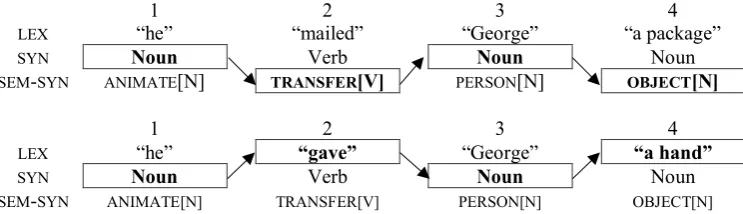
To illustrate the problem of construction extrac-tion, we can view each slot as a node, with the be-ginning of a construction the root node (c.f., tran-sition parsing for dependency grammars: Zhang & Nivre, 2012; Goldberg, et al., 2013). A construc-tion’s root can occur anywhere in a sentence. Each slot-constraint is a state, as visualized in Figure 1 with two forms of the ditransitive. There are four possible transitions: LEX, SYN,SEM-SYN, STOP. In the first example, the slot-constraints are gen-eralized to any transfer verb and any object noun. In the second example, the verb and object slots require idiomatic lexical items. The problem is to find the sequence of slot-constraints thatbest rep-resents the construction. Here, thebest represen-tation is the most efficient trade-off between mem-ory and computation across an entire grammar.
We first have to develop a pipeline for represent-ing all the possible constraints shown in Figure 1. Such a pipeline provides our hypothesis space: any sequence of constraints that is observed in the training data is a potential construction.
3 Representing Slot-Constraints
This section describes the pipeline that is used to represent the hypothesis space of potential con-structions. While it is important to take an em-pirical approach and evaluate aspects of this rep-resentation pipeline, the purpose of this paper is not to provide a counter-factual for each
compo-1 2 3 4
LEX “he” “mailed” “George” “a package”
SYN Noun Verb Noun Noun
SEM-SYN ANIMATE[N] TRANSFER[V] PERSON[N] OBJECT[N]
1 2 3 4
LEX “he” “gave” “George” “a hand”
SYN Noun Verb Noun Noun
[image:2.595.116.488.623.730.2]SEM-SYN ANIMATE[N] TRANSFER[V] PERSON[N] OBJECT[N]
nent individually (e.g., what type of embeddings or which part-of-speech tags to use). Instead, the two competing approaches are evaluated using the same representation pipeline in order to put such development decisions in the background. With-out a pre-defined ontology of concepts and frames, as in knowledge-based CxG, the representation of slot-constraints becomes a difficult problem.
First, lexical constraints use word-forms sepa-rated at whitespace; no morphological analysis is included in the pipeline. The lexicon of allowed word-forms is drawn from a background corpus (Section 4), with a frequency threshold to deter-mine inclusion (500 occurrences in corpora of ap-proximately 1 billion words). An example of a lexical slot-constraint is given in (2a), where this particular construction requires the specific words “give” and “a hand”, as in (2b).
Second, syntactic representations are drawn from the part-of-speech categories in the Univer-sal POS tagset using the RDRPOS tagger (Petrov, et al., 2012; Nguyen, et al., 2016); this is a pre-defined syntactic ontology. An unsupervised in-ventory of syntactic units is outside the scope of this paper, although ideally this would also be part of the representation pipeline. An example of a syntactically-defined slot-constraint is given in (2a), in which any noun can fill the subject po-sition. The problem of recursion within slots is discussed further in Section 11.
Third, semantic constraints are defined using a domain dictionary in which each word-form is as-signed to a cluster of word-forms. Clusters are based on word embeddings. First, a background corpus for each language is pos-tagged. No word sense disambiguation is used but word-forms are separated by syntactic category (i.e.,table verbis distinct from table noun). A skip-gram embed-ding with 500 dimensions is trained for each lan-guage ( ˘Reh˚u˘rek & Sojka, 2010). Clusters are then formed by applying x-means to these embeddings (Pelleg & Moore, 2000). While previous work used k-means to create a fixed number of domains across languages (Dunn, 2018a), x-means gener-alizes the number of clusters per language.
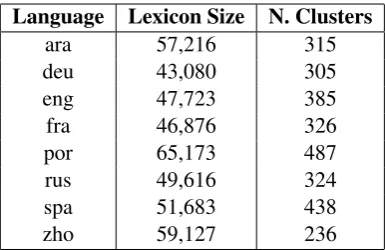
These clusters are heterogenous syntactically. Each output cluster is further divided by syntactic category so that each semantic cluster only con-tains words from a single part-of-speech, allowing joint semantic-syntactic constraints. The number of clusters for each language, shown in Table 2,
Language Lexicon Size N. Clusters
ara 57,216 315
deu 43,080 305
eng 47,723 385
fra 46,876 326
por 65,173 487
rus 49,616 324
spa 51,683 438
[image:3.595.320.513.61.186.2]zho 59,127 236
Table 2: Semantic Clusters by Language
ranges from 236 (zho) to 487 (por). This variation shows the importance of using x-means for defin-ing semantic constraints instead of k-means with a fixedkacross languages.
4 Corpora and Data Divisions
This paper evaluates models on eight languages: Arabic (ara), German (deu), English (eng), French (fra), Portuguese (por), Russian (rus), Spanish (spa), and Chinese (zho). Each language is repre-sented by a large background corpus that is used to (i) train word embeddings, (ii) determine the word-form lexicon, (iii) calculate association mea-sures, and (iv) learn and evaluate CxGs. This sec-tion discusses data sources and preparasec-tion.
A large portion of the corpus for each lan-guage comes from web-crawled data (Baroni, et al., 2009; Majli¸s & Z¸ abokrtsk´y, 2012; Benko, 2014; and data from the CoNLL 2017 Shared Task: Ginter, et al., 2017). Because the goal is to provide a wide representation of each language, this is augmented by legislative texts from the EU and UN (Tiedemann, 2012; Skadin¸ˆs, et al., 2014), the OpenSubtitles corpus (Tiedemann, 2012), and newspaper texts. The only language-specific pre-processing used is Chinese text segmentation1.
All punctuation is removed and text converted to lowercase. In order to avoid language-specific assumptions, no sentence splitting is performed. Instead, the corpus is divided into sequences of 100 words that form the main unit of analysis. The corpus is further divided into chunks of 100k sam-ples (for a total of 10 million words per chunk). These chunks are important because the data is randomly divided by chunk as shown in Table 3.
We perform CxG learning across four indepen-dent folds. Each fold retains the same lexicon and semantic domains, but every other part of the
Function Num. Words
Word embeddings Entire dataset
Background statistics 200 million words Generating potentials 50 million words
Optimizing CxGs 10 million words
Evaluation 10 million words (x5)
Table 3: Data Divisions
pipeline is repeated: (i) calculating frequency and association statistics for evaluating potential con-structions, (ii) generating potential concon-structions, (iii) searching through the potential constructions using a tabu search (Dunn, 2018a) to optimize the MDL metric (Section 9).
Each fold produces a single CxG. These CxGs are then merged by concatenation into a single grammar. The idea is that any construction which is productive on a sub-set of the corpus belongs in the final grammar. This final CxG is reduced using horizontal pruning (c.f., Wible & Tsao, 2010) to remove constructions that are wholly or partially contained within larger constructions. The code for this process is provided as an external resource.
5 Frequency and Association
The representation pipeline provides a rich hy-pothesis space from which to formulate slot-constraints. A usage-based grammar expects that constructions will emerge as common exemplars become entrenched via repeated production and perception. But how do we modelemergence?
One approach uses frequency: the most com-mon templates (i.e., sequences of constraints) will become a part of the grammar (Bybee, 2006; Arnon & Snider, 2010; Siyanova-Chanturia, et al., 2011). On the other hand, frequency alone will over-represent very common phrases and we know that less common and even rare constructions re-main perfectly grammatical. How do learners ac-quire rare constructions if they learn using fre-quency information? A second approach uses association: slot-constraints that occur together more frequently than expected indicate an en-trenched construction (Wible & Tsao, 2010; Fors-berg, et al., 2014; c.f., Ellis & Larsen-Freemen, 2009). An association-based model focuses on frequency relative to specific contexts rather than overall frequency in all contexts.
On the one hand, frequency and association as measures of entrenchment do not need to be
mu-tually exclusive. For example, association mea-sures explicitly depend on frequency information. On the other hand, the purpose of the experiments in this paper is to evaluate competing models of the emergence of slot-constraints against corpus data in order to better understand how CxGs are acquired. It should also be noted that it is not pos-sible to design an association-based algorithm that has no frequency thresholds whatsoever: we need at least a bound on which transitions need to be assigned association values. In the same way, the frequency-based algorithm references some asso-ciation information; otherwise the number of can-didates either will be intractibly large or will in-clude no infrequent forms. Regardless, the algo-rithms described in Sections 6 and 7 represent im-plementations of competing hypotheses about the emergence of slot-constraints.
For association, we use the bi-directional ∆P (Gries, 2013; Dunn, 2018b), with both left-to-right and right-to-left variants. For any two slot-fillers, X and Y, XP indicates that X is present and
XAthatX is absent, providing the two
direction-specific measures below.
∆PLR=p(XP|YP)−p(XP|YA)
∆PRL=p(YP|XP)−p(YP|XA)
Why not other measures of association? First, the ∆P was developed for precisely this sort of problem (Ellis, 2007). Second, the ∆P is bi-directional while other common measures like pointwise mutual information (PMI) average both directions together, thus disguising directional asymmetries. It has been shown that directional association is necessary to describe many linguis-tic patterns (Gries, 2013). Here we use the maxi-mum directional∆P to represent each transition. While a PMI disguises directional differences, this max∆Pallows each possible transition to be rep-resented by its strongest association value.
6 Frequency-Based Constraints
Variables
line= sequence of units
unit= possible slot-constraints: (lex, syn, sem) ui, ui+1= two adjacent units
ci, ci+1= constraint types forui, ui+1 RS= one slot-constraint per unit in line Algorithm
whileRSnot complete: forui, ui+1in line:
for all possible transitionsci, ci+1: if∆P(ci, ci+1)is highest available:
[image:5.595.73.293.61.227.2]addci, ci+1toRS
Table 4: Frequency-Based Selection Algorithm
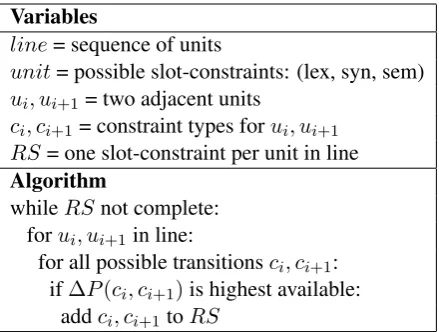
across the corpus to prune candidates.RSin Table 4 refers to a sequence of slot-constraints that rep-resents the input sentence; this sequence is com-plete when every slot in the sentence is represented by a hypothesized constraint.
This is similar to a template-based view of CxG: each n-gram of slot-constraints is a template. Only the most frequent templates are considered in the MDL stage. On the other hand, it is not tractable to include every sequence of slot-constraints; past work that took such an approach (Dunn, 2017) had to operate on much less data or enforce a series of intermediate frequency thresholds (i.e., per-chunk thresholds). For practical reasons the algorithm in Table 4 references local association between slot-constraints; at its core, however, this is an opera-tionalization of a frequency-centered model of the emergence of slot-constraints.
This frequency-based algorithm uses a fixed fre-quency threshold. After all candidates are ex-tracted from a corpus, those candidates with an overall frequency below the threshold are pruned. It is difficult to evaluate different thresholds using a grid search approach (as done below with asso-ciation) because many thresholds produce candi-date sets that are too large to evaluate. For purely practical reasons, then, the frequency threshold is fixed. Along these same lines, horizontal pruning removes any candidate that is entirely contained within another candidate, with the larger candi-date always remaining and the smaller candicandi-date always pruned. This type of pruning is essential for a frequency-based model because a frequent sequenceA−B−C−Dwill have frequent sub-sequences likeA−B−CandB−C−D. This nesting is not produced by an association-based
model, and so a different pruning strategy is re-quired, as described in Section 7.
7 Association-Based Constraints
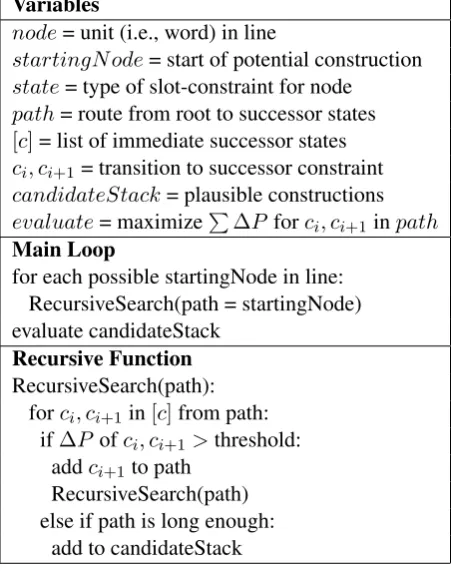
The association-based algorithm (Table 5) uses the total directional∆P (a sum across all transi-tions) to evaluate potential sequences. To imple-ment this idea, the search follows transitions from one slot-constraint to the next, proceeding left-to-right through the sentence. Any transition below a threshold∆Pstops that line of the search. This al-gorithm references local association values when choosing a transition from the current state. It also references global (i.e., construction-wide) associa-tion for selecting different paths, rather than using the frequency of specific templates.
Any series of constraints identified by this search whose transitions exceed the∆Pthreshold is added to the candidate stack. At the end of the search, this stack is scored using each candidate’s total∆P across all transitions. While primarily a transition-based extraction, this approach thus in-corporates some global evaluation methods (c.f., Nivre & McDonald, 2008; Zhang & Clark, 2008). A grid search for the best ∆P threshold per lan-guage is performed using independent test data.
This association-based algorithm is less influ-enced by the assumption that co-located slots gov-ern one another’s constraints. For example, in ref-erence to Figure 1, the slot filled by a NOUN in 3 and the slot filled by “a hand” in 4 have a lo-cal transition that is measured using the associa-tion between these two representaassocia-tions. Should we instead ignore the relationship between these two objects and focus on the relationship between each object and the verb slot? This algorithm tries to avoid specifying particular templates like this (i.e., a verb-centered frame) by using the global
∆P evaluation and the thread of associations to draw out these relationships.
Variables
node= unit (i.e., word) in line
startingN ode= start of potential construction state= type of slot-constraint for node
path= route from root to successor states
[c]= list of immediate successor states ci, ci+1= transition to successor constraint candidateStack= plausible constructions evaluate= maximizeP
∆P forci, ci+1inpath Main Loop
for each possible startingNode in line: RecursiveSearch(path = startingNode) evaluate candidateStack
Recursive Function RecursiveSearch(path):
forci, ci+1in[c]from path: if∆P ofci, ci+1>threshold:
addci+1to path RecursiveSearch(path) else if path is long enough:
[image:6.595.72.298.67.353.2]add to candidateStack
Table 5: Association-Based Selection Algorithm
8 Extracting Constructions
Given a set of candidates (i.e., a possible CxG), we use an additional algorithm to extract those candi-dates from a corpus in order to evaluate that gram-mar. The algorithm proceeds left-to-right across each word in the input. For each word, the ex-tractor checks for constructions whose first slot-constraint is satisfied by the current word. Because there are three types of slot-constraints, the extrac-tor must check each constraint type. If the cur-rent word satisfies the first slot-constraint, the ex-tractor looks-ahead and tests each successive word until either (i) all slot-constraints are satisfied and a construction match is identified or (ii) a slot-constraint is not satisfied and this portion of the search is terminated. If there is no match, then a particular construction is not present. This al-gorithm extracts all candidates identified by the above algorithms so that the competing grammars can be evaluated.
9 Modeling Constraint Quality
We now have frequency-based and assocation-based models of how slot-constraints emerge from usage. How can we measure the quality of both (i) a set of potential slot-constraints and (ii) an entire CxG? The process of searching over
se-lected slot-constraints using a tabu search (Glover, 1989, 1990) is adopted from previous work (Dunn, 2018a). A tabu search is a meta-level heuristic search that evaluates a number of possible local moves for each turn and then makes the move which produces the best grammar. Importantly, a tabu search allows moves which make the gram-mar worse in the short-term (with a restricted set of tabu moves) so that the learner can climb out of local optima. Here, each state is a grammar that contains a specific set of constructions. A move changes the current state by adding or re-moving some constructions. As before, the pur-pose is not to evaluate counter-factuals for every step in the pipeline because both the frequency-based and association-frequency-based models use exactly the same tabu search algorithm.
The MDL metric quantifies the trade-off be-tween memory (operationalized as the encoding size of a grammar) and computation (operational-ized as the encoding size of a test corpus given that grammar). A grammar that provides better gener-alizations will allow the test corpus to be encoded using a smaller number of bits. The metric com-bines three encoding-based terms: L1 (the cost of encoding the grammar), L2{C} (the cost of en-coding pointers to constructions in the grammar), and L2{R} (the cost of encoding linguistic ma-terial that is not in the grammar and thus cannot be encoded using a pointer). A pointer here is a partial parse of an utterance that refers to a con-struction that is already contained in the grammar. These terms represent the grammar, the data as described by the grammar, and the data that is not described by the grammar; note that bothL2terms are combined below. In other words,L2(D | G) is the sum of bothL2{C}andL2{R}. Din this equation refers to the dataset which is used to eval-uate the model. The relationship between these three encoding terms across languages is exam-ined further in Table 7.
M DL= min
G {L1(G) +L2(D|G)}
Encoding size, in turn, is based on probability: the encoding size of an item, X, is measured in bits, below, using the negative log of its probability. We describe how probabilities are estimated later in this section. The basic idea is that more probable constraints should have smaller encoding sizes.
According to this model, a construction is only worth remembering if its contribution to decreas-ing the overall encoddecreas-ing size of the test corpus is smaller than its contribution to the encoding size of the grammar. This is important for CxGs be-cause similar constructions overlap, describing the same sentences in the corpus. Each overlapping construction must be individually represented in the grammar, adding to theL1 term: similar con-structions must be encoded separately in L1 but do not improve the encoding ofL2. For example, the two constructions in (1a) and (2a) describe the same utterance in (2b). Both of these construc-tions need to be encoded in the grammar, increas-ingL1. But encoding only one of them would not increase the regret portion ofL2because the utter-ance itself can still be encoded using a pointer to the construction that is in the grammar.
The encoding size of a grammar,L1, is the sum of the encoding size of all constructions in that grammar. Each construction is a series of slot-constraints that must be satisfied for a linguistic utterance to be an instance of that construction. For each constraint, two items must be encoded: (i) the constraint type (lexical, semantic, syntactic) and (ii) the filler which defines that constraint. As shown in Table 7, this portion of the MDL metric is quite small given a large dataset.
The cost of (i) is fixed because each represen-tation is considered equally probable: the gram-mar is not explicitly biased towards syntactic con-straints. But the cost of (ii) depends on the type of representation: syntactic units come out of a much smaller inventory, so that any given part-of-speech is more probable and thus easier to en-code. For example, if there are 14 parts-of-speech, then the probability of observing one of them is
1/14 = 0.0714bits. On the other hand, because there are more lexical items, each word is less probable and thus more expensive to encode.
For example, if there are 50k lexical items, then the probability is 1/50,000 = 0.00002. In this way, the grammar is allowed to employ item-specific slot-constraints, but doing so increases the encoding cost of the grammar. Here, a syntactic constraint contributes 3.8 bits but a lexical con-straint contributes 15.6 bits. Future work will evaluate the impact of probability estimation for slot-fillers, currently done only at the contruction level. The total encoding size of a construction is the accumulated bits required to encode each
slot-constraint, where NR represents the number
of representation types (here, 3) andTRrepresents
the number of possible slot-fillers for that type.
NSLOT S
X
i
−log2( 1
NRi
) +−log2( 1
TR
)
The encoding size of the test corpus,L2, contains two quantities: first, the cost of encoding pointers to constructions in the grammar; second, the cost of encoding on-the-fly any parts of the corpus that cannot be described by the grammar. The cost of encoding pointers is also based on probabilities, so that more probable or common constructions require fewer bits to encode. For example, a con-struction that occurs 100 times in a corpus of 500k words has a pointer encoding size of 12.28 bits, but a construction that occurs 1,000 times costs only 8.96 bits per use. In this way, the probabil-ity of potential constructions influences encoding size. The regret portion of theL2term is the cost of words which are not covered by constructions in the current grammar. Each of these is encoded on-the-fly (i.e., not remembered): the more unen-coded words accumulate, the more each one costs. There is a close relationship between MDL and Bayesian inference methods (c.f., Barak, et al., 2016; Barak & Goldberg, 2017; Goldwater, et al., 2009). Information theory describes the relation-ship between the log probabilities of representa-tions and their encoding size. But it does not esti-mate the probability of the grammar itself, which here is handled in two ways: First, there is a choice in CxG between different types of representa-tion (LEX, SYN, SEM). This model does not en-force one type, but syntactic constraints are more likely because there are fewer categories. Second, pointers to constructions are assigned probabilities based on their observed frequency; this means that more likely constructions are cheaper to encode and implicitly favored by the model.
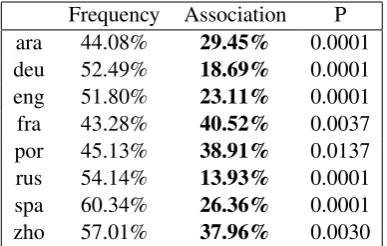
Frequency Association P
ara 44.08% 29.45% 0.0001
deu 52.49% 18.69% 0.0001
eng 51.80% 23.11% 0.0001
fra 43.28% 40.52% 0.0037
por 45.13% 38.91% 0.0137
rus 54.14% 13.93% 0.0001
spa 60.34% 26.36% 0.0001
[image:8.595.85.279.62.185.2]zho 57.01% 37.96% 0.0030
Table 6: Compression Rates by Language with Significance of Difference Between Models
10 Does Frequency or Association Produce Better Slot-Constraints?
We evaluate the frequency-based and association-based models on the same test sets, with the same hypothesis spaces derived from the same represen-tation pipeline, using the same implemenrepresen-tation of the MDL metric. While we have not evaluated counter-factuals for every development decision made within the pipeline, both competing models rely on the same decisions.2
MDL provides a single metric of a grammar’s fit relative to a particular dataset. This met-ric itself is dependent on each dataset; we thus calculate a baseline encoding score that repre-sents the encoding of the dataset without a gram-mar and use this to derive a compression metric: M DLCxG/M DLBase. The lower this
compres-sion metric, the greater the generalizations pro-vided by the CxG. Compression as used in MDL is similar to perplexity within language modelling; the connection is not explored further here except to note that some language models include CxG-like templates (e.g., Gimpel & Smith, 2011).
The evaluation uses all eight languages in order to provide a cross-linguistic counter-factual: do the generalizations agree across languages? Ad-ditionally, we evaluate the models against five in-dependent sets of 10 million words for each lan-guage. Table 6 shows the average compression by model for each language across these five test sets. We also report the p-values for a paired t-test (paired by dataset) to ensure that the difference in compression between models is significant.
2
The exact data used is available for download here: https://labbcat.canterbury.ac. nz/download/?jonathandunn/CxG_Data_ FixedSize. In addition, the code for the implemen-tation and the grammars themselves are available here: https://github.com/jonathandunn/c2xg/.
Lower compression scores reflect better gener-alizations; as shown in Table 6, the association-based model out-performs the frequency-association-based model for every language. In each case the dif-ference between models is significant. The gap and the significance level, however, vary widely across languages. For Russian, there is a gap of 40.21% compression that is significant below the p = 0.0001 level. But for French and Portuguese that gap is only 2.76% and 6.22%, with much larger p-values to match. Association always provides a better model of the emergence of slot-constraints, but for French and Portuguese the two models are much closer together than for other languages.
The frequency-based model represents what Goldberg calls conservatism via entrenchment, the idea that learners are more willing to over-generalize infrequent forms (Goldberg, 2016). In other words, the problem with a frequency-based model is that it does not allow for creative (and thus infrequent) uses of common forms. The more frequent a particular form is, the less likely that form will allow competing representations to emerge. But language is infinitely creative and this model blocks too many emerging constructions.
The association-based model, on the other hand, allows for the emergence of less familiar con-structions: a series of transitions between slot-constraints is permitted if it is relatively highly as-sociated, and infrequent forms are more open to forming new associations. This is the advantage of a directional measure like the∆P. Assume there are two constraints,A andB, in whichA is very common but B is rare. The PMI, by averaging, would disguise any association fromB toA. But the ∆P allows such new associations to emerge from a limited number of observations. Frequency alone pre-empts less common representations.
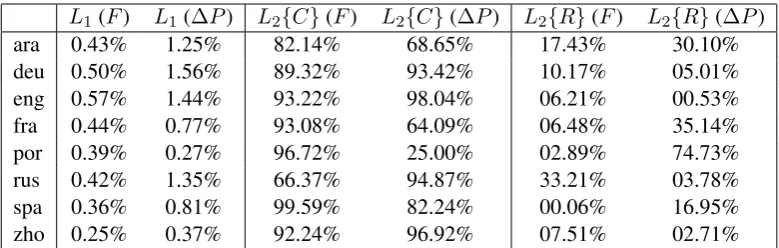
L1(F) L1(∆P) L2{C}(F) L2{C}(∆P) L2{R}(F) L2{R}(∆P)
ara 0.43% 1.25% 82.14% 68.65% 17.43% 30.10%
deu 0.50% 1.56% 89.32% 93.42% 10.17% 05.01%
eng 0.57% 1.44% 93.22% 98.04% 06.21% 00.53%
fra 0.44% 0.77% 93.08% 64.09% 06.48% 35.14%
por 0.39% 0.27% 96.72% 25.00% 02.89% 74.73%
rus 0.42% 1.35% 66.37% 94.87% 33.21% 03.78%
spa 0.36% 0.81% 99.59% 82.24% 00.06% 16.95%
[image:9.595.104.494.61.185.2]zho 0.25% 0.37% 92.24% 96.92% 07.51% 02.71%
Table 7: Break-down of MDL metric by relative proportion of the overall score
First, we see that the grammars themselves (L1) account for a small percentage of the overall met-ric. The great majority of the MDL score comes from the encoding of pointers or references of con-structions in the grammar in order to represent the dataset. A smaller percentage comes from encod-ing errors (i.e., parts of the dataset that cannot be represented using known constructions).
Second, however, there are important variations across languages and model-types. For French and Portuguese, the two languages with the least dif-ference between frequency-based and association-based models, the association-association-based models have significantly higher regret encodings (L2{R}). In other words, the overall fit of the association-based models for these languages is not nearly as good: only 64.09% (fra) and 25.00% (por) of the association-based model’s MDL score comes from correctly encoded constructions. This suggests that the association-based model provides rela-tively poor grammars for French and Portuguese, rather than that the frequency-based model pro-vides relatively good grammars. At the same time, this relative distribution of the MDL metric dis-guises the fact that the overall compression of the association-based model remains better for these two languages than the frequency-based model.
Could we evaluate usage-based grammars with-out relying on MDL? An alternate approach to evaluating the balance of memory and computa-tion when learning syntactic structures involves psycholinguistically-annotated datasets (c.f., Lu-ong, et al., 2015) or qualitative distinctions such as optional/obligatory arguments (c.f., Bergen, et al., 2013). These approaches are not as comprehen-sive as the work described in this paper because they cover, in effect, a small sub-set of possible constructions. Yet their interpretation in respect to individual cognition is more straight-forward.
11 Remaining Problems
This section offers a brief discussion of an impor-tant remaining challenge: how does a grammar treat non-contiguous constructions? A first option is that a CxG assumes a CFG that provides a no-tion of constituency: a noun phrase, for example, could be taken as a single slot-filler regardless of its internal structure. From a usage-based perspec-tive, this is potentially problematic: Is there a sep-arate syntactic mechanism for constituents that is based on different capabilities than the mechanism for learning slot-constraints?
A second option is that constituents are a form of purely-syntactic construction that can fill slots within larger constructions. This simpler type of construction would be learned using the same mechanisms as other constructions, but restricted to only syntactic constraints. Two difficulties arise: First, a constituent has aheadwhich catego-rizes it. Thus, if a constituent were categorized as aNOUN, it could fill any slot in a larger construc-tion that was categorized to accept a NOUN. But how do we categorize a construction? Does one single slot in a construction act as the head? The second difficulty is that constructions can overlap within a sentence, as with (1a) and (2a) above. But a constituency grammar cannot allow such ill-defined segmentations.
References
Arnon, I. and Snider, N. 2010. More than words: Fre-quency effects for multi-word phrases. Journal of Memory and Language, 62: 67–82.
Barak, L. and Goldberg, A. 2017. Modeling the Par-tial Productivity of Constructions. Proceedings of AAAI 2017 Spring Symposium on Computational Construction Grammar and Natural Language Un-derstanding. 131-138.
Barak, L.; Goldberg, A.; and Stevenson, S. 2017. Comparing Computational Cognitive Models of Generalization in a Language Acquisition Task. In
Proceedings of the Conference on Empirical Meth-ods in NLP. 96-106.
Baroni, M., Bernardini, S., Ferraresi, A., and Zanchetta, E. 2009. The WaCky Wide Web: A Col-lection of Very Large Linguistically Processed Web-crawled Corpora. Language Resources and Evalua-tion, 43: 209-226.
Benko, V. 2014. Aranea: Yet Another Family of (Comparable) Web Corpora. InProceedings of Text, Speech and Dialogue. 17th International Confer-ence. 257-264.
Bergen, L.; Gibson, E.; and O’Donnell, T. 2013. Argu-ments and Modifiers from the Learner’s Perspective. InProceedings of the Annual Meeting of the Associ-ation for ComputAssoci-ational Linguistics, 115-119.
Bybee, J. 2006. From Usage to Grammar: The mind’s response to repetition. Language82(4): 711-733.
Chang, N., De Beule, J., and Micelli, V. 2012. Com-putational construction grammar: Comparing ECG and FCG. In Steels, L. (ed.),Computational Issues in Fluid Construction Grammar. Berlin: Springer. 259-288.
Dodge, E., Trott, S., Gilardi, L., and Stickles, E. 2017. Grammar Scaling: Leveraging FrameNet Data to In-crease Embodied Construction Grammar Coverage.
Proceedings of AAAI 2017 Spring Symposium on Computational Construction Grammar and Natural Language Understanding. 154-162.
Dunn, J. 2017. Computational Learning of Construc-tion Grammars. Language & Cognition, 9(2): 254-292.
Dunn, J. 2018a. Modeling the Complexity and De-scriptive Adequacy of Construction Grammars. In
Proceedings of the Society for Computation in Lin-guistics (SCiL 2018). Stroudsburg, PA: Association for Computational Linguistics. 81-90.
Dunn, J. 2018b. Multi-Unit Directional Measures of Association: Moving Beyond Pairs of Words. Inter-national Journal of Corpus Linguistics, 23(2): 183-215.
Ellis, N. 2007. Language Acquisition as Rational Con-tingency Learning. Applied Linguistics, 27(1): 1-24.
Ellis, N. and Larsen-Freeman, D. 2009. Construct-ing a Second Language: Analyses and Computa-tional Simulations of the Emergence of Linguistic Constructions From Usage. Language Learning: A Journal of Research in Language Studies, 59(1): 90-125.
Forsberg, M., Johansson, R., Bckstrm, L., Borin, L., Lyngfelt, B., Olofsson, J., and Prentice, J. 2014. From Construction Candidates to Constructicon En-tries: An experiment using semi-automatic methods for identifying constructions in corpora. Construc-tions and Frames, 6(1): 114-135.
Gimpel, K. and Smith, N. 2011. Generative Models of Monolingual and Bilingual Gappy Patterns. In Pro-ceedings of the 6th Workshop on Statistical Machine Translation, 512-522.
Ginter, F.; Hajiˆc, J.; Luotolahti, J. 2017. CoNLL 2017 Shared Task - Automatically Annotated Raw Texts and Word Embeddings, LIN-DAT/CLARIN digital library at the Institute of Formal and Applied Linguistics ( ˜AˇsFAL), Faculty of Mathematics and Physics, Charles University. http://hdl.handle.net/11234/1-1989.
Glover, F. 1989. Tabu Search, Part 1. ORSA Journal on Computing, 1(3): 190-206.
Glover. F. 1990. Tabu Search, Part 2. ORSA Journal on Computing, 2(1): 4-32.
Goldberg, A. 2006. Constructions at Work: The Na-ture of Generalization in Language. Oxford: Ox-ford University Press.
Goldberg, A. 2011. Corpus evidence of the viability of statistical preemption. Cognitive Linguistics, 22 1: 131-154.
Goldberg, A. 2016. Partial Productivity of Linguistic Constructions: Dynamic categorization and Statisti-cal preemption. Language & Cognition, 8(3): 369-390.
Goldberg, Y., Zhao, K., and Huang, L. 2013. Effi-cient Implementations of Beam-Search Incremen-tal Parsers Proceedings of the Annual Meeting of the Association for Computational Linguistics. 628-633.
Goldsmith, J. 2001. Unsupervised Learning of the Morphology of a Natural Language. Computational Linguistics, 27(2): 153-198.
Goldsmith, J. 2006. An Algorithm for the Unsuper-vised Learning of Morphology. Natural Language Engineering, 12(4): 353-371.
Gries, S. 2013. 50-something years of work on col-locations: What is or should be next. International Journal of Corpus Linguistics, 18(1): 137-165.
Gr¨unwald, P. 1996. A Minimum Description Length Approach to Grammar Inference. In Wermter, G. S. S. and Riloff, E., (eds.) Connectionist, Statisti-cal and Symbolic Approaches to Learning for Natu-ral Language Processing, Springer Lecture Notes in Artificial Intelligence. 203–216.
Jackendoff, R. 2002. Foundations of Language. Ox-ford: Oxford University Press.
Langacker, R. 2008. Cognitive Grammar: A Basic In-troduction. Oxford: Oxford University Press.
Laviola, A., Lage, L., Marc¸˜ao, N., Tavares, T., Almeida, V., Matos, E., and Torrent, T. 2017. The Brazilian Portuguese Constructicon: Modeling structional Inheritance, Frame Evocation and Con-straints in FrameNet Brasil. Proceedings of AAAI 2017 Spring Symposium on Computational Con-struction Grammar and Natural Language Under-standing. 193-196.
Luong, M.; O’Donnell, T.; and Goodman, N. 2015. Evaluating Models of Computation and Storage in Human Sentence Processing. InProceedings of the Sixth Workshop on Cognitive Aspects of Computa-tional Language Learning, 14–21.
Majli¸s, M. and Z¸ abokrtsk´y, Z. 2012. Language Rich-ness of the Web. InProceedings of the International Conference on Language Resources and Evaluation (LREC 2012). https://ufal.mff.cuni.cz/w2c.
de Marcken, C. 1996. Unsupervised Language Acqui-sition. PhD thesis, MIT, Cambridge, MA.
Matos, E., Torrent, T., Almeida, V., Laviola, A., Lage, L., Marc¸˜ao, N., and Tavares, T. 2017. Construc-tional Analysis Using Constrained Spreading Acti-vation in a FrameNet-Based Structured Connection-ist Model. Proceedings of AAAI 2017 Spring Sym-posium on Computational Construction Grammar and Natural Language Understanding. 222-229.
Nguyen, Dat Quoc; Nguyen, Dai Quoc; Pham, Dang Duc; and Pham, Son Bao. 2016. A Robust Transformation-Based Learning Approach Using Ripple Down Rules for Part-Of-Speech Tagging. AI Communications, 29(3): 409-422.
Nivre, J. and McDonald, R. 2008. Integrating Graph-Based and Transition-Graph-Based Dependency Parsers.
Proceedings of the Annual Meeting of the Associ-ation for ComputAssoci-ational Linguistics. 950-958.
O’Donnell, T.; Snedeker, J.; Tenenbaum, J.; and Good-man, N. 2011. Productivity and Reuse in Language. In Proceedings of the Thirty-Third Annual Confer-ence of the Cognitive SciConfer-ence Society, 1,613-1,618.
Pelleg, D. and Moore, A. 2000. X-means: Extending K-means with Efficient Estimation of the Number of Clusters. InProceedings of the Seventeenth Interna-tional Conference on Machine Learning. 727-734.
Perek, F. and Goldberg, A. 2017. Linguistic general-ization on the basis of function and constraints on the basis of statistical preemption. Cognition, 168, 276-293.
Petrov, S., Das, D., and McDonald, R. 2012. A Uni-versal Part-of-Speech Tagset. In Proceedings of the Eight International Conference on Language Re-sources and Evaluation.
Piantadosi, S. T., Tenenbaum, J. B., and Goodman, N. D. 2016. The Logical Primitives of Thought: Empirical foundations for compositional cognitive models. Psychological Review, 123(4):392–424.
Rasin, E. and Katzir, R. 2016. On Evaluation Met-rics in Optimality Theory. Linguistic Inquiry, 47(2):235–282.
˘
Reh˚u˘rek, R. and Sojka, P. 2010. Software Framework for Topic Modelling with Large Corpora. In Pro-ceedings of the LREC 2010 Workshop on New Chal-lenges for NLP Frameworks.
Rissanen, J. 1978. Modeling by the Shortest Data De-scription. Automatica, 14: 465-471.
Rissanen, J. 1986. Stochastic Complexity and Model-ing.Annals of Statistics, 14: 1,080-1,100.
Siyanova-Chanturia, A.; Conklin, K.; and van Heuven, W. 2011. Seeing a phrase ”time and again” mat-ters: the role of phrasal frequency in the process-ing of multiword sequences. Journal of Experimen-tal Psychology: Learning, Memory and Cognition, 37(3),776-784.
Skadin¸ˆs, R.; Tiedemann, J.; Rozis, R.; & Deksne, D. 2014. Billions of Parallel Words for Free. In Proceedings of the International Conference on Language Resources and Evaluation (LREC 2014). http://opus.lingfil.uu.se/EUbookshop.php
Solomonoff, R. 1964. A Formal Theory of Inductive Inference, Parts I and II. Information and Control, 7(1 & 2):1–22, 224–254.
Steels, L. 2004. Constructivist development of grounded construction grammar. InProceedings of the 42nd Meeting of the Association for Computa-tional Linguistics: 9-16.
Steels, L. 2012. Design methods for fluid construction grammar. In Steels, L. (ed), Computational Issues in Fluid Construction Grammar. Berlin: Springer. 3-36.
Stolcke, A. 1994. Bayesian Learning of Probabilistic Language Models. PhD thesis, University of Cali-fornia at Berkeley. Berkeley, CaliCali-fornia.
Tiedemann, J. 2012. Parallel Data, Tools and Inter-faces in OPUS. InProceedings of the International Conference on Language Resources and Evaluation (LREC 2012). http://opus.lingfil.uu.se
van Trijp, R. 2017. A Computational Construction Grammar for English. Proceedings of AAAI 2017 Spring Symposium on Computational Construction Grammar and Natural Language Understanding. 266-273.
Wible, D. and Tsao, N. 2010. StringNet as a Com-putational Resource for Discovering and Investigat-ing LInvestigat-inguistic Constructions. InProceedings of the Workshop on Extracting and Using Constructions in Computational Linguistics (NAACL-HTL): 25-31.
Zhang, Y. and Clark, S. 2008. A Tale of Two Parsers: Investigating and Combining Graph-based and Transition-based Dependency Parsing using Beam-search. Proceedings of the Conference on Empirical Methods in NLP. 562-571.
Zhang, Y. and Nivre, J. 2012. Analyzing the Effect of Global Learning and Beam-search on Transition-based Dependency Parsing. Proceedings of COL-ING. 1391-1400.