35
Deep Cross-Lingual Coreference Resolution for Less-Resourced
Languages: The Case of Basque
Gorka Urbizu, Ander Soraluze and Olatz Arregi Ixa group, University of the Basque Country (UPV/EHU)
{ander.soraluze, olatz.arregi}@ehu.eus
Abstract
In this paper, we present a cross-lingual neu-ral coreference resolution system for a less-resourced language such as Basque. To be-gin with, we build the first neural coreference resolution system for Basque, training it with the relatively small EPEC-KORREF corpus (45,000 words). Next, a cross-lingual coref-erence resolution system is designed. With this approach, the system learns from a bigger English corpus, using cross-lingual embed-dings, to perform the coreference resolution for Basque. The cross-lingual system obtains slightly better results (40.93 F1 CoNLL) than the monolingual system (39.12 F1 CoNLL), without using any Basque language corpus to train it.
1 Introduction
Coreference resolution, the task of identifying and clustering all the expressions referring to the same real-world entity in a text, is essential in any Natural Language Processing (NLP) task that includes language understanding. For in-stance, tasks such as text summarisation (Stein-berger et al., 2007), question answering (Vicedo and Ferr´andez, 2006), sentiment analysis (Nicolov et al., 2008) or machine translation (Werlen and Popescu-Belis, 2017) can benefit from coreference resolution.
In the last few years, we have witnessed how the revolution of neural networks and deep learning has improved the previous results in almost any NLP task. Big improvements in results were also obtained in coreference resolution in the last two years using neural approaches, mainly for English. Although there is work in progress in languages other than English using neural networks, the re-sults obtained are not so good in all of them. This is mostly due to smaller corpus sizes, which af-fects neural approaches negatively. The situation of less-resourced languages is even harder, as they
have smaller datasets and annotating them is an ar-duous task to carry out by hand.
In this paper, we present a monolingual neural coreference resolution system for Basque. Subse-quently, we try a cross-lingual approach to analyze whether it is possible to build a language inde-pendent coreference resolution system that obtains competent results when applied to less-resourced languages. To this end, we build a system which learns exclusively from an English corpus and ap-ply it to resolve coreference in Basque texts. Af-terwards, we compare the results of the monolin-gual system with a small dataset of the target lan-guage, and those of the cross-lingual system that learns from a bigger available corpus of another language, but not the target language.
The paper is organized as follows. Section 2 introduces related work. Section 3 describes the model built for coreference resolution. In section 4, we present the monolingual and cross-lingual experimental setups. Section 5 contains the ob-tained results. Finally, Section 6 presents our con-clusions and future work.
2 Related Work
Coreference resolution has been handled with dif-ferent techniques during the last few decades un-til deep learning techniques spread in the field. Among the most influential works are the rule-based system by H. Lee et al. (2013) and machine learning based systems by Soon et al. (2001) and Versley et al. (2008).
One of the first successful neural coreference resolution system (Wiseman et al.) obtained state-of-the-art results. Similar works followed, and although they differ in the method used for gen-erating instances, all of them worked with auto-matic mentions and rule-based extracted features as input to a feedforward deep neural architecture (Clark and Manning; Wiseman et al., 2016).
the best results in the current state-of-the-art is an end-to-end neural system, which is presented in K. Lee et al. (2017) and K. Lee et al. (2018). This sys-tem does not use any automatically preprocessed mentions or features, and it is able to find the needed features in the raw text, so it does not need any annotation other than the coreferential rela-tions in the corpus. This manner, error propagation from the features extraction is reduced by learning those within the same neural network.
Neural coreference resolution systems for other languages have been created as well. For instance, in Clark and Manning they develop a system for Chinese, in Park et al. (2016) for Korean, and in Nito´n et al. (2018) for Polish.
Moreover, there has been some recent research to build cross-lingual systems for coreference resolution, as cross-lingual transfer learning has given good results in some other NLP tasks such as machine translation or language modeling (Lam-ple and Conneau, 2019). Cruz et al. (2018) used neural networks to solve coreference for Portuguese by learning from Spanish, a related language, using cross-lingual word embeddings. Kundu et al. presented a similar system for Span-ish and Chinese using EnglSpan-ish for training.
As regards the Basque language, this is the first work about neural coreference resolution. Nev-ertheless, a rule-based coreference resolution sys-tem (Soraluze et al., 2015) and a machine learning based system (Soraluze et al., 2016) have been de-veloped. Both of which used a rule-based mention detector (Soraluze et al., 2017).
3 Model
In this section, the neural coreference resolution model, which is used for the experiments carried out, is presented.
The model used for coreference resolution for Basque is based on the neural system developed for Polish (Nito´n et al., 2018). After considering and discarting different models, it was chosen be-cause both languages share some features such as being agglutinative or having free word order, and it obtained competitive results.
We use the mention-pair model to create in-stances, as in (Nito´n et al., 2018). They demon-strated that the mention-pair model obtains better results than the entity-mention for Polish.
In our case, gold mentions are used for train-ing and development sets, and gold and automatic
mentions are used for the test set, so we can see the effect of the performance of the mention detector in the results.
Once mention pairs are created, we extract some features of each mention and the mention pair to feed the neural network. In this work, we use pretrained 300-dimensional FastText em-beddings (Bojanowski et al., 2017). They work with substring information, and this gives better results with morphologically rich languages such as Basque.
For each mention, we extract the following fea-tures:
• An average of the embeddings of the words that make up the mention (300 dimensions).
• An average of the embeddings of the words in the sentence in which the mention appears (300).
We extract the following features for the men-tion pair:
• Distance in words between the mentions, rep-resented as binary features1(11).
• Distance in mentions between the mentions, represented as binary features (11).
• Whether mentions are in the same sentence (1).
• String matching (1).
• Lemma matching (1).
• Language2: Basque or English (1).
These features are easy to obtain for any lan-guage, and need very little preprocessing, just the lemmatization. In total, we obtain instances of 1,226 dimensions.
3.1 Neural Network
In this work, we use a fully connected network of 3 hidden layers, with 500, 300 and 100 neurons in each, and a single neuron in the output layer. The neural network takes instances of 1,226 di-mensions in the input layer, and it returns a num-ber between 0 and 1 in the output. The activation functions used are ReLU in the hidden layers and
1
Binned into one of the following slots [0,1,2,3,4,5-7,8-15,16-31,32-63,64+,discontinuous].
2Included with the purpose of training on mixed language
sigmoid in the output layer. ReLU function com-putes a positive number, while sigmoid function computes a number between 0 and 1.
Input vector:x= [ei, ej, eij]
1st hidden layer: h1 =RELU(W1Tx+b1)
2nd hidden layer:h2 =RELU(W2Th1+b2)
3rd hidden layer:h3=RELU(W3Th2+b3)
Output layer:p(i, j) =sigmoid(wTh
3)
Whereei andej are the features of each
men-tion, eij the features of the mention pair, W the
weights andbthe biases.
The neural network was trained to minimize the binary cross-entropy function. We trained the model for 2 epochs using a mini-batch size of 64. We used Adam optimization (Kingma and Ba, 2014), batch-normalization (Ioffe and Szegedy, 2015), and a dropout rate (Srivastava et al., 2014) of 0.2. The neural network was implemented us-ing python libraryKERAS3.
The mention pairs with a higher value than a threshold in the predictions are grouped in the same coreference cluster in testing time. To obtain the optimal threshold values, we used the develop-ment set.
4 Experimental Setup
Two experiments were carried out, both in simi-lar conditions to be able to compare the outputs. In the first experiment, we trained the model de-scribed in the previous section with the available corpus of the Basque language for coreference. After that, we trained the system using a big cor-pus of English to see if the coreference resolution task could be learnt using transfer learning from another language.
4.1 Corpora
For the next experiments two corpora for coref-erence resolution are used, the EPEC-KORREF corpus (Ceberio et al., 2018) for Basque, the tar-get language, and the OntoNotes English corpus (Hovy et al., 2006).
EPEC-KORREF4 corpus is a Basque corpus, composed of news, of around 45K words and 12K mentions, which has mentions and coreferential relations, including singletons, annotated. The
3
https://keras.io/
4http://ixa.si.ehu.es/node/4487
corpus is already divided into training, develop-ment and test sets, more details about the partition are shown in Table 1.
Words Mentions Clusters Singletons Train 23,520 6,525 1,011 3,401 Dev 6,914 1,907 302 982 Test 15,949 4,360 621 2,445 Total 46,383 12,792 1,934 6,828
Table 1: EPEC-KORREF corpus
OntoNotes corpus is an English corpus with text from a variety of domains of more than one mil-lion words, with annotated mentions and coref-erential relations. We used only newswire (nw), and broadcast news (bn) sets, avoiding conversa-tion sets, in order to have texts of the same domain (around 825K words and 100K mentions). The de-tails about the corpus are shown in Table 2.
Words Mentions nw 625,000 75,000
bn 200,000 24,000
Table 2: OntoNotes corpus
4.2 Monolingual System
To develop the monolingual system, the neural model presented in Section 3 was trained on the EPEC-KORREF Basque corpus. In Figure 1, we can see how a train instance is generated from a coreferential mention pair of the following sen-tence:
Gaur egungo 15 herrialdeetatik 27ra igaro be-harko du erdiko epera [Europar Batasunak], Eu-ropa ekialdeko eta hego ekialdeko 12 herrialde [bere] baitan hartuta.
“From the 15 countries of today, the [European Union] will have to change to 27 in the medium term, taking on [its] own 12 countries from west and southwest Europe.”
The threshold for clustering mentions referring to the same entity was settled at 0.5 in the devel-opment set.
4.3 Cross-Lingual System
lan-Figure 1: Example of an instance for a positive mention pair
guage, for the task of coreference resolution for Basque.
For this purpose, we use cross-lingual embed-dings, as the language in the training set and the test set is different. We did this using the VecMap tool (Artetxe et al., 2018), which maps embed-dings of one language to the other without using any bilingual dictionary.
The threshold for clustering coreferential men-tions was settled at 0.9 in the development set.
5 Results
The coreference clusters obtained in the output of each experiment were evaluated with the official scorer proposed by Pradhan et al. (2014) for coref-erence resolution, and we also added the more re-cent LEA metric.
The main metrics used in the task are MUC (Vilain et al., 1995), B3 (Bagga and Baldwin, 1998), CEAFm and CEAFe(Luo, 2005), BLANC
(Recasens and Hovy, 2011), LEA (Moosavi and Strube) and CoNLL, which is the average of MUC, B3 and CEAFe (Denis and Baldridge,
2009).
The results for the monolingual system and the cross-lingual system are shown in Table 4.
Our monolingual system obtains 39.12 F1 and 53.19 F1 for the CoNLL metric with automatic mentions and gold mentions respectively. The dif-ference of using automatic (F1 = 73.79) or gold mentions is considerable (more than 14 points), which shows the importance of mention detec-tion in the results. Furthermore, the low values for MUC metric stand out, which shows that the model does create a small number of coreference links.
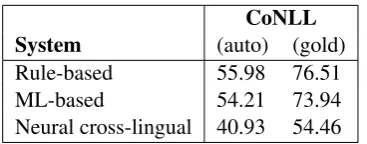
Similar results were obtained for the cross-lingual system. The results for some metrics, such as MUC, decrease slightly, while the results for other metrics, such as LEA, increase a bit. Our cross-lingual system obtains 40.93 F1 for the CoNLL metric when automatic mentions are used and 54.46 F1 with gold mentions. We obtain better results with the cross-lingual system without us-ing the target language corpus for the trainus-ing than when using the small corpus available for Basque. Moreover, to contextualize the results we ob-tained, in Table 3, we can see the results of the neural cross-lingual system in comparison with previous coreference resolution systems for Basque. The results obtained are lower than those obtained by previous rule-based (Soraluze et al., 2015) and ML-based (Soraluze et al., 2016) sys-tems with the same corpus.
[image:4.595.83.523.61.223.2]CoNLL System (auto) (gold) Rule-based 55.98 76.51 ML-based 54.21 73.94 Neural cross-lingual 40.93 54.46
Table 3: Comparison with previous systems for Basque
[image:4.595.326.510.524.596.2]sys-System MD MUC B3 CEAFm CEAFe BLANC LEA CoNLL
Monolingual (auto)
73.79 9.72 54.83 49.66 52.81 29.41 29.40 39.12 Cross-lingual (auto) 8.30 58.61 53.27 55.87 29.14 36.34 40.93 Monolingual (gold)
[image:5.595.78.522.63.133.2]100 15.81 74.60 63.10 69.17 53.28 39.87 53.19 Cross-lingual (gold) 10.00 79.90 68.09 73.47 51.91 49.30 54.46
Table 4: Results of monolingual and cross-lingual systems for gold and automatic mentions
Key ... eta(bera)1,( (zailtasun hori)2 gainditu duen munduko lehen emakumea)1.
Response ... eta(bera)1,(zailtasun hori)2gainditu duen(munduko lehen emakumea)3.
Translation ... and(she)1is(the first woman in the world to overcome(that difficulty)2)1.
Table 5: Example of mistakes in the output
tems. Training our cross-lingual system on En-glish might make this even harder, as Basque has gender-neutral pronouns and it is quite common to drop pronouns at subject or object positions.
6 Conclusions and Future Work
We present a neural coreference resolution system for Basque, and a cross-lingual system, which is trained on a bigger English corpus.
The results obtained with both systems are sig-nificantly lower than those obtained by previous non-neural systems for Basque. The results of the cross-lingual system (40.93 F1 CoNLL) are slightly better than the monolingual ones (39.12 F1 CoNLL), and this was obtained without using any target language corpus in the training phase.
Furthermore, we conclude that the corpus for Basque, of 45,000 words, is too small for a mono-lingual neural approach. Thus, the results obtained with the cross-lingual system are outstanding, as they improved the results obtained without using any corpus of the target language.
An in-depth error analysis needs to be done to understand better the results of both systems. Moreover, training the same model for coreference resolution for English would help to see whether the results obtained were due to the neural archi-tecture and the model, or the small corpus and the cross-lingual approach. In addition, it might be in-teresting to see what results we would obtain with a simpler model, mostly for the monolingual sys-tem.
The cross-lingual approach needs to be investi-gated further. We are planning to apply this cross-lingual approach to the state-of-the-art neural net-work architecture (K. Lee et al., 2018), which might learn better, and could help to close the gap
between results obtained with automatic and gold mentions.
Finally, this cross-lingual system could be tested for different language pairs, to see what language pairs give better results, with the aim of building a universal coreference resolution sys-tem, which would learn the task for many guages and resolve coreference for any other lan-guage.
Acknowledgments
This research was partially supported by the Span-ish Ministry of Economy and Competitiveness (MINECO/FEDER, UE; PROSA-MED project, TIN2016-77820-C3-1-R) and by the European Commission (LINGUATEC project, EFA227/16). We thank the three anonymous reviewers whose comments and suggestions contributed to improve this work.
References
Mikel Artetxe, Gorka Labaka, and Eneko Agirre. 2018. A robust self-learning method for fully unsupervised cross-lingual mappings of word embeddings. In
Proceedings of the 56th Annual Meeting of the As-sociation for Computational Linguistics (Volume 1: Long Papers), pages 789–798.
Amit Bagga and Breck Baldwin. 1998. Entity-based cross-document coreferencing using the vec-tor space model. InProceedings of the 36th Annual Meeting of the Association for Computational Lin-guistics and 17th International Conference on Com-putational Linguistics-Volume 1, pages 79–85. As-sociation for Computational Linguistics.
Klara Ceberio, Itziar Aduriz, Arantza D´ıaz de Ilarraza, and Ines Garcia-Azkoaga. 2018. Coreferential rela-tions in Basque: the annotation process. Journal of psycholinguistic research, 47(2):325–342.
Kevin Clark and Christopher D Manning. Improving Coreference Resolution by Learning Entity-Level Distributed Representations. In Proceedings of the 54th Annual Meeting of the Association for Compu-tational Linguistics (Volume 1: Long Papers).
Andr´e Ferreira Cruz, Gil Rocha, and Henrique Lopes Cardoso. 2018. Exploring Spanish corpora for Por-tuguese coreference resolution. In 2018 Fifth In-ternational Conference on Social Networks Analy-sis, Management and Security (SNAMS), pages 290– 295. IEEE.
Pascal Denis and Jason Baldridge. 2009. Global joint models for coreference resolution and named entity classification. Procesamiento del Lenguaje Natural, 42:87–96.
Eduard Hovy, Mitchell Marcus, Martha Palmer, Lance Ramshaw, and Ralph Weischedel. 2006. Ontonotes: The 90% solution. In Proceedings of the Human Language Technology Conference of the NAACL, Companion Volume: Short Papers.
Sergey Ioffe and Christian Szegedy. 2015. Batch Nor-malization: Accelerating Deep Network Training by Reducing Internal Covariate Shift. InProceedings of the 32nd International Conference on Machine Learning, ICML 2015, Lille, France, 6-11 July 2015, pages 448–456.
Diederik Kingma and Jimmy Ba. 2014. Adam: A method for stochastic optimization. International Conference on Learning Representations.
Gourab Kundu, Avi Sil, Radu Florian, and Wael Hamza. Neural cross-lingual coreference resolution and its application to entity linking. In Proceed-ings of the 56th Annual Meeting of the Association for Computational Linguistics (Volume 2: Short Pa-pers).
Guillaume Lample and Alexis Conneau. 2019. Cross-lingual language model pretraining. arXiv preprint arXiv:1901.07291.
Heeyoung Lee, Angel Chang, Yves Peirsman, Nathanael Chambers, Mihai Surdeanu, and Dan Jurafsky. 2013. Deterministic coreference resolu-tion based on entity-centric, precision-ranked rules.
Computational Linguistics, 39(4):885–916.
Kenton Lee, Luheng He, Mike Lewis, and Luke Zettle-moyer. 2017. End-to-end Neural Coreference Reso-lution. InProceedings of the 2017 Conference on Empirical Methods in Natural Language Process-ing, pages 188–197.
Kenton Lee, Luheng He, and Luke Zettlemoyer. 2018. Higher-order coreference resolution with coarse-to-fine inference. InNAACL-HLT (2), pages 687–692. Association for Computational Linguistics.
Xiaoqiang Luo. 2005. On coreference resolution per-formance metrics. In Proceedings of the Confer-ence on Human Language Technology and Empiri-cal Methods in Natural Language Processing, pages 25–32. Association for Computational Linguistics.
Nafise Sadat Moosavi and Michael Strube. Which coreference evaluation metric do you trust? a pro-posal for a link-based entity aware metric. In Pro-ceedings of the 54th Annual Meeting of the Associa-tion for ComputaAssocia-tional Linguistics (Volume 1: Long Papers).
Nicolas Nicolov, Franco Salvetti, and Steliana Ivanova. 2008. Sentiment Analysis: Does Coreference Mat-ter? InAISB 2008 Convention Communication, In-teraction and Social Intelligence, pages 37–40.
Bartłomiej Nito´n, Paweł Morawiecki, and Maciej Ogrodniczuk. 2018. Deep neural networks for coreference resolution for Polish. In Proceed-ings of the Eleventh International Conference on Language Resources and Evaluation (LREC-2018), pages 395–400.
Cheoneum Park, KyoungHo Choi, Changki Lee, and Soojong Lim. 2016. Korean Coreference Resolu-tion with Guided MenResolu-tion Pair Model Using Deep Learning.ETRI Journal, 38(6):1207–1217.
Sameer Pradhan, Xiaoqiang Luo, Marta Recasens, Ed-uard Hovy, Vincent Ng, and Michael Strube. 2014. Scoring Coreference Partitions of Predicted Men-tions: A Reference Implementation. In Proceed-ings of the 52nd Annual Meeting of the Association for Computational Linguistics (Volume 2: Short Pa-pers), pages 30–35, Baltimore, Maryland. Associa-tion for ComputaAssocia-tional Linguistics.
Marta Recasens and Eduard Hovy. 2011. BLANC: Im-plementing the Rand index for coreference evalu-ation. Natural Language Engineering, 17(4):485– 510.
Wee Meng Soon, Hwee Tou Ng, and Daniel Chung Yong Lim. 2001. A machine learning ap-proach to coreference resolution of noun phrases.
Computational linguistics, 27(4):521–544.
Ander Soraluze, Olatz Arregi, Xabier Arregi, and Arantza Diaz de Ilarraza. 2015. Coreference Res-olution for Morphologically Rich Languages. Adap-tation of the Stanford System to Basque. In Proce-samiento del Lenguaje Natural, volume 55, pages 23–30.
Ander Soraluze, Olatz Arregi, Xabier Arregi, and Arantza D´ıaz de Ilarraza. 2017. Improving mention detection for Basque based on a deep error analysis.
Natural Language Engineering, 23(3):351–384.
Nitish Srivastava, Geoffrey Hinton, Alex Krizhevsky, Ilya Sutskever, and Ruslan Salakhutdinov. 2014. Dropout: a simple way to prevent neural networks from overfitting. The Journal of Machine Learning Research, 15(1):1929–1958.
Josef Steinberger, Massimo Poesio, Mijail A. Kabad-jov, and Karel Jeek. 2007. Two Uses of Anaphora Resolution in Summarization. Information Process-ing and Management, 43(6):1663–1680.
Yannick Versley, Simone Paolo Ponzetto, Massimo Poesio, Vladimir Eidelman, Alan Jern, Jason Smith, Xiaofeng Yang, and Alessandro Moschitti. 2008. BART: A modular toolkit for coreference resolution. InProceedings of the 46th Annual Meeting of the As-sociation for Computational Linguistics on Human Language Technologies: Demo Session, pages 9–12. Association for Computational Linguistics.
Jose Vicedo and Antonio Ferr´andez. 2006. Corefer-ence In Q&A. InAdvances in Open Domain Ques-tion Answering, volume 32 ofText, Speech and Lan-guage Technology, pages 71–96. Springer.
Marc Vilain, John Burger, John Aberdeen, Dennis Con-nolly, and Lynette Hirschman. 1995. A model-theoretic coreference scoring scheme. In Proceed-ings of the 6th Conference on Message Understand-ing, pages 45–52. Association for Computational Linguistics.
Lesly Miculicich Werlen and Andrei Popescu-Belis. 2017. Using coreference links to improve Spanish-to-English machine translation. In Proceedings of the 2nd Workshop on Coreference Resolution Be-yond OntoNotes (CORBON 2017), pages 30–40.
Sam Wiseman, Alexander M Rush, Stuart Shieber, and Jason Weston. Learning Anaphoricity and An-tecedent Ranking Features for Coreference Resolu-tion. InProceedings of the 53rd Annual Meeting of the Association for Computational Linguistics and the 7th International Joint Conference on Natural Language Processing (Volume 1: Long Papers).