149
Clinical Data Classification using Conditional Random Fields and Neural
Parsing for Morphologically Rich Languages
Razieh Ehsani, Tyko Niemi, Gaurav Khullar and Tiina Leivo
Digital Workforce Services Oy, Helsinki, Finland {name.lastname}@digitalworkforce.fi
Abstract
Past prescriptions constitute a central element in patient records. These are often written in an unstructured and brief form. Extract-ing information from such prescriptions en-ables the development of automated processes in the medical data mining field. This paper presents a Conditional Random Fields (CRFs) based approach to extract relevant information from prescriptions. We focus on Finnish lan-guage prescriptions and make use of Finnish language specific features. Our labeling ac-curacy is 95%, which compares favorably to the current state-of-the-art in English language prescriptions. This, to the best of our knowl-edge, is the first such work for the Finnish lan-guage.
1 Introduction
Processing and mining unstructured data is a ma-jor contemporary challenge. Automated methods reduce human labor and increase accuracy and proficiency. Application of such methods revo-lutionized many processes in the healthcare sec-tor by eliminating huge amounts of manual work needed to process archive files. Automated pro-cessing of past patient data, such as prescriptions, allows easy digital access to patient records and allows healthcare practitioners to quickly inquire about family history, past medication usage, and other important data.
A large number of medical archives are in text format. Prescriptions, clinical reports, and other clinical texts are widely available but the prob-lem with most of these texts is that they are un-structured and cannot be processed into a struc-tured database directly. Extracting information from these is an important data mining problem called clinical text analysis.
In this paper, we will introduce an approach to extract entities from prescriptions. These entities
are dosage, dosage unit and frequency. All pre-scriptions are in the Finnish language. Finnish is an agglutinative language with rich derivational and inflectional morphology. Morphemes mostly come afterword stem as suffixes and phonetics may also change depending on the morphemes. Finnish has complex vowel harmony and conso-nant gradation processes which causes large vari-ations in each word stem.
This paper is organized as follows: In Section 2 we briefly introduce some important works as related works. Section3is about data that we used for training and also is about prepossessing step. In Section4we give information about the model and approach that we used in the paper. In Section 5we present experimental results and we discuss over different tests. In Section6we describe post-processing step for mapping extracted information from prescriptions to the standardized master table data. Finally in Section7we conclude this paper.
2 Related work
CRFs are widely used in agglutinative language processing and have good accuracy when linguis-tic features are used (Yıldız et al.,2015), (Ehsani et al.,2012).
Here we list some of the existing tools in med-ication extraction. MedLEE (Friedman, 2000) is one which uses handwritten rules for extract-ing and encodextract-ing and structurextract-ing clinical infor-mation using free-form texts like patient reports. MetaMap (Aronson and Lang,2010) also is a rule-based tool which extracts medication names by querying in the Unified Medical Language System (UMLS) Metathesaurus (Bodenreider,2004).
fea-tures like n-grams and length of words over a small dataset from i2b2 task. They use a rule-based al-gorithm to improve the accuracy of CRF classifi-cation.
Another work (Tao et al.,2017) is also related to the same i2b2 shared task. They use CRFs to extract dosage unit, dosage and frequency. They show that CRFs performs better than other clas-sifiers. They also try adding word embedding to their model but there is no significant improve-ment in dosage, dosage unit and frequency label-ing. They employ POS tags of tokens besides some categorical features.
3 Data and preprocessing
Our training data contains 9692 prescriptions. We annotate these prescriptions to 4 categories: i) Dosage, which shows the amount of dosage of medication ii) Dosage unit gives the unit of medi-cation, like ”tablet” iii) Frequency of using dosage can be more than one token and iv) Comments cat-egory is for all other tokens in prescription. We an-notated data manually by Finnish native speakers and with the supervision of healthcare profession-als.
As mentioned before, working with the Finnish language brings its own challenges, we now dis-cuss these in more detail. Beside compound words, rich morphology and phonology of Finnish language means that the same root word can ap-pear in vastly different forms in texts. In addition to that, the colloquial patient-friendly language of the prescriptions means that they don’t perfectly follow grammatical rules or spelling.
For example, the word “tabletti”, (tablet in En-glish), can appear like “tbl”, “tabl”, “tablettia” or “tb” and word “annos” (dose in English) can appear in different compound words like “annos-pussi” (dosage bag in English), “annosruisku” (sy-ringe in English) ,“annossuihke” (dosage spray in English), “annosmitta” (measurement cup) when word “annosmitta” itself can appear in differ-ent grammatical forms like : “annosmitallinen” (a measuring cup’s worth in English), “annos-mitallista” (partitive form of “annosmitallinen”), “annosmittaa” (partitive from), “annospussillista” (partitive form of annospussi) and “annostelu-mitallinen” (portioning measurement unit in En-glish). In many cases, we also have “dosage” and “unit name” joined together without space charac-ter in between. For example, most doctors write
“1 tabletti” as “1tabletti”. All these listed difficul-ties necessitate a robust prepossessing step before the actual labeling.
4 Model and feature extraction
This section is about model creation using CRFs and feature extraction steps.
4.1 Model
Conditional random fields (CRFs) (Lafferty et al., 2001) is a powerful method to solve labeling prob-lem in a sequence of input word tokens. CRF mod-els the conditional probability of a sequence of la-bels with respect to the input sequence. It takes into account the sequential relations between la-bels as well as the relations between a label and its corresponding input token. The inference is done by finding the most probable label sequence given input features, this holistic nature implies consis-tency, as opposed to the case where one would la-bel each word (or n-gram) individually and sepa-rately. Here we use it to model prescription enti-ties (dosage, dosage unit, frequency) using various linguistic and categorical features. We use Crf-suite C++ library for the implementation of our method (Okazaki, 2007). Crfsuite provides fast training and labeling and uses the standard feature templates.
4.2 Features
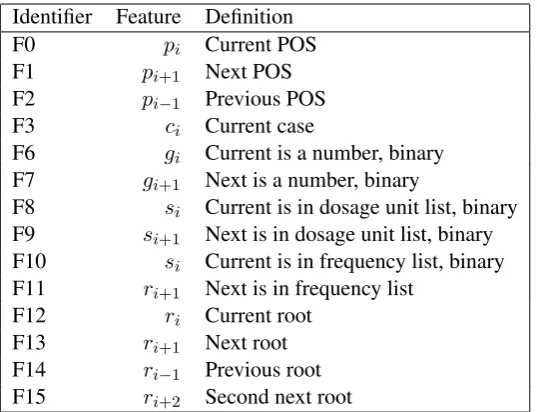
We make use of both linguistic as well as cate-gorical features for the modeling problem. Ta-ble 1 lists defined feature templates that we use. Categorical features are created using two lists, first is the list of dosage unit while second is the list of frequency identifier names. Both lists are taken from a predefined list in the health care sys-tem for regular prescriptions. Naturally, these lists do not contain all possible form of dosage unit or frequencies, as we mentioned in previous section, dosages and frequencies can appear in different grammatical forms or as abbreviations or even ty-pos.
segmenta-Identifier Feature Definition
F0 pi Current POS
F1 pi+1 Next POS F2 pi−1 Previous POS F3 ci Current case
F6 gi Current is a number, binary F7 gi+1 Next is a number, binary
F8 si Current is in dosage unit list, binary F9 si+1 Next is in dosage unit list, binary F10 si Current is in frequency list, binary
F11 ri+1 Next is in frequency list F12 ri Current root
F13 ri+1 Next root F14 ri−1 Previous root F15 ri+2 Second next root
Table 1: List of features templates
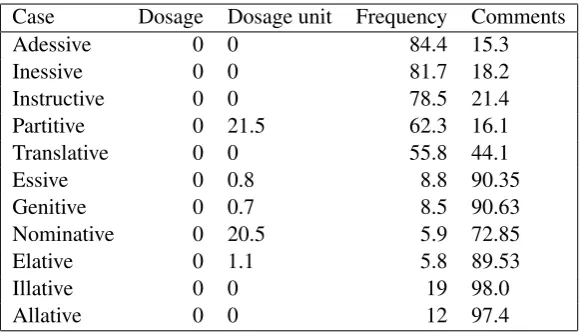
tion, morphological tagging, dependency parsing and lemmatization for the Finnish language. We use morphological tagging outputs of Turku de-pendency parser in this work. There is a relation between output labels and morphemes. For ex-ample, dosage are numbers and POS tag “NUM” (number) refers to being number. Feature IsNum-ber is a binary feature in cases that POS tag is not “NUM” but token includes numbers like ranges. The Finnish language has very rich noun cases. Often there is a relation between the case of a token in prescription and its output label. Table 2shows the percentage of tokens in prescriptions that have a specific case for each label. In Finnish, cases indicate the syntactic function of a noun in the sentence. The case markings are suffixed to the end of the token. Thus, the presence of a case marking in the token can give information about the label like frequency. Because frequency is mostly related to time or duration, when the token has “Adessive” case. Adessive case corresponds to prepositions “on” or “at” in English. Second in-formative feature for label frequency is “Inessive” which corresponds to “in” in English. Case “Alla-tive” (“onto”) has very small relation with being frequency.
5 Experimental Results
In this section, we show the experimental results for our proposed CRFs based tagging method. We tested the model using 10-fold cross-validation. In order to assess the importance of different ele-ments of our proposed model, we train a sequence
of classifiers of increasing complexity. We start with a memorization classifier, where each token is labeled individually by looking up the most fre-quent label it is associated with in the training data. This baseline method corresponds to a 0-order CRF with the word surface forms as the only feature. The results of this baseline classifier are shown in Table3. Next, we try a CRF with order 1 and surface forms as features. This allows us to measure the effect of enforcing label order consis-tency. As seen in Table4, the effect varies for each label, e.g. dosage labeling shows the biggest im-provement over the simple memorization method. In particular, numeric tokens are hard to distin-guish individually since they can be a frequency or a dosage, but when taken in the context of the token sequence they are much easier to classify. Without other more complicated features, F1 mea-sure is over 90%, this shows that CRFs are very powerful in sequential tagging just by enforcing labeling consistency.
[image:3.595.166.435.61.267.2]Precision recall F1 Dosage 0.6677 0.8460 0.7464 Dosage unit 0.9562 0.9707 0.9634 Frequency 0.8361 0.9006 0.8672 Comments 0.9541 0.8337 0.8898 Macro-average 0.8535 0.8877 0.8667
Case Dosage Dosage unit Frequency Comments
Adessive 0 0 84.4 15.3
Inessive 0 0 81.7 18.2
Instructive 0 0 78.5 21.4
Partitive 0 21.5 62.3 16.1
Translative 0 0 55.8 44.1
Essive 0 0.8 8.8 90.35
Genitive 0 0.7 8.5 90.63
Nominative 0 20.5 5.9 72.85
Elative 0 1.1 5.8 89.53
Illative 0 0 19 98.0
[image:4.595.154.446.61.227.2]Allative 0 0 12 97.4
Table 2: Percentage of cases in labels
Precision recall F1 Dosage 0.9686 0.9546 0.9616 Dosage unit 0.9642 0.9601 0.9622 Frequency 0.8909 0.9071 0.8989 Comments 0.9350 0.9303 0.9326 Macro-average 0.9396 0.9380 0.9388
Table 4: CRFs Baseline results
In Table5we show results of tagging for each label when we use just categorical features and the surface form of current token. As before, dosage unit benefits the most from the inclusion of cate-gorical features.
Table 6 shows the result for tagging when we use linguistic features and surface form of the cur-rent token. F1 measure of label frequency com-pared to baseline and categorical feature exhibits a clear improvement. The relation between linguis-tic features and the tags can be observed simply by counting the associated cases. In Table 2 we show the percentage of certain grammatical cases being labeled with a given tag. It is immediately observed that most of the cases are highly infor-mative for the labels, for example “Adessive” case strongly suggests the label frequency while elimi-nating the possibilities of dosage and dosage unit. On the other hand, “Translative” case is much less informative in distinguishing between a frequency and a comment; hence we require additional fea-tures and the label sequence consistency provided by CRFs to correctly identify them. It is also seen that these cases only provide negative information about the dosage label, instead, the POS tag value of “NUM” is positively associated with that label (not shown in the table).
Precision recall F1 Dosage 0.9677 0.9588 0.9632 Dosage unit 0.9733 0.9849 0.9791 Frequency 0.8951 0.9128 0.903 Comments 0.9453 0.9341 0.9397 Macro-average 0.9453 0.9476 0.9464
Table 5: Categorical features results
Precision recall F1 Dosage 0.9780 0.9619 0.9699 Dosage unit 0.9764 0.9806 0.9785 Frequency 0.9219 0.9444 0.9331 Comments 0.9609 0.9510 0.9559 Macro-average 0.9593 0.9594 0.9593
Table 6: Linguistic features results
In Table 7we show results for the final model with all features. Using previous and next token information has a positive impact on F1 measure.
Precision recall F1 Dosage 0.9822 0.9680 0.9751 Dosage unit 0.9819 0.9924 0.9871 Frequency 0.9253 0.9460 0.9356 Comments 0.9653 0.9542 0.9597 Macro-average 0.9636 0.9651 0.9643
Table 7: All features results
ac-curacy is acac-curacy of all tokens in one prescrip-tion that are labeled correctly, i.e. even a single labeling error is counted as an error for the whole prescription. In instance accuracy we observe a remarkable improvement when we add linguistic features.
6 Post processing
In attaining this preferred state of data quality, we would be required to further classify our model re-sults into a set of known categories found in this target information system that are defined as the subsets of natural classes of “dosage frequency” and “dosage unit”, an action which we would be calling as conducting the database mapping.
For testing the accuracy of database mapping we developed an automated testing solution that would perform full end-to-end integration testing of the complete solution and simulate possible nat-ural world usage such as concurrent and batch pro-cessing of unstructured prescriptions. The auto-mated testing solution would use a set of 3694 hand-labeled prescriptions provided by a third-party actor as the ground-truth with guaranteed la-beling accuracy of over 98% if the prescription in question had all classes labeled.
This sequential classification event creates a compound probability problem where the actual model performance can be considered as a priori probability for conducting the database mapping as its performance directly affects the results of database mapping. As a result, post-processing encounters two primary challenges: model label-ing error and variance in language-specific syntax as well as semantics.
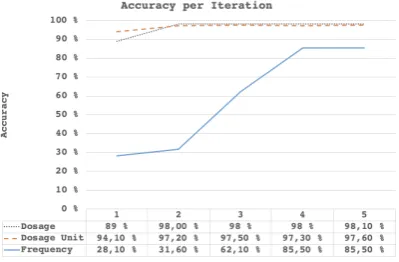
Language variance was solved by a combina-tion of three different solucombina-tions: First we intro-duced internal orthography for the system by im-plementing robust rule-based heuristics in pre-processing that would perform spell-correction on input strings by transforming them into a more standardized language e.g. prescription string “tarv 1 1/2 -2 3/4x3 -5 pv:ss¨a” would be trans-formed into “1.5-2.75 tablettia 3-5 kertaa p¨aiv¨ass¨a tarvittaessa” (In English, 1.5-2.75 tablets 3-5 times per day if required), thus reducing language complexity with negligible data loss (less than 0.5% in all categories combined). Improvement is seen in Figure1as iteration 2 from baseline it-eration of 1.
Second, we analyzed results for string
fre-quencies and created stemmed versions of object-relational-mapping (ORM) pair dictionar-ies, where the key was a stemmed class name e.g. “3 kerta p¨aiv¨a” and the value was in a code rep-resentation e.g. ”100056” based on string occur-rences. Stemming was performed on the same Turku neural parsing pipeline that is used for model generation. By matching stemmed versions of classes and model results we were able to fur-ther reduce complexity as demonstrated in Figure 1as iteration 3.
The third solution was the implementation of approximate string matching, colloquially known as fuzzy matching, based on Levenshtein distance (Yujian and Bo,2007) between the stemmed input string and stemmed class name. As we can see from Figure1iteration 4 this improved our results in “frequency” substantially. This solution had outstanding performance when the class names are relatively short e.g. unit “ml” (in English, ml, ab-breviation of milliliter) compared to frequency “3 kertaa p¨aiv¨ass¨a tarvittaessa” (In English, 3 times per day if required). In longer class names we experienced challenges in Hamming distance (Xu and Xia,2011) conditions, where strings had equal length, but semantically different, class names. For example ”2 times per day” and “8 times per day” have a Hamming distance of 1, but this dif-ference has a high risk of the detrimental outcome in a clinical setting from potential under or over-dose. Separability of classes was increased by writing out numbers, thus increasing their Leven-shtein distance and minimizing the possible occur-rences of equal length strings i.e. Hamming dis-tance conditions.
Further on we implemented rule-based heuris-tics based on observed standard errors from model inference and database mapping functionality to increase our overall accuracy. This was imple-mented in a form of stepped funnel process, where the incorrectly mapped code representations were gathered in a list that would be processed by a set of heuristics. As a step result average of the sys-tem error would be reduced and a new list of in-correctly mapped code representations would be gathered and the process would be repeated recur-sively until required levels of accuracy would be attained.
Baseline Categorical features Linguistic features All features
Item accuracy 0.9312 0.9383 0.9545 0.9588
[image:6.595.82.282.153.284.2]Instance accuracy 0.6863 0.7100 0.78740 0.7998
Table 8: Item and instance accuracy for different feature sets
Figure 1: Mapping accuracy
7 Conclusion
In this paper, we used CRFs to model conditional probability between tokens in prescriptions and output labels, dosage, dosage unit, frequency, and comments. This model is for Finnish prescrip-tions. Since Finnish is an agglutinative language and has rich morphology we define two types of features. First, are categorical features which are binary features of belonging to a certain list of to-kens. Second features are linguistic features which are based on the morphological analysis. In previ-ous works, linguistic features were under-utilized. We show that linguistic features are more infor-mative than categorical features. This model is the state of art for prescription extraction prob-lem in the Finnish language. We are using 9692 prescriptions and our reported results are based on 10-fold cross-validation. We show that a robust pre-processing step followed by a CRF based clas-sifier using a combination of linguistic and cate-gorical features yield an excellent labeling accu-racy. Finally by implementing heuristics in post-processing based on observed standard errors in the system we were able to reach clinical standard in classification results.
References
Alan R Aronson and Franc¸ois-Michel Lang. 2010. An overview of metamap: historical perspective and re-cent advances.Journal of the American Medical In-formatics Association, 17(3):229–236.
Olivier Bodenreider. 2004. The unified medical lan-guage system (umls): integrating biomedical termi-nology. Nucleic acids research, 32(suppl 1):D267– D270.
Razieh Ehsani, Muzaffer Ege Alper, Gulsen Eryigit, and Esref Adali. 2012. Disambiguating main pos tags for turkish. InProceedings of the 24th Confer-ence on Computational Linguistics and Speech Pro-cessing (ROCLING 2012), pages 202–213.
Carol Friedman. 2000. A broad-coverage natural lan-guage processing system. In Proceedings of the AMIA Symposium, page 270. American Medical In-formatics Association.
Jenna Kanerva, Filip Ginter, Niko Miekka, Akseli Leino, and Tapio Salakoski. 2018. Turku neural parser pipeline: An end-to-end system for the conll 2018 shared task. In Proceedings of the CoNLL 2018 Shared Task: Multilingual Parsing from Raw Text to Universal Dependencies. Association for Computational Linguistics.
John Lafferty, Andrew McCallum, and Fernando CN Pereira. 2001. Conditional random fields: Prob-abilistic models for segmenting and labeling se-quence data.
Zuofeng Li, Feifan Liu, Lamont Antieau, Yonggang Cao, and Hong Yu. 2010. Lancet: a high precision medication event extraction system for clinical text.
Journal of the American Medical Informatics Asso-ciation, 17(5):563–567.
Naoaki Okazaki. 2007. Crfsuite: a fast implementation of conditional random fields (crfs).
Jon Patrick and Min Li. 2009. A cascade approach to extracting medication events. In Proceedings of the Australasian Language Technology Association Workshop 2009, pages 99–103.
Carson Tao, Michele Filannino, and ¨Ozlem Uzuner. 2017. Prescription extraction using crfs and word embeddings. Journal of biomedical informatics, 72:60–66.
¨
Ozlem Uzuner, Brett R South, Shuying Shen, and Scott L DuVall. 2011. 2010 i2b2/va challenge on concepts, assertions, and relations in clinical text.
Journal of the American Medical Informatics Asso-ciation, 18(5):552–556.
Olcay Taner Yıldız, Ercan Solak, Razieh Ehsani, and Onur G¨org¨un. 2015. Chunking in turkish with con-ditional random fields. InInternational Conference on Intelligent Text Processing and Computational Linguistics, pages 173–184. Springer.