188
Investigating Machine Learning Methods for
Language and Dialect Identification of Cuneiform Texts
Ehsan DoostmohammadiandMinoo Nassajian
Computational Lingusitics Group, Sharif University of Technology, Tehran, Iran
{e.doostm72, m.nassajian2016}@student.sharif.edu
Abstract
Identification of the languages written using cuneiform symbols is a difficult task due to the lack of resources and the problem of tokeniza-tion. The Cuneiform Language Identification task in VarDial 2019 addresses the problem of identifying seven languages and dialects writ-ten in cuneiform; Sumerian and six dialects of Akkadian language: Old Babylonian, Mid-dle Babylonian Peripheral, Standard Babylo-nian, Neo-BabyloBabylo-nian, Late BabyloBabylo-nian, and Neo-Assyrian. This paper describes the ap-proaches taken by SharifCL team to this problem in VarDial 2019. The best result be-longs to an ensemble of Support Vector Ma-chines and a naive Bayes classifier, both work-ing on character-level features, with macro-averaged F1-score of 72.10%.
1 Introduction
A wide range of Natural Language Process-ing (NLP) tasks, such as Machine Translation (MT), speech recognition, information retrieval, data mining, and creating text resources for low-resource languages benefit from the upstream task of language identification. The Cuneiform Lan-guage Identification (CLI) task in VarDial 2019 (Zampieri et al., 2019) tries to address the prob-lem of identifying languages and dialects of the texts written in cuneiform symbols.
Identifying languages and dialects of the cuneiform texts is a difficult task, since such lan-guages lack resources and also there is the prob-lem of tokenization. Although there are some work addressing the problem of tokenization in some of these languages or dialects, there is not any universal method or tool available for tok-enization of cuneiform texts, as such a task de-pends on the rules of that language, simply be-cause cuneiform writing system is a syllabic as well as a logographic one. As a result, all the
en-deavors in this paper are based on character-level features. This work investigates different machine learning methods which are proven to be effective in text classification and compares them by their obtained F1-score, accuracy, and training time.
In this paper, we first review the literature of language identification and the work on languages written using cuneiform writing system in 2, in-troduce the models used to tackle the problem of identifying such languages and dialects in 3, de-scribe the training data in4, and discuss the results in5.
2 Related Work
The majority of research conducted in the field of language identification has been on textual data. However, there are some studies focusing on speech samples, such as (Hategan et al.,2009;
Ali et al., 2015; Malmasi and Zampieri, 2016). Language identification systems are meant to dis-tinguish between similar languages (Goutte et al.,
2016;Williams and Dagli, 2017), language vari-eties (Rangel et al.,2016;Castro et al.,2017), or a set of different dialects of the same language (Malmasi et al.,2016;El Haj et al.,2018). There has also been the annually held VarDial workshop since 2014, which deals with computational meth-ods and language resources for closely related lan-guages, language varieties, and dialects (Zampieri et al.,2017,2018).
Various kinds of features are used to train these systems, including bytes and encodings (Singh and Gorla, 2007; Brown, 2012), charac-ters (van der Lee and van den Bosch,2017;Samih and Kallmeyer,2017), morphemes (Gomez et al.,
2017; Barbaresi, 2016), and words (Duvenhage et al.,2017;Clematide and Makarov,2017).
(Bora and Kumar,2018), Bayesian network clas-sifiers (Rangel et al., 2016), similarity measures (such as the out-of-place method (Jauhiainen et al.,
2017), local ranked distance (Franco-Salvador et al., 2017), and cross entropy (Hanani et al.,
2017)), SVM (Alrifai et al., 2017), and neural networks (Chang and Lin,2014;Cazamias et al.,
2015; Jurgens et al., 2017; Kocmi and Bojar,
2017).
To the extent of our knowledge, there is no work addressing the problem of language and dialect identification of cuneiform texts. Such languages, Sumerian and Akkadian for instance, are considered low-resource languages, meaning that there are only a few electronic resources for cuneiform processing. Some of these datasets in-clude (Yamauchi et al., 2018) which developed a handwritten cuneiform character imageset, and (Chiarcos et al., 2018) which is an annotated cuneiform corpus with morphological, syntactic, and semantic tags. Furthermore, there are some early studies on rule-based morphological analyz-ers for these languages like (Kataja and Kosken-niemi, 1988; Barth´elemy, 1998; Macks, 2002;
Barth´elemy,2009), and (Tablan et al.,2006). Additionally, a small number of cuneiform text processing tasks have been carried out in which the transliterations of cuneiform characters were considered as the base feature. For instance, (Luo et al., 2015) adapted an unsupervised algorithm to recognize Sumerian personal names. Having transliterated the cuneiform corpus, they utilized the knowledge and applied limited tags to pre-annotate the corpus. As another study, (Homburg and Chiarcos, 2016) conducted the first research on word segmentation on Akkadian cuneiform. They used three types of word segmentations al-gorithms including rule-based alal-gorithms (such as bigram and prefix/suffix), dictionary-based al-gorithms (like MaxMatch, MaxMatchCombined, LCUMatching, MinWCMatch), and statistical and/or machine learning algorithms (such as C4.5, CRF, HMM,k-means,kNearest Neighbors, Max-Ent, naive Bayes, multi-layer perceptron, and Sup-port Vector Machines (SVM)) which work based on transliterations of cuneiform characters. The paper reports that the dictionary-based approaches obtained the best results. In addition, as one of the most recent studies on languages written in cuneiform, (Chiarcos et al., 2017) worked on a machine translation task. The used data consists of
unannotated raw transliterations of Sumerian texts with their English translations. They use a mor-phological analyzer to extract word information to be used in the machine translation task. Moreover, a distantly supervised Part of Speech tagger and a dependency parser are applied to annotate data to facilitate the machine translation task.
3 Methodology
We investigated different machine learning meth-ods, all of them based on character-level features, to tackle the problem. The following methods take 1- to 3-gram character TFIDF and 1- to 4-gram character count as input features and were imple-mented using Scikit-learn (Pedregosa et al.,2011):
• SVM: an SVM with a learning rate of1e−6, hinge loss, and elasticnet penalty, trained for 5 epochs with a random state of 11.
• Naive Bayes: a multinomial naive Bayes classifier with alpha of0.14andfit prior
asTrue.
• Ensemble of SVM and naive Bayes: a soft voting classifier which predicts the class label based on the argmax of the sums of the pre-dicted probabilities of the SVM and the naive Bayes models.
• Random Forest: a random forest classifier with 25 estimators of depth 300.
• Logistic Regression: a logistic regression classifier withlbfgs optimizer, trained for 100 epochs.
We also experimented with deep learning ap-proaches. The following two methods take char-acter embeddings of size 32 for the 256 most com-mon characters as input, and are trained using an Adam optimizer (Kingma and Ba, 2014) with batch size of 64 and learning rate of1e−4:
with the same keeping rate on the first dense layer’s output.
• Recurrent Neural Network: A Recurrent Neural Network (RNN) with Long Short-Term Memory (LSTM) (Hochreiter and Schmidhuber, 1997) cell of size 256 and a dense layer mapping to anR128space and an-other one mapping to theR7space of the la-bels. We also applied dropout with0.4 keep-ing rate on RNN’s output and another one with0.5keeping rate on the first dense layer’s output.
4 Data Description
The data of CLI shared task is described in ( Jauhi-ainen et al.,2019). This data consists of 7 classes: Sumerian (SUX), Old Babylonian (OLB), Middle Babylonian peripheral (MPB), Standard Babylo-nian (STB), Neo-Babylonian (NEB), Late Baby-lonian (LTB), and Neo-Assyrian (NEA). Figure1
shows the number of samples for each label in the training data. The whole training data consists of 139,421 samples. The development set comprises 668 and the test set 985 samples per label.
LTB MPB OLB
NEA STB NEB
SUX 0 K 10 K 20 K 30 K 40 K 50 K
15.95
3.8 5.51 32.97
9.71 17.82
[image:3.595.338.496.60.174.2]53.67
Figure 1: Number of samples for each label in the train-ing set (in thousands).
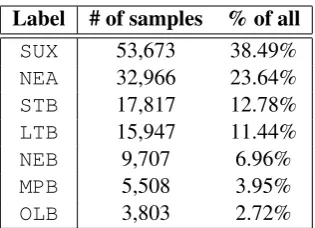
Figure 1 shows that most of the training data belongs to SUX and NEA classes. Table1 con-tains more detailed information on the data which shows that 86.35% of the data belongs to four classes of SUX, NEA, STB, LTB, whereas only 13.65% belongs to the other three.
5 Results and Discussion
Firstly, we trained the methods described in3and evaluated the models on development set. We
Label # of samples % of all
SUX 53,673 38.49%
NEA 32,966 23.64%
STB 17,817 12.78%
LTB 15,947 11.44%
NEB 9,707 6.96%
MPB 5,508 3.95%
OLB 3,803 2.72%
Table 1: Number of samples in the training set for each label and their percentage of a total of 139,421 samples ordered from the highest to the lowest.
continued with the best two methods, SVM and NB, and evaluated them on the test set. Ta-ble 2 shows the macro-averaged F1-score,
accu-racy, and training time (in seconds) of the five non-deep and two deep methods on the devel-opment set. The non-deep models are trained using an Intel(R) Core(TM) i7-7700K CPU @ 4.20GHz CPU with 8 threads, and the deep ones using an NVIDIA GeForce GTX 1080 Ti.
Method F1-score Accuracy T. Time
RF 0.5201 0.5615 264.14 LR 0.6861 0.6982 40.54
NB 0.7194 0.7301 0.15
SVM 0.7222 0.7309 1.67
Ens. 0.7268 0.7356 3.34
[image:3.595.312.521.384.499.2]CNN 0.6192 0.6249 +4K RNN 0.6259 0.6364 +4K
Table 2: Accuracy and F1-score on the development set, and the training time (in seconds) of the methods described in section 3: Random Forest (RF), Logis-tic Regression (LR), naive Bayes (NB), Support Vector Machine (SVM), Ensemble of the last two (Ens.), and Convolutional and Recurrent Neural Networks (CNN and RNN, respectively). The best result in each column is in bold, the second best underlined, and the third best in italics.
The ensemble method obtained the best F1
[image:3.595.77.282.414.576.2]hyperparameters play a more important role in the results, therefore further tuning them might im-prove the results in table2. As of training time, the naive Bayes method was the fastest and the RNN and the CNN the slowest methods. We also experi-mented with one-hot encoded characters as RNN’s and CNN’s input features, which was not fruitful, and therefore are not included in the results.
Table 3 shows the results of the SVM and the ensemble of SVM and NB on the test set. The en-semble outperforms SVM, as on the development set.
System F1 (macro) Accuracy
SVM (T) 0.6660 0.6722 SVM (TD) 0.7171 0.7179 SVM + NB (TD) 0.7210 0.7239
Table 3: Results of the CLI task on the test set. T stands for training and D for development data. TD means that the model was trained on the combination of training and development data and T, only on the training data. The best result in each column is in bold.
Table 4 contains more detailed results of the best performing model on the test set, i.e. the ensemble. It shows the precision, recall, and F1
-score of the model on each class and their average. The results are ordered based on the F1-score.
Label Precision Recall F1-score
LTB 0.8913 0.9655 0.9269
MPB 0.8109 0.8579 0.8337
OLB 0.8358 0.6924 0.7574
SUX 0.8273 0.6274 0.7136
NEA 0.5621 0.8772 0.6852
NEB 0.6775 0.5523 0.6085
STB 0.5515 0.4944 0.5214 Macro Avg. 0.7366 0.7239 0.7210
Table 4: Precision, Recall and F1-score of all the classes and their macro average ordered from the high-est to the lowhigh-est F1-score.
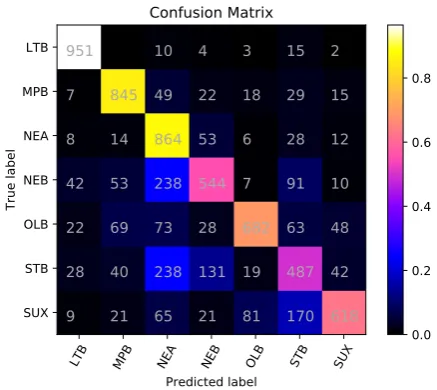
Considering the results in table4 and the con-fusion matrix, Late Babylonian (LTB) was the easiest class to identify with a recall of 96.55% and Middle Babylonian Peripheral (MPB) the sec-ond easiest, with a recall of 85.79% (with only 5,508 (+668) training samples). Old Babylonian (OLB) was also easy to identifiy, especially when we consider its amount training samples, 3,803 (+668). Standard Babylonian (STB) is mainly
LTB MPB NEA NEB OLB STB SUX
Predicted label LTB
MPB
NEA
NEB
OLB
STB
SUX
True label
951 10 4 3 15 2 7 845 49 22 18 29 15 8 14 864 53 6 28 12 42 53 238 544 7 91 10 22 69 73 28 682 63 48 28 40 238 131 19 487 42 9 21 65 21 81 170 618
Confusion Matrix
0.0 0.2 0.4 0.6 0.8
Figure 2: Confusion matrix of the ensemble model’s results on the test data.
misclassified as Sumerian, and Neo-Babylonian as Standard Babylonian. Neo-Assyrian (NEA) is also among the classes with low F1-score, but the
model has achieved a very high recall, 87.72%, in this class. Neo-Assyrian (NEA) is mainly mis-classified as Neo-Babylonian (NEB) and Standard Babylonian (STB).
6 Conclusion
In this paper, we investigated different machine learning methods, such as SVM and neural net-works, and compared their performance in the task of language and dialect identification of cuneiform texts. The best performance was achieved by a combination of SVM and naive Bayes, using only character-level features. It was shown that charac-ters are enough to obtain at least 72.10% F1-score.
However, the best model was not able to achieve a good result classifying some of the dialects which indicates a need for other kinds of features, such as word-level ones, and/or embedded or transferred knowledge of these languages and dialects to be used in training the deep models.
References
Ahmed Ali, Najim Dehak, Patrick Cardinal, Sameer Khurana, Sree Harsha Yella, James Glass, Peter Bell, and Steve Renals. 2015. Automatic dialect de-tection in arabic broadcast speech. arXiv preprint arXiv:1509.06928.
[image:4.595.309.528.64.259.2]2017. Arabic tweeps gender and dialect prediction. InCLEF (Working Notes).
Adrien Barbaresi. 2016. An unsupervised morphologi-cal criterion for discriminating similar languages. In 3rd Workshop on NLP for Similar Languages, Vari-eties and Dialects (VarDial 2016), pages 212–220. Association for Computational Linguistics.
Franc¸ois Barth´elemy. 1998. A morphological analyzer for akkadian verbal forms with a model of phonetic transformations. InProceedings of the Workshop on Computational Approaches to Semitic Languages, pages 73–81. Association for Computational Lin-guistics.
Franc¸ois Barth´elemy. 2009. The karamel system and semitic languages: structured multi-tiered morphol-ogy. InProceedings of the EACL 2009 Workshop on Computational Approaches to Semitic Languages, pages 10–18. Association for Computational Lin-guistics.
Manas Jyoti Bora and Ritesh Kumar. 2018. Automatic word-level identification of language in assamese english hindi code-mixed data. In 4th Workshop on Indian Language Data and Resources, Proceed-ings of the Eleventh International Conference on Language Resources and Evaluation (LREC 2018), pages 7–12.
Ralf D Brown. 2012. Finding and identifying text in 900+ languages. Digital Investigation, 9:S34–S43.
Dayvid W Castro, Ellen Souza, Douglas Vit´orio, Diego Santos, and Adriano LI Oliveira. 2017. Smoothed n-gram based models for tweet language identifica-tion: A case study of the brazilian and european por-tuguese national varieties. Applied Soft Computing, 61:1160–1172.
Jordan Cazamias, Chinmayi Dixit, and Martina Marek. 2015. Large-scale language classification.
Joseph Chee Chang and Chu-Cheng Lin. 2014. Recurrent-neural-network for language detection on twitter code-switching corpus. arXiv preprint arXiv:1412.4314.
Christian Chiarcos, Ilya Khait, ´Emilie Pag´e-Perron, and Maria Sukhareva. 2017. Machine translation and automated analysis of the sumerian language. InJoint SIGHUM Workshop on Computational Lin-guistics for Cultural Heritage, Social Sciences, Hu-manities and Literature, ACL, pages 10–16. Associ-ation for ComputAssoci-ational Linguistics.
Christian Chiarcos, Emilie Page-Perron, Niko Schenk, Jayanth, and Lucas Reckling. 2018. Annotating sumerian: A llod-enhanced workflow for cuneiform corpora. InProceedings of the Language Resources and Evaluation Conference.
Simon Clematide and Peter Makarov. 2017. Cluzh at vardial gdi 2017: Testing a variety of machine learn-ing tools for the classification of swiss german di-alects. In Proceedings of the Fourth Workshop on
NLP for Similar Languages, Varieties and Dialects (VarDial), pages 170–177.
Bernardt Duvenhage, Mfundo Ntini, and Phala Ra-monyai. 2017. Improved text language identifi-cation for the south african languages. In 2017 Pattern Recognition Association of South Africa and Robotics and Mechatronics (PRASA-RobMech), pages 214–218. IEEE.
Mahmoud El Haj, Paul Edward Rayson, and Mariam Aboelezz. 2018. Arabic dialect identification in the context of bivalency and code-switching.
Marc Franco-Salvador, Greg Kondrak, and Paolo Rosso. 2017. Bridging the native language and lan-guage variety identification tasks. Procedia com-puter science, 112:1554–1561.
Helena Gomez, Ilia Markov, Jorge Baptista, Grigori Sidorov, and David Pinto. 2017. Discriminating between similar languages using a combination of typed and untyped character n-grams and words. In Proceedings of the Fourth Workshop on NLP for Similar Languages, Varieties and Dialects (Var-Dial), pages 137–145.
Cyril Goutte, Serge L´eger, Shervin Malmasi, and Marcos Zampieri. 2016. Discriminating similar languages: Evaluations and explorations. arXiv preprint arXiv:1610.00031.
Abualsoud Hanani, Aziz Qaroush, and Stephen Taylor. 2017. Identifying dialects with textual and acous-tic cues. InProceedings of the Fourth Workshop on NLP for Similar Languages, Varieties and Dialects (VarDial), pages 93–101.
Andrea Hategan, Bogdan Barliga, and Ioan Tabus. 2009. Language identification of individualwords in a multilingual automatic speech recognition system. In 2009 IEEE International Conference on Acous-tics, Speech and Signal Processing, pages 4357– 4360. IEEE.
Sepp Hochreiter and J¨urgen Schmidhuber. 1997. Long short-term memory. Neural computation, 9(8):1735–1780.
Timo Homburg and Christian Chiarcos. 2016. Akka-dian word segmentation. InProceedings Tenth In-ternational Conference on Language Resource Eval-uation.(LREC 2016), pages 4067–4074.
Tommi Jauhiainen, Heidi Jauhiainen, Tero Alstola, and Krister Lind´en. 2019. Language and Dialect Identi-fication of Cuneiform Texts. InProceedings of the Sixth Workshop on NLP for Similar Languages, Va-rieties and Dialects (VarDial).
Tommi Jauhiainen, Marco Lui, Marcos Zampieri, Tim-othy Baldwin, and Krister Lind´en. 2018. Automatic language identification in texts: A survey. arXiv preprint arXiv:1804.08186.
David Jurgens, Yulia Tsvetkov, and Dan Jurafsky. 2017. Incorporating dialectal variability for socially equitable language identification. InProceedings of the 55th Annual Meeting of the Association for Com-putational Linguistics (Volume 2: Short Papers), volume 2, pages 51–57.
Laura Kataja and Kimmo Koskenniemi. 1988. Finite-state description of semitic morphology: A case study of ancient accadian. InColing Budapest 1988 Volume 1: International Conference on Computa-tional Linguistics, volume 1.
Diederik P Kingma and Jimmy Ba. 2014. Adam: A method for stochastic optimization. arXiv preprint arXiv:1412.6980.
Tom Kocmi and Ondˇrej Bojar. 2017. Lanidenn: Multi-lingual language identification on character window. arXiv preprint arXiv:1701.03338.
Chris van der Lee and Antal van den Bosch. 2017. Ex-ploring lexical and syntactic features for language variety identification. InProceedings of the Fourth Workshop on NLP for Similar Languages, Varieties and Dialects (VarDial), pages 190–199.
Liang Luo, Yudong Liu, James Hearne, and Clinton Burkhart. 2015. Unsupervised sumerian personal name recognition. In The Twenty-Eighth Interna-tional Flairs Conference.
Aaron Macks. 2002. Parsing akkadian verbs with pro-log. In Proceedings of the ACL-02 workshop on Computational approaches to semitic languages.
Shervin Malmasi and Marcos Zampieri. 2016. Arabic dialect identification in speech transcripts. In Pro-ceedings of the Third Workshop on NLP for Similar Languages, Varieties and Dialects (VarDial3), pages 106–113.
Shervin Malmasi, Marcos Zampieri, Nikola Ljubeˇsi´c, Preslav Nakov, Ahmed Ali, and J¨org Tiedemann. 2016. Discriminating between similar languages and arabic dialect identification: A report on the third dsl shared task. In Proceedings of the Third Workshop on NLP for Similar Languages, Varieties and Dialects (VarDial3), pages 1–14.
Fabian Pedregosa, Ga¨el Varoquaux, Alexandre Gram-fort, Vincent Michel, Bertrand Thirion, Olivier Grisel, Mathieu Blondel, Peter Prettenhofer, Ron Weiss, Vincent Dubourg, Jake Vanderplas, Alexan-dre Passos, David Cournapeau, Matthieu Brucher, Matthieu Perrot, and ´Edouard Duchesnay. 2011.
Scikit-learn: Machine learning in python. J. Mach.
Learn. Res., 12:2825–2830.
Francisco Rangel, Marc Franco-Salvador, and Paolo Rosso. 2016. A low dimensionality representation for language variety identification. InInternational Conference on Intelligent Text Processing and Com-putational Linguistics, pages 156–169. Springer.
Younes Samih and Laura Kallmeyer. 2017. Dialectal Arabic processing Using Deep Learning. Ph.D. the-sis, Ph. D. thethe-sis, D¨usseldorf, Germany.
Anil Kumar Singh and Jagadeesh Gorla. 2007. Identi-fication of languages and encodings in a multilingual document. InBuilding and Exploring Web Corpora (WAC3-2007): Proceedings of the 3rd Web as Cor-pus Workshop, Incorporating Cleaneval, volume 4, page 95. Presses univ. de Louvain.
Valentin Tablan, Wim Peters, Diana Maynard, Hamish Cunningham, and K Bontcheva. 2006. Creating tools for morphological analysis of sumerian. In LREC, pages 1762–1765.
Jennifer Williams and Charlie Dagli. 2017. Twitter language identification of similar languages and di-alects without ground truth. InProceedings of the Fourth Workshop on NLP for Similar Languages, Varieties and Dialects (VarDial), pages 73–83.
Kenji Yamauchi, Hajime Yamamoto, and Wakaha Mori. 2018. Building a handwritten cuneiform char-acter imageset. InProceedings of the Eleventh In-ternational Conference on Language Resources and Evaluation (LREC-2018).
Marcos Zampieri, Shervin Malmasi, Nikola Ljubeˇsi´c, Preslav Nakov, Ahmed Ali, J¨org Tiedemann, Yves Scherrer, and No¨emi Aepli. 2017. Findings of the VarDial Evaluation Campaign 2017. InProceedings of the Fourth Workshop on NLP for Similar Lan-guages, Varieties and Dialects (VarDial), Valencia, Spain.
Marcos Zampieri, Shervin Malmasi, Preslav Nakov, Ahmed Ali, Suwon Shuon, James Glass, Yves Scherrer, Tanja Samardˇzi´c, Nikola Ljubeˇsi´c, J¨org Tiedemann, Chris van der Lee, Stefan Grondelaers, Nelleke Oostdijk, Antal van den Bosch, Ritesh Ku-mar, Bornini Lahiri, and Mayank Jain. 2018. Lan-guage Identification and Morphosyntactic Tagging: The Second VarDial Evaluation Campaign. In Pro-ceedings of the Fifth Workshop on NLP for Similar Languages, Varieties and Dialects (VarDial), Santa Fe, USA.