Disfluency Detection Using Multi-step Stacked Learning
Xian Qian and Yang Liu Computer Science Department The University of Texas at Dallas
{qx,yangl}@hlt.utdallas.edu
Abstract
In this paper, we propose a multi-step stacked learning model for disfluency detection. Our method incorporates refined n-gram features step by step from different word sequences. First, we detect filler words. Second, edited words are detected using n-gram features ex-tracted from both the original text and filler fil-tered text. In the third step, additional n-gram features are extracted from edit removed texts together with our newly induced in-between features to improve edited word detection. We use Max-Margin Markov Networks (M3Ns) as the classifier with the weighted hamming loss to balance precision and recall. Experiments on the Switchboard corpus show that the re-fined n-gram features from multiple steps and M3Ns with weighted hamming loss can signif-icantly improve the performance. Our method for disfluency detection achieves the best re-ported F-score0.841without the use of addi-tional resources.1
1 Introduction
Detecting disfluencies in spontaneous speech can be used to clean up speech transcripts, which help-s improve readability of the tranhelp-scripthelp-s and make it easy for downstream language processing modules. There are two types of disfluencies: filler words in-cluding filled pauses (e.g., ‘uh’, ‘um’) and discourse markers (e.g., ‘I mean’, ‘you know’), and edited words that are repeated, discarded, or corrected by
1
Our source code is available at
http://code.google.com/p/disfluency-detection/downloads/list
the following words. An example is shown below that includes edited words and filler words.
I want a flightto Boston| {z }
edited
uh I mean
| {z } filler
to Denver
Automatic filler word detection is much more ac-curate than edit detection as they are often fixed phrases (e.g., “uh”, “you know”, “I mean”), hence our work focuses on edited word detection.
Many models have been evaluated for this task. Liu et al. (2006) used Conditional Random Fields (CRFs) for sentence boundary and edited word de-tection. They showed that CRFs significantly out-performed Maximum Entropy models and HMM-s. Johnson and Charniak (2004) proposed a TAG-based noisy channel model which showed great im-provement over boosting based classifier (Charniak and Johnson, 2001). Zwarts and Johnson (2011) extended this model using minimal expected F-loss oriented n-best reranking. They obtained the best re-ported F-score of83.8%on the Switchboard corpus. Georgila (2009) presented a post-processing method during testing based on Integer Linear Programming (ILP) to incorporate local and global constraints.
From the view of features, in addition to tex-tual information, prosodic features extracted from speech have been incorporated to detect edited words in some previous work (Kahn et al., 2005; Zhang et al., 2006; Liu et al., 2006). Zwarts and Johnson (2011) trained an extra language model on additional corpora, and used output log probabili-ties of language models as features in the reranking stage. They reported that the language model gained about absolute3%F-score for edited word detection on the Switchboard development dataset.
In this paper, we propose a multi-step stacked learning approach for disfluency detection. In our method, we first perform filler word detection, then edited word detection. In every step, we generate new refined n-gram features based on the processed text (remove the detected filler or edited words from the previous step), and use these in the next step. We also include a new type of features, called in-between features, and incorporate them into the last step. For edited word detection, we use Max-Margin Markov Networks (M3Ns) with weighted hamming loss as the classifier, as it can well balance the pre-cision and recall to achieve high performance. On the commonly used Switchboard corpus, we demon-strate that our proposed method outperforms other state-of-the-art systems for edit disfluency detection.
2 Balancing Precision and Recall Using Weighted M3Ns
We use a sequence labeling model for edit detection. Each word is assigned one of the five labels:BE (be-ginning of the multi-word edited region),IE(in the edited region),EE(end of the edited region),SE (s-ingle word edited region), O(other). For example, the previous sentence is represented as:
I/O want/O a/O flight/O to/BE Boston/EE uh/O I/Omean/Oto/ODenver/O
We use the F-score as the evaluation metrics (Zwarts and Johnson, 2011; Johnson and Charniak, 2004), which is defined as the harmonic mean of the precision and recall of the edited words:
P = #correctly predicted edited words #predicted edited words
R = #correctly predicted edited words #gold standard edited words
F = 2×P×R
P+R
There are many methods to train the sequence mod-el, such as CRFs (Lafferty et al., 2001), averaged structured perceptrons (Collins, 2002), structured SVM (Altun et al., 2003), online passive aggressive learning (Crammer et al., 2006). Previous work has shown that minimizing F-loss is more effective than minimizing log-loss (Zwarts and Johnson, 2011), because edited words are much fewer than normal words.
In this paper, we use Max-margin Markov Net-works (Taskar et al., 2004) because our preliminary
results showed that they outperform other classifier-s, and using weighted hamming loss is simple in this approach (whereas for perceptron or CRFs, the mod-ification of the objective function is not straightfor-ward).
The learning task for M3Ns can be represented as follows:
min
α
1 2C∥
∑
x,y
αx,y∆f(x, y)∥22+
∑
x,y
αx,yL(x, y)
s.t. ∑ y
αx,y= 1 ∀x
αx,y≥0, ∀x, y
The above shows the dual form for training M3Ns, where x is the observation of a training sample,
y ∈ Y is a label. α is the parameter needed to be optimized, C > 0 is the regularization pa-rameter. ∆f(x, y) is the residual feature vector:
f(x,y˜) −f(x, y), where y˜ is the true label of x.
L(x, y)is the loss function. Taskar et al. (2004) used un-weighted hamming loss, which is the number of incorrect components: L(x, y) = ∑tδ(yt,y˜t),
whereδ(a, b)is the binary indicator function (it is0
ifa = b). In our work, we use the weighted ham-ming loss:
L(x, y) =∑
t
v(yt,y˜t)δ(yt,y˜t)
where v(yt,y˜t) is the weighted loss for the error
when yt˜ is mislabeled asyt. Such a weighted loss function allows us to balance the model’s precision and recall rates. For example, if we assign a large value tov(O,·E)(·Edenotes SE, BE, IE, EE), then the classifier is more sensitive to false negative er-rors (edited word misclassified as non-edited word), thus we can improve the recall rate. In our work, we tune the weight matrixvusing the development dataset.
3 Multi-step Stacked Learning for Edit Disfluency Detection
(or more) levels of predictors, where the outputs of the low level predictors are incorporated as features into the next level predictors. It has the advantage of incorporating local features as well as non-linear classifiers. In our task, we do not just use the classifier’s output (a word is an edited word or not) as a feature, rather we use such output to remove the disfluencies and extract new n-gram features for the subsequent stacked classifiers. We use 10 fold cross validation to train the low level predictors. The fol-lowing describes the three steps in our approach.
3.1 Step 1: Filler Word Detection
In the first step, we automatically detect filler word-s. Since filler words often occur immediately after edited words (before the corrected words), we ex-pect that removing them will make rough copy de-tection easy. For example, in the previous example shown in Section 1, if “uh I mean” is removed, then the reparandum “to Boston” and repair “to Denver” will be adjacent and we can use word/POS based n-gram features to detect that disfluency. Otherwise, the classifier needs to skip possible filler words to find the rough copy of the reparandum.
For filler word detection, similar to edited word detection, we define 5 labels:BP,IP,EP,SP,O. We use un-weighted hamming loss to learn M3Ns for this task. Since for filler word detection, our per-formance metric is not F-measure, but just the over-all accuracy in order to generate cleaned text for sub-sequent n-gram features, we did not use the weight-ed hamming hoss for this. The features we usweight-ed are listed in Table 1. All n-grams are extracted from the original text.
3.2 Step 2: Edited Word Detection
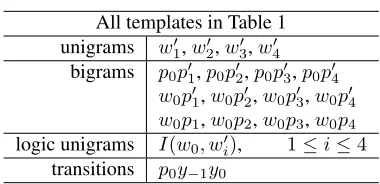
In the second step, edited words are detected using M3Ns with the weighted-hamming loss. The fea-tures we used are listed in Table 2. All n-grams in the first step are also used here. Besides that, word n-grams, POS n-grams and logic n-grams extracted from filler word removed text are included. Feature templatesI(w0, wi′)is to generate features detecting
rough copies separated by filler words.
3.3 Step 3: Refined Edited Word Detection
In this step, we use n-gram features extracted from the text after removing edit disfluencies based on
unigrams w0,w−1,w1,w−2,w2 p0,p−1,p1,p−2,p2,w0p0 bigrams w−1w0,w0w1,p−1p0,p0p1 trigrams p−2p−1p0,p−1p0p1,p0p1p2 logic unigrams I(wi, w0),I(pi, p0), −4≤i≤4
logic bigrams I(wi−1wi, w−1, w0) I(pi−1pi, p−1p0) I(wiwi+1, w0w1)
I(pipi+1, p0p1), −4≤i≤4 transitions y−1y0
Table 1: Feature templates for filler word detection. w0, p0 denote the current word and POS tag respective-ly. w−i denotes theithword to the left, widenotes the ithword to the right. The logic functionI(a, b)indicates whetheraandbare identical (eigher unigrams or bigram-s).
All templates in Table 1 unigrams w′1,w′2,w′3,w′4
bigrams p0p′1,p0p′2,p0p′3,p0p′4 w0p′1,w0p′2,w0p′3,w0p′4 w0p1,w0p2,w0p3,w0p4 logic unigrams I(w0, w′i), 1≤i≤4
[image:3.612.314.540.54.179.2]transitions p0y−1y0
Table 2: Feature templates for edit detection (step 2). wi′, p′idenote theithword/POS tag to the right in the filler words removed text. If current wordw0 is removed in step 1, we use its original n-gram features rather than the refined n-gram features.
the previous step. According to our analysis of the errors produced by step 2, we observed that many errors occurred at the boundaries of the disfluen-cies, and the word bigrams after removing the edited words are unnatural. The following is an example:
• Ref: The new type is prettier than what their/SEthey used to look like.
• Sys: The new type is prettier than what/BE
their/EEthey used to look like.
[image:3.612.331.521.269.361.2]2011). They have the benefit of measuring the flu-ency of the cleaned text.
Another common error we noticed is caused by the ambiguities of coordinates, because the coordi-nates have similar patterns as rough copies. For ex-ample,
• Coordinates: they ca n′t decide which are the good aspects and which are the bad aspects
• Rough Copies: it/BE ′s/IE a/IE pleasure/IE to/EE it s good to get outside
To distinguish the rough copies and the coordinate examples shown above, we analyze the training data statistically. We extract all the pieces lying between identical word bigrams AB . . . AB. The observation is that coordinates are often longer than edited se-quences. Hence we introduce the in-between fea-tures for each word. If a word lies between identical word bigrams, then its in-between feature is the log length of the subsequence lying between the two bi-grams; otherwise, it is zero (we use log length to avoid sparsity). We also used other patterns such as A . . . AandABC . . . ABC, but they are too noisy or infrequent and do not yield much performance gain. Table 3 lists the feature templates used in this last step.
All templates in Table 1, Table 2 word n-grams w′′1,w0w1′′
in-between LAB,w0bAB,bAB
Table 3: Feature templates for refined edit detection (step 3). w′′i denotes theithword tag to the right in the edit-ed word removedit-ed text. LAB denotes the log length of the sub-sequence in the patternAB. . . AB,bAB indicates whether the current word lies between two identical bi-grams.
4 Experiments
4.1 Experimental Setup
We use the Switchboard corpus in our experimen-t, with the same train/develop/test split as the pre-vious work (Johnson and Charniak, 2004). We al-so remove the partial words and punctuation from the training and test data for the reason to simulate the situation when speech recognizers are used and
such kind of information is not available (Johnson and Charniak, 2004).
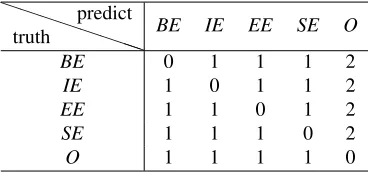
We tuned the weight matrix for hamming loss on the development dataset using simple grid search. The diagonal elements are fixed at0; for false pos-itive errors,O → ·E (non-edited word mis-labeled as edited word), their weights are fixed at1; for false negative errors,·E → O, we tried the weight from
1to3, and increased the weight0.5each time. The optimal weight matrix is shown in Table 4. Note that we use five labels in the sequence labeling task; however, for edited word detection evaluation, it is only a binary task, that is, all of the words labeled with·Ewill be mapped to the class of edited words.
PPPPPP
PP
truth
predict
BE IE EE SE O
BE 0 1 1 1 2
IE 1 0 1 1 2
EE 1 1 0 1 2
SE 1 1 1 0 2
[image:4.612.334.518.256.342.2]O 1 1 1 1 0
Table 4: Weighted hamming loss for M3Ns.
4.2 Results
We compare several sequence labeling models: CRFs, structured averaged perceptron (AP), M3Ns with un-weighted/weighted loss, and online passive-aggressive (PA) learning. For each model, we tuned the parameters on the development data: Gaussian prior for CRFs is1.0, iteration number for AP is10, iteration number and regularization penalty for PA are10and1. For M3Ns, we use Structured Sequen-tial Minimal Optimization (Taskar, 2004) for model training. Regularization penalty isC = 0.1and iter-ation number is30.
fea-CRF AP PA M3N w. M3N Baseline 78.8 79.0 78.9 79.4 80.1
Step 2 81.0 81.1 81.1 81.5 82.3
[image:5.612.78.294.53.106.2]Step 3 82.9 83.0 82.8 83.3 84.1
Table 5: Effect of training strategy and recovered features for stacked learning. F scores are reported. AP = Aver-aged Perceptron, PA = online Passive Aggresive, M3N = un-weighted M3Ns, w. M3N = weighted M3Ns.
tures yield about1%improvement in F-score for all models (the gain of step 3 over step 2 is because of the in-between features and the new n-gram features extracted from the text after removing previously detected edited words). We performed McNemar’s test to evaluate the significance of the difference a-mong various methods, and found that when using the same features, weighted M3Ns significantly out-performs all the other models (p value < 0.001). There are no significant differences among CRFs, AP and PA. Using recovered n-gram features and in-between features significantly improves all sequence labeling models (p value<0.001).
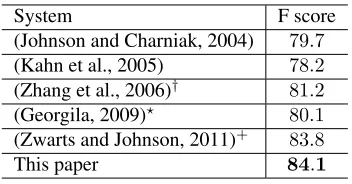
We also list the state-of-the-art systems evaluat-ed on the same dataset, as shown in Table 6. We achieved the best F-score. The most competitive system is (Zwarts and Johnson, 2011), which uses extra resources to train language models.
System F score
(Johnson and Charniak, 2004) 79.7
(Kahn et al., 2005) 78.2
(Zhang et al., 2006)† 81.2
(Georgila, 2009)⋆ 80.1 (Zwarts and Johnson, 2011)+ 83.8
This paper 84.1
Table 6: Comparison with other systems. † they used the re-segmented Switchboard corpus, which is not ex-actly the same as ours. ⋆ they reported the F-score of
BEtag (beginning of the edited sequences). +they used language model learned from 3 additional corpora.
5 Conclusion
In this paper, we proposed multi-step stacked learn-ing to extract n-gram features step by step. The first level removes the filler words providing new ngram-s for the ngram-second level to remove edited wordngram-s. The
third level uses the n-grams from the original tex-t and tex-the cleaned tex-textex-t generatex-ted by tex-the previous tex- t-wo steps for accurate edit detection. To minimize the F-loss approximately, we modified the hamming loss in M3Ns. Experimental results show that our method is effective, and achieved the best reported performance on the Switchboard corpus without the use of any additional resources.
Acknowledgments
We thank three anonymous reviewers for their valu-able comments. This work is partly supported by DARPA under Contract No. HR0011-12-C-0016 and FA8750-13-2-0041. Any opinions expressed in this material are those of the authors and do not nec-essarily reflect the views of DARPA.
References
Yasemin Altun, Ioannis Tsochantaridis, and Thomas Hofmann. 2003. Hidden markov support vector ma-chines. InProc. of ICML.
Eugene Charniak and Mark Johnson. 2001. Edit detec-tion and parsing for transcribed speech. In Proc. of
NAACL.
William W. Cohen and Vitor Rocha de Carvalho. 2005. Stacked sequential learning. InProc. of IJCAI. Michael Collins. 2002. Discriminative training methods
for hidden markov models: Theory and experiments with perceptron algorithms. InProc. of EMNLP. Koby Crammer, Ofer Dekel, Joseph Keshet, Shai
Shalev-Shwartz, Yoram Singer, and Yoram Singer. 2006. On-line passive-aggressive algorithms. Journal of Ma-chine Learning Research.
Kallirroi Georgila. 2009. Using integer linear program-ming for detecting speech disfluencies. In Proc. of
NAACL.
Mark Johnson and Eugene Charniak. 2004. A TAG-based noisy-channel model of speech repairs. InProc. of ACL.
Jeremy G. Kahn, Matthew Lease, Eugene Charniak, Mark Johnson, and Mari Ostendorf. 2005. Effective use of prosody in parsing conversational speech. In
Proc. of HLT-EMNLP.
John D. Lafferty, Andrew McCallum, and Fernando C. N. Pereira. 2001. Conditional random fields: Probabilis-tic models for segmenting and labeling sequence data. InProc. of ICML.
[image:5.612.98.274.441.533.2]bound-aries and disfluencies. IEEE Transactions on Audio,
Speech, and Language Processing, 14(5).
Ben Taskar, Carlos Guestrin, and Daphne Koller. 2004. Max-margin markov networks. InProc. of NIPS. Ben Taskar. 2004. Learning Structured Prediction
Mod-els: A Large Margin Approach. Ph.D. thesis, Stanford University.
Qi Zhang, Fuliang Weng, and Zhe Feng. 2006. A pro-gressive feature selection algorithm for ultra large fea-ture spaces. InProc. of ACL.